Explore kanban for data teams, ensuring efficiency and successful project management outcomes.
Try Lark for Free
In an era where data-driven insights steer organizational strategies and innovations, it becomes paramount for data teams to streamline their operations and optimize workflow management. This necessitates the adoption of methodologies that not only foster collaboration and visibility but also encourage adaptability and continuous improvement. Amidst a plethora of project management techniques, kanban emerges as a promising solution uniquely tailored to meet the dynamic demands of data team initiatives.
Leverage Lark for project management within your team.
Understanding kanban
Before delving into the specific applications within data teams, it's imperative to grasp the fundamental principles that underpin the kanban methodology. At its core, kanban emphasizes visualizing workflow, limiting work in progress (WIP), and facilitating the smooth flow of work items. With its foundation in the pull-based approach, where work is pulled into the system based on capacity, rather than being pushed to meet deadlines, kanban inherently aligns with the iterative and often unpredictable nature of data-focused endeavors.
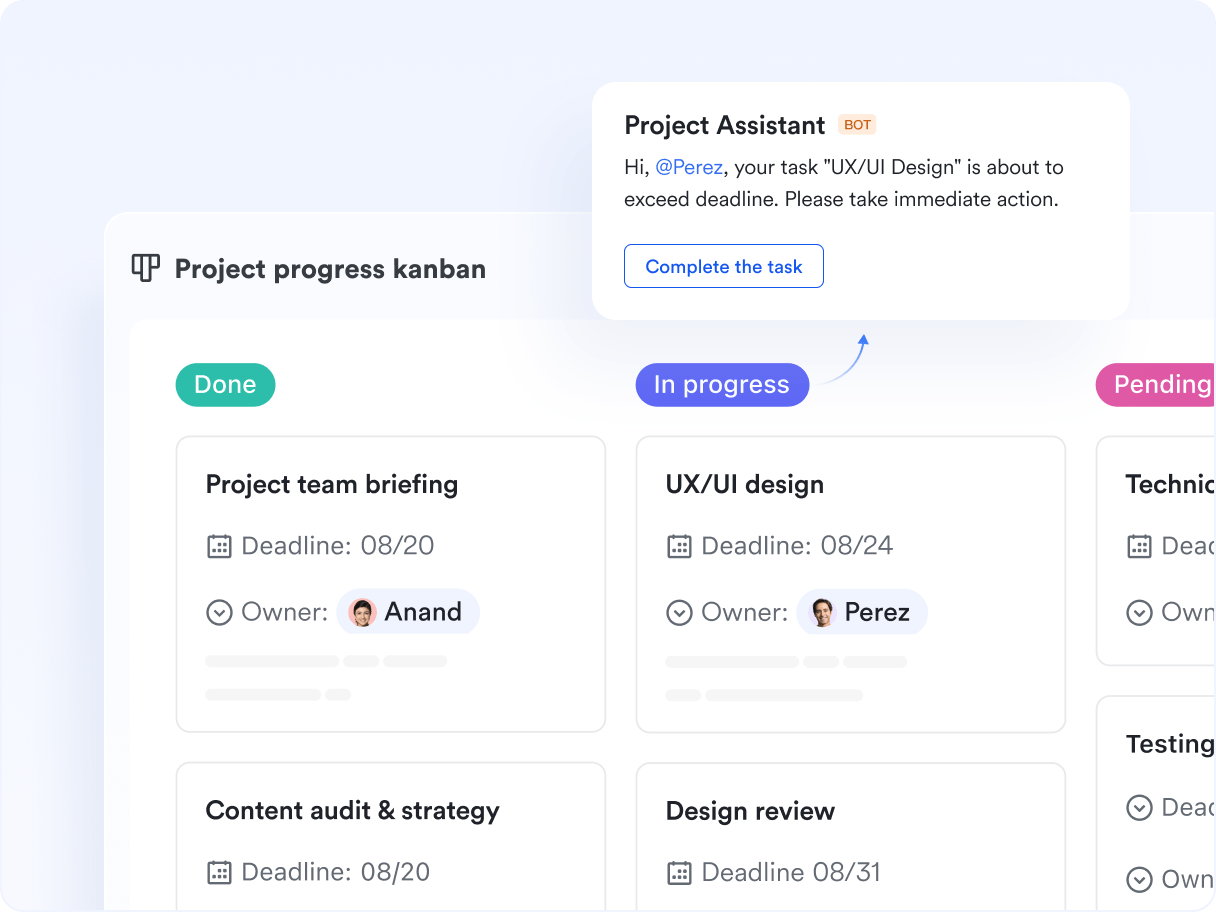
By introducing visual signals such as kanban boards and cards, the method provides a transparent and real-time representation of the work status, allowing teams to identify bottlenecks, balance workloads, and make informed decisions to optimize their processes continually.
Benefits of kanban for data teams
The implementation of kanban within data teams brings forth a multitude of advantages that directly address the complex and iterative nature of data-centric projects.
In the context of data teams, transparency and visibility into the workflow are foundational to operational success. Kanban's visual management approach equips teams with real-time insights into the status of each data-related task, fostering a clear understanding of priorities, dependencies, and potential impediments. By mapping out the workflow stages and visualizing the movement of work items, data teams can swiftly identify areas requiring attention, thereby ensuring a continuous and uninterrupted flow of work.
Data teams often grapple with multiple concurrent projects and shifting priorities, rendering effective work prioritization and resource allocation a critical challenge. Kanban's WIP limits and pull-based system enable teams to focus on completing existing tasks before undertaking new ones, preventing overburdening and fostering a balanced workflow. This, in turn, optimizes resource utilization, minimizes task switching, and cultivates a heightened focus on throughput efficiency.
The iterative and data-driven nature of projects necessitates a malleable and adaptable approach, ensuring that processes remain agile and responsive to evolving requirements. Through regular retrospectives and the encouragement of kaizen – the concept of continuous improvement – kanban fosters a culture of adaptability and learning within data teams. Leveraging accumulated metrics and feedback, teams can iteratively enhance their workflows, fine-tuning their processes to align with changing project dynamics effectively.
Steps to implement kanban for data teams
Transitioning data teams to a kanban framework demands a meticulous and well-structured approach, ensuring that the method integrates seamlessly into existing processes and yields maximum benefits.
Learn more about Lark Project Management for Teams
Common pitfalls and how to avoid them in data teams
The integration of kanban within data teams, while promising substantial benefits, presents potential challenges that teams must navigate to ensure optimal results.
Inadequate clarity in defining work items and establishing coherent policies can lead to confusion, misinterpretation, and inconsistency in workflow management. To mitigate this, data teams should prioritize the articulation and documentation of work items and policies, ensuring that all team members share a common understanding of the workflow and its governing principles.
In the absence of stringent WIP limits and a pull-based approach, data teams may succumb to overburdening, impacting the quality and timeliness of deliverables. By carefully enforcing WIP constraints and embracing the pull principles, teams can safeguard against excessive workloads, enabling a balanced distribution of efforts and resources.
Stagnation in process refinement and a reluctance to adapt to evolving project dynamics can impede the effectiveness of the kanban methodology. Encouraging a culture of openness to feedback, promoting the iteration of workflows, and fostering a mindset of continuous improvement can mitigate these challenges, ensuring that kanban remains finely attuned to the evolving needs of data teams.
Examples of successful kanban implementation for data teams
Case study 1: implementing kanban for data analytics projects
In a data analytics firm, the adoption of kanban revolutionized the management of analytics projects. By visualizing the flow of tasks encompassing data collection, modeling, and insights generation, the team achieved enhanced prioritization and flexibility, fostering a remarkable boost in project turnaround time and resource optimization.
Case study 2: kanban in data engineering: optimizing data pipeline development
A data engineering team leveraged kanban to streamline the development of data pipelines, reducing lead times and operational inefficiencies significantly. By implementing WIP limits and regular retrospective sessions, the team harnessed improved adaptability and an accelerated development cycle, translating to a marked bolstering of data pipeline robustness.
Case study 3: kanban in data science: streamlining experimentation and analysis
Within a data science team, embracing kanban for experiment planning and analysis streamlined the progression of tasks, fostering a culture of consistency and adaptability. The visual management approach and emphasis on continuous improvement catalyzed a surge in experimentation throughput and the seamless alignment of analytical efforts with evolving project requirements.
Learn more about Lark Project Management for Teams
Tips for do's and dont's
| Do's | Dont's |
|---|---|
| Establish clear and consistent work item definitions | Overload teams with excessive workloads |
| Foster a culture of collaboration and continuous improvement | Allow WIP limits to be frequently disregarded |
| Leverage metrics and feedback for iterative process refinement | Resist change and deter from adapting to evolving project needs |
Learn more about Lark Project Management for Teams
Leverage Lark for project management within your team.