


What Is a Product Lifecycle Management (PLM) System? Definition and Guide

Benjamin Grant
Lark Content Manager
Aug 5, 2026
Benjamin Grant
Aug 5, 2026

12 min read


Every new product faces a long and complicated road before it finally reaches the consumer, which makes keeping track of vital information a major challenge. A reliable product lifecycle management (PLM) system works behind the scenes, acting as a central communication hub for your entire operation.
This post covers everything you need to know about these PLM solutions, including their historical background, core operational stages, major business benefits, and common real-world applications.
Key takeaways
- Product lifecycle management (PLM) is a strategic process used to oversee the complete product development lifecycle from its initial ideation and development through to service and final disposal.
- Modern PLM tools act as a centralized platform that connects data, machines, and cross-functional teams, breaking down organizational silos.
- The overarching lifecycle is typically categorized into distinct, highly integrated phases, including concept and design, manufacturing, distribution, and ongoing support.
- Implementing the right PLM software provides significant business value, such as faster time-to-market, reduced production costs, and improved product quality.
What is product lifecycle management (PLM)?
Product lifecycle management is a strategic approach that allows organizations to oversee the entire lifecycle of a product, from the very first spark of an idea all the way through development, manufacturing, market release, ongoing service, and its eventual end of life. This strategy effectively manages a product from cradle to grave. Departments often treat design, production, distribution, and customer support as isolated events, but this methodology weaves them together into a continuous, interconnected development process.
A structured environment that consolidates all necessary information significantly increases a product's competitive advantage. Cross-functional teams—including design and development teams, project managers, marketing specialists, and supply chain coordinators—can collaborate transparently without information getting lost in translation. Ultimately, this comprehensive oversight ensures that every phase is meticulously tracked, helping organizations adapt proactively to changing market demands and reduce unnecessary waste.
What is a product lifecycle management (PLM) system?
To put that strategy into practice, organizations rely on a product lifecycle management system, usually in the form of software. The PLM software acts as a centralized digital hub connecting enterprise data, business systems, diverse applications, and global teams. Design files and manufacturing instructions no longer need to be scattered across servers and paper documents, because the platform manages everything in one secure place.
Core management functions and capabilities of these systems include managing:
- Computer-aided design (CAD) files
- Complex bills of materials (BOM)
- Compliance and regulatory documentation
- Engineering change processes and orders
In short, these platforms offer centralized data management and provide a single source of truth for the entire supply chain, ensuring all teams have up-to-date information by breaking down organizational silos.
A brief history of PLM
The foundational concepts behind managing a product's lifespan can trace their early origins back to the 1930s. A major milestone occurred in 1957 when the consulting firm, Booz Allen Hamilton, formalized a five-step lifecycle mapping a product's journey. However, the technological evolution of today's PLM software unfolded across four distinct eras:
- PLM 1.0 (1960s-1980s): Often called Product Data Management (PDM), this era strictly focused on helping engineers store massive CAD data and files and basic bills of materials.
- PLM 2.0 (1990s): Driven by global expansion and outsourcing, systems evolved to handle inter-departmental collaboration, quality planning, and basic security across different time zones.
- PLM 3.0 (2000s): Shifted focus toward streamlining complex product launches, incorporating requirements management, and building stronger connections for robust supply chain management.
- PLM 4.0 (Today): Modern software providers mostly focus on cloud-based PLM solutions, which offer convenient access and diverse capabilities. They prioritize supply chain resilience and utilize a "digital thread" connecting live IoT data and digital twins back into the design process.
5 key stages of PLM
We'll take a closer look at the specific stages a product experiences during its lifespan to get a clearer understanding of how this software makes a difference in daily operations. PLM systems offer a wide range of process management capabilities, which apply across five broad stages.
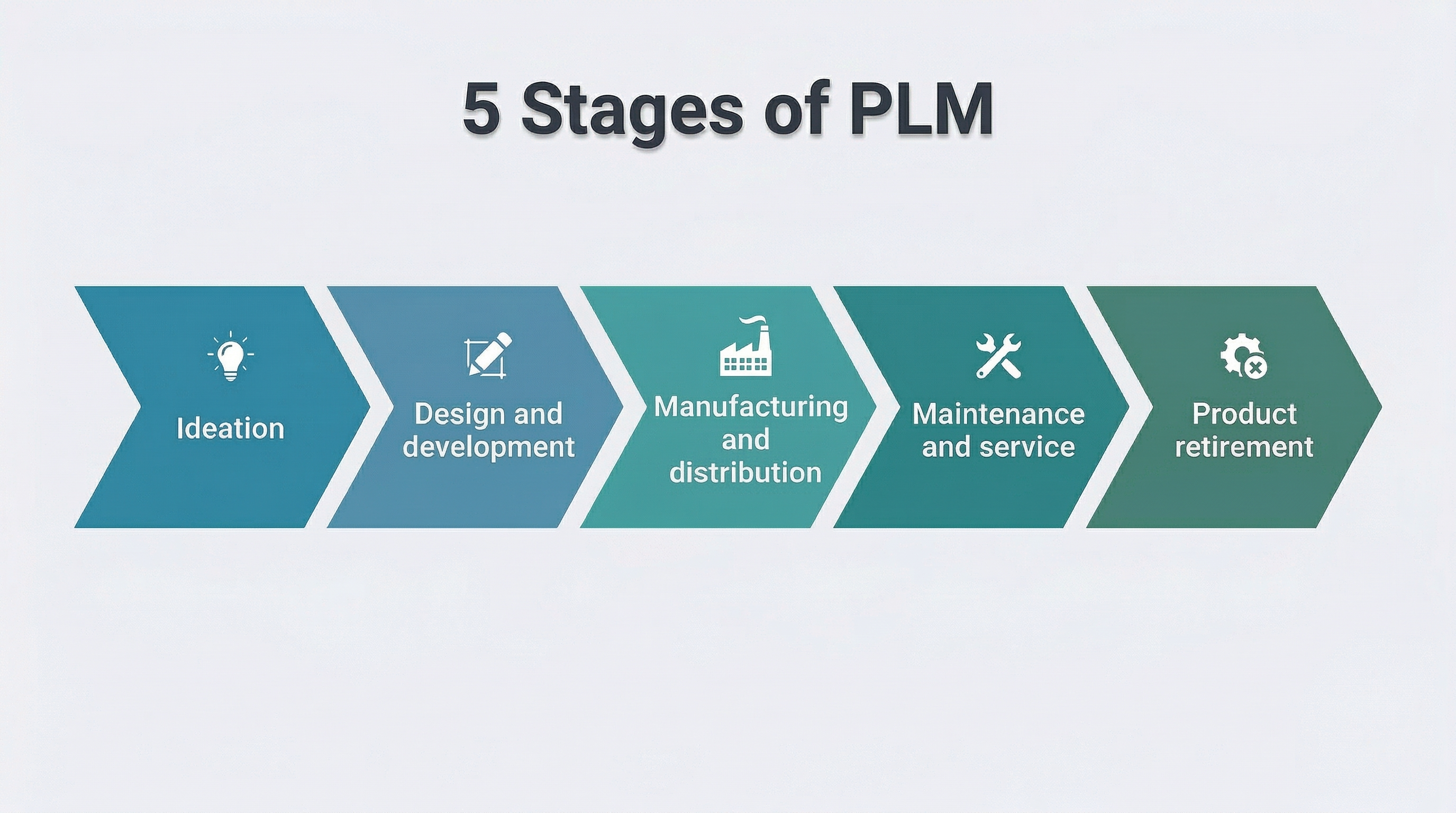
Ideation and requirements definition
Every product begins as a simple idea. Teams conduct extensive market research and gather customer feedback to identify shifting customer needs, pinpoint lucrative market gaps, and ensure the final design meets modern customer expectations.
- Requirement-driven development: Organizations capture multi-domain requirements directly within the software. Every subsequent design decision must trace back to an initial market need or regulatory mandate.
- Sustainability focus: Decisions regarding eco-friendly materials and carbon footprints are locked in early to ensure environmental responsibility.
Design and development
Abstract ideas are hardened into specific, manufacturable realities during this rigorous phase.
- Cross-domain collaboration: Industrial designers and engineers seamlessly manage both mechanical CAD (MCAD) and electrical CAD (ECAD) data simultaneously, preventing isolated departmental friction.
- Digital twins and prototyping: High-fidelity digital models simulate real-world behavior, drastically reducing the need for expensive physical prototypes. When physical mockups are tested, centralized data ensures engineers can document exact structural failures, creating an instant feedback loop for the design team.
- Bill of Materials (BOM) management: The system maintains precise version control over the master recipe of components. Any modification to a component instantly notifies procurement teams and adjusts projected costs.
- Continuous quality assurance: Products are validated against stringent industry regulations and safety standards to detect potential defects as early as possible.
Manufacturing and distribution
Physical production begins with the goal of building the product efficiently and successfully bringing it to market.
- Transition to manufacturing: The engineering BOM translates into a manufacturing BOM (mBOM), defining specific machines, workstations, and order of operations. Dedicated online portals connect internal sourcing teams directly with external suppliers for seamless supplier collaboration and rapid mass requests for quotations (RFQs).
- Manufacturing execution: Factory workers use mobile apps for real-time digital quality checks before goods move to packaging. Meanwhile, Internet of Things (IoT) sensors in assembly equipment provide real-time data on performance, instantly flagging anomalies for predictive maintenance.
- Distribution and commercialization: Commercial teams extract highly accurate 3D models directly from the system to build advertising materials. AI-driven Product Experience Management (PXM) tools automatically push accurate descriptions across global e-commerce channels to ensure brand consistency.
Maintenance and service
The product lifecycle continues long after the customer makes a purchase.
- Service Lifecycle Management (SLM): This feature translates complex engineering data into clear technical publications, empowering field technicians with accurate repair instructions to boost first-time fix rates.
- Real-world intelligence: IoT sensors continuously beam usage data back to the central system. This bidirectional digital thread informs targeted design changes for the next generation of products.
Product retirement
Eventually, every product faces declining market demand and must be systematically phased out. Because the software tracked the exact material composition from day one, teams can responsibly guide recycling and repurposing programs. The ability to identify hazardous materials and salvage valuable metals closes the loop on the circular economy, which honors the company's initial sustainable practices.
Benefits of PLM
PLM technology provides a unified digital foundation to replace disconnected systems, which unlocks transformative operational capabilities and directly impacts the bottom line.
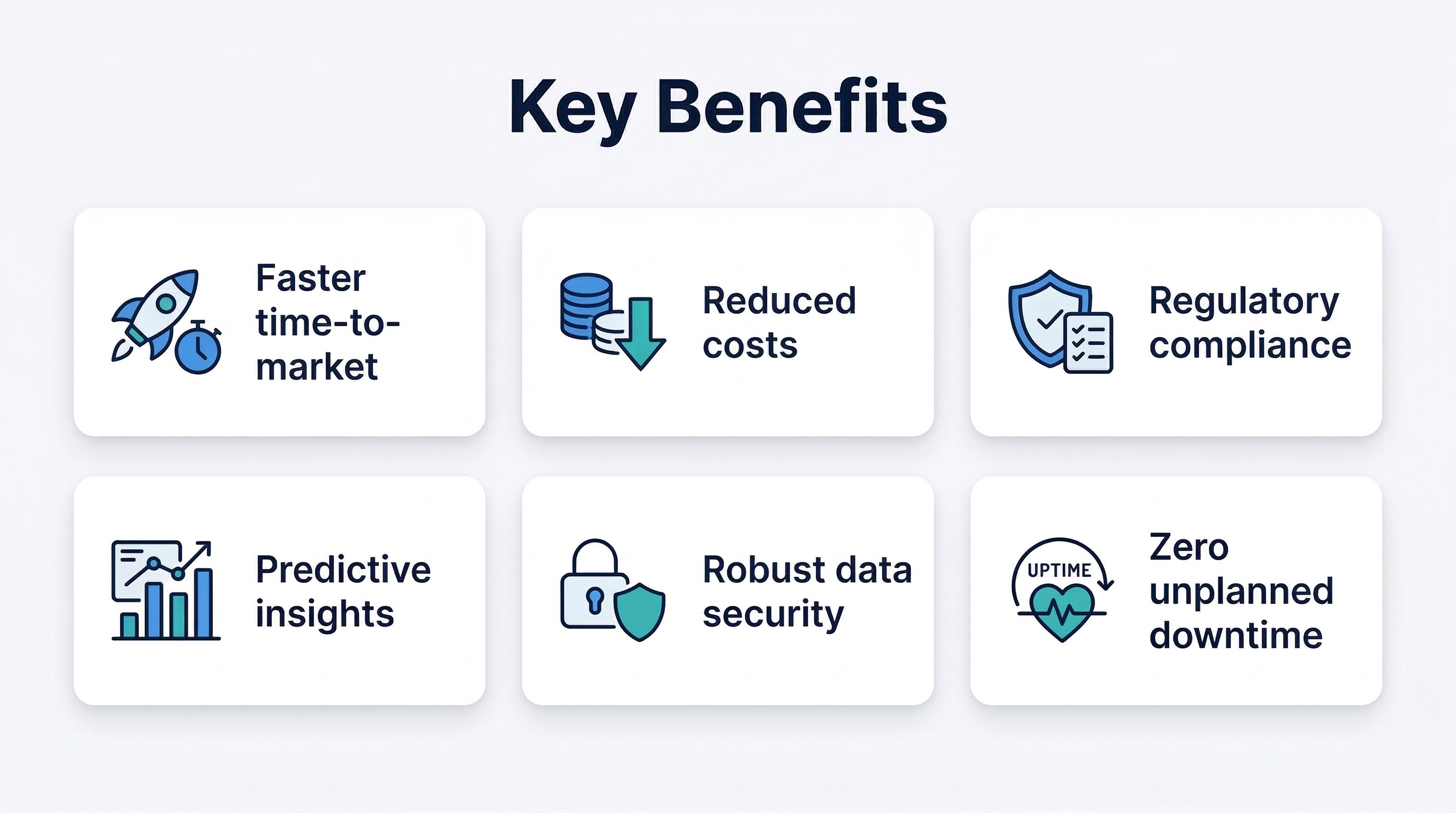
Faster time-to-market
Speed is a major competitive advantage in any industry. PLM software shortens the overall development cycle by enabling parallel workflows and cutting out unnecessary waiting periods. Digital twins and workflow automation can drastically reduce the time your team spends building physical prototypes, which means new items will be able to reach your customers much faster.
Improved collaboration
A centralized workspace equipped with modern collaboration tools effectively tears down the walls between different departments. Shared real-time data eliminates geographic silos and expensive miscommunications across the entire organization. This unified environment accelerates consensus and helps teams work together seamlessly from the initial design phase all the way to the factory floor.
Reduced costs
Early detection of design flaws prevents late-stage manufacturing rework, which saves a tremendous amount of money and materials. The software also cuts development costs through the efficient reuse of existing components and designs across multiple product lines. Cloud-native solutions further minimize ongoing IT administrative overhead, leading to significant cost savings so your business can protect its profit margins.
Regulatory compliance
Highly regulated industries require bulletproof documentation and clear audit trails. Built-in quality management tools automatically capture exactly who made a change, when it happened, and why. This proactive tracking enforces shifting global safety standards and significantly reduces the company's risk of facing expensive legal liabilities or product recalls.
Predictive insights
Modern systems transform raw operational data into actionable insights using artificial intelligence (AI), machine learning, and IoT integrations. These advanced analytics empower business executives to anticipate shifting consumer trends and help businesses optimize their resource allocation, and adjust agile pricing strategies based on actual real-world performance metrics.
Robust data security
Centralized platforms act as a secure fortress for a company's most valuable intellectual property. Strong encryption and granular access controls ensure that sensitive design files, source code, and manufacturing data remain protected from internal leaks or external cyberattacks.
Zero unplanned downtime
Equipment failure can bring an entire production line to a grinding halt. Virtual simulations and digital twins allow businesses to predict maintenance needs and fix mechanical problems in a digital environment first. This proactive approach eliminates unplanned downtime and keeps factory operations running smoothly without costly interruptions.
Common challenges of PLM
While these platforms offer transformative benefits, organizations frequently encounter significant hurdles when implementing PLM.
- Unclear strategic outcomes: Companies often treat this software as a niche engineering tool rather than a strategic enterprise platform. Implementations frequently fail to deliver the promised return on investment without clear business objectives tied to the broader business strategy.
- Complex system integration: A major technical hurdle involves connecting the new platform with existing legacy systems, such as ERP or CRM systems. Existing systems that are disconnected often create data-sharing roadblocks that severely stall product development.
- User adoption and change management: Organizations routinely overlook the human element of digital transformation. Employees may resist new workflows or struggle with unfamiliar interfaces. This resistance makes comprehensive training and strong change management strategies absolutely essential for long-term success.
- Data migration difficulties: The transition of historical product data from old spreadsheets and local servers into a new centralized hub requires meticulous planning. Teams must maintain strict data quality and integrity throughout this transition to prevent costly production errors down the line.
Use cases of PLM
Modern enterprises face immense pressure to innovate quickly while navigating complex supply chains and escalating product complexity. A robust digital platform serves as the central nervous system for these operations, offering versatile tools that solve universal business challenges. The most impactful applications of this technology span several critical areas:
Transform product lifecycle management with Lark
A cloud-based interconnected ecosystem can completely change how the product lifecycle is managed from the very beginning to end-of-life. Lark is an all-in-one platform that brings all the essential tools, such instant messaging, document collaboration, data and project management, approvals, and more for collaboration and product management. With all these tools in one shared workspace, teams can easily connect their daily conversations directly to project data and engineering specifications. This also means everyone can stay on the same page, helping organizations bridge the gap between abstract brainstorming and tangible production effortlessly.
Watch this video to learn more about Lark:
loading...
Key features of Lark
- Visual project management: Product managers can build custom tables and dashboards to track milestones, identify bottlenecks, or monitor resource allocation effortlessly. Automations can be configured without any coding, and data can be visualized in six different views, including Gantt, Kanban, and gallery.
- Real-time document collaboration: Design and engineering teams can co-edit feature specifications simultaneously, which prevents version control issues and keeps everyone aligned on the latest requirements.
- Structured digital approvals: Managers can easily set up and customize structured digital approvals for any workflow without needing technical expertise. They can also approve requests from anywhere and get notifications of new or urgent requests.
- Actionable team communication: The unified chat feed connects directly with your calendar, video meetings, and tasks so you can schedule meetings, create tasks, or share documents without switching screens.
- Convenient cloud and mobile access: Every team member can easily access the latest data from anywhere through their desktop or mobile. Changes are synced in real-time, which means everyone, from frontline workers to remote engineers, can stay perfectly connected to the central development process.

Frequently asked questions
What is the difference between PLM and PDM?
Product Data Management (PDM) is strictly focused on helping engineers store massive CAD files and basic bills of materials during the development phase. Product lifecycle management system definition is broader as it's a system that connects the entire enterprise, managing a product's full journey from initial concept through to final disposal.
What is a product lifecycle management system?
A product lifecycle management system is a dedicated software solution acting as a centralized digital hub for all enterprise data and global teams. The most common type is cloud PLMs, which enable access from anywhere. They break down organizational silos to manage an exhaustive array of product-related information, including compliance documents and engineering change orders, and provide a single source of truth that connects the supply chain from design to manufacturing.
What is a digital twin?
A digital twin is a dynamic, high-fidelity virtual representation of a physical asset or system. These digital models leverage current and historical data to simulate real-world behavior and continuous performance over the course of a product's lifecycle. Companies utilize these simulations to test changes and predict downtime without needing to build expensive physical prototypes.
What are the success metrics for product lifecycle management?
Organizations typically measure the success of these systems by tracking time-to-market speed, product quality, and overall cost reduction. Key performance indicators often include customer satisfaction scores, feature adoption rates, and the number of physical prototypes successfully avoided. Executives track these metrics to pinpoint inefficiencies and optimize resource allocation based on real performance data.
Related reading
Table of contents
Start using Lark today

Manage all your work in one place
Boost team efficiency by 10x
Save up to 70% on software costs
Table of contents
Start using Lark today
Manage all your work in one place
Boost team efficiency by 10x
Save up to 70% on software costs



2026 Lark Technologies Pte. Ltd.
Headquartered in Singapore with offices worldwide.






Explore: