In this digital era, AI has evolved from an emerging concept to a strategic necessity. To remain competitive, organizations must move beyond traditional digital tools—which can no longer keep pace with modern complexity—and embed AI digital transformation directly into their core operations. This transformation isn't a separate initiative; it is a fundamental reengineering of how data is interpreted and how teams collaborate. Platforms like Lark bridge this gap by seamlessly integrating AI with data, communication, and automation, allowing businesses to innovate at scale without disrupting existing workflows.
What AI digital transformation really means today
AI digital transformation today goes beyond automation or basic analytics. It represents a structural change in how organizations use intelligence to guide decisions, , and continuously adapt to change. Unlike earlier digital initiatives, AI-driven digital transformation relies on learning systems that improve with usage.
Digital transformation AI initiatives focus on turning raw data into insights that can be acted on immediately. This approach enables organizations to move from reactive operations to predictive and proactive models. AI and digital transformation together create systems that evolve alongside the business rather than remaining static.
At its core, AI digital transformation aligns technology, people, and processes around intelligence. It ensures that insights are accessible to decision makers at the moment they are needed. This shift is what differentiates true AI-driven digital transformation from isolated AI experiments. By integrating these tools into a , companies can scale their business workflows while maintaining high team performance.

Image source: unsplash.com
AI vs traditional digital transformation
Traditional digital transformation focuses on digitizing existing processes. AI-driven digital transformation focuses on improving and redesigning those processes using intelligence. The difference lies not only in tools but in outcomes.
Earlier digital transformation and often involved moving paper-based . While this improved efficiency, it did not fundamentally change how decisions were made. AI in digital transformation introduces adaptive systems that can interpret patterns, predict outcomes, and recommend actions.
Digital transformation with AI also reduces dependence on manual oversight. AI-powered systems continuously monitor performance and surface insights automatically. This makes digital transformation AI initiatives more resilient and scalable compared to traditional approaches.
What is the role of AI in digital transformation strategy
A successful AI digital transformation strategy defines how intelligence supports business goals rather than how models are deployed. The role of AI in digital transformation is to enhance human decision-making, not replace it.
AI-driven digital transformation strategies typically focus on a few high-impact capabilities. These capabilities work together to improve operational visibility and responsiveness across the organization. Digital transformation and AI succeed when these elements are aligned with real workflows. Below are the core roles AI plays in modern digital transformation.
- Data interpretation: Data interpretation is a foundational role of AI in digital transformation. Organizations generate large volumes of structured and unstructured data that cannot be analyzed manually. AI systems interpret this data in real time and surface meaningful insights for teams. In an AI-driven digital transformation, this enables faster trend identification and better cross-functional visibility. Digital transformation with AI ensures insights are delivered in context rather than as static reports.
- Prediction: Prediction allows AI to turn historical and real-time data into forward-looking insights. In AI driven digital transformation, predictive models help organizations anticipate demand changes and . AI in digital transformation supports better planning by highlighting likely outcomes before issues occur. Digital transformation AI initiatives use prediction to improve forecasting accuracy across functions. This reduces uncertainty and improves decision confidence.
- Personalization: Personalization enables AI systems to tailor experiences based on user behavior and context. In AI digital transformation, personalization improves customer engagement and internal efficiency at scale. AI in digital transformation removes the need for manual customization across channels. Digital transformation with AI ensures consistent and relevant interactions throughout the user journey. This leads to higher satisfaction and stronger long-term relationships.
- Process optimization: focuses on improving how work flows across the organization. In AI driven digital transformation, AI identifies bottlenecks, delays, and inefficiencies in real time. Intelligent automation enhances operational efficiency by streamlining workflows and reducing manual intervention. AI for digital transformation enables continuous improvement rather than periodic reviews. Digital transformation AI initiatives automate routine decisions to reduce friction. This results in faster execution and more reliable operations.
Embrace AI digital transformation from this moment
Where generative AI is applied for digital transformation
Applied generative AI for digital transformation focuses on creating, summarizing, and structuring information automatically. These systems work directly with knowledge rather than numerical patterns alone. Their value lies in reducing cognitive and administrative load.
Applied generative AI for digital transformation supports both internal productivity and. It transforms how organizations document, share, and reuse information. This capability has become central to AI-driven digital transformation efforts.
Below are practical areas where applied generative AI delivers measurable value.
- Content automation: Content automation uses generative AI to draft reports, summaries, and documentation. In digital transformation with AI, this reduces time spent on repetitive writing tasks. As these tasks scale, teams need reliable infrastructure to run their models, which is why they can evaluate to find the right fit for cost and performance. Generative AI and computer vision can automate repetitive tasks such as document processing and image analysis, enabling systems to extract meaningful information from digital images or videos. Applied generative AI for digital transformation helps teams maintain consistency across documents. AI in digital transformation improves speed without sacrificing quality. This allows employees to focus on analysis and execution.
- Customer support: Customer support benefits from applied generative AI for digital transformation through faster and more consistent responses. AI in digital transformation assists agents by summarizing cases and suggesting replies. Digital transformation AI initiatives reduce resolution time without increasing headcount. AI-driven digital transformation also improves knowledge reuse across support teams. This leads to better customer satisfaction.
- Knowledge management: becomes scalable through applied generative AI for digital transformation. AI systems summarize, categorize, and surface relevant information automatically. In AI driven digital transformation, this prevents knowledge from being trapped in documents or chats. Digital transformation with AI improves onboarding and decision accuracy. Information stays current and accessible.
Industrial examples of AI-driven digital transformation
AI digital transformation takes different forms across industries, but the underlying goals remain consistent. Organizations apply AI based on data maturity, regulatory needs, and customer expectations.
AI-driven digital transformation works best when industry-specific challenges are addressed directly. Below are examples of how sectors apply AI for digital transformation in practice.
- Retail: AI retail digital transformation focuses on demand forecasting, personalization, and supply chain efficiency. Retailers use AI to analyze customer behavior across channels. AI in digital transformation improves inventory accuracy and pricing decisions. Digital transformation with AI enables faster response to demand changes. This agility supports competitiveness in fast-moving markets by transforming business processes.
- Healthcare: Healthcare uses AI digital transformation to improve diagnostics, scheduling, and patient engagement. AI in digital transformation reduces administrative workload for clinicians. Digital transformation AI initiatives improve accuracy while maintaining compliance. AI and digital transformation together support better patient outcomes. Trust and transparency remain essential for adoption, and AI is reshaping healthcare business processes.
- Finance: Finance applies AI driven digital transformation to , fraud detection, and customer service. AI for digital transformation monitors transactions continuously. Digital transformation AI initiatives improve regulatory compliance through early detection. AI in digital transformation supports faster and more accurate decisions. This strengthens operational resilience and streamlines financial business processes.
- Manufacturing: Manufacturing leverages AI digital transformation for predictive maintenance and quality control. AI in digital transformation analyzes sensor data in real time. Digital transformation with AI reduces downtime and waste. AI driven digital transformation improves production planning accuracy. Smart factories adapt more effectively to change by optimizing business processes.
AI-driven digital transformation also enables the creation of new business models tailored to each industry's unique challenges and opportunities.
Step-by-step AI transformation roadmap
A helps organizations move from experimentation to scale without unnecessary risk. AI digital transformation succeeds when capabilities are introduced in manageable stages rather than all at once. Each phase allows teams to validate assumptions, build internal skills, and refine data practices. Digital transformation AI initiatives benefit from this gradual approach because progress remains visible and measurable. Over time, the roadmap turns isolated AI efforts into a coordinated, organization-wide capability.
Step 1: Identify AI-ready workflows
have clear data and repeatable decisions. AI-driven digital transformation starts where impact is visible. AI in digital transformation delivers early wins. Digital transformation with AI builds momentum. Practical focus reduces risk.
Step 2: Clean data sources
Clean data is essential for AI digital transformation. AI for digital transformation depends on consistency. Digital transformation AI initiatives prioritize governance early. Clean data builds trust. Outcomes improve reliability.
Step 3: Pilot use cases
Pilots allow safe experimentation in AI-driven digital transformation. AI in digital transformation benefits from feedback loops. Digital transformation with AI improves through iteration. Risks remain controlled. Learning accelerates.
Step 4: Scale automation
Successful pilots expand into automation. AI for digital transformation standardizes decisions. Digital transformation AI initiatives reduce manual dependency. Scale improves consistency. Operations become predictable.
Step 5: Measure impact
Measurement ensures AI digital transformation delivers value. AI in digital transformation improves continuously. Digital transformation with AI aligns outcomes with strategy. Metrics guide optimization. Success becomes visible.
Start AI workflows and AI transformation today
Modern choice: Accelerates AI digital transformation in Lark
As an all-in-one, modern platform, supports AI digital transformation by embedding intelligence into everyday and operations. Rather than positioning AI as a separate system, it applies AI across data, communication, and workflows. This approach aligns closely with AI-driven digital transformation principles. Intelligence becomes part of how work is done rather than an additional layer. Digital transformation with AI benefits from this continuity.
AI-powered data extraction & trend detection
transforms from a static database into an active intelligence tool through AI field shortcuts. Instead of manual entry, the system can automatically extract structured data from unstructured sources like PDF invoices or images of packing slips. Beyond extraction, its smart analysis function for dashboards can instantly detect sales patterns or inventory anomalies, summarizing complex datasets into a single "one-pager" of actionable insights. 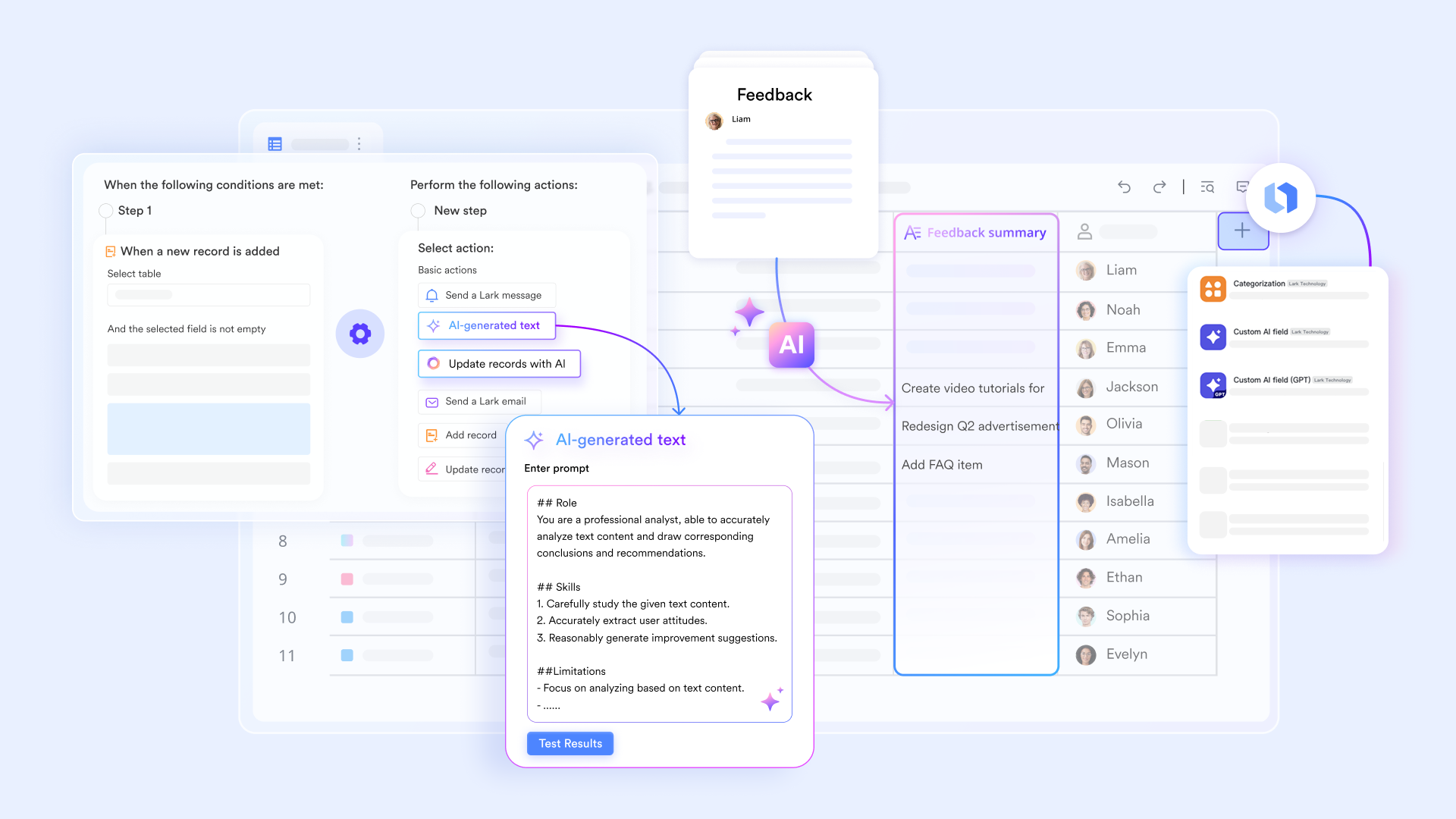
AI-powered data insights and trends analysis
Lark's smart analysis and dashboard summary provide AI insights for current data, helping you master the trends behind the data. These tools automatically interpret complex datasets, generating instant text-based insights and "Detailed Mode" breakdowns that eliminate the need for manual data analysis. By providing one-click summaries of entire dashboards and automated change notifications, Lark democratizes data access, allowing non-technical teams to make rapid, data-driven decisions. 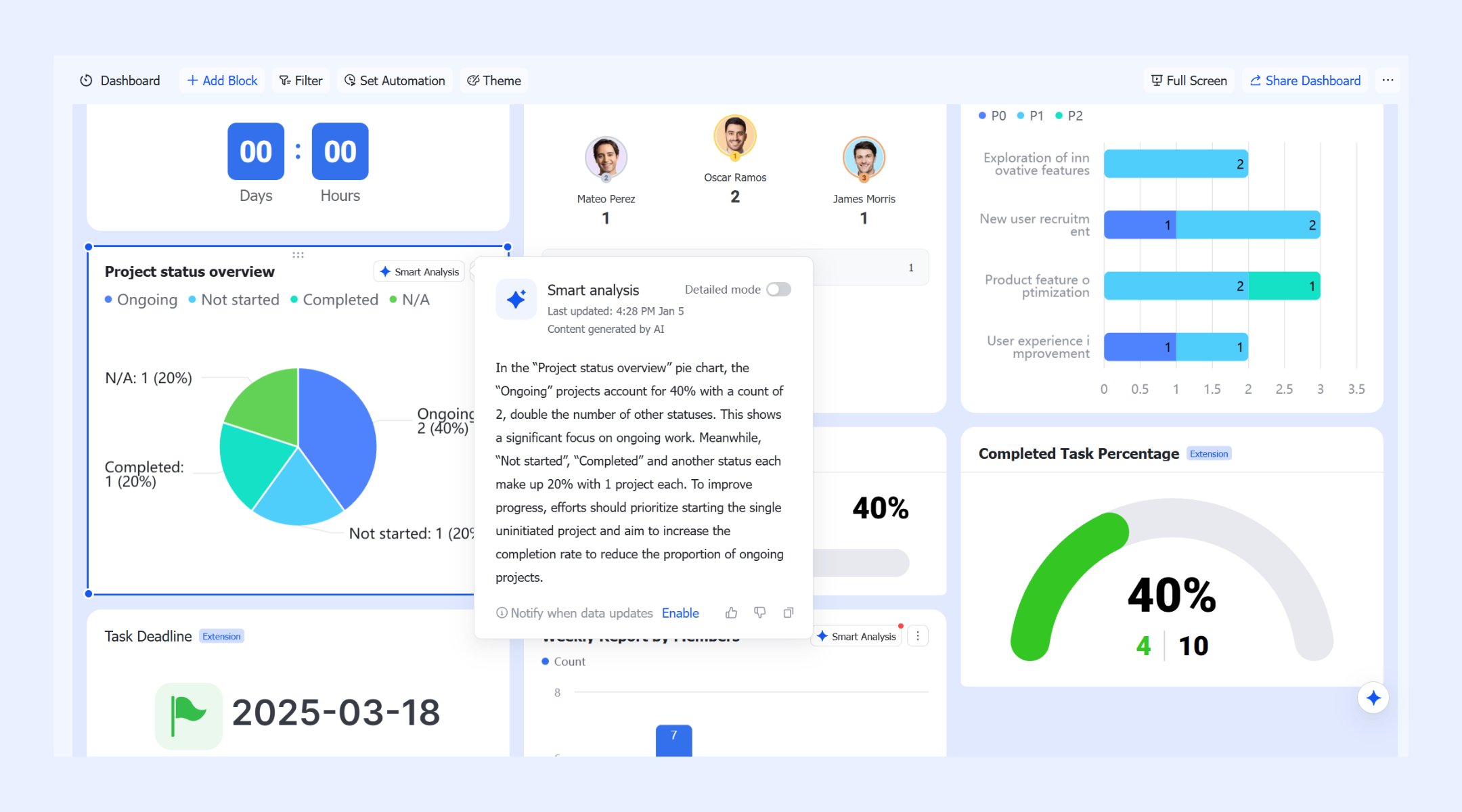
AI-driven workflow routing and alerts
Lark Base automation uses AI-powered logic to manage complex business processes through a visual, no-code builder. Using AI nodes, workflows can "decide" where to route information, for example, automatically escalating a high-value purchase request to a director while processing standard orders instantly. These automations send proactive alerts via , ensuring that the right person is notified the moment a data threshold is met, effectively putting the business's repetitive operations on autopilot. 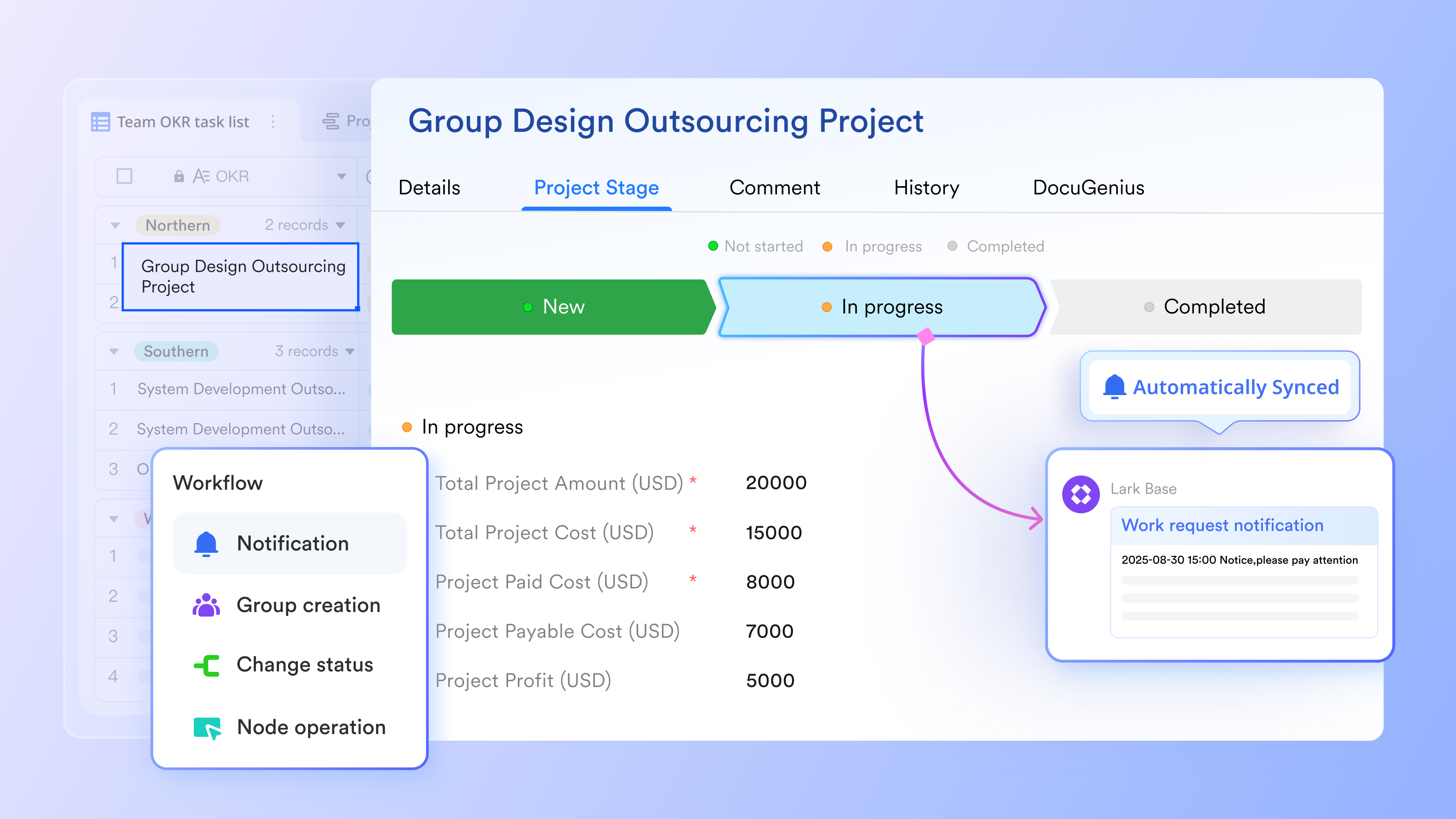
Automated summaries, action items & translation
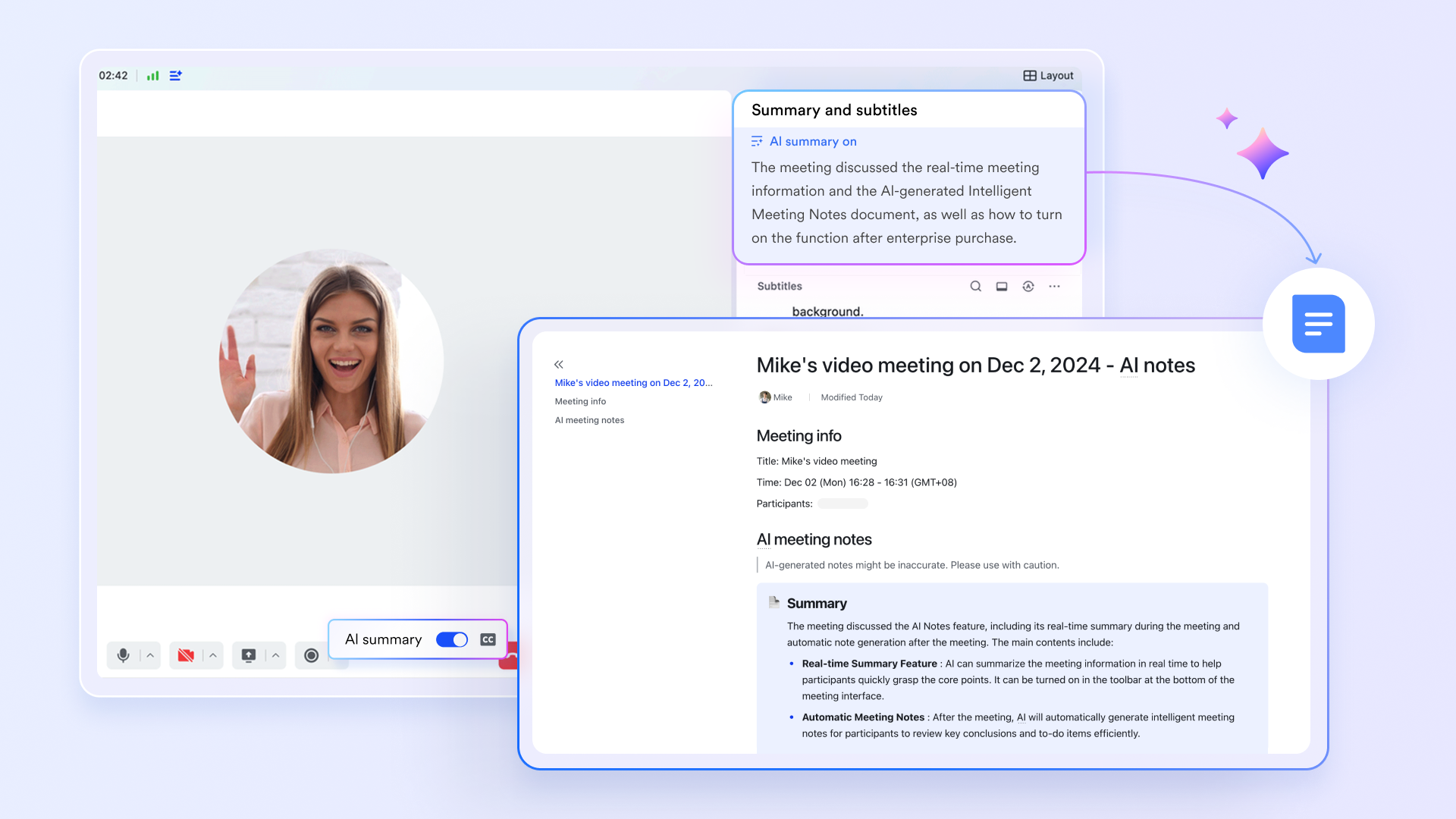
To eliminate the administrative burden of post-meeting follow-ups, comes as an AI assistant. It automatically condenses a 60-minute discussion into a concise summary with a clearly defined to-do list of action items. For global teams, its real-time AI translation supports over 100 languages, ensuring that technical specifications or strategic decisions are understood across borders without language friction.
Context-aware, cross-app enterprise search
The Lark Search engine acts as a unified knowledge hub that understands the "intent" behind a query rather than just matching keywords. Because Lark is a "superapp," the search AI can retrieve information simultaneously across , , Lark Base records, and . It provides contextual previews, such as showing the most recent stock update alongside the related chat thread, drastically reducing the time spent "app-hopping" to find critical business information. 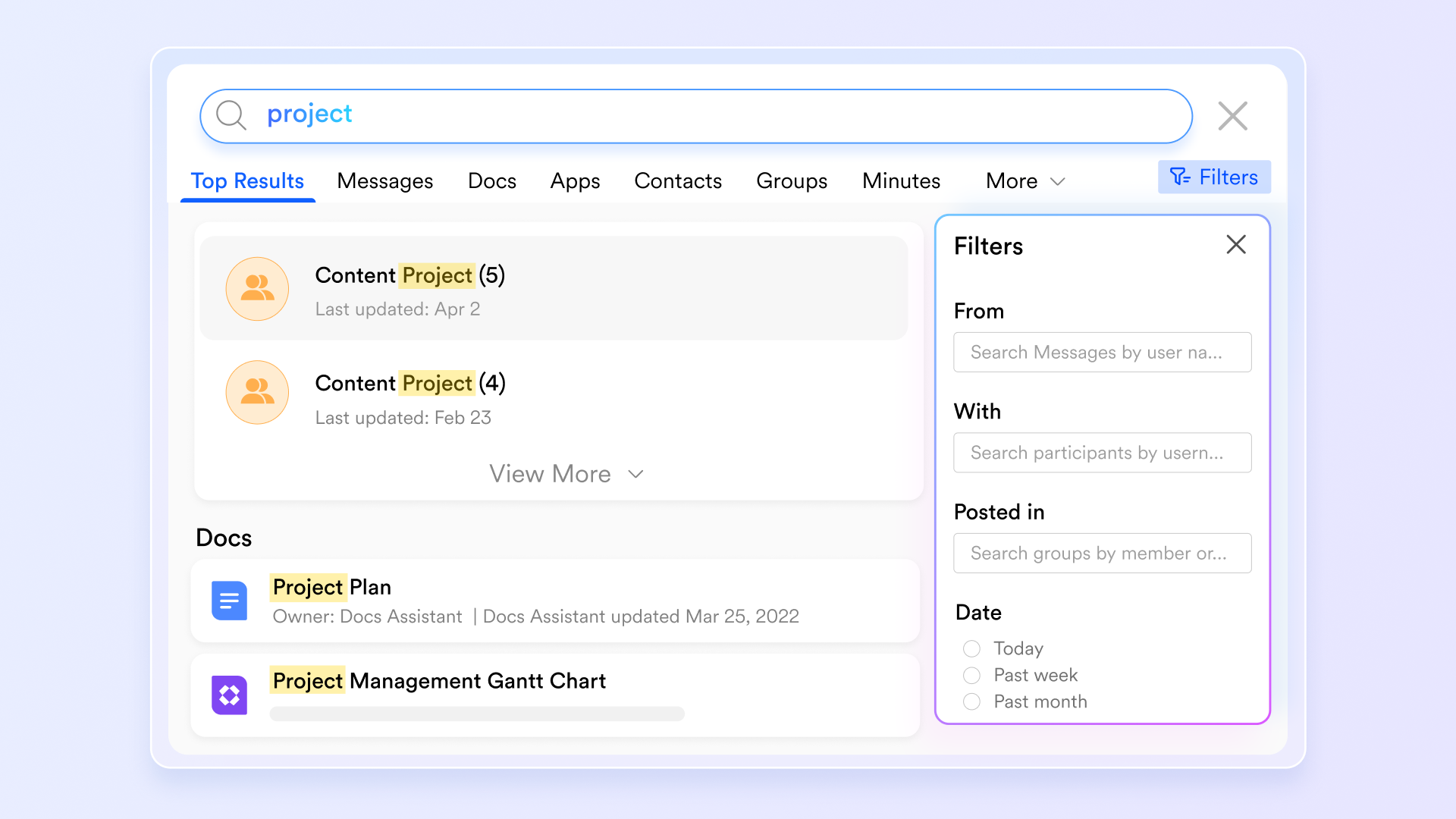
:
- Starter plan: Free forever plan that includes 11 powerful tools for up to 20 users. It also comes with 100GB of storage, 1000 automation runs, AI translations, and more.
- Pro plan: $12/user/month (billed annually) for up to 500 users. It includes everything in Starter plus group calling for up to 500 attendees, 15TB of storage, 50,000 automation runs, and more.
- Enterprise plan: for custom pricing. Supports unlimited users and includes even more automation runs and advanced security, compliance, and management features.
For small teams with simple communication needs

18 months message history
1000 Base automation runs/month
2000 rows per table in Base
Most POPULAR
For companies with comprehensive collaboration and management needs
Unlimited message history
500-participant video meetings
50k Base automation runs/month
20k rows per table in Base
For large companies with advanced security and organizational management needs
Get a personalized demo and pricing
Unlimited message history
500-participant video meetings
15 TB storage + 30 GB storage/user
500k Base automation runs/month
50k Base automation runs/month
Most POPULAR
For companies with comprehensive collaboration and management needs
Unlimited message history
500-participant video meetings
50k Base automation runs/month
20k rows per table in Base
Common barriers to AI adoption
Despite its benefits, AI digital transformation often encounters organizational challenges. These barriers are usually related to structure, governance, and legacy systems rather than technology itself. Organizations with a proven track record in digital transformation are better equipped to overcome these barriers and drive successful outcomes.
Recognizing these obstacles quickly improves the success of digital transformation AI initiatives. Addressing them systematically supports sustainable adoption.
- Data silos: Data silos limit the effectiveness of AI in digital transformation. Fragmented data reduces insight accuracy and trust. AI-driven digital transformation requires integrated data sources. Digital transformation with AI often begins by standardizing data access. Breaking silos improves visibility and outcomes.
- Ethical concerns: Ethical concerns play a central role in AI and digital transformation. Organizations must ensure transparency and accountability. AI-driven digital transformation includes governance frameworks to . Digital transformation AI initiatives build trust when ethics are prioritized. Responsible AI supports long-term adoption. Many organizations operationalize these principles through an that helps monitor usage, manage risk, and enforce consistent security and compliance standards.
- Legacy systems: Legacy systems slow AI digital transformation by limiting flexibility. AI for digital transformation requires modern, connected platforms. Digital transformation with AI often involves gradual modernization. AI-driven digital transformation progresses faster when constraints are addressed incrementally. This reduces disruption.
By systematically addressing these barriers, organizations position themselves as a future ready business, prepared to adapt to new challenges and technological advancements.
Learn how teams overcome AI adoption barriers
Measuring the success of AI transformation
Measuring success ensures AI digital transformation remains outcome-driven. Metrics should reflect operational and strategic impact.
AI-driven digital transformation focuses on improvements that matter to stakeholders. Below are common indicators.
- Cost reduction: AI for digital transformation reduces manual effort and inefficiency. Digital transformation AI initiatives track operational savings. . Cost visibility supports leadership alignment. Investment decisions improve.
- Decision speed: Decision speed reflects AI's impact on responsiveness. AI in digital transformation shortens insight cycles. Digital transformation with AI reduces delays. Faster decisions improve competitiveness. Teams act with confidence.
- Customer satisfaction: Customer satisfaction reflects external impact. AI and digital transformation improve service consistency. Digital transformation AI initiatives personalize experiences. Feedback improves retention. Trust strengthens.
Conclusion
AI digital transformation is no longer about experimentation or isolated innovation. It represents a shift in how organizations think, decide, and execute at scale. When AI and digital transformation are aligned with , intelligence becomes a daily capability rather than a specialized function. This allows organizations to adapt continuously while maintaining control and clarity.
Digital transformation with AI succeeds when approached incrementally, grounded in data, and supported by the right platforms. Tools that unify collaboration, data, and automation help sustain progress over time. Platforms like demonstrate how applied generative AI for digital transformation can support execution without overwhelming teams. As AI-driven digital transformation matures, success will depend less on models and more on how effectively intelligence is embedded into everyday work.
Start your AI digital transformation journey
FAQs
What are the 4 pillars of digital transformation?
The four pillars include people, processes, data, and technology. AI strengthens each pillar by improving how information flows and decisions are made. As organizations mature, platforms like Lark help connect these pillars by embedding intelligence into collaboration and daily workflows. This makes transformation practical rather than theoretical.
What are the 4 types of AI technology?
The four types are reactive machines, limited memory systems, theory of mind, and self-aware AI. Most AI-driven digital transformation efforts rely on limited memory models that learn from historical data. Tools such as Lark apply this type of AI within everyday work contexts. This allows intelligence to support decisions without adding complexity.
What are the 3 C's of AI?
The 3 C's are computation, data, and context. AI in digital transformation becomes effective only when insights are delivered with proper context. Platforms like Lark provide this context by linking AI outputs directly to documents, conversations, and workflows. This helps teams act on insights faster and with more confidence.
Is AI transformation expensive?
AI digital transformation does not have to be expensive when approached incrementally. Many organizations begin with small, high-impact use cases before scaling further. Solutions such as Lark support this gradual adoption by combining AI capabilities with and automation. This reduces upfront cost while delivering early value.
Related reading