














Complete Guide to Warehouse Management Systems (WMS)

Benjamin Grant
Lark Content Manager
Sep 18, 2026
Benjamin Grant
Sep 18, 2026

9 min read


Whether you manage a small warehouse or a large one, the right software can help you run it better. It's easy to see why: Inventory is hard to track, issues are spotted too late, and teams are uncoordinated.
With a warehouse management system (WMS) in place, you get higher accuracy, visibility, and control, while making operations easier to scale without adding complexity. This guide explains what a warehouse management system does, how it works, when you need one, and how to choose and implement the right solution for your operation.
What is a warehouse management system (WMS)?
A warehouse management system is software that controls and coordinates the entire lifecycle of warehouse operations, which involves receiving, storing, picking, packing, shipping, and returns of goods. WMS can also track inventory in real time and guide workers on what to do next to ensure efficient warehouse management. Unlike inventory management software, a WMS goes much deeper by managing workflows, assigning and monitoring labor, and making real-time decisions about storage, order prioritization, and worker routing.
The core roles of a warehouse management system come down to:
- Visibility: Knowing exactly what inventory you have, where it is, and its status at any moment
- Control: Directing warehouse operations through structured workflows instead of ad-hoc decisions
- Optimization: Reducing travel time, improving space utilization, and maximizing labor productivity
- Compliance: Maintaining audit trails and supporting regulatory compliance through accurate records
Real-world example:
A mid-size ecommerce warehouse processes 5,000 orders per day. Without a WMS, warehouse managers rely on experienced workers to know where products are, which orders are urgent, and how to organize the work. Add seasonal staff, new product lines, or a sales spike, and the operation breaks down. With a WMS, every order automatically becomes a sequence of tasks assigned to specific workers, every item has a known location, and managers can see exactly where bottlenecks are forming in real time.
7 key benefits of a warehouse management system
While manual processes often lead to bottlenecks and errors, a WMS streamlines every facet of warehouse operations to drive performance and support rapid growth. Here are the major benefits you can expect:
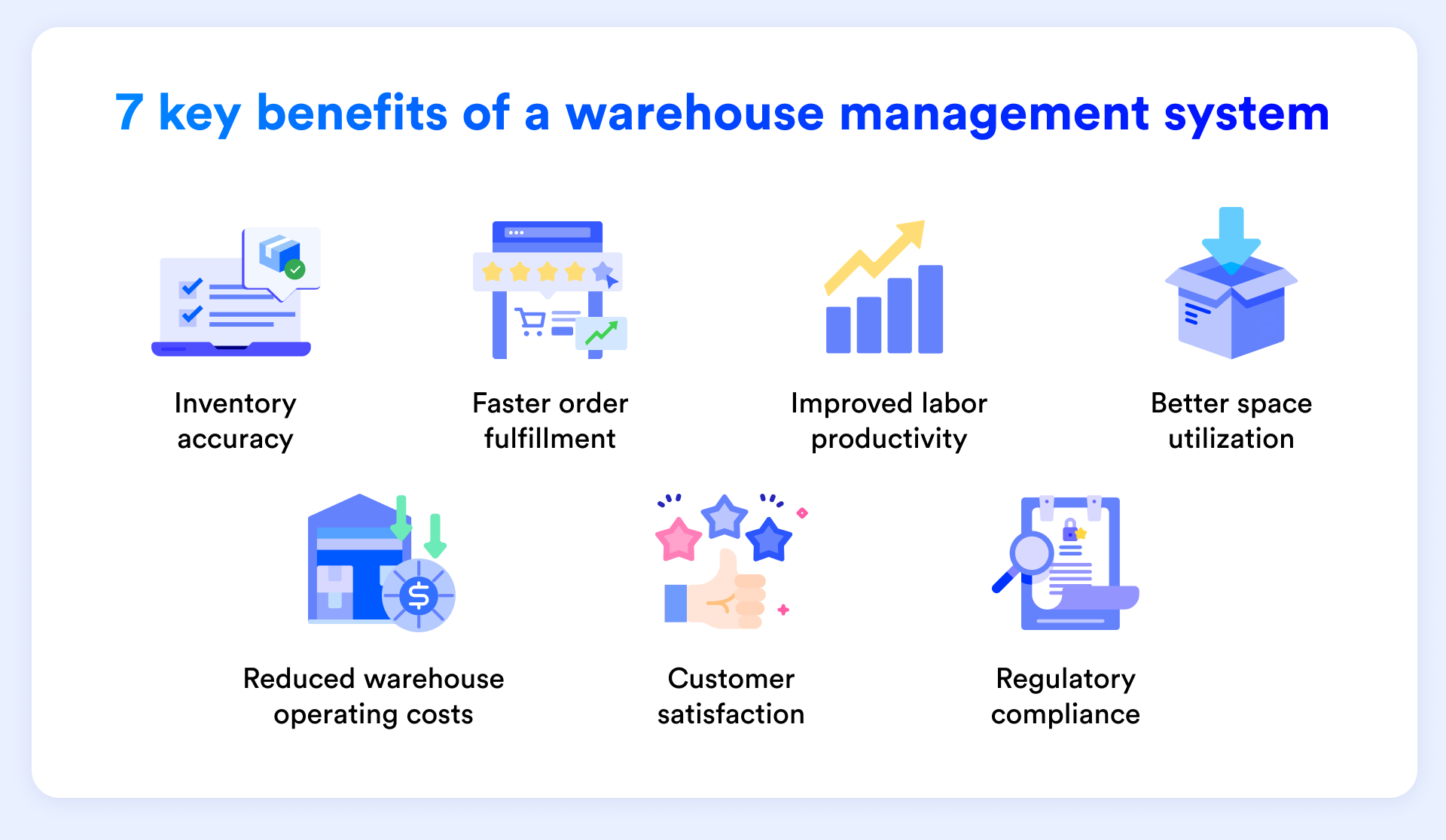
- Inventory accuracy: Real-time tracking means you know what you have and where it is. This eliminates the "we thought we had it" problem that leads to stockouts, disappointed customers, and emergency orders. Accurate inventory data also improves forecasting and reduces safety stock requirements.
- Faster order fulfillment: By optimizing pick paths, batching orders intelligently, and automating task assignments, a WMS cuts the time from order receipt to shipment. For many operations, this means meeting same-day or next-day shipping promises that would be impossible otherwise.
- Improved labor productivity: Workers spend less time walking, searching, and waiting for instructions. The system can assign tasks, route workers efficiently, and track completion, saving hundreds of labor hours through route-optimized picking.
- Better space utilization: Smart slotting puts fast-movers in accessible locations and uses vertical space effectively. More volume can fit into the same warehouse space, delaying or avoiding costly facility expansions.
- Reduced warehouse operating costs: Fewer errors mean fewer returns, less rework, and lower customer service costs. Efficient operations reduce overtime while accurate inventory reduces write-offs and obsolescence.
- Customer satisfaction: Accurate orders, on-time delivery, and the ability to provide real-time tracking information all contribute to customer satisfaction. In competitive markets, fulfillment capabilities become a differentiator.
What can a warehouse management system do?
Inbound operations
A modern WMS automates receiving by importing Advance Shipping Notices (ASNs) before the truck arrives, which allows workers to scan incoming items against expected quantities to flag shortages or damages. This ensures that quality issues are caught at the dock and that inventory is visible and available for sale minutes after it is unloaded.
Once received, the system directs put-away based on pre-set logic to optimize storage space. For example, the WMS can route fast-moving items to forward pick locations and hazmat products to safety zones.
Inventory management
The WMS helps to maintain inventory visibility with high granularity by tracking stock not just by quantity, but by specific bin location, lot number, serial number, and status. This means a planner knows exactly how many units are available versus how many are in a quality-hold queue. It also gives precise traceability for regulated industries, enabling auditors to track a specific lot's entire history through the facility.
Labor management
A warehouse management system maximizes productivity by assigning tasks based on a worker's role, certification, and current location. It also uses task interleaving to reduce wasted movement.
For example, a forklift driver might be directed to put away a pallet in aisle five and immediately pick a replenishment item from aisle four on the return trip. This intelligent routing minimizes "deadheading" or empty travel, which is often the biggest drain on efficiency.
Beyond task assignment, real-time performance dashboards enable precise workforce planning and help managers adjust staffing levels dynamically.
Order processing
Order fulfillment drives the majority of warehouse labor costs. The WMS optimizes this by grouping orders into batches based on priority and carrier cut-off times. Workers receive tasks on mobile devices that guide them to the exact location and require a scan to confirm the item, ensuring high accuracy even during peak volume.
The packing process acts as a final quality firewall. The WMS determines the optimal box size to reduce shipping costs and guides packers to verify each item with a final scan, lowering shipping errors and customer complaints.
Shipping labels and packing slips can also be generated automatically, so even temporary staff can complete complex fulfillment tasks with minimal training.
Shipping
Shipping execution relies on the WMS to organize staging, assign dock doors, and rate-shop across carriers for the best delivery price. Labels and manifests are generated automatically. For international shipments, the WMS ensures all customs documentation is accurate and ready to prevent costly delays at borders or carrier hubs.
Crucially, the WMS can enforce validation checks at the dock door to prevent expensive loading mistakes. Workers scan items as they are loaded to confirm the shipment against the manifest, ensuring the right pallet goes on the right truck. Once the load is sealed, tracking notifications are sent to ensure customers know their package is on the way before the truck even leaves the yard.
Yard operations
For facilities with heavy traffic, the WMS extends control outside the four walls to track every trailer's location, contents, and status. Appointment scheduling tools smooth out arrival peaks to prevent congestion and reduce driver wait times. Real-time monitoring of dwell time helps warehouses avoid costly demurrage charges by prioritizing containers that are nearing the end of their free windows.
Operational intelligence
Real-time dashboards provide immediate visibility into critical KPIs like inventory accuracy and on-time shipment rates. Supervisors can reallocate labor to a struggling zone or investigate a sudden drop in fill rates to ensure daily warehouse operations stay on track.
Historical data and predictive analytics can also be used to drive long-term strategy. For example, managers can analyze pick frequency to optimize slotting layouts or forecast labor requirements for peak seasons based on past performance.

Who is the warehouse management system for?
How do you know if a WMS makes sense for your operation? It depends as much on complexity as it does on the size of your operations.
Common triggers for adopting a WMS include:
- Rising order volumes that overwhelm manual processes and spreadsheet tracking
- More SKUs making it harder to know where everything is and which location to use
- Expansion to multiple warehouses requiring consistent processes and consolidated visibility
- Higher error rates as complexity increases—wrong items shipped, inventory discrepancies, missed orders
- Compliance demands from customers (EDI requirements, labeling standards) or regulators (lot tracking, cold chain documentation)
- New channels like marketplace selling that require faster turnaround and more granular inventory visibility
- 3PL services requiring accurate billing, client-specific processes, and separate inventory tracking
The thresholds vary by the line of business:
Brands and retailers: Often need a WMS when exceeding 500-1,000 orders per day, managing more than 5,000 SKUs, or selling through multiple channels with different fulfillment requirements.
Wholesalers and distributors: May need WMS at lower order volumes if managing complex lot tracking, hazmat products, or customer-specific pricing and allocation.
Manufacturers: Benefit from WMS when raw material and finished goods tracking becomes critical to production scheduling and customer delivery.
3PL providers: Essentially require WMS from day one since the ability to track inventory by client, bill accurately for activity, and meet diverse customer requirements is the core of the business.
Even smaller operations can benefit from a WMS if they have complex rules. For example, a 50-person warehouse handling pharmaceuticals needs lot tracking and regulatory compliance capabilities regardless of order volume. A food distributor needs FEFO enforcement even if they're only shipping 200 orders daily.
Types of warehouse management systems
There are different types of warehouse management systems, each with trade-offs in cost, control, flexibility, and complexity.
- Standalone WMS (on-premise): Traditional software installed on your own servers. You own the infrastructure, control updates, and can customize deeply. This type is best for large enterprises with complex requirements, strong IT teams, and specific compliance or integration needs.
- The drawback is higher upfront costs, longer implementation timelines, and full responsibility for maintenance and upgrades.
- Cloud-based WMS (SaaS): Software as a service means you can access the software via browser or mobile apps, with the vendor managing the infrastructure. Cloud-based WMS systems offer faster implementation, lower upfront investment, automatic updates, and scalability. This is the most popular type among companies, accounting for 55% of market share in 2024.
- Trade-offs include less customization flexibility and ongoing subscription costs rather than one-time licenses.
- WMS modules within ERP or supply chain suites: Major enterprise software vendors offer WMS functionality as part of broader platforms. Benefits include integration with finance, purchasing, and manufacturing modules—all sharing the same data model.
- Drawbacks include higher complexity, potentially less depth in warehouse-specific features, and the need to coordinate updates across the entire platform.
How to choose the right warehouse management system
WMS selection shouldn't focus primarily on feature checklists. Almost every WMS on the market can do basic receiving, picking, and shipping. Fit, integration, implementation, and ongoing support are more important factors.
Key decision criteria include:
- Operational complexity: The right warehouse management system matches your current needs and supports foreseeable future requirements without requiring custom development.
- Growth plans: If you're adding warehouses, new channels, or significant volume, the system needs to scale accordingly.
- Budget: Include implementation services, training, and ongoing subscription/maintenance in your total cost analysis, not just license fees.
- Internal IT capacity: Cloud-based solutions require less internal support while on-premise or heavily customized solutions need dedicated resources.
- Industry requirements: Pharma, food, manufacturing, and other regulated industries need specific capabilities for lot tracking, temperature monitoring, and audit trails.
Involve cross-functional stakeholders early to pave the way for a successful WMS implementation. Every team can contribute in some way or form: Operations knows the workflow details, IT understands integration complexity, finance needs the business case, and customer service sees the downstream impacts of warehouse problems. Together, define must-have versus nice-to-have features.
Emerging technologies & future trends
Warehouse technology has shifted from basic real-time tracking to a new era of automation, AI, and data-driven optimization. A modern WMS now serves as a central "brain," orchestrating a complex ecosystem of humans, machines, and algorithms to execute work. It receives orders, determines the optimal fulfillment strategy, and assigns tasks to the most efficient resource, whether that is a robotic arm, a conveyor system, or a human picker.
Integrated automation and robotics
The WMS orchestrates both fixed automation (conveyors, sorters, AS/RS) and mobile robotics (AMRs, AGVs) by managing inventory flow and issuing commands. For example, a WMS might direct an Autonomous Mobile Robot (AMR) to retrieve a shelf and bring it to a stationary picker, boosting pick rates compared to walking. Similarly, in high-volume environments, the system routes parcels through automated sortation lines, diverting packages to specific carrier lanes at speeds manual labor cannot match. This integration allows facilities to handle massive throughput consistently while reducing dependence on tight labor markets.
Connected workforce technologies
Voice-directed picking and wearable devices decouple workers from screens, enabling safer and faster hands-free operations. Instead of reading a scanner, a worker hears "go to location Alpha 5" and confirms the pick verbally, which is critical in cold storage or heavy-lifting environments. Augmented Reality (AR) and Virtual Reality (VR) are further enhancing this by projecting navigation arrows or inspection checklists directly into a worker's field of view. VR simulations are particularly valuable for training, allowing new hires to practice emergency procedures or forklift operations in a risk-free virtual environment before stepping onto the floor.
AI, IoT, and predictive intelligence
The Internet of Things (IoT) floods the WMS with real-time data from temperature sensors, forklift trackers, and smart scales. AI algorithms process this stream to move from reactive tracking to predictive action. Machine learning models can forecast labor needs for upcoming shifts, detect equipment anomalies before failures occur, or automatically place inventory on hold if environmental sensors detect temperature spikes. This shifts the WMS role from simply recording what happened to actively recommending optimal next steps.
Future trends
Looking ahead, several key trends will define the next wave of warehouse management.
- Embedded AI: Analytics will move from separate modules to core functions, with systems automatically optimizing slotting and workflows without user intervention.
- No-code configuration: Operations managers will use visual tools to modify workflows and reports instantly, removing the need for costly technical customization.
- Unified platforms: The boundaries between WMS, order management systems(OMS), and transportation management systems (TMS) will blur into single platforms that optimize the entire chain from order promise to delivery.
- Sustainability & micro-fulfillment: Systems will natively track carbon footprints and energy usage while scaling down to run efficiently in small, urban "dark stores" closer to the consumer.
Get flexible warehouse management software with Lark
Lark redefines warehouse management by replacing rigid legacy systems with a flexible, all-in-one workspace. Teams are not forced to use pre-built modules but can create their own custom inventory trackers and workflows without writing a single line of code. Data, team chats, dashboards, and approvals all live together in one seamless platform to unify your supply chain.
Real-time collaboration features give real-time visibility of your operations while ensuring that discrepancies or delays trigger instant notifications to the right people. What's more, everything you need to resolve issues can be found directly within the app, eliminating the need to switch tools.

Key advantages:
- Dynamic dashboards: Track real-time KPIs like inventory turnover and pick rates to spot trends and make data-backed decisions instantly.
- AI-driven insights: Automatically extract and categorize data, get record summaries, and analyze charts and data to discover trends instantly.
- Automated workflows: Set up no-code automation to automate routine tasks like sending reorder alerts or assigning tasks instantly when inventory levels change.
- Unified collaboration: Integrate inventory alerts directly with team chat and approval flows to speed up decision-making.
- Mobile-first efficiency: Equip workers with a mobile app that handles scanning, task management, and updates from the warehouse floor.
- Cost-effective scalability: Scale your operations easily without expensive handheld terminals or separate software licenses.
- Customizable workflows: Build inventory systems that mirror your exact operations rather than adapting to pre-set software limitations. Alternatively, you can get started quickly with the template below.
FAQs
What is a warehouse management system?
A WMS is a comprehensive platform that optimizes every step of the fulfillment process, including receiving, put-away, picking, packing, and shipping. It can not only record data, but direct workers with precise instructions, replacing manual guesswork with intelligent, system-guided workflows.
What is the difference between WMS and OMS?
OMS (Order Management System) manages the entire order lifecycle, including sales, payments, and channel routing, while WMS manages the physical execution inside the facility, directing how inventory is stored, picked, and shipped.
What is a 3PL warehouse management system?
3PL stands for Third-Party Logistics, which refers to providers who handle outsourced logistics and fulfillment for other businesses. A 3PL WMS is specialized software designed for this multi-client environment, allowing the provider to segregate inventory by owner and automate complex billing for storage and handling services.
What is the best warehouse management system for a small business?
Small businesses need WMS software that is flexible and low-cost. Lark is an excellent choice because it combines inventory tracking and team communication in one mobile-friendly app, allowing you to build a custom workflow without expensive hardware.
Are there any free warehouse management systems?
Yes, there are free WMS solutions available. For example, Lark offers a powerful free plan for up to 20 users that includes automated workflows, inventory tracking, and a customizable database, a powerful solution for small to medium operations.
Related reading
Table of contents
Start using Lark today

Manage all your work in one place
Boost team efficiency by 10x
Save up to 70% on software costs
Table of contents
Start using Lark today
Manage all your work in one place
Boost team efficiency by 10x
Save up to 70% on software costs
Keep reading







2026 Lark Technologies Pte. Ltd.
Headquartered in Singapore with offices worldwide.






Explore: