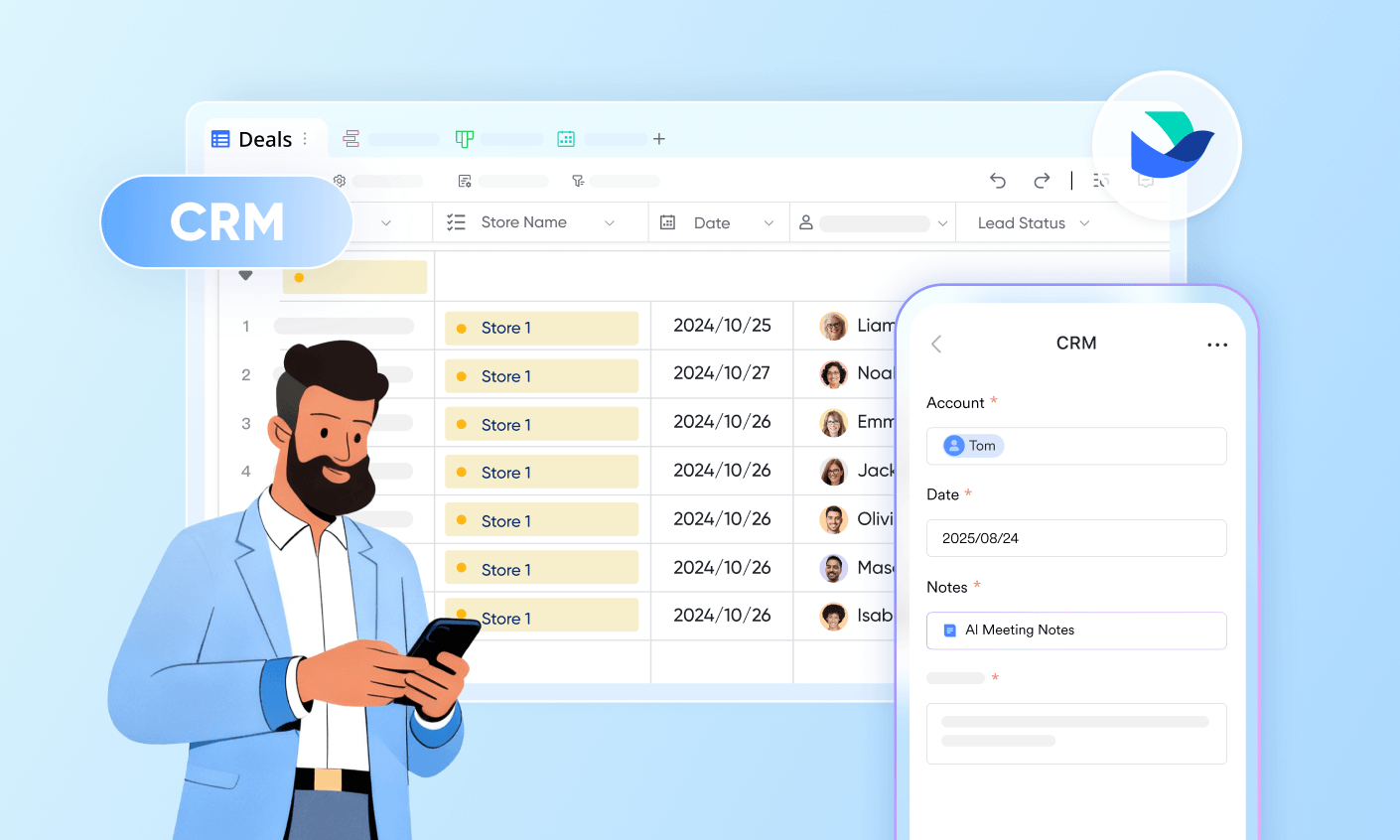
8 Software For Ecommerce Warehouse Management System

Ryan Tanner

Product Marketing Specialist

Aug 5, 2026

Ryan Tanner

Product Marketing Specialist

Aug 5, 2026

Try Lark for free
15 min read
The ecommerce industry is expanding rapidly, and warehouse operations are becoming more complex, faster, and increasingly reliant on technology. Teams must handle fluctuating order volumes, maintain accurate inventory, and meet rising expectations for fast delivery. This makes an ecommerce warehouse management system (WMS) essential for smooth operations.
Modern WMS streamlines workflows, reduces fulfillment errors, improves inventory placement, and connects easily with platforms like Shopify, WooCommerce, and Amazon. In this guide, we break down what to look for in the best warehouse management system for ecommerce and compare seven leading options, including how tools like Lark can support more efficient coordination across warehouse teams.

Key takeaways: Best warehouse management system for ecommerce

1. Lark: End-to-end solution for ecommerce WMS
2. ShipHero: Warehouse management for e-commerce fulfillment
3. Skubana: Inventory and order operations
4. Zoho Inventory: Inventory control for growing businesses

See how smarter systems improve operations

First glance at the best warehouse management system for ecommerce

This article will examine seven leading WMS solutions, but we will start by providing an overview snapshot of the top 4 platforms below. The table details each tool's core strengths, free plan availability, and transparent annual pricing structures
Top 5 tools
Best for
Core strengths
Free plan
Pricing
Lark
All-in-one team collaboration
Tasks, docs, chat, meetings, workflows, dashboards
✅ Yes
Starter plan: free (up to 20 users)
Basic: $6/user/month
Pro: $12/user/month
Enterprise: custom
ShipHero
Ecommerce stores need robust fulfillment and third-party logistics support
Strong order fulfillment workflows, shipping integrations, and multi-warehouse support
❌ No
Enterprise WMS plan: $70,000/year
Brand standard plan: $22,200/year
3PL WMS plan: $23,940/year
Skubana
Growing ecommerce businesses need unified inventory & order operations
Centralized inventory and order management across channels, analytics
❌ No
Custom pricing
Zoho Inventory
Small-to-medium online sellers needing easy inventory control & order sync
Inventory control, order management, multichannel integration, simplicity
✅ Yes
Standard plan: $29/user/month
Professional plan: $79/user/month
Premium plan: $129/user/month
Enterprise plan: $249/user/month
Information source: Official vendor sites
Update time: 2025-12-08
Note: Pricing and plan details reflect publicly available data as of the update date and may vary based on region, billing cycle, and number of agents.

Find solutions that support your growth

What is an ecommerce warehouse management system?

An ecommerce warehouse management system (WMS) is software designed to manage, track, and optimize all warehouse activities that support online selling. It provides real-time visibility into inventory levels, stock locations, and order movement, so businesses can maintain accuracy as volumes fluctuate. A WMS supports key functions, including receiving goods, efficient item storage, managing pick-and-pack workflows, and coordinating shipping with carriers.
Unlike basic inventory tools, an ecommerce WMS integrates directly with online storefronts and marketplaces, ensuring orders flow automatically and stock updates sync across channels. It also helps reduce human errors, improve fulfillment speed, and maintain consistent customer delivery experiences. As ecommerce grows more complex with multi-warehouse operations and rapid delivery expectations, a modern WMS becomes essential for operational efficiency and scalable growth.

Types of ecommerce warehouse management systems

Ecommerce warehouse management systems come in several forms, each designed to support different operational needs, budgets, and levels of scalability. Understanding these types helps businesses choose a solution that aligns with their technical capacity and growth stage.
  • On-premise: Installed on a company's own servers, offering complete control and customization. Best suited for large operations with dedicated IT teams and strict data requirements.
  • Cloud-based: Hosted online and accessible from any location, making it flexible and scalable. Ideal for ecommerce businesses that want quick setup, automatic updates, and lower upfront costs.
  • ERP-integrated: Built as part of broader enterprise resource planning systems. Useful for companies that want warehouse data tightly connected to finance, procurement, and supply chain.
  • Third-party fulfillment platforms: Offered by 3PL providers who manage storage and fulfillment on your behalf. A strong option for businesses that want to outsource logistics while maintaining order visibility.

What are the main components of an ecommerce warehouse management system?

An ecommerce warehouse management system is built on several core components that work together to ensure accurate, efficient, and scalable operations. Each element plays a distinct role in helping businesses manage inventory flow, order fulfillment, and overall warehouse performance.
  • Inventory tracking: Tracks stock levels, item locations, and product movement in real time. This prevents stockouts, overselling, and misplaced items across one or multiple warehouses.
  • Order management: Manages incoming orders from ecommerce platforms, assigns picking tasks, and monitors fulfillment status. It ensures orders move smoothly from purchase to packing and shipping.
  • Shipping integrations: Connects the WMS to carriers such as UPS, FedEx, DHL, and regional couriers. This streamlines label creation, rate comparison, and delivery tracking, enabling faster dispatch.
  • Automation and analytics: Automates repetitive steps—such as reordering, task assignment, or routing—and provides insights into warehouse efficiency. Analytics help improve forecasting, labor planning, and operational accuracy.

Top 8 ecommerce warehouse management software systems

1. Lark: End-to-end solution for ecommerce WMS

Lark offers an end-to-end approach to ecommerce warehouse management by bringing communication, workflow automation, and operational tracking into a single platform. Unlike traditional WMS tools that focus solely on inventory and fulfillment, Lark connects warehouse teams with real-time collaboration and integrated task management. This helps reduce delays caused by miscommunication and fragmented systems. With customizable workflows, automation features, and seamless built-in options, Lark supports both growing and established ecommerce operations. It provides a unified environment where teams can coordinate more quickly, maintain visibility, and streamline warehouse processes.
Lark's end-to-end solution for ecommerce WMS
Lark Base: Central data hub for inventory and store operations
Lark Base functions as the core system for organizing and coordinating warehouse and store operations. Teams create structured tables to manage inventory records, daily stock checks, store audits, issue logs, maintenance requests, and performance reporting in one shared workspace. All updates flow into Base as a single source of truth for headquarters and regional managers. Data connections link products with orders, locations, and task workflows, while multiple views—such as Kanban boards and timelines—support operational monitoring and scheduling. This centralized approach replaces disconnected spreadsheets and siloed databases with a unified command hub for ecommerce warehouse management.
Lark Base supports data on Kanban boards
Lark Docs & Sheets: Centralized inventory and order tracking
Lark Docs and Lark Sheets support collaborative tracking of product catalogs, stock levels, shipment schedules, and fulfillment records across all warehouse locations. Teams update inventory data in real time, ensuring headquarters and branches work from the same information. Version history maintains a clear audit trail, role-based permissions protect sensitive details, and in-document comments enable teams to flag discrepancies —such as damaged items or delayed deliveries — directly within records—keeping communication tied to operational data instead of scattered across messaging platforms.
Lark Docs helps with collaborative editing
Lark Approval: Maintenance and issue management automation
Lark Approval streamlines operational requests, including equipment maintenance, inventory write-offs, damaged goods claims, and vendor returns. Warehouse staff submit standardized approval forms with descriptions, priority levels, attachments, and supporting details. Approval workflows are automatically routed to relevant supervisors or asset managers based on defined rules, such as cost thresholds or equipment categories. Decision status remains visible in real time, reducing delays caused by manual handoffs or email chains while ensuring accountability and compliance throughout resolution processes.
Automated workflows streamline operations
Attendance tracking: Workforce scheduling and labor oversight
Lark Attendance manages shift scheduling, clock-ins, overtime tracking, and location-based workforce monitoring across warehouse operations. Supervisors gain clear visibility into daily staffing coverage, identify labor shortages for picking or packing teams, and monitor attendance patterns that affect productivity. Automated attendance reports support payroll processing and regulatory compliance while enabling leadership teams to align staffing levels with seasonal demand spikes or high-volume fulfillment cycles.
Lark Attendance manages shift scheduling
Calendar & Tasks: Shift coordination and execution management
Lark Calendar organizes shift schedules, equipment servicing appointments, delivery timelines, and training sessions in shared team calendars. Managers assign roles and schedule operational activities, so every team member has clear visibility into responsibilities. Lark Tasks translates daily work into trackable action items—such as inventory audits, picking lists, packing deadlines, and safety inspections—assigned directly to staff or teams. Real-time updates and scheduled reminders ensure key operational tasks stay on pace and reduce missed handoffs across warehouse teams.
Lark Calendar manages schedules and real-time updates
Pros:
  • Reduces operational complexity by centralizing communication and warehouse workflows, ensuring teams work cohesively without switching between multiple disconnected tools frequently.
  • Enhances warehouse decision-making with real-time visibility and analytics, empowering managers to allocate resources effectively and respond quickly to changing order volumes.
  • Improves coordination across ecommerce, sales, and fulfillment teams, supporting smoother processes from order intake to warehouse dispatch through integrated tools and shared dashboards.
  • Scales effortlessly with business growth, making it suitable for ecommerce teams expanding to multiple warehouses or increasing order volumes without added system burdens.
Cons:
  • Lark may require customization efforts for teams seeking highly specialized warehouse automation or deep logistics features beyond its core workflow capabilities.
  • Starter plan: Free forever plan that includes 11 powerful tools for up to 20 users. It also comes with 100GB of storage, 1000 automation runs, AI translations, and more.
  • Basic plan: $6/user/month (billed annually) for up to 500 users. It includes everything in Starter plus group calling for up to 500 attendees, 5TB of storage, 1000 automation runs, and more. For more details, please contact sales.
  • Pro plan: $12/user/month (billed annually) for up to 500 users. It includes everything in Basic plus group calling for up to 500 attendees, 15TB of storage, 50,000 automation runs, and more.
  • Enterprise plan: Contact sales for custom pricing. Supports unlimited users and includes even more automation runs and advanced security, compliance, and management features.
Starter
Pro
Enterprise

Starter

For small teams with simple communication needs

$0

/ user / month

Try for free

No credit card needed

20 users max
18 months message history
1-on-1 video meetings
100 GB storage
Lark Docs & Mail
1000 Base automation runs/month
2000 rows per table in Base

Pro

For companies with comprehensive collaboration and management needs

$12

/ user / month

Billed annually

500 users max
Unlimited message history
500-participant video meetings
15 TB storage
Lark Docs & Mail
50k Base automation runs/month
20k rows per table in Base

Enterprise

For large companies with advanced security and organizational management needs

Get a personalized demo and pricing

Unlimited users
Unlimited message history
500-participant video meetings
15 TB storage + 30 GB storage/user
Lark Docs & Mail
500k Base automation runs/month
50k Base automation runs/month
Single sign-on (SSO)

Pro

For companies with comprehensive collaboration and management needs

$12

/ user / month

Billed annually

500 users max
Unlimited message history
500-participant video meetings
15 TB storage
Lark Docs & Mail
50k Base automation runs/month
20k rows per table in Base

2. ShipHero: Warehouse management for e-commerce fulfillment

ShipHero is a dedicated ecommerce warehouse management and fulfillment platform designed to help brands and 3PLs streamline high-volume operations. It offers tools for inventory accuracy, optimized picking, and multi-warehouse management, making it suitable for fast-growing online businesses. ShipHero also integrates with major ecommerce platforms, enabling seamless order syncing and real-time updates. Its focus on automation and fulfillment efficiency makes it a strong option for teams aiming to scale without adding excessive manual workload.
ShipHero allows warehouse management for e-commerce fulfillment
Image source: shiphero.com
Key features:
  • Real-time inventory tracking with automated stock syncing across channels to prevent overselling and maintain accurate stock levels.
  • Advanced picking workflows, including batch, zone, and wave picking, to accelerate fulfillment and reduce warehouse travel time.
  • Integrated shipping tools that compare carrier rates, print labels, and optimize routing for faster, more cost-efficient deliveries.
  • Multi-warehouse management tools enable teams to allocate orders intelligently and maintain visibility across distributed fulfillment centers.
Pros:
  • Intense picking and packing capabilities designed for high-volume ecommerce fulfillment.
  • Highly scalable for both brands and third-party logistics providers.
  • Reliable inventory accuracy with automated sync across online sales channels.
Cons:
  • Pricing can be higher than simpler inventory systems.
  • Requires time for setup and optimization, especially for complex warehouse workflows.
Pricing:
  • Enterprise WMS plan: $70,000/year (billed annually).
  • Brand standard plan: $22,200/year (billed annually).
  • 3PL WMS plan: $23,940/year (billed annually).

3. Skubana: Inventory and order operations

Skubana is an operations platform designed for fast-growing ecommerce brands that need centralized control across sales channels, warehouses, and fulfillment partners. It focuses on unifying order, inventory, and forecasting data to help businesses maintain accuracy at scale. By integrating with leading marketplaces and 3PLs, Skubana helps automate repetitive tasks and reduce operational fragmentation. It is especially suited for multichannel sellers looking for a single source of truth.
Skubana manages inventory and order operations
Image source: skubana.com
Key features:
  • Centralized multichannel order routing that optimizes fulfillment decisions based on inventory availability, warehouse proximity, and service-level priorities.
  • Real-time demand forecasting tools that use historical data to improve reordering accuracy and prevent stockouts during high-volume periods.
  • Automated purchase order generation triggered by inventory thresholds, supplier lead times, and sales velocity calculations.
  • Integrations with major marketplaces, ERPs, and 3PLs to synchronize product listings, stock levels, and shipment statuses seamlessly.
Pros:
  • Highly scalable platform suitable for ecommerce brands experiencing rapid growth across multiple channels and warehouses simultaneously.
  • Strong automation capabilities that significantly reduce manual intervention in inventory planning, reordering, and order routing tasks.
  • Detailed analytics and forecasting dashboards that support data-driven operational and purchasing decisions.
Cons:
  • Pricing can be expensive for smaller sellers or early-stage ecommerce businesses.
  • Advanced configuration requires time and operational experience to optimize fully.
Pricing:
  • Skubana does not provide a fixed plan; it is customized based on various factors.

4. Zoho Inventory: Inventory control for growing businesses

Zoho Inventory is an inventory and order management solution designed for growing ecommerce businesses that need organized stock control. It helps streamline purchasing, sales orders, and warehouse transfers while staying connected to online marketplaces. The platform supports multi-channel inventory sync, making it useful for businesses selling across several storefronts. Its simple interface and automation features make it accessible to teams with minimal technical experience.
Zoho Inventory is an inventory control tool for growing businesses
Image source: zoho.com
Key features:
  • Automated stock updates across multiple ecommerce channels to prevent overselling and maintain accurate inventory visibility at all times.
  • Order management tools that handle sales orders, backorders, shipments, and drop-shipping workflows for smoother daily operations.
  • Barcode scanning support to speed up receiving, picking, and stock adjustments within warehouse environments.
  • Integration with accounting, shipping carriers, and marketplaces to keep financial and operational data synchronized.
Pros:
  • Affordable for small and mid-sized ecommerce businesses needing structured inventory control without heavy system complexity.
  • Clean interface and guided workflows make onboarding simple, even for non-technical warehouse staff.
  • Strong marketplace integrations enable centralized order handling across Amazon, eBay, Shopify, and more.
Cons:
  • Limited advanced warehouse automation features compared to full-scale WMS platforms.
  • It can become restrictive for large enterprises needing deep customization or multi-warehouse complexity.
Pricing:
  • Standard plan: $29/user/month (billed annually).
  • Professional plan: $79/user/month (billed annually).
  • Premium plan: $129/user/month (billed annually).
  • Enterprise plan: $249/user/month (billed annually).

5. SAP EWM: Enterprise warehouse management

SAP Extended Warehouse Management (SAP EWM) is a highly advanced, enterprise-grade solution designed for organizations with complex supply chain operations and large-scale fulfillment needs. It supports end-to-end warehouse processes with deep automation, robust inventory control, and seamless integration into SAP's broader ERP ecosystem. SAP EWM is built for high-volume environments where precision, compliance, and orchestration across multiple facilities are essential. Its capabilities suit businesses managing global distribution networks, intricate logistics flows, and strict operational standards.
SAP EWM helps in enterprise warehouse management
Image source: sap.com
Key features:
  • Provides detailed warehouse process control with advanced inbound, outbound, replenishment, and storage management for large operational environments.
  • Integrates deeply with SAP ERP and S/4HANA, ensuring real-time synchronization of inventory, orders, procurement, and financial data.
  • Offers strong automation support, including conveyor systems, robotics, RF scanning, and task interleaving for optimized workforce efficiency.
  • Includes flexible slotting, labor management, and yard management tools to streamline material flow and resource planning.
Pros:
  • Highly scalable and suitable for enterprises requiring extensive customization and multi-facility coordination across global supply chains.
  • Strong automation and robotics compatibility enable advanced warehouse optimization and high throughput performance.
  • Deep integration with SAP applications ensures unified reporting, financial accuracy, and efficient cross-departmental collaboration.
Cons:
  • Implementation is complex and time-intensive, often requiring specialized consultants and significant upfront planning.
  • Cost is considerably higher than mid-market WMS options, making it less suitable for smaller ecommerce businesses.
Pricing:
  • SAP EWM does not provide a fixed plan; it is customized based on various factors.

6. Fishbowl: Manufacturing and inventory control

Fishbowl is a popular inventory and manufacturing management system used by growing ecommerce and production-based businesses that need stronger operational control. It connects purchasing, warehouse workflows, and manufacturing processes on a single platform, helping teams streamline order fulfillment and raw material use. With its barcode-based system, Fishbowl improves accuracy and simplifies pick, pack, and shipping tasks across warehouses. It also integrates with tools like QuickBooks and Xero, making it a practical option for companies wanting unified inventory and financial data. Built for small and mid-sized businesses, Fishbowl provides structured workflows that reduce manual work and support consistent production output.
Fishbowl supports manufacturing and inventory control
Image source: fishbowl.com
Key features:
  • Advanced inventory tracking for raw materials, finished goods, reorder points, and multi-location warehouses with automated updates across the system.
  • Manufacturing work order management to schedule builds, manage assemblies, and track component usage through bill of materials workflows.
  • Barcode scanning tools that improve accuracy in picking, receiving, stock counts, and movement across warehouse zones.
  • Integrations with QuickBooks, Xero, and ecommerce platforms for synchronized accounting, order updates, and inventory flow.
Pros:
  • Strong manufacturing and assembly capabilities suitable for production-driven ecommerce businesses.
  • Reliable inventory control with real-time updates across locations using scanning workflows.
  • Works well with accounting tools, reducing data entry errors and improving financial accuracy.
Cons:
  • Higher setup effort and learning curve compared to simpler e-commerce-focused WMS solutions.
  • Limited scalability for rapidly growing ecommerce businesses, as expanding features or adding advanced automation often requires costly upgrades or third-party add-ons.
Pricing:
  • Fishbowl does not provide a fixed plan; it is customized based on various factors.

7. Packiyo: Cloud warehouse software for ecommerce

Packiyo is a modern cloud-based warehouse management platform built specifically for ecommerce teams needing fast, accurate fulfillment. It offers intuitive workflows that help brands scale without heavy technical setup or complex configuration. Designed for multi-channel sellers, Packiyo centralizes inventory, orders, and warehouse operations in one interface. Its lightweight footprint and automation features make it a strong choice for fast-growing online businesses.
Packiyo is a cloud warehouse software for ecommerce
Image source: packiyo.com
Key features:
  • Real-time inventory tracking across multiple warehouses, ensuring stock accuracy and reducing overselling during high-volume sales periods across ecommerce marketplaces.
  • Automated order routing rules that optimize picking, packing, and shipping processes for faster fulfillment with minimal manual intervention and fewer operational bottlenecks.
  • Integrated carrier connections enable quick label creation, rate comparison, and shipment tracking directly within the platform, streamlining outbound logistics workflows.
  • Customizable workflows and automation triggers that support unique business processes, letting ecommerce teams adapt the system to evolving operational needs.
Pros:
  • A very easy-to-use interface that requires minimal onboarding time, making it ideal for growing ecommerce teams with limited technical resources or warehouse training.
  • Fast implementation compared to traditional WMS platforms, allowing businesses to get up and running quickly without complex IT infrastructure or long deployment cycles.
  • Strong multi-warehouse support and real-time visibility help teams coordinate stock levels, transfer items efficiently, and maintain accurate cross-location reporting.
Cons:
  • Limited advanced enterprise features make it less suitable for large or highly complex warehouse networks that require extensive customization.
  • Fewer native integrations compared to older WMS providers, requiring third-party connectors for some ecommerce and ERP platforms.
Pricing:
  • 3PL startup plan: $7549/year (billed annually).
  • For brands plan: $10789/year (billed annually).
  • 3PL scale plan: $14029/year (billed annually).

8. SkuVault: Accurate inventory control for ecommerce

SkuVault is a cloud-based warehouse inventory management platform built for ecommerce brands processing large order volumes across multiple sales channels. It focuses heavily on picking accuracy, barcode scanning, and real-time stock synchronization to reduce overselling and fulfillment errors. SkuVault works best for merchants that need tight operational controls without investing in complex enterprise WMS systems. Its scanning-first workflows are especially valuable for teams scaling fulfillment speed while maintaining inventory accuracy.
Image source: linnworks.com
Key features:
  • Real-time inventory sync across channels ensuring stock levels update instantly across marketplaces, storefronts, and warehouses to prevent overselling and stock discrepancies.
  • Barcode-based picking and packing workflows that guide warehouse staff step by step, increasing fulfillment accuracy and reducing costly shipping mistakes.
  • Batch picking and smart routing tools designed to accelerate order processing by grouping picks and optimizing walking paths within fulfillment centers.
  • Order quality control checkpoints that require barcode verification before packing, minimizing wrong-item shipments and customer returns.
  • Warehouse performance reporting dashboards providing insights into pick speed, shipping accuracy, stock turnover, and operational efficiency across locations.
Pros:
  • Extremely strong barcode-driven accuracy controls, making it ideal for high-volume order fulfillment operations.
  • Multi-channel inventory management works well for ecommerce brands selling across Amazon, Shopify, Walmart, and marketplaces simultaneously.
  • User-friendly warehouse workflows that reduce training time for seasonal staff or rapid warehouse scaling.
  • Reliable integrations with ecommerce platforms and shipping tools, enabling smooth data flow between sales and fulfillment systems.
Cons:
  • Limited flexibility outside ecommerce use cases, making it less suited for complex B2B, manufacturing, or custom warehouse processes.
  • Higher pricing tiers compared to entry-level inventory tools, which may be challenging for early-stage merchants with low order volume.
Pricing:
  • Price on quote

Benefits of using a warehouse management system for ecommerce

Using a warehouse management system (WMS) provides significant advantages for ecommerce businesses, especially as order volumes increase and customer expectations rise. These benefits help streamline daily operations while supporting long-term scalability and efficiency.
  • Faster order fulfillment: A WMS optimizes picking routes, automates task assignments, and reduces bottlenecks, enabling teams to process and ship orders more quickly.
  • Reduced warehouse errors: Digital workflows minimize manual entry and guide staff through standardized processes, lowering the risk of mispicks, incorrect quantities, or shipping mistakes.
  • Lower operational cost: Better resource allocation, reduced labor waste, and improved space utilization contribute to leaner, more cost-efficient warehouse operations.
  • Better stock accuracy: Real-time tracking ensures inventory levels and locations stay up to date, preventing stockouts, overselling, or misplaced items.
  • Improved customer experience: Accurate orders and faster delivery times lead to higher customer satisfaction and more reliable repeat purchasing.

Common challenges in ecommerce warehouse operations and how Lark solves

Ecommerce warehouses face fast-moving operational pressures—from fluctuating stock levels to high return volumes—that can quickly disrupt fulfillment workflows. Lark helps teams stay coordinated with real-time visibility, automation, and flexible process controls, keeping operations running smoothly.
  • Stockouts and overselling: Stock discrepancies cause missed sales and customer dissatisfaction. Lark's real-time updates and automated alerts ensure teams never sell items that aren't available.
  • Inventory visibility: Scattered data reduces accuracy and slows decision-making. Lark centralizes inventory information across locations, giving teams instant insight into stock levels and movements.
  • Multi-warehouse control: Managing multiple sites creates coordination gaps and inconsistent workflows. Lark unifies warehouse operations, enabling standardized processes and shared visibility across all locations.
  • High return rates: Returns increase processing workload and complicate restocking. Lark streamlines return handling with structured workflows that help teams quickly verify, sort, and update inventory.
  • Seasonal spikes: Order surges strain capacity and overwhelm teams. Lark's automation and task routing help handle peak seasons efficiently without compromising fulfillment accuracy or speed.

Conclusion

A well-managed ecommerce warehouse is essential for meeting rising customer expectations, controlling operational costs, and sustaining long-term growth. The right warehouse management system helps streamline fulfillment, improve inventory accuracy, reduce manual errors, and support smoother multi-channel operations. As this guide shows, each WMS offers different strengths—from automation capabilities to integrations and scalability—making it essential to choose a solution that aligns with your workflows and future expansion plans.
Platforms like Lark bring together collaboration, workflow automation, and operational visibility in one place, helping teams coordinate tasks more efficiently across fast-moving warehouse environments. Whether you are upgrading from manual systems or optimizing an existing setup, adopting the right tools can create meaningful improvements in daily operations.
If you're ready to explore a modern, integrated approach, consider Lark to support more connected, efficient warehouse processes.

Learn more and choose what fits your needs

FAQs

Can small ecommerce businesses use a warehouse management system?

Yes, small ecommerce businesses can benefit from a WMS because it reduces manual work and improves order accuracy from day one. Cloud tools make it affordable and scalable without heavy setup costs. Even lightweight platforms like Lark help small teams coordinate tasks and documentation more efficiently.

How much does an ecommerce warehouse management system cost?

Pricing varies widely depending on features, order volume, and integrations, with options ranging from free tiers to enterprise-level subscriptions. Many vendors charge per user or per warehouse, allowing businesses to scale gradually. Platforms such as Lark also offer flexible entry points for growing teams managing more complex workflows.

Is a WMS different from an inventory management system?

Yes—an inventory system tracks stock levels, while a WMS manages the entire fulfillment workflow, including picking, packing, and shipping. A warehouse management system ecommerce solution usually integrates both functions for smoother operations. Tools like Lark complement this by supporting communication, tracking, and workflow coordination across teams.

Do I need barcode scanners to run a WMS?

Barcode scanners aren't mandatory, but they significantly improve accuracy and speed during receiving, picking, and auditing. Many WMS platforms allow teams to start with mobile devices before investing in hardware. Using tools like Lark for team coordination ensures scanning-related tasks stay aligned across shifts.

How long does WMS implementation usually take?

Implementation time can range from a few days to several months, depending on warehouse size, integrations, and data migration needs. Smaller operations typically onboard faster, while complex workflows require phased rollouts. Lark can support teams during implementation by centralizing tasks, documentation, and approvals.

Can a WMS help manage international shipping and customs documents?

Yes, most WMS platforms integrate with shipping carriers and documentation tools to handle customs forms, HS codes, and export requirements. This ensures smoother processing for cross-border orders and fewer delays. Using Lark alongside a WMS helps teams coordinate paperwork, deadlines, and communication with logistics partners.

Related reading

Ryan Tanner

Product Marketing Specialist

Ryan is a Product Marketing Specialist. Having helped over 150 project managers overcome challenges, Ryan delivers actionable strategies and forward-thinking insights to elevate your team's performance by leveraging innovative methods for revolutionary project execution.

Keep reading