


7 Top Virtual Assistant For Businesses Solutions

Matthew Sia
Product Marketing Manager
Aug 5, 2026
Matthew Sia
Aug 5, 2026

13 min read


Hybrid work is now standard for remote capable jobs in the United States. According to Gallup's 2025 data, 52% of such roles are hybrid, 26% are fully remote and 22% remain on site. This shift means leaders need capacity that flexes across locations and time zones without adding headcount risk.
The virtual assistant industry has experienced explosive growth, with McKinsey's Future of Work Institute reporting that 87% of companies now view flexible staffing as essential for competitive advantage. Remote work adoption accelerated VA adoption by 312% between 2020-2025, fundamentally changing how businesses approach administrative support.
Most teams I talk to do not need another app. They need someone who can absorb recurring work with minimal management overhead. A managed virtual assistant for businesses can reduce hiring risk, speed up execution and consolidate workflows inside a single workspace like Lark.

Modern VAs handle far more than traditional administrative tasks. Today's virtual assistants manage complex sales operations, customer success workflows, content creation, social media management and even basic accounting functions. The average VA now manages 15-20 different software platforms and reduces task completion time by 40-60% compared to untrained staff.
Seven providers stand out for U.S. businesses, with Wing Assistant taking the top spot. Understanding where a virtual assistant fits, what it costs and how to onboard one will help you pick the right model.
Define what a virtual assistant for businesses is
A virtual assistant for businesses is a remote human professional who handles recurring tasks for your company. Clarity on this definition matters before comparing providers. You can buy this as a managed service where the provider recruits, supervises and replaces talent or you can source independent contractors directly.
Service models explained: Managed Service VAs include full provider oversight, quality assurance, backup coverage and standardized training. The provider handles recruitment, performance management and replacement if needed. This costs more but reduces management overhead significantly.
Dedicated VAs work exclusively with your business, learning processes deeply over time. They deliver higher quality after a 30-60 day ramp period. Pool-Based VAs rotate among clients but offer lower costs and immediate availability for simple, documented tasks.
This model differs fundamentally from AI assistants that generate or summarize content. AI can help a VA but cannot safely manage calendars, follow up with vendors or update CRM fields independently. Current AI tools lack the judgment, relationship management skills and contextual understanding that human VAs provide.
Key terms: Managed VA means the provider hires and supervises, while a dedicated VA is assigned consistently to your account. A CSM (customer success manager) handles quality and continuity, and SOPs (standard operating procedures) document task steps. SLAs define service level agreements for response times and quality metrics.
Demand is rising dramatically. Deloitte's 2024 Global Outsourcing Survey reports 80% of executives plan to maintain or increase outsourcing investments. The global virtual assistant market reached $5.36 billion in 2024 with 24.3% projected annual growth through 2030, driven primarily by small and medium businesses seeking flexible alternatives to full-time hires.
Decide when a VA makes sense for your team
Use a VA when the workload is consistent, process friendly and not core intellectual property. Good fits include inbox management, calendar coordination, travel booking, vendor follow up, CRM hygiene, lead research, invoice prep, meeting notes, basic reporting and content coordination.
Specific use cases by function:
Executive support: Calendar optimization, travel coordination, expense management, meeting preparation, email filtering, document organization, vendor management and presentation creation.
Sales operations: Lead qualification, CRM data entry, proposal formatting, follow-up sequences, meeting scheduling, pipeline reporting, competitive research and contact list building.
Marketing support: Content calendar management, social media posting, email campaign setup, event coordination, analytics reporting and campaign tracking.
Customer success: Onboarding documentation, support ticket triage, customer data updates, renewal reminders and satisfaction surveys.
Decision framework: Is the work repeatable for 10+ hours weekly for at least eight weeks? Are success criteria measurable with documented steps? Does the task require judgment that can be trained through examples? If yes to all three, a VA works well.
Red flags: Regulatory tasks without supervision, privileged production access, unstable daily scope changes, high-trust finance work without controls, strategic decision-making, confidential HR matters or customer escalations requiring senior judgment.
Research from UC Irvine shows knowledge workers average 47 seconds on screen before switching and take up to 25 minutes to refocus after interruptions. VAs can gate requests, prep agendas and reduce context switching by triaging requests in centralized workspaces.
Calculate the ROI in real numbers
A virtual assistant should deliver clear savings versus W-2 hires including salary, benefits and hiring costs. The median annual wage for administrative assistants was $47,460 in May 2024 per Bureau of Labor Statistics. Executive assistants earned $74,260.
Complete cost analysis for full-time hires:
- Administrative assistant base salary: $47,460
- Benefits (29.7% of compensation): $14,090
- Hiring and recruitment costs: $5,475
- Training and onboarding: $3,200
- Software licenses and tools: $1,800
- Office space allocation: $4,200
- Management overhead (10%): $4,750
- Total year 1 cost: $80,975
Virtual assistant investment:
- Part-time VA (20 hours): $699-899 monthly ($8,388-10,788 annually)
- Full-time VA (40 hours): $1,299-1,899 monthly ($15,588-22,788 annually)
- Setup and training costs: $500-750 one-time
- Annual savings vs. full-time admin: $58,187-70,637
Beyond cost savings, VAs often deliver superior productivity. Stanford research shows remote workers are 13% more productive than office counterparts. VAs typically complete tasks 25-40% faster than untrained staff due to specialization and fewer interruptions.
Quality improvements include 95%+ task completion rates versus 78% for overloaded internal staff, 2-4 hour average response times versus 24-48 hours internal, and 40% reduction in process errors through standardized procedures.
Compare the top 7 providers for U.S. businesses
The best virtual assistant provider balances oversight, coverage and security in a model fitting your team workflows. Many teams prioritize fully managed models, clear SLAs and unified workspaces for routing tasks through single points of contact.
1. Wing Assistant
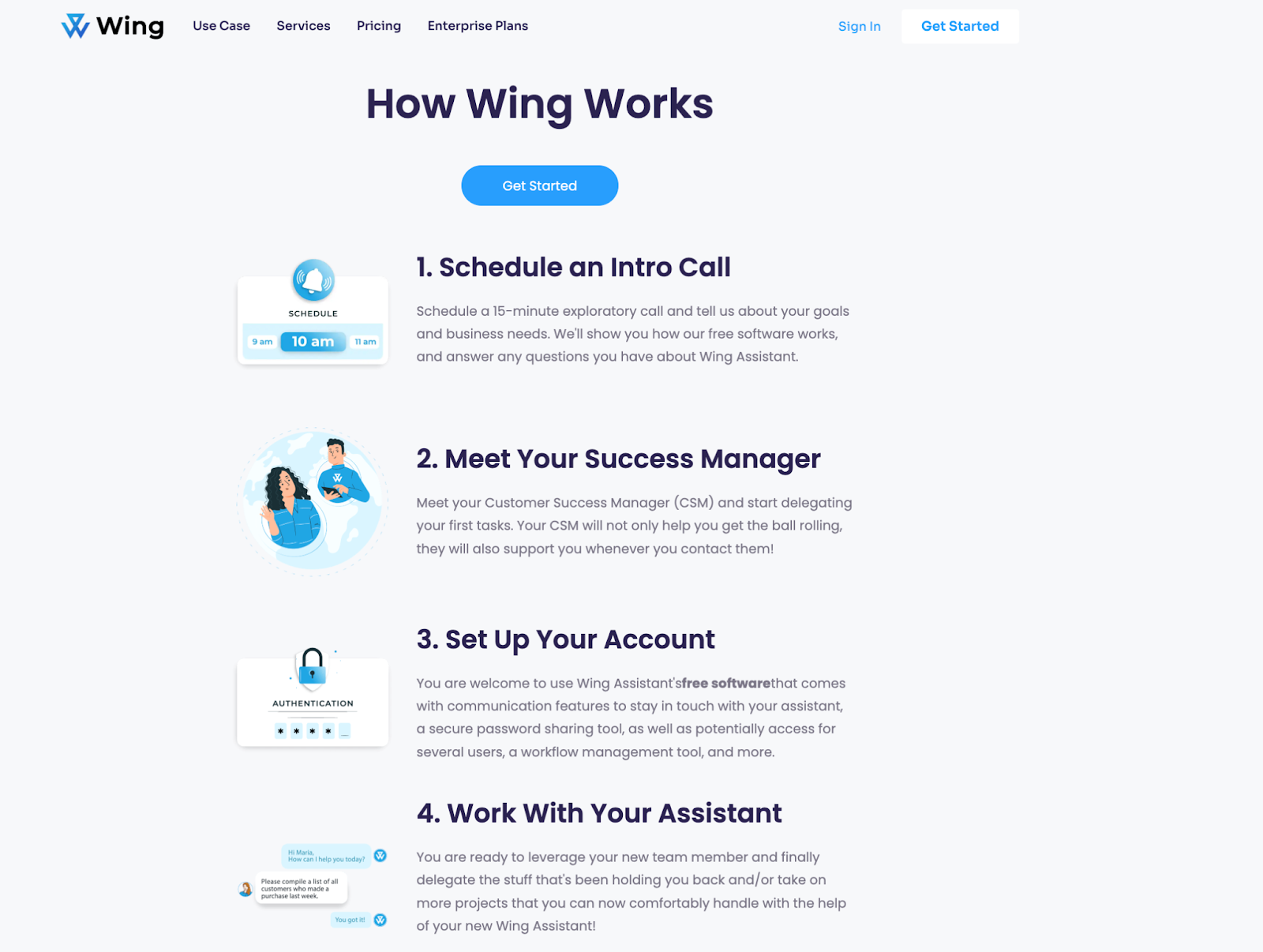
Image source: wingassistant.com
Wing Assistant offers a fully managed model with dedicated assistants, CSM support, quality oversight and easy replacements. Pricing starts around $699 monthly for part-time coverage with established U.S. presence and BBB profile for buyer confidence.
Comprehensive features: Dedicated VA with 2-week replacement guarantee, 24/7 customer success manager support, multi-timezone coverage across US, Philippines and Eastern Europe, 150+ pre-built SOP templates, integration with 50+ business tools including Salesforce and HubSpot, weekly performance dashboards, GDPR and SOC 2 compliance, and automatic backup assistant assignment.
Pricing structure: Part-time (20 hours): $699/month, Full-time (40 hours): $1,299/month, Premium (senior VA): $1,899/month, with $199 setup fee waived for annual contracts.
Service coverage: General administration, executive support, sales development, marketing operations, customer support and specialized industries including healthcare and real estate. Strong retention rates of 87% indicate high client satisfaction.
Best for U.S. SMBs and mid-market teams wanting single vendor deployment, standardized processes and clear SLAs. Consider data access boundaries, device policies and response time requirements during scoping.
2. BELAY
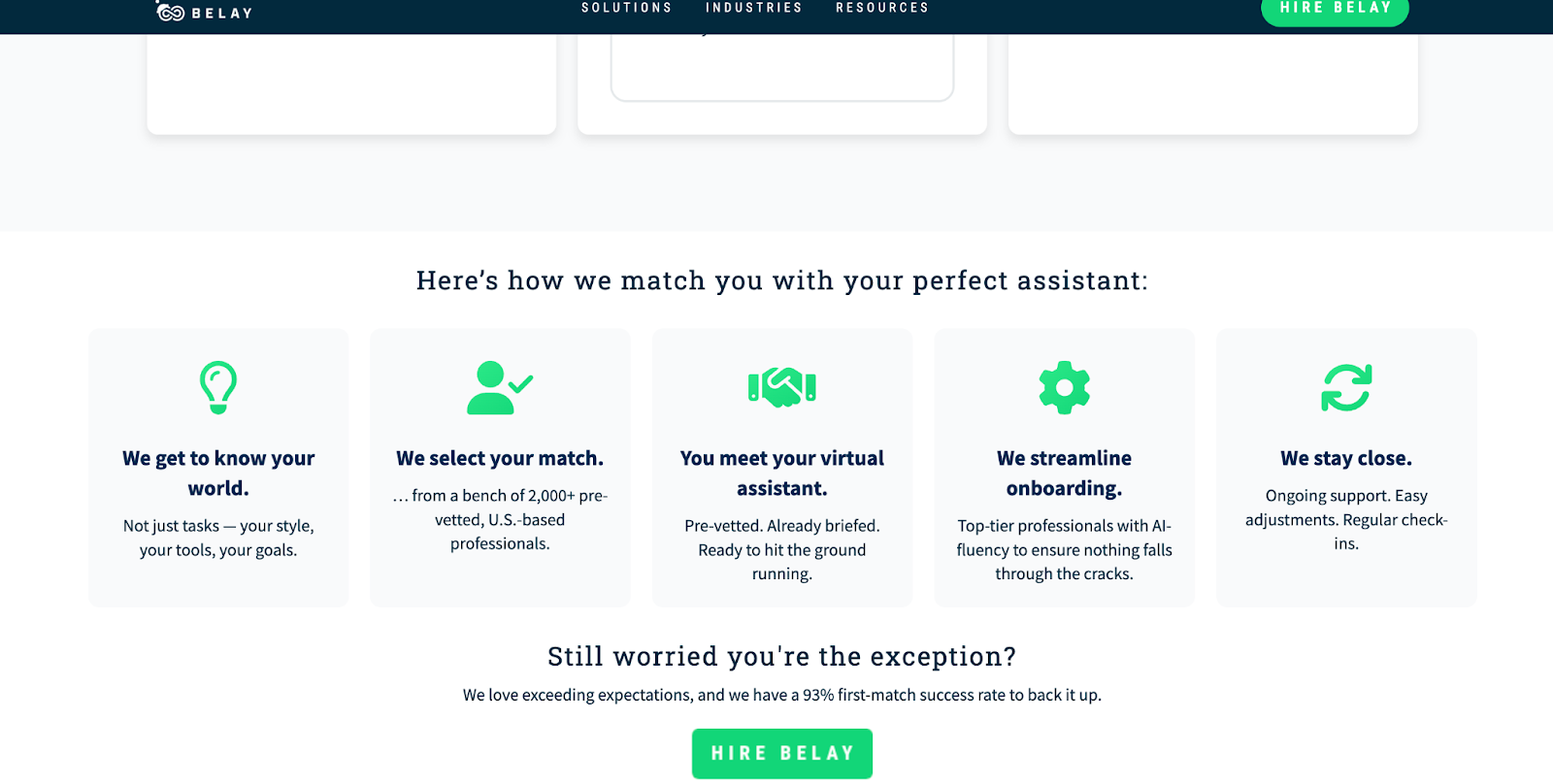
Image source: belaysolutions.com
BELAY focuses on the U.S.-based executive assistants, bookkeeping and social media support with strong process orientation. Founded in 2010, they serve over 2,000 clients primarily in the SMB market with a rigorous 3% acceptance rate for contractors.
Service portfolio: Virtual executive assistants for calendar and project management, virtual bookkeepers for QuickBooks and expense tracking, social media assistants for content and engagement, website content writers for blogs and SEO.
Investment levels: Executive Assistant $1,350/month (30 hours), Bookkeeper $990/month (20 hours), Social Media $1,050/month (25 hours), all including backup coverage and client success management.
Best for established businesses preferring domestic talent for sensitive tasks and requiring integrated bookkeeping capabilities.
3. Boldly
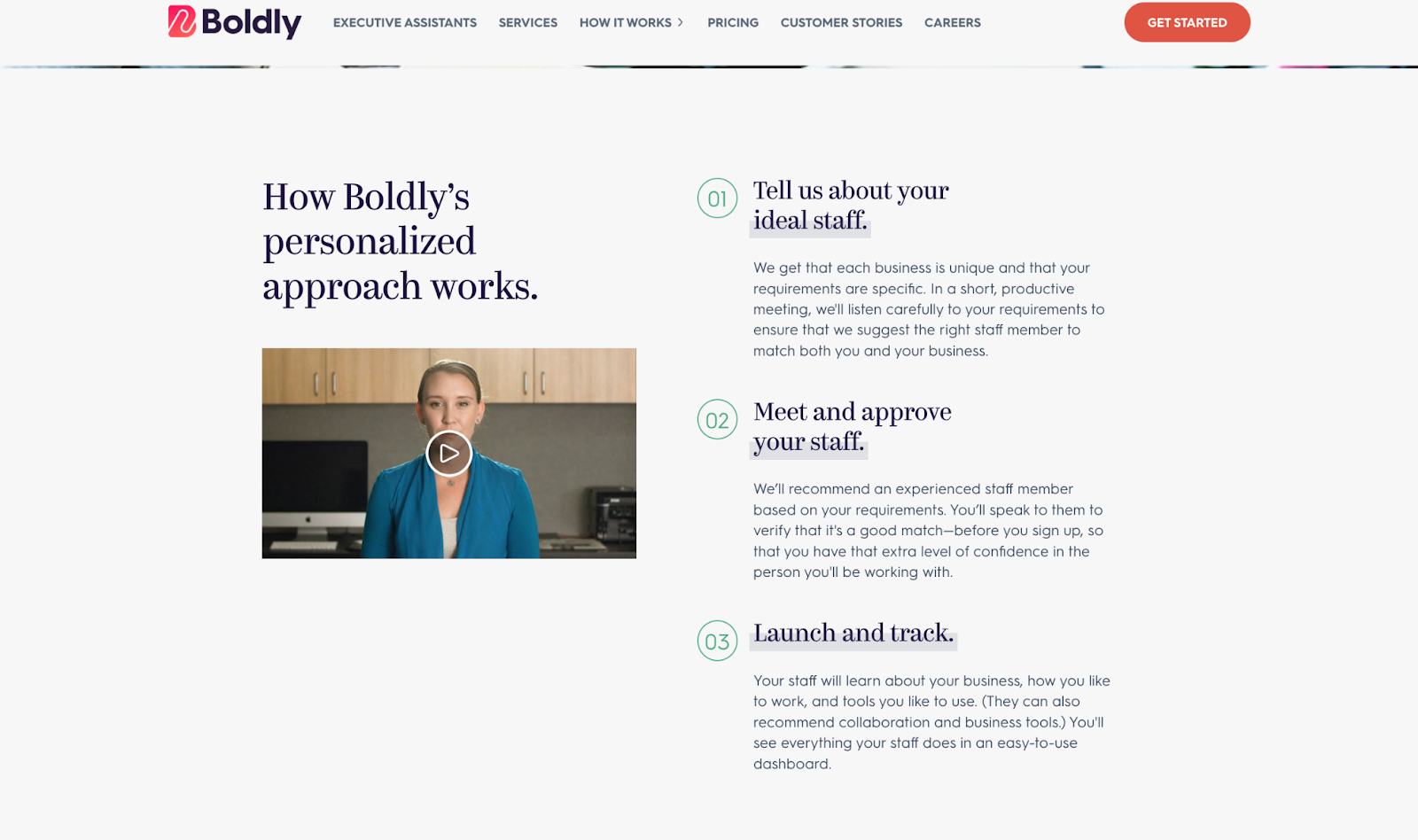
Image source: boldly.com
Boldly provides premium fractional professionals for EA, marketing and project roles. Average assistant tenure exceeds 3 years, providing exceptional continuity for complex long-term projects.
Professional categories: Executive assistants for C-level support, marketing assistants for campaign management and analytics, project coordinators for cross-functional initiatives, customer success managers for retention strategies.
Premium pricing: $1,350-2,400 monthly (25-35 hours) with 6-month minimum commitments. College-educated professionals with 5+ years specialized experience undergo personality assessments, skills testing and client interviews.
Best for founders wanting senior stable support several days weekly. Build clear deliverables backlog before engagement starts.
4. Prialto
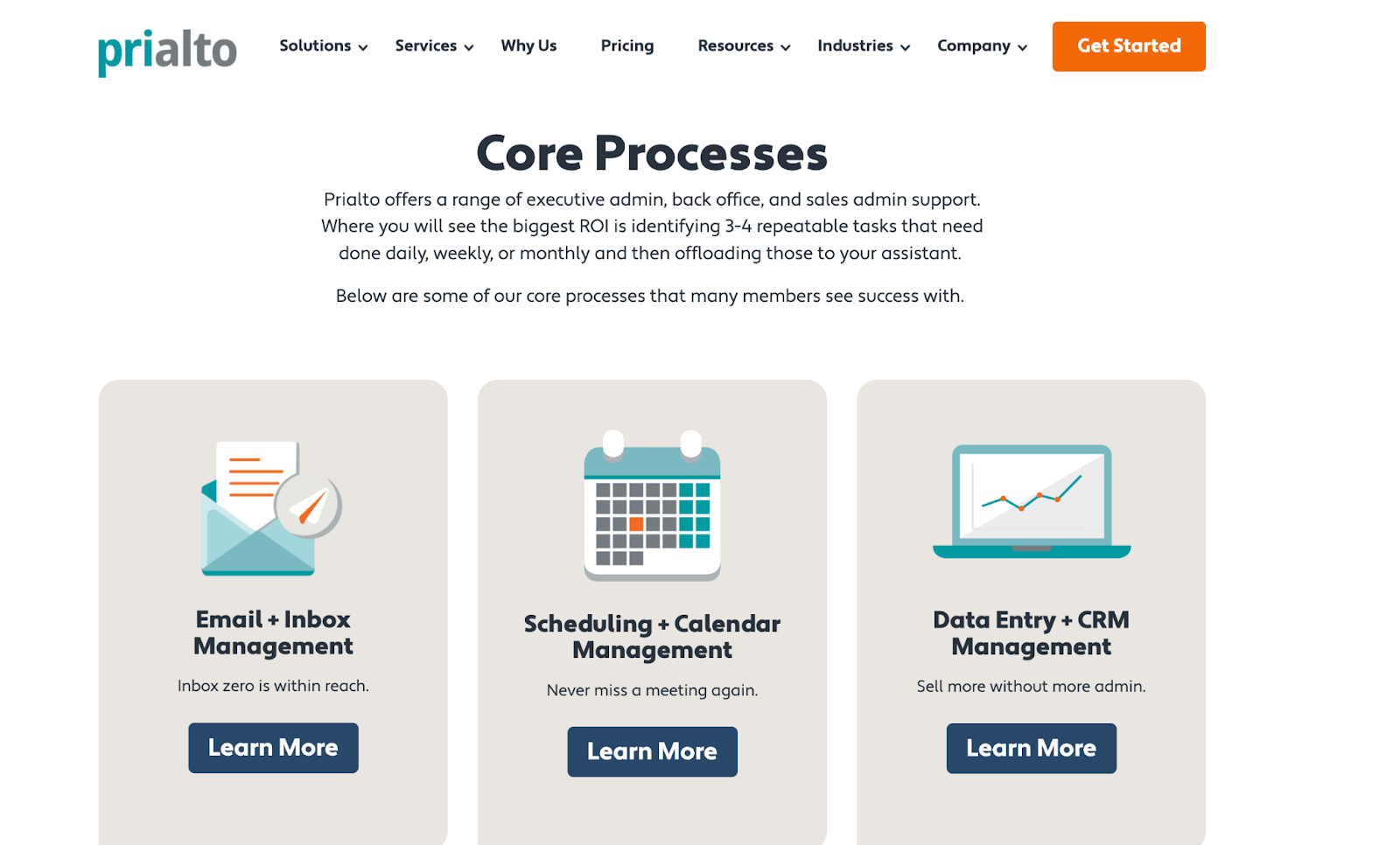
Image source: prialto.com
Prialto uses innovative team-based models with U.S. engagement managers and offshore execution teams providing 24/5 coverage with built-in redundancy.
Team structure: 3-4 assistants per client account, standardized workflows, quality checklists and proprietary task management systems with real-time progress tracking and detailed analytics.
Service tiers: Starter $1,200/month (35 hours), Professional $1,800/month (50 hours), Enterprise $2,500/month (75 hours) with custom packages for larger volumes.
Best for sales teams and busy executives wanting managed quality assurance and comprehensive coverage. Align SOP granularity early to avoid over-processing simple tasks.
5. Double
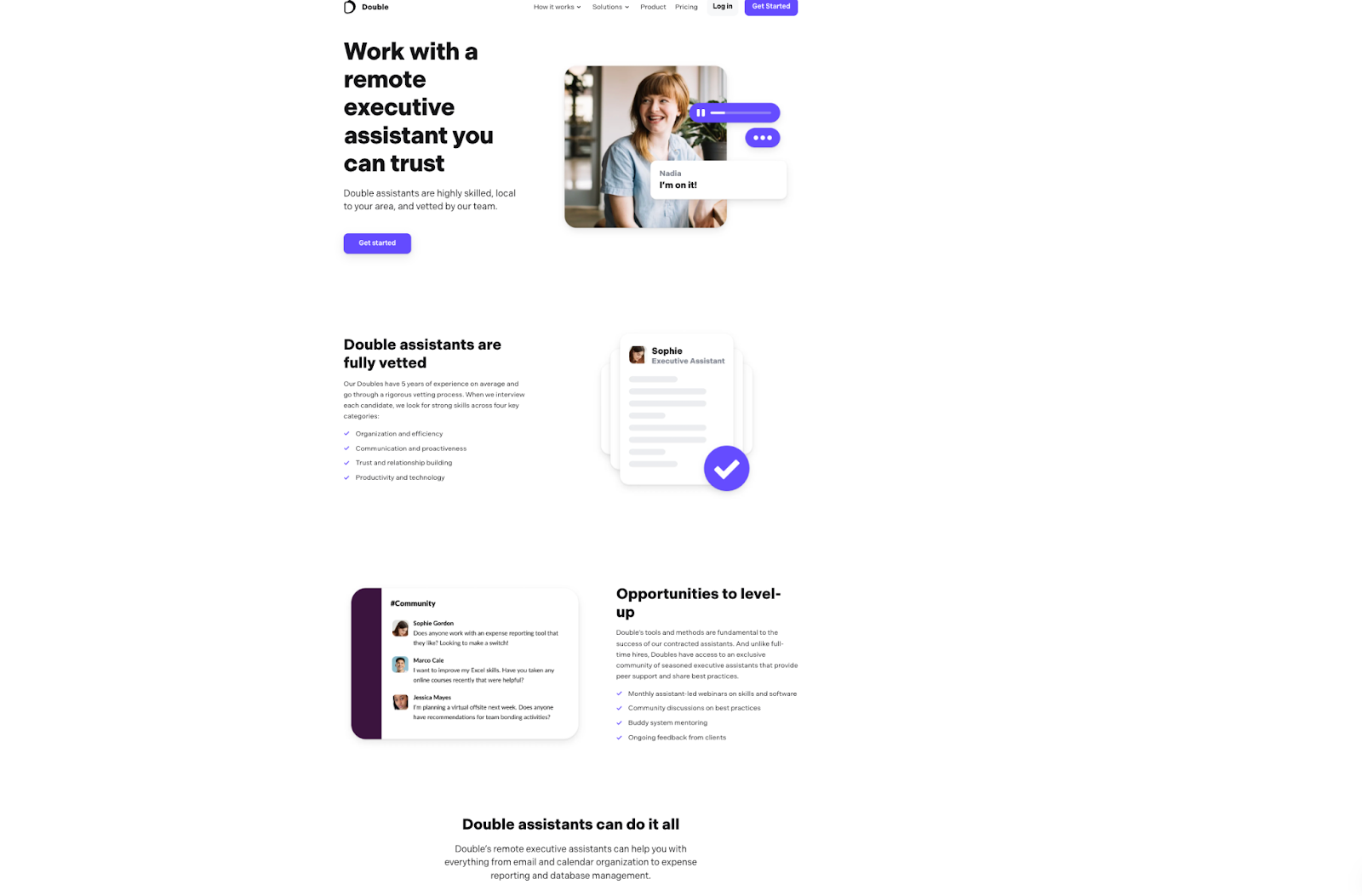
Image source: withdouble.com
Double emphasizes executive workflows with modern delegation apps and streamlined user experience for high-frequency delegators.
Platform innovation: Mobile-first task delegation, AI-powered categorization, real-time collaboration tools, calendar optimization algorithms, expense management integration and travel booking systems.
Service delivery: U.S.-based executive assistants averaging 7+ years experience with 4-hour response times and same-day completion for routine tasks.
Pricing tiers: Essential $1,399/month (30 hours), Professional $1,899/month (45 hours), Executive $2,499/month (65 hours) including platform access and mobile applications.
Best for technology executives and venture partners wanting intuitive platforms and rapid turnaround. Set weekly time budgets and guard against scope creep beyond EA functions.
6. Time etc
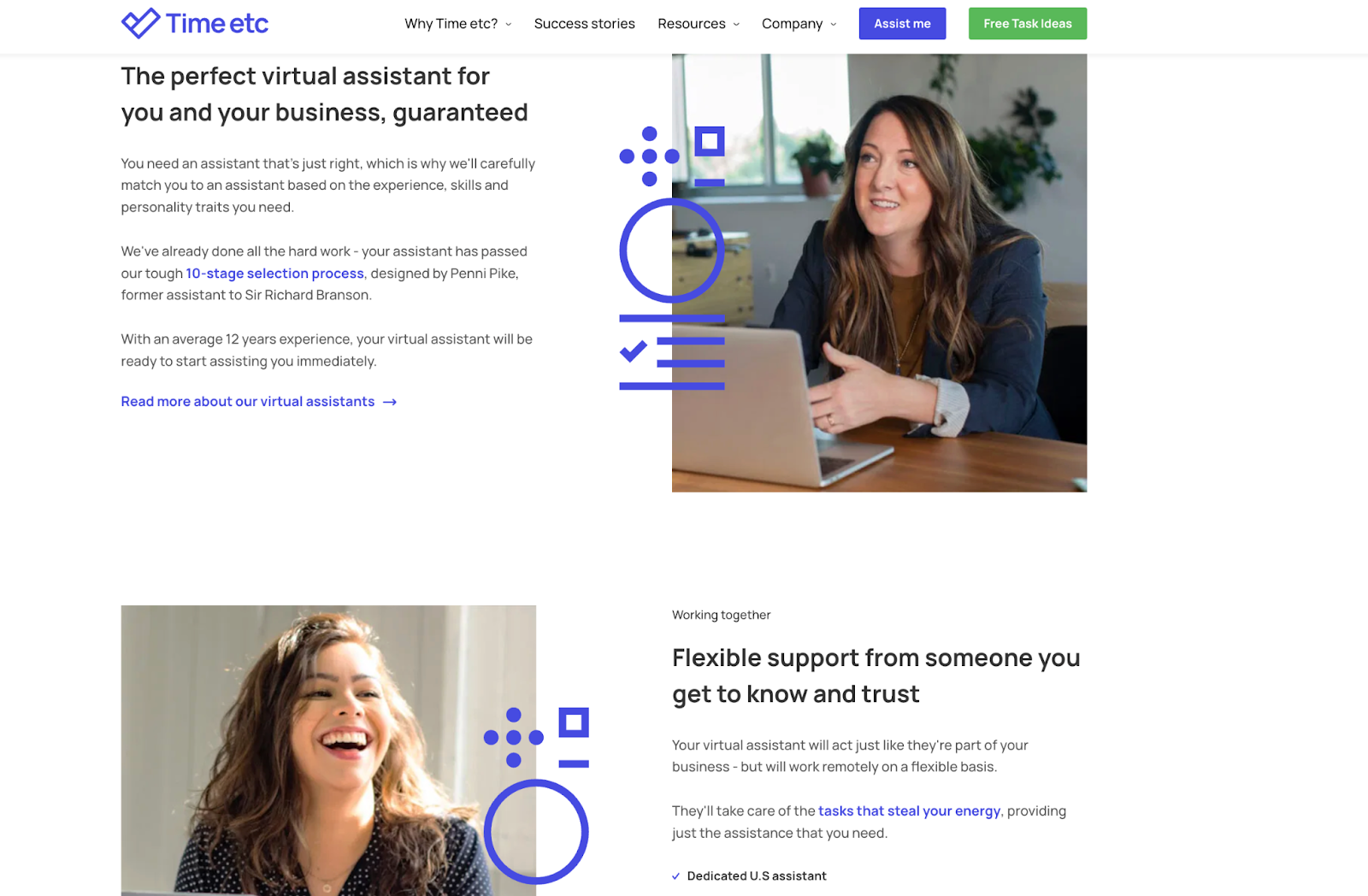
Image source: timeetc.com
Time etc offers maximum flexibility through task-based billing with no long-term commitments and mixed U.S./international talent pools.
Flexible structure: Pool of generalist assistants, task-based billing in 1-hour minimum blocks, 24-hour completion guarantees and 90-day hour rollover policies.
Pricing options: Pay-as-you-go $18-24/hour or monthly packages from $240 (10 hours) to $760 (40 hours) with no setup fees or minimum commitments.
Best for variable workloads and strict budget control. Document comprehensive SOPs early for continuity across different assistants.
7. Hello Rache
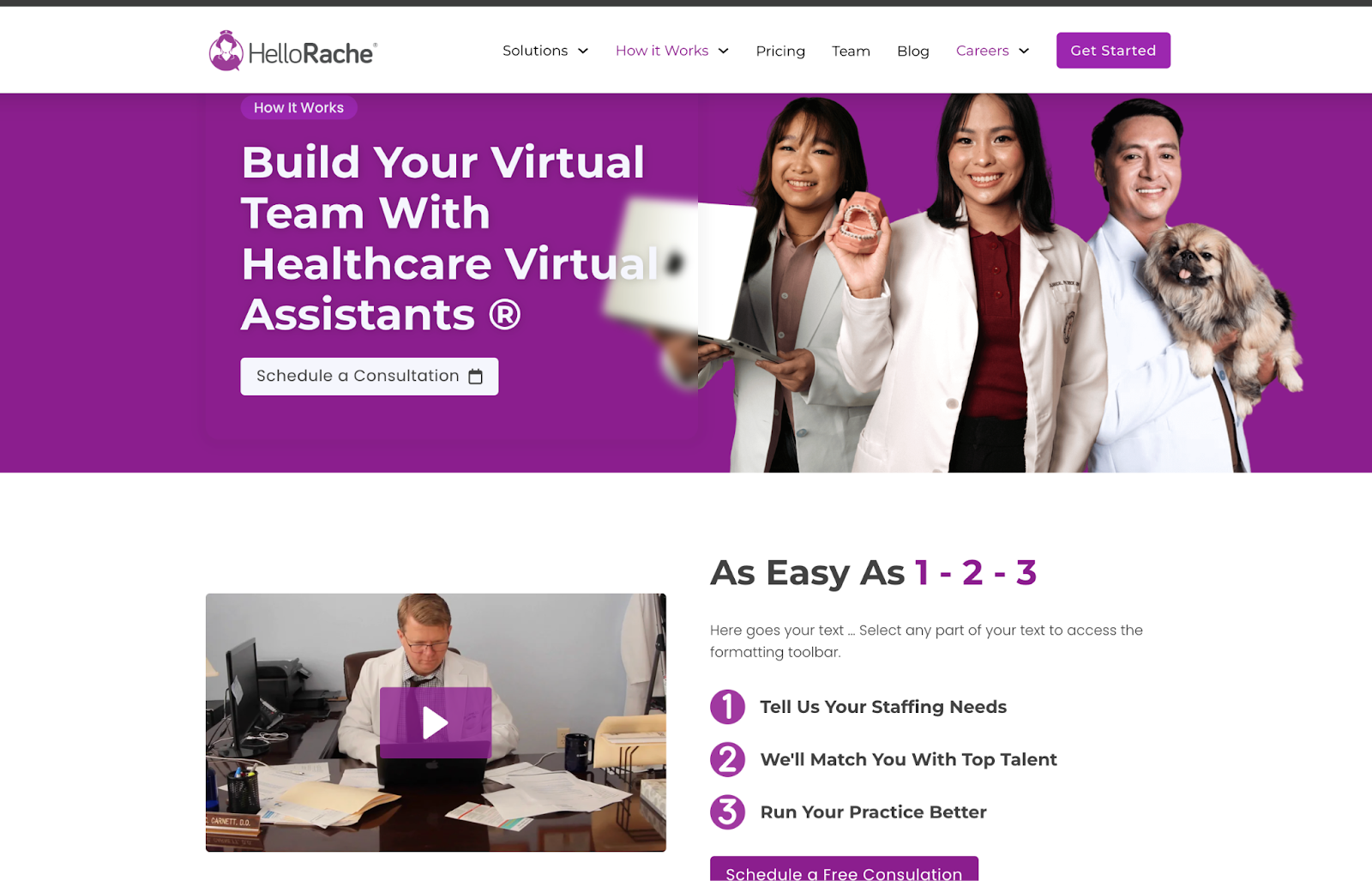
Image source: hellorache.com
Hello Rache specializes in HIPAA-compliant healthcare administration and patient communication with healthcare-trained staff and compliance infrastructure.
Healthcare focus: Patient scheduling, insurance verification, medical scribing, telehealth support, care coordination and billing support with EMR/EHR integration and practice management compatibility.
Compliance features: Business Associate Agreements, encrypted communications, secure file sharing, access controls, audit trails and continuous compliance monitoring.
Pricing structure: Medical Assistant $899/month (20 hours), Medical Scribe $1,299/month (30 hours), Practice Administrator $1,599/month (35 hours) with custom multi-provider packages.
Best for healthcare practices requiring specialized compliance. Confirm HIPAA processes, BAAs and minimum necessary access to protected health information.
Run a practical 90-day onboarding blueprint
Ninety focused days embed virtual assistants into workflows and prove value through systematic integration.
Days 1-7: Set technical access, define role charter, create SOP skeletons and assign 5-10 sample tasks with clear completion criteria. Establish weekly cadence, escalation paths and communication protocols in your workspace.
Days 8-30: Set weekly OKRs, standardize routines, add quality assurance checklists. Track cycle times and SLA hit rates. Document successful procedures immediately and refine processes based on early feedback.
Days 31-90: Expand to Tier 2 tasks, create macros and templates, add light automation for recurring work and finalize vacation coverage plans. Run quarterly business reviews and maintain stop-doing lists to reclaim valuable hours.
Focus on measurable outcomes, clear communication protocols and gradual responsibility expansion. Most properly onboarded VAs prove ROI within 60 days when given structured processes and clear expectations for success.
Conclusion
Virtual assistants have evolved from basic administrative support to sophisticated business enablement services. The seven providers reviewed offer distinct approaches, with Wing Assistant leading due to its comprehensive managed service model, competitive pricing and strong client retention rates.
Success depends on clear process documentation, realistic expectations and systematic onboarding. Most businesses see positive ROI within 60-90 days when they match the right provider to their specific workflow needs.
The key lies in treating the relationship as a strategic partnership rather than a vendor transaction. Start with documented processes for 10-20 hours weekly, establish measurable success criteria and follow the 90-day implementation blueprint for systematic integration.
Whether choosing premium providers like Boldly for senior support or flexible solutions like Time etc for variable workloads, the fundamentals remain constant: clear communication, documented processes and realistic expectations drive results. Virtual assistants represent one of the most accessible paths to operational scaling without traditional hiring risks and costs.
Choose a provider that aligns with your management style, budget constraints and growth trajectory. Businesses implementing VA programs thoughtfully today will have significant competitive advantages as the market evolves toward more flexible, distributed workforce models.
FAQs
How much does a virtual assistant cost?
$699-$2,500 monthly depending on hours and expertise. This represents 60-85% savings vs. full-time staff.
What tasks should I not give to a virtual assistant?
Avoid regulatory compliance, strategic decisions, confidential HR matters or high-trust financial work. Stick to repeatable, process-driven tasks.
How long does it take to see ROI from a virtual assistant?
Most VAs prove ROI within 60 days with 25-40% faster task completion after the ramp period.
What's the difference between dedicated and pool-based virtual assistants?
Dedicated VAs work exclusively with you for higher quality. Pool-based VAs rotate among clients for lower costs.
Do I need special software to work with a virtual assistant?
Most providers integrate with tools like Salesforce, HubSpot and Microsoft 365. Ensure compatibility with your current software.
How do I maintain quality control with a remote virtual assistant?
Use clear SOPs, regular check-ins, performance dashboards and choose providers with customer success managers.
Related reading
Table of contents
Start using Lark today

Manage all your work in one place
Boost team efficiency by 10x
Save up to 70% on software costs
Table of contents
Start using Lark today
Manage all your work in one place
Boost team efficiency by 10x
Save up to 70% on software costs
Keep reading







2026 Lark Technologies Pte. Ltd.
Headquartered in Singapore with offices worldwide.






Explore: