














Lark Base AI Tops TableBench Leaderboard

Jessica O
Content Lead
Nov 3, 2026
Jessica O
Nov 3, 2026

3 min read
Add to preferred sources


Lark Base AI has ranked first on the latest TableBench leaderboard, an international benchmark that evaluates table-based data Q&A against real business scenarios.
This means Lark Base AI now leads the industry in retrieving, calculating, analyzing, and drawing insights from business data, helping users get deeper, more accurate, and more reliable insights from their data with less effort.
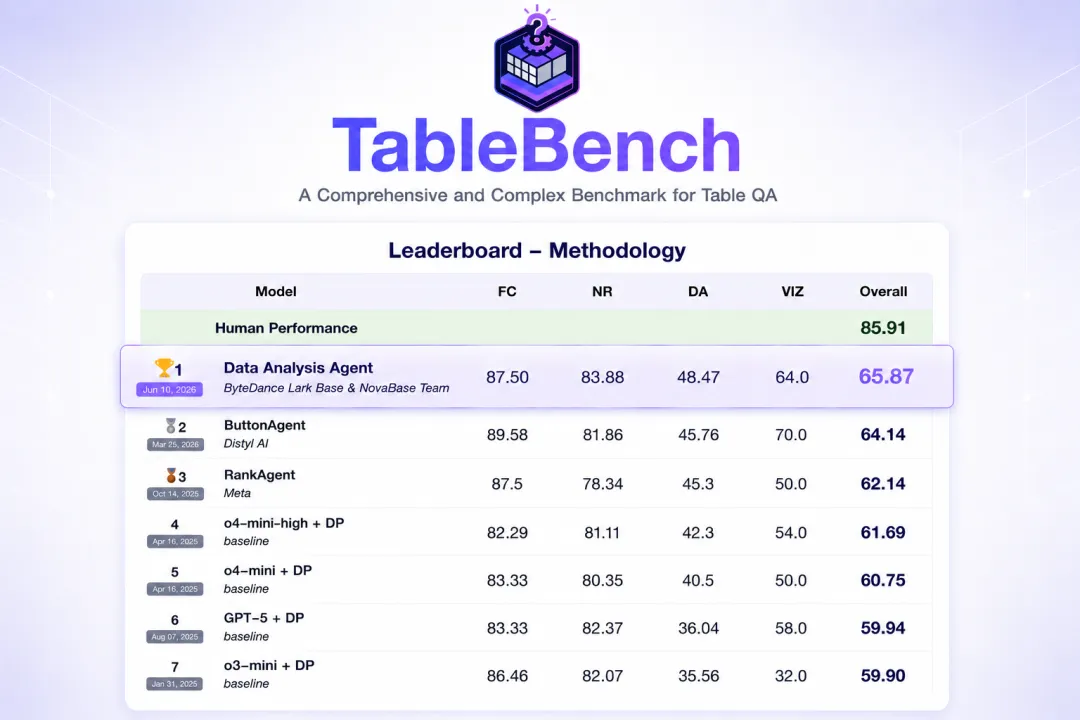

Ranking 1st on TableBench: From table data to usable insight
Questions about table data are rarely as simple as looking up a single value. They usually require filtering, calculation, comparison, and root-cause analysis before they turn into a conclusion the business can actually use.
That's the kind of reasoning TableBench is designed to test. It's a benchmark for table question answering in real business scenarios, covering four core capabilities: fact checking, numerical reasoning, data analysis, and visualization, across 18 specialized tasks and 886 test cases.
For enterprise users, these aren't abstract technical metrics. They're the real, day-to-day challenges of running the business. When sales numbers swing, how do you quickly pinpoint the cause? When a project falls behind, how do you spot the bottleneck at a glance? When inventory turnover looks off, how do you catch it early and back up the call with evidence?
In other words, TableBench doesn't just test whether an AI can read a table. It tests whether the AI can work through a complex table and reason its way to a clear business answer.
Ranking first means Lark Base AI can now handle real business tables with more accurate fact checking, numerical reasoning, data analysis, and visualization, giving users conclusions they can actually act on.
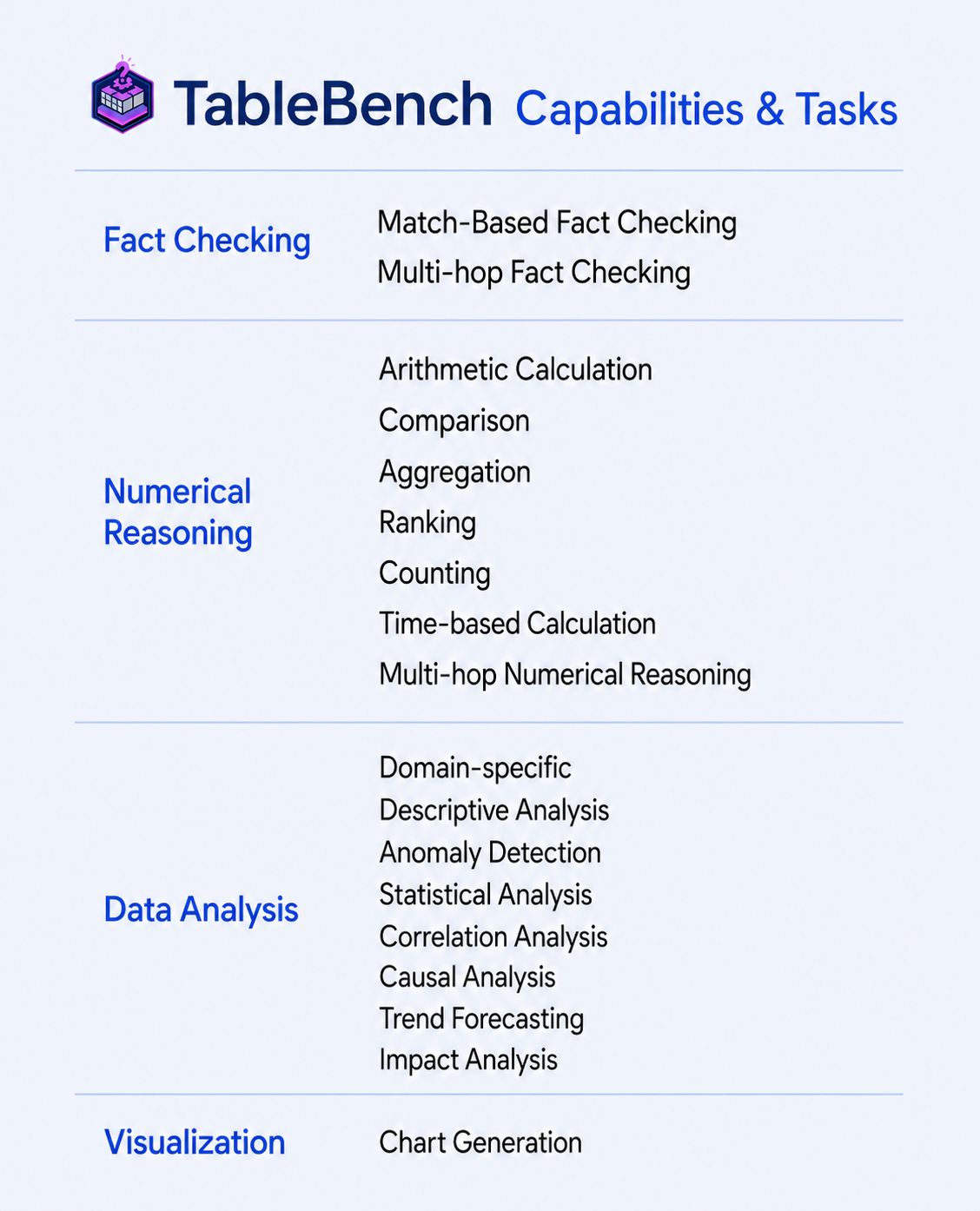

Lark Base AI: Making data analysis more accessible
A lot of an organization's most important data already lives in tables: sales records, payment tracking, inventory details, project schedules, department performance, customer follow-ups. This data updates daily. But actually figuring out what's going on used to mean knowing formulas, filters, and pivot tables, or asking a data analyst for help.
Now, inside Lark Base, users can just ask the AI a question in plain language. For example:
Find products with three straight months of declining sales and inventory turnover over 30 days.
Compare this year's Q1 to last year's Q4, and show the five fastest-growing categories by total sales, profit, and growth rate.
Calculate the total confirmed payments received in November 2025, excluding refunds and voided records, and summarize the result in RMB.
Based on annual performance data across 12 departments: calculate each employee's average score, then weight it by region to get an overall average, then convert that to a final rating out of 5.
Looking at follower growth rate, average engagement rate, conversion rate, and goal completion rate together, identify what the top 5 performing creators have in common.
The AI works from the real data in the table to retrieve, calculate, compare, and analyze, and shows both the reasoning process and the conclusion.
For business teams, this means not needing to master complex data tools first. Teams can move faster: spot a problem in the data, find the cause, and make the next call.
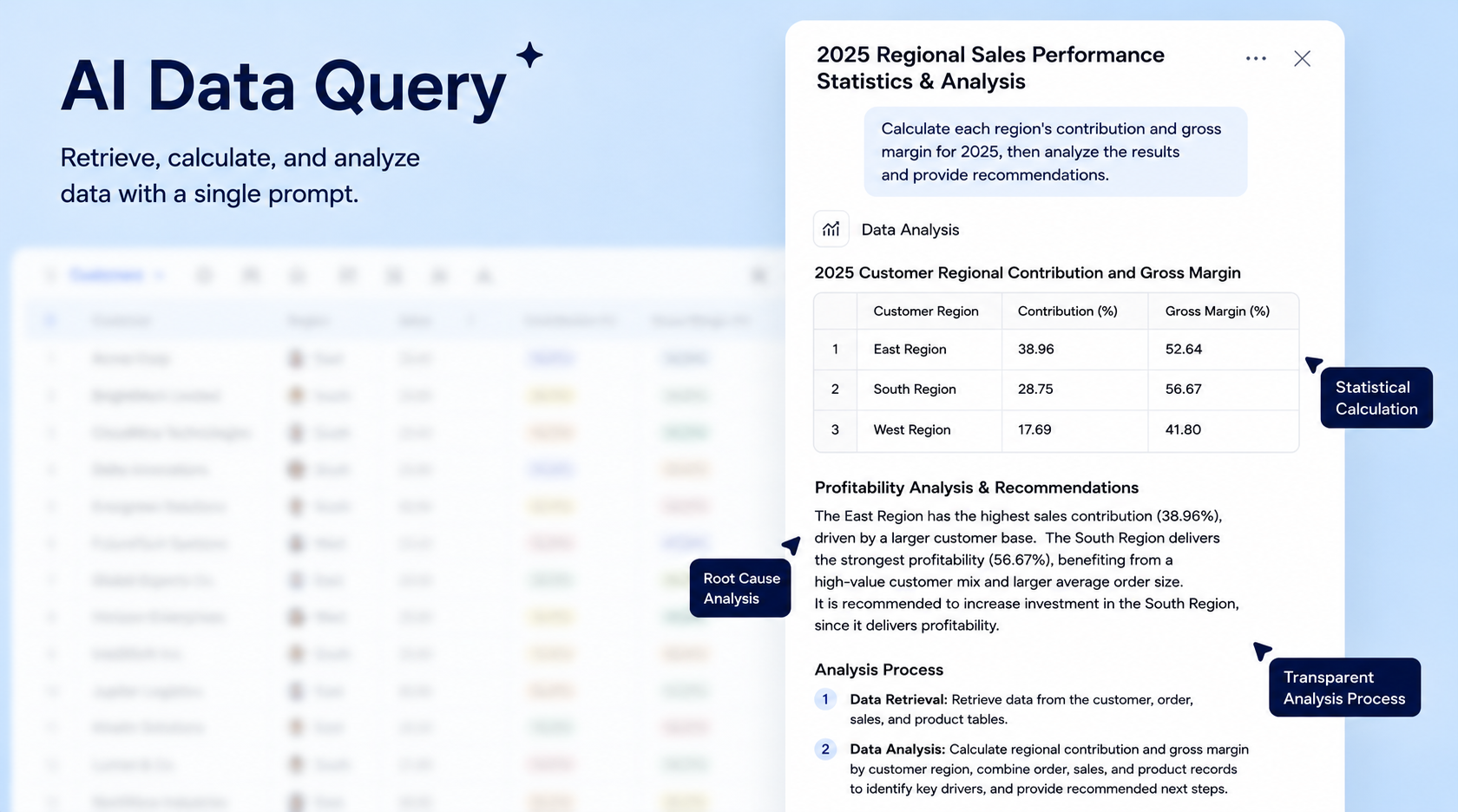

Bringing business data to life
Lark Base has long been the operational foundation for teams: leads, orders, projects, inventory, goals, timelines. Information that used to be scattered across different places gets managed in one place, with a clear flow between it all.
Now Lark Base AI takes it a step further. The AI works directly with an organization's business structure and system data, making data analysis something anyone can use. When a question comes up, there's no need to wait for an expert or a report. Teams can understand the data and get the numbers as things happen, and move naturally to the next decision.

Table of contents
Start using Lark today

Manage all your work in one place
Boost team efficiency by 10x
Save up to 70% on software costs
Table of contents
Start using Lark today
Manage all your work in one place
Boost team efficiency by 10x
Save up to 70% on software costs
Keep reading


When Anyone Can Be the One Who Fixes It
People who had never written a line of code. Teams whose jobs had nothing to do with technology. But when Mr D.I.Y. asked its employees "what would you fix if you could?", 33 teams across 14 departments built real, working solutions. What happened next quietly changed how an entire organization thinks about innovation.



2026 Lark Technologies Pte. Ltd.
Headquartered in Singapore with offices worldwide.






Explore: