Managing projects today involves balancing deadlines, distributed teams, evolving requirements, and constant communication demands. Organizations are increasingly relying on modern PM tools and techniques to maintain clarity, improve execution, and monitor progress across complex workflows. While many teams begin with standalone task trackers or documentation platforms, integrated workspaces are gradually changing how projects are planned and delivered. Solutions like Lark are helping teams connect communication, automation, and project tracking in a single environment, reducing tool fragmentation. This blog explores leading project management tools and techniques, practical methodologies, and proven strategies that help organizations streamline project execution and improve team collaboration.
What are project management tools?
Project management tools are digital or procedural solutions designed to help teams plan, execute, monitor, and complete projects efficiently. These platforms provide structured environments for coordinating tasks, deadlines, resources, and communication workflows. Businesses use PM tools and techniques to improve visibility, reduce operational risk, and support collaborative decision-making throughout .
Modern project management organization tools combine multiple functions such as scheduling, task tracking, reporting, and communication. Many platforms also support project management tools to track progress through dashboards, , and analytics. Teams looking for project management tools and techniques PDF resources often seek standardized frameworks that explain best practices and implementation strategies.
Understanding how to use project management tools effectively allows teams to improve productivity and streamline project delivery. Organizations frequently adopt different project management techniques to adapt workflows based on project complexity, team structure, and industry requirements.
Key capabilities of project management tools and techniques
Modern PM tools and techniques provide a combination of planning, execution, and monitoring features that help organizations manage projects efficiently. Understanding these capabilities helps teams select project management organization tools that align with operational needs. The following capabilities represent the most valuable features businesses evaluate when selecting Project management tools to track progress.
- Task and : Project management platforms allow teams to create tasks, assign responsibilities, and monitor project workflows. These features help teams break large projects into manageable activities. Strong task management supports accountability and improves execution clarity. Many project management concepts and techniques rely on structured task tracking to improve productivity.
- Collaboration and communication support: Modern tools combine messaging, document sharing, and real-time updates within . This ensures stakeholders remain aligned across departments and time zones. Collaboration capabilities help teams reduce communication delays and improve coordination. Understanding how to use project management tools effectively often depends on strong communication integration.
- Reporting and progress tracking: Reporting dashboards provide real-time insights into project status, risks, and performance metrics. These analytics help managers identify bottlenecks and optimize workflows. Project management tools to track progress and improve decision-making through visual data reporting. Teams can monitor deadlines, budgets, and deliverables more accurately.
- Automation and workflow optimization: Automation tools reduce repetitive administrative tasks such as notifications and approvals. These features support different project management techniques by improving efficiency and reducing human error. Automated workflows help teams maintain consistency across projects. Automation also improves scalability for growing organisations.
- Resource and capacity planning: Resource planning tools help organizations monitor team workload and availability. These capabilities support workforce optimization and prevent resource conflicts. Effective capacity planning ensures projects remain achievable within timeline constraints. Project management organization tools rely on resource tracking to improve operational efficiency.
Explore unified project execution with a modern choice
22 tools and techniques supporting project management
1. Gantt charts
Gantt charts provide a visual timeline that maps out task durations, overlapping schedules, and critical dependencies. They are among the most to track progress because they allow managers to see the entire project lifecycle at a glance. By identifying which tasks are linked, teams can better coordinate resources and adjust deadlines in real-time to avoid costly bottlenecks or scheduling conflicts during execution.
2. Work Breakdown Structure (WBS)
The WBS involves deconstructing a complex project into smaller, more manageable deliverables. This is a foundational method that ensures every aspect of the project scope is accounted for and organized. Breaking down the project into granular work packages makes it significantly easier for leads to assign specific responsibilities, estimate accurate budgets, and establish realistic timelines for each phase of the project lifecycle.
3. Cost Breakdown Structure (CBS)
A Cost Breakdown Structure (CBS) organizes the project budget into specific categories linked directly to the work packages defined in your WBS. This helps financial controllers and spending at a highly granular level throughout the project. Integrating a detailed CBS into your daily workflow is a practical way to use project management tools to prevent budget overruns and allocate financial resources efficiently.
4. Resource Breakdown Structure (RBS)
The is a hierarchical list of all resources—including personnel, specialized tools, and raw materials—required to complete a job. It helps project leads identify potential resource shortages or overall location before they impact the master's schedule. Many teams reference standardized templates for these lists, ensuring that no critical resource is overlooked during the initial planning phase or when assessing long-term capacity.
5. Project network diagrams
These diagrams use boxes and arrows to illustrate the logical sequence of project activities. They are excellent visual aids because they highlight which tasks act as "bottlenecks" for the rest of the team. Understanding these visual flows is essential for identifying the most efficient path to completion and managing the intricate dependencies that often exist in large-scale organizational projects or complex engineering tasks.
6. Kanban boards
use visual columns such as "To Do," "In Progress," and "Done" to categorize work by its current state. They are popular organizational tools because they provide instant clarity on task status for every team member. This method focuses on limiting work-in-progress, helping teams maintain a steady, predictable flow, and preventing individuals from becoming overwhelmed by too many simultaneous tasks.
7. Risk register
A risk register is a living document used to identify, evaluate, and mitigate potential project threats throughout the execution phase. It is a core principle that encourages proactive planning rather than reactive firefighting when issues inevitably arise. Most modern digital platforms now allow teams to flag and track these risks directly within their primary task views, improving visibility and enabling faster stakeholder communication during crises.
8. Risk matrix
The risk matrix helps teams prioritize potential issues by plotting the statistical likelihood of an event against its potential project impact. This makes it one of the most effective methods for allocating limited contingency funds or management attention. It ensures the project team stays focused on the most critical threats that could derail the project's success or cause significant delays.
9. Timesheets
Timesheets record the actual labor hours spent on specific project activities and individual tasks. While often used for payroll or client billing, they are also incredibly valuable for measuring overall team efficiency. Comparing the original estimated hours to the actual time spent helps managers refine their future planning and create more accurate labor estimates for upcoming initiatives and project bids based on historical performance.
10. Project dashboards
Project dashboards aggregate complex data into real-time charts and graphs to show a project's immediate health. They serve as central hubs for busy stakeholders who need a high-level summary of performance. Dashboards make it easy to monitor key performance indicators (KPIs), budget consumption, and major milestones without requiring the viewer to sift through individual task details or long, convoluted email chains.
11. Change log
A change log tracks every modification made to the original project plan, including scope shifts, timeline extensions, and budget adjustments. This is an essential practice for maintaining accountability and preventing the "scope creep" that often causes projects to fail. It ensures that every single change is properly documented, approved by stakeholders, and communicated clearly to the relevant parties performing the work on the ground.
12. Project reports
Formal reports provide structured, written updates on project status, overall performance, and emerging risks. These are primary communication vehicles for executive sponsors and external clients. Reliable, consistent reporting ensures that everyone—from the junior project team members to the CEO—is perfectly aligned on the current state of the deliverables and any major hurdles that may require senior leadership intervention or strategic shifts.
13. RACI chart
The RACI chart clarifies exactly who is responsible, accountable, consulted, and informed for every specific task in a project. By defining these vital roles early in the planning phase, organizations can use this method to eliminate confusion and overlapping efforts. It is a simple yet extremely powerful way to ensure clear ownership and faster decision-making across large, cross-functional teams and distributed departments.
14. RAID log
A RAID log captures Risks, Assumptions, Issues, and Dependencies in a single, centralized location. It is a comprehensive tool used by many project leaders to stay organized and informed throughout the entire project lifecycle. This specific log is a key part of broader project management concepts and techniques designed to anticipate hurdles and manage external dependencies before they have the chance to disrupt the primary workflow.
15. Agile project management
Agile is an iterative methodology focused on flexibility, speed, and the frequent delivery of small project increments. It is often cited as one of the most effective approaches for software development and creative industries. Agile relies on continuous feedback loops and short "sprints" to ensure the final product meets evolving user needs and rapidly changing market demands throughout the entire development process.
16. PERT (Program Evaluation and Review Technique)
PERT is a statistical method used to analyze the time required to complete each individual task within a complex project. It is a sophisticated analysis tool used to estimate project duration when high uncertainty is involved. This technique helps in creating more realistic schedules by calculating the "weighted average" of the most likely, optimistic, and pessimistic time estimates provided by experts.
17. Critical Path Method (CPM)
identifies the longest sequence of dependent tasks that must be completed exactly on time for the project to finish by its deadline. It is one of the most reliable ways to manage complex engineering, construction, or manufacturing projects. Focusing on the critical path ensures that limited resources are never diverted from the most time-sensitive activities that directly impact the final delivery date.
18. Cost-benefit analysis
This technique involves weighing the total projected costs of a project against its expected financial, operational, and strategic benefits. It is a vital analysis used during the initiation phase to justify the initial investment of time and money. A thorough analysis ensures that the organization only pursues projects that offer a clear positive return on investment or solve a significant business problem.
19. Earned value management (EVM)
Earned value management (EVM) provides a mathematical framework for measuring project performance by comparing planned work to actual progress and costs incurred. This is a highly objective performance metric for assessing whether a project is truly on track regarding both its budget and its schedule. It allows savvy managers to predict future performance and final costs based on current productivity trends and spending patterns.
20. Stakeholder mapping
Stakeholder mapping categorizes individuals and groups based on their level of influence and their interest in the project outcome. This is a key engagement strategy for ensuring effective communication and maintaining project buy-in. Mapping helps project leaders decide who needs daily technical updates, who requires high-level monthly summaries, and which groups need to be managed closely to ensure long-term success.
21. Feasibility study
A feasibility study is a preliminary evaluation designed to determine if a project is technically, legally, and financially viable before work begins. It is a critical step in the early lifecycle, helping teams avoid committing to projects that are destined for failure. This study identifies potential deal-breakers or major risks early on, helping the organization decide whether to proceed, pivot, or cancel.
22. Project pipeline management
involves overseeing a portfolio of multiple projects simultaneously to ensure they align with the company's broader strategic goals. It is an essential management layer for balancing human and financial resources across an entire department or organization. This high-level view helps leaders prioritize the most valuable projects while identifying underperforming projects that may need restructuring or cancellation.
Meet Lark: A unified workspace for project management, execution, and collaboration
redefines PM tools and techniques by merging with communication tools teams use daily. Instead of separating task execution from collaboration, Lark creates a connected environment where teams can plan, execute, and monitor projects simultaneously. Organizations that use project management tools to track progress benefit from centralized visibility into tasks, communication, and documentation.
Multi-view project bases
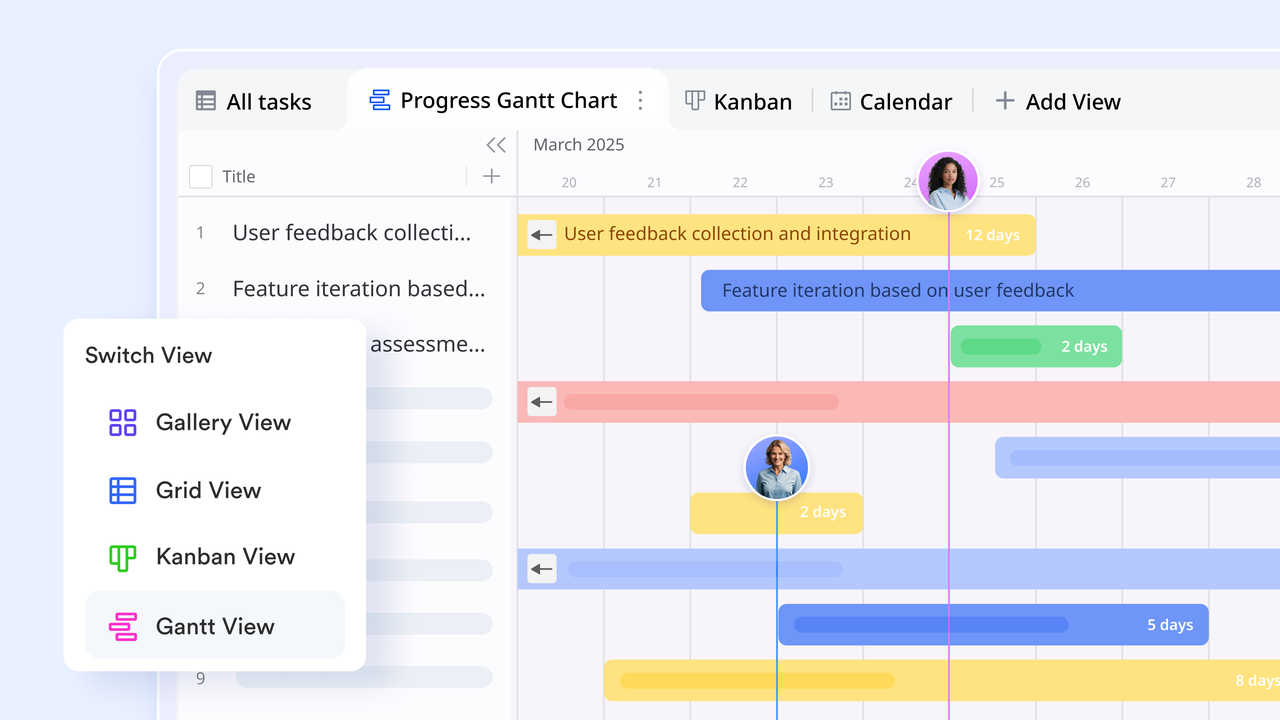
allows teams to organize project data using multiple visualization formats, including , Kanban boards, and table views. These visual formats support project management concepts and techniques by allowing managers to oversee long-term project timelines while enabling contributors to manage daily workflows efficiently within the same dataset.
Unified workflow automation
Lark Base automation removes the manual burden of project coordination. You can create custom triggers that send automatic status updates to chat groups or generate follow-up tasks when a is reached. By automating these repetitive administrative actions, your team can spend more time on execution and less on overhead. 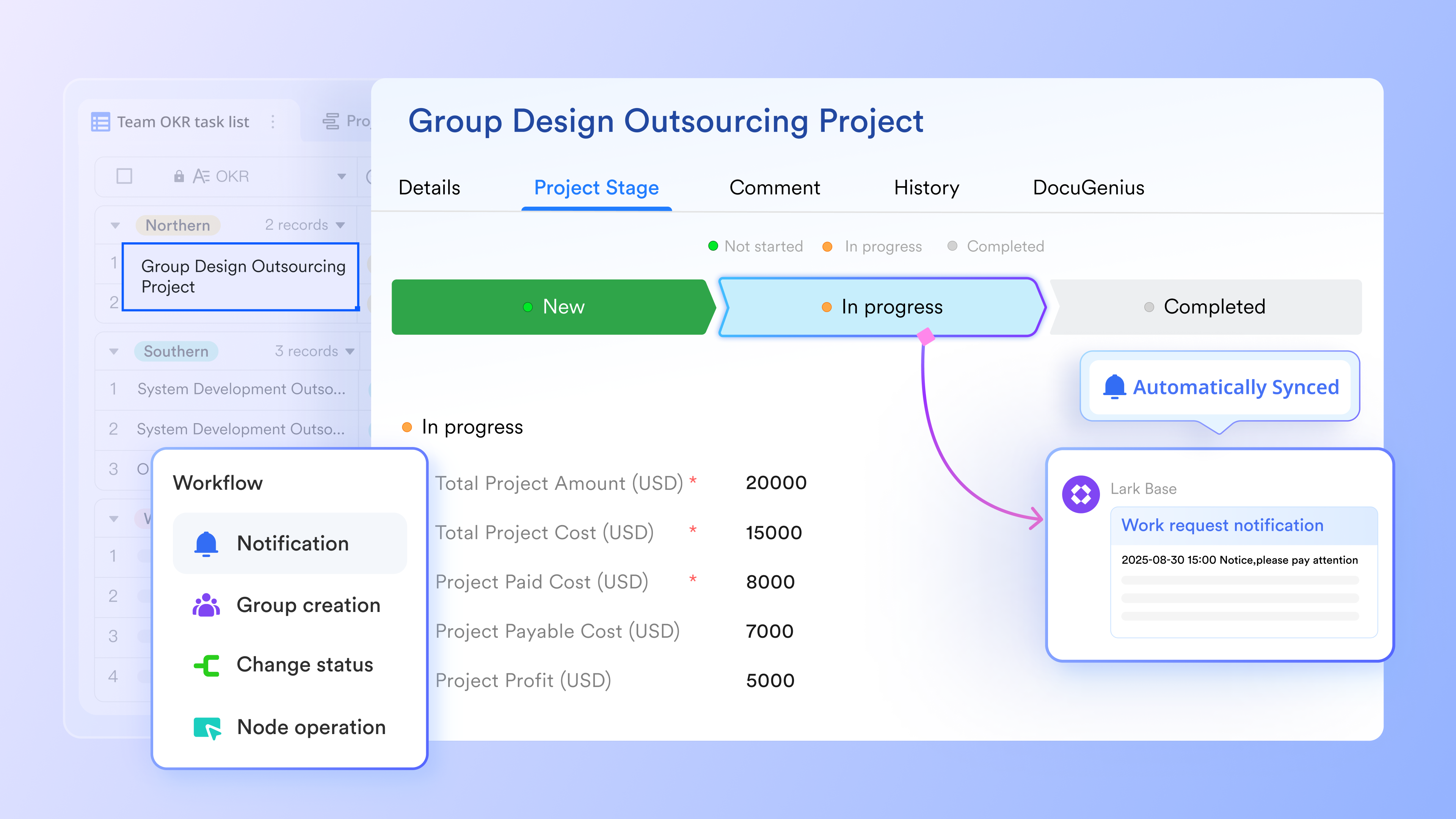
Collaborative project docs
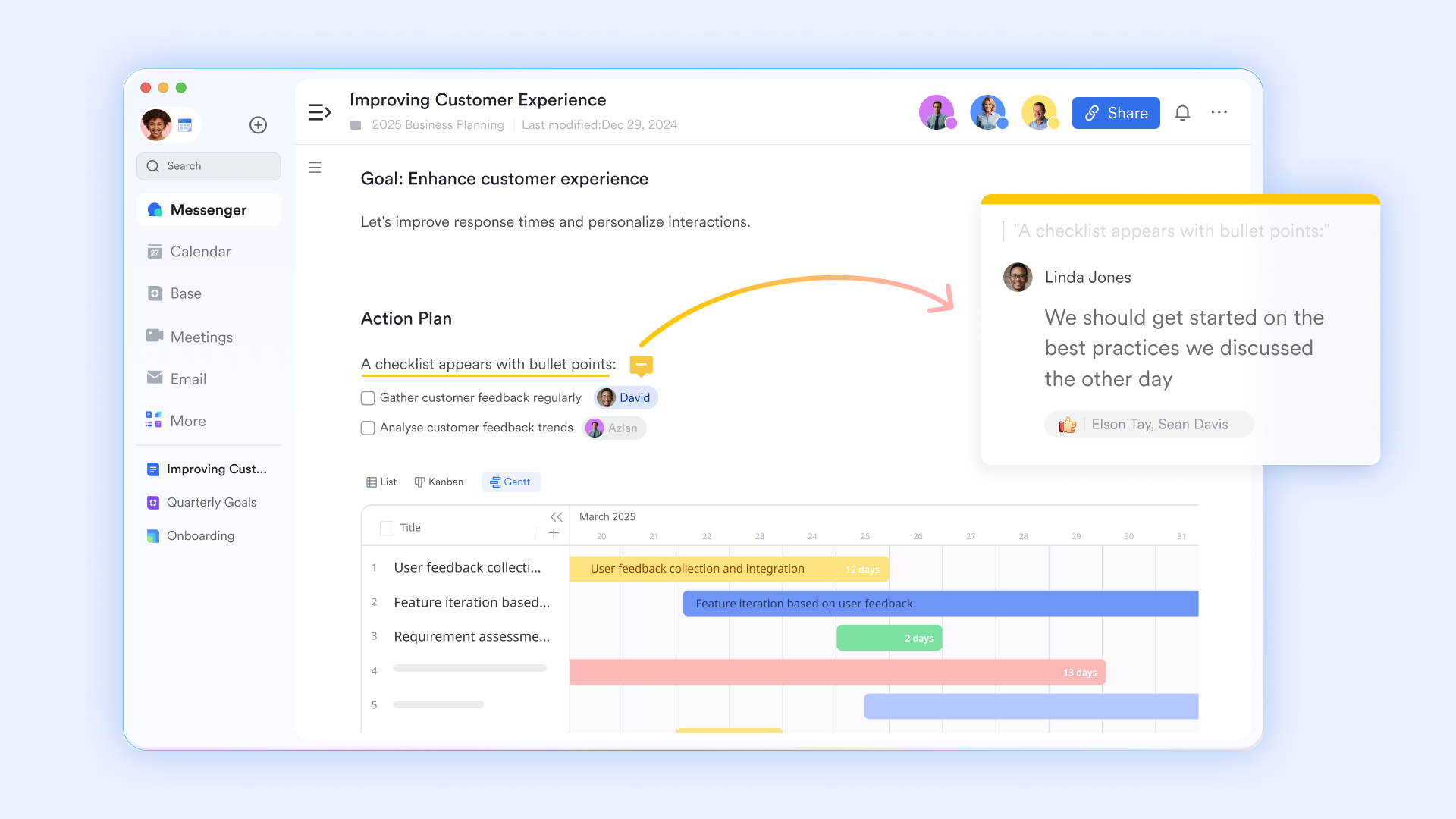
Unlike static spreadsheets, allow for real-time, interactive planning. You can embed live project tables directly into a brief, @mention teammates to assign responsibilities, and use unified polls for quick decision-making. This ensures that the project's strategy and its execution are always aligned within a single document.
Global Sprint coordination
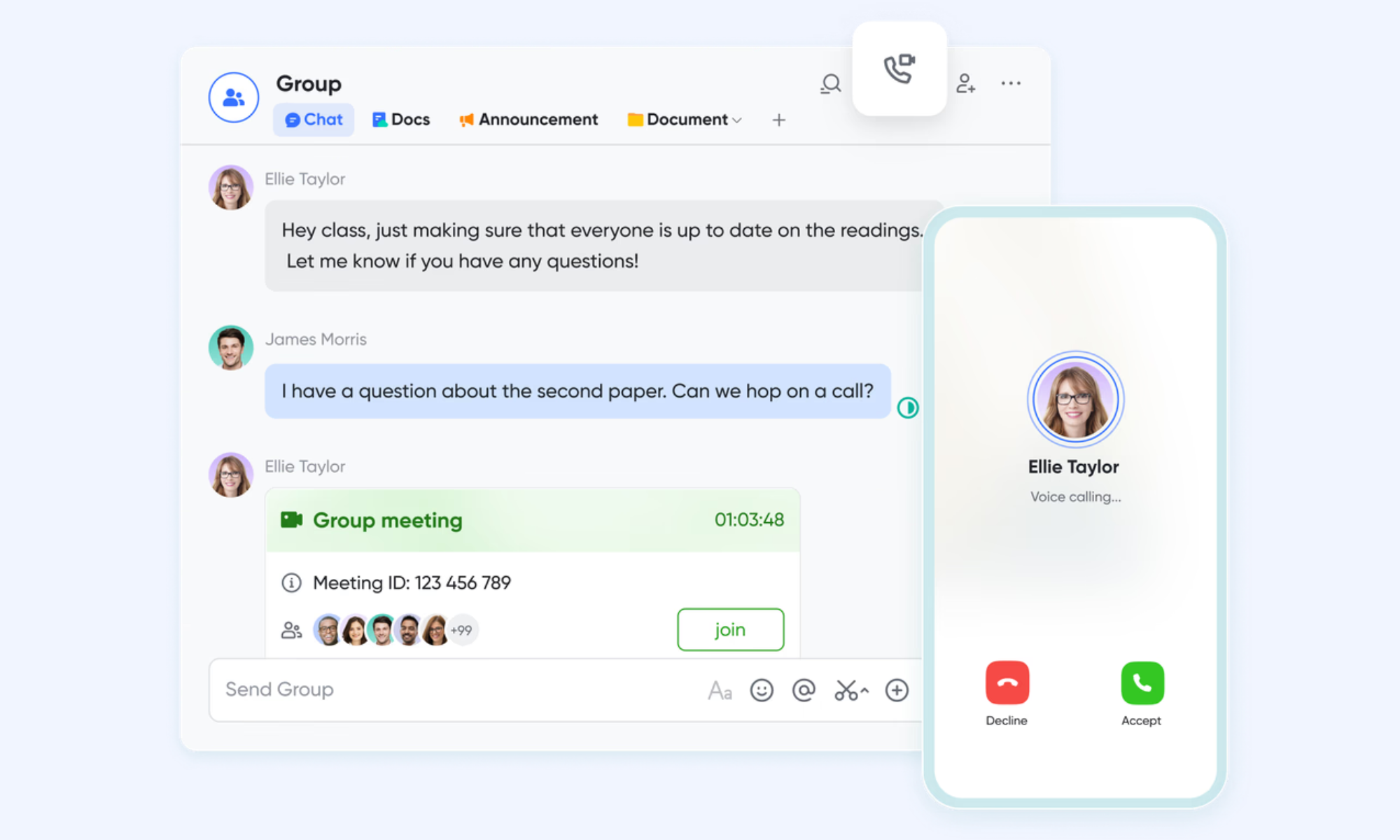
and support distributed Agile teams by enabling across locations. Teams can conduct stand-ups, sprint reviews, and planning sessions using built-in video conferencing with AI translation and live screen sharing. automatically captures meeting summaries and action items, helping teams track sprint decisions. These Lark tools allow global teams to maintain delivery speed while improving collaboration across language and geographic boundaries.
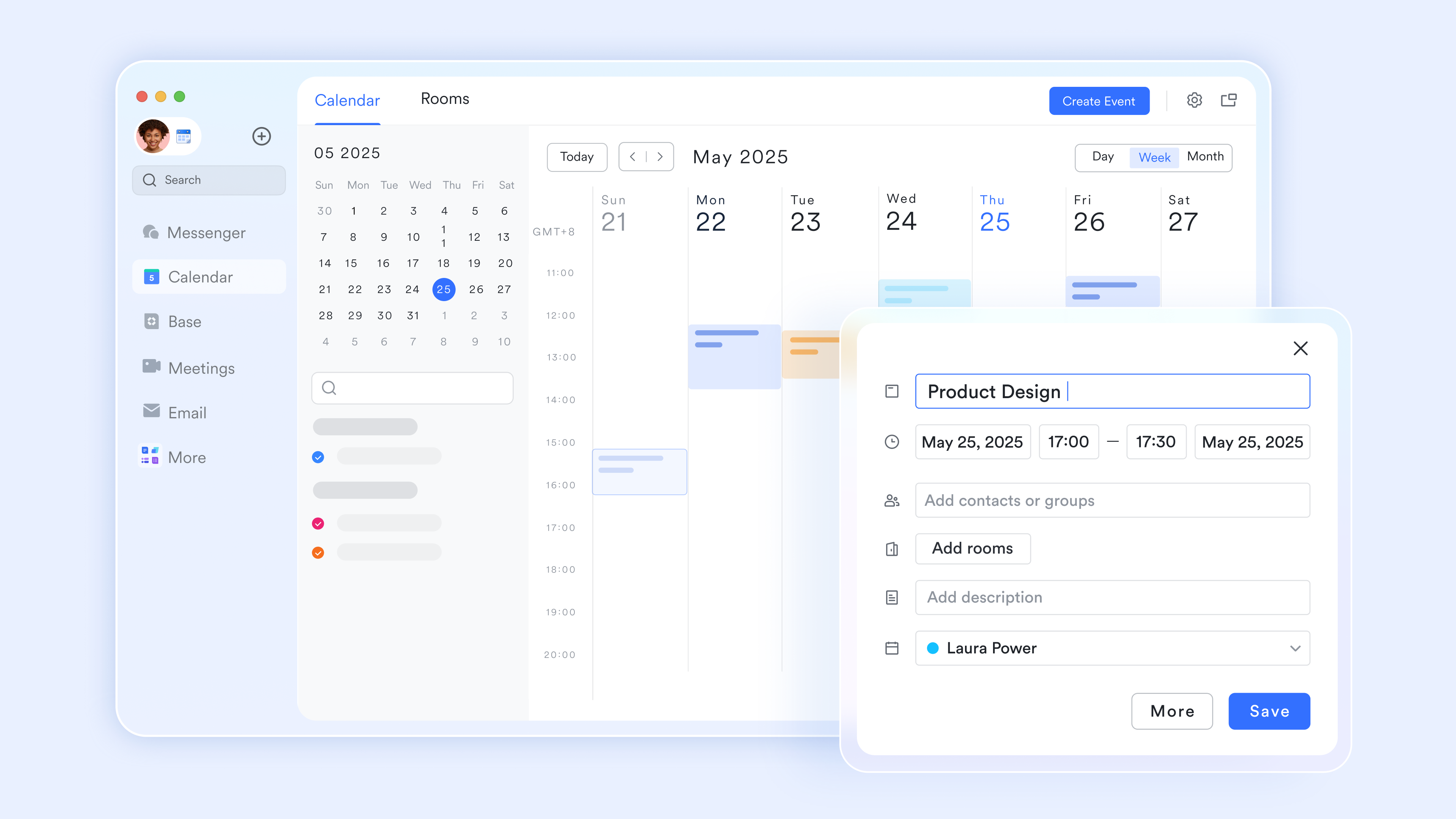
Smart resource calendars
Managing team bandwidth is simplified through the . Project leaders can overlay multiple to identify potential over-allocation or burnout before it happens. By seeing actual availability alongside task deadlines, you can assign resources more effectively and ensure that project timelines remain realistic and achievable.
:
- Starter plan: Free forever plan that includes 11 powerful tools for up to 20 users. It also comes with 100GB of storage, 1000 automation runs, AI translations, and more.
- Pro plan: $12/user/month (billed annually) for up to 500 users. It includes everything in Starter plus group calling for up to 500 attendees, 15TB of storage, 50,000 automation runs, and more.
- Enterprise plan: for custom pricing. Supports unlimited users and includes even more automation runs and advanced security, compliance, and management features.
For small teams with simple communication needs

18 months message history
1000 Base automation runs/month
2000 rows per table in Base
Most POPULAR
For companies with comprehensive collaboration and management needs
Unlimited message history
500-participant video meetings
50k Base automation runs/month
20k rows per table in Base
For large companies with advanced security and organizational management needs
Get a personalized demo and pricing
Unlimited message history
500-participant video meetings
15 TB storage + 30 GB storage/user
500k Base automation runs/month
50k Base automation runs/month
Most POPULAR
For companies with comprehensive collaboration and management needs
Unlimited message history
500-participant video meetings
50k Base automation runs/month
20k rows per table in Base
Choosing the right project management tools and techniques
Selecting the right PM tools and techniques requires evaluating project complexity, team structure, and organizational goals. Businesses must choose platforms that support workflow flexibility while improving project transparency. Understanding project management concepts and techniques helps teams align software selection with project requirements. The following factors help organizations determine the most suitable solution.
- Project complexity and workflow structure: Organizations managing complex projects require advanced scheduling, automation, and reporting tools. Simple projects may only require visual task tracking and communication features. Selecting project management tools to track progress should reflect workflow complexity and team coordination requirements. Matching tools with project structure improves efficiency and reduces operational friction.
- and communication needs: Teams working across departments or global locations require collaboration-driven solutions. Platforms that combine communication and execution workflows help reduce coordination delays. Understanding how to use project management tools depends on selecting systems that support real-time collaboration. Strong communication integration improves project transparency and stakeholder alignment.
- Scalability and long-term growth: Businesses should evaluate whether tools can support workforce expansion and project growth. Scalable project management organization tools help organizations avoid frequent system replacements. Solutions supporting automation and advanced reporting typically provide stronger scalability. Selecting scalable PM tools and techniques supports long-term operational efficiency.
- Integration and ecosystem compatibility: Organizations should choose tools that integrate with existing productivity and reporting systems. Integration support helps teams maintain workflow continuity across departments. Project management tools that connect with CRM, communication, and analytics platforms improve operational visibility. Strong integration capabilities help organizations streamline .
Conclusion
Organizations continue to face increasing complexity in managing distributed teams, evolving workflows, and growing project expectations. Modern PM tools and techniques help businesses improve execution efficiency, enhance collaboration, and support data-driven decision-making. Companies evaluating project management tools to track progress must prioritize solutions that combine , reporting, and communication capabilities.
Platforms such as demonstrate how unified workspaces can transform project execution by combining collaboration, planning, and automation within one environment. Teams adopting integrated solutions gain stronger visibility into project progress while improving stakeholder alignment. As project management continues to evolve, adopting scalable and intelligent tools helps businesses maintain productivity, improve delivery consistency, and support long-term organizational growth.
Improve execution and streamline workflows with Lark
FAQs
What are the 7 management planning tools?
The seven commonly recognized planning tools include flowcharts, check sheets, histograms, , scatter diagrams, control charts, and cause-and-effect diagrams. These tools support project management concepts and techniques by improving workflow analysis and quality management. Organizations often combine these methods with PM tools and techniques to improve decision-making and project monitoring.
What are the 5 C's of project management?
The 5 C's include communication, collaboration, coordination, control, and completion. These principles help teams manage project execution and stakeholder alignment. Businesses that use project management tools rely on these concepts to maintain workflow efficiency. Understanding these principles helps you use project management tools effectively and supports successful project delivery.
How do project management tools improve team productivity?
Project management tools improve productivity by organizing tasks, automating , and providing real-time visibility into project progress. Teams using project management tools to track progress can reduce manual coordination and improve accountability. These platforms also support collaboration by centralizing communication and documentation. Understanding how to use project management tools allows organizations to streamline workflows and reduce project delays.
What is the difference between Agile and traditional project management techniques?
Agile emphasizes iterative development, flexibility, and continuous feedback, while traditional approaches like Waterfall follow a structured, sequential execution model. Different project management techniques are selected based on project complexity and workflow requirements. Agile is commonly used in software and product development, while traditional methods are used in compliance-focused industries. Many organizations combine both approaches using PM tools and techniques to improve project adaptability and planning accuracy.
Related reading












