














Sales Management: Best Tools, Process & Strategies

Ryan Tanner
Product Marketing Specialist
Sep 18, 2026
Ryan Tanner
Sep 18, 2026

24 min read


Sales management is the backbone of every thriving organization. Whether you're running a small business or leading an enterprise sales force, having the right tools to manage people, performance, and pipelines makes all the difference. The right sales management software helps leaders plan territories, monitor KPIs, forecast revenue, and align teams toward shared targets. In this guide, we'll explore the 10 best sales management tools that redefine productivity and collaboration:
1. Lark: All-in-one sales collaboration and performance platform
2. Salesforce Sales Cloud: Industry-leading CRM and performance analytics
3. Xactly: Sales compensation and incentive optimization
4. Anaplan: Data-driven sales forecasting and planning
5. Oracle Sales Performance Management: Enterprise-grade incentive and forecasting system
6. Varicent: Revenue intelligence and planning suite
7. Performio: Transparent commission tracking and reporting
8. beqom: Unified performance and compensation management
9. Pipedrive: Visual pipeline CRM for SMBs
10. SAP Sales Cloud: Comprehensive enterprise sales platform

What is sales management?
Sales management is the process of planning, directing, and controlling a company's sales activities to achieve business goals. It involves setting quotas, managing pipelines, analyzing performance, and training teams for consistent results. Using sales management software or a CRM for sales management enables leaders to track leads, automate workflows, and monitor progress in real time.
Effective sales performance management also ensures transparency in incentives and goal achievement. With the right sales management system in place, businesses can streamline operations, boost accountability, and make data-driven decisions that drive sustainable growth and revenue success.
Image source: unsplash.com
The pillars of successful sales management
A strong sales management process is built on clear goals, consistent execution, and data-driven decision-making. Each pillar plays a critical role in aligning people, technology, and strategy to achieve peak performance. Modern sales management systems and CRM platforms empower teams to automate tasks, improve visibility, and enhance collaboration. Below are the key pillars that form the foundation of effective sales performance management.
- Goal & quota setting: Define clear revenue and activity targets using your sales management software. Quotas motivate teams and create measurable benchmarks for performance. With real-time dashboards, managers can track progress and adjust goals dynamically.
- Pipeline management: Monitor deals, conversion rates, and pipeline value through a unified sales pipeline management tool. This gives managers insight into bottlenecks and opportunities. Effective tracking helps boost forecasting accuracy and close rates.
- Territory & account planning: Use your sales management system to balance workloads and allocate resources efficiently. Smart territory planning improves coverage and minimizes overlap. Data-driven account assignments also increase sales potential in key markets.
- Performance analytics: Track metrics such as win rates, deal velocity, and quota attainment through sales performance management software. Analytics-driven insights enable managers to identify top performers and improvement areas. Visual dashboards help translate complex data into actionable strategies.
- Coaching & training: A successful sales team management approach includes continuous learning and mentorship. Use performance dashboards and CRM insights to tailor coaching sessions. Consistent training builds confidence, sharpens selling skills, and aligns teams with company goals.
- Process automation: Implement automation through your sales management CRM to eliminate manual tasks and approvals. Automated workflows improve response times, reduce errors, and enhance efficiency. This frees up sales reps to focus on relationship building and closing deals.
How technology transforms modern sales management
Digital innovation has revolutionized sales management, empowering teams with data-driven insights, seamless collaboration, and automated workflows. With the right sales management software, organizations can centralize information, eliminate silos, and accelerate decision-making.
Key benefits
- Better Visibility: Real-time dashboards in CRM sales management systems give leaders a complete view of the pipeline, performance metrics, and forecasts. This transparency helps identify bottlenecks early and improve conversion rates.
- Quicker Decisions: Automated reporting and AI insights enable managers to act fast on changing trends. Instant data access through sales management tools helps sales leaders respond to opportunities before competitors do.
- Improved Accountability: Sales performance management software tracks and assigns every activity, ensuring ownership and transparency. Clear audit trails make it easier to measure productivity and reward results.
Emerging tech trends
- AI-Driven Forecasting: Artificial intelligence enhances revenue predictions by analyzing patterns across deals and historical performance. This leads to more accurate quota planning and sales pipeline management.
- CRM Automation: Automation in sales management CRM systems eliminates repetitive data entry and approval delays. It also streamlines lead assignments, follow-ups, and task tracking for higher efficiency.
- Mobile Dashboards: Sales leaders can monitor KPIs and deal updates on the go. Mobile-first sales management platforms empower field teams with instant access to data and customer insights.
- Analytics-Driven Coaching: Modern sales performance management systems use analytics to guide personalized coaching. Managers can identify skill gaps, track progress, and tailor training programs for improved performance.
Let's explore the top sales management software platforms that bring these technologies together.
Top 10 sales management and performance tools
1. Lark: All-in-one sales collaboration and performance platform
High-performing sales teams move fast, stay tightly coordinated, and make informed decisions from a single source of truth. Lark provides a single workspace—combines communication, task management, dashboards, documents, and approvals, so reps and managers spend less time chasing information and more time closing deals. Below, we break down each core feature, explain what it does for sales, and show a practical example you can adopt immediately.
- Lark Base: Real-time pipeline databases and dashboards
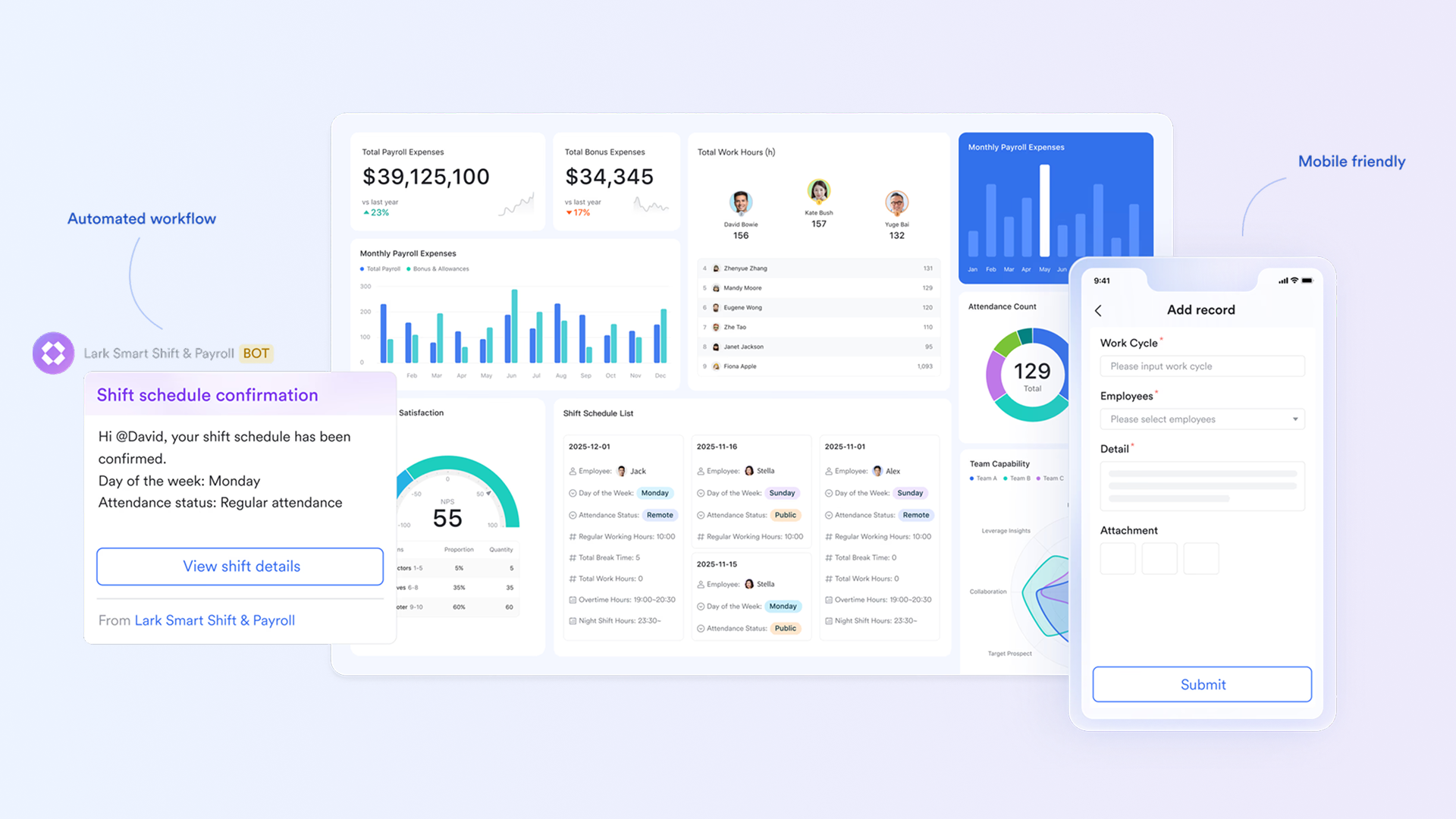
What it does: Lark Base is a flexible, visual database where you model your sales pipeline, accounts, and territory assignments. Use table views for a CRM-style list, Kanban for deal stages, and dashboards to surface KPIs (pipeline value, stage conversion, average deal age). You can also automate repetitive steps with rules—a prime use case for automated workflow (e.g., auto-assign, tag, or create tasks when conditions are met).
Why it matters for sales: One source of up-to-date deal data reduces double entry, prevents missed follow-ups, and gives managers an accurate real-time view of pipeline health.
- Lark Messenger: Contextual, fast decision-making chat
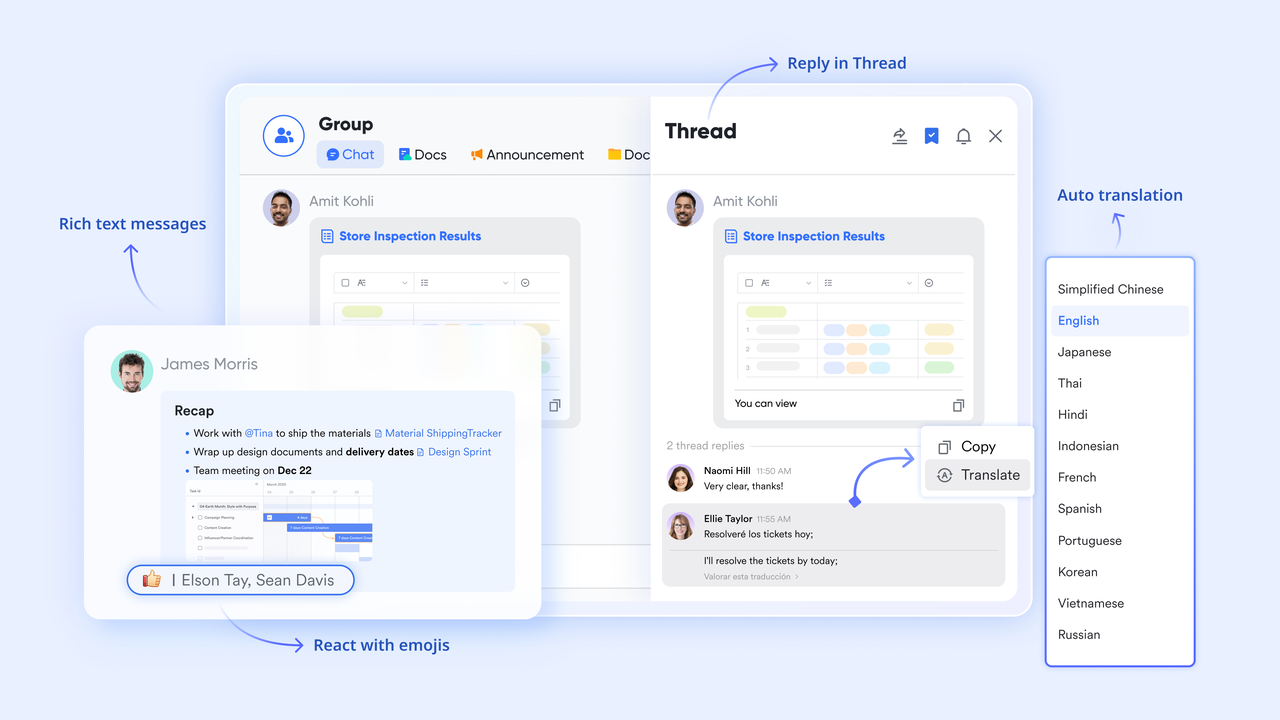
What it does: Lark Messenger connects teammates in topic channels, direct messages, and threaded conversations while letting you attach Docs, Sheets, or Base records directly into the chat. It also offers robust message management features, such as advanced search capabilities and the ability to pin essential threads, ensuring that critical information remains easily accessible and well-organized.
Why it matters for sales: Quick answers—product clarifications, pricing approvals, and client questions—often decide deals. Messenger removes lag from email and keeps the context next to the asset (proposal, PO, or contract).
- Lark Tasks: Convert pipeline movement into accountable action
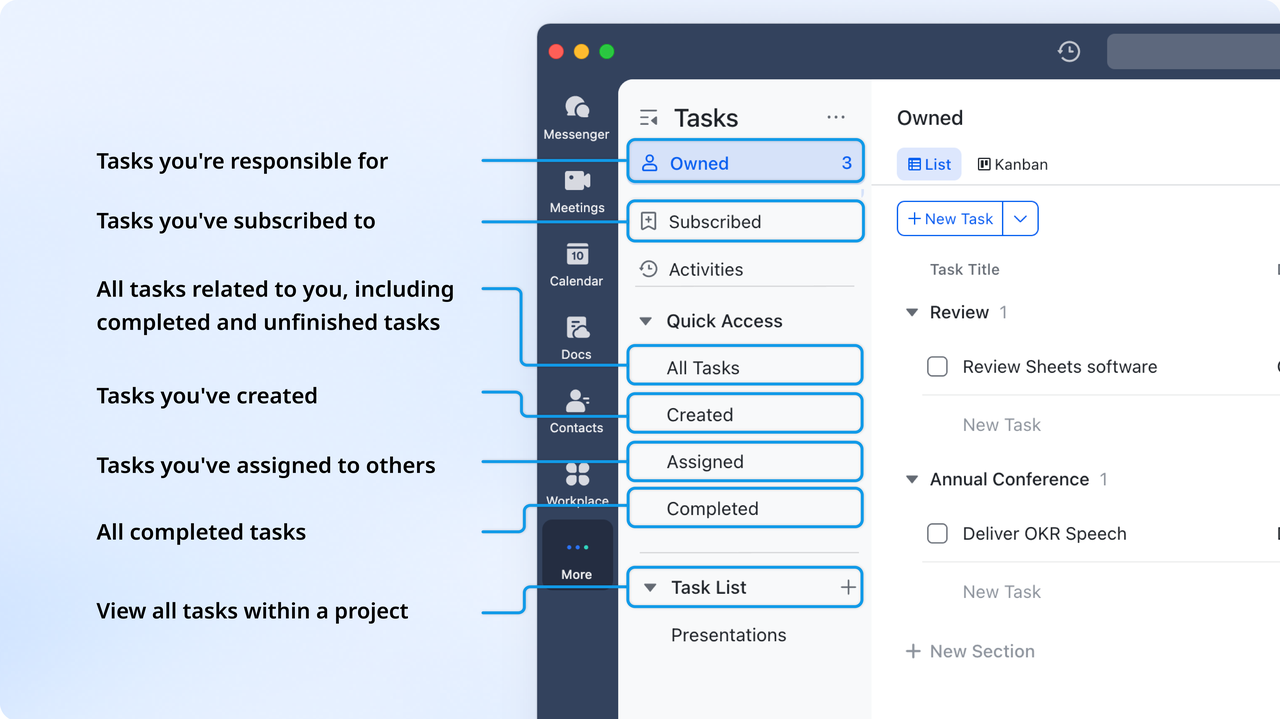
What it does: Lark Tasks turns actions into assignable, trackable items with due dates, priorities, and attachments. Via Base, the data can be viewed in multiple formats—list, Kanban board, timeline, or calendar—allowing teams to visualize progress in the way that suits them best. Each task can include attachments, subtasks, and comments, keeping all relevant context and discussions in one place.
Why it matters for sales: Tasks enforce discipline (demos scheduled, proposals followed up, contract signatures tracked). They create an auditable trail of who did what and when.
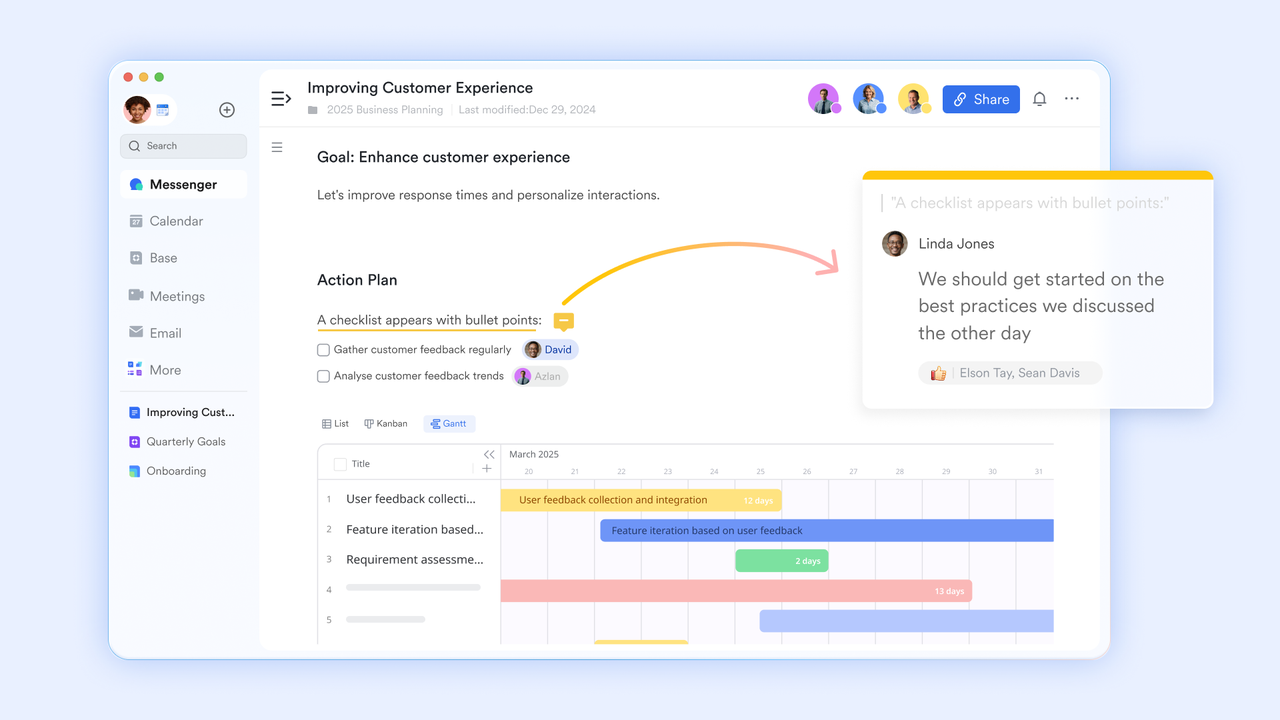
- Lark Docs & Lark Sheets: Collaborative proposals, forecasts, and territory plans
What it does: Lark Docs and Lark Sheets are live, multi-user files with comments, permissions, and version history. In Lark Docs, multiple users can edit simultaneously, leave comments, manage access permissions, and review version history to track changes or restore previous edits. Lark Sheets extends these capabilities to structured data, supporting powerful formulas, pivot tables, and charts for analysis and forecasting.
Why it matters for sales: Shared templates mean reps use consistent messaging; live forecasts let teams react mid-quarter; embedded Sheets in Base or meetings keep everyone on the same numbers.
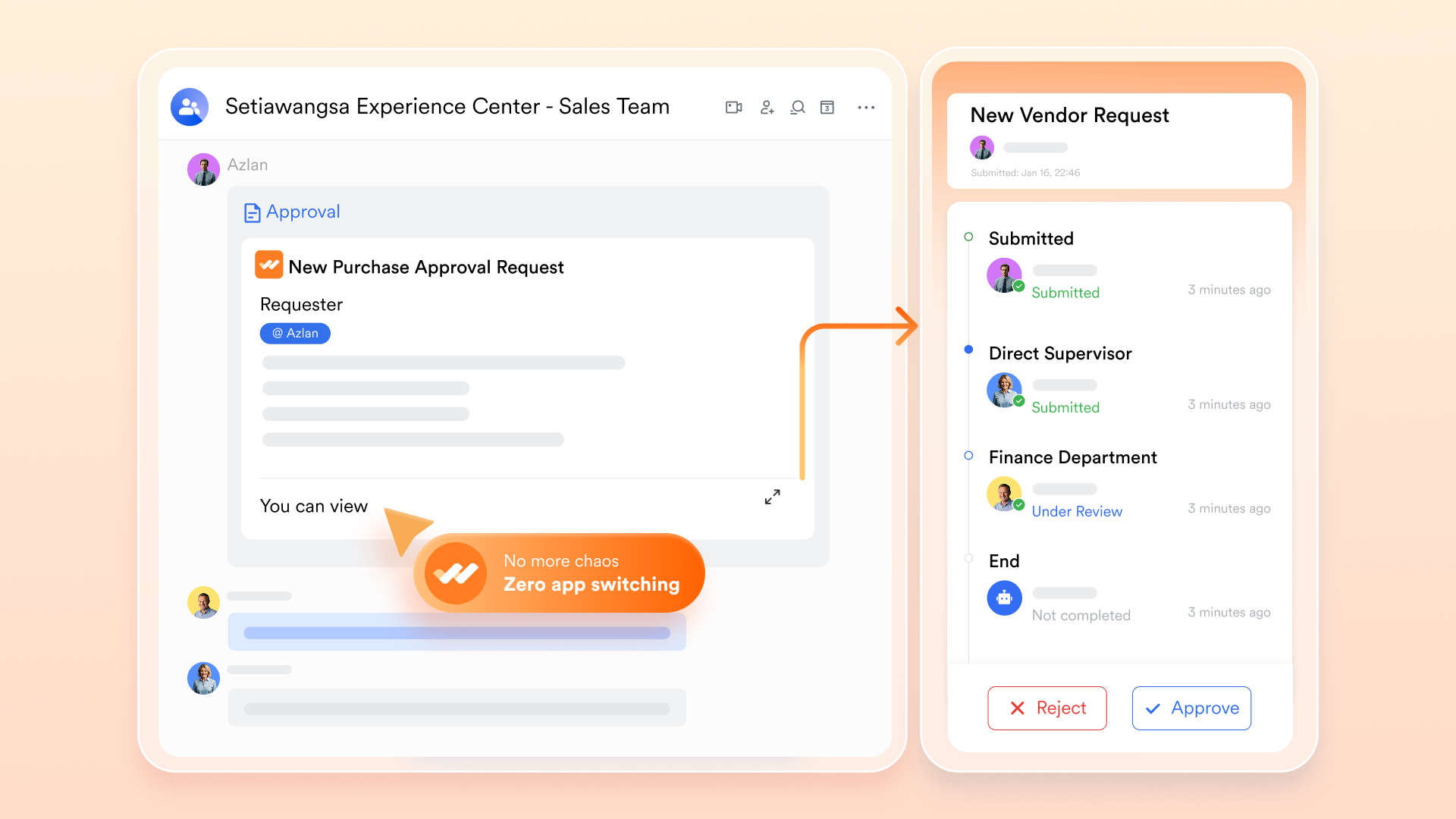
- Lark Approval: Fast, auditable discount and deal approvals
What it does: Lark Approval digitises request forms and multi-level sign-offs (e.g., sales discount approvals, special payment terms). Sales representatives can initiate requests directly within Lark, by providing specific conditions. These requests are then routed through a customizable, multi-level approval chain. Approvers receive real-time notifications and can review and approve requests within the platform.
Why it matters for sales: Speed matters—long approval cycles kill momentum. Approvals ensure guardrails are respected while removing email bottlenecks.
- Starter plan: Free forever plan that includes 11 powerful tools for up to 20 users. It also comes with 100GB of storage, 1000 automation runs, AI translations, and more.
- Pro plan: $12/user/month (billed annually) for up to 500 users. It includes everything in Starter plus group calling for up to 500 attendees, 15TB of storage, 50,000 automation runs, and more.
- Enterprise plan: Contact sales for custom pricing. Supports unlimited users and includes even more automation runs and advanced security, compliance, and management features.
2. Salesforce Sales Cloud: Industry-leading CRM and performance analytics
Salesforce Sales Cloud is one of the most powerful and widely used CRM sales management systems in the world. Designed for scalability and customization, it enables organizations to manage leads, track opportunities, forecast revenue, and analyze performance—all in one platform. Its AI-powered analytics and automation capabilities make it a go-to choice for businesses seeking to optimize sales performance management. Whether you're handling enterprise-level pipelines or small business sales, Salesforce delivers the visibility and insights teams need to close deals faster and smarter.
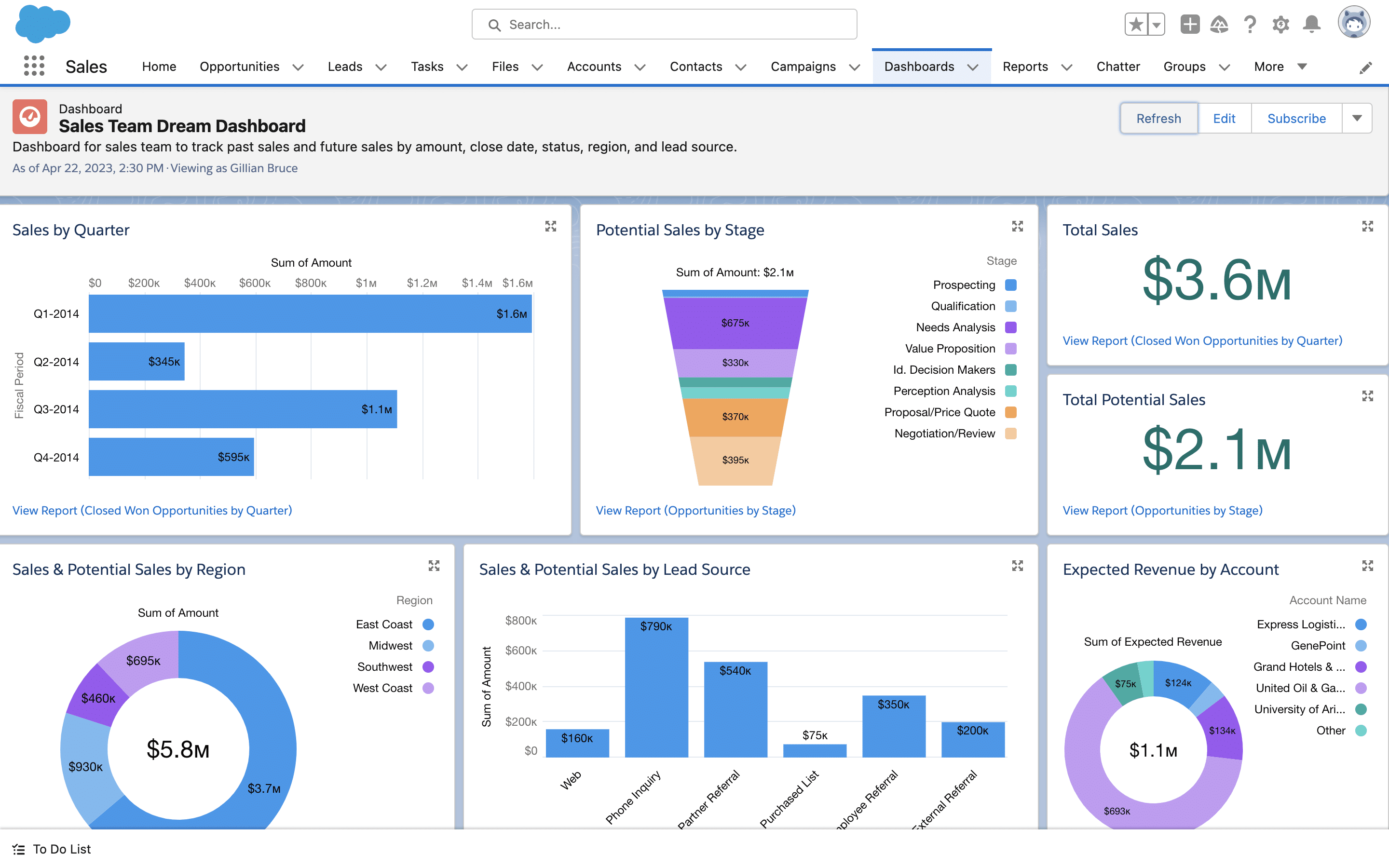
Image source: salesforce.com
Features:
- Capture, track, and nurture leads through a unified platform, ensuring no opportunity is missed.
- Utilize AI-driven insights to predict sales trends and make informed decisions.
- Create tailored views and reports to monitor key performance indicators and track sales performance.
- Access sales data and manage activities on-the-go through Salesforce's mobile application.
- Seamlessly connect with various tools and platforms to enhance functionality and streamline workflows.
Reviews:
Users praise Salesforce for its powerful customization, scalability, and vast integration ecosystem. Many highlight its advanced analytics and automation features that enhance decision-making. However, some note a steep learning curve and higher cost compared to simpler sales management software options. Overall, Salesforce remains the industry benchmark for robust CRM and sales performance management.
Pricing:
- Essentials: $25/user/month (entry)
- Professional / higher tiers: $80/user/month+ (varies by edition)
- Unlimited / Enterprise: Up to $330/user/month (based on edition)
3. Xactly: Sales compensation and incentive optimization
Xactly Incent is a comprehensive sales performance management (SPM) platform designed to automate and optimize incentive compensation programs. It enables organizations to create transparent, timely commission payouts while aligning rewards with business goals. With integrations into CRM and ERP systems, Xactly supports complex compensation models across territories and geographies, helping businesses link compensation, analytics, and strategy seamlessly.
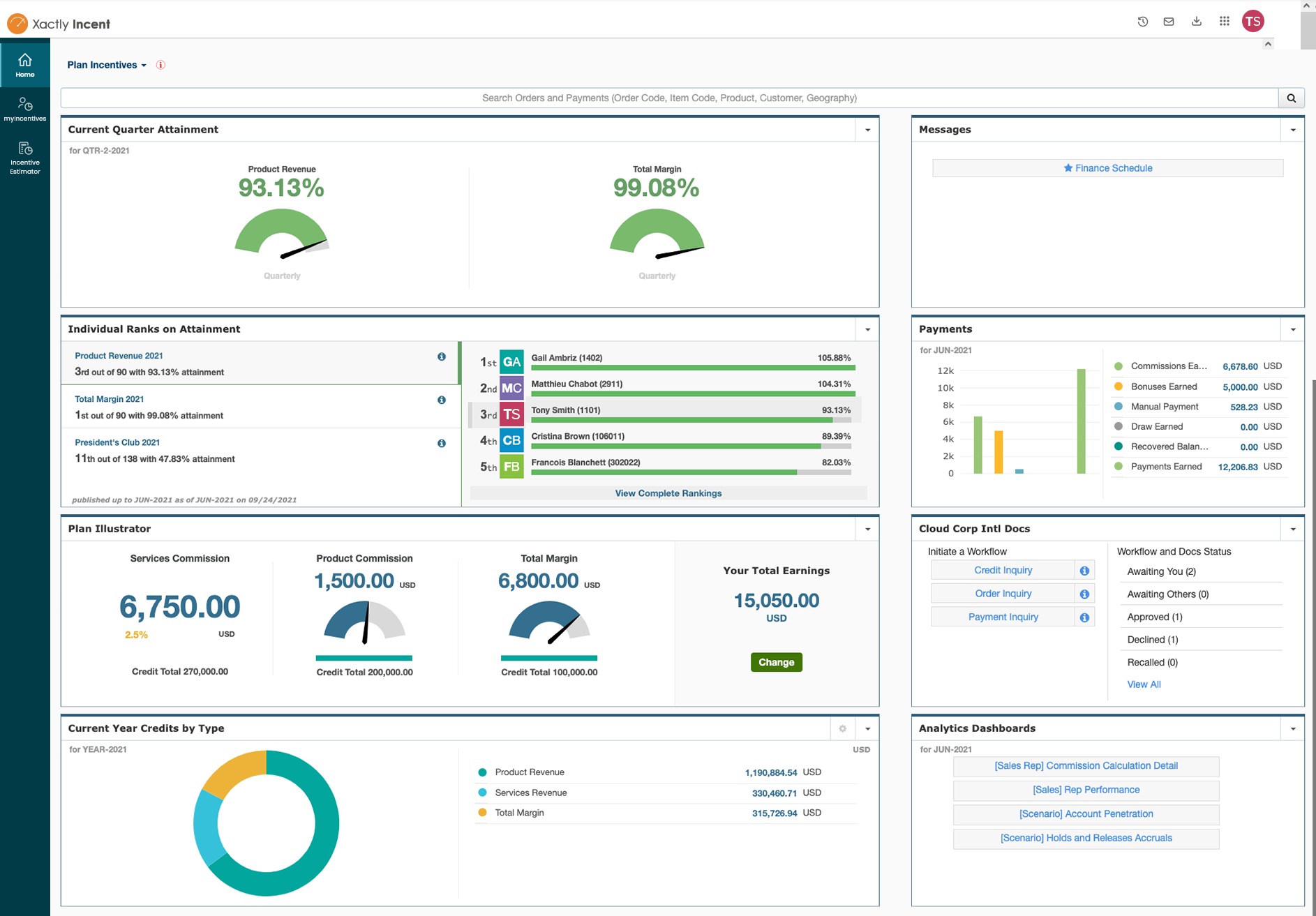
Image source: xactly.com
Features:
- Create and manage complex compensation plans with flexible structures.
- Automate commission calculations to reduce errors and administrative overhead.
- Provide sales reps with on-demand access to their earnings and performance metrics.
- Seamlessly integrate with systems like Salesforce, Microsoft Dynamics, and NetSuite.
- Utilize embedded analytics to monitor compensation trends and performance metrics.
Reviews:
Users consistently praise Xactly Incent for its ability to automate complex commission structures and provide real-time visibility into earnings. Customers report reduced administration time, improved accuracy, and stronger alignment between performance and incentives. Its integration capabilities with CRM and ERP systems are highlighted as key strengths. However, some users note that setup can be complex and that there is a learning curve for new users. Still, overall Xactly Incent is considered a robust platform for sales performance management.
Pricing:
- Contact vendor for custom quote (no public standard starting point)
4. Anaplan: Data-driven sales forecasting and planning
Anaplan is a cloud-based platform specializing in connected planning, enabling organizations to create accurate, real-time sales forecasts by integrating data from various sources. Its AI-driven predictive insights and scenario modeling capabilities help businesses optimize their sales pipeline and align forecasts with strategic goals. Anaplan's collaborative environment ensures that sales, finance, and other departments work with a unified, up-to-date view of sales projections.
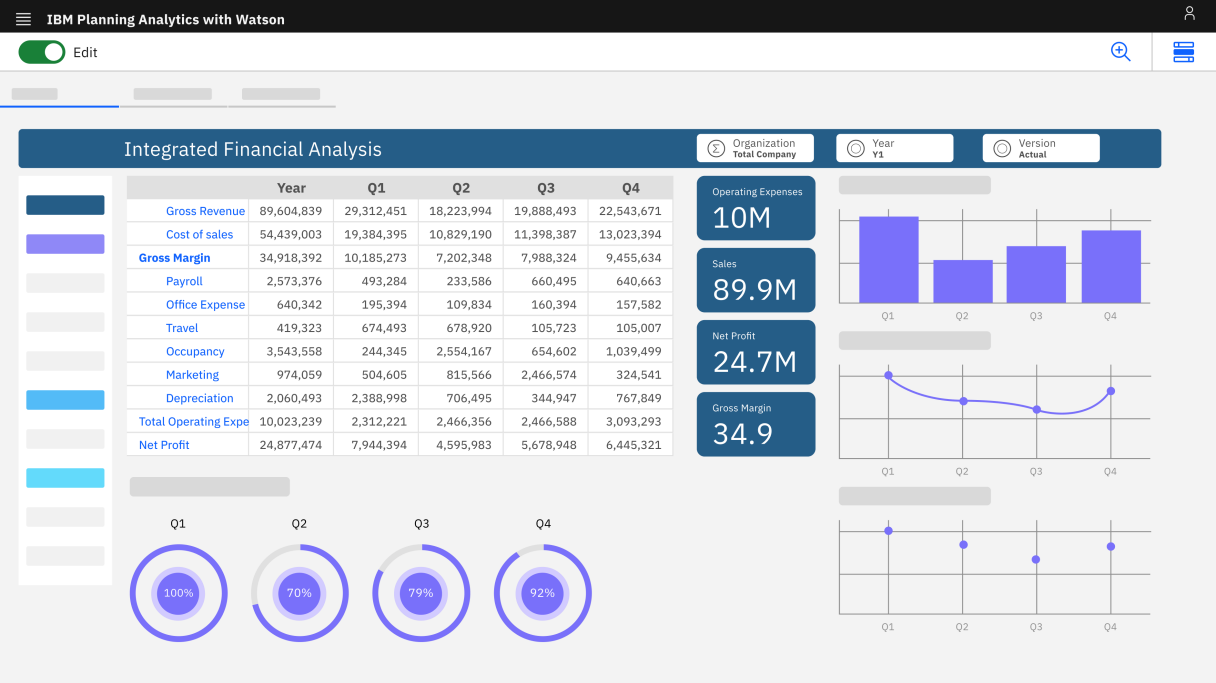
Image source: anaplan.com
Features:
- Generate accurate, real-time sales projections using integrated data sources.
- Leverage AI-driven analytics to identify trends and optimize sales strategies.
- Conduct "what-if" analyses to assess the impact of various business scenarios.
- Incorporate data from CRM, ERP, and other systems for comprehensive forecasting.
- Enable cross-departmental collaboration with a unified planning platform.
Reviews:
Users commend Anaplan for its robust forecasting capabilities and seamless integration with existing systems. The platform's real-time data processing and AI-driven insights are particularly appreciated for enhancing decision-making and sales strategy optimization. However, some users note that the platform's complexity and implementation time can be challenging, requiring dedicated resources and training. Overall, Anaplan is recognized as a powerful tool for organizations seeking to improve their sales forecasting accuracy and agility.
Pricing:
- Custom quoting only; no public starting rate available in reviewed sources
5. Oracle Sales Performance Management: Enterprise-grade incentive and forecasting system
Oracle Sales Performance Management (SPM) is an enterprise-grade platform designed to optimize sales strategies through advanced incentive compensation, quota management, and territory planning. Leveraging AI-driven insights and seamless integration with Oracle's cloud ecosystem, it empowers sales organizations to align performance with business objectives, enhance forecasting accuracy, and drive revenue growth.
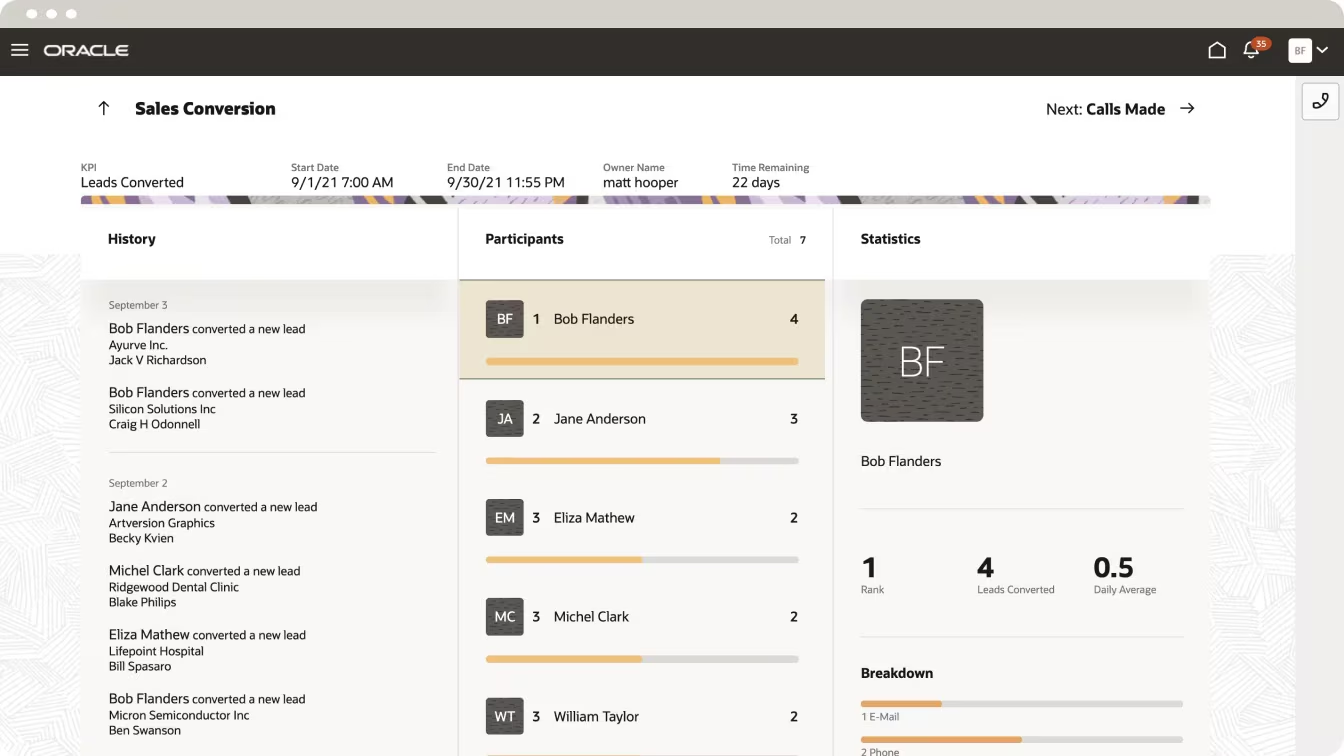
Image source: oracle.com
Features:
- Automate and manage complex commission structures, ensuring timely and accurate payouts.
- Allocate and adjust quotas and territories based on performance data and market dynamics.
- Utilize predictive analytics to generate accurate sales forecasts and identify growth opportunities.
- Access customizable dashboards to monitor individual and team performance metrics in real time.
- Integrate with other Oracle Cloud applications for a unified view of sales data and processes.
Reviews:
Users commend Oracle SPM for its robust features and seamless integration within the Oracle ecosystem. The platform's ability to automate complex compensation plans and provide real-time visibility into sales performance is highly appreciated. However, some users note that the platform's complexity may require a learning curve and dedicated resources for implementation.
Pricing:
- Contact vendor for quote (public information doesn't list fixed starting price)
6. Varicent: Revenue intelligence and planning suite
Varicent is a comprehensive Sales Performance Management (SPM) platform designed to optimize revenue generation through advanced incentive compensation, territory planning, and forecasting. Leveraging AI-driven insights and a unified data model, Varicent enables organizations to align sales strategies with business objectives, enhance performance visibility, and drive growth. Its scalable architecture supports enterprises across various industries, including financial services, telecommunications, and media.
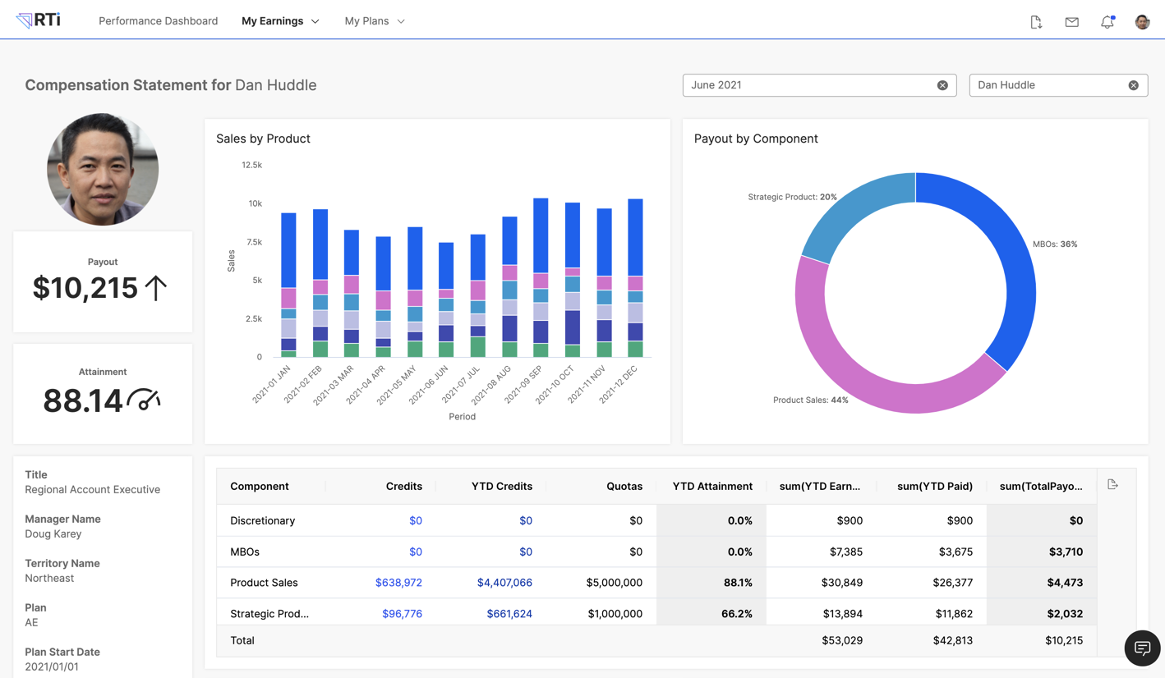
Image source: varicent.com
Features:
- Automate and manage complex commission structures, ensuring timely and accurate payouts.
- Allocate and adjust quotas and territories based on performance data and market dynamics.
- Utilize predictive analytics to generate accurate sales forecasts and identify growth opportunities.
- Access customizable dashboards to monitor individual and team performance metrics in real time.
- Integrate with CRM, ERP, and HRM systems for a unified view of sales data and processes.
Reviews:
Users commend Varicent for its robust features and seamless integration within the enterprise ecosystem. The platform's ability to automate complex compensation plans and provide real-time visibility into sales performance is highly appreciated. However, some users note that the platform's complexity may require a learning curve and dedicated resources for implementation. Overall, Varicent is recognized as a powerful tool for organizations seeking to improve their sales performance management processes.
Pricing:
- Contact vendor for quote (public information doesn't list fixed starting price)
7. Performio: Transparent commission tracking and reporting
Performio is a comprehensive Incentive Compensation Management (ICM) platform designed to automate and optimize sales commission processes. It offers real-time tracking, customizable dashboards, and seamless integrations, enabling organizations to manage complex compensation plans with ease. Trusted by enterprises and high-growth companies, Performio ensures accuracy, transparency, and scalability in sales compensation management.
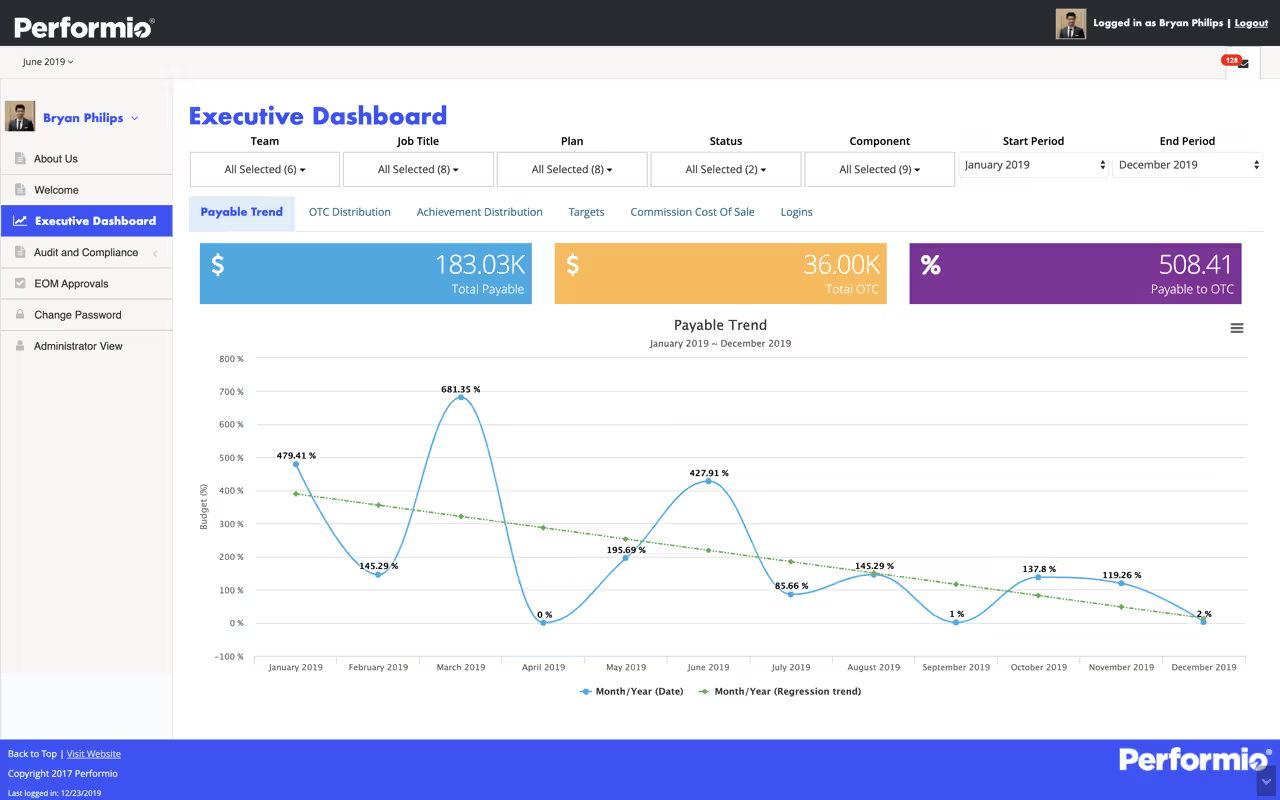
Image source: performio.com
Features:
- Eliminate manual errors and reduce administrative overhead by automating complex commission calculations.
- Provide sales teams with real-time visibility into their earnings, quotas, and performance metrics through tailored dashboards.
- Easily design, implement, and modify incentive compensation plans to align with evolving business objectives.
- Utilize built-in reporting tools and analytics to gain insights into compensation trends, performance, and ROI.
- Integrate with CRM, ERP, and HRM systems to ensure data consistency and streamline compensation workflows.
Reviews:
Users commend Performio for its intuitive interface, robust automation capabilities, and real-time visibility features. The platform's ability to handle complex compensation structures and provide transparent reporting is highly appreciated. However, some users note that the initial setup can be challenging and may require dedicated resources for configuration. Overall, Performio is recognized as a powerful tool for optimizing sales compensation processes.
Pricing:
- Contact vendor for quote (public information doesn't list fixed starting price)
8. beqom: Unified performance and compensation management
beqom is a comprehensive Total Compensation Management (TCM) platform designed to streamline and optimize compensation processes across global organizations. It offers a unified solution for managing salaries, bonuses, long-term incentives, and performance-based rewards, ensuring alignment with business objectives and compliance with regional regulations. With its cloud-based architecture, beqom provides scalability, flexibility, and real-time analytics, empowering HR and compensation teams to make data-driven decisions and enhance employee engagement.
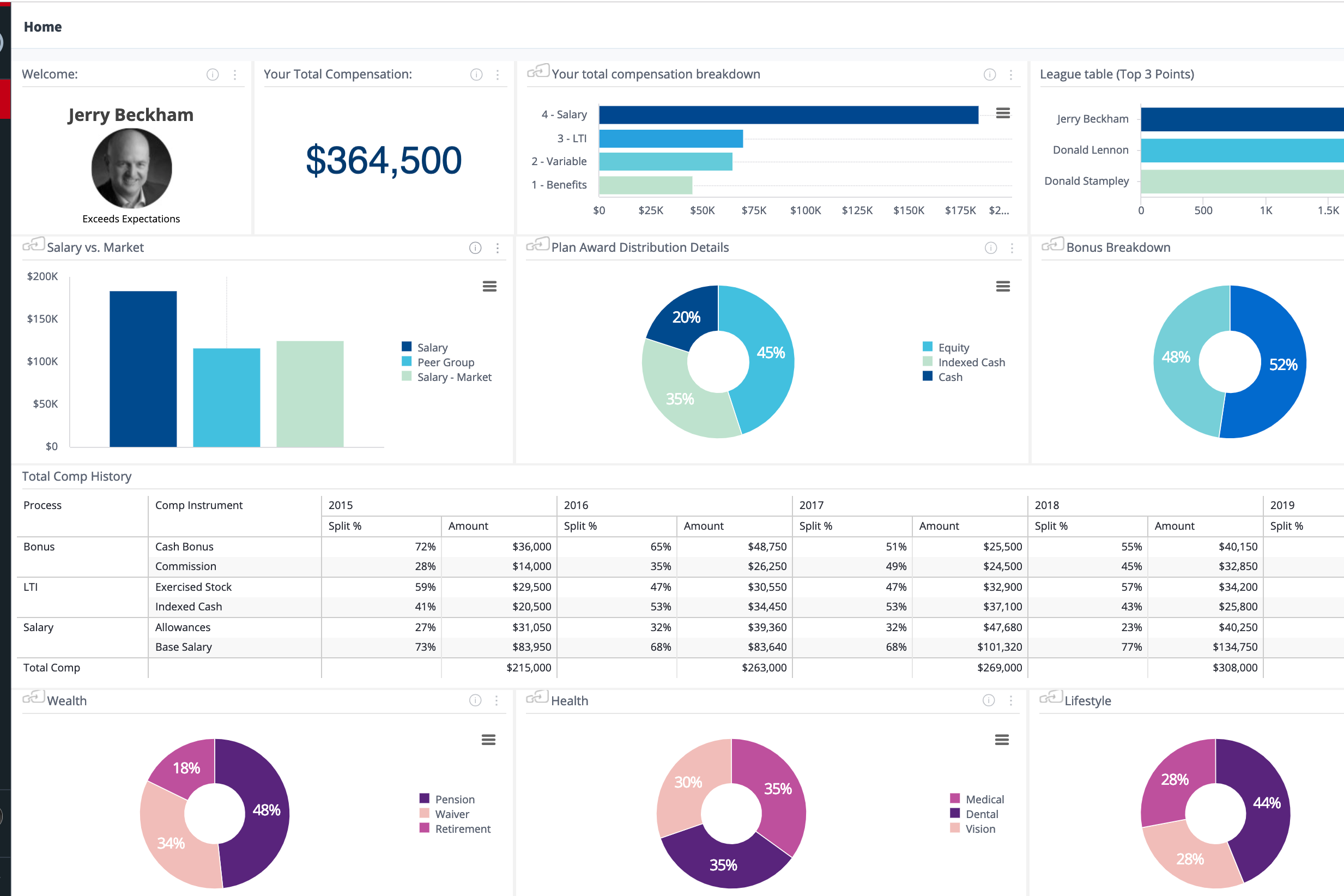
Image source: beqom.com
Features:
- Automate and manage global salary reviews, adhering to local guidelines and policies, while tracking associated costs in a centralized platform.
- Design and simulate bonus schemes, set targets, calculate payouts, and track performance to achieve a balanced performance-to-reward ratio.
- Implement and monitor LTI programs to build performance, retention, and shareholder value, improving operational efficiency and ensuring regulatory compliance.
- Integrate employee performance data to supplement compensation history, establishing pay-for-performance structures and enhancing decision-making.
- Utilize embedded analytics to view compensation trends, budget allocations, and individual employee data, facilitating informed strategic decisions.
Reviews:
beqom has received positive feedback for its flexibility and customization capabilities, allowing organizations to tailor compensation processes to their specific needs. Users appreciate the platform's intuitive design and seamless integration with existing HR systems. However, some users have noted that the complexity of the platform can lead to a steeper learning curve and potential performance issues if not properly configured.
Pricing:
- Custom quote only (no public starting rate)
9. Pipedrive: Visual pipeline CRM for SMBs
Pipedrive is a user-friendly, sales-focused CRM designed to help small and medium-sized businesses (SMBs) streamline their sales processes. Its intuitive interface and visual pipeline enable teams to manage deals, track activities, and automate workflows efficiently. With over 100,000 customers globally, Pipedrive is recognized for its simplicity and effectiveness in driving sales success.
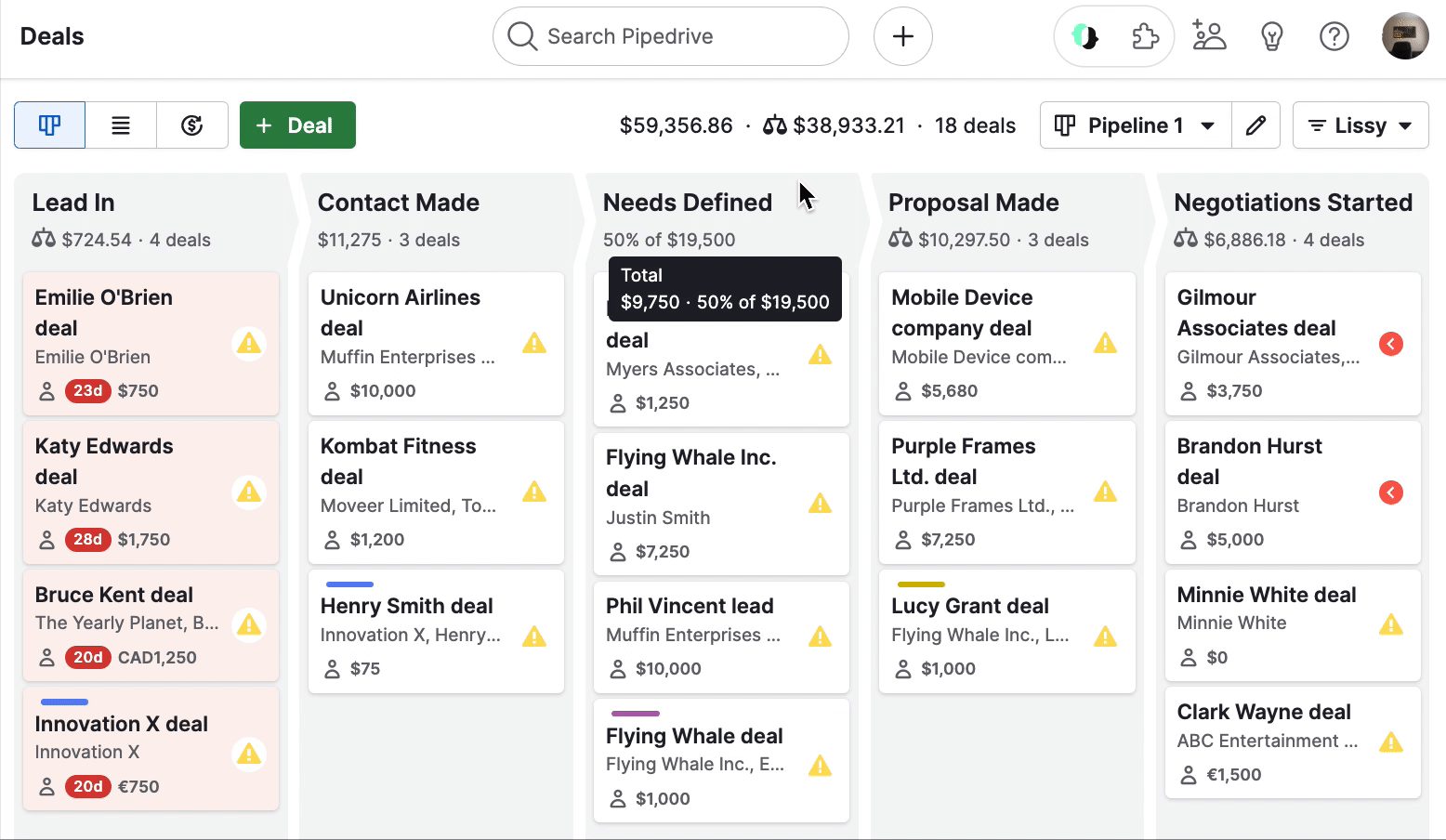
Image source: pipedrive.com
Features:
- Offers a drag-and-drop interface to manage deals through customizable stages.
- Syncs with Gmail and Outlook for seamless communication and tracking.
- Automates repetitive tasks like follow-ups and data entry to enhance productivity.
- Provides real-time insights with customizable reports and analytics.
- Ensures sales teams can manage deals on-the-go with mobile applications.
Reviews:
Users praise Pipedrive for its intuitive design and ease of use. The visual pipeline and automation features are highlighted as key strengths. However, some users note limitations in advanced reporting capabilities and the lack of a free permanent plan.
Pricing:
- Essential / Lite: From ~$14/user/month (annual billing)
- Growth / Premium / Ultimate tiers: ~$39–$79/user/month (annual billing)
10. SAP Sales Cloud: Comprehensive enterprise sales platform
SAP Sales Cloud is a robust, AI-powered Customer Relationship Management (CRM) solution designed to streamline and automate sales processes for enterprises. It offers a unified view of customer interactions, integrates seamlessly with SAP S/4HANA, and provides advanced analytics to enhance decision-making. Tailored for B2B environments, it empowers sales teams to engage customers effectively, manage pipelines efficiently, and drive revenue growth.
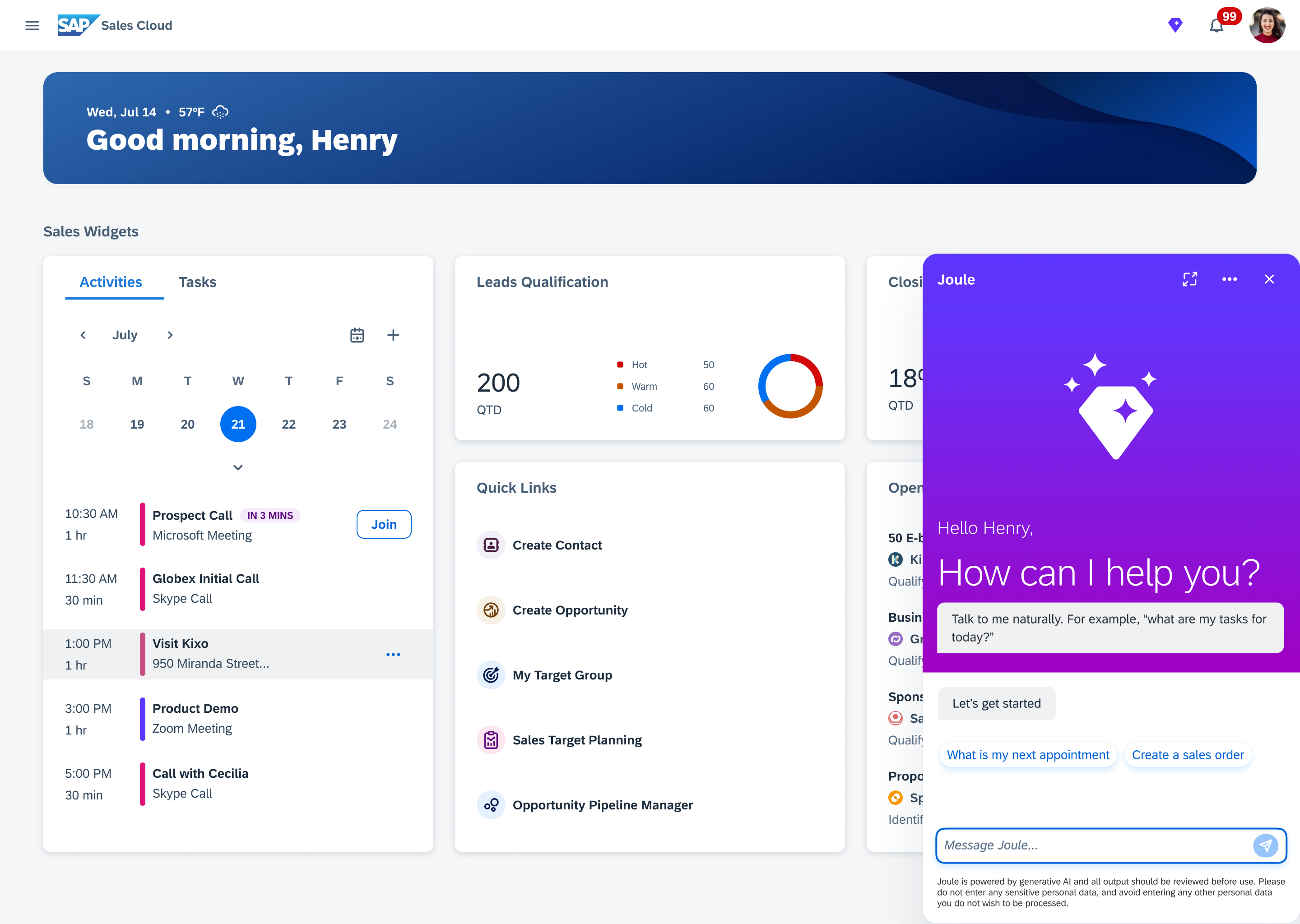
Image source: sap.com
Features:
- Utilizes artificial intelligence to automate routine tasks, providing sales teams with intelligent recommendations and insights.
- Integrates data from various sources to offer a comprehensive 360-degree view of each customer, enhancing personalization and engagement.
- Provides a mobile application that allows sales professionals to access customer information and manage sales activities on-the-go.
- Offers predictive analytics and forecasting tools to help sales teams make data-driven decisions and accurately predict sales outcomes.
- Integrates smoothly with other SAP solutions, ensuring a cohesive enterprise resource planning experience.
Reviews:
SAP Sales Cloud has received positive feedback for its comprehensive features and integration capabilities. Users appreciate the AI-driven insights and the unified customer view, which enhance sales efficiency and effectiveness. However, some users have noted that the platform's complexity may require a learning curve and dedicated resources for implementation.
Pricing:
- Base plan: ~$138/user/month for 3-36 month contract.
- Additional add-ons: +$22/user/month (service add-on), +$47/user/month (field sales add-on)
Best practices for effective sales management
Effective sales management requires a combination of visibility, data-driven decision-making, automation, and alignment across teams. Modern sales leaders rely on digital tools to track performance, streamline workflows, and foster collaboration between sales, marketing, and operations. By following proven best practices, organizations can optimize their sales processes, boost team productivity, and consistently achieve revenue targets.
Here's a breakdown of key strategies for successful sales management.
- Improve visibility: Use shared dashboards like Lark Base to centralize sales data. Real-time dashboards allow managers to track pipeline health, deal progression, and team performance. Visibility ensures quick identification of bottlenecks and informed decision-making across the organization.
- Use data, not guesswork: Track KPIs and adapt strategies quickly. Measuring metrics like conversion rates, quota attainment, and average deal size helps identify trends. Data-driven insights enable managers to make proactive adjustments and improve sales outcomes.
- Automate workflows: From lead routing to approval chains, automation streamlines processes. Reduce manual tasks, minimize errors, and save time for high-value sales activities. Automated workflows improve consistency and ensure accountability across all sales operations.
- Keep teams aligned: Bridge communication between sales, marketing, and operations. Collaborative platforms like Lark integrate messaging, task management, and dashboards in one workspace. Alignment ensures that all teams work toward shared objectives and synchronized strategies.
- Combine tech with strategy: Success requires both process discipline and collaboration tools. Technology enhances execution, but strong sales processes and training are equally essential. A balanced approach drives efficiency, accountability, and long-term revenue growth.
Conclusion
Modern sales success hinges on unified data, streamlined workflows, and agile collaboration. Sales teams need real-time visibility into pipelines, accurate forecasting, and seamless communication to stay competitive. Lark serves as a connected workspace, integrating messaging, task management, dashboards, approvals, and documents into a single platform. By centralizing all sales activities,
Lark enables teams to reduce manual effort, enhance accountability, and accelerate decision-making. Whether tracking leads, managing commissions, or generating reports, Lark ensures every sales function is supported efficiently. Investing in tools like Lark empowers organizations to drive consistent revenue growth and maintain a high-performing sales culture.
FAQs
What is the difference between sales management and sales performance management?
Lark helps sales leaders manage both operations and performance. Sales management focuses on overseeing day-to-day activities, pipelines, and team coordination, while sales performance management emphasizes tracking results, measuring KPIs, and aligning incentives to achieve targets. Together, they ensure efficiency and goal attainment.
How can automation improve sales management efficiency?
Automation reduces manual tasks such as data entry, follow-ups, and approvals, freeing sales teams to focus on selling. It ensures consistency, speeds up workflows, and minimizes errors across processes like lead routing, pipeline updates, and reporting.
What are the key KPIs to track in sales management?
Important KPIs include pipeline value, conversion rates, average deal size, sales cycle length, quota attainment, and forecast accuracy. Monitoring these helps managers identify bottlenecks, optimize strategies, and drive predictable revenue growth.
How does CRM software support sales management?
CRM systems centralize customer and deal information, enabling teams to track interactions, manage pipelines, and forecast revenue. They improve collaboration, provide actionable insights, and ensure accountability across the sales organization.
How can sales managers keep remote teams productive?
Managers can use tools like Lark to maintain communication, set clear goals, and monitor progress. Regular virtual meetings, shared dashboards, and automated task tracking help remote teams stay aligned and focused on priorities.
Related reading
Table of contents
Start using Lark today

Manage all your work in one place
Boost team efficiency by 10x
Save up to 70% on software costs
Table of contents
Start using Lark today
Manage all your work in one place
Boost team efficiency by 10x
Save up to 70% on software costs
Keep reading









2026 Lark Technologies Pte. Ltd.
Headquartered in Singapore with offices worldwide.






Explore: