














How Managers can Adapt as Skills-Based Hiring Reshapes Teams

Matthew Sia
Product Marketing Manager
Sep 18, 2026
Matthew Sia
Sep 18, 2026

10 min read


Skills-based hiring isn’t some shiny HR trend. If you look at real worker behavior, you can see the shift happening a mile away. HR tech companies map large numbers of real career paths, and they certainly don’t always look like ladders, as some may expect. To the contrary, they sometimes look like someone dropped spaghetti on a whiteboard. They twist, pivot, start over, skip sideways, double back, and somehow still make sense once you see the skills underneath.
People aren’t building careers by title anymore. They’re building them by ability.
What skills-based hiring actually means
Skills-based hiring shifts the focus of hiring decisions away from job titles, degrees, and linear career paths, and toward the abilities required to do the work. Instead of asking whether someone has held a specific role before, employers evaluate whether a candidate has the skills needed to succeed in the role today.
Those skills can include technical capabilities, such as data analysis or project planning, as well as human skills like communication, problem-solving, and adaptability. In a skills-based model, where and how someone gained those skills matters far less than whether they can apply them effectively.
This approach recognizes a reality that traditional hiring often ignores: people develop skills in many ways. They gain them across industries, through adjacent roles, side projects, volunteer work, contract work, or on-the-job learning. A candidate may lack the “right” title on paper while still possessing the exact capabilities a team needs.
Skills-based hiring also changes how roles themselves are defined. Instead of rigid job descriptions built around historical titles, roles are shaped around outcomes. What problems does this role solve? What responsibilities truly matter? What skills are essential on day one, and which can be developed over time?
For managers, this shift brings clarity. It replaces vague requirements like “5+ years of experience” with concrete expectations tied to real work. It also expands the talent pool, making it easier to identify capable candidates who might otherwise be overlooked due to unconventional backgrounds.
Most importantly, skills-based hiring aligns hiring decisions with how work actually happens. Teams are dynamic. Priorities shift. Responsibilities evolve. Hiring for skills rather than titles creates teams that are more adaptable, resilient, and better equipped to grow as the organization changes.
Job titles keep failing as predictors
One thing you learn fast when looking at a career path: titles lie. A career path centers on one role and shows the most common paths into and out of it. But the paths rarely follow what companies assume. They’re busy, branching, and surprising. You drag a new role into the center, and the whole chart reshapes itself like a living ecosystem.
The surprising part? Most people don’t “climb a ladder.” They move sideways. They shift industries. They pick up skills in one job that unlock completely different jobs later.
Hiring by title alone is like ordering dinner based on menu font size. It’s the wrong signal entirely.
Workers are searching based on skills, not titles
Jobseekers are way ahead of employers on this. According to the Jobtrees workforce survey:
- 95 percent believe their skills can transfer to a new career.
- 60 percent tailor their résumé for each application.
People want to match themselves to roles based on what they can really do. That’s why so many take their experience or skills and run it through an AI-powered job experience matching tool to see roles that would actually be a good next fit. And the results often surprise them.
For example:
- Someone with customer service experience discovers they match operations roles.
- A teacher finds they match training or project roles.
- A retail lead realizes they fit HR or sales operations.
Jobseekers are using tools to pivot. Meanwhile, many managers still hire based on old résumés.
Hiring breaks down when teams aren’t even using the same definition of “Skills”
Skills-based hiring only works when a team agrees on what the role actually needs. But this is where most teams collapse.
One person thinks communication means being good on video calls. Another thinks it means summarizing complex issues. Someone else thinks it means writing tight emails. And nobody realizes they disagree because their feedback is scattered across DMs, emails, outdated docs, and passing conversations.
This is exactly how great candidates get stuck in hiring limbo. The team isn’t aligned, not because they disagree, but because they aren’t talking in one place.
Where Lark makes skills-based hiring real
Lark gives teams the one thing most hiring processes desperately lack: a shared brain. Lark provides a single workspace where collaboration, documentation, feedback, everything, lives in one place. Because of that, hiring based on skills becomes not just possible, but practical. Here’s how:
- Use Lark Docs for a shared “skills rubric” to collaboratively define what skills your team actually values for a role. Everyone works on the same document simultaneously.
- Use Lark Messenger / Chat to discuss candidates in real time like feedback, doubts, and impressions, without scattering messages across email chains or private threads.
- Use Lark Calendar + Meeting + Magic Share to organize interviews, share candidate materials, or run feedback sessions all in one place, so nothing gets lost.
- Use Lark Base / Lark Tasks to structure the hiring workflow: track candidates, status, next steps, reviewer assignments, and feedback deadlines.
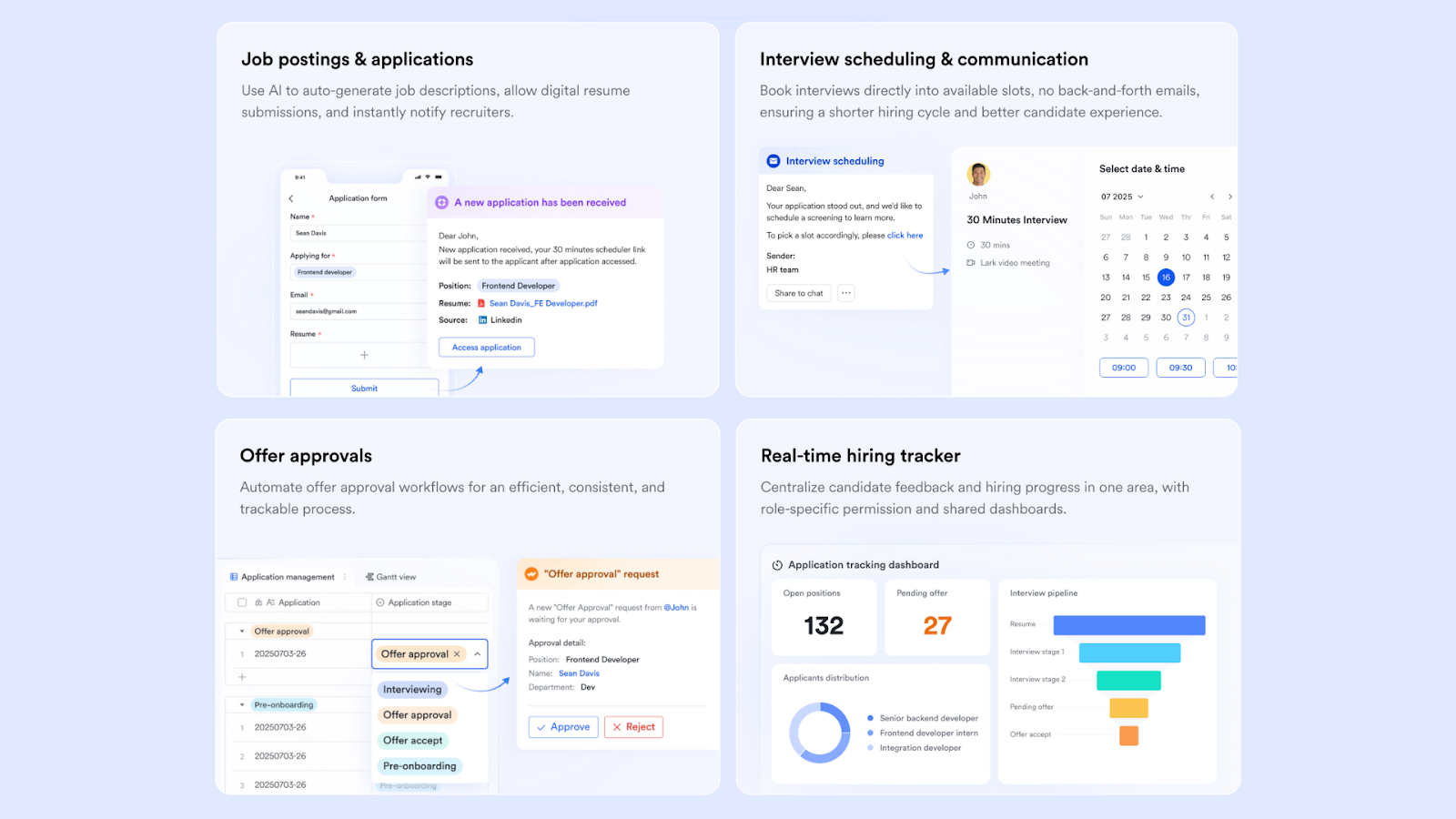
With Lark, everything stays connected so no more hunting through threads or unanswered emails.
Try lark for free or book a demo today to learn more about how Lark can help simplify your business operations with our productivity superapp.

What skills-based hiring changes for managers day to day
For managers, skills-based hiring isn’t just a change in how candidates are evaluated. It fundamentally alters how hiring decisions are made, discussed, and defended. The shift can feel uncomfortable at first because it removes familiar shortcuts like titles, degrees, and company names. But once teams adapt, it leads to clearer decisions and stronger hires.
From résumé screening to capability evaluation
The first change managers notice is how they screen candidates. Instead of asking, “Have they done this job before?” the question becomes, “Can they do this work now?” That requires looking past surface-level markers and focusing on how someone approaches problems, communicates, and adapts. A candidate who hasn’t held the exact title may still demonstrate the core skills needed to succeed. Managers who embrace this shift often discover talent they would have filtered out in a traditional process.
Interviewing for skills, not credentials
Interviewing also changes. Skills-based hiring pushes managers to ask better questions. Rather than walking through a résumé line by line, interviews focus on real scenarios. How does this person break down complex tasks? How do they prioritize when everything feels urgent? How do they collaborate across functions when goals conflict? These conversations reveal far more than years of experience alone. They show how someone thinks, not just where they’ve been.
Rethinking team fit and long-term performance
Another adjustment comes in how managers evaluate “fit.” In a skills-first model, fit isn’t about background similarity or cultural mirroring. It’s about whether a candidate’s skills complement the existing team. Managers begin to think in terms of gaps rather than replacements. What skills does the team already have in abundance? Where are they stretched thin? Hiring becomes an act of balancing capabilities rather than cloning past hires.
Managing skills-based teams also requires more intentional onboarding. When team members come from varied backgrounds, assumptions can’t go unspoken. Managers need to clarify expectations early, document workflows, and make success criteria explicit. This upfront effort pays off quickly. New hires ramp faster because they understand how their skills connect to the work and where they can contribute most.
Letting go of certainty to hire better
Perhaps the biggest shift is psychological. Skills-based hiring asks managers to let go of certainty. Titles and credentials feel safe because they’re familiar, even when they’re unreliable. Evaluating skills requires judgment, discussion, and sometimes disagreement. Strong managers learn to lean into that discomfort. They encourage open conversations about what the role truly requires and push teams to articulate their thinking rather than relying on instinct alone.
The payoff is substantial. Managers who adopt skills-based hiring report faster hiring decisions, fewer stalled debates, and better long-term performance. Teams become more resilient because they’re built around complementary abilities, not rigid roles. When priorities shift, these teams adapt more easily because their members were hired for how they work, not just what they’ve done before.
Skills-based hiring doesn’t lower standards. It raises them. It asks managers to be clearer, more thoughtful, and more aligned. And in return, it unlocks talent that traditional hiring methods consistently overlook.
Jobseekers are already shifting to a skills-first mindset
This is the part employers underestimate. Workers are actively shaping their job search around skills. They’re updating résumés, tailoring for different paths, and using career advancement tools to match themselves to roles they never knew they qualified for.
Some are applying for jobs outside their industry because the skills match. Some are rewriting their résumés to highlight strengths the old job titles didn’t showcase. Many are exploring paths revealed by modern career placement tools because they didn’t realize such jobs were even within their reach.
This is happening at scale. The survey data makes it obvious:
- 73 percent believe switching careers is necessary for growth.
- 69 percent apply to roles they aren’t “qualified for” on paper.
Workers are writing the new playbook. It’s hiring teams who need to catch up.
Skills + data + real collaboration = teams that actually work
When a hiring team uses Lark to stay aligned on the skills that matter, it becomes obvious which candidates fit. Not the ones with the fanciest titles. Not the ones with the “right” degrees. The ones with the skills that genuinely match the work.
Managers start choosing people for their real capabilities instead of résumé aesthetics. And teams hire faster, fairer, and smarter.
Jobseekers have already shifted into a skills-first world. With Lark, hiring teams finally can too.
Related reading
Table of contents
Start using Lark today

Manage all your work in one place
Boost team efficiency by 10x
Save up to 70% on software costs
Table of contents
Start using Lark today
Manage all your work in one place
Boost team efficiency by 10x
Save up to 70% on software costs
Keep reading








2026 Lark Technologies Pte. Ltd.
Headquartered in Singapore with offices worldwide.






Explore: