Considering Zoho CRM for your business? Let's take a look to see if it's worth the investment.
Zoho CRM is a popular customer relationship management software that helps businesses manage their sales, marketing, and customer service activities. It provides a centralized system for tracking customer interactions, automating key tasks, and gaining insights into business performance.
With multiple tiers and editions, Zoho CRM's pricing structure is not easy to navigate. This guide will break down every plan and uncover the costs hiding in the fine print. We will explore what you get, what you don't, and what it really takes to get started with the platform.
Get the best Zoho CRM alternative for free
Zoho CRM pricing plans at a glance
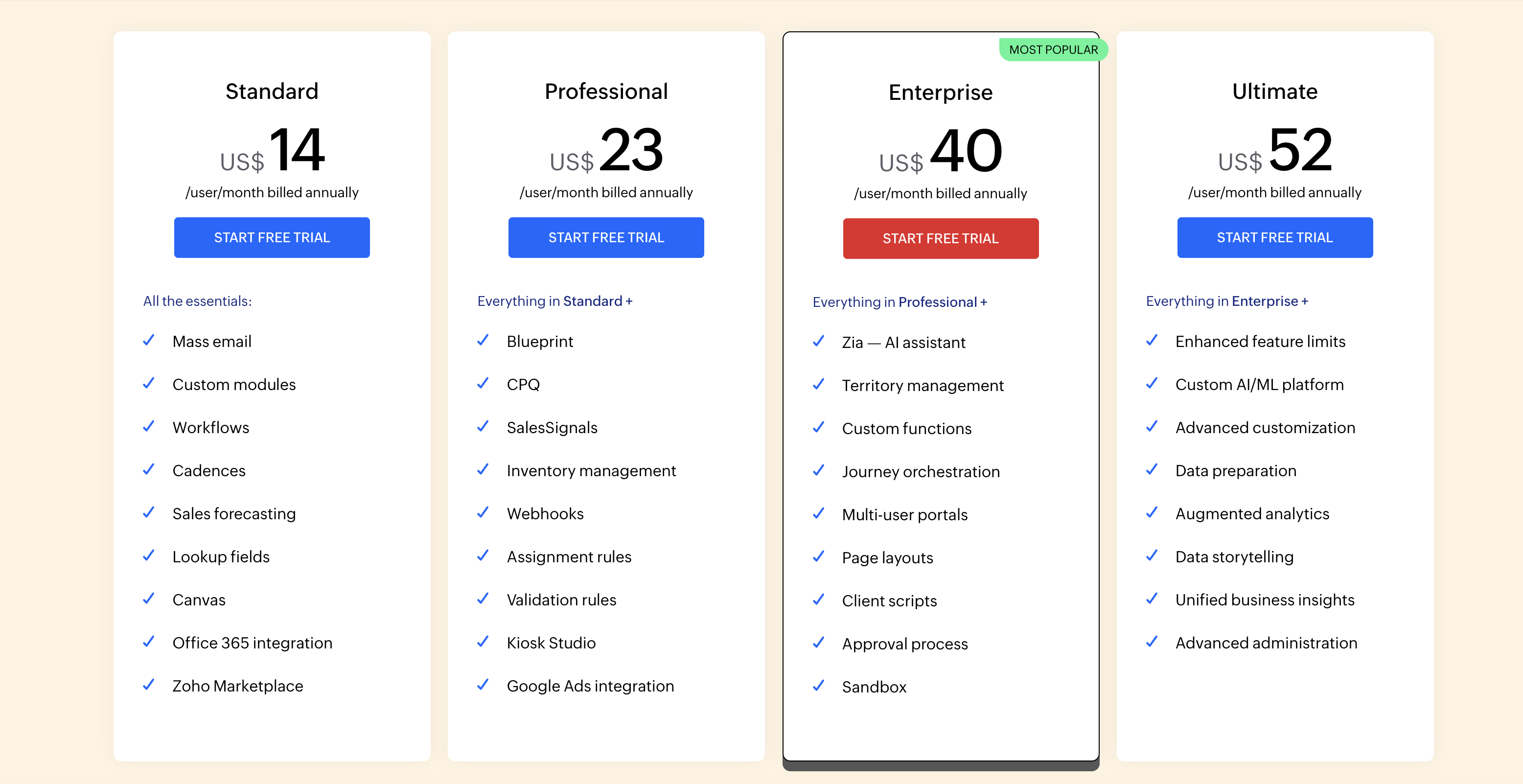
Zoho CRM's pricing per user per month starts from $0 and goes up to $65 for its highest plan. It offers a free plan for very small teams and four paid plans. Annual billing can cost up to 34% less than monthly billing.
Here's a quick overview of Zoho CRM's pricing.
The price jumps between tiers are substantial, so be aware that your costs could rise dramatically as your business grows and your needs become more sophisticated.
Detailed plan breakdown
The value of a isn't just in its price, but in the specific capabilities it unlocks at each level. Let's dissect what each Zoho CRM plan offers and, just as importantly, what limitations might push you to upgrade.
The free plan
Zoho’s free plan is a popular entry point, offering basic CRM functionality for up to three users. It covers the essentials: lead, contact, account, and deal management. However, the plan is designed with clear limitations. You get just 1 GB of total storage, are restricted to five custom lists per module, and can only send 150 automated email notifications per day. Crucially, it lacks foundational sales tools like sales forecasting, advanced customization, and meaningful automation.
The free plan's structure makes it an effective way to get users into the Zoho ecosystem, but it's not a viable long-term solution for any business planning to grow. The moment a company hires its fourth employee or needs to do more than simply store contact information, it hits a wall and is forced to upgrade every user to a paid plan.
Standard plan
At $14 per user per month (billed annually), the Standard plan is the true starting point for a functional sales team. The plan unlocks several key features, including the ability to create multiple sales pipelines, set up basic scoring rules to rank leads (limited to 10 fields per module), and use mass email capabilities. The plan also introduces sales forecasting and customizable dashboards, giving managers a better view of team performance.
While it's a significant step up from the free version, the Standard plan still has its limits. Automation is minimal, and advanced analytics are absent. The cap of 10 custom fields per module means that businesses with moderate products or customer data requirements may find themselves constrained.
Professional plan
The Professional plan, priced at $23 per user per month annually, is where Zoho CRM begins to transition from a contact database into a powerful sales engine. The plan includes critical automation and process management tools that most sales teams need.
Two features stand out: SalesSignals and Blueprint. SalesSignals provides real-time notifications about customer actions across various channels (like email opens or social media mentions), so follow-ups can be done promptly. Blueprint is a visual process editor that lets you map out and enforce your entire sales process, ensuring every team member follows the same steps for lead nurturing or deal closing. Inventory management is also included, making it suitable for businesses that sell physical products.
By gating these core automation features until the third pricing tier, Zoho creates a compelling reason for businesses on the Standard plan to upgrade. Without tools like Blueprint, a company can't effectively scale its sales operations, making the Professional plan a near-necessity for any ambitious team.
Enterprise plan
The Enterprise tier ($40 per user per month annually) is built for larger, more sophisticated companies. Its headline feature is Zia, Zoho's AI-powered assistant. Zia analyzes your sales data to provide predictive recommendations, suggest the best times to contact leads, detect anomalies in your sales trends, and automate workflows.
Multi-user portals for collaborating with clients or partners and advanced customization options are also introduced. The inclusion of a sandbox environment allows developers or admins to test new customizations and workflows without affecting live data, a crucial feature for established businesses where system stability is paramount.
Ultimate plan
The highest standalone CRM tier, the Ultimate plan ($52 per user per month annually), is less about adding new features and more about removing limitations for large-scale organizations. It primarily enhances the capabilities of the Enterprise plan by providing higher API limits and advanced analytics tools.
The Ultimate tier is clearly aimed at enterprises that have hit the operational ceilings of the Enterprise plan. The upgrade is driven by a need for more capacity and deeper data analysis rather than a new set of tools.
Get more and pay less with Lark
Beyond the main plans: Zoho CRM Plus and Bigin
Zoho's offerings don't stop with its core CRM plans. The company has two other products that reveal a lot about its overall strategy: Zoho CRM Plus and Bigin.
Zoho CRM Plus
Zoho CRM Plus is an all-in-one bundle of more than eight integrated Zoho applications, costing $57/user/month, annually. It combines the CRM with tools for marketing automation, customer support (helpdesk), social media management, project management, and advanced analytics.
At a price point just slightly higher than the standalone Ultimate CRM plan, it nudges users to upgrade to the pricier plan. To achieve a truly unified view of the customer across sales, marketing, and support, businesses are nudged toward buying into the entire Zoho ecosystem.
A fragmented experience is created for those who only purchase the CRM, as they will inevitably need to integrate other tools, either from Zoho or third parties, which adds both complexity and cost.
Bigin by Zoho
Priced at $7/user/month, billed annually, Bigin is on the other end of the price spectrum. It is a simplified, pipeline-focused CRM designed for small businesses that find the main Zoho CRM too overwhelming. It acts as another gateway into the Zoho ecosystem, capturing businesses at the earliest stage.
Additional costs of Zoho CRM
A CRM's sticker price is often just the beginning. The total cost of ownership can be significantly higher once you account for necessary but separately priced services. Zoho CRM is no exception.
Implementation and onboarding fees
For many businesses, setting up a powerful CRM is not a simple plug-and-play process. Zoho offers a "Jumpstart" program that provides professional assistance with initial setup, customization, and user training. However, this service comes at a steep price. It starts at $200 per hour with a 10-hour minimum, meaning businesses should budget at least $2,000 for guided onboarding.
The very existence of such a service suggests that the platform's complexity, especially in the higher tiers, can be a significant hurdle for teams without dedicated IT resources. The setup process is a hidden cost in both time and money.
Tiered and costly customer support
Tiered support is perhaps the most significant hidden cost in Zoho's pricing model. All paid plans include "Classic Support," which offers email support during business hours with a maximum response time of eight hours. For many businesses, waiting up to a full business day for a response to a critical issue is simply not feasible.
To get faster, more comprehensive support, you have to pay a premium. Zoho’s paid support plans are priced as a percentage of your total license fee.
The pricing structure means that support is a recurring operational expense. For a team of 20 on the popular Enterprise plan ($40/user/month), the annual license cost is $9,600. To get priority support, that team would need to pay an additional $1,920 per year for the Premium plan or $2,400 per year for the Enterprise plan.
Storage and backup add-ons
The costs don't stop there. While each plan comes with a certain amount of storage, businesses that need more will have to pay for it. For example, additional file storage costs $4.60 per month for every 5 GB. Similarly, while most plans include two free data backups per month, any additional backups will cost $12 each. For companies in regulated industries or those dealing with large media files, these metered costs can quickly add up.
Is Zoho CRM the right fit?
After this deep dive, it's clear that Zoho CRM is an incredibly powerful and feature-rich platform. Its high degree of customization, especially in the Enterprise and Ultimate tiers, and its ability to scale make it a viable option for large organizations with complex needs. If a company has the budget, time, and dedicated technical staff to implement and manage it properly, Zoho CRM can be a great fit.
However, there are also significant drawbacks:
- Cost complexity: The true cost is obscured by a maze of different tiers, bundles, add-ons, and paid support plans.
- Feature fragmentation: Core functionalities like automation, AI, and analytics are strategically spread across different plans and products, creating pressure to constantly upgrade or buy more from the Zoho ecosystem.
- Implementation overhead: The platform's complexity often requires a significant upfront investment in paid implementation services.
- Siloed collaboration: The CRM operates as a separate entity from a team's primary communication tools, leading to constant app-switching and a disconnected workflow.
Cut down on software bloat and costs with Lark
A simpler, more integrated alternative: Lark
The challenges posed by Zoho, including complexity, fragmentation, and hidden costs, stem from an older model of software, where different business functions live in separate, siloed applications. A more modern approach is to unify these functions into a single, collaborative workspace.
Lark is designed from the ground up to work seamlessly across all teams. , , , ,, , and all live on one platform and are supercharged by . So instead of shopping for separate tools and fitting them together, teams get a fully integrated suite from day one. This fundamental difference in philosophy is reflected in pricing and functionality.
Powerful and customizable CRM
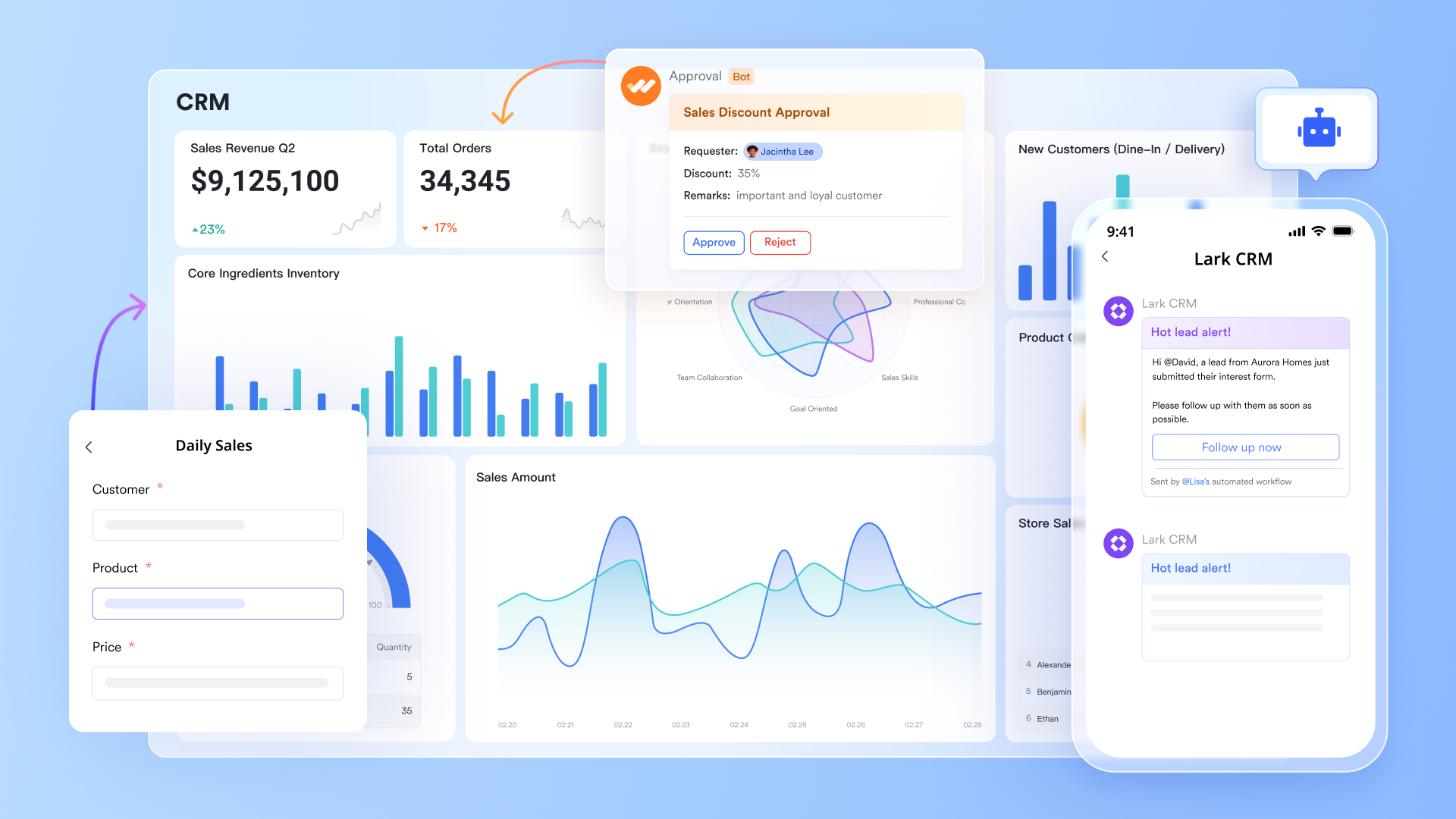
Instead of a rigid, pre-built CRM, Lark CRM is powered by a flexible, no-code database that teams can use to build a completely custom CRM that fits their exact workflow. Teams can create custom sales pipelines, build lead capture forms, design real-time dashboards, and set up powerful workflow automations, all without writing a single line of code.
For example, when a new lead comes in, an automation can instantly create a dedicated group chat for the sales team, assign the lead to a rep, and push real-time updates as the deal progresses. AI can even be used to score opportunities and enrich lead data automatically. The CRM isn't a separate application you have to log into because it's woven directly into the collaborative fabric where your team already works.
Watch Lark CRM in action:
Transparent and predictable pricing
Lark’s pricing stands in stark contrast to Zoho's complex structure. There are three simple tiers:
- Starter: A generous that supports up to 20 users and includes all of Lark's core tools, 100 GB of storage, and 1,000 Base automation runs per month.
- Pro: For just (billed annually) for up to 500 users, you get everything in Starter plus unlimited message history, 15 TB of storage, 50,000 automation runs, and advanced video conferencing features.
- Enterprise: to get a custom plan. This plan has no limit on the number of users and is designed for large organizations that need advanced security and management controls.
For small teams with simple communication needs

18 months message history
1000 Base automation runs/month
2000 rows per table in Base
Most POPULAR
For companies with comprehensive collaboration and management needs
Unlimited message history
500-participant video meetings
50k Base automation runs/month
20k rows per table in Base
For large companies with advanced security and organizational management needs
Get a personalized demo and pricing
Unlimited message history
500-participant video meetings
15 TB storage + 30 GB storage/user
500k Base automation runs/month
50k Base automation runs/month
Most POPULAR
For companies with comprehensive collaboration and management needs
Unlimited message history
500-participant video meetings
50k Base automation runs/month
20k rows per table in Base
Lark CRM vs Zoho CRM comparison
Ultimately, while Zoho offers a deep set of tools for those willing to pay the price in both money and complexity, Lark provides a more modern, integrated, and cost-effective solution. By bringing your CRM and collaboration into a single workspace, you can save money, eliminate complexity, and empower your team to work more efficiently.
Final thoughts
The right CRM can have a real impact on your business operations. Zoho CRM offers a deep and powerful platform for large enterprises, but this power comes with complexity and hidden costs for implementation, support, and add-ons. The tiered system creates a path of continuous upgrades, where the total cost of ownership could be much higher than anticipated.
For most businesses, the modern workplace demands simplicity and integration. Lark represents this new approach by embedding a flexible CRM within an all-in-one suite, eliminating the fragmentation and hidden costs of traditional models. The choice is no longer just about features, but about philosophy: a powerful but separate tool, or an integrated solution that makes your sales process a natural part of how your team already works?
Frequently asked questions
Is Zoho CRM free?
Yes, Zoho CRM offers a completely free plan for up to three users. It includes basic tools for managing leads, contacts, and deals, but it has significant limitations on storage, automation, and advanced features.
How much does Zoho CRM cost?
Zoho CRM's paid plans start at $14 per user per month when billed annually, or $20 per user per month with monthly billing. The price increases with each tier, reaching up to $52 per user per month for the Ultimate plan, which offers more advanced features and higher limits.
What are some alternatives to Zoho CRM?
Popular alternatives include Salesforce, Pipedrive, monday.com, and Microsoft Dynamics 365. For teams looking for a more integrated, all-in-one solution that combines CRM with communication and collaboration tools, Lark is a strong alternative.
Read more:
Does Zoho CRM offer a free trial?
Yes, Zoho CRM offers a 15- to 30-day free trial for all of its paid plans, allowing you to test the platform's features before making a purchase.
Related reading