














Finding the Right AI Tool for Digital Marketing in 2026 Copiar
Sep 18, 2026
Sep 18, 2026

12 min read


If you are searching for the perfect ai tool for digital marketing, you are not alone. Every team wants a quick fix for productivity. But if you look closely at most agencies or in-house setups, you won't see streamlined efficiency. Instead, you will see disjointed subscriptions, endless tab switching, and stretched budgets. Finding the right tech is not just about picking the smartest algorithm; it is about building a stack that actually works together. I am going to walk you through an evaluation framework, the most effective platforms available, and why consolidating your workspace is your highest-ROI move.
What are AI tools for digital marketing?
AI tools for digital marketing are software products that use artificial intelligence — most commonly large language models (LLMs), machine learning, or computer vision — to automate, accelerate, or improve tasks across the marketing workflow.
That definition covers a wide range. It includes a simple headline generator and a fully agentic campaign system that researches an audience, drafts assets, routes them for approval, and updates a performance tracker — all with minimal manual steps in between. Both are "AI marketing tools." They are not remotely the same thing.
Understanding that range matters before you evaluate anything, because the category has gone through three distinct generations in a short time:
Generation 1 — Autocomplete and templates: AI-assisted suggestions baked into existing tools — subject line predictors, headline testers, smart reply features in email clients. Useful, but limited to nudging work that was already happening.
Generation 2 — Content generation at scale: Full-draft copywriting, AI image generation, SEO content briefs, social caption tools. This is still where most "AI marketing tool" lists spend the majority of their word count — and where most teams start their AI adoption.
Generation 3 — Agentic workflows: AI systems that handle multi-step tasks with minimal human intervention between each stage. As marketing technology shifts toward more autonomous agentic AI frameworks, tools are beginning to research a topic, generate a brief, route it for review, and update the project tracker on their own.
Knowing which generation you're evaluating helps you set realistic expectations. A generation-2 tool that produces strong copy is one piece of a workflow. If you still need to manually carry that copy into a brief, circulate it via email for feedback, and paste the final version into a scheduler, the AI saved you time at one step while leaving the rest of the process untouched.
The most useful question to ask about any AI marketing tool isn't "what can it create?" It's "where does the output go next — and is that step also handled, or does it land back in someone's inbox?"
Why having more digital marketing AI tools isn't always better
It is easy to fall into the trap of thinking that more software equals more output. When a new generative AI platform launches, the immediate instinct for many digital marketing managers is to grab a subscription, hand it to the team, and expect a sudden spike in productivity.
I see the opposite happen frequently. We call this "SaaS sprawl," and it is quietly killing your team's momentum.
When you buy separate AI applications for SEO, copywriting, image generation, and social media scheduling, you force your team to constantly switch contexts. The friction does not come from the AI itself; it comes from moving the data around.
Consider this common mini-scenario: Your content strategist uses an AI research tool to find a keyword. They copy the brief into a Google Doc. The copywriter uses ChatGPT in another window to draft the text, pastes it back into the doc, and pings the editor on Slack. The editor reviews it, realizes they need a budget approval for the accompanying paid social ad, and sends an email to the marketing director.
The AI saved the copywriter maybe 30 minutes of typing, but the fragmented process cost the team two days in alignment, buried messages, and waiting for approvals. The truth is, optimizing a single task with an AI tool is pointless if the overall team workflow is broken. Your goal should not be to collect the most tools, but to create the tightest loop from ideation to execution.

How to evaluate an AI tool for your digital marketing team
Before you add another line item to your monthly software budget, you need a strict filtering mechanism. I use a three-part framework to evaluate any digital marketing AI tool to ensure it actually serves the team rather than complicating their day.
- Does it integrate with your daily workflow? A tool is only valuable if your team actually opens it. If an AI solution operates in a silo and cannot export data to your project management system or team chat, it will eventually be abandoned. Look for tools that offer robust APIs, native integrations, or better yet, live directly inside the unified workspace your company already uses.
- What is the true cost at scale? Many platforms lure you in with a cheap introductory tier for one user. But what happens when you want your entire content team, your designers, and your external agency partners to collaborate on it? Per-user pricing models can escalate rapidly. You need to calculate the cost based on your team size a year from now, not just today.
- Can it maintain your brand's unique point of view? The biggest risk of deploying AI in digital marketing is sounding like everyone else. If an AI tool only gives you generic, out-of-the-box responses, it is actively harming your brand. You need platforms that allow you to upload your own style guides, past successful campaigns, and customer research. If the system cannot be trained on your specific brand voice, it is a liability, not an asset.
How a unified workspace changes the AI marketing tool equation
There's a version of the AI marketing stack that looks impressive on a slide deck: best-in-class tool for each function, each one with a strong G2 rating, each one doing its job well in isolation. And then there's what it actually feels like to work in that stack — logging into six platforms before 10am, re-explaining campaign context every time you switch tools, and watching a brief that took 20 minutes to write take three days to get approved because feedback is scattered across Slack threads, email, and a comment in a Google Doc that two people can't find.
The fragmentation tax is real, and it compounds as teams grow.
A unified workspace doesn't eliminate the need for specialized AI tools. But it changes the equation significantly by reducing the number of handoffs where context gets lost. When the brief, the draft, the review thread, the approval decision, and the task assignment all live in the same environment, campaigns move faster — not because any individual step is automated, but because the transitions between steps are no longer friction points.
What this looks like in practice
Mini-scenario: A campaign for a new product feature needs to go from brief to published in eight days. In a fragmented stack, the sequence looks like this: brief drafted in Notion → shared via Slack → feedback in email → revised draft in Google Docs → approval requested via a separate form tool → final copy pasted into the scheduling platform → task updates logged manually in Asana. Each handoff requires someone to re-establish context. Delays accumulate at every seam.
In a unified workspace like Lark, the same campaign runs differently: the brief is drafted in Lark Docs with real-time co-editing, an approval workflow is triggered directly from the document, feedback is threaded in-context, the approved copy is linked to a task in the same platform, and the team lead gets a notification without anyone sending a separate message. The AI translation feature handles the version for the regional team without a separate localization request.
The difference isn't that one scenario uses more AI than the other. It's that one has fewer gaps between the tools.
Who benefits most from this model
- Remote and hybrid marketing teams where coordination overhead is highest — every unnecessary handoff costs more when people are across time zones
- Multilingual teams managing campaigns in more than one language, where a platform with built-in AI translation reduces a whole category of back-and-forth
- Fast-scaling SMEs where the marketing team is adding headcount and the informal processes that worked at five people start breaking at fifteen
- Teams moving from agency to in-house who are building process infrastructure for the first time and want to avoid inheriting a fragmented stack
Lark's Starter plan — free for up to 20 users — includes messaging, video meetings, cloud docs and sheets, calendar, email, wiki, approval workflows, goal tracking, and 1,000 automation runs per month. For a team evaluating whether a consolidated workspace reduces their coordination cost, that's a meaningful starting point without upfront commitment.
The broader point holds regardless of which platform you use: before adding another AI point solution to your stack, ask whether what you actually need is fewer seams, not more features.
The best AI tools for digital marketing by use case
Once you have a framework in place to filter out the noise, you can start looking at specific solutions. I categorize the most effective platforms by their core marketing function. Here is a breakdown of the tools that consistently prove their value for modern marketing teams.
Content creation and copywriting
If your team is staring at a blank page, you are losing money. Generative AI tools are excellent for overcoming that initial friction, provided you use them as drafting assistants rather than final authors.
ChatGPT: This remains the most versatile engine for raw ideation. Whether I need to brainstorm twenty angles for a new product launch or generate basic outlines for a webinar series, ChatGPT handles the heavy lifting. It acts as a highly capable research assistant, but the output still requires a human editor to inject brand personality.
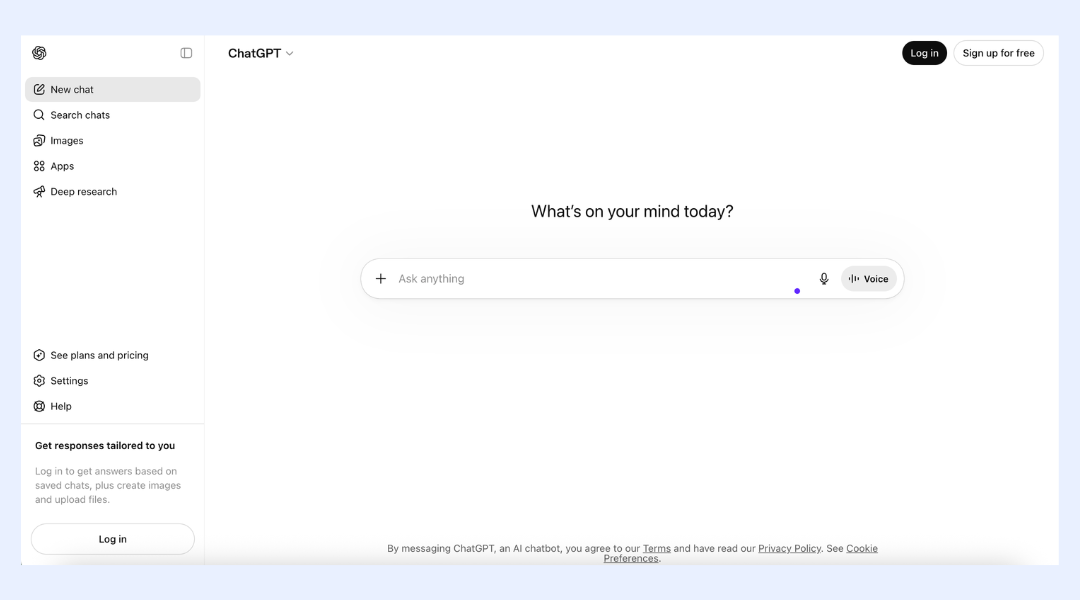
Image source: chatgpt.com
Jasper: For teams that need a more specialized copywriting environment, Jasper stands out. It is built specifically for marketing formats. You can establish specific brand voices, load your own style guides, and use templates designed for Facebook ads, email subject lines, or long-form blog posts. It keeps the copy tightly aligned with your established tone, which is critical when scaling content production.
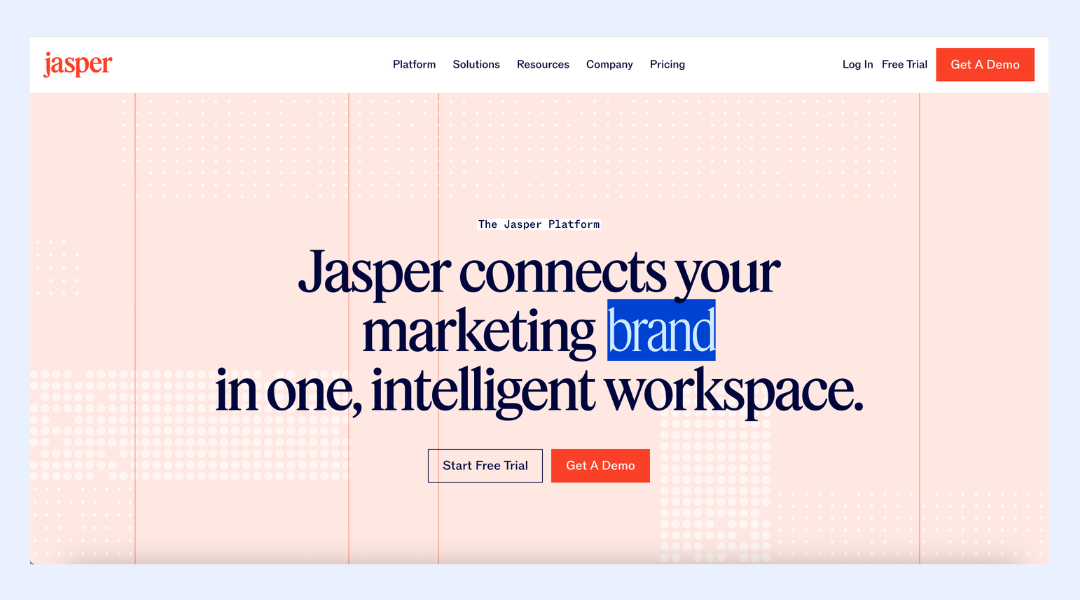
Image source: jasper.ai
Grammarly: Far beyond a spell-checker, its AI engine helps enforce tone and style guidelines across your entire content team, ensuring that a brief drafted by a junior writer sounds like it belongs to your brand.
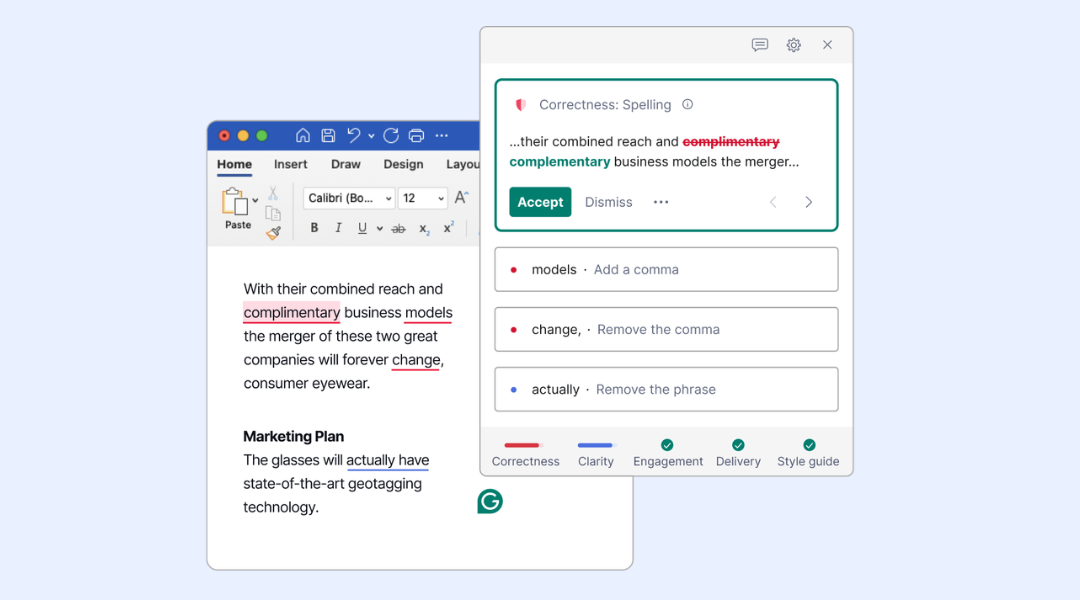
Image source: grammarly.com
Midjourney: For visual content, it provides incredibly high-quality image generation. It is essential for producing unique ad creatives, blog thumbnails, and social media assets without requiring a massive design budget or stock photo subscription.

Image source: midjourney.com
SEO and content optimization
Creating content is only half the equation; getting it to rank requires data-driven optimization. AI is exceptionally good at analyzing search engine result pages (SERPs) and identifying exact content gaps.
Semrush: I look at Semrush as the radar for your marketing strategy. Its AI-powered competitive analysis tools allow you to identify exactly what keywords your competitors are ranking for and where your own content is falling short. It handles the broad, macro-level SEO research that dictates what topics you should cover next.
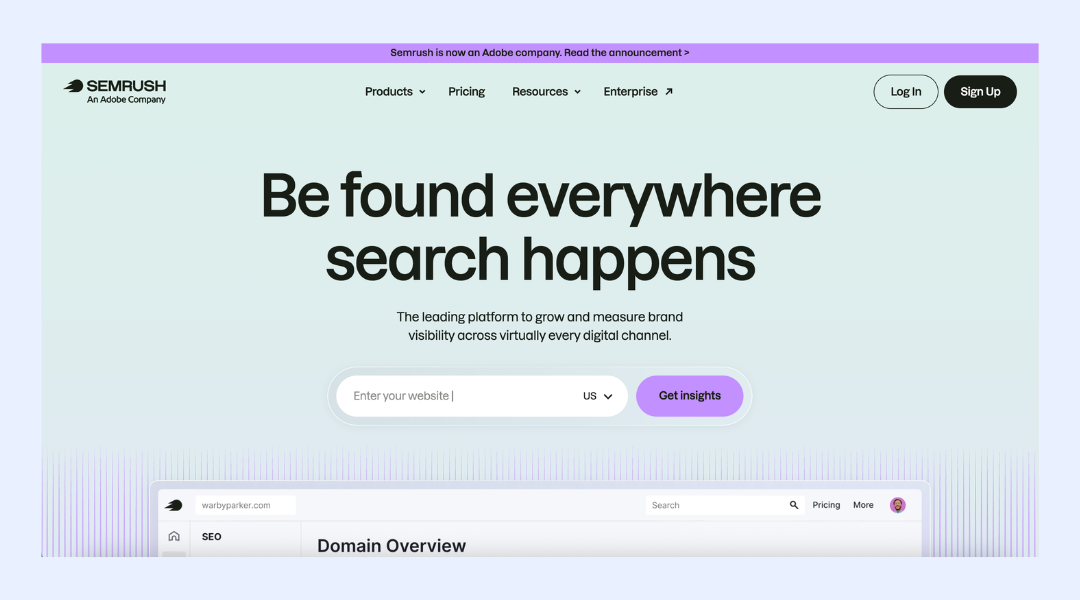
Image source: semrush.com
Surfer SEO: While Semrush tells you what to write about, Surfer SEO tells you how to write it. As you draft your article, Surfer uses AI to benchmark your text against the top-ranking pages in real-time. It suggests specific keyword densities, header structures, and word counts, taking the guesswork out of on-page optimization.
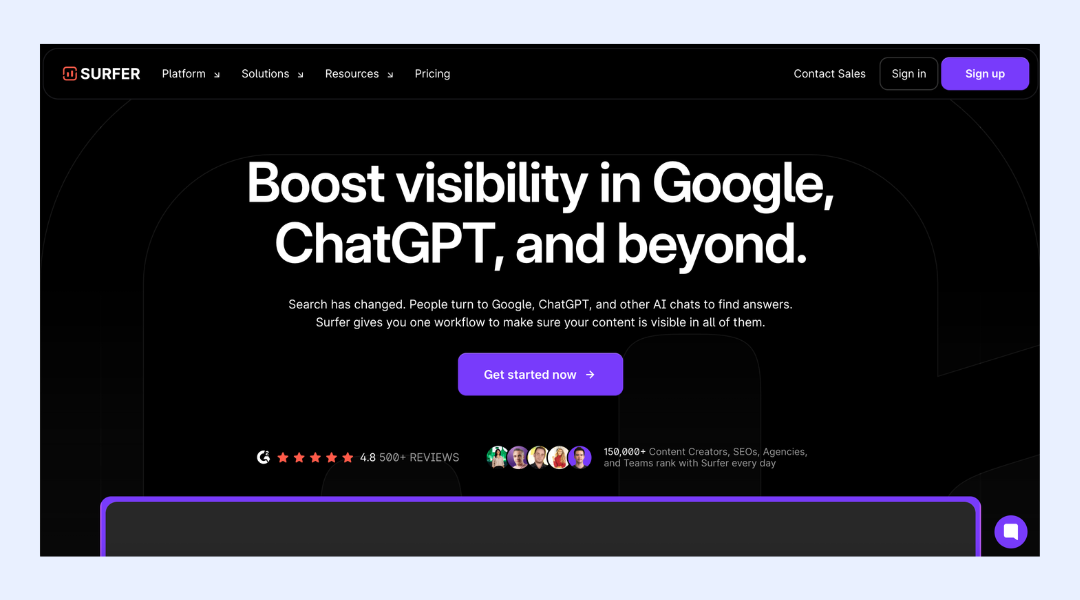
Image source: surferseo.com
Clearscope: Highly effective for content grading. It analyzes real-time search data to tell your writers exactly which secondary keywords and entities need to be included to meet the user's search intent fully.
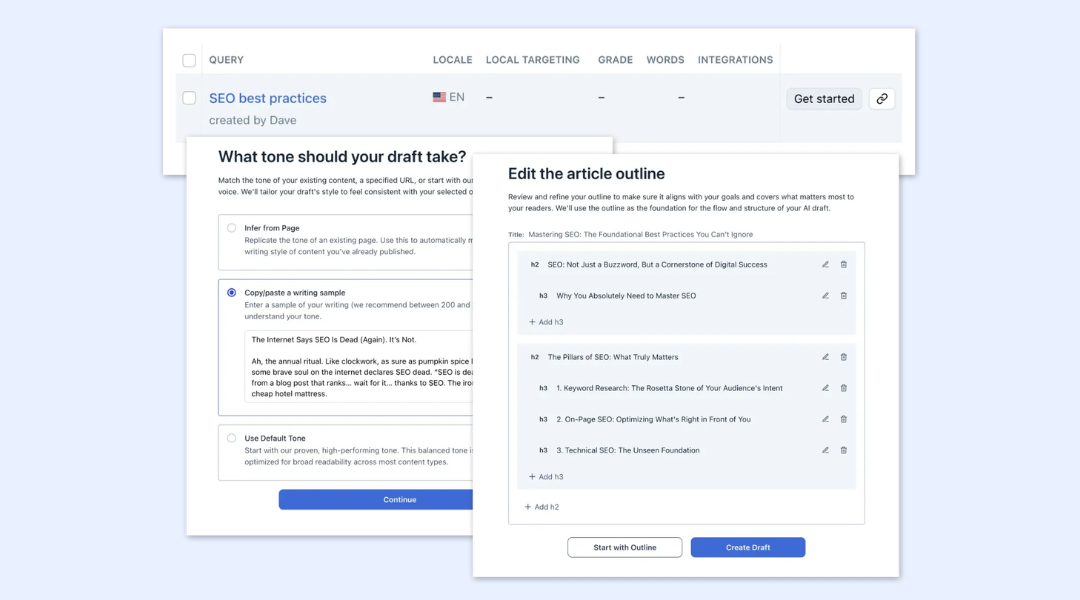
Image source: clearscope.com
Customer engagement and social listening
Marketing does not stop when you hit publish. You need to know how the market is reacting and you need systems to engage with prospects efficiently.
Brandwatch: This tool acts as the ear to the ground for your digital campaigns. It uses AI sentiment analysis to scan social media conversations, forums, and reviews to tell you exactly how people feel about your brand or a specific campaign. It turns qualitative noise into quantitative data you can act on.
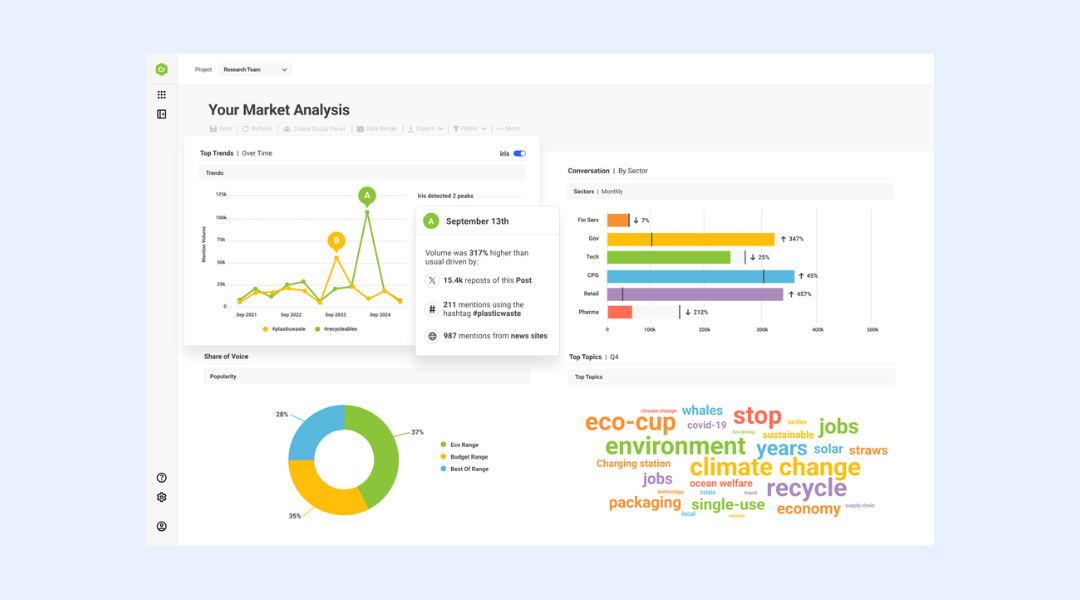
Image source: brandwatch.com
Manychat: For active engagement, Manychat allows you to build automated, AI-driven chatbot funnels for platforms like Instagram and Facebook Messenger. If a user comments on your ad, the bot can instantly direct-message them a discount code or answer a pricing question, keeping the lead warm without requiring a human to sit at a keyboard 24/7.
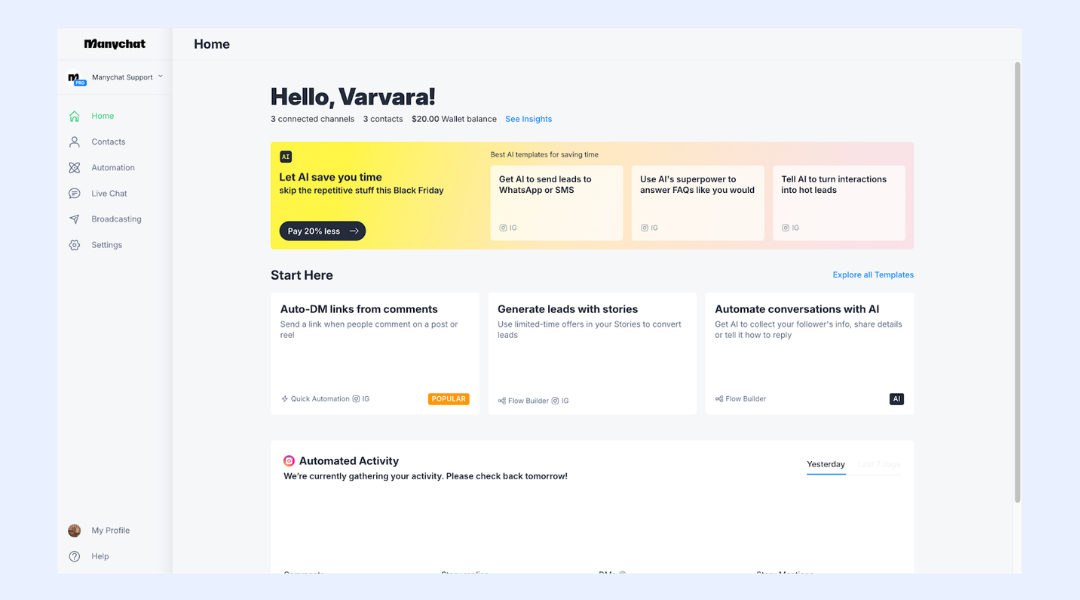
Image source: manychat.com
Sprout Social: Beyond scheduling, its AI features surface the most critical mentions and analyze social sentiment at a macro level, saving community managers hours of manual tagging.
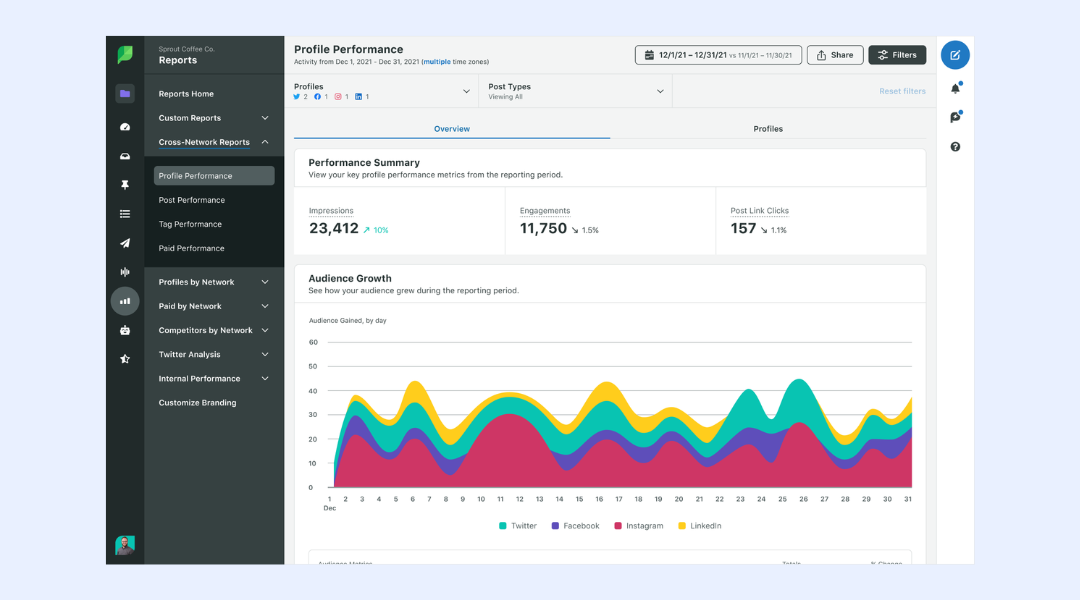
Image source: sproutsocial.com
Connecting your tech: The role of a unified marketing workspace
If you subscribe to all the tools listed above, you have successfully solved several specific marketing problems—but you have also just created a dozen new tabs for your team to navigate. We are back to the core issue: fragmented tool stacks.
Transitioning from single-point solutions to an integrated environment is the only way to scale without burning out your staff. This is where a unified workspace becomes your most valuable asset.
I point many growing SMEs and enterprise teams toward Lark as this foundational layer. Rather than duct-taping different apps together, Lark is an all-in-one suite that combines messaging/chat, video meetings, cloud-native documents and sheets, calendar, email, wiki, approval workflows, goal/OKR tracking, and automation tools into a unified workspace. It brings a level of cohesion that point solutions simply cannot offer.
Consider a global campaign collaboration scenario. You have a product marketer in New York, a designer in London, and a paid media specialist in Tokyo. With Lark, they do not need to switch between an email thread, a third-party translation app, and a standalone project management board. They can draft the campaign in a cloud-native doc, tag each other, and discuss the asset in a chat window that features built-in AI translation. Everyone reads and responds in their native language in real-time.
With a G2 rating of 4.5/5 and a Capterra rating of 4.4/5, it is clear that teams are finding massive value in bringing their workflows under one roof rather than managing a bloated software portfolio.
How to automate a marketing campaign workflow from start to finish
To see how powerful consolidation is, let us break down a realistic marketing campaign workflow. We will move away from abstract concepts and look at exactly how a campaign moves from an idea to a tracked objective using an integrated system.
Phase 1: Ideation and brief drafting
Everything starts in a collaborative document. Instead of sending a static file back and forth, the marketing manager opens a cloud-native doc within their unified workspace. They drop in the keyword research they pulled from an SEO tool and write the creative brief. The copywriter, designer, and SEO lead all jump into the same document, leaving comments and finalizing the deliverables together.
Phase 2: Budget approval and sign-off
Here is where most campaigns stall. The team needs $5,000 for ad spend, which usually means chasing a director via email. In a unified system, this is automated. Using Lark Base paired with an Approval workflow, the project lead submits the budget request directly from the campaign tracker. The marketing director receives an automated notification right inside their daily chat interface. They review the attached brief, click "Approve," and the workflow immediately updates the project status and notifies the finance team.
Phase 3: Launch and reporting automation
Once the campaign is live, the focus shifts to tracking. Because the team's goal tracking is built into the same platform, the campaign metrics are tied directly to the quarter's OKRs. The team sets up an automation that pulls weekly performance data into a dashboard. Every Monday morning, an automated message hits the team chat with a summary of the campaign's progress against their target OKRs, ensuring everyone knows exactly where the metrics stand without needing to call a status meeting.
Conclusion
Building a modern marketing tech stack is about curation, not accumulation. Buying every new AI application will only fragment your team's focus and inflate your budget. Instead, prioritize integration. Take time this week to audit your current software subscriptions. Identify overlapping tools, calculate the true cost of context switching, and consider moving your team into a unified workspace. The right technology should make your marketing operations quieter, clearer, and far more effective.
FAQs
Can I use AI for digital marketing?
AI can automate and improve keyword research and content optimization by analyzing user behavior, along with creating meta tags and headings. Marketers can also use it to predict SEO trends, user behavior, and algorithm updates through predictive SEO.
What is the 70/20/10 rule in digital marketing?
At a high level, the 70 20 10 marketing rule divides your marketing efforts into three clear buckets: 70% focused on what already works. 20% dedicated to improving and scaling promising initiatives. 10% reserved for experimentation and innovation.
What are the 5 C's of digital marketing?
The backbone of digital marketing strategy is our 5 C's: Content, Context, Community, Connection, and Conversion. These principles help businesses create their campaigns which will match the desires of their audience. They make sure the content not only has its eyes on the prize but also the ears of the audience.
What are the 5 pillars of digital marketing?
We've seen how the main pillars of digital marketing — content marketing, email marketing, SEO, social media, and paid advertising- are essential for building a successful online presence. Each contributes uniquely to attracting, engaging, and converting customers in today's highly competitive digital landscape.
What is the 3 3 3 rule in marketing?
The 3-3-3 rule in marketing is a strategic framework designed to reduce complexity and increase effectiveness by focusing on three core pillars: 3 key messages, 3 target audience segments, and 3 primary marketing channels. By limiting variables, this approach ensures consistent, clear branding and better audience retention.
What AI type is trending now?
AI, agentic AI
AI that proactively anticipates needs and makes decisions autonomously will likely become a core part of personal and business life. Agentic AI refers to systems composed of specialized agents that operate independently, each handling specific tasks.
Related reading
Table of contents
Start using Lark today

Manage all your work in one place
Boost team efficiency by 10x
Save up to 70% on software costs
Table of contents
Start using Lark today
Manage all your work in one place
Boost team efficiency by 10x
Save up to 70% on software costs
Keep reading








2026 Lark Technologies Pte. Ltd.
Headquartered in Singapore with offices worldwide.






Explore: