














Compliance Management Software: An Ultimate Guide

Fecilia Clarke
Solutions Marketing Specialist
Sep 18, 2026
Fecilia Clarke
Sep 18, 2026

22 min read


Compliance is no longer a back-office function that surfaces only at audit time. It's woven into everyday work—how you run meetings, manage documents, ship changes, handle customer data, and collaborate across teams and regions. As regulations evolve and stakeholder expectations rise, organizations that treat compliance as a native capability within their workflows move faster, reduce risk, and build trust.
Traditional approaches rely on a patchwork of spreadsheets, scattered evidence, and siloed tools. That model strains under scale and complexity. Compliance management software brings structure, automation, and visibility to this reality. And when those capabilities live inside the same platform where your teams already chat, meet, share, and task—like Lark—the burden drops even further. Decisions turn into traceable records, collaboration generates audit-ready context, and routine operations produce evidence by default.
In this guide, we explore how compliance management software works, what features matter, and how to evaluate options We also share a workflow-centric perspective: how Lark embeds compliance within daily work so teams stay productive while staying compliant.
1. Lark: A unified workspace that embeds compliance directly into daily workflows
2. ServiceNow GRC: An enterprise-grade governance, risk and compliance solution
3. OneTrust: The market leader in privacy, security and third-party risk management
4. Vanta: Automated security compliance for technology companies
5. Cflow: A workflow automation platform with compliance applications
6. Complinity: A specialized compliance platform for food safety and quality management
7. Libryo: A regulatory intelligence platform for environmental, health and safety compliance
8. Risk Hawk: An integrated GRC platform for risk management and compliance automation

What is compliance management software?
Compliance management software is a centralized system that helps you translate obligations into day-to-day operations. It maps regulations and standards to controls and workflows, orchestrates tasks and approvals, captures evidence with context, and surfaces real-time status for leaders and auditors.
Manual, checklist-driven approaches worked when obligations were narrower and teams smaller. Today, organizations juggle multiple frameworks across jurisdictions, each with unique reporting, evidence, and timing. Modern platforms consolidate frameworks, align them to a unified control library, and use automation to ensure consistent, repeatable execution, often integrating smoothly with project managment tools to align compliance tasks with broader project workflows. The shift is from reactive fire drills to proactive, always-ready assurance.
As for how compliance management software works, there is a practical view:
- Obligations: Privacy, security, financial, and industry-specific requirements.
- Controls: The policy, process, and technical measures that address those obligations.
- Workflows: Recurring tasks, attestations, approvals, and reviews performed by control owners.
- Evidence and reporting: Artifacts captured at the moment work happens, tied to controls and time periods, summarized in dashboards and reports.
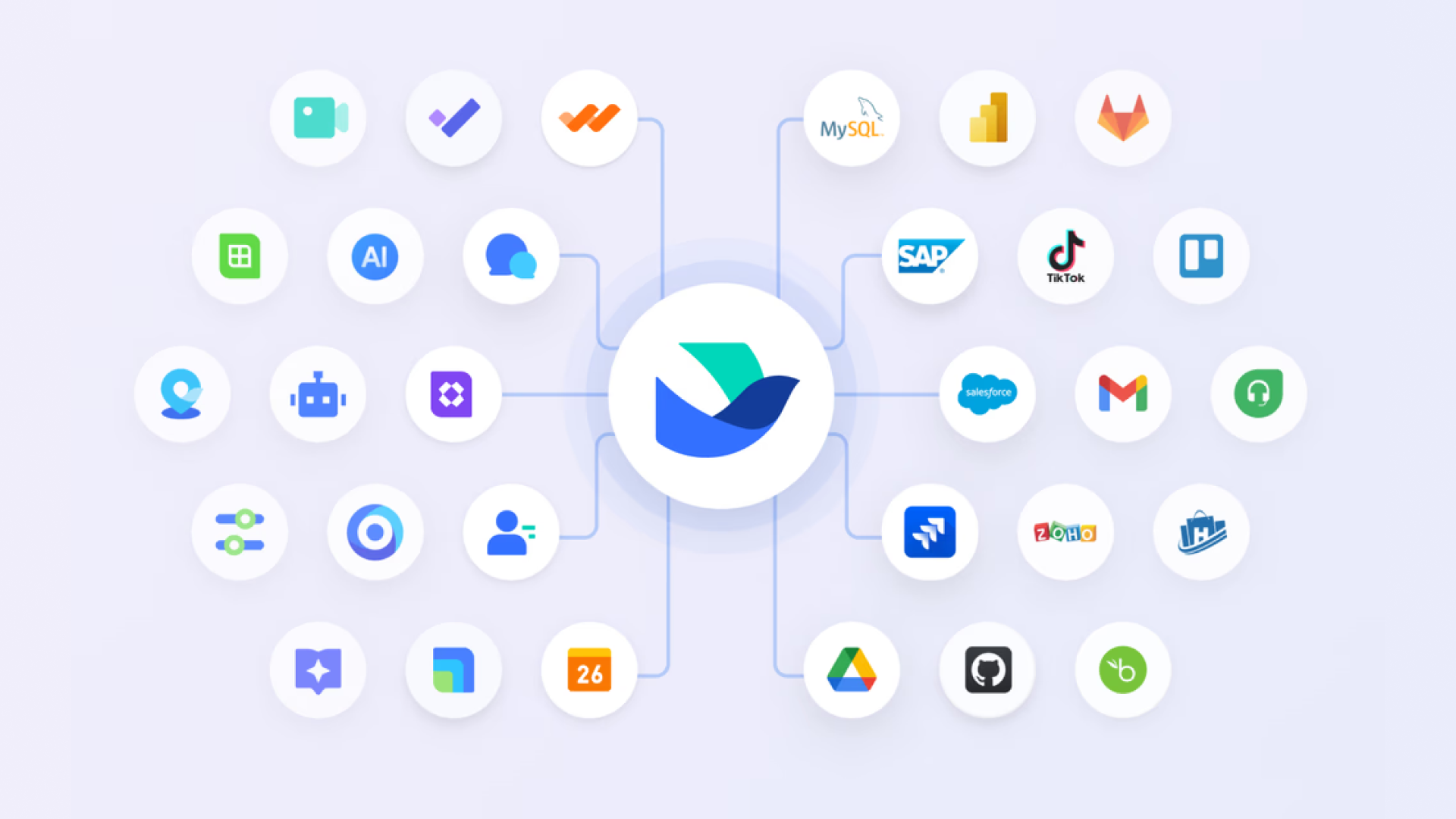
Modern compliance platforms like Lark, ServiceNow GRC, and OneTrust exemplify this unified approach. These systems integrate compliance capabilities directly into operational workflows. For instance, in a platform like Lark that combines chat, meetings, docs, and databases, everyday work activities—such as meeting decisions, document approvals, and task completions—automatically generate time-stamped, attributable records. When these records are structured within the platform's database, organizations achieve both operational efficiency and a continuous audit trail without requiring employees to switch between different applications or perform manual evidence collection.
Why compliance management software is essential for trust and resilience
- Stakeholder trust: Customers, partners, and regulators increasingly want demonstrable control and transparency.
- Operational resilience: Integrated workflows reduce missed steps, accelerate response to change, and scale with growth.
- Strategic impact: Strong compliance foundations open markets, speed certifications, and reduce the drag from fragmented processes.
Essential features of compliance management software
Policy and document control with versioning and approvals
- Central repository with version history, approvals, and role-based access
- Structured acknowledgment workflows for employees and vendors
- Links between policies, procedures, controls, and training
- Search and tagging for quick audit responses
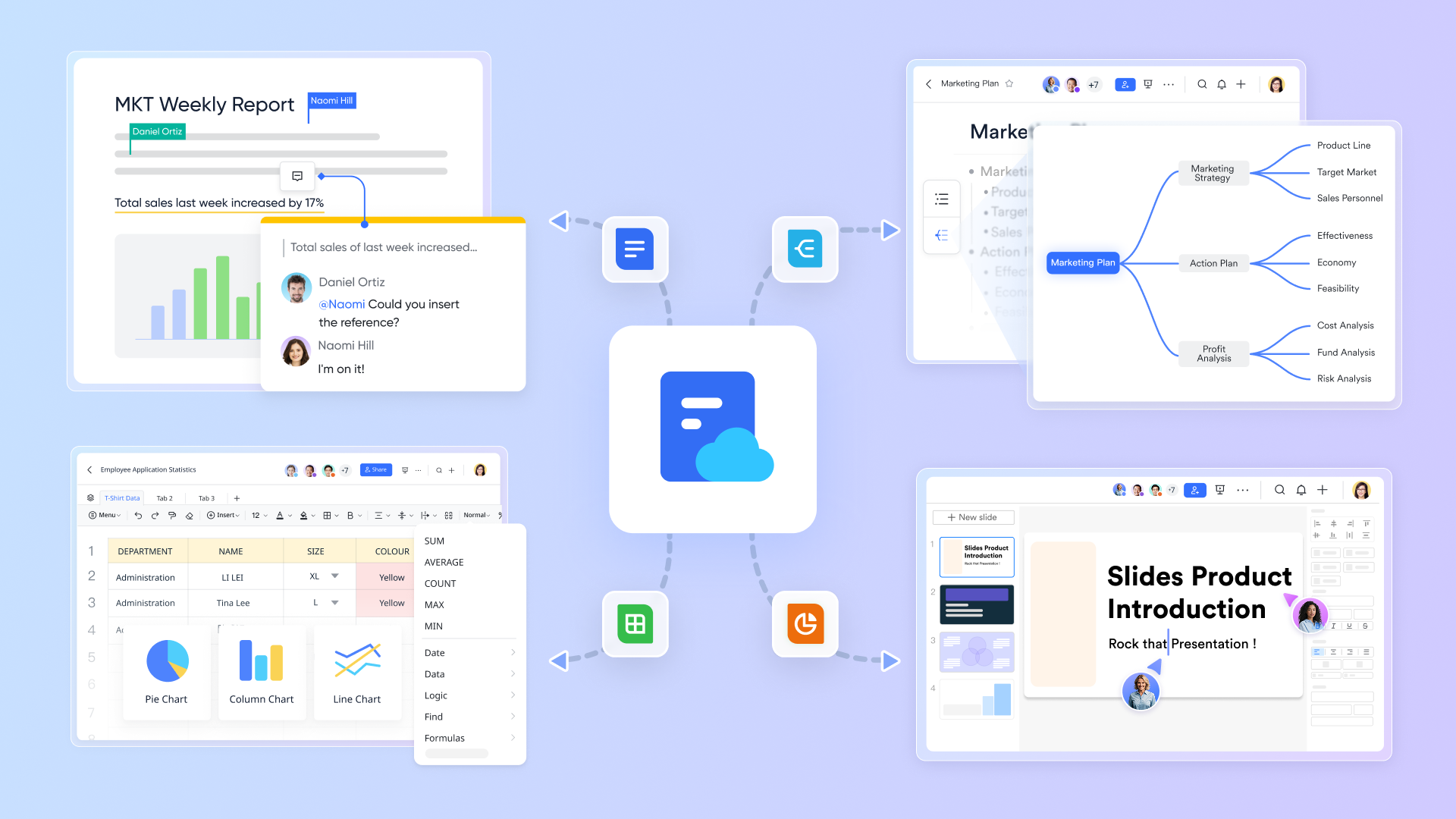
How it works in practice: In a unified platform like Lark, policies managed in Docs with full version control and commenting can be directly linked to control records and training materials. Employee acknowledgments are tracked through structured forms or tasks, creating a traceable path from a policy to its implementation—all within the same environment.
Automated workflows for control testing, risk assessment, and audits
- Recurring schedules for access reviews, change approvals, and risk assessments
- Conditional routing based on responses or risk scores
- Reminders, escalations, and ownership transfers
- Embedded evidence captured inside each workflow step
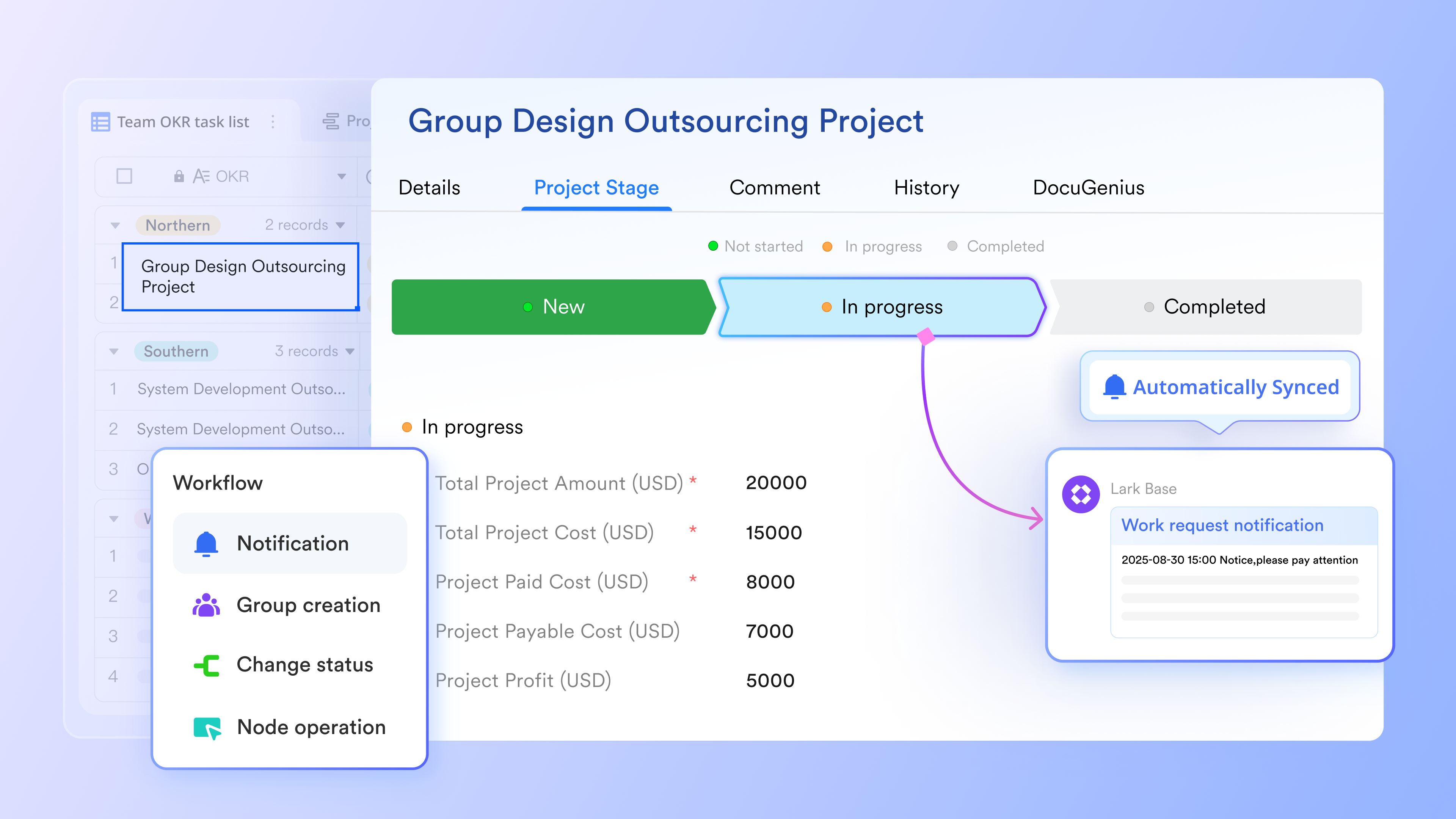
Putting automation into action: Using a flexible base system, teams can build no-code workflows that automatically assign quarterly access reviews to managers, route approvals based on risk scores, and send reminders via chat. Each completed task captures evidence directly in the record, turning process into provable practice.
Reporting and dashboards for real-time compliance visibility
- Role-based dashboards for leadership, control owners, and auditors
- Coverage views by framework, control family, and business unit
- Drill-down to evidence for fast validation
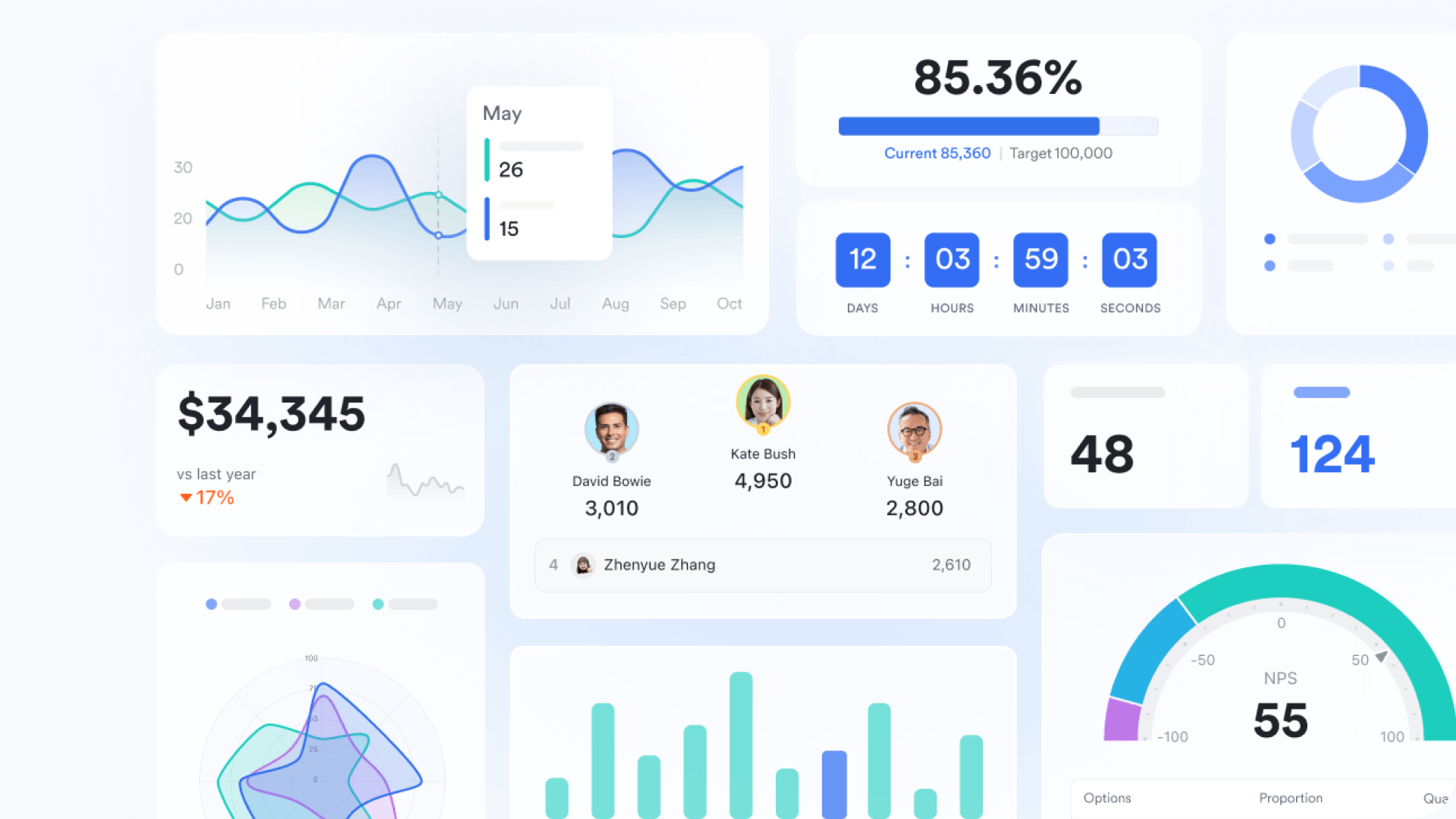
Gaining insights: In Lark, custom dashboards built directly into the workflow database visualize metrics like control completion rates and exception trends. Because documents, tasks, and approvals are natively linked to records, auditors and leaders can drill down into supporting evidence without switching tools.
Audit evidence management
- Collection: Inline evidence capture with metadata (control ID, period, owner)
- Tagging: Version locks and approved copies
- Retention: Retention schedules and legal holds
Streamlining evidence collection: When work happens in a unified platform, meeting notes, task completions, and document edits naturally become time-stamped evidence. Final approvals can lock evidence packages for the audit period, while retention policies ensure information governance is maintained.
Best compliance management tools in 2026
The landscape of compliance management software in 2025 offers robust solutions for organizations of all sizes. Here's a look at some of the leading options and how they compare.
1. Lark: A unified workspace that embeds compliance directly into daily workflows
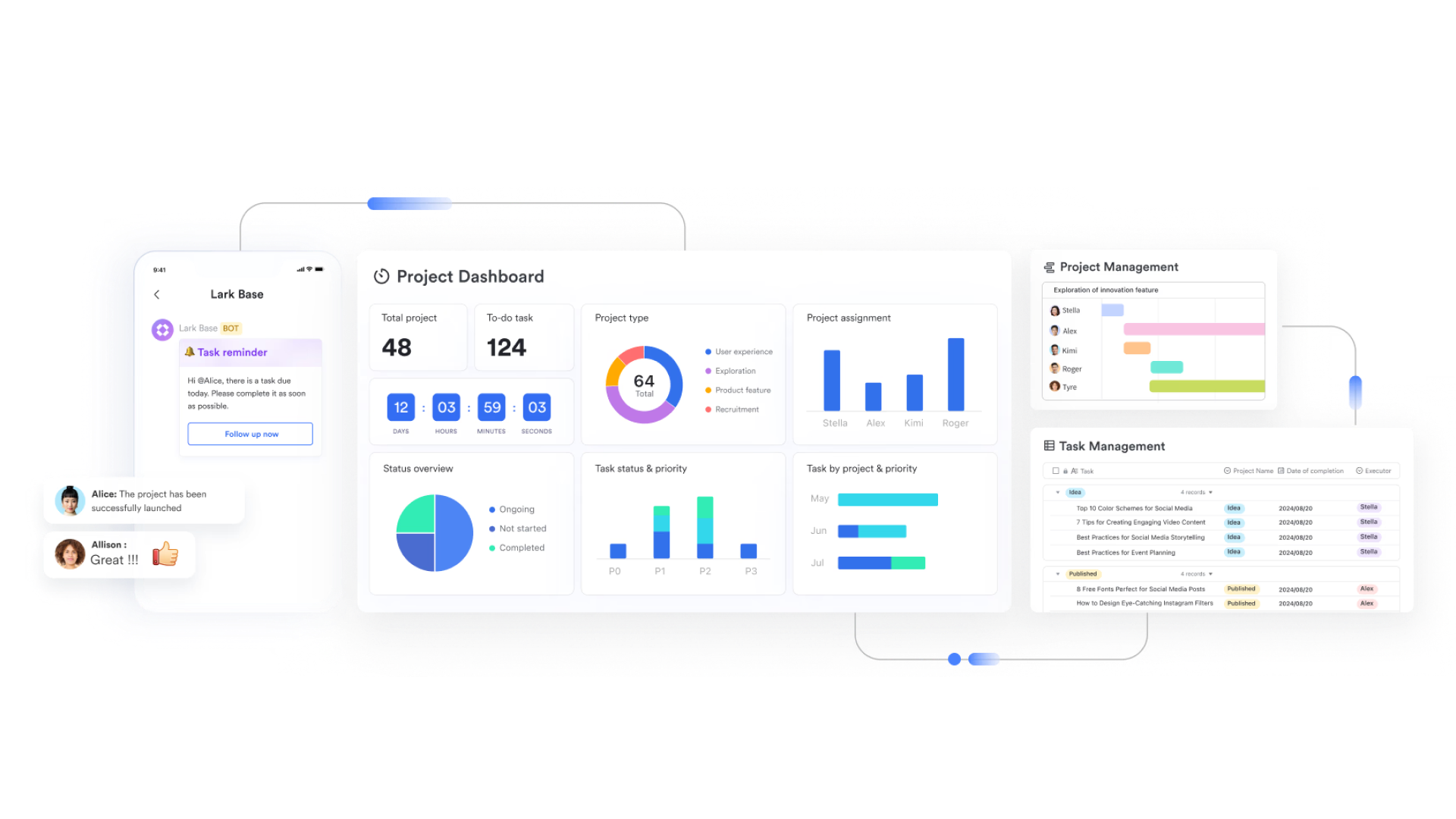
Lark transforms compliance from a separate activity into a natural byproduct of collaborative work. Its integrated environment connects chat, meetings, docs, and Lark Base - a flexible database for building no-code compliance workflows. This unified approach automatically generates audit-ready evidence from daily operations like meeting decisions and task completions. Teams maintain productivity while staying compliant, eliminating context switching and manual evidence collection across disparate systems. Lark's design is particularly valuable for fast-growing companies seeking to scale compliance without adding administrative burden.
The unified workspace: The digital foundation for compliance
This is the bedrock upon which all compliance functions are built. Lark integrates traditionally siloed contexts into a single, cohesive environment.
Core components:
- Lark Messenger: Serves as the central nervous system for real-time discussions, notifications, and escalations, with all conversations being traceable and linkable to specific records.
- Lark Docs: Provides a dynamic environment for creating, collaborating on, and version-controlling policies, SOPs, and runbooks with inline comments.
- Lark Base: Acts as the compliance "operating system," a flexible database for building control libraries, workflows, issue trackers, and dashboards.
- Lark Calendar & Lark Meetings: Used for scheduling control reviews; meeting notes and recordings become direct evidence of management oversight and decisions.
How it enables compliance:
- Eliminates data silos: A control record in Base can directly reference its related policy (Docs), and the discussion about an exception (Chat). Auditors never need to switch between systems.
- Preserves context: Conversations about a compliance issue happen in the comment thread of the relevant Base record or Docs, locking the "why" and "how" directly alongside the evidence.
The no-code compliance workflow engine
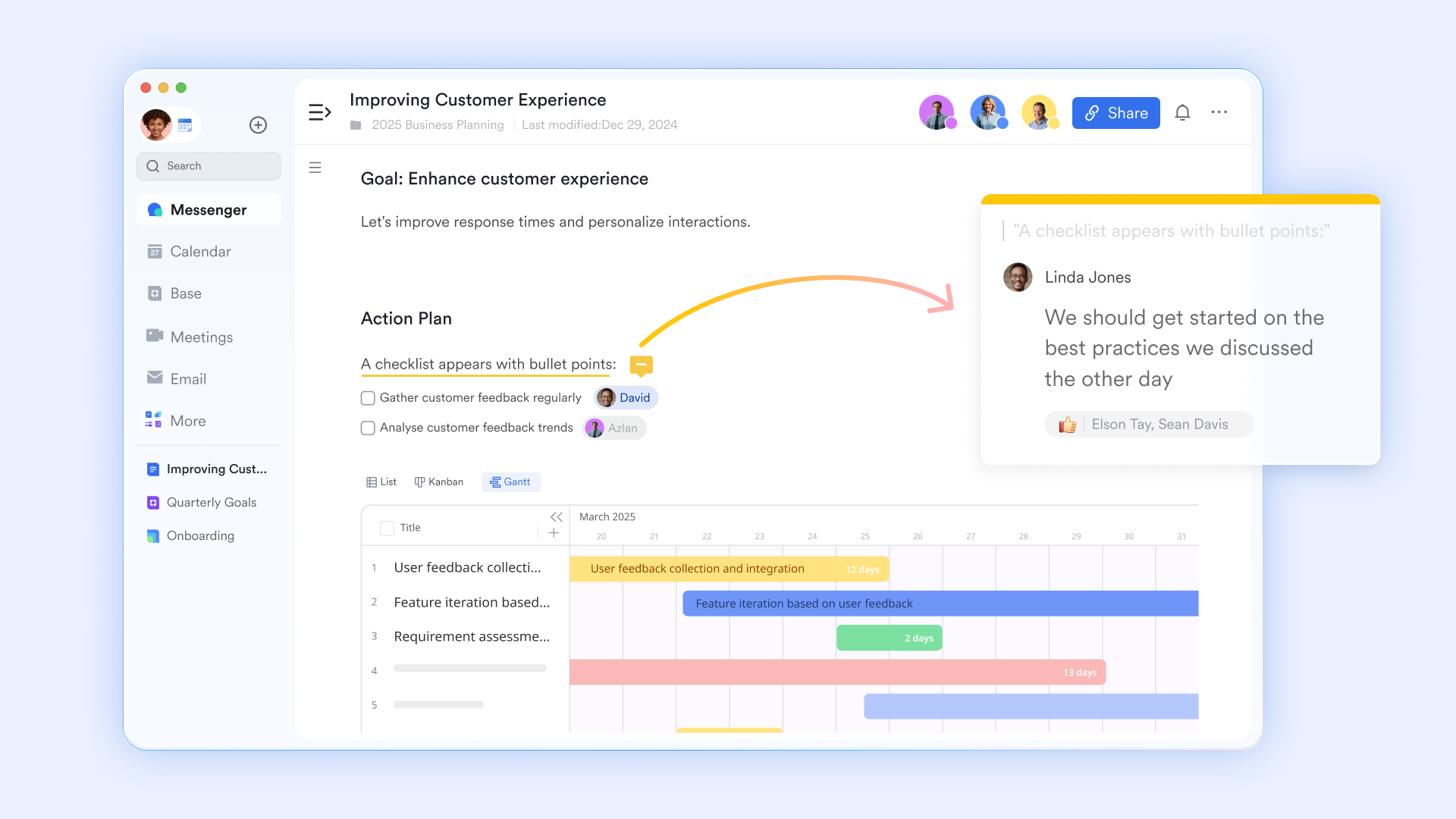
Lark Base is the powerhouse that brings structure and automation to compliance processes, moving far beyond a simple spreadsheet.
Core capabilities:
- Structured data modeling: Map your entire compliance universe by creating interconnected tables for Obligations, Controls, Risks, Issues, and Assets. For example, link a "SOC 2" framework table to multiple "Control" tables, which are then linked to an "Evidence" table.
- No-code automation:
- Time-based triggers: Automatically generate recurring tasks for monthly access reviews, quarterly risk assessments, or policy attestations.
- Condition-based triggers: Auto-assign and escalate tasks when a field changes (e.g., when an issue's status is set to "Open," notify the remediation owner).
- Approval workflows: Route policy changes, vendor onboarding, or exception requests through multi-stage approvals, with requests sent directly to Lark Chat.
- Customizable views: Create tailored views (e.g., Kanban, Gallery, Gantt) and filters for different personas—control owners see their tasks, auditors see evidence packages, and leadership sees high-level dashboards.
How Lark enables compliance:
- Transforms controls into action: A control like "Perform quarterly access reviews" becomes an automated workflow in Base that creates tasks, notifies managers in Chat, escalates overdue items, and locks completion records as evidence.
- Enables end-to-end tracking: Manage the entire lifecycle of an issue—from identification and root-cause analysis to remediation planning, task assignment, and verification—within a single Base record, with a full audit trail of all related discussions.
Embedded evidence capture: Turning daily work into an audit trail
Lark's transformative power lies in turning cumbersome compliance audits into a seamless, automated outcome.
Practical scenarios:
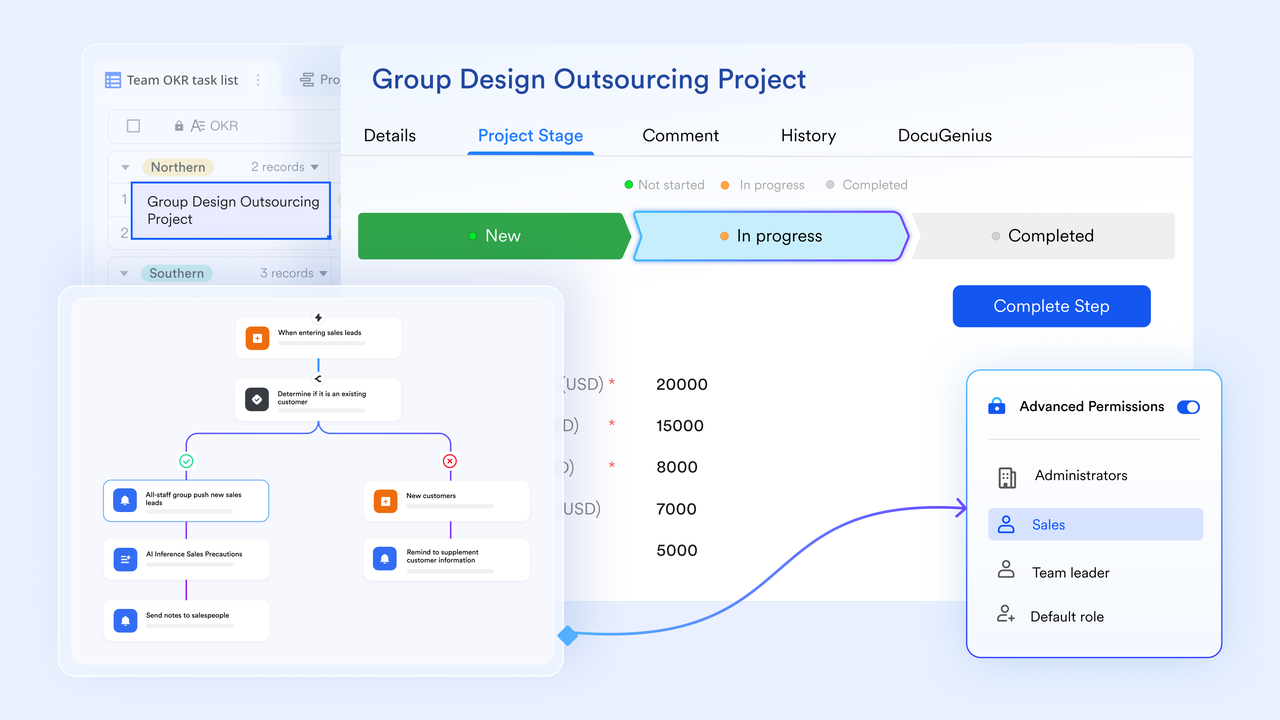
- Meeting decisions as evidence: Critical compliance decisions made in Lark Meetings are documented in the AI meeting notes or via recording/transcription. This artifact can be directly linked to the relevant control in Base, serving as immutable proof of management review.
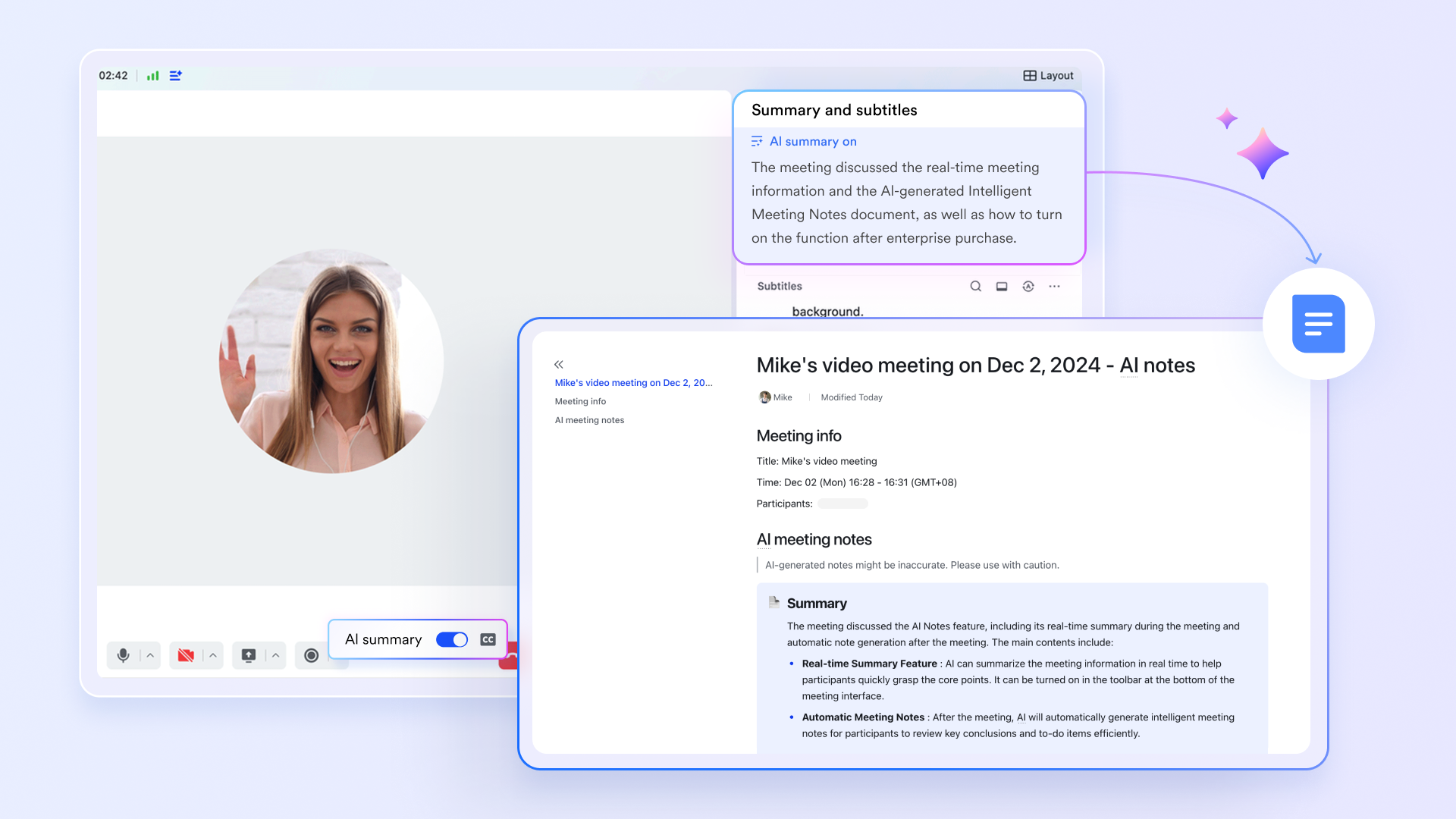
- Document collaboration as a compliance record: The entire lifecycle of a policy—drafting, reviewing, commenting, and final approval — is captured in Lark Docs with user attribution and timestamps. The final version can be "locked" for the audit period, while a working draft continues to evolve.
- Task execution proves control operation: A control is defined as a recurring task in Base. Upon completion, the owner attaches screenshots, files, or fills out a form within the task. The completion record, with its timestamp and user info, becomes direct proof that the control operated as designed.
Real-time visibility and reporting
All these streams of data converge into clear, actionable insights for stakeholders at every level.
Dynamic dashboards: Build real-time compliance dashboards directly within Lark Base using charts, kanban boards, and summary fields. Monitor KPIs like:
- Control implementation and testing completion rates.
- Volume of overdue tasks and open exceptions.
- Trends in issue identification and resolution SLAs.
Role-based visibility: Leadership gets a high-level view of compliance health, managers monitor their domain's status, and control owners see a personalized list of their responsibilities and deadlines.
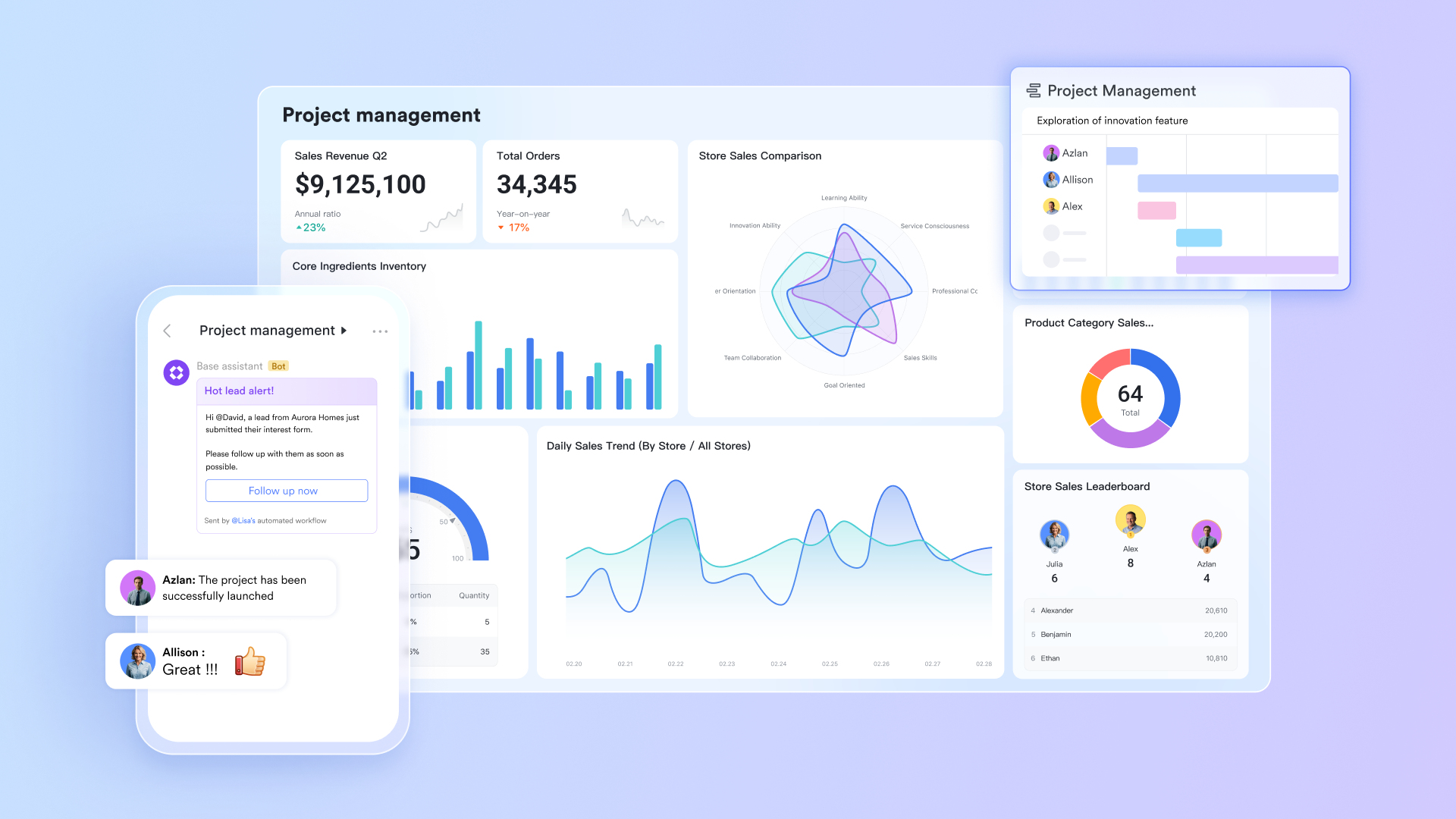
Pricing:
- Free plan: Includes 11 powerful products, supporting up to 20 users, 100 GB storage, 1,000 automation runs and unlimited AI translation in chats, docs and email.
- Paid plans: Starts at $12/user/month, supporting up to 500 users. Includes unlimited message history, 50,000 automated Base workflow executions per month.
- Enterprise plan: Contact sales for custom pricing. Supports unlimited users and includes even more automation runs and advanced security, compliance, and management features.
2. ServiceNow GRC: An enterprise-grade governance, risk and compliance solution
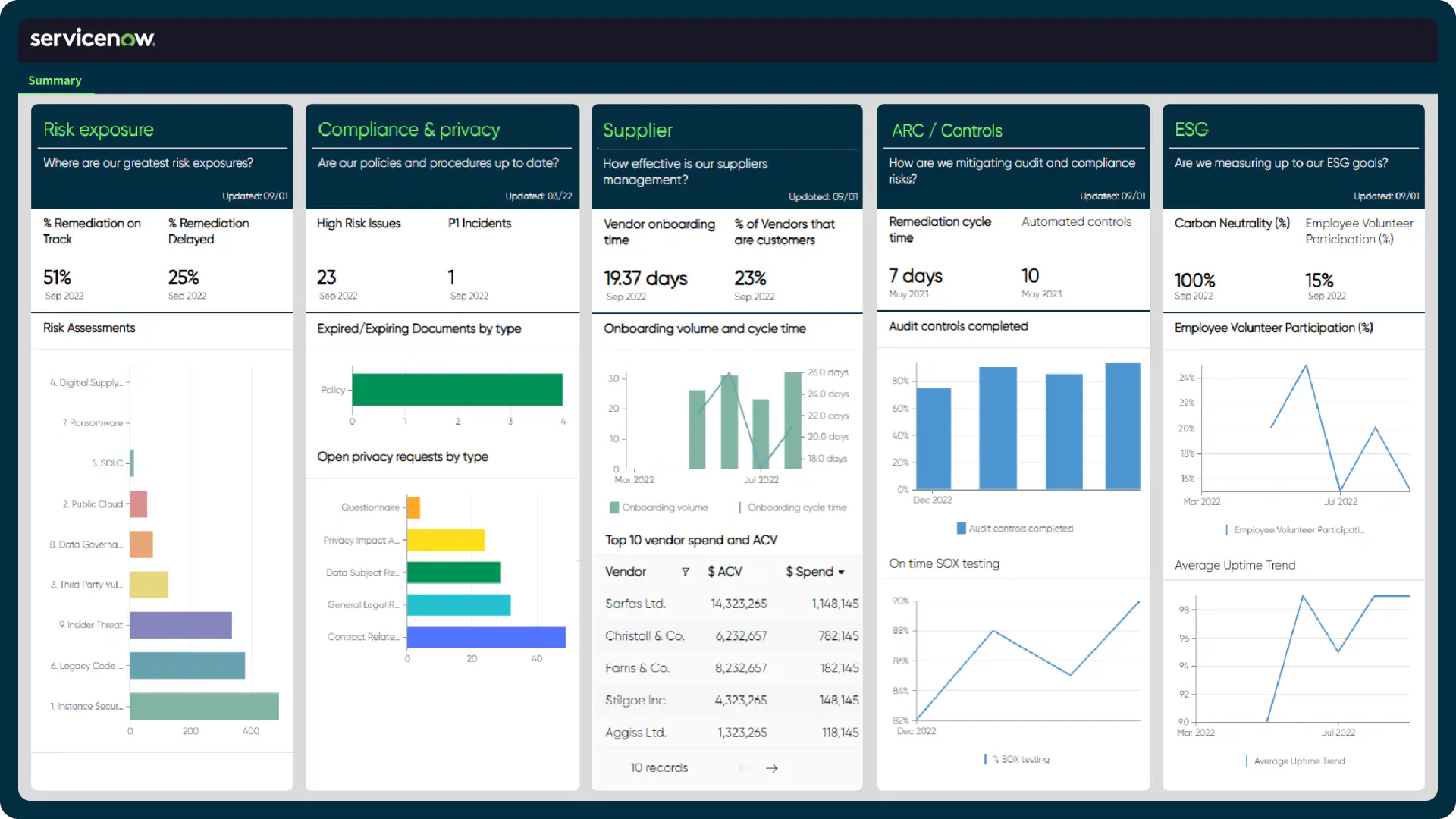
ServiceNow GRC offers robust capabilities for large organizations with complex compliance needs. Built on the ServiceNow platform, it provides integrated risk management, policy control, and audit management. The solution excels at automating compliance workflows and providing enterprise-wide visibility into risk and control environments. Its strength lies in seamless integration with IT service management processes, making it ideal for enterprises already invested in the ServiceNow ecosystem and requiring mature GRC capabilities.
Pros:
- Deep integration with IT service management
- Highly customizable for complex needs
- Strong enterprise scalability
- Comprehensive risk management
- Mature audit capabilities
Cons:
- Steep learning curve
- High implementation cost
- Requires dedicated administration
3. OneTrust: The market leader in privacy, security and third-party risk management
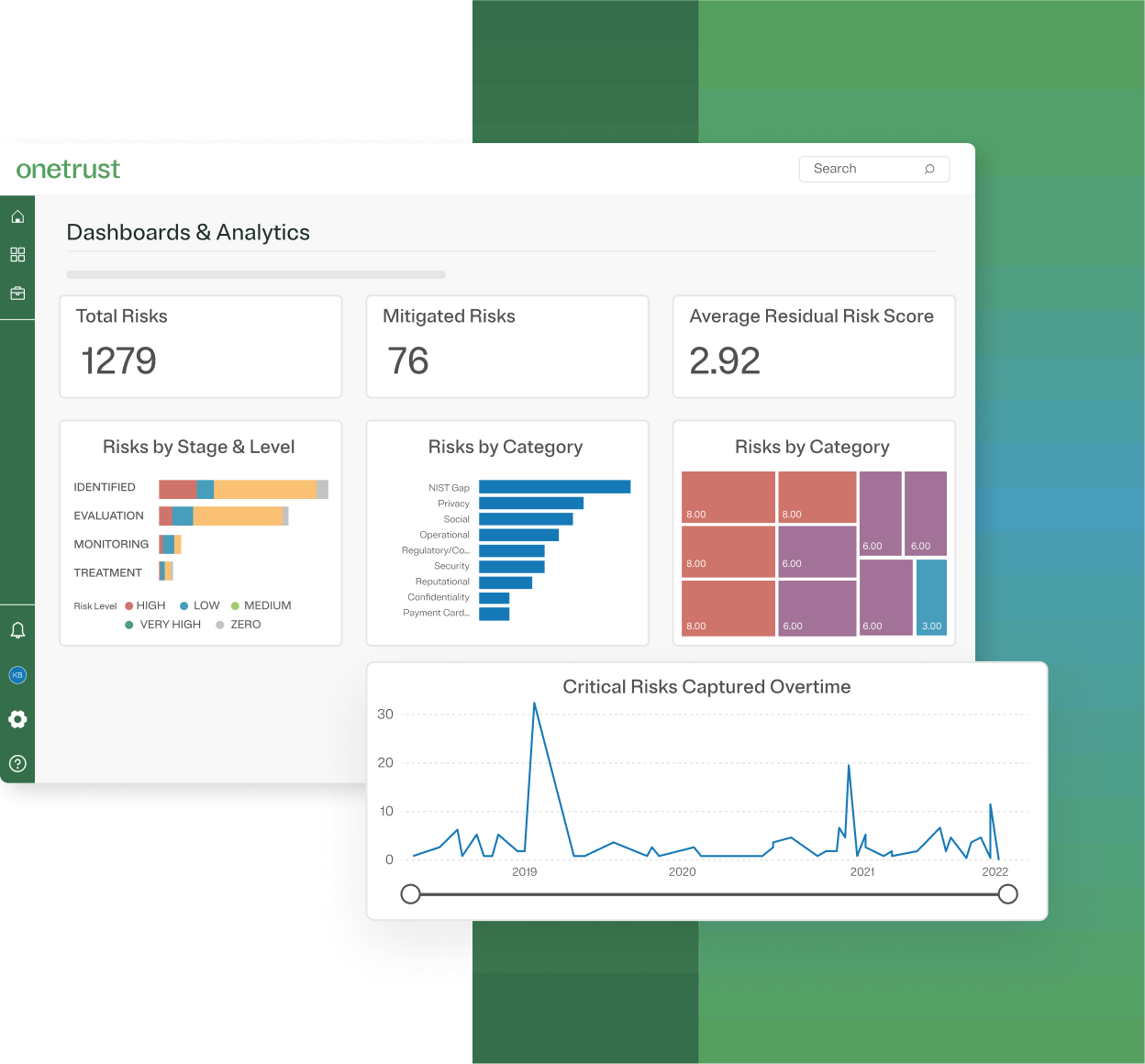
OneTrust provides an extensive suite of compliance tools, particularly strong in data privacy and governance. Its platform supports automated privacy impact assessments, consent management, and data mapping across global regulations like GDPR and CCPA. The integration of regulatory intelligence through DataGuidance keeps compliance teams updated on legal changes. OneTrust's comprehensive approach and scalability make it the go-to choice for large enterprises managing complex, multinational compliance requirements across privacy, security, and vendor risk domains.
Pros:
- Comprehensive privacy management
- Extensive regulatory intelligence
- Strong third-party risk features
- Global compliance coverage
- AI-powered automation
Cons:
- Complex module structure
- High total cost of ownership
- Can be overwhelming for smaller teams
4. Vanta: Automated security compliance for technology companies
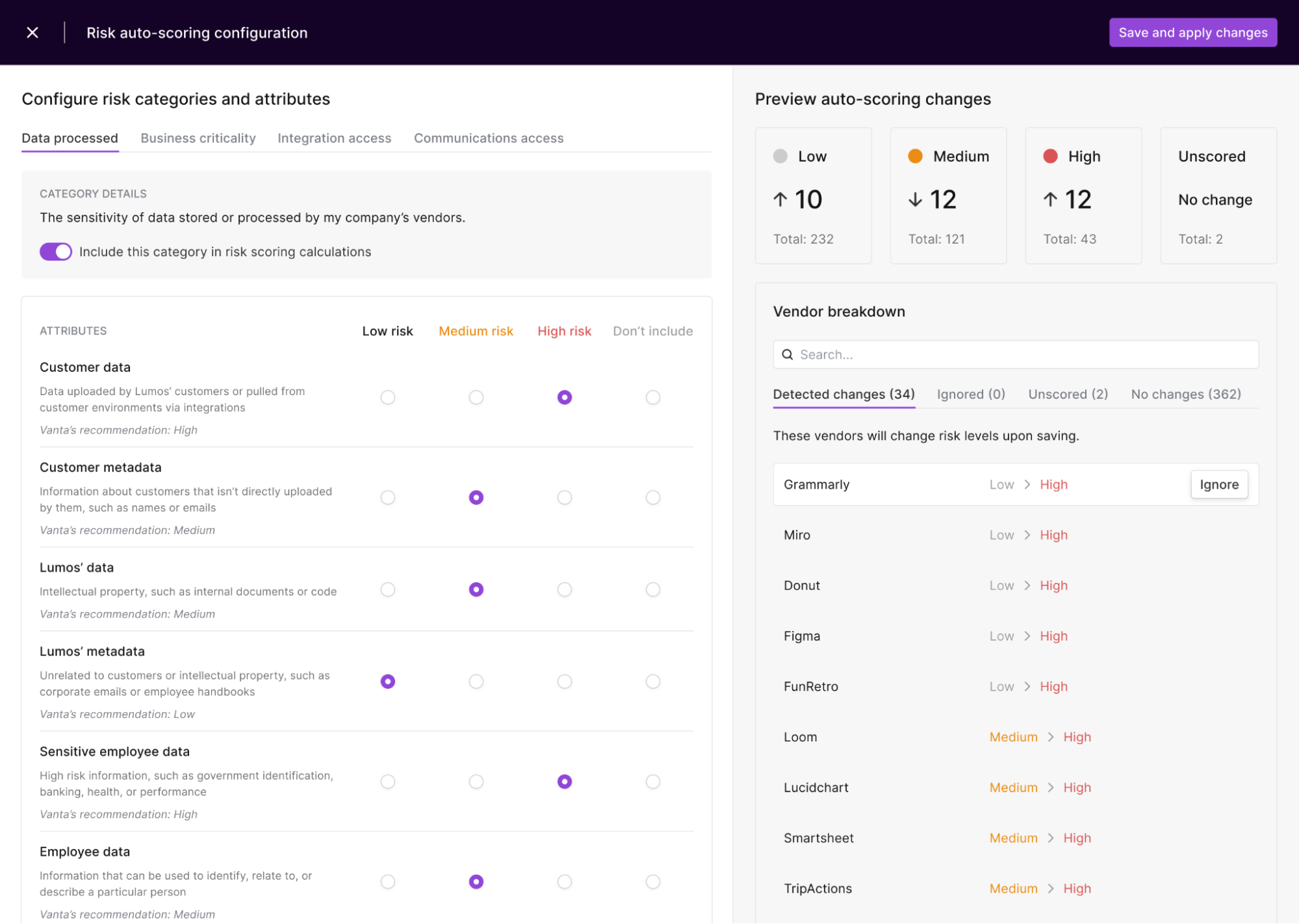
Vanta simplifies the process of achieving and maintaining security certifications like SOC 2, ISO 27001, and HIPAA. The platform automates evidence collection from cloud services and systems, continuously monitoring controls and identifying gaps. Its intuitive interface and pre-built compliance frameworks help startups and SaaS companies streamline audit preparation. Vanta's automated approach significantly reduces the time and resources needed for security compliance, making it popular among technology companies seeking to build customer trust through security certifications.
Pros:
- Rapid implementation (weeks, not months)
- Automated evidence collection
- Pre-built compliance frameworks
- User-friendly interface
- Strong customer support
Cons:
- Limited customization options
- Focused mainly on security compliance
- Can become expensive at scale
5. Cflow: A workflow automation platform with compliance applications
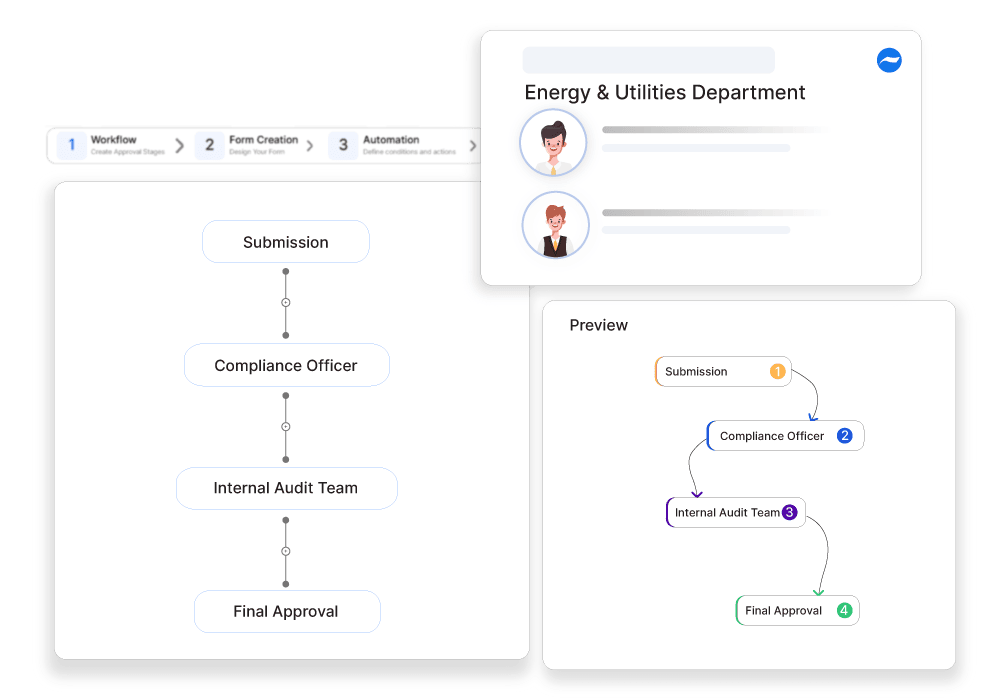
Cflow enables organizations to automate approval processes and operational compliance through visual workflow design. The no-code platform helps businesses create compliant processes for purchase orders, contract reviews, and other business operations. Its strength lies in creating transparent, auditable workflows that enforce compliance checkpoints automatically. This makes Cflow particularly useful for mid-sized companies looking to reduce manual bottlenecks while maintaining process consistency and compliance across departments like finance, HR, and operations.
Pros:
- Visual workflow builder
- Quick deployment
- Affordable pricing
- Good for operational compliance
- Minimal training required
Cons:
- Limited advanced features
- Basic reporting capabilities
- Not suited for complex GRC needs
6. Complinity: A specialized compliance platform for food safety and quality management
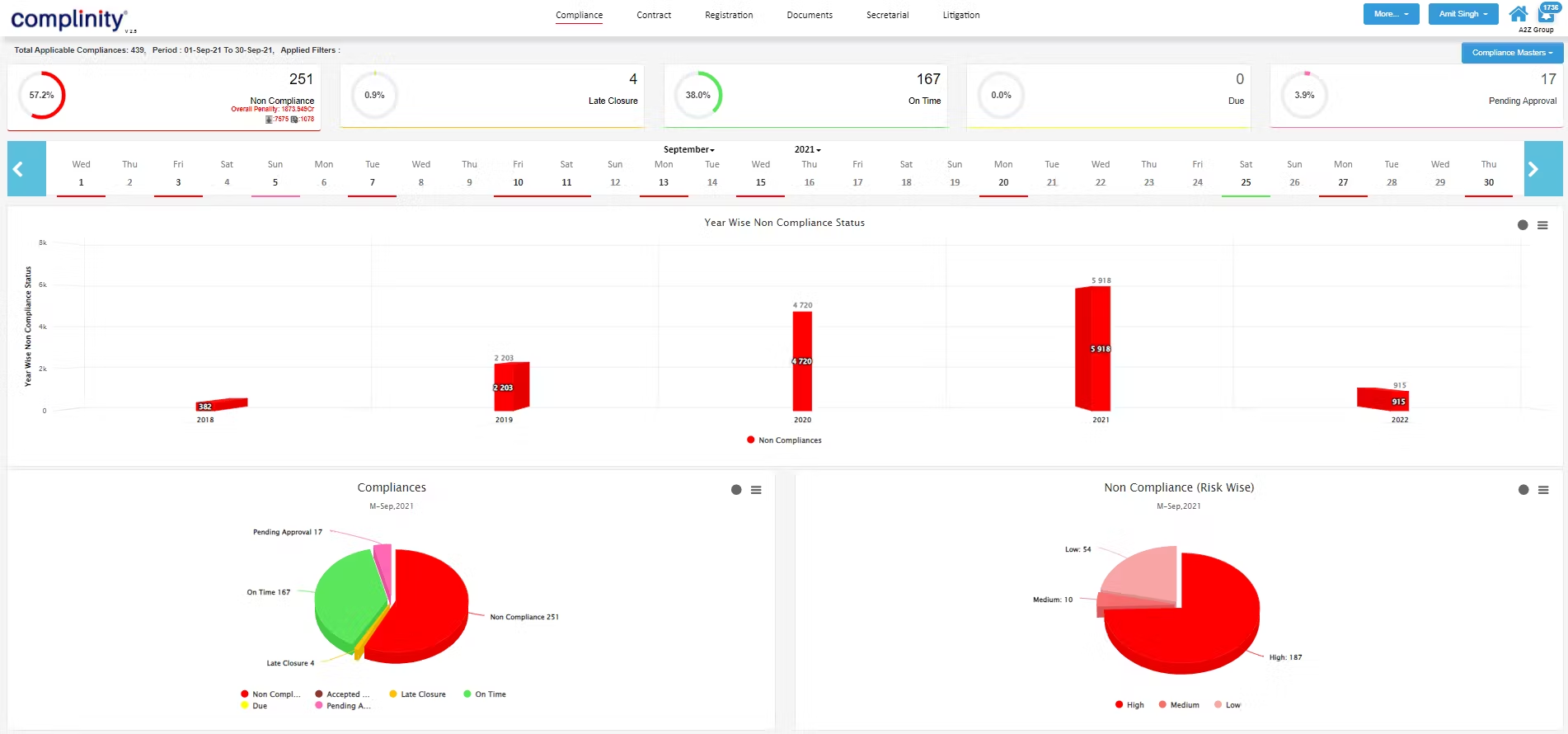
Complinity offers targeted solutions for the food and beverage industry, addressing GFSI standards and food safety protocols. Its integrated platform centralizes documentation, manages corrective actions, and streamlines audit preparation. The system provides real-time visibility into compliance status across multiple facilities, with automated alerts for deviations and expiring certificates. This industry-specific approach helps food manufacturers and processors maintain consistent quality control while reducing the administrative overhead of manual compliance tracking and reporting.
Pros:
- Industry-specific functionality
- Real-time compliance monitoring
- Multi-site management
- Automated certification tracking
- Strong corrective action features
Cons:
- Niche focus limits broader use
- Limited integration options
- Higher cost for small operations
7. Libryo: A regulatory intelligence platform for environmental, health and safety compliance
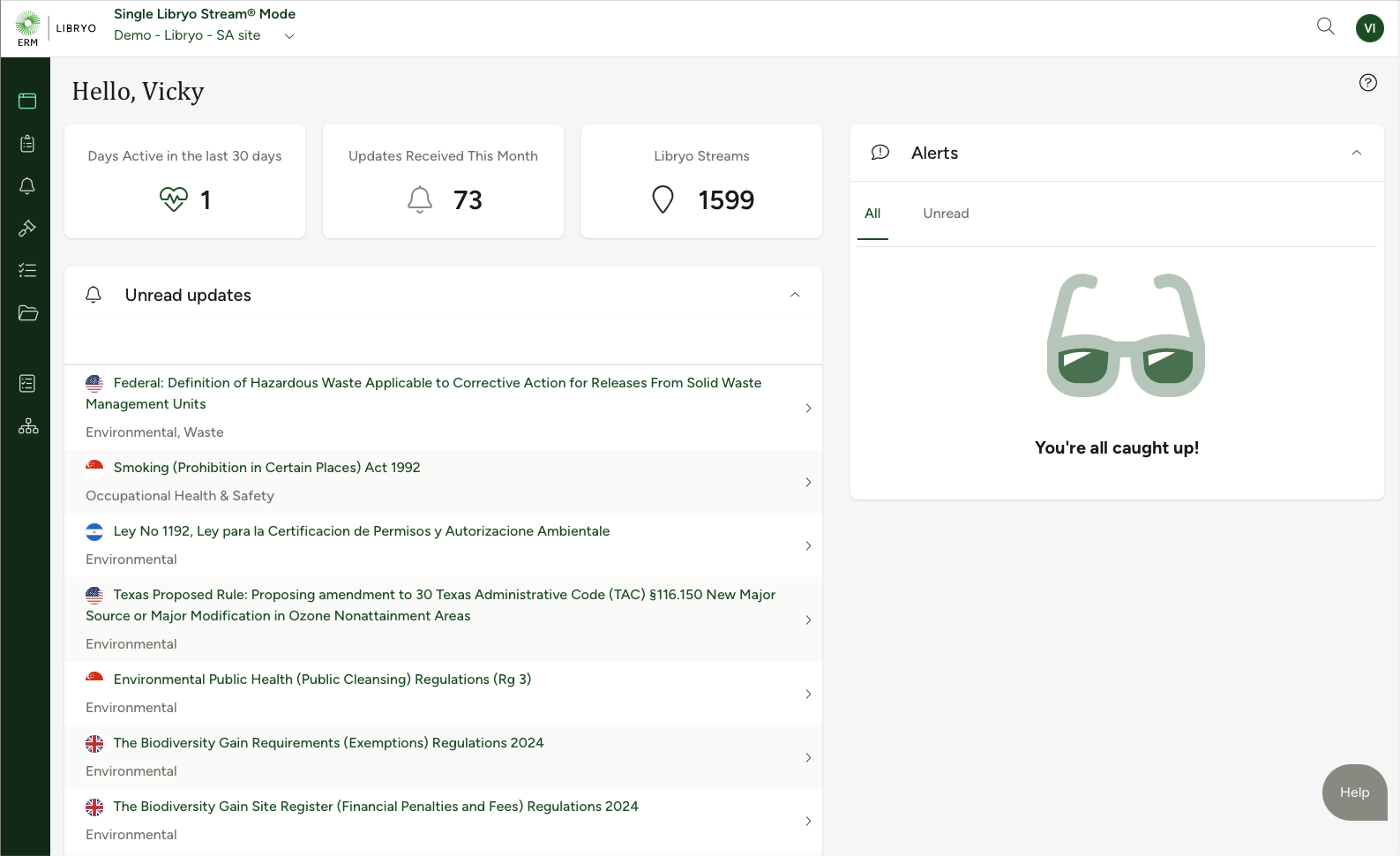
Libryo helps organizations understand their EHS regulatory obligations across multiple jurisdictions. The platform continuously monitors and maps applicable laws to specific business operations, providing clear guidance on compliance requirements. Its granular filtering enables teams to quickly identify relevant regulations without manual research. This proactive approach is particularly valuable for companies with global operations or those in highly regulated industries like manufacturing and energy, where regulatory changes can significantly impact compliance status.
Pros:
- Global regulatory coverage
- Proactive change alerts
- Easy-to-use interface
- Strong filtering capabilities
- Reduces manual research time
Cons:
- Limited workflow automation
- Focused primarily on EHS
- Requires supplementing with other tools
8. Risk Hawk: An integrated GRC platform for risk management and compliance automation
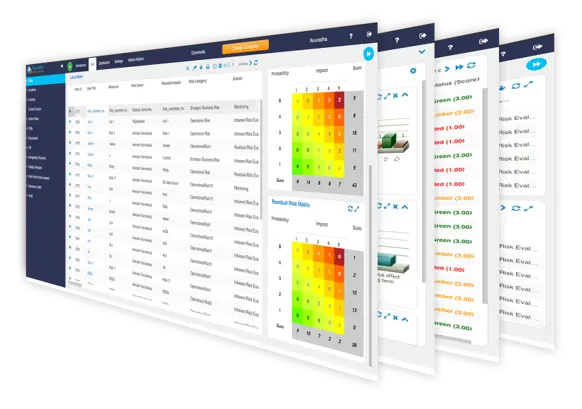
Risk Hawk provides comprehensive governance, risk and compliance capabilities in a unified system. The platform enables organizations to manage risks, automate control testing, and streamline audit processes. Its workflow automation reduces manual effort in compliance tasks like risk assessments and policy acknowledgments. With real-time dashboards and reporting, Risk Hawk gives leadership clear visibility into compliance status and risk exposure, making it suitable for mid-to-large enterprises seeking to mature their GRC programs.
Pros:
- Comprehensive risk management
- Good workflow automation
- Real-time dashboards
- Suitable for mid-sized enterprises
- Balanced feature set
Cons:
- Less sophisticated than enterprise solutions
- Limited industry-specific content
- Integration capabilities could be stronger
Business values of compliance management software
- Reducing risk exposure and achieving continuous audit readiness
Consistent workflows and integrated evidence reduce the chance of overlooked steps and last-minute scrambles. In Lark, continuous operations—like approvals and task completions—are inherently logged, which helps maintain a steady state of readiness.
- Cutting manual effort and costs through automation
Automation minimizes chasing and rework. With Lark, automated reminders via chat, embedded approvals, and pre-filled forms reduce email chains and context switching.
- Improving decision-making with compliance analytics and KPIs
Dashboards show where controls are strong, where exceptions cluster, and which owners need support. Because Lark centralizes tasks, docs, and discussions, leaders get both quantitative and qualitative insight.
- Strengthening cross-functional collaboration and accountability
Compliance spans security, IT, legal, finance, HR, and operations. Lark's unified workspace keeps discussions tied to records, so accountability is clear and knowledge is preserved — even as teams change.
Key steps for choosing compliance management software
1. Assessing compliance maturity and regulatory scope
Start by documenting your frameworks, jurisdictions, and upcoming audits. Identify high-risk processes and the controls that matter most. Map your current state across people, process, and tooling. This self-assessment clarifies requirements and informs your pilot scope. When selecting a HIPAA-compliant hosting platform, ensure it includes a signed Business Associate Agreements (BAAs).
2. Defining must-have features vs. nice-to-haves for your industry
Prioritize capabilities aligned to your biggest risks:
- Healthcare: Access traceability, SOP control, incident workflows
- Financial services: Segregation of duties, change and access governance
- SaaS/cloud: Asset inventories, CI/CD change controls, privacy mapping
In Lark, many of these become straightforward: use Base schemas for inventories, connect approvals to tasks, and keep policies and training materials in Docs.
3. Security and privacy requirements: Data residency, encryption, access
Any compliance system should meet strong security and privacy expectations. Evaluate residency options, encryption practices, and access controls. Confirm how administrative actions are logged and how data is segregated.
4. Scalability, usability, and support: Pilots, SLAs, and vendor roadmap
Run a pilot with representative users and real workflows. Look for high adoption without heavy training—an advantage of Lark's familiar, consumer-grade experience. Review service commitments and roadmap alignment with your future frameworks and automation needs.
5. Calculating TCO and ROI for compliance management software
A simple framing helps structure the business case: ROI = (Avoided fines + efficiency gains − software cost) / software cost
- Efficiency gains: Time saved on evidence collection, approvals, and reporting
- Audit readiness: Fewer ad hoc requests and less disruption during audits
- Risk reduction: Earlier detection and resolution of exceptions
A unified platform like Lark can reduce tool sprawl, training overhead, and integration maintenance—key factors in total cost.
Measuring compliance program success
To ensure your compliance program is not just existing but effective, you need to focus on metrics that truly reflect its health and efficiency. By tracking progress in the following areas, you can transform from a reactive project into a proactive, valuable business function.
Key performance indicators: Focusing on efficiency and accountability
Measuring success starts with tracking a few core metrics that directly reflect your team's readiness and operational efficiency.
- Audit cycle time refers to the total time required to complete an audit. Shorter cycles typically indicate better preparedness and more organized evidence.
- Percentage of automated controls shows how much of your compliance work (like access reviews or risk assessments) is handled automatically by the system. A higher rate of automation means your team can focus on more critical issues instead of manual tasks.
- Efficiency in addressing compliance gaps measures how quickly your team can identify and resolve compliance exceptions. Timely resolution demonstrates clear accountability and effective execution mechanisms.
Through these metrics, you can clearly demonstrate how the compliance program helps the business reduce risk and save time.
From foundational to advanced: The compliance maturity journey
Every organization's compliance program is at a different stage of development. The maturity model below describes the typical evolution from a disorganized state to an optimized one.
- At the initial stage, processes are often ad-hoc, and evidence is scattered across individual emails and computers, requiring a major effort to collect before an audit.
- When progressing to the emerging stage, core controls are clearly defined, tasks begin to be executed on a schedule, and evidence can be systematically linked and stored.
- Upon reaching the managed stage, workflows can be automatically triggered by specific events (like new employee onboarding or system changes). Management can view status in real-time via dashboards, and clear time requirements are set for resolving exceptions.
- The ultimate optimized stage is characterized by proactive compliance management. The system can provide predictive insights to help anticipate risks, and the entire compliance system is continuously improved through regular retrospective meetings.
Calculating the true return on your compliance investment
The return on investment in compliance management can be demonstrated through the actual time savings and problems it avoids in daily operations.
For instance, when access reviews are completed on schedule automatically, it means no longer spending significant time chasing responsible owners. When an employee leaves the company, the entire account deprovisioning and access revocation process is triggered and logged automatically, ensuring zero oversights. When an audit arrives, the required evidence is already organized from daily work, eliminating the need for a frantic "evidence scavenger hunt." The saved labor costs, reduced risks, and improved audit efficiency from these scenarios collectively form the most compelling proof of value for your compliance program.
Specific industry compliance strategies
Different industries face unique compliance challenges. Here's how to build effective compliance strategies tailored to the core requirements of key sectors.
At the heart of financial services is the need to build trust, with compliance focusing on the accuracy of financial data and the security of client information.
- Implement strict change management processes for any system modifications.
- Enforce segregation of duties to prevent errors and fraud in critical processes.
- Maintain a complete, traceable record by linking approvals, system tickets, and deployment logs.
Healthcare: Protecting patient data with precision
Compliance in healthcare centers on safeguarding the privacy and security of patient health information and ensuring the reliability of electronic records.
- Control access to patient data with traceable approvals and logs.
- Manage standard operating procedures with version control and formal employee acknowledgments.
- Preserve immutable audit trails for all actions taken on regulated systems and data.
Technology companies, especially SaaS providers, need to prove their service reliability through recognized security certifications.
- Maintain clear and current inventories of IT assets and data.
- Govern code changes through secure and controlled CI/CD pipelines.
- Automate the collection of system logs and security reports for continuous proof of control effectiveness.
For manufacturing and critical infrastructure, compliance involves protecting both information technology and core operational technology.
- Track both IT and operational technology assets within a unified management framework.
- Enforce procedures for both physical access to sites and logical access to critical systems.
- Coordinate and document all maintenance work and system changes with supporting evidence.
Companies operating globally must comply with complex and varying data privacy laws across different countries and regions.
- Map how personal data flows across international borders.
- Localize internal policies and training materials to meet regional legal requirements.
- Formally record compliance assessments and approvals for international data transfers and vendor partnerships.
Conclusion
Compliance is most effective when it's not a separate lane but the natural outcome of how work gets done. Compliance management software provides structure and automation. A unified platform like Lark ensures those capabilities live where teams already collaborate. The result: fewer gaps, faster audits, clearer accountability, and a program that scales with your business.
FAQs
What is compliance management software?
Compliance management software is a centralized system that helps organizations translate regulatory obligations and internal policies into controlled, day-to-day operations. It replaces manual, spreadsheet-based tracking by providing a structured framework to map regulations to specific controls, automate recurring tasks like audits and access reviews, capture evidence, and provide real-time visibility into compliance status for leaders and auditors.
Which is the best software for statutory compliance?
The best software depends on your industry, company size, and specific compliance needs. Large enterprises often choose comprehensive GRC platforms like ServiceNow or RSA Archer for their extensive customization capabilities. For privacy-focused compliance, OneTrust is a market leader. However, for organizations seeking to embed compliance directly into daily operations, unified platforms like Lark offer significant advantages by connecting compliance tasks with collaboration tools, reducing manual work and improving adoption.
Which database software has the best compliance tools?
Traditional databases alone aren't optimized for compliance management. More effective are specialized platforms built for workflow management. Airtable provides flexible foundations for building custom compliance trackers, while Smartsheet offers robust reporting capabilities. For truly integrated compliance management, platforms like Lark Base combine database flexibility with native connections to chat, docs, and automation - creating a cohesive environment where compliance data remains connected to business context.
What is an example of a compliance management system?
Compliance management systems range from specialized to integrated solutions. ServiceNow GRC represents a comprehensive, enterprise-grade system ideal for complex regulatory environments. Vanta exemplifies modern, automated systems focused on security compliance certifications. For a unified approach, Lark demonstrates how compliance can be woven into daily operations - connecting controls in its Base module with collaborative work in documents, chat, and tasks to automatically generate audit trails as work happens.
Related reading
Table of contents
Start using Lark today

Manage all your work in one place
Boost team efficiency by 10x
Save up to 70% on software costs
Table of contents
Start using Lark today
Manage all your work in one place
Boost team efficiency by 10x
Save up to 70% on software costs
Keep reading








2026 Lark Technologies Pte. Ltd.
Headquartered in Singapore with offices worldwide.






Explore: