In organisations, communication happens in many ways. Teams work across departments, locations, and time zones. They use platforms to coordinate work, share updates, and make decisions.
As organisations grow, communication gets more complex. What starts as a flow of information becomes fragmented. Different teams use systems and processes. Without a structure, communication gaps appear. This slows down workflows. Affects productivity. Improving communication is not about adding more tools. It is about understanding how communication fits into work.
Communication as part of daily workflows
In organisations, communication is still separate from work. However, this approach creates inefficiencies. Employees switch between platforms to find information, follow up on updates, or clarify decisions. This constant switching reduces productivity. Increases miscommunication.
Organisations are now embedding communication into workflows.
Collaboration platforms allow teams to:
- share updates within project spaces
- keep conversations tied to tasks and outcomes
This shift reduces the need for separate communication processes. It ensures that information is available where and when it is needed.
Explore communication tips and solutions for large enterprises
The challenge of distributed teams
Distributed workforces add another layer of complexity. Teams are no longer in an office. Employees may work remotely in offices or on-site. Each group interacts with communication tools differently.
For example:
- office-based teams use desktop platforms
- remote workers use access
- frontline employees may not have access to traditional systems
Ensuring communication reaches all groups requires a coordinated approach.
Balancing collaboration and reach
Collaboration platforms improve communication. They provide a shared space for discussions, updates and decision-making.
However, collaboration tools alone are not enough. There are situations where communication needs to extend beyond platforms:
- notifications that require immediate attention
Organisations need to use additional channels to ensure effective delivery.
This creates a balance between:
- collaboration within platforms
Managing this balance is a challenge for large organisations.
Reducing fragmentation across systems
Fragmentation is an issue in enterprise communication. Different teams adopt tools that suit their needs. Over time, this leads to a collection of systems that do not work together. Information becomes siloed, and visibility across the organisation is harder to maintain.
To reduce fragmentation, organisations focus on integration. They connect existing tools rather than replacing them. This allows communication to flow smoothly between systems.
Supporting consistency at scale
As communication becomes more complex, consistency becomes more important. Teams need aligned information regardless of location or tools. Inconsistent communication leads to confusion and misalignment. Consistency is not about message content. It is also about how messages are delivered. Coordinated communication across channels helps organizations maintain clarity.
The role of supporting communication infrastructure
Collaboration platforms help teams work together. Organisations also rely on underlying systems to support .
These systems enable organisations to deliver messages beyond platforms. They ensure that communication reaches employees, customers, and stakeholders when needed.
For example, platforms such as provide communication capabilities that can be integrated into existing business systems, allowing organisations to send messages across channels such as SMS and other digital touchpoints from a centralised platform. This approach supports more consistent communication, particularly in environments where information needs to move across both internal workflows and external channels.
This type of infrastructure does not replace collaboration tools. It complements them by extending communication beyond a platform.
Aligning communication with productivity
Communication is closely linked to productivity. When teams receive relevant information, they make decisions quickly. They coordinate their work effectively.
By aligning communication with workflows and ensuring systems work together, organisations can reduce inefficiencies.
This involves:
- making communication accessible within workflows
- ensuring messages reach the people
- maintaining consistency across channels
Try the all-in-one platform with a built-in messaging tool
Introducing Lark: A comprehensive enterprise communication tool
is an all-in-one enterprise communication and collaboration platform designed to streamline teamwork and boost productivity across organizations of all sizes. At its core, Lark offers a suite of unified tools that unify communication, document management, project tracking, and into a single seamless experience.
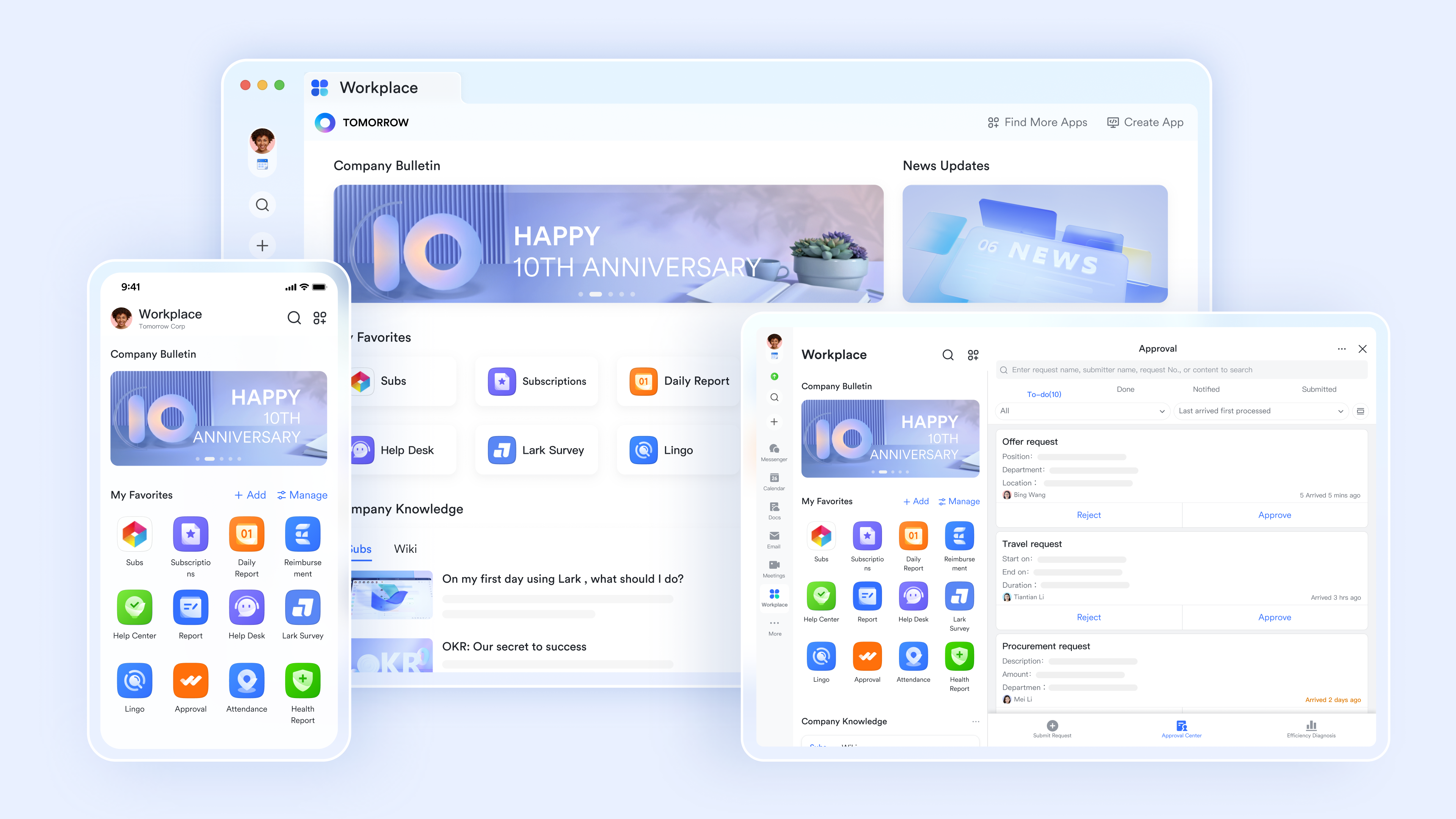
Key components of Lark include:
- : A powerful messaging platform that supports real-time chat, group conversations, and multimedia sharing, enabling teams to communicate instantly and effectively.
- : Cloud-native documents and sheets that allow multiple users to collaborate simultaneously, making content creation and editing effortless and dynamic.
- : A robust video conferencing solution featuring Magic Share for interactive screen sharing and collaboration, supporting high-quality group calls and virtual meetings.
- : A centralized knowledge base where teams can organize, share, and maintain important information and documentation in a structured, easily accessible format.
- Lark Tasks: An intuitive task management tool that helps teams plan, assign, and track tasks to ensure timely completion and clear accountability.
- : A flexible database tool designed to organize project data and workflows, enabling users to build custom applications tailored to their team’s needs.
- : A streamlined approval workflow system that automates requests and authorizations, reducing bottlenecks and accelerating decision-making processes.
Together, these integrated tools make Lark a comprehensive platform that supports enterprise communication, , and team collaboration—empowering organizations to work smarter, faster, and more cohesively.
:
- Starter plan: that includes 11 powerful tools for up to 20 users. It also comes with 100GB of storage space, 1000 automation runs, AI translations, and more. No credit card needed.
- Pro plan: (billed annually) for up to 500 users. It includes everything in Starter plus group calling for up to 500 attendees, 15TB of storage space, 50,000 automation runs, and more.
- Enterprise plan: for custom pricing. Supports unlimited users and includes even more automation runs and advanced security, compliance, and management features.
For small teams with simple communication needs

18 months message history
1000 Base automation runs/month
2000 rows per table in Base
Most POPULAR
For companies with comprehensive collaboration and management needs
Unlimited message history
500-participant video meetings
50k Base automation runs/month
20k rows per table in Base
For large companies with advanced security and organizational management needs
Get a personalized demo and pricing
Unlimited message history
500-participant video meetings
15 TB storage + 30 GB storage/user
500k Base automation runs/month
50k Base automation runs/month
Most POPULAR
For companies with comprehensive collaboration and management needs
Unlimited message history
500-participant video meetings
50k Base automation runs/month
20k rows per table in Base
Looking ahead
As organisations evolve, their approach to communication will change. There is a growing emphasis on:
- integrating communication into workflows
- connecting systems across the organisation
- supporting communication across channels
These changes reflect a broader shift in how communication is understood. It is no longer a standalone function but a key part of operations.
Conclusion
Improving communication across teams is not about adopting new tools. It requires understanding how communication supports workflows, productivity, and coordination.
Collaboration platforms play a role. Supporting infrastructure ensures that communication can extend beyond these platforms when needed.
By combining these approaches, organisations can create integrated, consistent, and aligned communication systems. These systems match the way work actually happens.
FAQs
How can large organizations improve communication across multiple teams?
Large organizations can improve communication by adopting unified collaboration platforms that integrate messaging, video meetings, document sharing, and task management. These tools help break down silos, streamline workflows, and foster real-time collaboration among dispersed teams.
What role do integrated systems play in enhancing team communication?
All-in-one systems consolidate various communication and productivity tools into a single platform, reducing the need to switch between apps. This integration ensures seamless information flow, better project tracking, and consistent updates, which collectively enhance team communication and efficiency.
How does workflow automation support better communication in large enterprises?
Workflow automation minimizes manual tasks and accelerates approval processes, ensuring that requests and updates move swiftly through the organization. Automated notifications and task assignments keep all stakeholders informed, reducing delays and miscommunication.
What are the key features to look for in a project management tool for large organizations?
Key features include real-time messaging, cloud-native document collaboration, task and project tracking, customizable workflows, robust security, and scalability to support multiple teams and complex projects.
Can unified communication platforms support remote or hybrid work models effectively?
Yes, unified platforms designed for enterprise communication provide tools like video conferencing, shared calendars, and collaborative documents that enable remote and hybrid teams to stay connected, coordinate work efficiently, and maintain productivity regardless of location.
Related reading




















![What Is a 2-2-3 Work Schedule? Explanation and More [2026]](https://framerusercontent.com/images/uKHRfkp4v7y4azRNTYUmuteNQz8.png)








