Customer experience is everything. Successful retailers and e-commerce empires rely on a solution for building strong, lasting customer relationships and providing outstanding service. That solution is called retail CRM software.
But what exactly is retail CRM, and what is the best software available? In this article, we'll guide you through everything you need to know, providing a detailed look at the top 10 retail CRM tools for 2025 so you can choose the perfect tool for your business.
Best retail CRM software
Here's our top three retail CRMs out of the ten we tested.
Boost sales with the #1 retail CRM
What is retail CRM software?
Retail is the bridge between your physical store and your digital presence. Unlike generic tools, a retail CRM is tailored to handle unique retail demands. This could range from loyalty programs to deep integration with POS (point-of-sale) systems.
Why is this essential? Because happens in two places: on the screen and in the aisles. A robust retail CRM connects the digital footprint of your online shoppers (clicks, abandoned carts, wishlists) with the physical behavior of your in-store customers (foot traffic and face-to-face interactions). This creates a single, unified profile for every shopper. Because your staff can now see the full picture, a customer who buys online can return in-store seamlessly, without the frustration of missing receipts or disconnected systems.
Here’s how the best retail CRM software makes a difference:
- It centralizes customer data: It gathers data from every channel into a unified platform, creating a true 360-degree customer view. This can include data about purchase history, online browsing, and loyalty activity.
- It bridges online and offline experiences: It ensures your marketing isn't generic. You can use rich insights to create personalized campaigns that resonate with specific segments, whether they shop via e-commerce or in your boutique.
- It improves loyalty and retention: With built-in loyalty tools, you can easily identify VIPs and reward repeat customers, turning one-time buyers into long-term brand advocates.
- It automates operations: It handles time-consuming tasks like data entry and follow-ups. For instance, a platform like lets you trigger automated, personalized messages after a purchase, freeing your team to focus on high-value strategy.
Retail CRM helps you deliver the seamless, personalized experiences today’s customers demand. When you achieve that, you don’t just win sales—you win sustainable competitive advantage.
Top 10 retail CRM software
We've compiled a list of the top 10 retail CRM tools. Each of these tools offers unique features and benefits, so whether you’re a small retail business or a large enterprise, there's something here for you.
1. Lark: Best CRM for retail and e-commerce teams needing collaboration and AI
Best for: Retail, online, and e-commerce businesses of all sizes looking for a highly customizable and cost-effective retail CRM solution that seamlessly integrates customer data with daily team workflows.
Lark stands out as more than just a software CRM retail solution—it’s a collaborative ecosystem. Its strength lies in breaking down the silos that often exist between customer data and the teams that use it. By embedding CRM functionalities within a platform that also handles chat, documents, and project management, Lark empowers retailers to manage customer relationships and internal workflows more effectively and affordably.
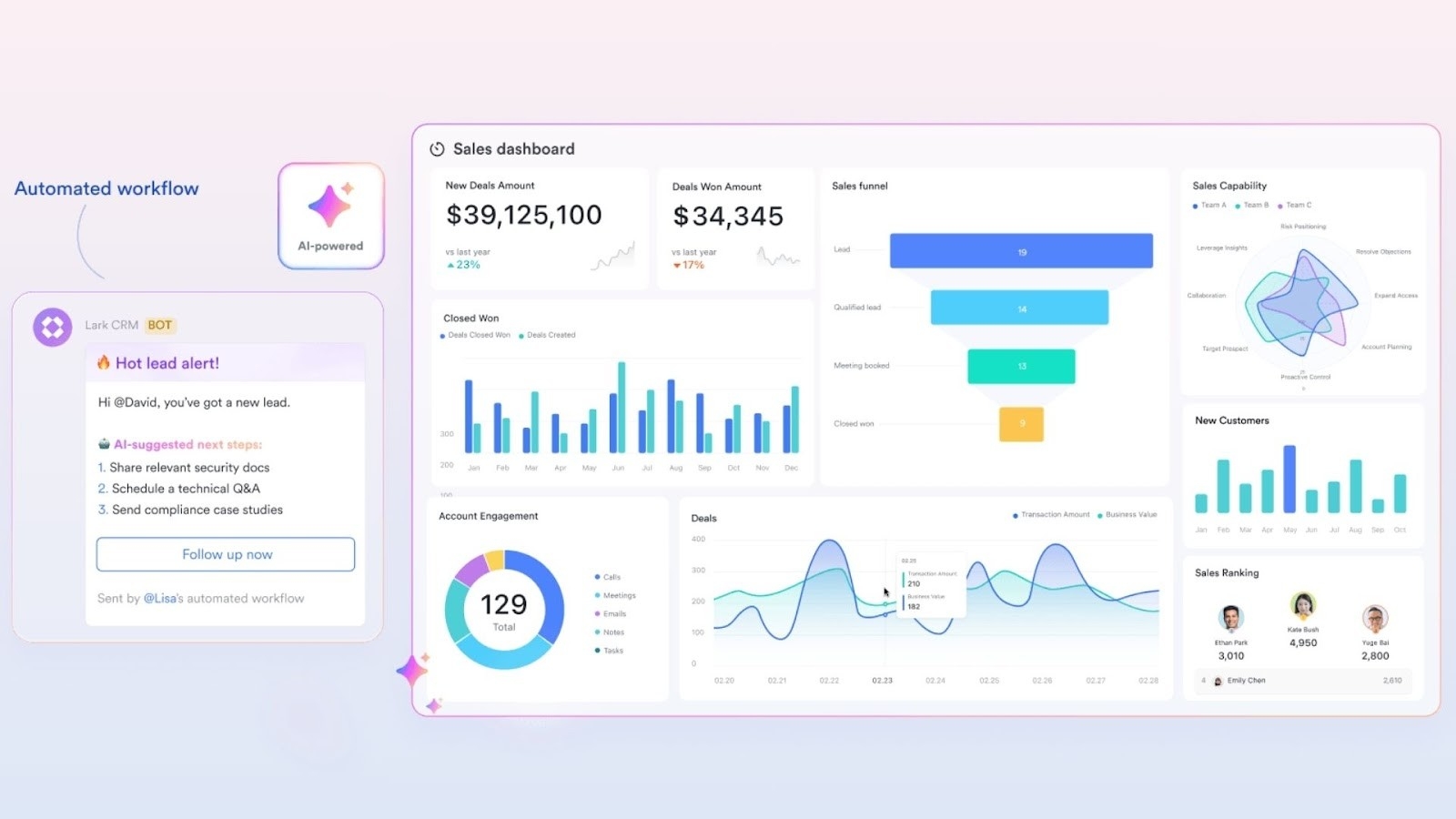
Lark is our number one pick, because it replaces a fragmented tech stack with a single, cost-effective superapp. It offers the messaging power of Slack, the organization of Asana, the CRM depth of Salesforce, and more to help you manage your retail business and customer relationships with ease.
Key features:
- Real-time reporting and analytics: Use to build real-time dashboards that track sales pipelines, customer satisfaction (CSAT), and marketing ROI, giving you instant visibility into business performance.
- Mobile-friendly CRM: Empower floor staff to access customer profiles, check inventory, and manage tasks directly from their smartphones, ensuring seamless service from the aisle to the register. Rated 4.8 in the App Store.
- Integrated communication and approvals: Centralize , , and such as instant discount authorizations or refund requests in a single app to speed up operations.
- AI-powered insights and automation: Leverage built-in AI to automatically summarize customer histories, translate messages for global shoppers, , and generate smart sales scripts.
- Intelligent workflow automation: Set up to streamline retail operations. For example, set triggers for post-purchase follow-ups and service ticket assignments to ensure consistent, timely engagement without manual effort.
- Cost-effective all-in-one solution: Consolidate CRM, collaboration, and project management into one subscription, eliminating tech stack bloat and freeing up budget for inventory and marketing. What's more, you'll enjoy up to by switching to Lark.
"Coming to Lark from Slack and DingTalk, we were amazed at just how everything we needed was there in one simple to use app. Lark has helped our regional teams work better, has saved us time, money and makes working more joyful."
- Mulyono Xu, Co-founder & CEO of Desty
Pricing:
- Starter plan: that includes 11 powerful tools for up to 20 users. It also comes with 100GB of storage space, 1000 automation runs, AI translations, and more. No credit card is needed.
- Basic plan: (billed annually) for up to 500 users. It includes everything in Starter, plus unlimited message history, 5TB of storage space, 1,000 automation runs, and more. Some users may need to to purchase this plan.
- Pro plan: (billed annually) for up to 500 users. It includes everything in Basic plus group calling for up to 500 attendees, 15TB of storage space, 50,000 automation runs, and more.
- Enterprise plan: for custom pricing. Supports unlimited users and includes even more automation runs and advanced security, compliance, and management features.
For small teams with simple communication needs

18 months message history
1000 Base automation runs/month
2000 rows per table in Base
Most POPULAR
For companies with comprehensive collaboration and management needs
Unlimited message history
500-participant video meetings
50k Base automation runs/month
20k rows per table in Base
For large companies with advanced security and organizational management needs
Get a personalized demo and pricing
Unlimited message history
500-participant video meetings
15 TB storage + 30 GB storage/user
500k Base automation runs/month
50k Base automation runs/month
Most POPULAR
For companies with comprehensive collaboration and management needs
Unlimited message history
500-participant video meetings
50k Base automation runs/month
20k rows per table in Base
2. Salesforce: Scalable CRM with AI analytics for large retailers
Best for: Large enterprises with complex retail operations.
Salesforce is a powerhouse in the customer relationship management world, offering advanced features that cater to the needs of a large retail business. Its AI capabilities and robust analytics make it ideal for businesses looking to gain deep insights into customer behavior and enhance customer satisfaction.
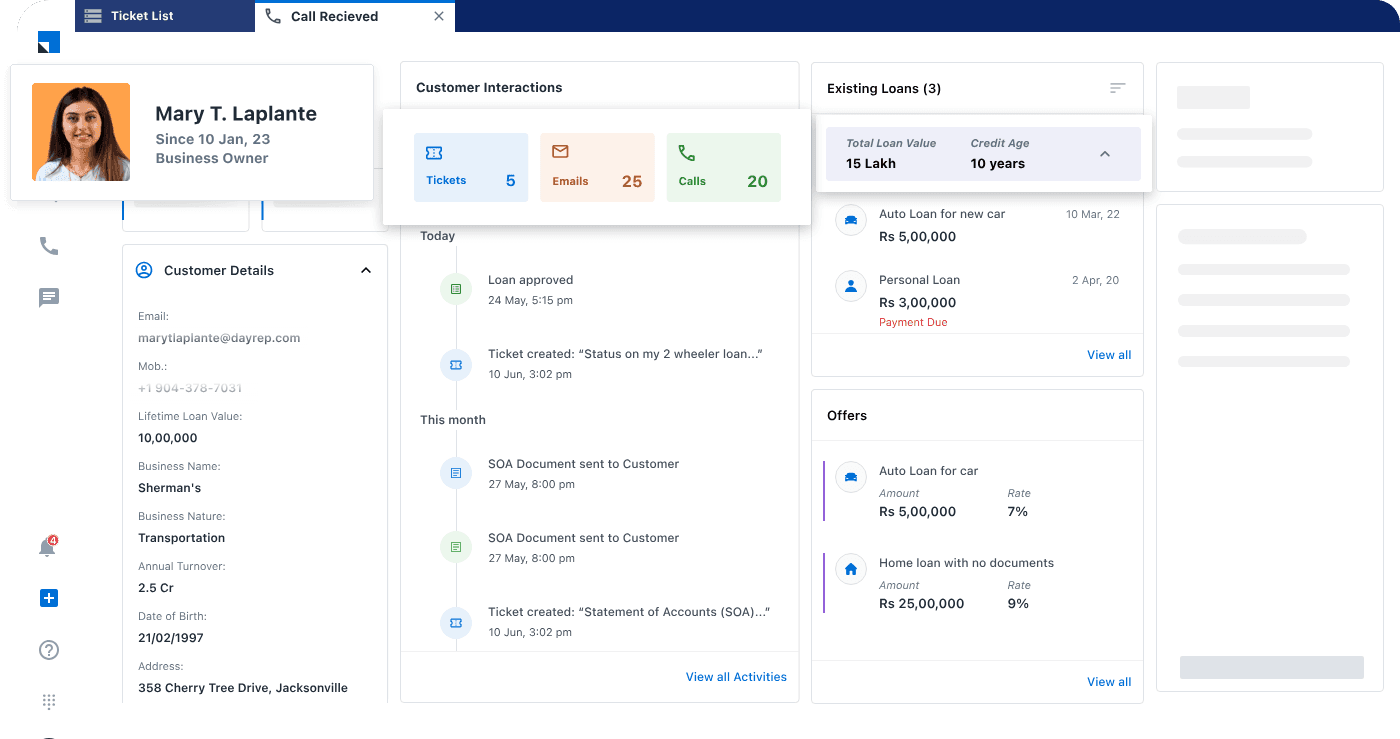 Image source: leadsquared.com
 Key features:
- AI-powered analytics with Einstein AI.
- Omnichannel communication tools.
- Extensive app integrations for seamless workflows.
Pricing:
- Starter Suite: $25/user/month.
- Pro Suite: $100/user/month.
- Enterprise: $175/user/month.
- Unlimited: $350/user/month.
- Agentforce 1 Sales: $550/user/month
Pricing varies by product. To learn more, visit .
3. Zoho CRM: Budget-friendly and customizable for growing businesses
Best for: Small to medium-sized retail businesses.
Zoho CRM is perfect for retailers who need a budget-friendly yet powerful retail CRM solution. Its flexibility and ease of use make it a popular choice for growing businesses. While not the cheapest of Zoho's products, we found that when you compared Zoho CRM features with Salesforce's, you do get good value for your money.
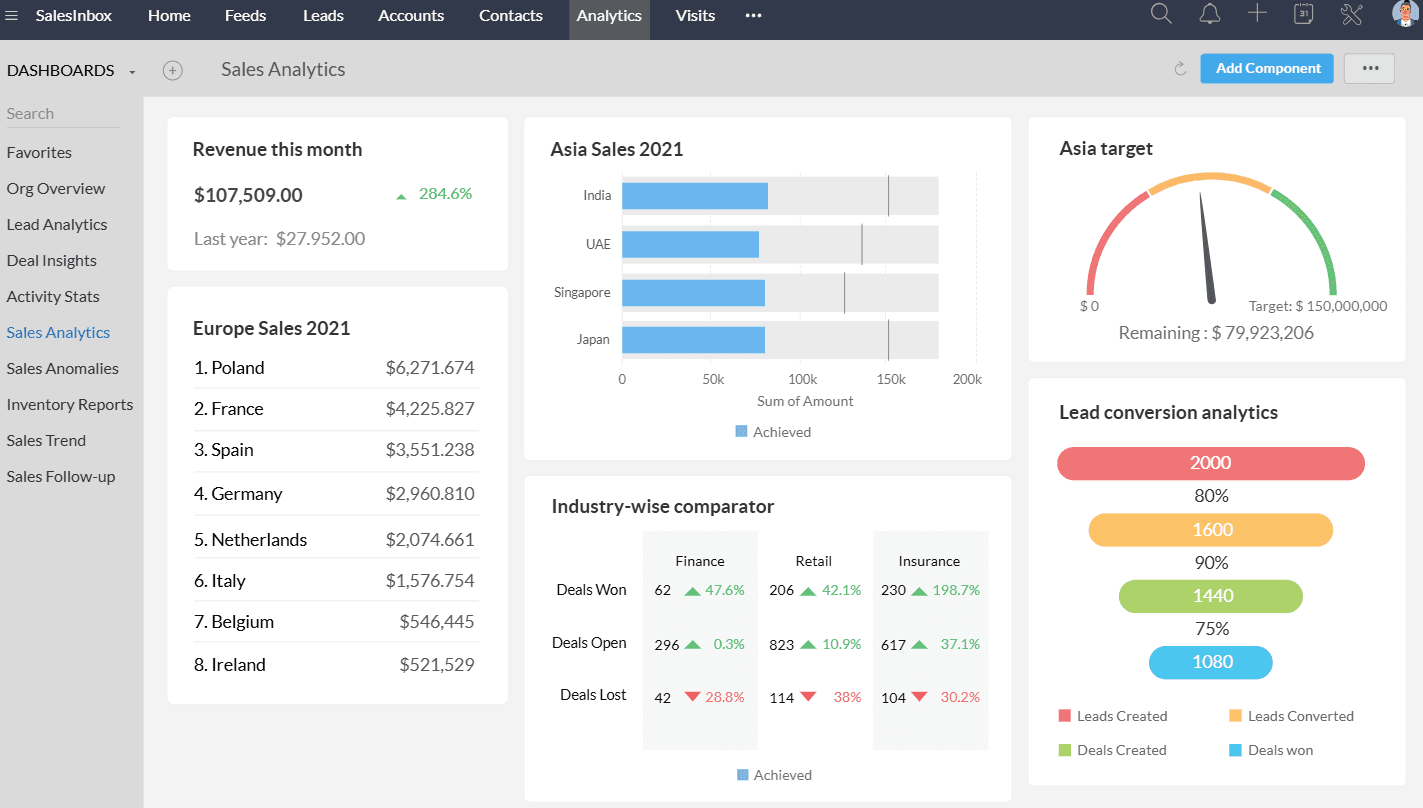 Image source: zoho.com
 Key features:
- Omnichannel communication.
- Loyalty program management.
Pricing:
- Free plan for 3 users is available.
- Standard: $14/user/month
- Professional: $23/user/month.
- Enterprise: $40/user/month.
- Ultimate: $52/user/month
4. HubSpot CRM: Free CRM with marketing automation for lead nurturing
Best for: Retailers focused on inbound marketing.
HubSpot CRM stands out for its marketing capabilities, making it a great option for retailers who want to attract, nurture leads, and enhance customer relationships effectively. During our review, we found that HubSpot offered a generous amount of free tools for marketing teams.
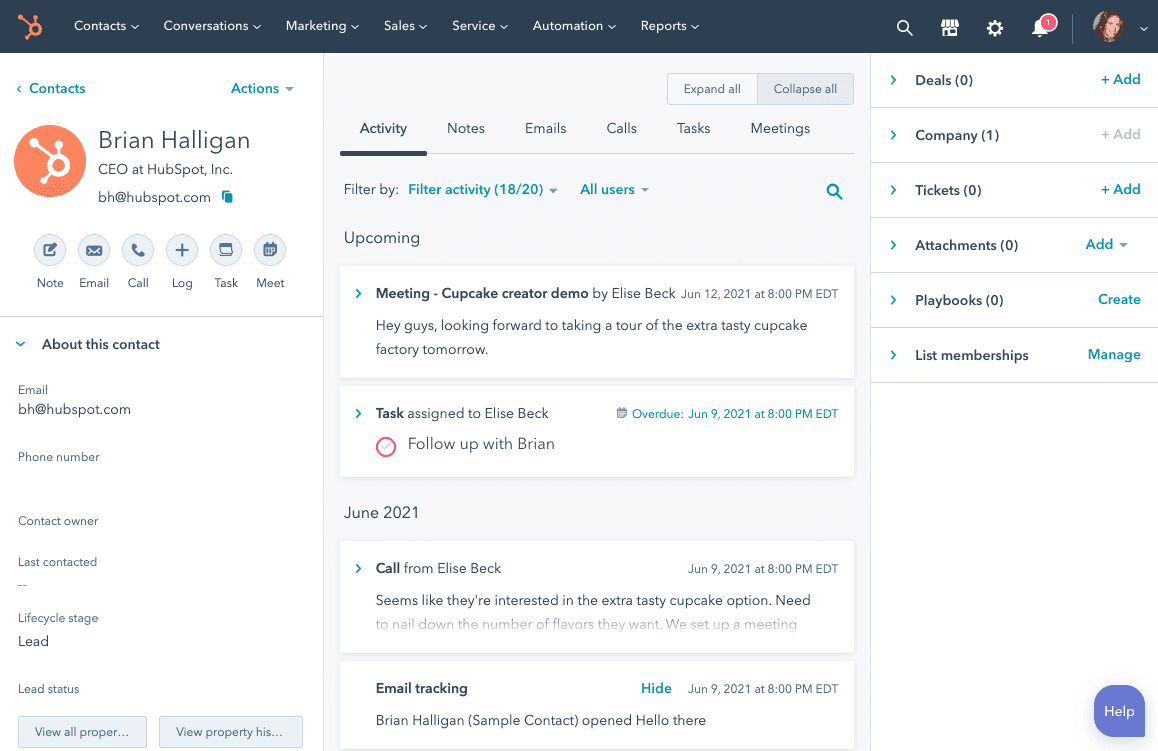 Image source: makewebbetter.com
 Key features:
- Email marketing and customer segmentation.
- Detailed analytics for campaign performance.
- Integration with HubSpot’s marketing and sales tools.
Pricing:
- Starter: $15/seat/month.
- Professional: $50/seat/month.
- Enterprise: $75/seat/user.
5. Freshsales (by Freshworks): User-friendly and affordable for customer management
Best for: Retailers seeking simplicity and affordability in their CRM system.
Freshsales is an intuitive CRM that’s perfect for retailers who want a straightforward solution without sacrificing essential features. What's great about Freshsales is that our entire team found the platform easy to use, making it ideal for teams that just want simple tools.
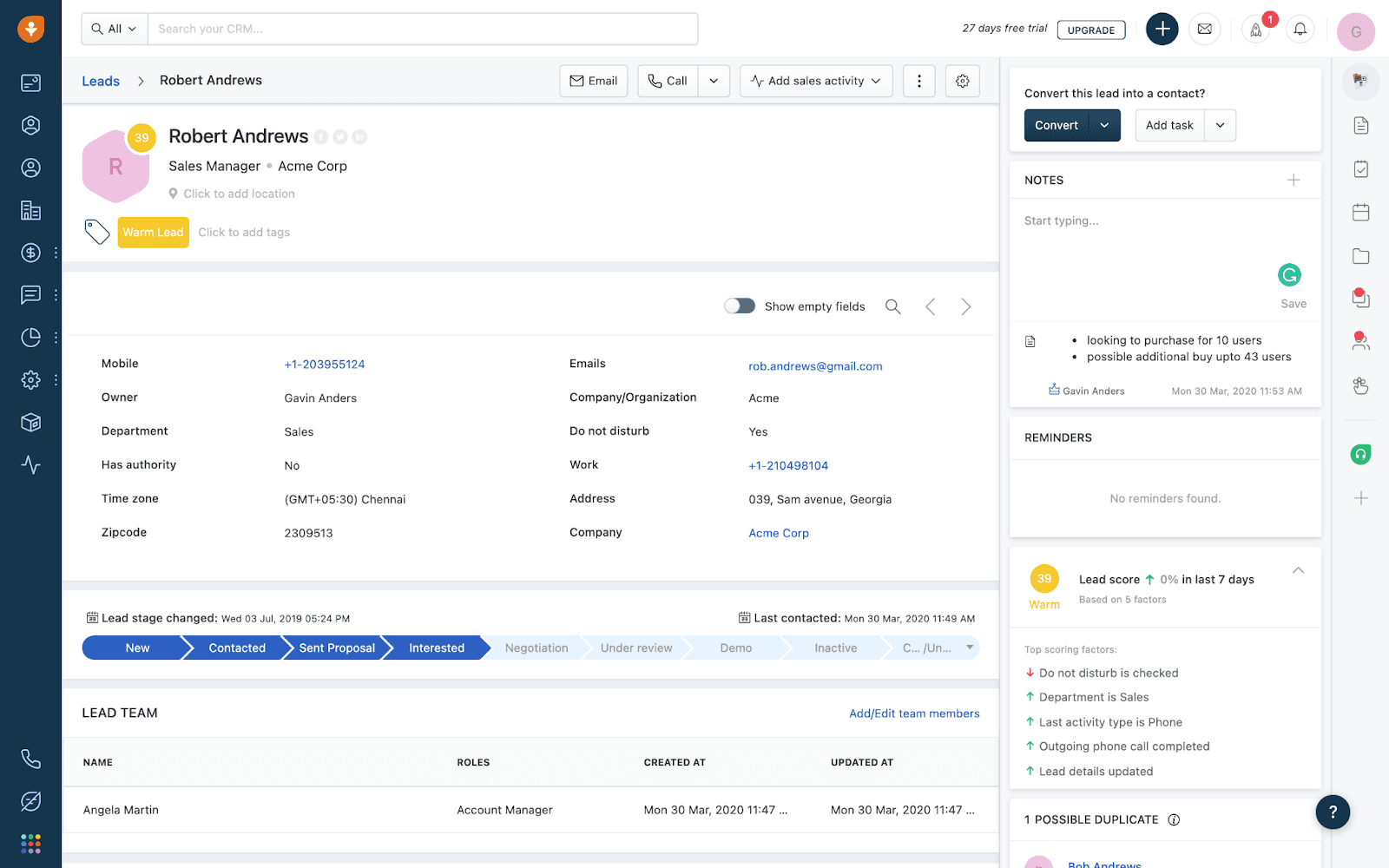 Image source: freshworks.com
 Key features:
- AI-powered lead scoring.
- Contact management and deal management.
Pricing:
- Enterprise: $59/user/month.
6. Pipedrive: Visual sales pipeline for tracking and closing deals
Best for: A retail business prioritizing sales tracking.
Pipedrive is ideal for retailers who want to focus on managing their sales process efficiently. When comparing with other retail CRMs, we noticed Pipedrive did a great job of helping us visualize our data and actions, which is great for those new to CRM or for teams that like visualization.
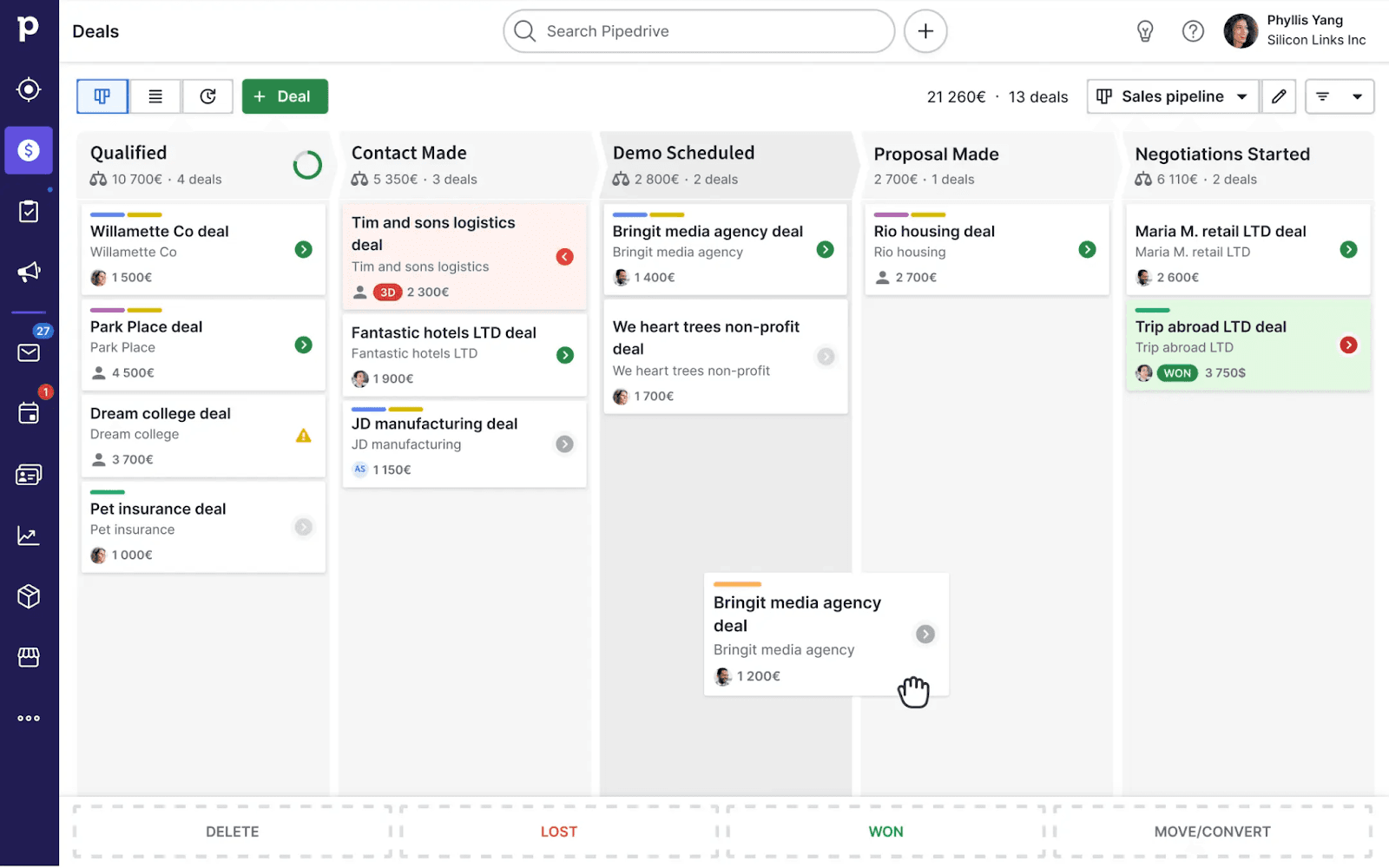 Image source: pipedrive.com
 Key features:
- Customizable sales pipelines.
- Email integration and performance tracking.
Pricing:
- Premium: $59/user/month.
- Ultimate: $79/user/month.
7. Creatio: No-code CRM for tailored solutions and engagement
Best for: Retailers looking for tailored retail CRM solutions.
Creatio is perfect for businesses that want a highly customizable retail CRM without needing technical expertise. What we liked most about Creatio is its AI insights, which didn't require us to send endless prompts to get the information we needed.
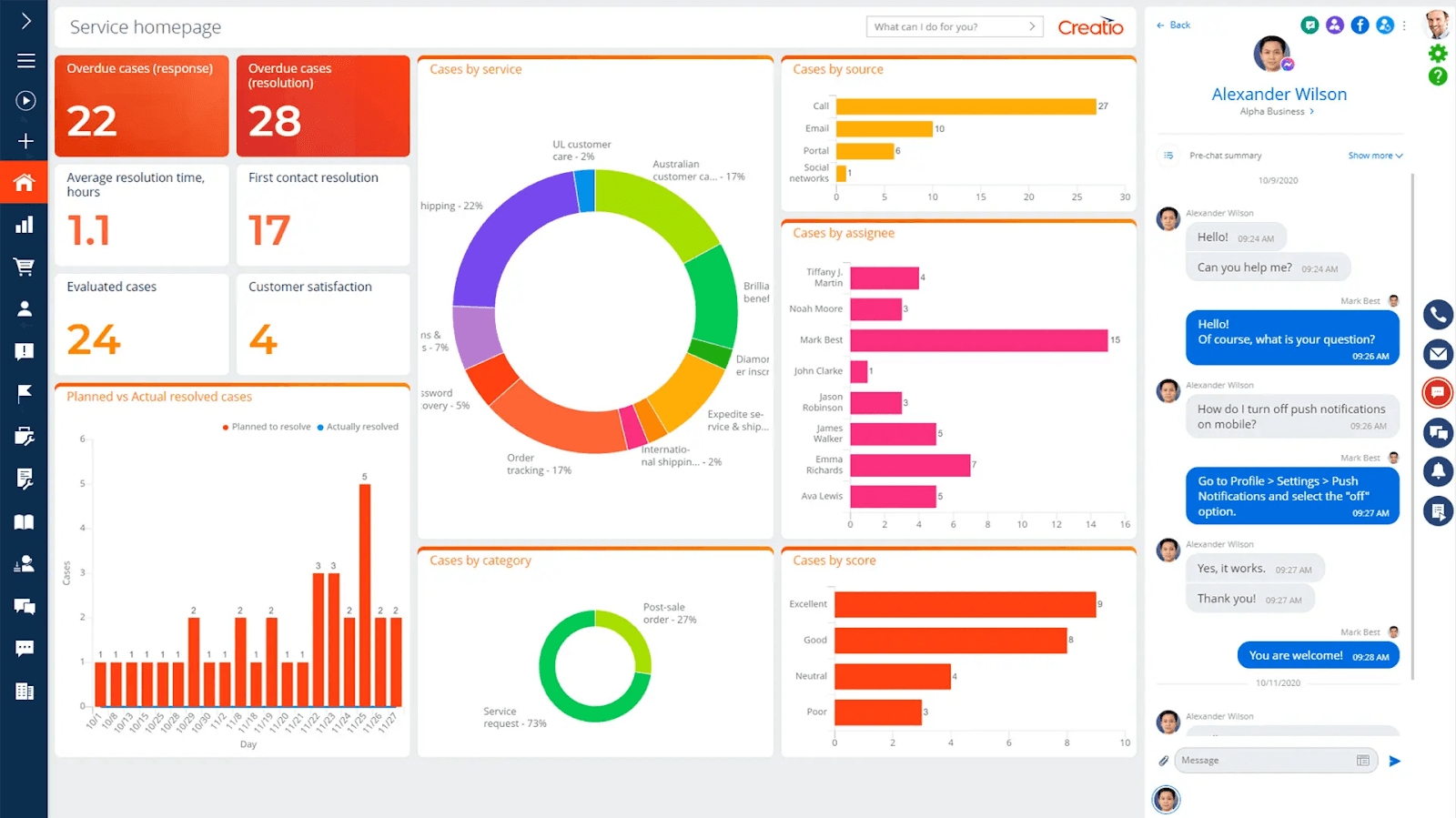 Image source: creatio.com
 Key features:
- Omnichannel customer engagement.
Pricing:
- Enterprise: $55/user/month.
- Unlimited: $85/user/month.
8. Salesmate: Affordable CRM with automation for small businesses
Best for: Small retailers aiming to streamline customer engagement.
Salesmate offers great value for a small retail business looking to improve its sales and marketing efforts. Despite being less powerful than Lark, Salesforce, and other big CRM players, we feel Salesmate would be a great companion for small retailers that just need email, calling, and automation.
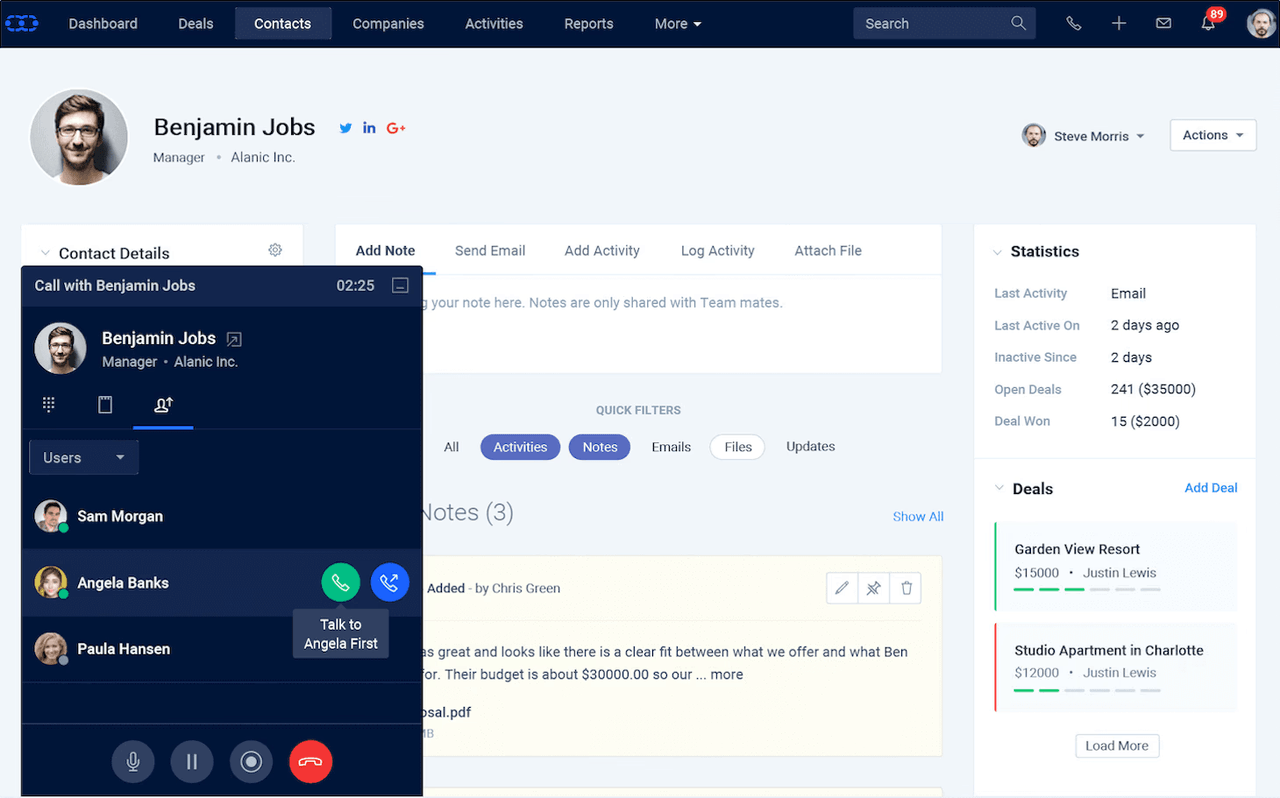
Image source: salesmate.com
Key features:
- Email sequences and built-in calling.
- Sales pipeline management.
Pricing:
- Business: $63/user/month.
9. Netsuite CRM: ERP-integrated for inventory and customer management
Best for: Retailers managing inventory management alongside customer relationships.
NetSuite CRM is designed for a retail business that needs to combine its retail CRM system with efficient inventory management and financial management. Many businesses integrate their CRM system with their ERP system, so we were really impressed with how simple NetSuite makes it for teams to integrate the two.
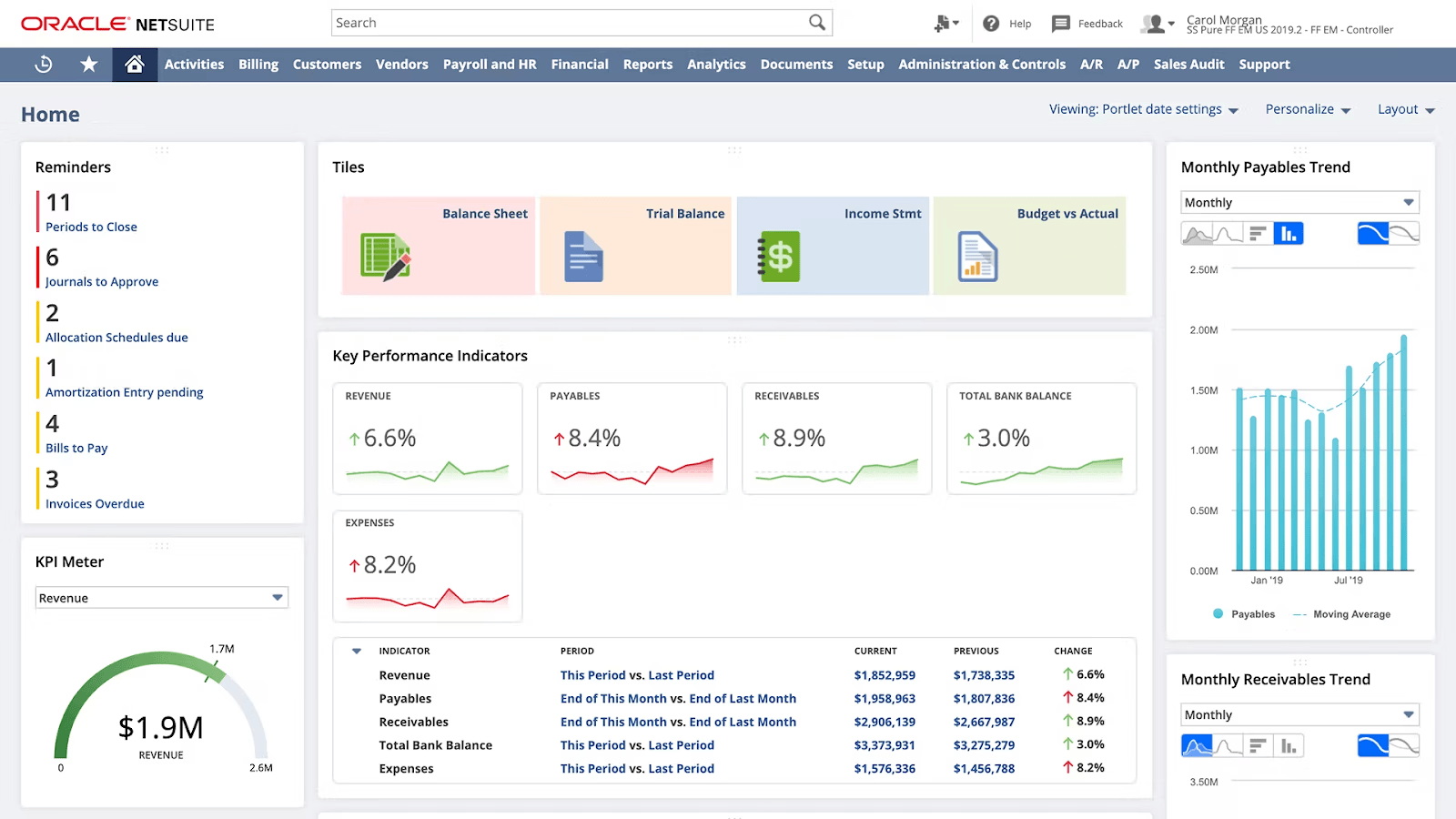
Image source: netsuite.com
Key features:
- Order management and customer segmentation.
- E-commerce integration.
Pricing: NetSuite does not disclose the cost of its CRM solution online. Contact their sales team to learn more.
10. Podium: CRM for reviews and local customer interaction
Best for: Local retail stores focused on customer feedback.
Podium is perfect for a retail business that relies on local customers and wants to improve its online reputation. We were particularly drawn to its direct messaging capability, which makes customer communication effortless and immediate.
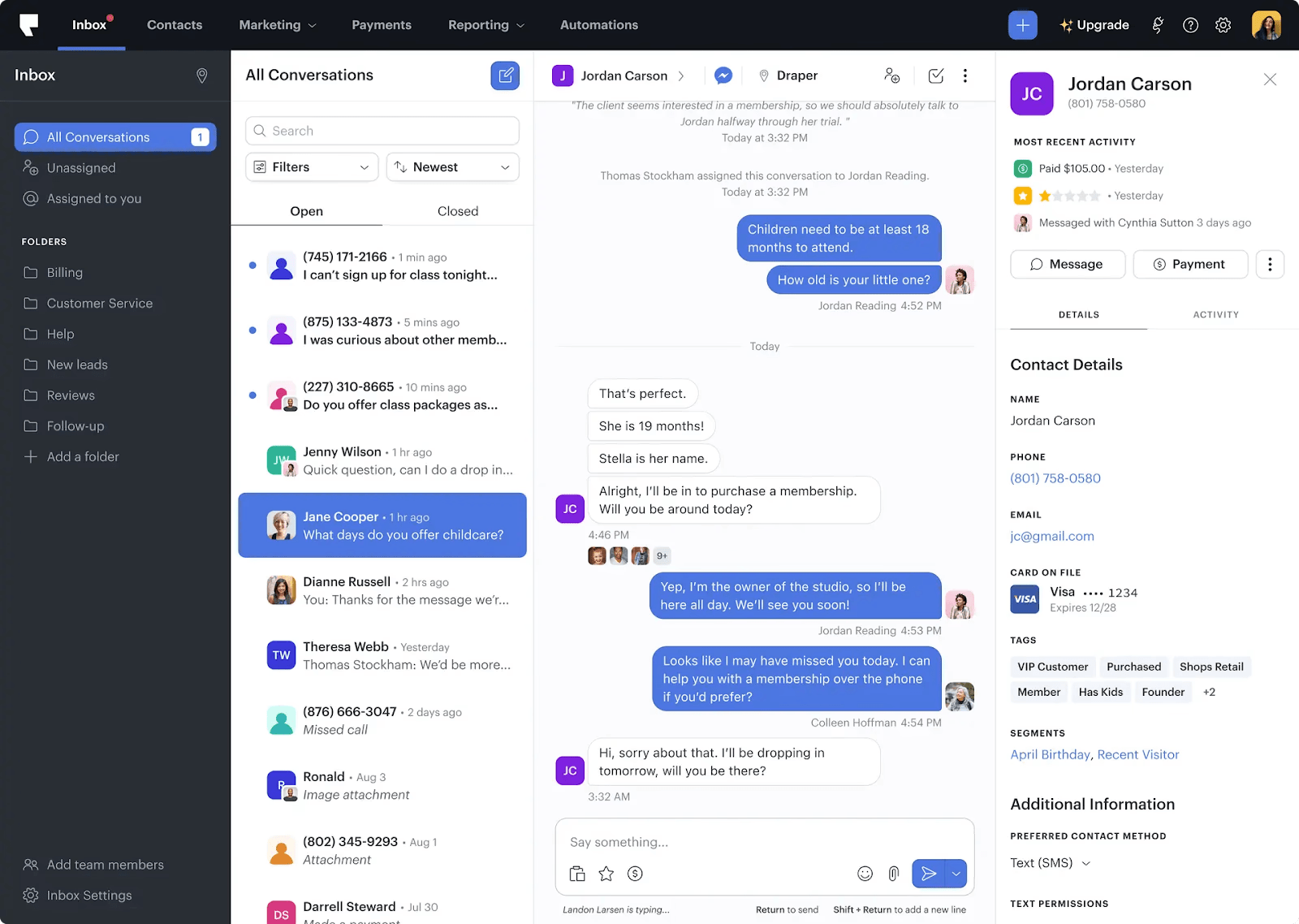
Image source: podium.com
Key features:
- Messaging tools for customer engagement.
- Review generation and management.
- Analytics for customer interactions.
Pricing: Podium does not disclose the cost of its CRM solution online. Contact their sales team to learn more.
Benefits of using retail CRM software
The best retail CRM software offers a wide range of benefits that can transform your business. Here are some of the most impactful ones:
Personalized customer experiences
Customers expect personalized experiences, whether they are clicking "add to cart" or walking through your front door. By centralizing customer data, a retail CRM system allows you to synchronize online and offline preferences to create a unified profile.
For your customers, this might mean sending personalized product recommendations based on their recent browsing history. For your brick-and-mortar shoppers, it means equipping floor staff with mobile data to greet VIPs by name and suggest items based on their previous online purchases. This convergence of data ensures that your marketing campaigns and service interactions resonate with every segment of your audience, fostering a feeling of being a VIP regardless of where they shop.
Streamlined operations
Let’s face it—managing customer relationships manually can be time-consuming and error-prone. CRM software for retail sales automates many of these tasks, from data entry to customer segmentation. This frees up your team to focus on more strategic initiatives, like improving the in-store experience or launching new marketing campaigns.
For example, a retail CRM can automatically send follow-up emails to customers who abandon their carts or notify your sales team when a high-value customer hasn’t shopped with you in a while. These automated workflows ensure nothing falls through the cracks.
Data-driven decision-making
Retail management CRM software doesn’t just collect data—it helps you make sense of it. Most CRM systems come with built-in analytics tools that allow you to track key metrics like customer lifetime value, purchase frequency, and campaign performance. This is where a CRM solution with powerful, accessible analytics shines. For example, allows you to create customizable, real-time dashboards to track everything from customer lifetime value to campaign performance, putting actionable insights directly in front of your team.
These valuable insights can help you identify trends, spot opportunities, and make smarter business decisions. For instance, if you notice that a certain product is especially popular among your VIP customers, you can create targeted promotions to drive even more sales for your retail business.
Improved customer retention
Customer loyalty is the lifeblood of any retail business, and retail CRM software helps you keep your customers coming back. Many CRM systems include tools for managing loyalty programs, such as tracking points, sending rewards, and identifying at-risk customers.
By staying engaged with your customers and rewarding their loyalty, you can turn one-time buyers into lifelong fans. These benefits are most powerful when they work together, which is why an integrated CRM platform like , which connects personalized marketing to streamlined operations, can truly transform your retail business.
How to choose the best retail CRM software for your business
Here's a simple guide to help you choose the best retail CRM software for your business:
Understand your business needs
Start by identifying the specific challenges your retail store is facing. Are you struggling to keep track of customer data across multiple channels? Do you need better tools for loyalty programs or personalizing marketing campaigns? Or maybe your sales team needs a more efficient way to track leads and streamline sales processes.
By understanding your pain points, you can prioritize the key features that matter most. For example, if customer retention is a top priority, look for a CRM software for retail stores with robust loyalty programs management. If you’re focused on omnichannel communication, choose a CRM solution that supports seamless across all your channels.
Scalability is key
Your retail business might be small now, but that doesn’t mean it will stay that way. It’s important to choose a CRM software for the retail industry that can grow with you. Look for retail CRM solutions that offer flexible pricing plans and additional features you can unlock as your needs evolve.
For example, many CRM platforms offer modular add-ons for advanced analytics, AI capabilities, or marketing automation. This ensures you’re not paying for features you don’t need right now but have the ability to scale up when the time comes.
Ease of use matters
A retail CRM is only as good as your team’s ability to use it. If the software is too complex or unintuitive, your employees may resist adopting it, which can lead to wasted time and money. Platforms like Lark, which combine retail CRM functionalities with tools your team already uses daily like chat and docs, can drastically reduce the and boost adoption.
Look for a retail CRM with a user-friendly interface and clear onboarding resources. Many platforms offer free trials or demos, so take advantage of these to see how easy the retail CRM system is to navigate. Remember, the goal is to make your team’s job easier, not harder.
Integration capabilities
Your retail CRM doesn’t exist in a vacuum—it needs to work seamlessly with the other tools you’re already using, such as your retail POS and CRM software, e-commerce platform, or email marketing software. Check whether the retail CRM you’re considering offers integrations with your existing systems.
For example, if you run an online store, a retail CRM that integrates with Shopify or WooCommerce can save you countless hours by automatically syncing customer data and purchase history. Similarly, integration with tools like Mailchimp or Google Analytics can enhance your marketing strategies.
For more Google Workspace's information, you can refer to and .
How to measure the success of retail CRM software
Implementing a retail CRM system is just the first step. To ensure it’s delivering the desired results, you need to measure its success.
1. Key performance indicators (KPIs) to track
- (CLV): Measures the total revenue a customer is expected to generate over their lifetime.
- Customer retention rate: Indicates how well your business is retaining customers over time.
- Sales growth: Tracks the increase in sales attributed to your CRM software for retail sales implementation.
- Customer satisfaction (CSAT): Measures how satisfied customers are with your products and services.
2. Tools and techniques for measuring effectiveness
- Analytics and reporting: Use your CRM's built-in analytics tools to generate reports on customer behavior and sales performance.
- Customer surveys: Gather direct feedback from customers to assess their satisfaction levels.
- A/B testing: Experiment with different campaigns and strategies to see what resonates best with your audience. Many modern systems offer powerful built-in tools. For instance, you can use Lark's dashboards to generate reports and then share and discuss the results of customer surveys or A/B tests directly in a team chat, keeping the feedback loop tight.
3. Adjusting strategies based on data insights
The data collected from your retail CRM software system is a goldmine of insights. Use it to refine your strategies, address customer pain points, and identify new opportunities to enhance relationships and drive sales. Success comes from a continuous cycle of learning and adapting. not only provides the data but also empowers your team to quickly collaborate and adjust strategies.
Grow sales, meet KPIs, and keep customers happy
Future trends of retail CRM software
The retail industry is constantly evolving, and customer relationship management CRM technology is no exception.
Artificial intelligence and machine learning
The future of retail CRM software is poised to be significantly influenced by artificial intelligence (AI) and machine learning. Beyond simple automation, AI will offer predictive analytics to forecast customer behavior and needs, enabling smarter, proactive decision-making. AI-driven chatbots and personalized recommendation engines will provide personalized customer experiences at scale, transforming how retailers engage with their clientele on a fundamental level.
Omnichannel retailing
As consumers increasingly navigate both online and offline channels, the importance of omnichannel retailing cannot be overstated. Integrating the online and offline customer journey—from an initial social media ad to an in-store purchase and a follow-up email—is essential for delivering a unified experience. Retail CRM systems that support omnichannel strategies will enable retailers to provide seamless interactions, regardless of the touchpoint.
Sustainability and ethical practices
With a growing consumer preference for sustainable brands, retailers must adapt their strategies to align with ethical practices. Your retail CRM software can support these initiatives by tracking customer preferences for sustainable products or noting their engagement with content about your company's ethical sourcing. By integrating these values into your retail CRM strategies, retailers can build stronger, more authentic connections with socially conscious consumers.
To stay ahead of these trends, retailers need an adaptable platform. A collaborative, all-in-one system like is built for the future, integrating AI and omnichannel communication to help you innovate faster and meet tomorrow’s customer demands today.
Final thoughts on retail CRM software
Retail success now hinges on creating meaningful customer experiences. The right retail CRM software is the engine for this, allowing you to turn data into personalized interactions, automate tasks, and make smarter, data-driven decisions that propel your business forward.
Choosing the right retail CRM is an investment in stronger customer relationships and a more successful future. A collaborative retail CRM platform like Lark can transform the way you connect with customers and fully empower your team to achieve growth and efficiency through its advanced tools and AI capabilities.
Cut costs by 70% & boost team productivity by 10x
FAQs
What is a CRM in retail?
A CRM in retail is a specialized system designed to manage all of a company's relationships and interactions with its customers. It centralizes customer data from various touchpoints like in-store visits, e-commerce sales, and social media, enabling personalized marketing campaigns, improved customer service, and increased customer loyalty.
What are the 4 types of CRM?
The four main types of CRM are: Operational, which automates sales, marketing, and service processes; Analytical, which focuses on analyzing customer data to inform business decisions; Collaborative, which facilitates sharing customer information across teams; and Strategic, which focuses on building long-term, profitable customer relationships.
What is the best CRM software for sales?
The best CRM for sales excels at pipeline management, lead scoring, and automation. A collaborative tool like Lark is a strong contender, as it allows sales teams to track deals in Lark Base, instantly discuss strategy in Lark Messenger, and even generate AI-powered call scripts for smarter selling.
What's the best CRM software for a small business?
The best CRM for a small business is affordable, easy to use, and scalable. An all-in-one platform like Lark is an excellent choice, as its free Starter plan provides powerful CRM functionalities out of the box, helping small businesses save costs by avoiding multiple software subscriptions.
Is there a free retail CRM?
Yes. HubSpot, Lark, and Zoho all offer free CRM software for retailers. However, it's important to note that HubSpot only allows 2 users, while Zoho allows 3 users. In comparison, 20 users can use Lark for free.
Which retail CRM is best for beginners?
Lark, Zoho CRM, HubSpot CRM, and Salesmate all offer excellent solutions for small to medium retailers.
Which CRM is best for omnichannel retail?
Lark, Salesforce, and Creatio each offer great omnichannel capabilities for retail businesses.
What is the best CRM software for marketing?
HubSpot CRM is widely regarded as one of the best for marketing because it offers easy-to-use tools for email marketing, customer segmentation, automation workflows, and integrates well with various marketing channels. However, platforms like Lark offer an all-in-one marketing experience that allows your team to complete all their marketing activities without plugins or third-party apps.
What is the most popular retail CRM software?
The most popular CRM solutions used by retailers are HubSpot CRM, Zoho CRM, Salesforce, and Lark. Each has different strengths depending on store size and complexity.
Which retail CRM is best for beginners?
Freshsales and HubSpot CRM are often praised for their ease of use. Additionally, Lark provides 100s of templates, videos, and help center articles to guide users with a large focus on helping customers.
Does Microsoft Office have a CRM tool?
Microsoft Dynamics 365 serves as a CRM tool and integrates seamlessly with Microsoft Teams and other Microsoft services.
Related Reading