














How AI‑Driven Intelligent Data is Transforming Project Management Documentation

Olivia Taylor
B2B Product Marketing Specialist
Sep 8, 2026
Olivia Taylor
Sep 8, 2026

11 min read


Businesses in the digital market are under the hardest pressures in history to deliver better results faster and with fewer resources. This is true for several industries, where executives and project leaders are demanding smarter methods to handle their complicated workflows, vast inflows of data, and most importantly, documentation processes. The most significant change that has happened in the last few years is the use of artificial intelligence (AI) in daily business processes, especially in such areas as Project Management and Automated Reporting.
There is a common perception that generative AI tools are mainly used for creative tasks such as content marketing or customer engagement, but their influence is going on fast in the background in operational functions: project documentation, reporting workflows, and knowledge management. This change is possible due to intelligent data infrastructures, machine learning models, and low-friction AI assistants. Here at this article, we look at the ways in which AI speeds up project workflow productivity, the difficulties that the teams still have, and how such tools as Koke AI are determining the future of documentation in project environments.
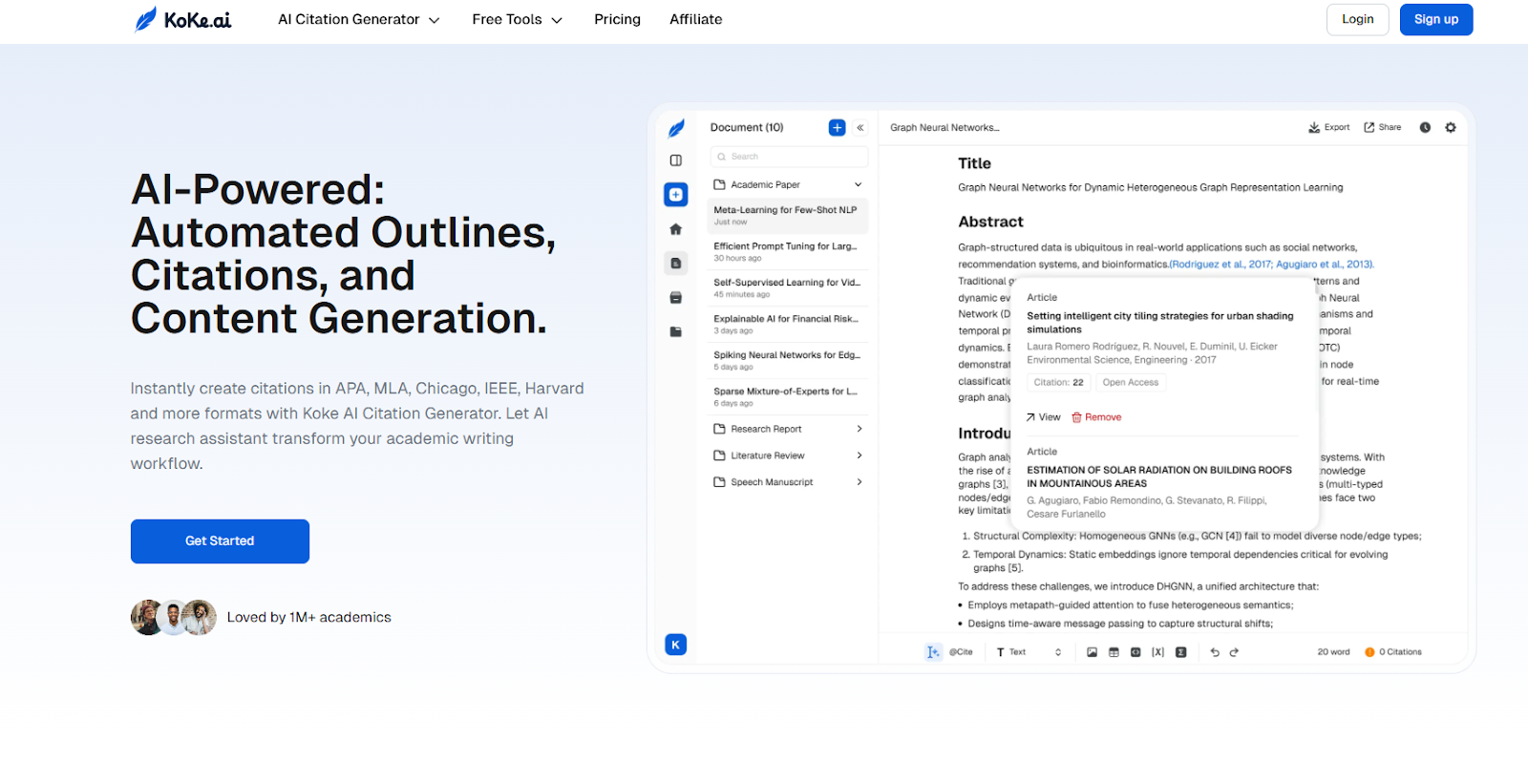
Image source: koke.ai
The intersection of AI and modern project management
Artificial Intelligence (AI) is no longer an idea that is just being explored by companies. Instead, it has been widely adopted. According to a recent McKinsey report, out of the 63 use cases that were identified, generative AI can bring about a value that ranges from $2.6 trillion to $4.4 trillion to the global economy annually. Most of this value is from productivity gains and workflow automation.
Within the scope of Project Management, AI is the source of a change that allows teams to use more data for decisions, forecast more accurately, simplify workflows by automation, and have better discussions. Imagine the fact that project managers are occupied with making drafts of status updates, performing risk analyses, creating progress reports, and producing deliverables for a great part of their time. Based on the conversations of project professionals, these worksalthough one can use templates for themstill take up large portions of time, which could be used for strategic decision-making and stakeholder engagement if these tasks were done.
Besides the stories that are told from experience, university studies about the use of AI in project management also support the idea of potential enhancements. Research exhibits that AI technology can take over the execution of repetitive tasks that are of high volume, and thus, it can facilitate project analytics, estimation, risk prediction, and even provide a solution to the problem. By having such potentials, AI is not only changing the landscape of work of teams, but also influencing the team functioning paradigm.
Documentation challenges in project management
Despite AI's promise, project documentation is still a bottleneck that teams struggle with. Its complexity results from a combination of factors that are deeply interrelated:
- Volume of Outputs: Projects become the source of various kinds of documentsproject charters, status reports, meeting minutes, requirement specifications, risk assessments, and compliance reports.
- Diverse Stakeholder Needs: Different audiences (technical teams, management, customers) require different languages, different levels of detail, and also have to be consistent in formatting.
- Accuracy Requirements: Inaccuracies in reporting can cause misunderstandings, an increase in the budget, and the wrong orientation of the strategy.
- Workflow Fragmentation: Often, the data sources are in different platforms (Jira, SharePoint, email, spreadsheets), and that is why the process of consolidation and manual editing is very time-consuming.
The professional discussion of project managers demonstrates that they are fed up with these processes. Among the common operational overheads are: synthesizing updates from team members who are scattered, cleaning up meeting notes, and updating trackers while still holding a single source of truth.
Even seasoned managers say that automation tools are helpful for trackers and task lists, but still, human intervention is needed for quality documentation, which is a task that has historically not been amenable to scalable automation.
How AI tools revolutionize documentation
That is the point when the difference between the use of AI Writing Assistants and Automated Reporting is shifting.
Artificial intelligence of today, whether it's a sophisticated enterprise suite or a specialized generative assistant, can simply handle the whole process of the creation, the refinement, and the summarization of materials. Such instruments absorb structured data and convert it into readable, professional writing that meets the requirements of the organization's style guides and communication objectives.
To name a few, documentation workflow innovations brought about by AI include:
- Automated Meeting Summaries: AI is capable of filtering out the most valuable parts, decisions, and tasks from the transcript of a meeting lasting several hours.
- Status Report Generation: AI, by observing the progress of the project and the time left from tools like Jira or Asana, can write the narrative of the progress.
- Template-Driven Document Creation: The pre-set templates, aided with AI, help the teams to create complicated documents (for instance, risk analyses) with very little manual input.
- Language and Structure Optimization: AI can change the wording of the text in order to make it more understandable, keep the style uniform throughout the text, and check the text for missing parts.
An excellent illustration of such a trend is Lark. As a productivity superapp for teams, Lark integrates chat, docs, meetings, and workflow automation into one platform. By making these AI services accessible for free, it serves as a prime example of instruments that can create documents simply by unifying the data from different sources and carrying out smart formatting.

Case in point: Koke AI
Koke AI is perhaps one of the most effective instruments that lie at the crossroads between an AI Writing Assistant and project documentation. To support professionals in writing, related tasks, Koke AI is a technology that mainly focuses on the creation of team project documents and reports, which it can later revise and optimize on a large scale.
Koke AI boasts its features through its functionalities. Firstly, the machine can interact with a variety of materials in different formats, like notes, bullet points, or data tables, and produce a refined piece of writing. Secondly, the system can improve the readability level of a text as well as adjust its style to a more professional one, provided that the accuracy is not compromised. Thirdly, it can also give suggestions which are compatible with the forms of organized writing (e.g., APA style references generated by citation where it is required). Additionally, the device shortens documentation turnaround time, making it possible for staff to engage in decision-making, critical tasks.
Thus, it would be a good idea for project managers to spend one or two hours consolidating weekly status updates and then simply use Koke AI for the automatic generation of the consolidated summary from contributions of each team, which is dispersedthereby accomplishing both workflow efficiency and error rate reduction.
Usually, such effectiveness in a project kind of environment means results that can be measured. As a consequence, teams that decide on the implementation of AI assistants such as Koke AI are likely to enjoy the positive impact on document quality, along with accelerated delivery cycles, which in turn cause them to be in a better position than the rest, in which rapid operations are conducted.
Practical implementation: How teams use AI
How AI Facilitates Document Efficiency in Real Life. First of all, let's consider real-life situations where AI-powered software documentation is efficient and fast.
Scenario 1: recap of a sprint
The software team, whose work is based on agile principles, regularly produces sprint retrospectives including both figures and descriptive insight. In the old days, a project manager would probably spend an entire afternoon collecting the statuses of Jira tickets, sprint velocities, and team feedback to finally produce a report that was easy to read.
With an AI tool like Koke AI:
- The AI assistant gets all the data on the sprint and the team notes, either by an upload or a copy, paste operation.
- Koke AI examines the data and creates a well-organized report of the retrospective, complete with sections, bullet points, and brief summaries that are in line with the given context.
- The resulting file can be saved locally in Word or PDF formats, or it can be uploaded to project documentation repositories.
Such a method is a great time saver, indeed, because it turns the work that usually takes several hours into a small number of minutes.
Scenario 2: executive status updates
The members of the board require short summaries backed by data depicting the most important risks, achievements, financial impacts, and next steps. Moreover, these reports should meet the highest standards of accuracy and clarity.
Koke AI does the job by:
- Transform the unprocessed project data into coherent text.
- Use the same business style for language and formatting throughout the text.
- Discover the supplied data, based insights such as trend changes or risk patterns and analyze the input data.
Such a degree of automation is not only a great time saver but also a means of improving communication between different departments that results in faster and better-informed executive decisions.
Points of caution and best practices
While the advantages of AI in documentation are substantial, teams must follow certain best practices to ensure effective adoption:
- Maintain data integrity: AI systems are only as reliable as their input data. Teams should establish data quality governance to avoid “garbage in, garbage out” outcomes.
- Human oversight: Because generative models can produce incorrect conclusions (a phenomenon known as “hallucination”), subject‑matter experts should review AI‑generated outputs, especially for compliance or legal documents.
- Security and privacy: Sensitive project data must be handled in accordance with organizational and regulatory security policies.
- Alignment with style guidelines: Integrate AI outputs with internal style guides and citation standards (e.g., APA Citation Generator formats) to maintain professional consistency.
Balancing automation with oversight ensures that AI becomes an asset—not a liability—in documentation workflows.
Looking ahead: The future of documentation in project management
The role of AI in project workflows is poised for further expansion. Industry forecasts and practitioner sentiment consistently underscore that AI will not replace project managers but augment their capabilities, enhance decision quality, and offload repetitive tasks.
Key trends to watch include:
- AI‑Driven predictive analytics: Intelligent data models will increasingly forecast project risks and timelines based on historical patterns.
- Augmented collaboration workflows: As AI integrates with collaboration platforms, teams will generate and refine documents directly within communication channels.
- Knowledge graphs and continuous learning: AI systems will learn from past project outputs and recreate best practices for future use.
- Embedded intelligent reporting: Automated Reporting will become a native feature of project management platforms, reducing the need for separate, standalone tools.
With these developments, the future workplace will see documentation transform from a scheduling burden into a strategic asset—fueling rapid decision cycles and elevating organizational intelligence.
Conclusion
Documentation has become a driver of organizational insight and transparency rather than a monotonous output in today's complex project environments. With the continuous evolution of AI, teams are significantly improving how they create, refine, and consume project documentation through intelligent data sources and generative models. In fact, AI tools are able to give time savings, clarity, and workflow efficiency to the organizations in a very tangible way through the automation of meeting summaries, the generation of executive reports, etc.
Koke AI and similar tools are good examples of this change, as they bring real benefits by turning the documentation of the old-fashioned way into scalable, AI-led processes. AI writing assistants, by lessening the manual labor and improving the editorial quality, give the power back to project teams to do the things that really matter: creating the right impact and contributing to business success.
In the coming years, project professionals with AI will be able to not only simplify their documentation methods but also lead the way to a new frontier where data, automation, and intelligent insight combine to redefine productivity.
Related reading
Table of contents
Start using Lark today

Manage all your work in one place
Boost team efficiency by 10x
Save up to 70% on software costs
Table of contents
Start using Lark today
Manage all your work in one place
Boost team efficiency by 10x
Save up to 70% on software costs
Keep reading








2026 Lark Technologies Pte. Ltd.
Headquartered in Singapore with offices worldwide.






Explore: