














Asset Management CRM: The Ultimate Guide for Investment Firms

Fecilia Clarke
Solutions Marketing Specialist
Sep 18, 2026
Fecilia Clarke
Sep 18, 2026

16 min read


In asset management industry, is your firm's most critical information scattered across spreadsheets, personal inboxes, and disconnected applications? For many ambitious asset management firms, the answer is a resounding yes. You might have one system for tracking contacts and another for managing your deal pipeline, while crucial conversations with limited partners happen in yet another silo. This fragmentation doesn’t just cause frustration; it creates invisible friction that slows down fundraising, delays due diligence, and puts vital client relationships at risk. It’s a common scenario where the very tools meant to improve efficiency end up holding you back.
This is where a purpose-built asset management CRM solution comes in. But what if a management CRM could do more than just store data? What if it could become the very place where your team collaborates and executes on that data to make data-driven decisions? In this guide, we'll explore the essential functions of a modern asset management CRM and why it’s a non-negotiable tool for growth. More importantly, we'll offer the top solutions in 2025, facilitating your decision for your business.
Key takeaways: Top 8 asset management CRMs
- Lark: A dynamic, all-in-one workspace that combines a no-code CRM with built-in communication and automation tools to connect data directly to team actions.
- Salesforce Financial Services Cloud: An enterprise-grade, industry-specific CRM for large firms requiring deep customization, advanced AI, and a vast third-party app ecosystem.
- Dynamo Software: A purpose-built platform for alternative investments, offering end-to-end functionality across the entire investment lifecycle.
- Satuit CRM: A specialized, user-friendly solution for buy-side asset management professionals focused on sales, client retention, and investor relations.
- Wealthbox: A modern, intuitive CRM popular with financial advisors and smaller firms for its simplicity, ease of use, and strong workflow automation.
- Backstop Solutions: An integrated productivity suite for institutional investors that centralizes CRM, pipeline tracking, and portfolio management to unify operations.
- DealCloud: A highly configurable platform for capital markets professionals, known for its extreme flexibility in creating bespoke deal and relationship management processes.
- Juniper Square: A leading investor management platform for private markets, excelling at lifecycle management and offering a best-in-class digital investor portal.

What exactly is asset management CRM?
At its core, an asset management CRM is a centralized software platform designed to manage and nurture the complex web of relationships that drive investment firms. Think of it as far more than a digital address book. It is a strategic tool built specifically for the entire investment lifecycle, from initial contact with a potential investor to the long-term management of committed partners. It’s the single source of truth that consolidates every interaction, document, and data point related to your clients, deals, and overall portfolio management. This system is a key factor in achieving sustainable success.
Unlike generic CRMs, a specialized asset management CRM is built with the vocabulary of your industry in mind. It understands concepts like funds, commitments, asset classes, and compliance. Its features are tailored to manage investor relations, streamline due diligence, and improve client service. Instead of forcing your team to adapt their workflow to the software, the right CRM system adapts to them. It acts as the central nervous system for many asset management firms, seamlessly connecting your people, your intricate processes, and your most valuable client data to drive growth and efficiency.
The essential features of modern asset management CRM
Choosing the right portfolio management software means focusing on features that solve the specific challenges of your firm. A powerful asset management CRM should provide a suite of integrated tools designed for the entire investment lifecycle. These features are the building blocks of a more efficient and compliant firm, fostering better internal knowledge sharing and stronger client trust. As we explore them, you'll see how an unified platform like Lark weaves them together into a seamless workflow, connecting your data directly to your team's day-to-day actions and helping you build strong relationships.
Centralized relationship management
The foundation of any great CRM is its ability to create a 360-degree view of every relationship. This means a complete history of all client interactions—emails, meetings, and calls—all in one place. It should allow you to map complex networks and understand how different investors are connected, a concept often referred to as relationship intelligence.
Dynamic deal and pipeline tracking
Managing your deal flow on a static spreadsheet is a recipe for missed deadlines and unclear ownership. A modern CRM must provide a dynamic, visual way to track opportunities from sourcing to close. This includes customizable stages, clear task assignments, and the ability to see your entire pipeline at a glance, giving you real-time insights into your business development efforts.
Automated workflow and compliance tools
Repetitive, manual tasks are a major source of inefficiency. The right CRM should allow you to automate workflows. This could be as simple as assigning a follow-up task after a meeting or as complex as a multi-stage approval process for a new investment. These automations ensure standard procedures are followed every time, creating consistency and a clear audit trail. With powerful compliance features and approval tools, you can embed these processes directly into your CRM, making compliance a natural part of your workflow.
Powerful reporting and business intelligence
You can't manage what you can't measure. Your CRM should include robust reporting tools that make it easy to generate insights from your portfolio data. This means intuitive, customizable dashboards that can visualize everything from your fundraising progress and fund performance to the effectiveness of your deal sourcing channels. This level of business intelligence allows partners to make strategic decisions based on real-time performance metrics rather than outdated reports, and to better analyze portfolio trends.
Secure document management with network security
Sharing sensitive information requires a secure and professional solution with strong network security. A leading CRM should offer a way to share documents with granular permissions. With Lark Docs, you can create, collaborate on, and share critical documents with advanced security features like password protection and watermarks. This ensures the safety of your client and portfolio data while providing a seamless and secure experience for your limited partners, ultimately boosting customer loyalty.
Seamless integration with your existing tech stack
Your CRM does not exist in a vacuum. It needs to communicate with your existing tech stack, including third-party data providers, and other fund accounting systems. Strong integration capabilities enable firms to unlock data from across their tools, preventing the creation of new silos. Platforms with open APIs and integration tools are built to be the connected hub of your operations, ensuring your CRM can evolve with your firm's needs.
Top 8 asset management CRM solutions for investment firms
Navigating the CRM market can be a daunting task. The landscape is filled with options, from massive enterprise platforms to niche, purpose-built tools. To help you make an informed decision, we have reviewed the leading solutions. We've placed Lark at the top because it offers a uniquely collaborative and customizable approach that redefines what a CRM can be—transforming it from a simple database into your firm's central workspace for communication and execution.
1. Lark: The all-in-one collaborative workspace for asset management
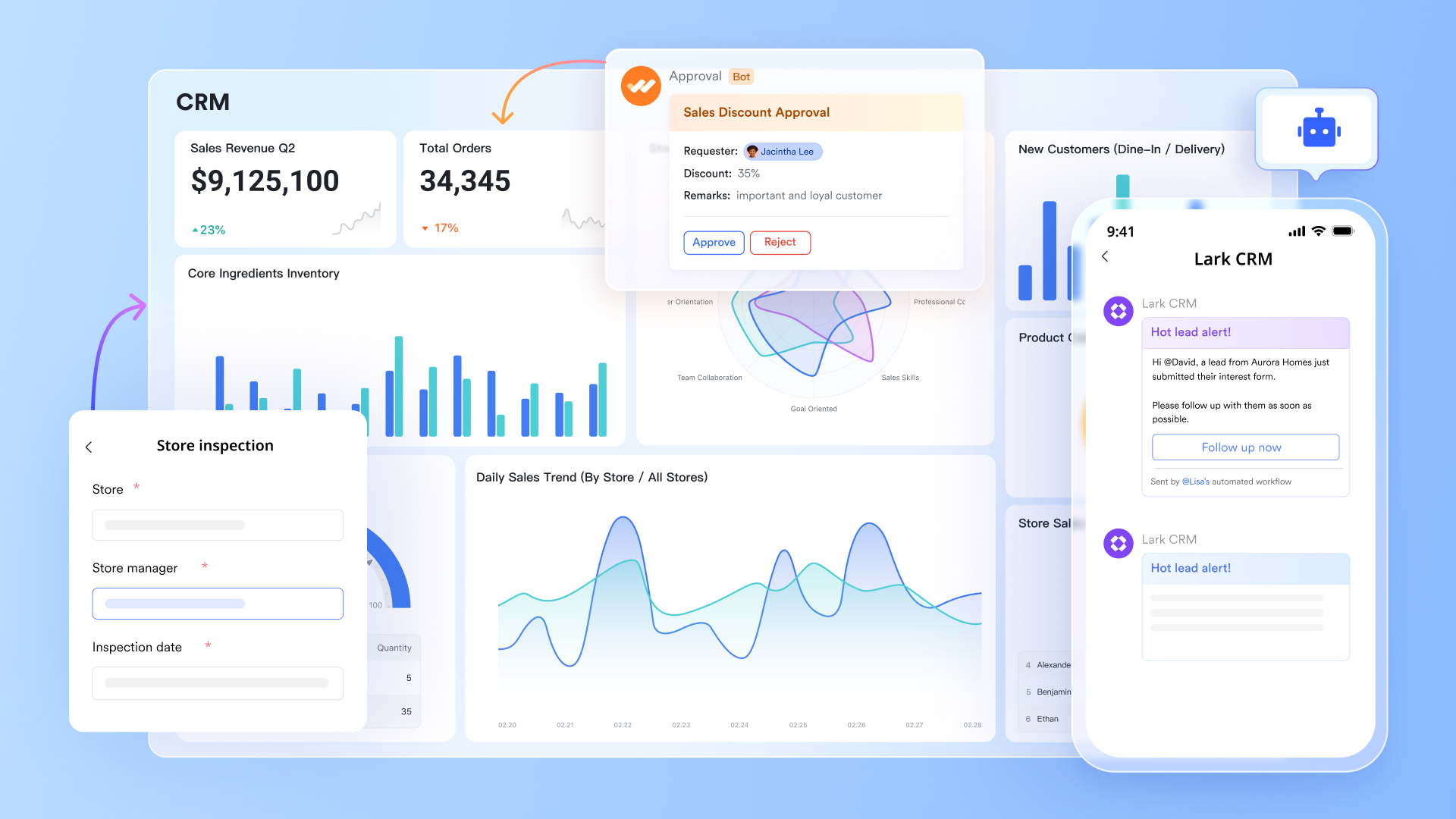
Overview: Lark is an all-in-one collaborative suite that fundamentally changes how teams interact with their CRM. Instead of a standalone system, Lark combines a powerful database (Lark Base) with the communication tools your team uses every day. This unique fusion turns a static CRM into a dynamic workspace where portfolio managers can manage deals, communicate contextually, and automate complex workflows. It's the ideal dedicated CRM for firms looking to connect their data directly to their team's actions.
Key features:
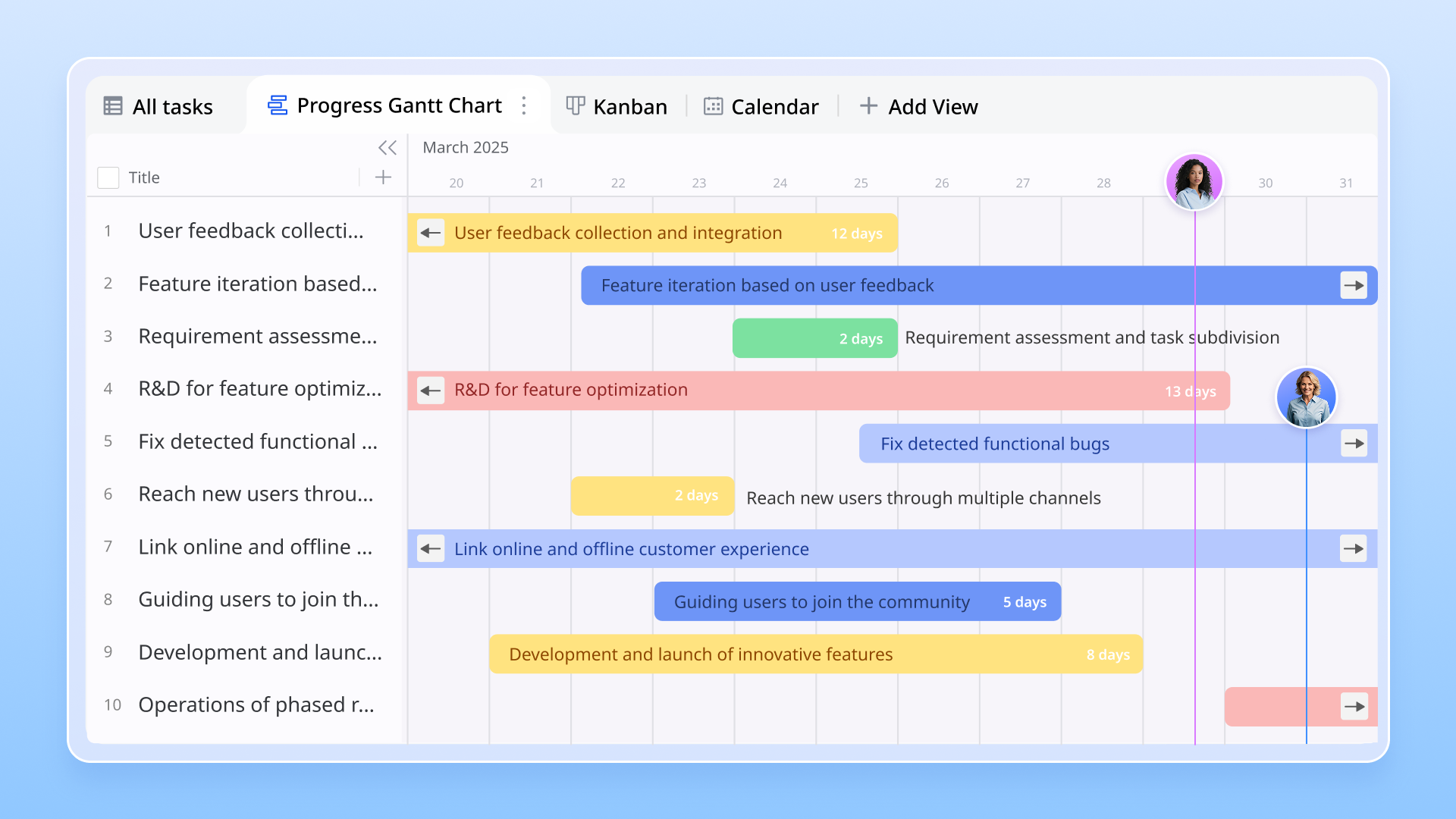
- Customizable no-code CRM: Build a CRM perfectly tailored to your investment workflows with a fully customizable database. Use configurable fields and multiple views like Kanban, Gantt, and Grid to manage contacts and pipelines, all without needing to write a single line of code.
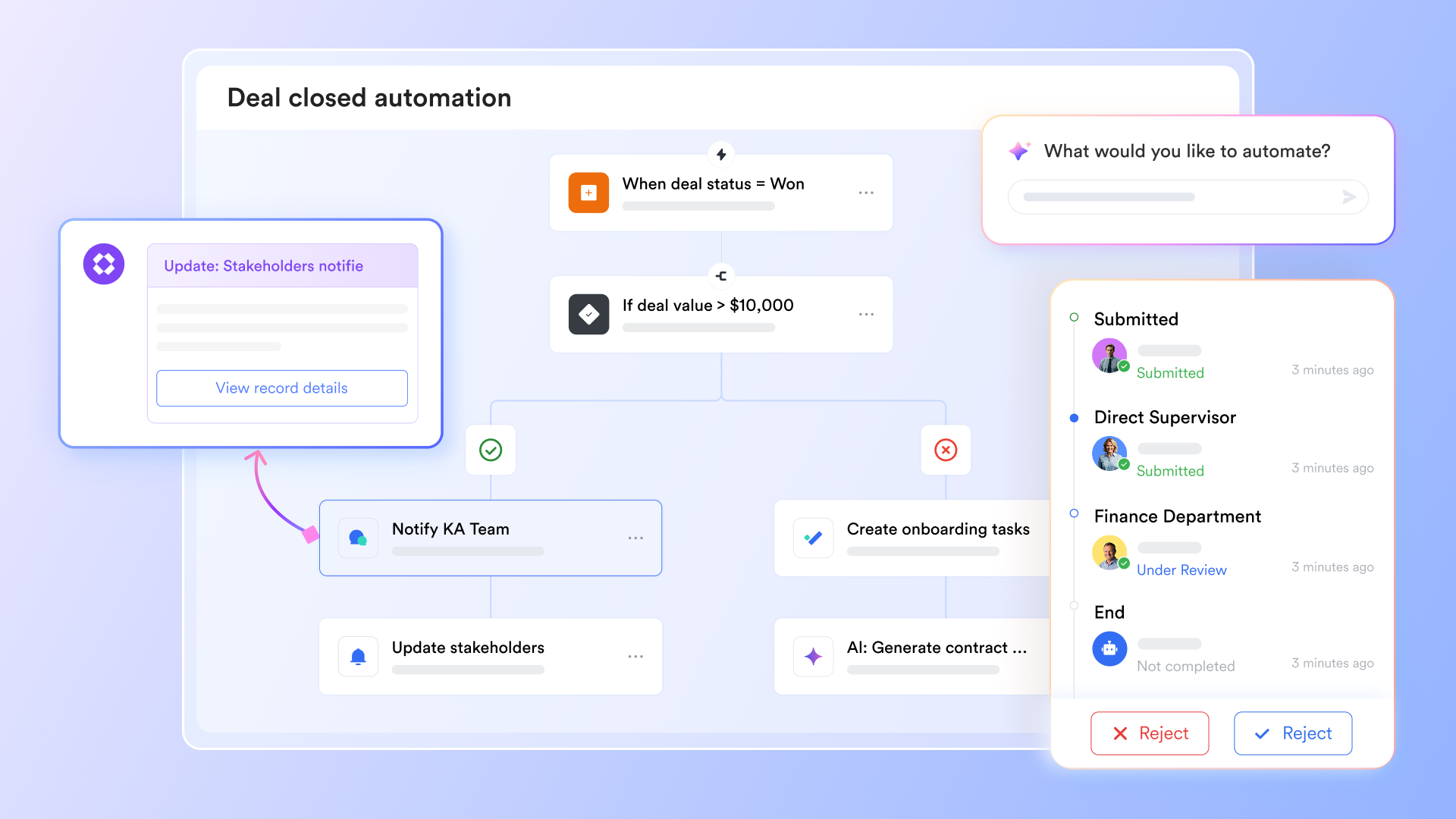
- Custom workflow automation: Standardize compliance and operational processes with a built-in, no-code automation engine. Easily build tailored automations for approvals, notifications, and task assignments to eliminate repetitive manual work and reduce administrative overhead.
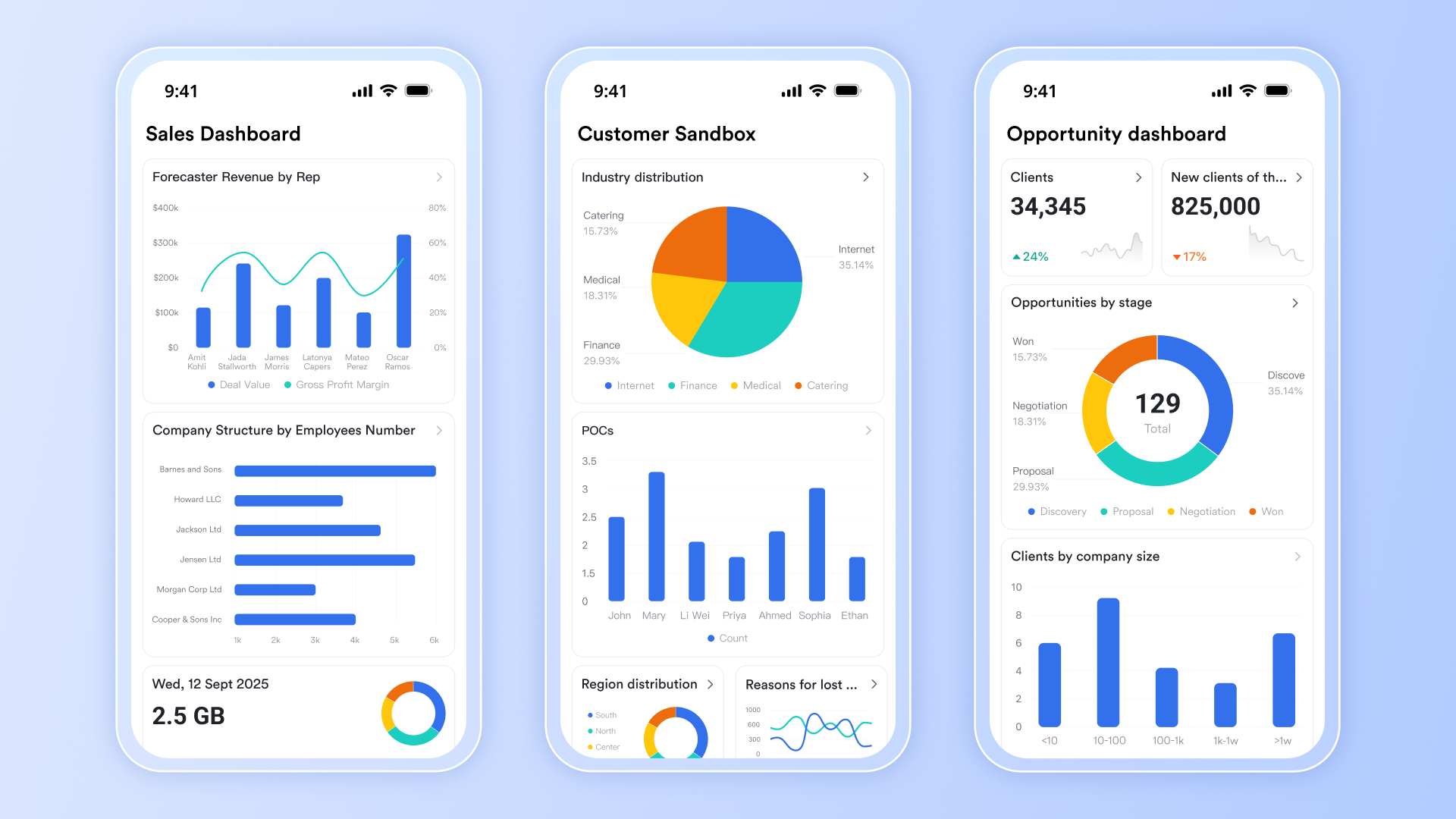
- Cross-platform synchronization: Maintain seamless workflow continuity with automatic data synchronization across web, desktop, and mobile apps. Access and update your full CRM history from any device, ensuring your team has the latest information, whether in the office or on the road.
- Built-in collaboration hub: Connect your CRM data directly to your team's conversations. Use integrated Messenger and Meetings for real-time, contextual collaboration on deals and client service, eliminating the constant need to switch between different applications and lose valuable context.
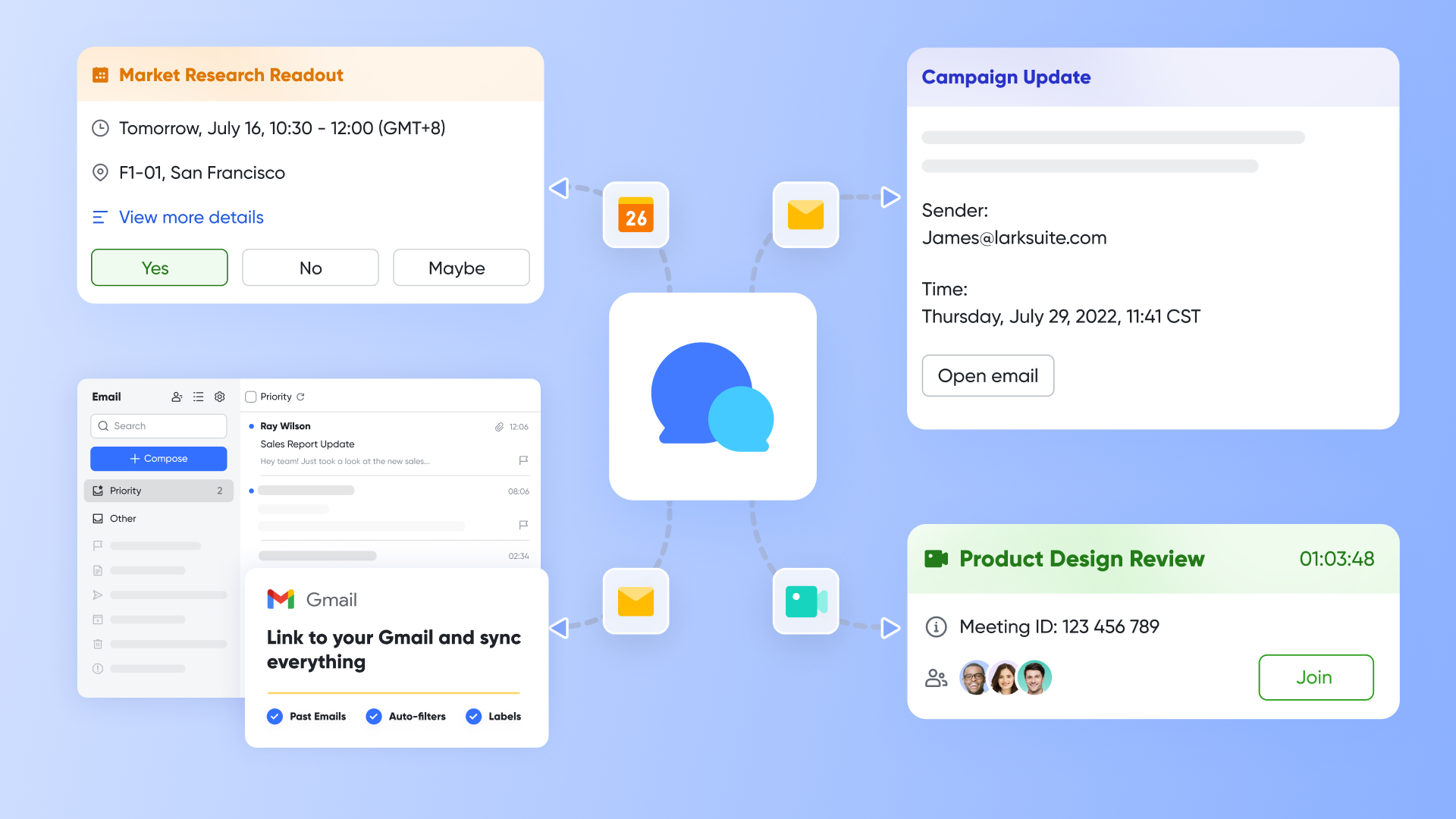
- AI-powered meeting intelligence: Leverage AI Meeting Notes to automatically generate meeting summaries, extract key takeaways, and create action items. This automates CRM data entry after client calls and investor meetings, ensuring your records are always up-to-date and your team never misses a follow-up.
- Unified document management: Centralize and collaboratively edit investment memos, due diligence reports, and compliance documents within Lark Docs. Link documents directly to your CRM records, creating a single source of truth for every deal and client relationship.
Pricing:
- Free plan: Includes 11 powerful products, supporting up to 20 users, 100 GB storage, 1,000 automation runs and unlimited AI translation in chats, docs and email.
- Paid plans: Starts at $12/user/month, supporting up to 500 users. Includes unlimited message history, 50,000 automated Base workflow executions per month.
- Enterprise plan: custom pricing.
2. Salesforce Financial Services Cloud: An enterprise-grade platform for large-scale firms
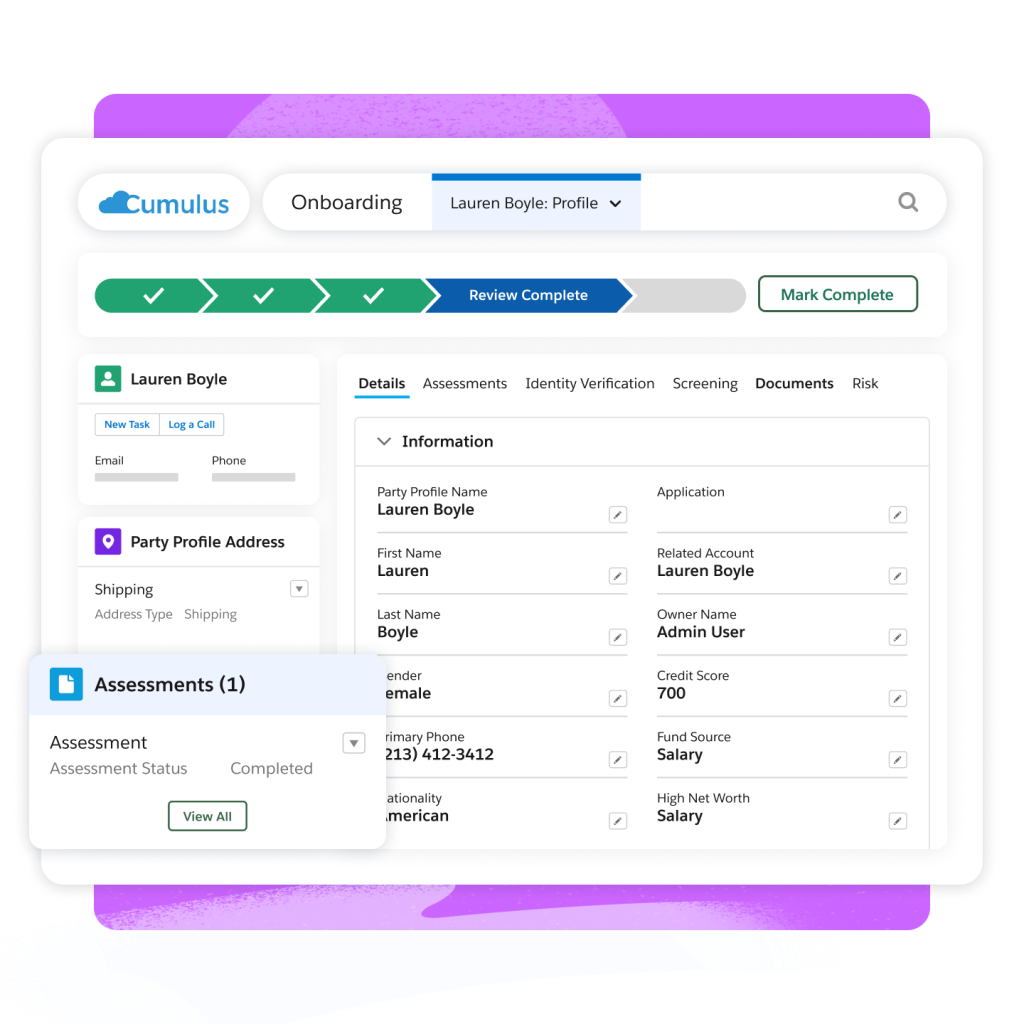
Image source: salesforce.com
Overview: Salesforce Financial Services Cloud is the industry-specific offering from the world's largest CRM provider. It's a robust, enterprise-grade solution that extends the core Salesforce platform with features tailored for wealth and asset management. It is incredibly powerful and scalable, designed for large firms that need deep customization and have the resources to manage a complex implementation. Its ecosystem of third-party apps provides nearly limitless extensibility for any business need.
Key features:
- Advanced relationship mapping to visualize complex client and household networks.
- Comprehensive client lifecycle management from prospecting through to onboarding and service.
- Embedded AI and analytics tools (Einstein) for predictive insights and next-best-action recommendations.
- A vast marketplace (AppExchange) for third-party financial services applications and integrations.
- Highly configurable dashboards and reporting for tracking AUM and client engagement.
Pricing:
Salesforce employs a premium pricing strategy. Costs are quoted on a per-user, per-month basis and typically require a custom package.
3. Dynamo Software: A purpose-built platform for the alternative investment ecosystem
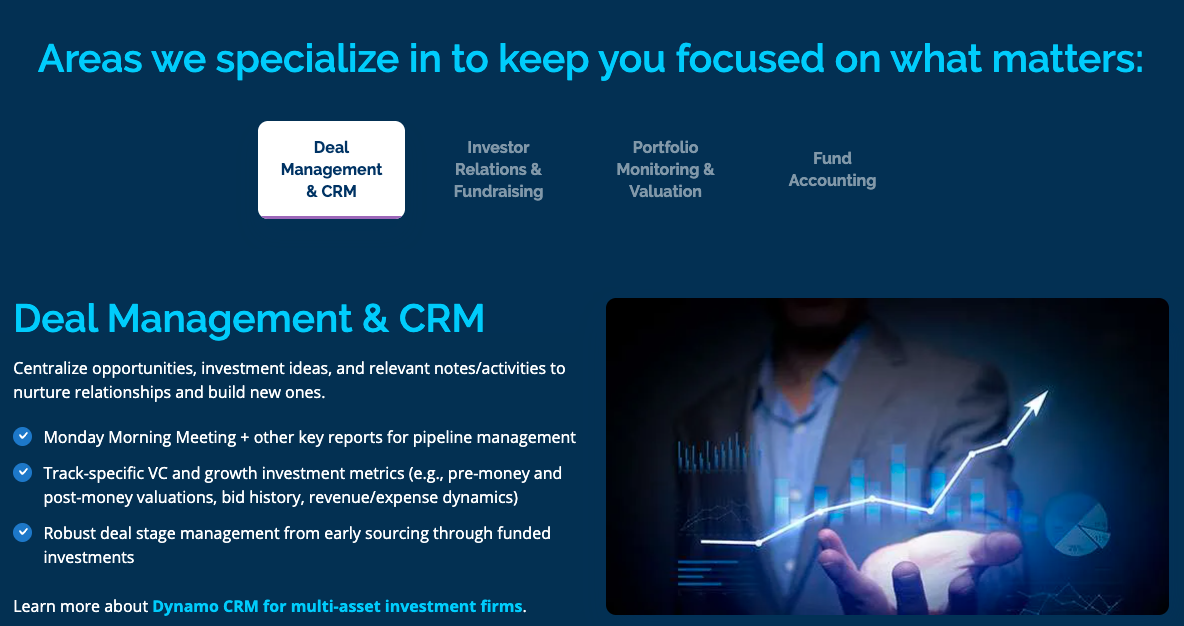
Image source: dynamosoftware.com
Overview: Dynamo Software is a well-established, purpose-built platform specifically for the alternative investment ecosystem, serving private equity, venture capital, and hedge funds. Its primary strength lies in its end-to-end functionality, covering the entire investment lifecycle. It provides dedicated modules that help firms manage deal flow, investor relations, and research, all from a single, integrated platform designed to improve operational efficiency and provide a centralized source of truth for all investment activities.
Key features:
- End-to-end deal management, from sourcing and due diligence to closing.
- Comprehensive investor relations tools for tracking commitments and communications.
- Integrated portfolio monitoring and performance reporting capabilities.
- A secure online investor portal for sharing documents and reports.
- Research management tools to track and organize investment theses and notes.
Pricing:
This management software has enterprise-focused pricing, available upon request for a demo and quote.
4. Satuit CRM: A specialized solution for buy-side asset management professionals
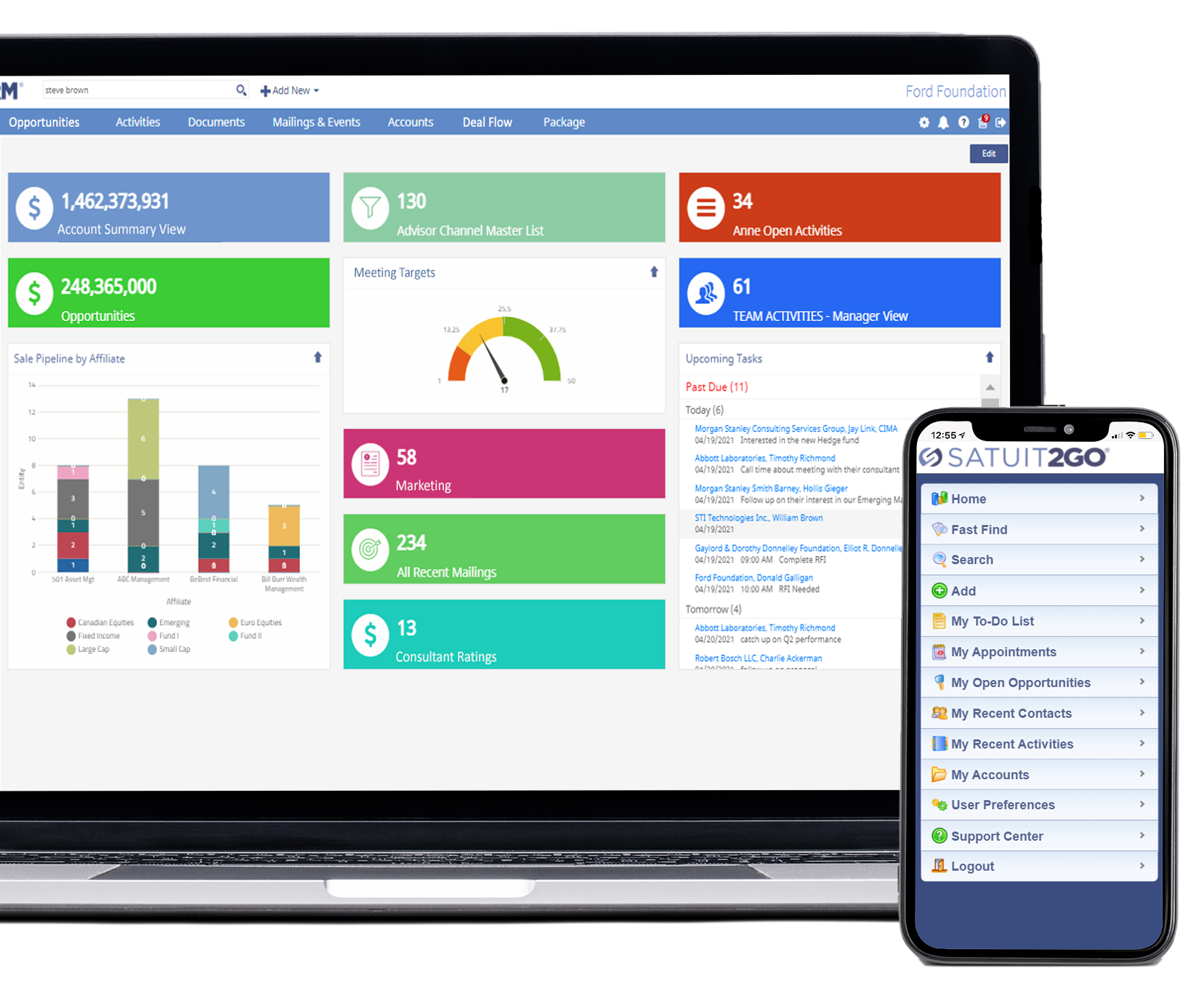
Image source: satuit.com
Overview: Satuit is a specialized CRM solution designed explicitly for buy-side asset management professionals. Its core focus is on supporting the distinct needs of sales, client retention, and investor relations teams within institutional asset management. The platform is often praised for its user-friendly interface and its collection of purpose-built features that streamline time-consuming tasks like preparing for client meetings, generating reports, and managing compliance documentation, making it a practical choice for this market segment.
Key features:
- Automated generation of tear sheets and client-ready reports.
- Integrated email marketing for targeted investor outreach and communication campaigns.
- Robust compliance tracking features and document management.
- Mobile application for on-the-go access to client and portfolio data.
- Customizable dashboards for sales, client service, and activity reporting.
Pricing:
Pricing information for Satuit CRM is provided upon request.
5. Wealthbox: A modern, user-friendly CRM for client-centric advisory firms
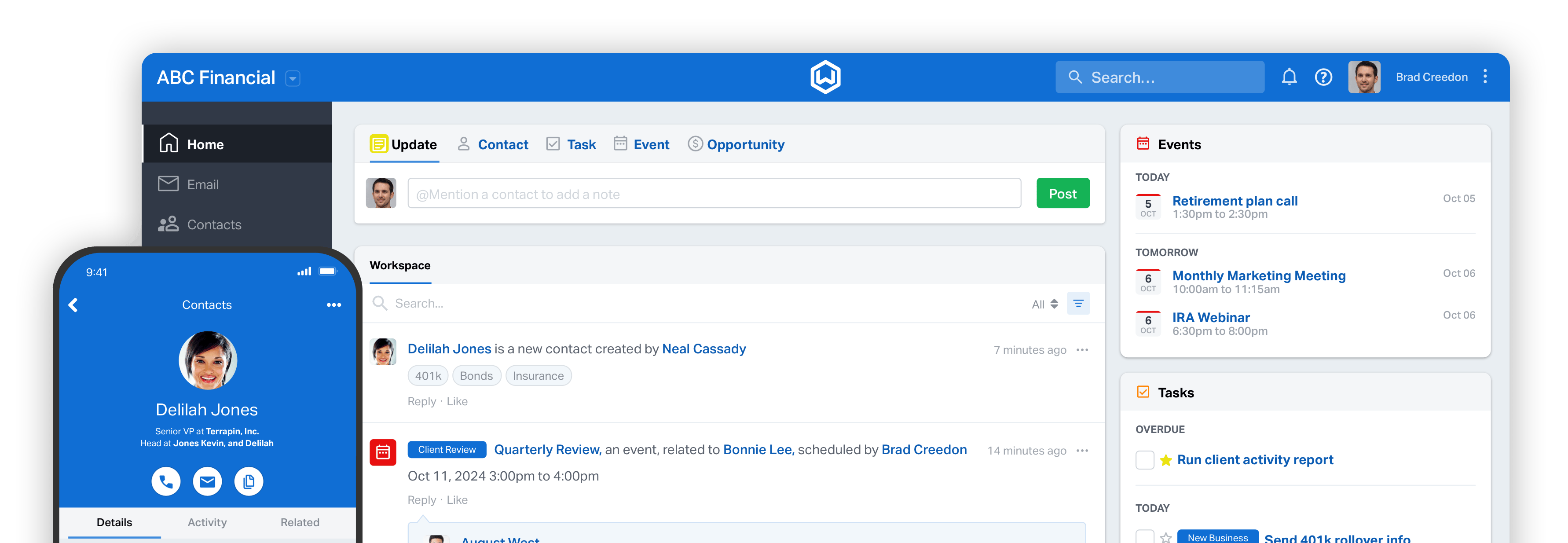
Image source: wealthbox.com
Overview: Wealthbox is a modern and highly intuitive CRM that has gained significant popularity among financial advisors for its simplicity and elegant design. While not exclusively for institutional asset management, its user-friendly interface and strong workflow automation make it a viable option for smaller, more agile investment firms and family offices. It's an excellent fit for teams that prioritize ease of use, rapid adoption, and the ability to deliver personalized advice without extensive training.
Key features:
- A collaborative, "social media-style" activity stream for team communication.
- A powerful and easy-to-use workflow builder for automating multi-step processes.
- Companion mobile app that provides full functionality on the go.
- Integrated "click-to-call" functionality and email tracking.
- An open API with a wide range of integrations to other wealth-tech tools.
Pricing:
Wealthbox is known for its transparent, tiered pricing, which is available on its website.
6. Backstop Solutions: An integrated productivity suite for institutional investors
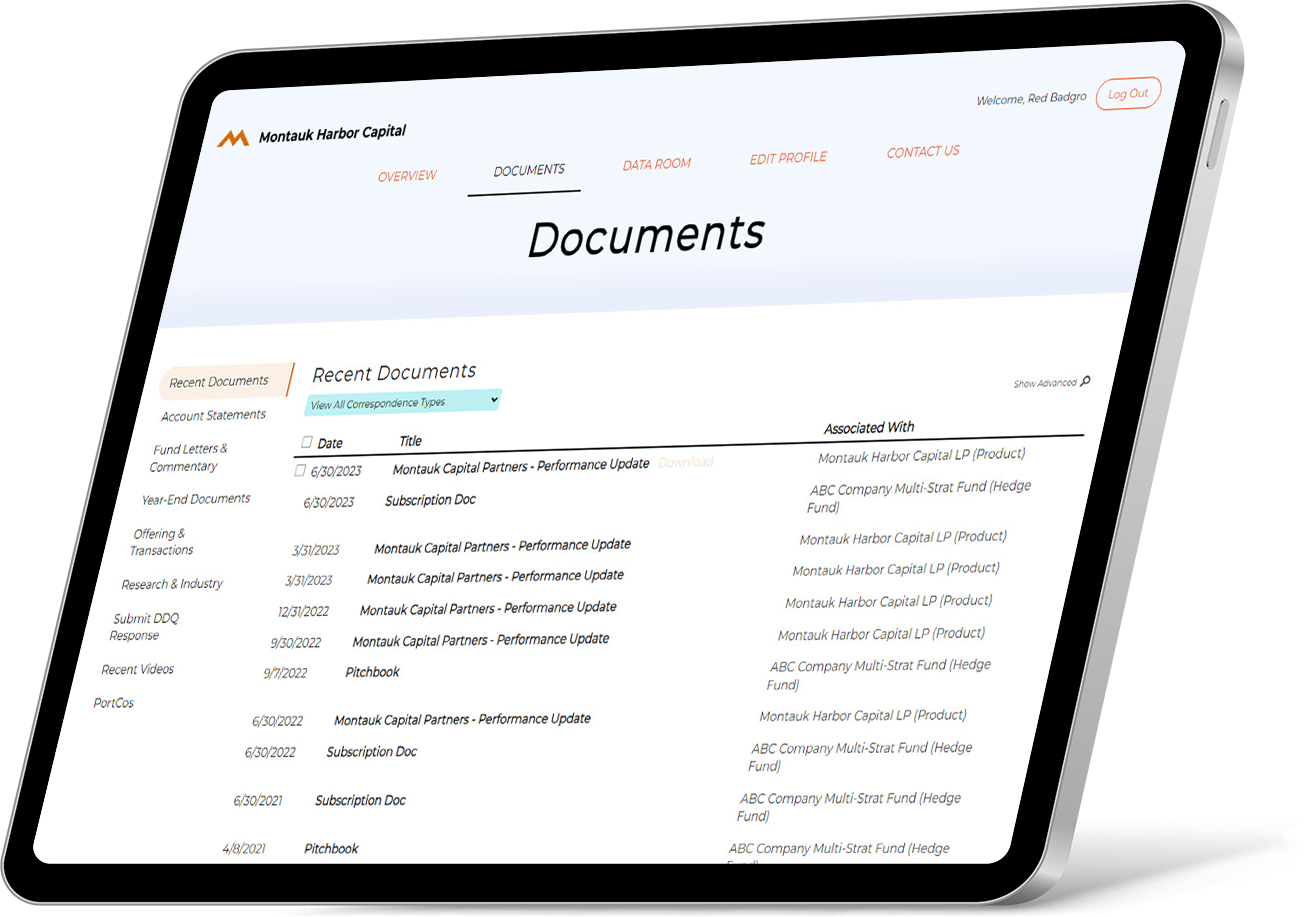
Image source: backstopsolutions.com
Overview: Backstop provides a cloud-based productivity suite for the institutional and alternative investment industry. The platform's goal is to centralize a firm's operational data by combining CRM, pipeline tracking, and portfolio management into a single integrated solution. It is designed to help firms manage their entire workflow, from capital raising and deal sourcing to accounting for investor commitments and managing portfolio data, thereby breaking down silos between front and back-office teams.
Key features:
- Dedicated workflows designed specifically for the capital raising process.
- Robust pipeline management tools for tracking deals and other opportunities.
- A secure investor portal for streamlined reporting and document sharing.
- Liquidity tracking and analysis for portfolio management.
- Accounting and management of investor commitments and capital calls.
Pricing:
Backstop's pricing is customized for each firm and is provided after a consultation.
7. DealCloud: A highly configurable platform for capital markets professionals
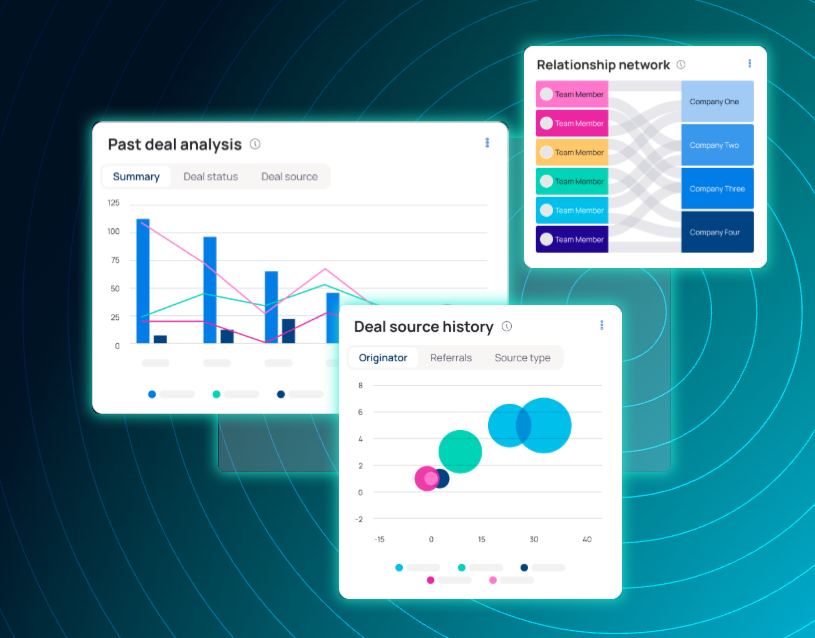
Image source: intapp.com
Overview: DealCloud, part of the Intapp family, is a highly configurable platform built by and for capital markets professionals. It is a dominant player in the investment banking, private equity, and venture capital spaces, renowned for its extreme flexibility. It allows firms to create a completely bespoke solution that precisely mirrors their unique deal-making, relationship management, and reporting processes, rather than forcing them to adapt to a predefined structure.
Key features:
- Tailored pipeline management for M&A, fundraising, and other capital markets activities.
- Deeply customizable reporting and analytics dashboards (Intapp DataCortex).
- A central data repository for all firm-wide relationship and activity data.
- Mobile app and Microsoft Office integrations for seamless workflow.
- Purpose-built compliance solutions for managing conflicts and regulatory needs.
Pricing:
DealCloud is a premium, enterprise-level solution with pricing available upon quotation.
8. Juniper Square: A leading investor management platform for private markets
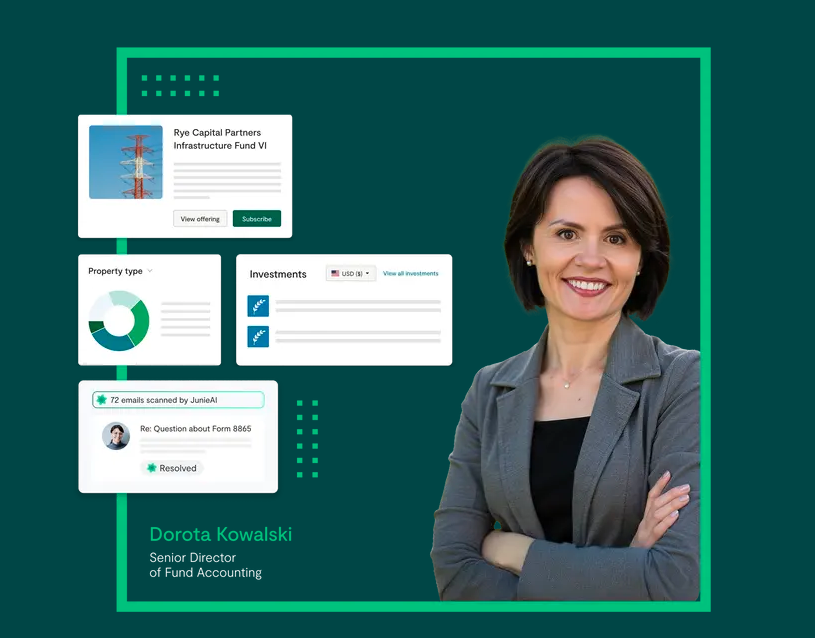
Image source: junipersquare.com
Overview: Juniper Square is a leading solution that combines a powerful CRM with partnership enablement and administration services. It has a particularly strong foothold in the real estate investment sector but serves all private markets. It excels at managing the entire investor lifecycle, from initial contact and fundraising to ongoing reporting and distributions. Its standout feature is a best-in-class investor portal that provides a modern, intuitive experience for limited partners.
Key features:
- An industry-leading, secure digital investor portal.
- Streamlined electronic subscription document processing and e-signing.
- Automated investor reporting, capital call, and distribution notices.
- Centralized CRM to track all investor data and communications.
- Integrated data rooms for secure document sharing during due diligence.
Pricing: Pricing is typically customized based on a firm's assets under management (AUM) and the number of limited partners.
The hidden costs of operating with multiple systems
Continuing to operate with disconnected spreadsheets and generic software isn't just inefficient; it carries significant hidden costs that can quietly erode your firm's competitive edge. Relying on multiple systems creates friction in daily operations, exposes the firm to unnecessary risks, and ultimately caps your potential for growth. While it may feel like the "free" or "good enough" solution, the reality is that the cost of inaction is often far greater than the investment in a modern, integrated system. Let's break down the key areas where these costs accumulate for asset management companies.
The compounding risk of fragmented data
When your investor information and customer data live in one analyst's spreadsheet, your deal pipeline in another, and your communication history is buried in individual email inboxes, you have no single view of your firm's relationships. This fragmentation is a major source of risk and prevents you from gaining actionable insights. An investor might have a critical conversation with one partner, but the rest of the team remains unaware. A promising deal lead might go cold because follow-up was unclear. These information gaps lead to missed opportunities and prevent the firm from making informed decisions.
The heavy burden of manual workflows
How many hours do your team members, from analysts to seasoned asset managers, spend each week manually updating spreadsheets, compiling data for investor reports, or searching through emails for a specific conversation? These manual processes are not just tedious; they are a significant drain on your firm's most valuable resource: your team's time. This lack of automated workflows means every hour an analyst spends on administrative data entry is an hour they aren't spending on due diligence or analyzing market trends. This inefficiency directly impacts productivity and operational efficiency.
The growing challenge of compliance and audit trails
In an era of increasing regulatory scrutiny, maintaining a clear and comprehensive audit trail is no longer optional. When a regulator asks for the complete communication history with specific institutional clients, pulling that data from various inboxes and personal notes is a frantic, time-consuming exercise. Without a centralized system that offers robust communication tracking, your firm is exposed to significant risk. Proving adherence to policies becomes a matter of manual reconstruction rather than a simple report, creating constant anxiety for your compliance teams and making it difficult to mitigate risk.
Beyond the CRM: Building a collaborative investment ecosystem
Choosing a CRM from a list of features is only half the story. The true value of a CRM in today's environment is not just in its ability to store data, but in its power to enable action and facilitate the relationship building that is crucial for success. The most forward-thinking firms are moving beyond the idea of a CRM as a static data repository. They are building a connected ecosystem where their data is inextricably linked to their team's communication and decision-making processes, leading to better client service.
From data repository to action engine
A traditional CRM tells you what you know. A collaborative platform helps you decide what to do with that knowledge. Imagine identifying a high-potential deal. In a disconnected system, the next step is to switch to email. In a connected ecosystem like Lark, that CRM record in Lark Base is your launchpad. With one click, you can create a dedicated meeting, pulling in the relevant analysts and partners. The context is right there, and the conversation begins instantly, allowing you to deliver a more personalized service.
The power of a single, auditable source of truth
This integration creates something incredibly valuable: a single, auditable source of truth. The due diligence discussion in your chat group, the AI-generated summary from your expert call in Lark Meetings, the collaborative investment memo in Lark Docs, and the deal stage in your Lark Base CRM are all interconnected. When it's time for an investment committee review or a regulatory audit, you no longer have to piece together a story. The entire history—from conversation to decision—is preserved in one cohesive, time-stamped narrative, empowering you to make more informed investment decisions.
How to start building your asset management CRM in Lark
The idea of implementing a new CRM can feel overwhelming, but it doesn't have to be. With a flexible and intuitive platform, you can start small and build powerful, customized solutions in a matter of hours, not months. The journey to a more connected and efficient asset management firm can begin today with a few simple steps. Lark is designed to be user-friendly, allowing you to build and adapt your CRM as your needs evolve, without requiring a team of developers.
Step 1: Sign up and import your existing data
The first step is the easiest. You can start with one of our pre-built templates in Lark Base designed for pipeline or contact management, or create a new one from scratch. Then, simply import your existing contacts and deals directly from a spreadsheet. Within minutes, your data will be live in a flexible, powerful database.
Step 2: Customize your views and pipelines
This is where you tailor the CRM to your firm’s unique process. With an intuitive drag-and-drop interface, you can add custom fields to track specific information and configure drop-down menus to standardize data entry. Create a Kanban board to visualize your deal pipeline and a calendar view to track your portfolio performance reviews—all pointing to the same central data.
Step 3: Connect your team and automate your first workflow
The final step is to bring your CRM to life. Invite your team members and begin connecting your data to their work. Create a dedicated Messenger group for your top deals. Set up your first automation in Lark Base—for example, automatically send a notification when a deal's status is changed. This is the moment your CRM transforms from a database into an active part of your team's collaborative process.
Conclusion
The asset management industry will always be built on a foundation of relationships and intelligence. However, the firms that will lead the next decade are those that master the flow of information. Relying on outdated, fragmented systems is no longer a viable strategy for growth. As we've explored, a modern asset management CRM is essential for centralizing data, streamlining workflows, and mitigating compliance risk. It provides the core features needed to manage the complexities of your business with clarity and control.
But the future demands more than just a better database. It demands a connected ecosystem where data fuels immediate, collaborative action. The true competitive advantage lies in breaking down the walls between your information and your communication. Lark is uniquely built for this future. We don't just offer a CRM; we provide a unified platform where your firm can manage relationships, execute deals, and collaborate with unparalleled speed and context. It’s time to move beyond static lists and build a living system that helps you make informed investment decisions and works as hard as you do.
FAQs
What is CRM in asset management?
An asset management CRM is a specialized system for managing relationships with investors, tracking deal pipelines, and monitoring portfolio companies. It centralizes all communications and data, helping firms streamline fundraising, improve investor relations, and ensure regulatory compliance with a single source of truth.
What is the best CRM for asset management?
The best CRM depends on a firm's size and needs. Integrated platforms like Lark are ideal for collaboration, while specialized tools like DealCloud offer deep customization. The key is choosing a system that supports relationship intelligence, pipeline management, and compliance workflows effectively.
What are the 4 types of CRM?
The four main types are:
- Analytical: Focuses on data analysis for insights.
- Operational: Automates sales, marketing, and service workflows.
- Collaborative: Improves information sharing across teams.
- Strategic: Focuses on building long-term, profitable customer relationships.
Who are the big 3 asset managers?
The "big three" typically refers to the world's largest asset management firms by assets under management (AUM). These are generally recognized as BlackRock, The Vanguard Group, and State Street Global Advisors, who collectively manage trillions of dollars.
Related reading
Table of contents
Start using Lark today

Manage all your work in one place
Boost team efficiency by 10x
Save up to 70% on software costs
Table of contents
Start using Lark today
Manage all your work in one place
Boost team efficiency by 10x
Save up to 70% on software costs
Keep reading









2026 Lark Technologies Pte. Ltd.
Headquartered in Singapore with offices worldwide.






Explore: