














A Complete Guide to Mastering B2C Sales in 2026

Cecilia Lane
Go-to-Market Associate
Sep 18, 2026
Cecilia Lane
Sep 18, 2026

22 min read


Think about the last time you bought something you truly love—that perfect pair of running shoes, the morning coffee that starts your day just right, or the subscription service you can't live without. That immediate, personal connection is the very heart of the business-to-consumer world. In this article, I'll walk you through a comprehensive guide to understanding and mastering B2C sales. Let's move from foundational concepts and the modern customer journey to advanced strategies and collaborative tools, like Lark, that empower teams to excel.

What is B2C sales?
At its core, the B2C(business-to-consumer) or DTC sales meaning is simple: it refers to the process where a business sells its products or services directly to an individual consumer for their personal use. When defining B2C sales, it is to describe a transaction driven by individual need, desire, and emotion. The model has undergone a breathtaking evolution. It began with the timeless tradition of the physical brick-and-mortar store, where relationships were built face-to-face over a counter.
The late 20th century then brought the e-commerce revolution, a seismic shift that moved the storefront online and opened up a global marketplace accessible from a desktop computer. Now, we are in the era of mobile and social commerce, where the entire B2C sales process can happen in the palm of your hand, often sparked by a post in your social media feed.
Throughout this evolution, one principle has remained the absolute key to success: understanding the consumer mindset is your greatest asset. Unlike the calculated, logic-driven world often seen in B2B sales vs B2C, the consumer journey is deeply personal. It's guided by a potent mix of factors:
- Emotional drivers: A B2C purchase is often about how a product makes someone feel. It could be the confidence from a new outfit, the joy of a new gadget, or the comfort of a trusted brand. Successful B2C sales teams know how to tap into these emotions through storytelling and brand identity.
- Immediate needs and gratification: The B2C consumer often seeks a quick solution to a problem or an immediate fulfillment of a desire. The path from discovery to purchase needs to be as short and frictionless as possible. A complicated checkout process or a slow-loading website can easily break the spell and lose a sale.
- Brand perception and trust: In a sea of options, consumers gravitate toward brands they trust and identify with. This trust is built through consistent messaging, positive reviews, excellent customer experience, and a transparent brand ethos. Every interaction contributes to this perception, making a unified team approach essential.
The entire B2C sales funnel, from initial awareness to final purchase and beyond, is designed around this individual-centric reality. It's a high-volume, changing environment where brand loyalty is the ultimate prize, and every single customer interaction matters. Mastering this requires not only a solid B2C sales strategy but also a deep empathy for the end consumer.
5 core types of B2C business models
The world of B2C sales is not a monolith. The way a company gets its products into the hands of consumers can vary dramatically, and these different approaches have given rise to several distinct business models. Most businesses today often blend elements from multiple models, but they generally fall into one of these five core types.
- Direct sellers
As the most traditional B2C model, direct sellers manufacture and sell their products straight to consumers, eliminating middlemen. This allows complete control over branding, pricing, and customer experience. Powered by the internet, these brands can now build a global audience without extensive physical presence.
Examples: Iconic tech companies like Apple and apparel giants like Nike are prime examples. Newer DTC brands have grown entirely online, such as Warby Parker or Casper.
- Online intermediaries
These companies serve as modern marketplaces, connecting buyers and sellers through digital platforms and operations without owning the products. They generate revenue via sales commissions, listing fees, or premium seller services. For B2C sales teams, these platforms offer immediate access to a broad customer base, creating a convenient and trusted one-stop shop with a wide selection of goods. A smooth marketplace seller onboarding process helps ensure that new sellers can join the platform efficiently and meet its operational requirements.
Examples: Amazon is the undisputed giant in this space, hosting millions of third-party sellers. Etsy has carved out a successful niche for handmade and vintage goods, while eBay remains a major player for both new and second-hand items.
- Advertising-based models
Operating on an audience-driven model, these businesses generate free, high-quality content to attract traffic. They profit by converting this audience into a monetizable asset, selling advertising access to third-party businesses. The consumer engages with the content, while the actual sale involves the platform and its advertisers.
Examples: Major media outlets like The Guardian or Forbes use this model to support their digital journalism. Video platforms like YouTube are a prime example, allowing creators to monetize their content through ads shown to viewers.
- Community-based models
Community-based platforms evolve the advertising model by harnessing user-generated content and network effects. They cultivate dedicated online spaces around shared interests, transforming user engagement into a valuable asset of targeted data for advertisers. This model derives its primary strength from the profound loyalty and active participation of its community members.
Examples: Social media platforms like Meta and Pinterest are the most prominent examples. Niche online forums and communities like Reddit also fall into this category.
- Fee-based models
Often called the subscription model, this approach charges a recurring fee for ongoing access to a service or content. Its popularity stems from providing businesses with predictable revenue while offering consumers substantial value at a low recurring cost. Success depends on continuously delivering high value to minimize customer churn.
Examples: Streaming services are the classic case, with Netflix, Spotify, and Xbox Game Pass leading the way. SaaS products for consumers also use this popular and effective model.
Key differences between B2B and B2C sales
To master B2C sales, it's crucial to understand how it differs from its counterpart, B2B sales. While both aim to sell, their audiences, motivations, and processes are fundamentally distinct. A B2C sales consultant knows that success in the consumer market requires a unique strategy, as the tactics of B2B vs B2C sales are not interchangeable. The core differences are a matter of a sprint versus a marathon, emotion versus logic, and volume versus value.
1. Sales cycle: The sprint vs. the marathon
The most striking difference is the speed of the transaction.
- B2C: The B2C sales process is a sprint. The path from seeing a product to making a purchase can take mere minutes. It’s a high-volume world of quick, transactional, and often impulsive decisions made by an individual.
- B2B: The B2B cycle is a marathon. A single purchase involves multiple decision-makers, extensive research, and a formal approval process. This results in a long, complex cycle that can take months or even longer to close.
2. Decision-making process: Emotion meets logic
The "why" behind a purchase is completely different.
- B2C: Decisions are heavily influenced by emotion, brand identity, and personal desire. A customer chooses a product based on how it makes them feel, the status it confers, or the immediate problem it solves. The connection is personal.
- B2B: Decisions are driven by logic and financial return. A business buys a solution based on a rational calculation of its return on investment (ROI), efficiency gains, or competitive advantage. The focus is on organizational value.
3. Price point and deal size: Lower value, higher volume
The financial scale of B2C and B2B sales operates on different levels.
- B2C: Like a game of volume—success comes from selling thousands or millions of lower-priced items.
- B2B: Like a game of value, where a single, high-priced deal can be worth more than thousands of individual consumer purchases.
4. Customer relationships: Building brand love vs. strategic partnerships
The nature of the ongoing connection with customers diverges significantly.
- B2C: The goal is to build brand loyalty at scale with a large customer base. The relationship is managed through mass communication, loyalty programs, and a consistent brand experience, often tracked within a B2C sales CRM.
- B2B: The focus is on developing deep, long-term strategic partnerships with a smaller number of high-value clients. The relationship is personal, consultative, and built on trust and mutual success.
5. Marketing and sales focus: Creating desire vs. demonstrating value
How you communicate with your audience reflects these differences.
- A B2C sales strategy focuses on creating desire. Marketing is about storytelling, emotional connection, and generating an immediate want through compelling visuals and relatable content.
- A B2B strategy is about demonstrating value. B2B marketing is educational, using case studies, white papers, and data to build a logical business case for the purchase.
The modern B2C sales cycle from start to finish
The traditional B2C sales funnel has evolved into a dynamic and cyclical customer journey. It's less of a linear path and more of a continuous loop, where a positive experience in one stage directly fuels the next. Understanding this journey is key to designing a B2C sales process that not only attracts new customers but also keeps them coming back. Let's walk through the five key stages.
Awareness: Grabbing attention in a crowded market
This is the "first hello." It's the moment a potential customer discovers your brand for the first time. In today's saturated market, cutting through the noise is the primary challenge. The goal is to be present where your audience is already spending their time. This involves a multi-pronged approach:
- Search engine optimization (SEO): Optimizing your website to rank high on Google for terms your target customers are searching for.
- Content marketing: Creating valuable and engaging content—like blog posts, how-to guides, or entertaining videos—that addresses your audience's needs and interests.
- Social media: Building a presence on platforms like Instagram, TikTok, or Facebook where you can showcase your brand's personality, engage with a community, and run targeted campaigns.
- Paid advertising: Using pay-per-click (PPC) ads on search engines and social media to get your brand in front of a highly specific demographic with speed and precision.
Consideration: Providing the information they need to choose you
Once a customer is aware of your brand, they enter the consideration phase. They are now actively evaluating their options, and your job is to convince them that you are the best choice. Transparency and information are your most powerful tools here. Key elements include:
- Detailed product pages: High-quality images and videos, thorough descriptions, clear specifications, and transparent pricing are non-negotiable.
- Customer reviews and ratings: Social proof is paramount. Consumers trust other consumers, so prominently displaying authentic reviews builds immense credibility.
- Comparison guides: Creating content that honestly compares your product to competitors can capture customers who are deep in the research process and position your brand as a confident leader.
- Live chat and support: Offering instant support via live chat or chatbots to answer questions in real-time can be the deciding factor for a customer who is on the fence.
Decision: Making the purchase seamless and secure
This is the moment of truth. The customer is ready to buy, and any friction now can lead to an abandoned cart. The goal of the decision stage is to make the checkout process as fast, easy, and secure as possible. This requires:
- A frictionless checkout process: Minimize the number of steps and form fields required. Offer a "guest checkout" option so users don't have to create an account.
- Multiple payment options: Cater to modern consumer preferences by offering a variety of payment methods, including credit cards, PayPal, and "buy now, pay later" (BNPL) services.
- Trust signals: Display security badges (like SSL certificates), return policy information, and customer service contacts clearly to reassure the customer that their purchase is safe.
The sale is not the end of the journey; it's the beginning of a long-term customer relationship. It costs far more to acquire a new customer than to retain an existing one, making this stage critical for sustainable growth. The focus shifts to delivering an outstanding post-purchase experience. Strategies include:
- Email marketing: Sending personalized follow-up emails, from order confirmations and shipping updates to exclusive offers and content relevant to their purchase.
- Loyalty programs: Rewarding repeat customers with points, discounts, or exclusive access to new products.
- Excellent customer service: Providing prompt, empathetic, and effective support when issues arise turns a potential negative experience into a positive, loyalty-building one.
- Community building: Creating spaces, like a VIP Facebook group or an online forum, where customers can connect with the brand and each other.
Advocacy: Empowering customers to become your best salespeople
The final and most powerful stage of the cycle is advocacy. This is when your satisfied customers become voluntary brand ambassadors, fueling the "Awareness" stage for a new wave of prospects. Tactics include:
- Referral programs: Offering incentives to customers who refer their friends and family.
- Encouraging user-generated content (UGC): Running campaigns that encourage customers to share photos or videos of themselves using your products on social media.
- Proactive review requests: Following up after a purchase to ask for a review on your site or a third-party platform. A wealth of positive, recent reviews is one of the most powerful assets for a B2C brand.
Actionable B2C sales strategies in 2026
Knowing the sales cycle is one thing; optimizing it for success is another. In a competitive market, a generic approach won't cut it. To thrive, you need a proactive and sophisticated B2C sales strategy that meets modern consumer expectations. Here are six actionable strategies that are essential for success today.
- Master the art of omnichannel selling
Today's shoppers mix and match channels freely—they might see a product on social media, research it online, and buy it on their phone. An omnichannel strategy makes this entire journey seamless by syncing inventory, customer data, and branding. A disjointed experience risks losing the customer.
- Leverage personalization to create unique customer experiences
Effective personalization is about leveraging data to make each customer feel uniquely understood. Through personalized recommendations, dynamic content, and tailored offers, it transforms standard interactions into a connection that builds loyalty.
- Harness the power of social proof and user-generated content
People trust other people more than brands. This "social proof" phenomenon means you should prominently feature customer reviews, ratings, influencer content and real user-generated content, which often outperforms even the most polished professional marketing.
- Build a brand story that connects emotionally
People don't just buy what you sell, but why you sell it. A compelling brand story transforms products into symbols of a larger purpose, giving customers a powerful reason to believe in your brand—not just purchase from it.
- Implement a frictionless mobile-first e-commerce experience
With most online traffic now coming from mobile devices, a mobile-first design is essential. Your website must load quickly, be easy to navigate with a thumb, and feature a streamlined checkout. A difficult mobile experience directly leads to lost sales.
- Develop a smart content marketing strategy
The most effective B2C teams sell by providing value, not by pushing products. Through helpful content like tutorials and guides, you build trust and position your brand as an expert. When customers are ready to buy, they will naturally turn to you.
Supercharging B2C sales with the right technology with Lark
In the high-velocity world of B2C sales, speed, accuracy, and collaboration are everything. The right technology doesn't just help your team perform; it provides a critical competitive edge by unifying your people, your data, and your processes. Investing in a platform that eliminates friction and centralizes information is one of the most impactful decisions a B2C sales leader can make. While many businesses look for the best CRM for B2C sales, the ideal solution often goes beyond a simple CRM, integrating communication and knowledge management into a single, powerful hub.
Create a single source of truth for customer and sales data
Challenge: A common pain point for B2C teams is information chaos. Customer data lives in one system, inventory is tracked in a spreadsheet, and sales scripts are buried in a shared drive. This disconnection leads to embarrassing mistakes, like trying to sell an out-of-stock item, and slow, frustrating customer service.
Lark's solution:
- Lark Base: Build a customized B2C sales CRM to track leads, monitor customer interactions, manage purchase history, and maintain real-time dashboard for inventory visibility. It offers flexible fields, customizable views, and automated updates, enabling teams to design tailored data dashboards that sync in real time for full operational clarity.
- Lark Wiki: Embed live Base tables directly into Wiki to create a unified sales playbook that seamlessly integrates scripts, guidelines, and training resources. With multi-user co-editing and version control for documentation, content stays aligned with real-time data from Base, ensuring that all sales materials are always accurate and actionable.
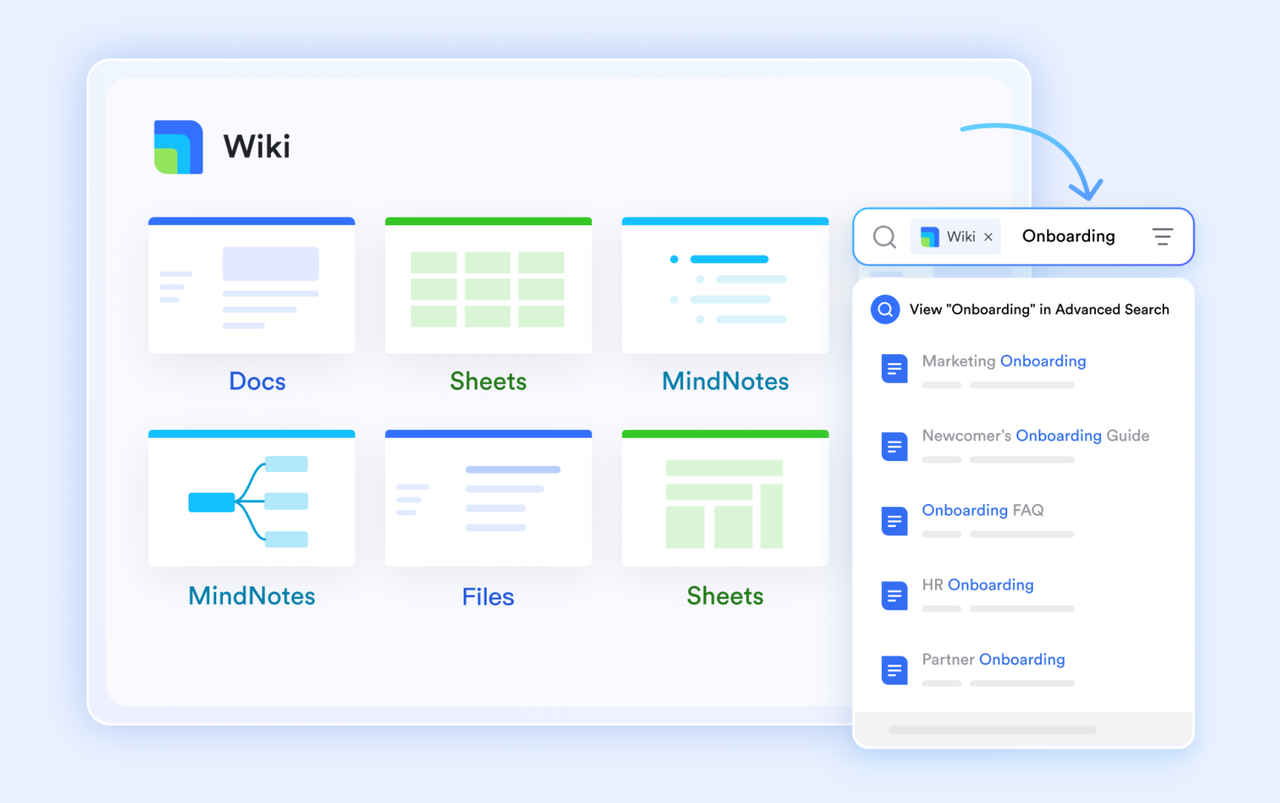
Unique angle: This approach eliminates the gap between knowing what to do (the playbook in Wiki) and knowing what's happening now (the live data in Base). It creates a single source of truth, enabling any sales representative to access up-to-the-second inventory levels and customer information instantly, ensuring every customer interaction is fast and accurate.
Accelerate the sales cycle with integrated communication and automation
Challenge: When a customer has a question, they expect an answer now. Slow internal communication—a sales rep having to email another department and wait for a reply—creates friction that kills conversion momentum and sends customers to competitors.
Lark's solution:
- Lark Messenger: Lark Messenger enables sales teams to maintain real-time connectivity with product specialists and managers during customer interactions. Through instant "team swarm" group chats, representatives can resolve complex queries with internal expertise while preserving full conversation context. All discussions are automatically archived and linked to customer profiles, ensuring seamless continuity across every touchpoint and elevating the overall customer experience.
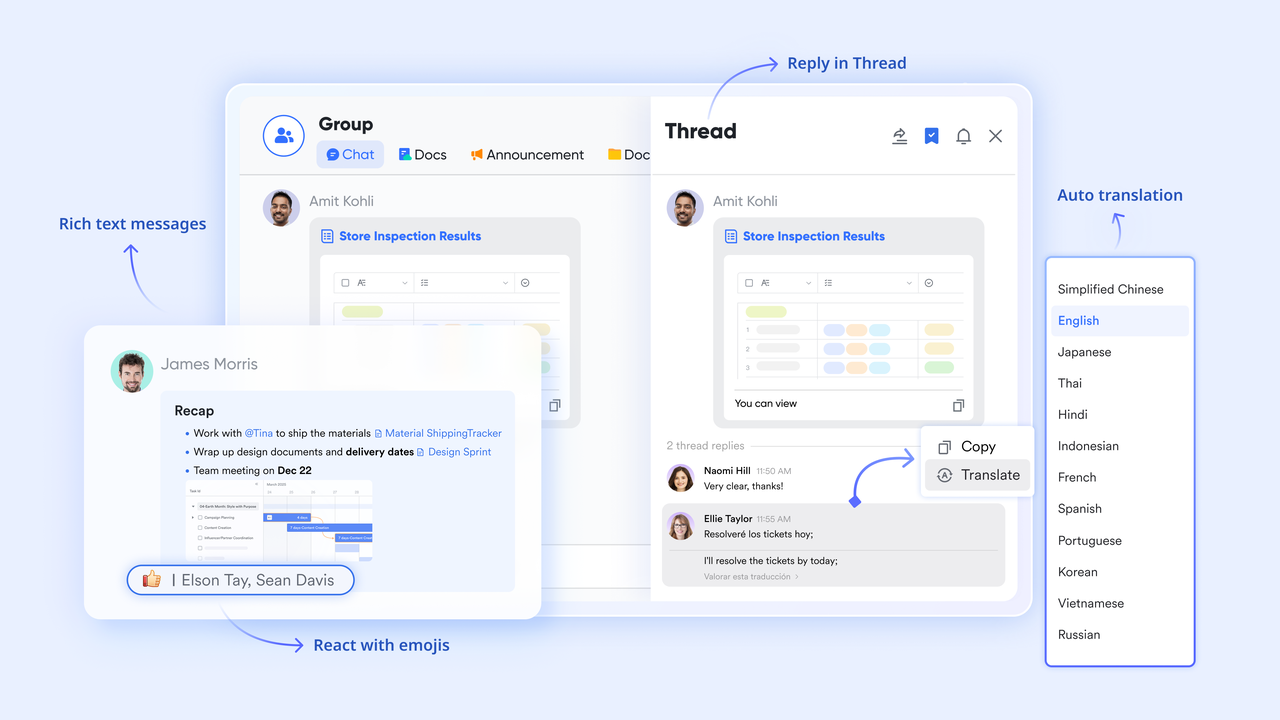
- Lark Calendar: Simplify appointment scheduling with public booking links that let customers book meetings in one click. The calendar syncs with team availability to avoid conflicts and supports custom booking forms—making it ideal for consultations, demos, and other sales-related interactions.
Unique angle: This approach transforms communication from a simple messaging tool into a high-velocity sales engine. By integrating real-time chat and automated scheduling directly into the sales process, you drastically reduce friction in the customer journey, leading to higher satisfaction and improved conversion rates.
Foster a high-performance sales culture with transparent goals and coaching
Challenge: High turnover and maintaining motivation are persistent struggles in B2C sales environments. It can be difficult for managers to provide consistent coaching, and for reps to feel connected to the bigger picture, leading to burnout and disengagement.
Lark's solution:
- Lark Meetings & AI Meeting Notes: Teams can run through business issues with high-quality audio and video with Lark Meetings, while integrated screen sharing allows presenters to display live data from Lark Base, Lark Docs, Lark Forms or whiteboard for collective analysis. Lark AI Meeting Notes automatically transcribe discussions, extract key insights on sales tactics and customer handling, and summarize actionable items—enabling managers to focus on delivering precise, high-impact feedback that accelerates sales readiness and team performance.
- Lark OKRs & Lark Base: Set and align team and individual goals using Lark OKR. Progress is visually tracked and linked to live dashboards in Lark Base, which update automatically as sales are recorded—keeping the entire team aligned and driven by clear, measurable outcomes.
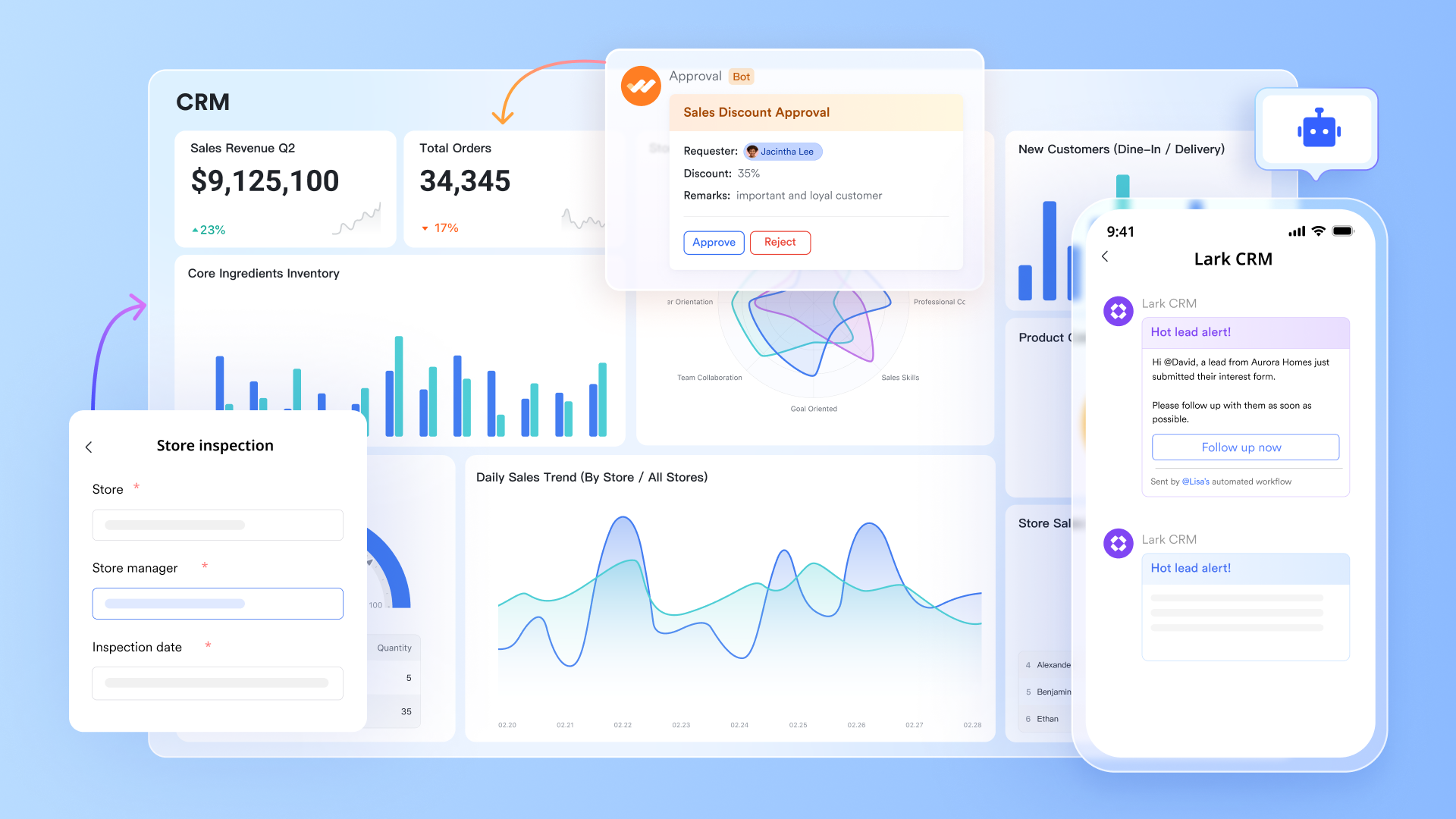
Unique angle: This directly connects performance management to daily work in a way that feels supportive, not micromanaged. It turns managers into effective coaches and makes individual contributions visible and celebrated. This transparent, data-driven approach to goal-setting fosters a culture of accountability and visible achievement, which is a powerful tool for boosting morale and retaining top talent.
The future of B2C sales: Trends to watch
The B2C landscape is constantly evolving, driven by technology and consumer behavior. Staying aware of key trends is crucial for any forward-thinking B2C sales strategy. Here are four major shifts to keep on your radar:
- Social commerce and live stream selling: The gap between social media and shopping is disappearing. Consumers can now buy products directly within apps like Instagram and TikTok. Live stream selling, in particular, blends entertainment with instant purchasing, creating a powerful, interactive sales channel that capitalizes on real-time engagement. To ensure seamless integration, considering a Uscreen alternative that supports your specific content strategy can help maintain quality and viewer engagement.
- Hyper-personalization powered by AI: Artificial intelligence will enable a new level of one-to-one marketing. Beyond using a customer's name, AI will analyze data to deliver uniquely tailored website experiences and product recommendations in real-time. This deep relevance will be key to building stronger customer affinity.
- The rise of ethical consumerism: Today's buyers care about a brand's values. They actively choose companies that demonstrate a real commitment to sustainability, ethical sourcing, and social responsibility. Transparency in these areas is no longer a bonus—it's a core driver of loyalty and purchasing decisions.
- Conversational commerce: Interactions with brands are becoming more natural. Advanced chatbots and voice assistants allow customers to ask questions, get recommendations, and make purchases simply by typing or speaking. Making your business easy to engage with through conversation will be essential for creating a frictionless customer experience.
Conclusion
Mastering the art of B2C sales represents a dynamic and rewarding business challenge. Success in this field demands deep consumer insight, operational agility, and strategic implementation of modern tools. From managing rapid sales cycles to building emotionally resonant brands, effective execution relies on a customer-centric foundation.
Ultimately, excellence in the modern consumer market requires authentic relationship building, seamless experience delivery, and a collaborative, data-driven team environment. The strategies outlined in this guide provide a proven framework for achievement, and Lark serves as a strategic enabler for B2C teams seeking to implement these methodologies systematically.
FAQs
What is a simple example of B2C?
A simple example of business-to-consumer (B2C) sales is when you buy a coffee from a café. The café is the business, and you are the consumer. Other common examples include purchasing clothes from a retail store, subscribing to a streaming service like Netflix, or buying groceries at a supermarket.
Is Amazon B2B or B2C?
Amazon is primarily a B2C company, as its main business is selling products directly to individual consumers. However, it also has a significant B2B component called Amazon Business, which serves business customers with features like bulk pricing and tax-exempt purchases. So, while its core is B2C, Amazon operates in both spaces.
Which is more difficult, B2B or B2C sales?
Neither is inherently "more difficult," but they present different challenges. B2C sales often involve a high-pressure, fast-paced environment and require connecting with customers on an emotional level. B2B sales typically have a much longer sales cycle, require navigating complex organizational politics, and demand a deep, logical understanding of business value and ROI.
How do you start a career in B2C sales?
A great way to start is with an entry-level position in retail, hospitality, or a call center. These roles help you build fundamental skills like communication, product knowledge, and customer service. Highlighting your communication skills, empathy, and a results-oriented mindset on your professional business resume can help you land your first B2C sales role.
What are the most important skills for a B2C salesperson?
The most crucial skills for a B2C salesperson are excellent communication and empathy, which allow you to quickly understand customer needs and build rapport. These are complemented by resilience, deep product knowledge, and the ability to gently persuade, all of which are essential for thriving in a fast-paced, consumer-focused environment.
Related Reading
Table of contents
Start using Lark today

Manage all your work in one place
Boost team efficiency by 10x
Save up to 70% on software costs
Table of contents
Start using Lark today
Manage all your work in one place
Boost team efficiency by 10x
Save up to 70% on software costs
Keep reading







2026 Lark Technologies Pte. Ltd.
Headquartered in Singapore with offices worldwide.






Explore: