Customer success is more than reactive support—it's a proactive strategy to help customers achieve their desired outcomes while using your product or service. Unlike traditional support, which resolves issues as they arise, customer success guides users through the entire lifecycle, from onboarding to renewal and expansion.
In this guide, we'll explore how effective customer success strategies impact retention, revenue, and long-term growth. You'll learn about key processes, metrics, and tools—including platforms like —that empower customer success managers (CSMs) to act proactively, streamline workflows, and drive meaningful results.
Build stronger relationships with your customers
What is customer success?
Customer success is a strategic approach focused on ensuring customers achieve their goals while using your product or service. Unlike customer support, which reacts to issues as they arise, is proactive—guiding customers from through adoption, renewal, and expansion. The goal is to build long-term relationships, reduce churn, increase engagement, and turn satisfied customers into advocates.
Customer success managers (CSMs) play a central role, using data, insights, and tools to monitor customer health, identify risks, and drive outcomes that align with both customer needs and business objectives. Metrics such as , time-to-value, and customer health scores help teams and take timely action. Platforms like Lark and other customer success software enable CSMs to consolidate data, automate workflows, and , support, and product teams, ensuring a seamless, proactive customer experience at every stage of the customer lifecycle.
 Image source: unsplash.com
 Key components of customer success
Effective customer success relies on a set of core components that help customer success managers (CSMs) drive engagement, retention, and growth. Understanding and implementing these elements ensures customers achieve value while your business meets its strategic goals.
- Onboarding and time-to-value: Onboarding sets the foundation for long-term success. Efficient onboarding reduces the time-to-value, helping customers achieve meaningful results quickly. , checklists, and early guidance keep customers engaged from day one.
- Adoption and engagement: and engagement ensures customers use features that drive outcomes. Monitoring usage patterns allows teams to identify gaps and provide targeted support. Higher adoption correlates with reduced churn and stronger customer loyalty.
- Renewal and expansion: sustain recurring revenue, while expansion drives growth. Proactive outreach to at-risk accounts and identifying upsell opportunities ensures customers continue to see value. Successful teams can align strategies to meet both customer and business goals.
- Customer health monitoring and risk management: Customer health scores combine engagement, usage, and support metrics to highlight at-risk accounts. Proactive monitoring enables timely interventions before issues escalate. Risk management ensures resources are focused where they have the most impact.
- Customer advocacy (referrals, case studies): Advocacy turns satisfied customers into brand champions. Encouraging referrals, testimonials, and case studies amplifies credibility and attracts new customers. Customer success teams nurture relationships to foster long-term advocacy.
- Integrating teams: sales, product, support, success: Customer success thrives when teams collaborate seamlessly. Sharing insights across sales, product, and support ensures a consistent customer experience. Integration helps CSMs align strategies with broader business objectives.
Customer success metrics & tools
Measuring success is critical for any customer success strategy. Customer success managers (CSMs) rely on metrics and tools to , identify risks, and optimize customer outcomes. These insights help teams act proactively and ensure customers achieve their goals.
Important KPIs
track both customer outcomes and business impact. Metrics like churn rate, net revenue retention, time-to-value, and customer health score provide a clear picture of engagement, satisfaction, and growth potential. Tracking these KPIs allows CSMs to identify at-risk accounts and prioritize interventions effectively.
Role of technology platforms
Customer success software and platforms streamline data collection, health scoring, and . They consolidate information from multiple touchpoints, making it easier for CSMs to monitor accounts, trigger workflows, and collaborate across teams. This ensures a scalable, proactive approach to customer success.
Let's explore Lark, including how Lark supports success teams with data-driven workflows, collaboration, and actionable insights.
Empower your customer success team today
Take a real step: Use Lark to attain customer success
Customer success thrives when teams, data, and actions stay connected—and that's where Lark shines. helps Customer Success Managers (CSMs) manage client data, communicate in real time, track performance, and automate key processes without switching tools. From monitoring customer health in to coordinating renewals via , Tasks, , Sheets, and Approvals, Lark enables a truly proactive, scalable customer success workflow that keeps every account on track for growth and retention. 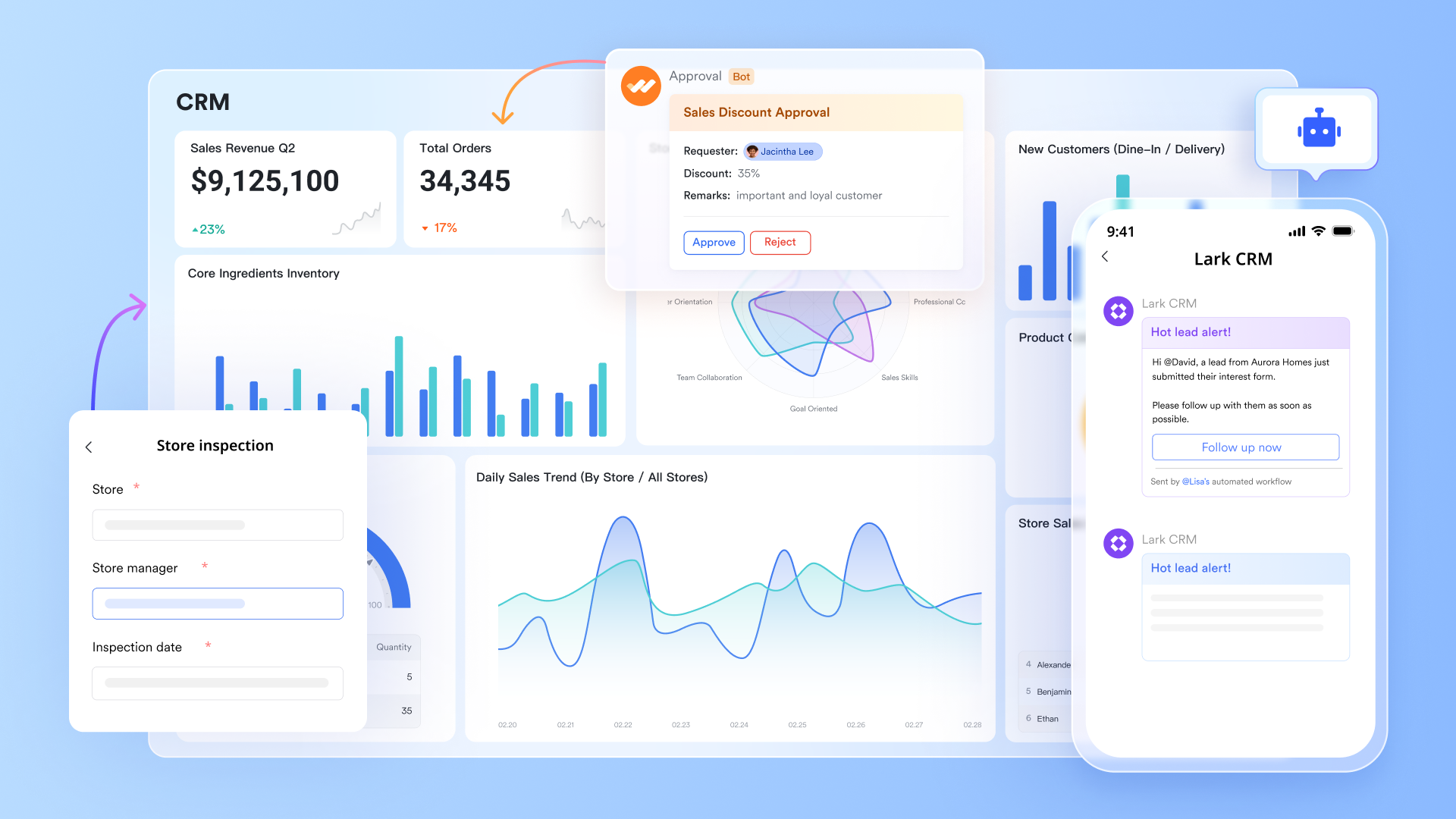
Lark Base: Track customer health & success workflows
lets you build a flexible database of customers, onboarding tasks, health metrics, renewal dates, upsell opportunities, and risk flags. You can model customer journey stages (e.g., Onboarded → Adopted → At-Risk → Renewed/Expanded) as fields or columns. You can create dashboards that consolidate key customer success metrics (e.g., Time to Value, usage frequency, churn risk score). You can set automation rules in Base: when a health score falls below a threshold → trigger a Task, notify the CSM, update the record. Why it's valuable for customer success:
- Makes all relevant data (adoption, engagement, renewal cycle) available in one place, helping the CSM team stay proactive rather than reactive.
- Enables consistent (onboarding checklist, risk remediation, renewal pipeline) that scale across many accounts.
Example use case:
A SaaS company sets up a "Customer Health" Base table with fields: Customer name, Onboarded date, Active users, Support tickets last 30 days, Health score, Renewal date. When Active users drop by > 20% mon-on-mon, the automation triggers a Task: "Schedule check-in call for risk review". The manager views a dashboard showing 12 customers flagged as At-Risk.
Lark Messenger: Cross-functional collaboration
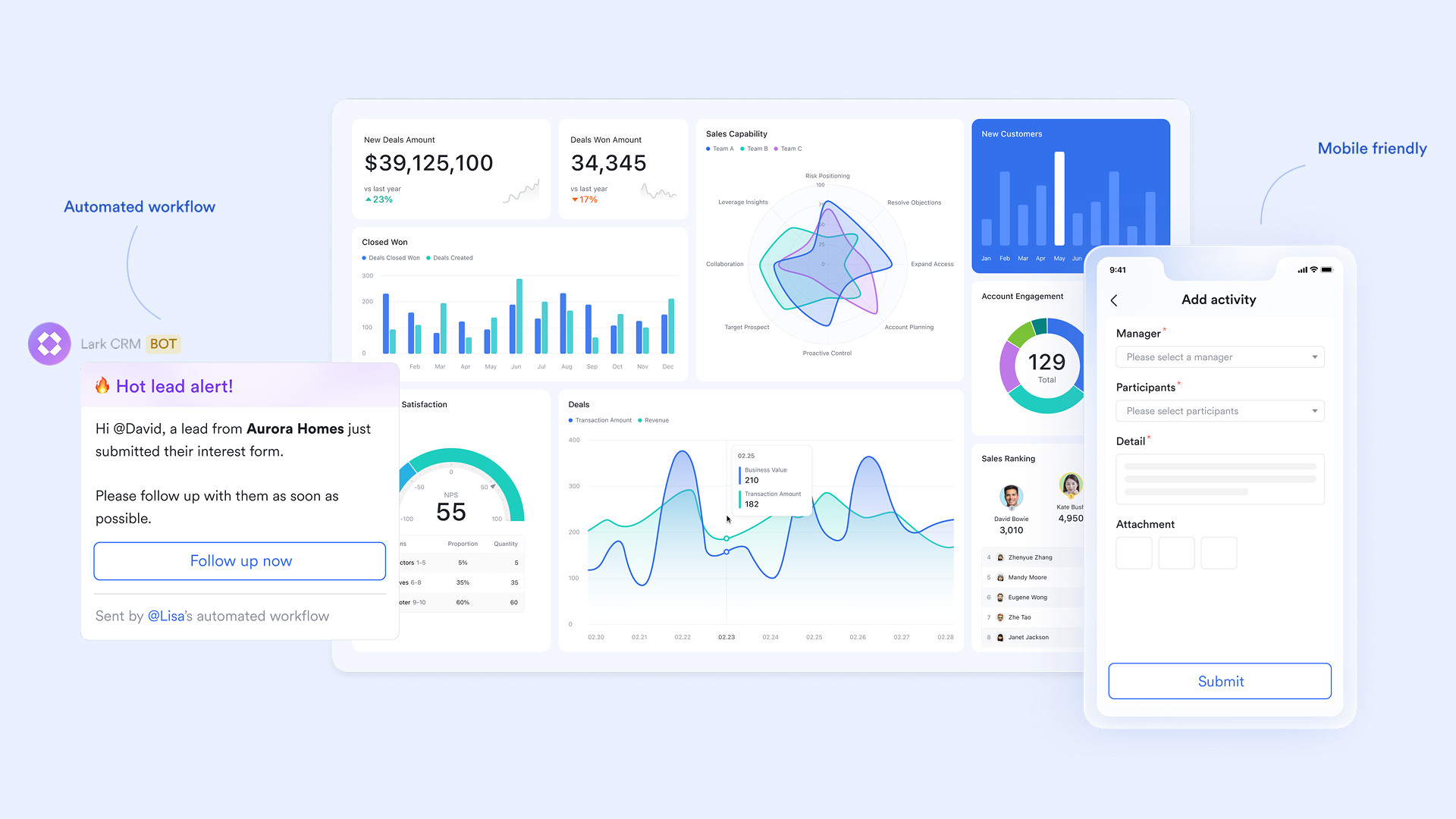
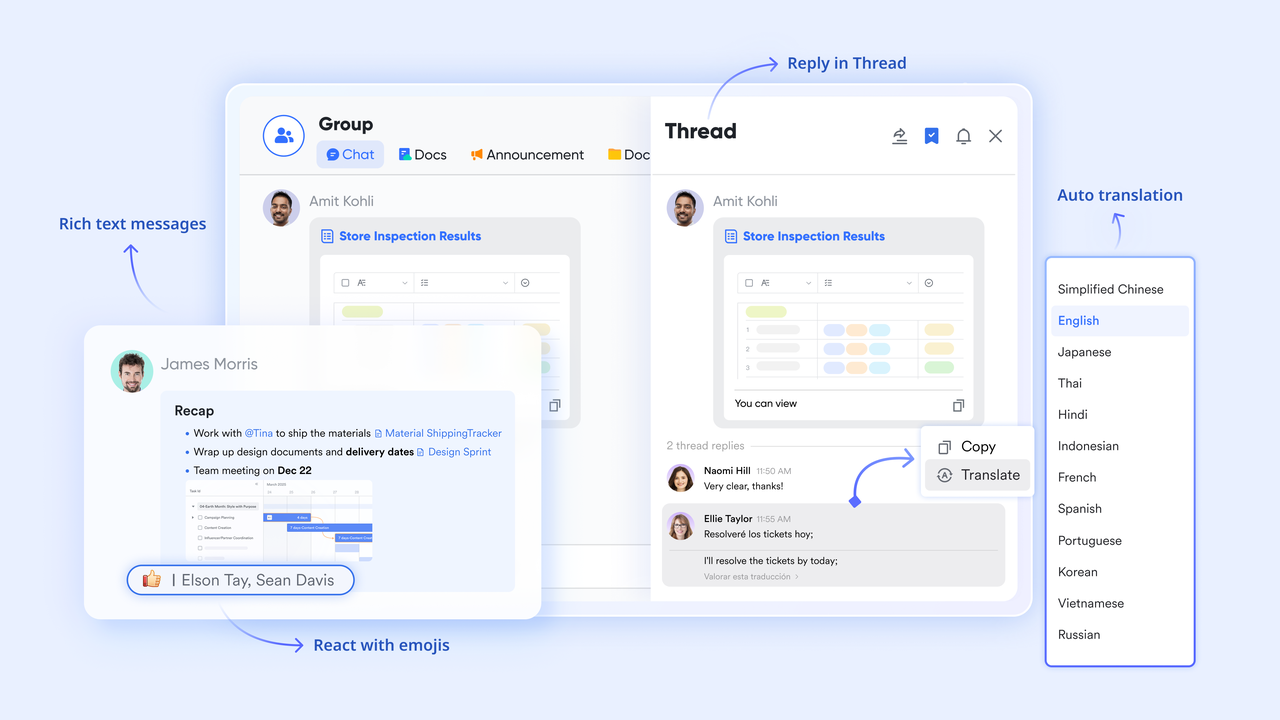
supports real-time chat channels, mention/threads, file attachments, and pinned messages—all within Lark's ecosystem. You can embed Doc or Base links within chats, so conversations stay connected to data. Why it's valuable for customer success:
Success teams often need to coordinate with onboarding, product, support, and renewal. Messenger ensures fast communication, reduces delays, and keeps context visible.
Example use case:
A Customer Success Manager creates a dedicated group chat for a new client onboarding. They upload the onboarding checklist Doc, share the client's Base record link, and @mention the support lead and product manager to discuss custom setup. Key next-step tasks, such as "Schedule 30-day review," are pinned to the top of the chat. As the onboarding progresses, every update includes questions, attachments, and meeting notes.
Lark Tasks: Assignment & action tracking
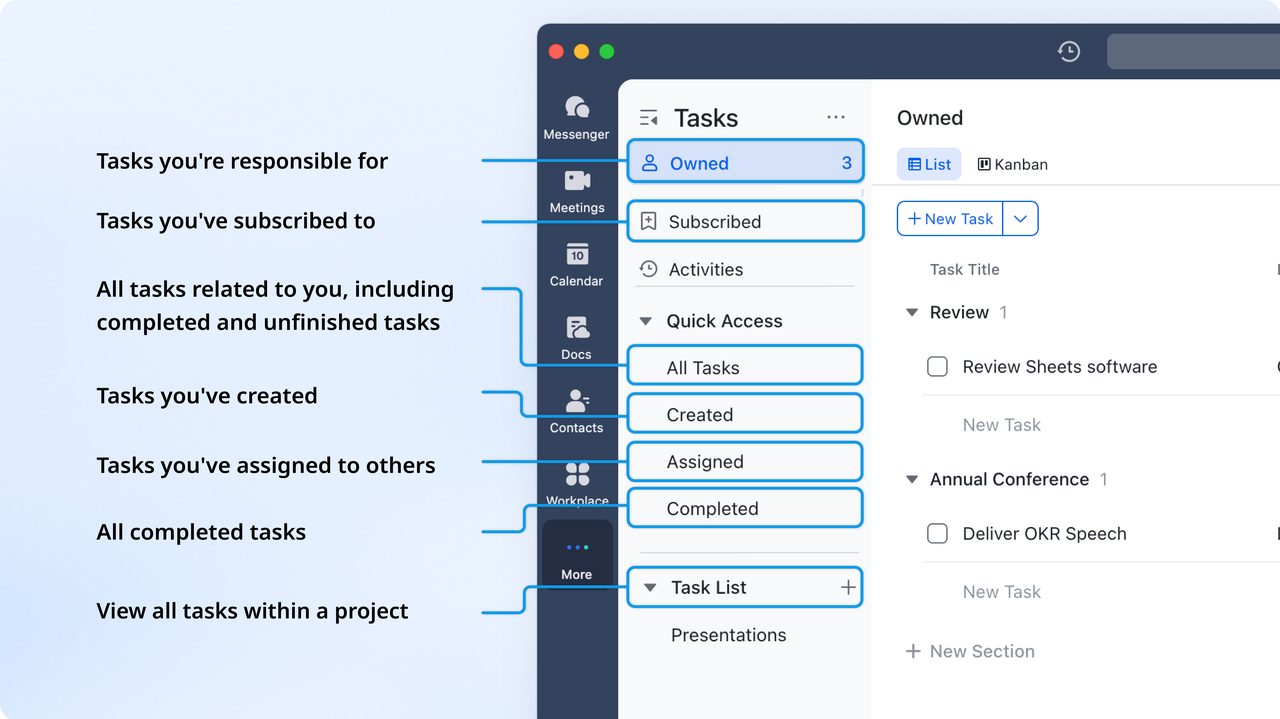
Lark Tasks help to create assignable, deadline-driven actions. Tasks can be manually created or auto-generated via Base workflows. Status updates, attachments, and assignee accountability are built in. Why it's valuable for customer success:
Tasks ensure that follow-up actions (e.g., "Check usage health", "Send renewal quote", "Schedule QBR") are assigned, tracked, and don't slip through.
Example use case:
After completing a new client's onboarding, the customer success manager triggers an that generates a series of follow-up tasks: a welcome call within five days, a usage review in thirty days, and a QBR preparation in forty-five days.
Lark Docs and Lark Sheets: Collaborative success plans and analytics
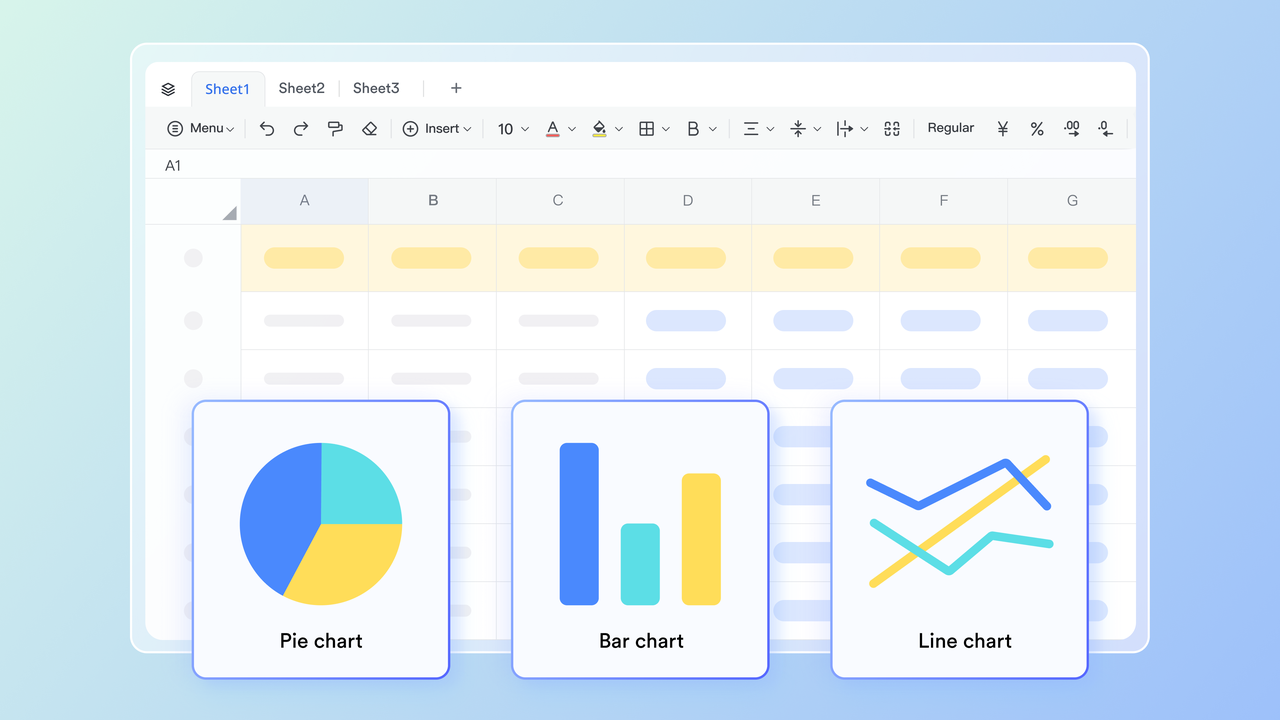
supports shared documents for success plans, , and playbooks. , comments, and version control. On the other hand, Lark Sheets supports Live spreadsheets with , pivot tables for KPIs, adoption metrics, and renewal forecasting. Can be embedded in Base dashboards or linked in Tasks/Messenger. Why it's valuable for customer success:
Enables CSMs to co-create and share Customer Success Plans with stakeholders, set outcome goals, and track progress. Provides up-to-date analytics on adoption, churn risk, and , helping with data-driven decisions.
Example use case:
The CSM team uses a Sheet titled "Quarterly Renewal & Expansion Forecast" listing each account, renewal date, expansion potential, health score, and risk level. During team sync, they open the Sheet in real time, update statuses, and use a comment thread in the Doc "Process for At-Risk Accounts" for next steps. Because the Sheet drives Base statuses, dashboards update automatically.
Lark Approval: Automated approvals for requests, upsells & renewals
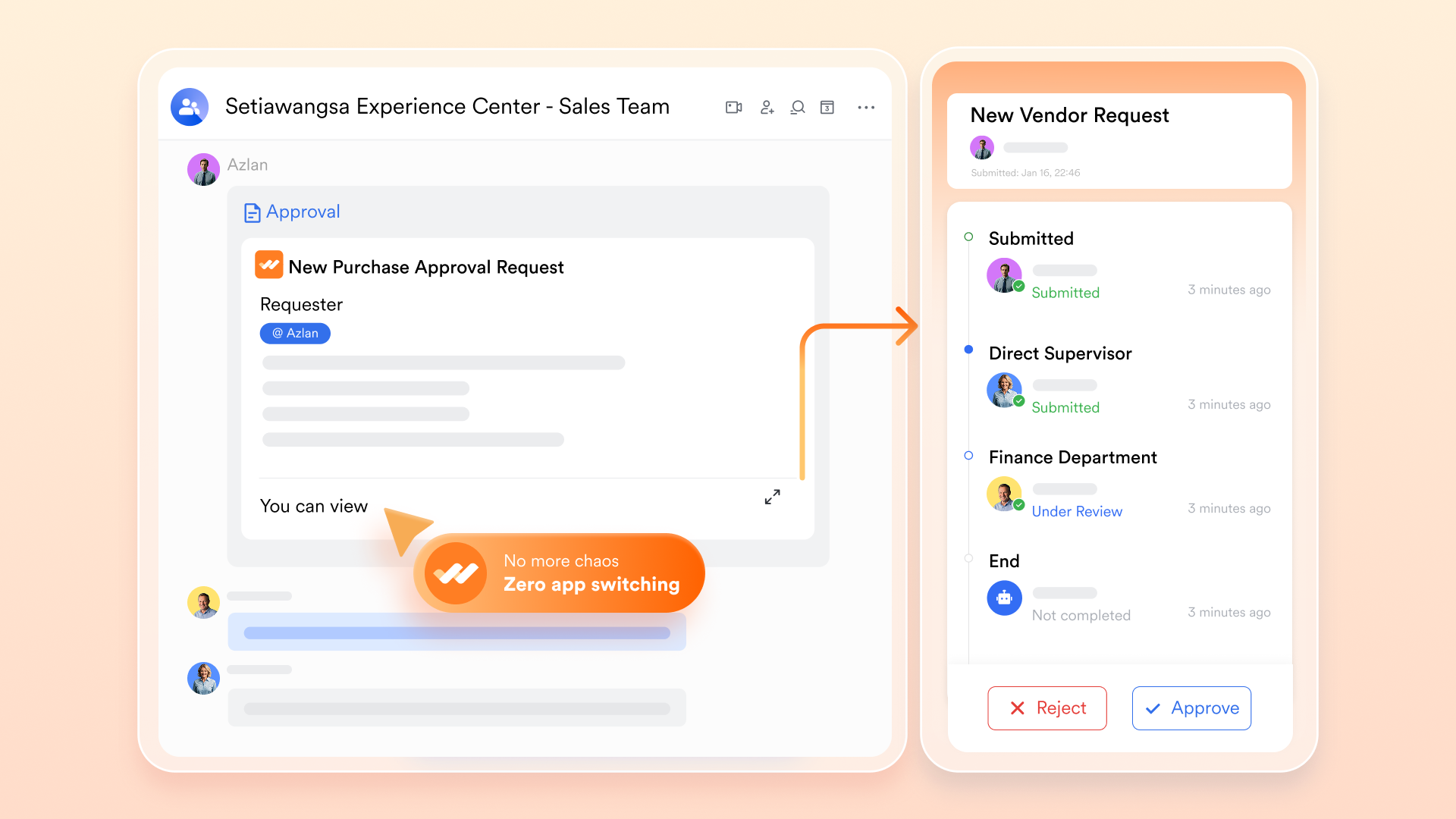
Lark Approval enables the creation of custom approval forms (e.g., onboarding waiver, discount request, late renewal exception) with multi-step sign-off workflows. Also, it can track status, capture comments, , and update records as needed. Why it's valuable for customer success:
- Ensures exceptions (e.g., free months for at-risk customers, special pricing for renewals) follow a consistent process, reducing manual delays and ensuring governance.
- When an approval completes, success and sales teams are aligned, and account records (in Base) can be updated automatically.
Example use case:
A high-value customer is late on renewal. The CSM submits an "Early Renewal Discount Request" form: includes account details, , and proposed discount. The form routes to Sales Ops, then to Finance, and finally to VP Success. Once approved, the Base record is updated to "Renewal approved with discount," and a Task is created: "Send revised quote to customer by EOD."
:
- Starter plan: Free forever plan that includes 11 powerful tools for up to 20 users. It also comes with 100GB of storage, 1000 automation runs, AI translations, and more.
- Pro plan: $12/user/month (billed annually) for up to 500 users. It includes everything in Starter plus group calling for up to 500 attendees, 15TB of storage, 50,000 automation runs, and more.
- Enterprise plan: for custom pricing. Supports unlimited users and includes even more automation runs and advanced security, compliance, and management features.
For small teams with simple communication needs

18 months message history
1000 Base automation runs/month
2000 rows per table in Base
Most POPULAR
For companies with comprehensive collaboration and management needs
Unlimited message history
500-participant video meetings
50k Base automation runs/month
20k rows per table in Base
For large companies with advanced security and organizational management needs
Get a personalized demo and pricing
Unlimited message history
500-participant video meetings
15 TB storage + 30 GB storage/user
500k Base automation runs/month
50k Base automation runs/month
Most POPULAR
For companies with comprehensive collaboration and management needs
Unlimited message history
500-participant video meetings
50k Base automation runs/month
20k rows per table in Base
Bonus tips: Try Lark's ready-to-use templates to kick off your plan
Customer relationship management template
This provides customer success teams with a unified workspace to manage every touchpoint from onboarding to renewal. It tracks interactions, responsibilities, and progress in one place, ensuring and visibility. With clear insights into each customer's journey, teams can identify risks early and seize upsell opportunities. It serves as a foundation for building strong relationships and driving long-term customer success.
Customer management template
The helps teams organise customer data, service milestones, and support activities in one hub. It aligns customer success, account management, and product teams around shared goals and health metrics. By structuring regular check-ins and deliverables, it ensures proactive engagement and reduces churn. This template is ideal for through clear visibility and collaboration.
Customer satisfaction form and analysis template
This customer satisfaction template simplifies how teams gather, analyse, and act on customer feedback. It captures survey data, tracks satisfaction trends, and reveals actionable insights that guide success strategies. By identifying satisfying drivers and areas for improvement, teams can respond faster and more effectively. The result is improved retention, stronger trust, and measurable growth in customer happiness. AI-powered customer review analysis template
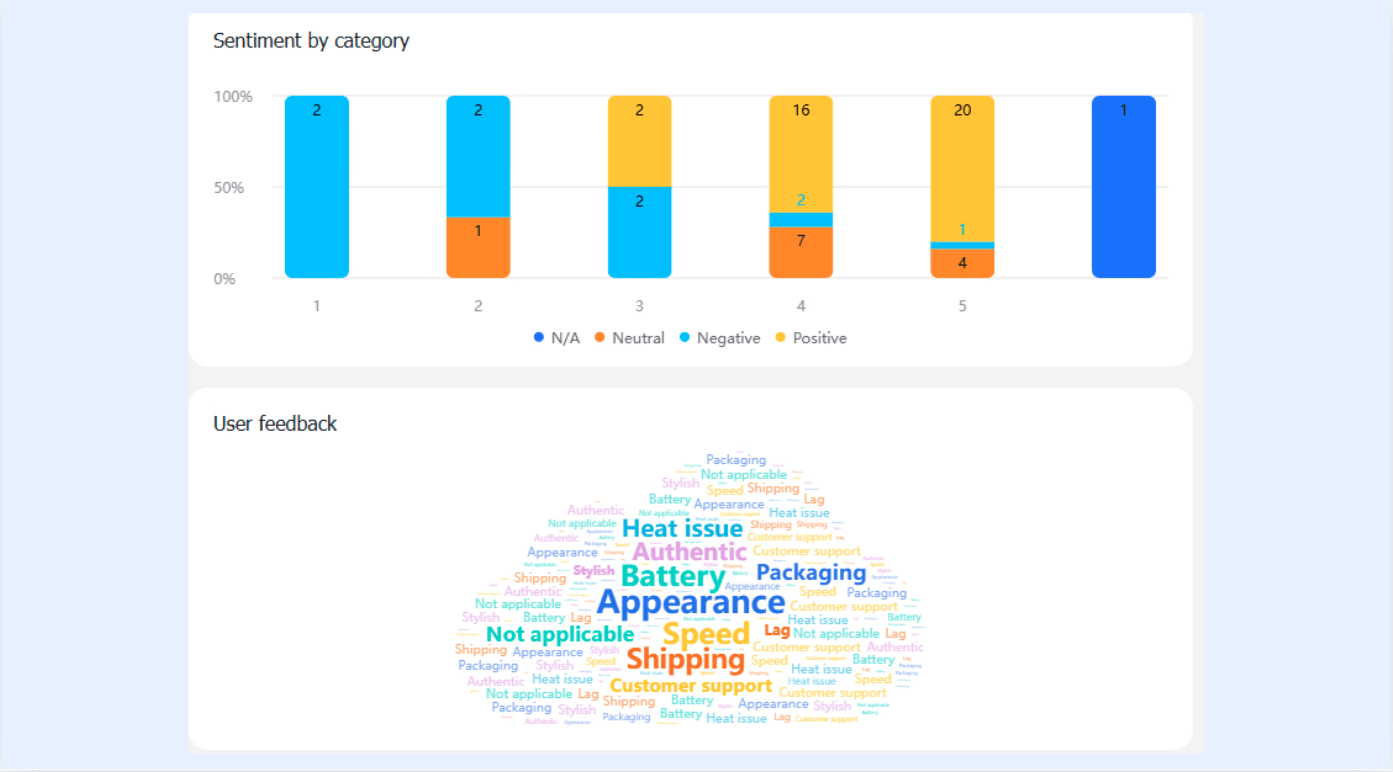
This helps customer success teams turn reviews and feedback into powerful insights. It automatically analyses sentiment, categorises comments, and highlights recurring issues or opportunities. By translating qualitative feedback into data-backed actions, it supports smarter renewal and engagement strategies. Perfect for teams that want to predict customer needs and strengthen relationships through data intelligence.
Best practices for building a customer-success program
Effective customer success requires a structured approach that aligns team efforts with measurable business outcomes. By following proven best practices, organizations can drive retention, growth, and long-term customer loyalty.
- Align customer success with business outcomes: Customer success should directly support company goals, such as revenue growth, , or product adoption. By linking CSM activities to these outcomes, teams prioritize actions that create tangible business impact. This alignment ensures every engagement adds strategic value.
- Segment customers and tailor the engagement model: Not all customers have the same needs or risk profiles. accounts by size, usage, or lifecycle stage allows CSMs to customize onboarding, check-ins, and engagement strategies. Tailored approaches improve satisfaction and reduce churn.
- Use data and automation to scale while retaining a personal touch: Tracking metrics like churn, adoption, and health scores helps teams identify at-risk customers. Automation—through alerts, , or tasks—ensures timely interventions, while personal interactions maintain strong relationships.
- Close the loop: use customer feedback to improve product and processes: Gathering NPS surveys, support tickets, and usage insights informs both product and service improvements. Sharing feedback across teams ensures that solutions address real customer needs. Acting on feedback builds trust and engagement.
- Equip your team with the right toolset and workflow: Customer success platforms like Lark consolidate data, streamline workflows, and enable collaboration across sales, support, and product teams. The right tools empower CSMs to act proactively and efficiently at scale.
- Continual iteration and measurement: Regularly review , customer health, and process effectiveness to refine strategies. Continuous improvement allows teams to adapt to changing customer needs and market conditions, ensuring sustained success.
Streamline success workflows and team collaboration
Conclusion
Proactive customer success is essential for driving retention, increasing revenue, and fostering long-term growth. By anticipating customer needs, addressing risks early, and guiding users toward their goals, organizations can transform satisfaction into loyalty and advocacy.
With the right strategy, clear metrics, and a platform like , customer success teams can consolidate data, automate workflows, and collaborate efficiently across departments. Lark enables CSMs to act proactively, track customer health, and scale their efforts effectively. This combination empowers businesses to deliver consistent value, strengthen customer relationships, and build enduring growth that lasts well beyond individual transactions.
Boost customer success with Lark today
FAQs
What is the difference between customer success and customer support?
Customer support is reactive, addressing issues as they arise, while customer success is proactive, ensuring customers achieve their goals and derive value from your product. CSMs monitor engagement, adoption, and satisfaction metrics. Platforms like Lark help teams track health scores, manage tasks, and collaborate across departments to prevent issues before they affect customers.
How do you calculate a customer health score?
A customer health score combines quantitative and qualitative metrics, including product usage, support tickets, engagement levels, survey responses, and renewal likelihood. Weighted scoring helps identify at-risk accounts and growth opportunities. Tools like Lark enable CSMs to consolidate this data, automate alerts, and visualize trends, making it easier to prioritize proactive outreach and retention efforts.
What is time-to-value (TTV) and why is it important?
Time-to-value measures how quickly a customer achieves meaningful outcomes from your product. Shorter TTV increases engagement, satisfaction, and reduces churn. Customer success teams track TTV using adoption metrics, onboarding completion, and usage patterns. Platforms like Lark allow teams to monitor milestones, trigger automated follow-ups, and ensure customers reach value faster.
How should customer success teams be structured for growth?
Customer success teams should align with customer segments, such as SMB, mid-market, or enterprise. Roles include onboarding specialists, CSMs, and renewal/expansion managers. Collaboration with sales, product, and support is critical. Tools like Lark enable cross-functional communication, task management, and centralized customer data, helping teams scale effectively while maintaining a personalized experience.
What role does automation play in customer success?
Automation helps customer success teams scale while maintaining consistent engagement. Tasks, alerts, health score triggers, and follow-up reminders reduce manual work. Automation ensures proactive outreach, timely renewal discussions, and efficient risk management. Platforms like Lark integrate workflows, messaging, and dashboards to automate repetitive actions while enabling CSMs to focus on strategic, high-value customer interactions.
Related reading