














What Is a Project Pipeline? Meaning, Stages, and Best Practices

Ryan Tanner
Product Marketing Specialist
Sep 18, 2026
Ryan Tanner
Sep 18, 2026

16 min read


Effective project delivery doesn't start at execution—it begins much earlier with idea capture, evaluation, and prioritization. This structured flow of initiatives from inception to completion is known as a project pipeline, and it helps organizations clearly visualize how ideas transform into approved and completed projects.
Many teams struggle with unclear priorities, fragmented planning, and slow decisions. A well-managed pipeline provides visibility into upcoming, approved, and active projects, so nothing stalls or gets overlooked. In this guide, you'll learn how a project pipeline works, its key stages, common challenges, and best practices for scaling it effectively. We'll also lightly touch on how tools like Lark support modern pipeline workflows.

What is a project pipeline?
A project pipeline is the structured sequence through which project ideas move from initial proposal to completion. It gives teams a clear view of upcoming, active, and completed initiatives, helping them prioritize work, allocate resources, and maintain consistent progress. A well-organized project pipeline ensures that every idea is evaluated for feasibility, risk, and alignment with strategic goals before moving into execution. Effective project pipeline management also reduces delays, prevents bottlenecks, and improves communication across teams.
Many organizations now use project pipeline management software to centralize data and automate updates. Whether overseeing internal initiatives or large efforts like the Alaskan pipeline project or the Bell County water restrictions pipeline project, a streamlined project management pipeline helps teams make better decisions and operate efficiently.
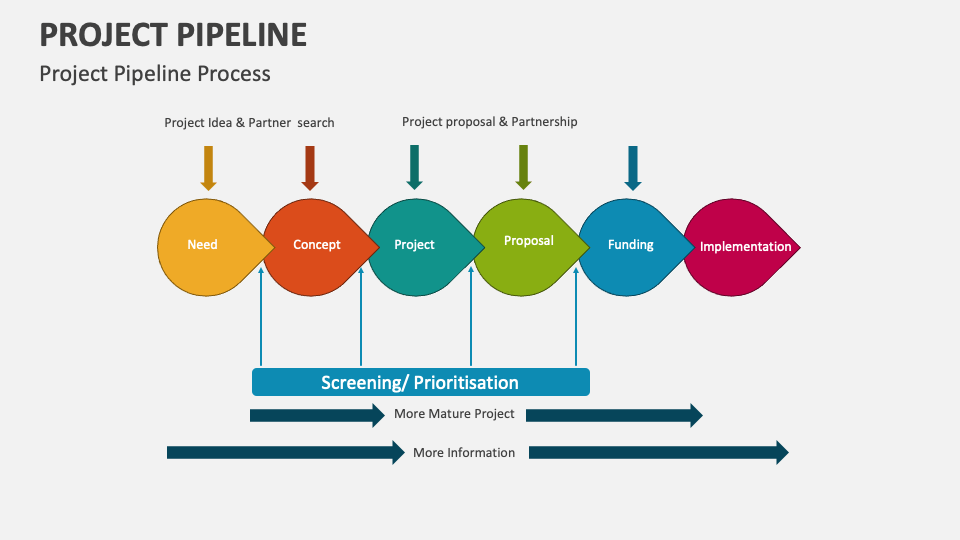
Image source: collidu.com
Why project pipeline management matters
Project pipeline management matters because it brings structure, clarity, and predictability to how organizations handle incoming project requests. Instead of reacting to ideas as they appear, teams gain a systematic way to evaluate, prioritize, and move projects forward. This not only improves planning but also ensures that initiatives support long-term business plans. With a well-managed pipeline, teams operate more efficiently and avoid the chaos of uncoordinated project intake.
- Helps identify viable projects: A strong project pipeline ensures that every idea is reviewed against consistent criteria such as value, feasibility, risks, and expected outcomes. This avoids pursuing low-impact or unrealistic initiatives. By screening ideas early, teams save time and resources. It also strengthens decision-making by promoting transparency and fairness.
- Improves resource scheduling: Pipeline management gives leaders visibility into upcoming, approved, and active projects, making it easier to allocate time, budgets, and skills effectively. Teams can forecast demand and avoid overloading staff. This proactive planning reduces stress and ensures smoother execution. It also helps set realistic timelines based on actual capacity.
- Reduces bottlenecks and delays: With structured stages and updated information, teams can quickly identify where projects are stuck and why. This helps managers intervene early to remove obstacles or adjust workloads. Consistent tracking prevents tasks from falling through the cracks. Overall, pipeline clarity strengthens momentum and reduces unwanted project slowdowns.
- Ensures alignment with business goals: A managed pipeline ensures that every approved project directly supports organizational objectives rather than competing agendas or ad-hoc requests. This alignment improves strategic focus and resource efficiency. Teams can easily justify priorities using clear evaluation frameworks. As a result, the organization advances toward its long-term goals with greater consistency and impact.
Key stages of a project pipeline
The key stages of a project pipeline create a structured flow that helps organizations evaluate ideas, plan effectively, and guide projects from initiation to completion. Understanding these stages also clarifies the meaning of the project pipeline and supports more consistent management of project pipeline efforts. Each step ensures that teams stay organized, avoid bottlenecks, and maintain visibility across the entire lifecycle. With a clear structure, businesses can make better decisions and use resources more efficiently.
- Idea capture: This stage gathers every project request in one place so nothing gets overlooked. Teams document goals, expected outcomes, and initial requirements to ensure proper evaluation later. A standardized intake process reduces confusion and keeps proposals consistent. Tools such as pipeline project management software help organize this early information effectively.
- Evaluation and prioritization: Projects are assessed based on value, feasibility, urgency, impact, and alignment with organizational goals. This prevents teams from pursuing low-priority or unrealistic ideas. Evaluation frameworks make prioritization more fair and predictable. Many organizations use project pipeline management tools to streamline scoring and comparison.
- Feasibility and resource review: Here, teams determine whether a project can realistically be delivered with available skills, budgets, and time. Potential risks, technical constraints, and workload implications are analyzed. This step protects teams from overcommitment and unrealistic expectations. It also strengthens planning by ensuring clarity before moving forward.
- Planning and scheduling: Approved projects enter detailed planning, where scope, timelines, responsibilities, and dependencies are defined. Teams map out milestones and resource assignments to create a workable schedule. Clear plans reduce misunderstandings and improve coordination across departments. Good planning also lays the foundation for smooth execution.
- Execution: Work begins according to the plan, with tasks assigned, progress tracked, and collaboration happening across teams. Communication becomes critical during this stage to keep everyone aligned. Timely updates help maintain momentum and avoid rework. Execution is where teams rely heavily on organized processes to stay efficient.
- Monitoring and optimizing: Teams continuously track progress, identify risks, and make adjustments as needed. Regular check-ins help address issues early before they become major roadblocks. Monitoring also ensures that the project stays aligned with goals and timelines. Optimization improves the quality and efficiency of ongoing work.
- Closure: Once the project is complete, teams finalize deliverables, document outcomes, and conduct a review of lessons learned. This stage ensures proper handoff and captures insights for future improvement. Closure also provides a clear endpoint for tracking and reporting. Properly closing projects strengthens the overall health of the pipeline and improves future cycles.
How to build a strong Project pipeline management strategy
A strong project pipeline management strategy gives teams clarity, reduces uncertainty, and ensures projects move efficiently from concept to completion. It provides a predictable flow of work, prevents resource overload, and improves collaboration across departments. With a well-built strategy, organizations can maintain balanced workloads, eliminate unnecessary delays, and ensure that high-value initiatives move forward smoothly. This framework also helps leaders make consistent, data-driven decisions.
Step 1: Define clear project intake criteria
Start by establishing what qualifies as a valid project request, including scope, goals, and impact. This prevents teams from investing time in low-value or misaligned ideas. Create standardized request forms or templates to ensure consistent information is captured. This clarity keeps the project pipeline organized and easy to evaluate.
Step 2: Standardize evaluation and prioritization
Use structured scoring models to compare projects based on value, risk, and resource requirements. This ensures fairness and prevents subjective decisions. Prioritization frameworks also help teams allocate resources to the most impactful initiatives. With standard evaluation methods, the pipeline remains transparent and predictable.
Step 3: Establish resource and capacity planning processes
Review the availability of people, budget, and tools before moving projects into execution. This avoids over-scheduling and ensures projects receive the support they need to succeed. Regular capacity checks help teams identify gaps early and prevent overload. Strong resource planning keeps the project management pipeline balanced.
Step 4: Implement continuous monitoring and optimization
Track project progress regularly to identify risks, delays, or inefficiencies before they escalate. Use unified dashboards or workflow tools for real-time visibility. Optimization helps refine the pipeline structure over time, improving accuracy and predictability. Continuous improvement ensures the strategy evolves with organizational needs.
Comparison: Manual vs. software-based pipeline management
Practice time: Find a tool to open modern project pipeline workflows
Lark, one of the most versatile project management tools, fits modern project pipeline workflow management because it brings communication, project tracking, and documentation into one unified workspace. Instead of switching between multiple apps, teams can manage their entire project lifecycle—from intake to execution—within a single platform. Real-time collaboration reduces delays, while automated workflows streamline approvals, updates, and task assignments. With shared docs, dynamic dashboards, and synced messaging, teams gain complete visibility into pipeline stages.
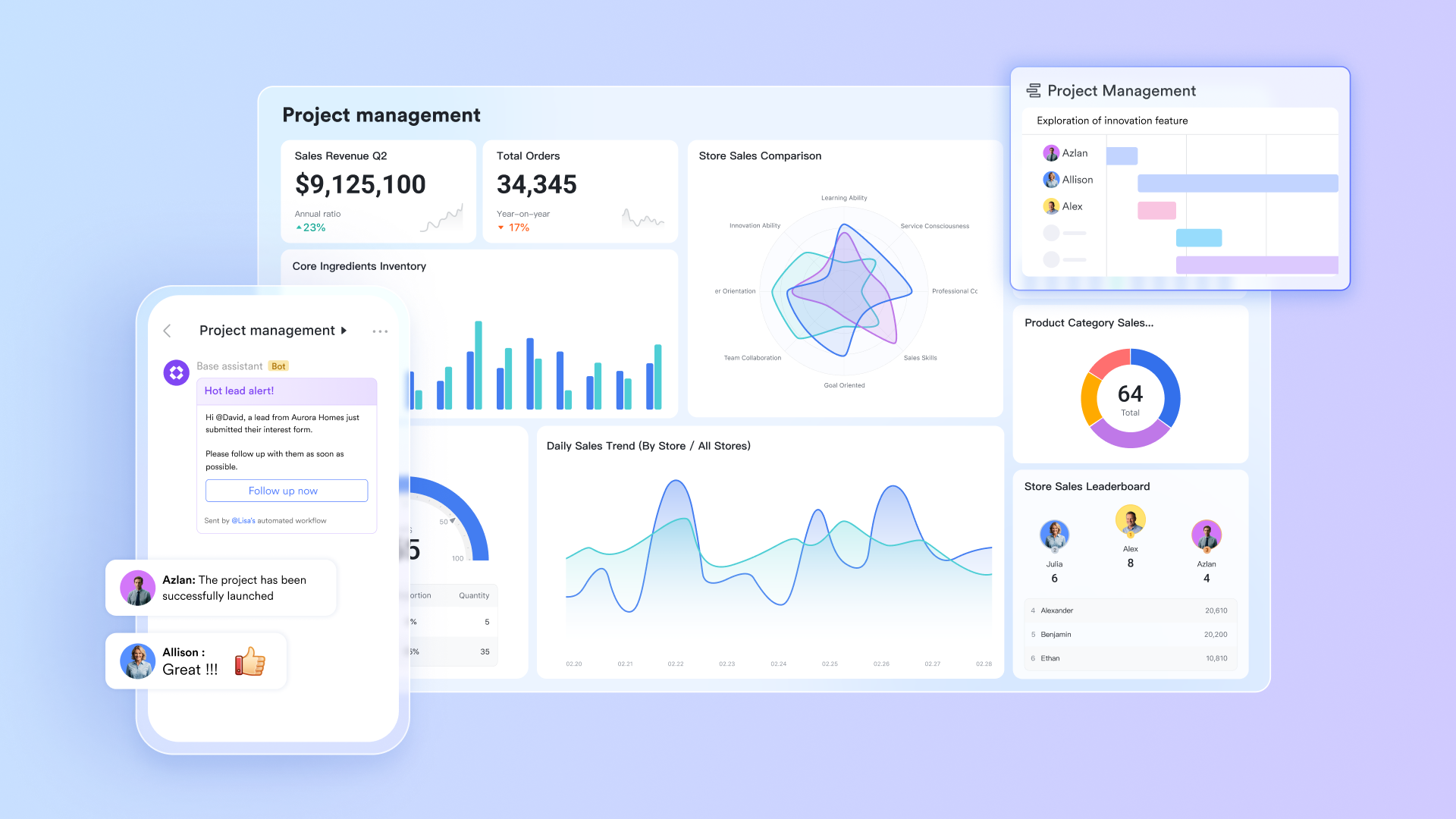
Centralized project hub & smart data visualization
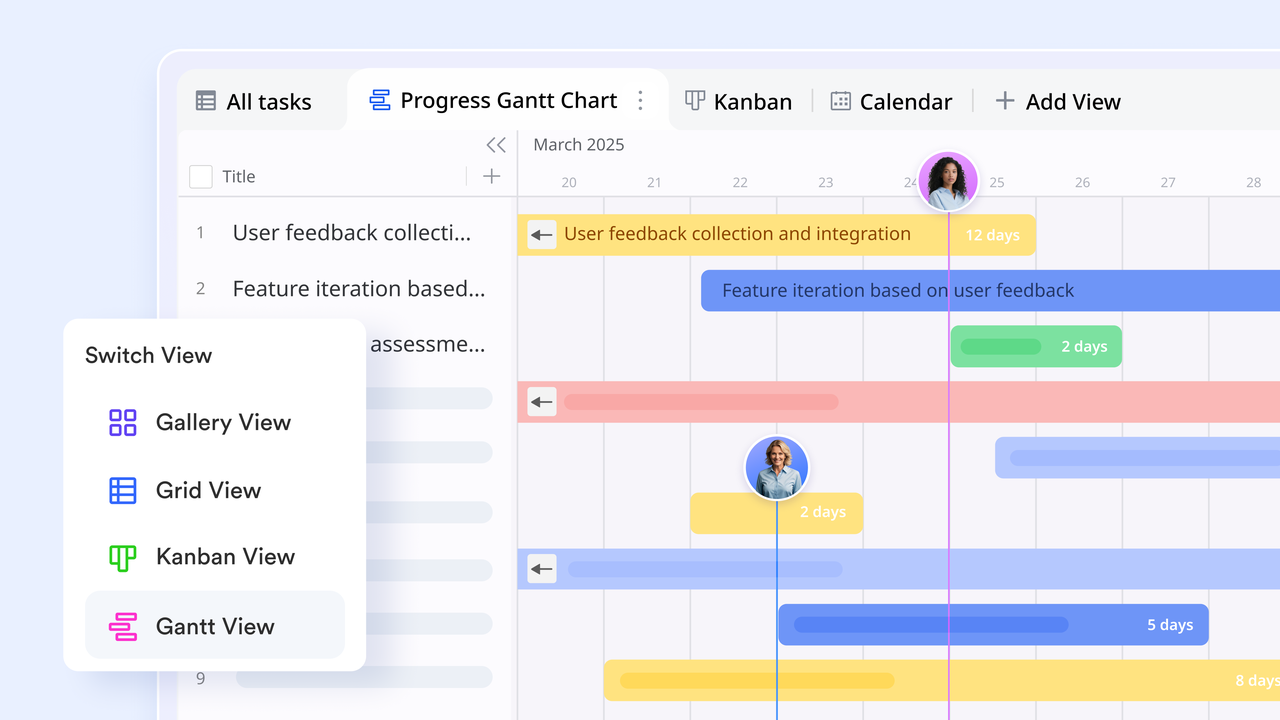
Lark Base helps streamline your project pipeline by letting you map out every stage in a clear, structured flow. You can define steps, assign responsibilities, and set required fields to ensure consistent data at each phase. With customizable views like Kanban or Gantt, teams can track progress visually and spot bottlenecks quickly. Everything stays synced and organized, making it easier to manage, monitor, and move projects forward efficiently.
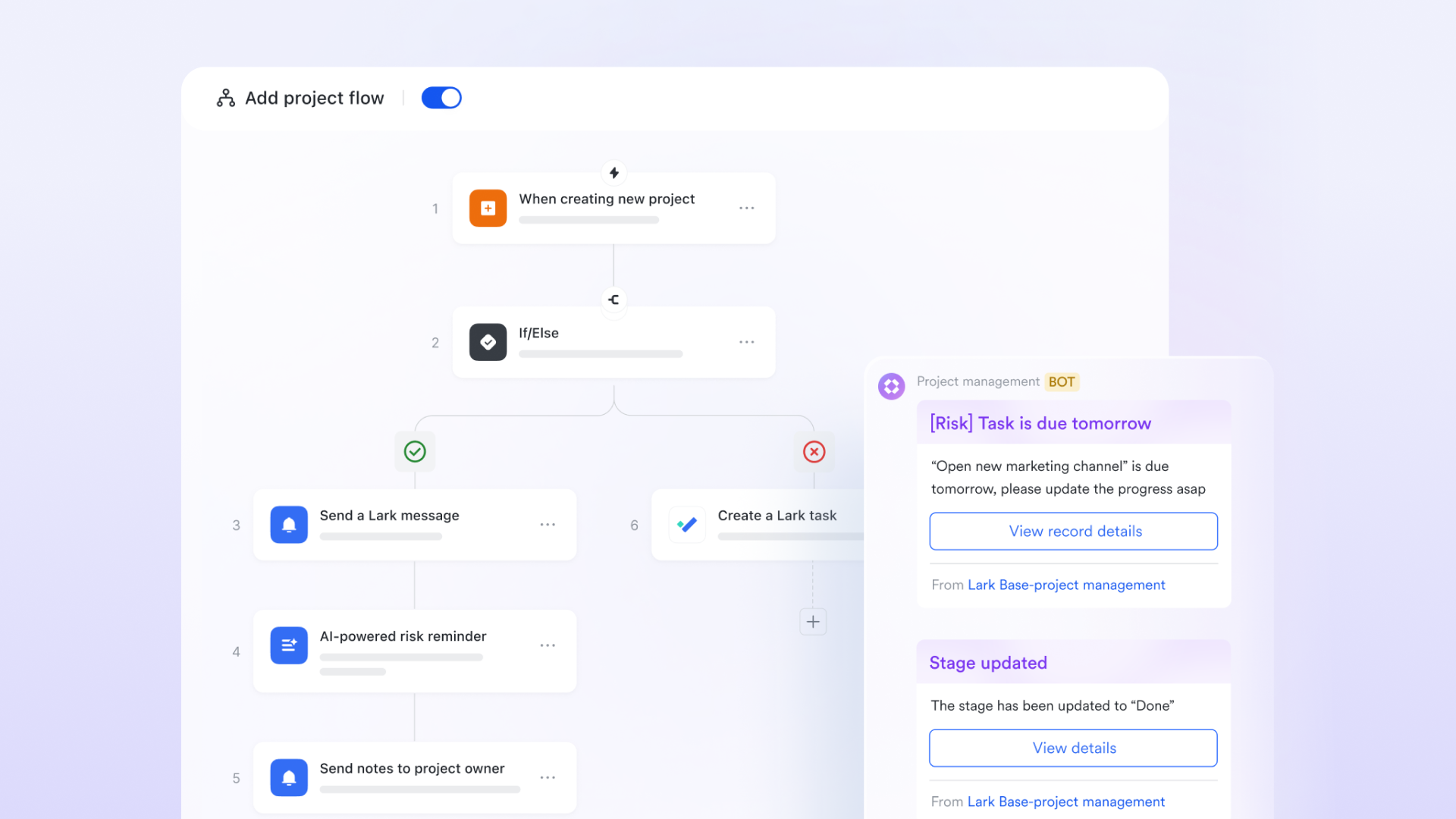
Automated actions to boost efficiency
The workflow engine evaluates conditions immediately and performs matching actions, eliminating repetitive tasks. In Lark Base automations, Teams can set up automation rules to automate updates, notifications, transitions, and more to keep the pipeline moving without delays. Automated actions also ensure that every project record stays aligned with the current status and requirements. Together, these capabilities help teams operate faster and maintain smoother cross-stage movement.
Co-edit, comment, and refine your project pipeline in a live document
Lark Docs helps clarify project requirements and consolidate reports by giving teams a shared, real-time space to create and refine documentation. You can build product requirement docs, add comments, and use templates like Project Plans to keep work structured. Rich content—text, images, and videos—can be added to provide clearer context. With collaborative editing and feedback, everyone stays aligned and informed.
Smart scheduling for key project checkpoints & regulars
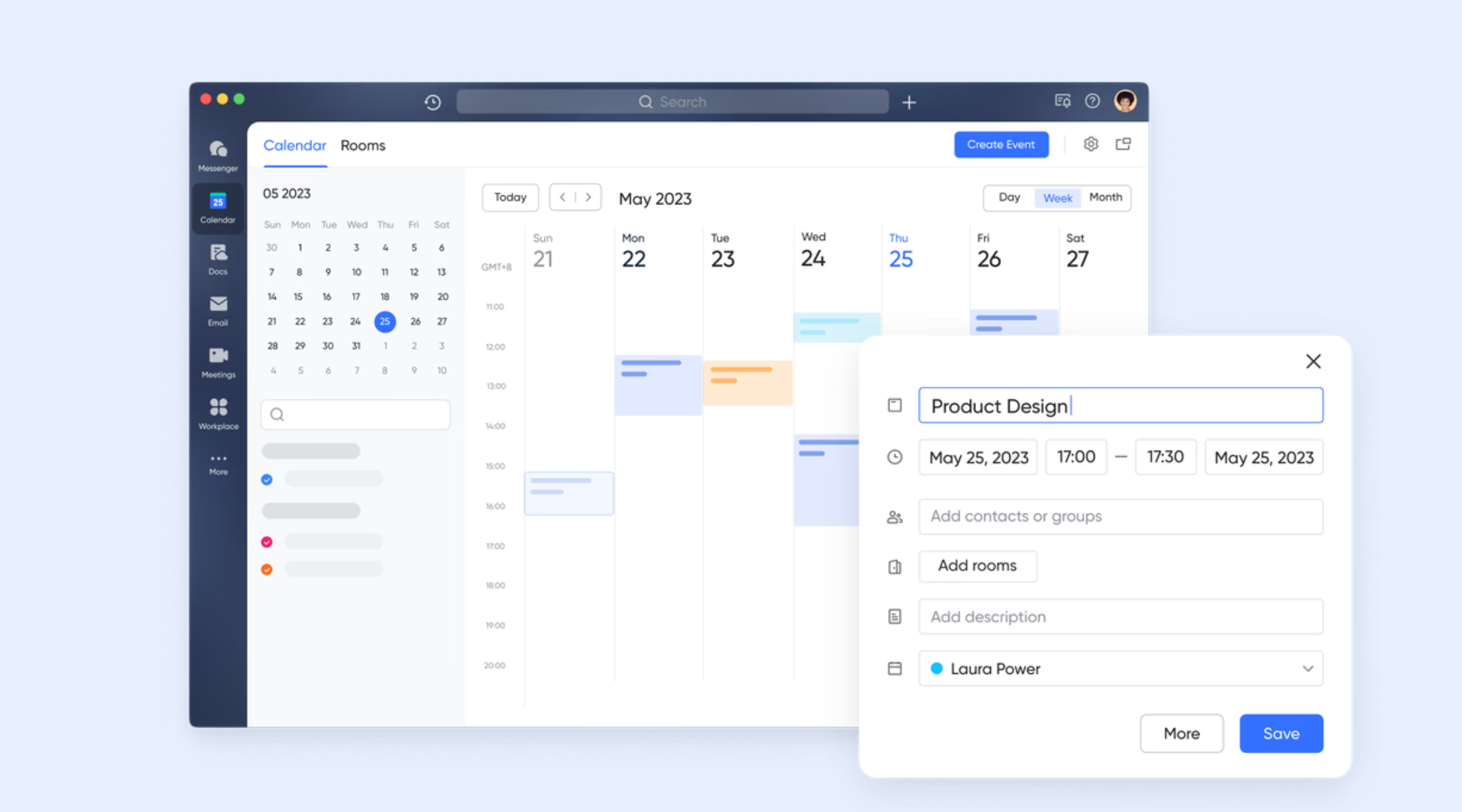
Lark Calendar helps teams publish release schedules and project milestones by providing a shared, transparent timeline. You can create a public project calendar and add key release dates or milestones for everyone to see. Colleagues across departments can subscribe to stay aligned and receive automatic updates. With all details visible in one place, teams stay informed, coordinated, and accountable throughout the project.
- Starter plan: Free forever plan that includes 11 powerful tools for up to 20 users. It also comes with 100GB of storage, 1000 automation runs, AI translations, and more.
- Pro plan: $12/user/month (billed annually) for up to 500 users. It includes everything in Starter plus group calling for up to 500 attendees, 15TB of storage, 50,000 automation runs, and more.
- Enterprise plan: Contact sales for custom pricing. Supports unlimited users and includes even more automation runs and advanced security, compliance, and management features.
Challenges in project pipeline management
Challenges in project pipeline management often emerge when teams lack structure, consistent evaluation standards, or the right visibility to track project movement from intake to completion. As organizations scale, these gaps become more prominent, leading to delays, confusion, and misalignment. A well-defined framework helps resolve these issues, but without it, even strong teams struggle to maintain flow. Many lessons come from large, complex efforts such as the Trans Mountain pipeline project or the Keystone pipeline expansion, where coordination and clarity are critical.
- Unclear project prioritization: Teams often struggle to decide which initiatives deserve attention first, especially when multiple departments push competing ideas. Without structured scoring, projects move forward based on urgency rather than strategic value. This leads to misaligned outcomes and wasted effort. Learning from large initiatives like the Colonial pipeline maintenance cycles shows how prioritization impacts long-term stability.
- Limited visibility across teams: When teams cannot see the full pipeline, dependencies get overlooked and plans become fragmented. This lack of transparency results in duplicated work, missed deadlines, and conflicting expectations. Centralized dashboards help unify information and maintain clarity. Even major efforts like the Enbridge Line 3 replacement relied on cross-team visibility to manage complexity.
- Resource constraints and overallocation: Overextended teams often face fatigue, reduced quality, and slow delivery. Without accurate forecasting, resources get pulled in different directions, delaying high-impact work. Balancing workloads becomes difficult when leaders lack a clear view of commitments. Examples like the Dakota Access pipeline development show how resource planning shapes execution timelines.
- Slow approval cycles: Bottlenecks form when decision-makers take too long to review proposals or provide feedback. Projects pile up in early stages, slowing the entire pipeline. Clear workflows and automated routing help accelerate sign-off. Large infrastructure programs such as the Mountain Valley pipeline highlight how approval timelines influence overall delivery.
- Data accuracy issues: Incorrect or outdated information causes misjudgments, misallocated resources, and poor tracking. Inconsistent updates create confusion across teams and hinder pipeline forecasting. Establishing standardized data entry practices improves reliability. High-scale projects like the TransCanada pipeline expansions show how critical clean data is in coordinating phases.
- Difficulty adapting the pipeline to changing needs: Rigid systems make it challenging to respond to shifts in priorities, budgets, or market conditions. When teams cannot adjust the pipeline quickly, opportunities are lost. Flexible frameworks help maintain resilience and momentum. Even massive undertakings like the Alaska LNG pipeline negotiations required frequent pipeline adjustments.
- Lack of standardized evaluation criteria: Without clear criteria, project proposals are judged inconsistently, leading to biased decisions and unbalanced portfolios. Standardized scoring enables fairness and strategic alignment. It ensures every project is assessed on impact, risk, and value. Lessons from public pipeline reviews, such as the Nord Stream environmental assessments, show the importance of uniform standards.
Best practices for project pipeline management
Effective project pipeline management relies on structure, transparency, and disciplined decision-making. When teams follow clear best practices, they reduce delays, improve forecasting, and ensure projects progress smoothly from idea to completion. A consistent approach also helps organizations stay aligned, even when priorities shift. The goal is to maintain a pipeline that is both efficient and adaptable.
- Keep scoring consistently: Consistent scoring ensures every project is evaluated fairly using the same factors, such as impact, cost, and risk. This prevents bias and helps teams compare initiatives objectively. A uniform scoring model also improves prioritization and decision-making. Over time, it creates a predictable flow of well-qualified projects through the pipeline.
- Centralize data: When project information lives in different tools or spreadsheets, teams lose time reconciling updates. Centralizing data ensures everyone sees the same source of truth at all times. This reduces errors, improves visibility, and speeds up reporting. A unified workspace also makes it easier to track progress across all pipeline stages.
- Use automation for repetitive work: Automation streamlines tasks like status updates, approval routing, data entry, and notifications. By reducing manual work, teams focus more on analysis and execution. Automation also lowers the risk of human error. This leads to faster movement through the pipeline and fewer delays in early-stage processes.
- Conduct periodic pipeline reviews: Regular reviews help teams spot bottlenecks, evaluate shifting priorities, and allocate resources as needed. These checkpoints ensure the pipeline stays accurate and relevant. They also allow leaders to catch outdated or low-value projects before they consume time and budget. Ongoing review keeps the entire pipeline aligned with current realities.
- Tie projects to organizational goals: A strong project pipeline reflects what the organization is trying to achieve, not just what teams want to work on. Linking each project to strategic goals ensures meaningful outcomes. This alignment helps leaders justify investments and measure impact. It also prevents teams from pursuing projects that deliver little long-term value.
Conclusion
A well-structured project pipeline ensures that ideas move smoothly from proposal to execution with clarity, consistency, and strong decision-making. By understanding each stage, addressing common challenges, and applying best practices like consistent scoring, centralized data, automation, and periodic reviews, organizations can greatly improve project flow and reduce delays. A strong pipeline also enables better resource allocation, sharper prioritization, and tighter alignment with strategic goals. When teams have visibility into what's coming next and why it matters, they operate with far more confidence and efficiency.
To manage your project pipeline with greater transparency and collaboration, explore how Lark can support your workflow with unified communication, data management, and automated processes.
FAQs
What is the difference between a project pipeline and a sales pipeline?
A project pipeline tracks how project ideas move from intake to execution, while a sales pipeline follows leads as they progress toward becoming customers. The project pipeline focuses on prioritization, resource planning, and delivery stages, whereas the sales pipeline centers on nurturing prospects and closing deals. Both provide structured visibility but serve different organizational goals. Using a unified workspace like Lark helps teams manage project stages clearly while staying aligned with broader business processes.
How do you prioritize projects in a pipeline?
Prioritization typically relies on factors such as strategic alignment, impact, cost, risk level, and available resources. Teams score each project using a standardized evaluation model to avoid bias and ensure consistency. High-value, time-sensitive, or low-risk projects often rise to the top. Regular reviews ensure priorities stay current as conditions change. Platforms like Lark help teams centralize scoring data and streamline prioritization workflows.
Who is responsible for managing a project pipeline?
Responsibility usually falls on project managers, PMOs, department heads, or cross-functional leadership teams. The role involves evaluating proposals, maintaining pipeline accuracy, coordinating approvals, and ensuring resources are allocated effectively. Large organizations may assign dedicated pipeline owners, while smaller teams manage it collaboratively. Clear oversight ensures smooth transitions between stages. Tools like Lark make this easier by providing shared dashboards, automated updates, and centralized communication.
How often should a project pipeline be reviewed?
Project pipelines are typically reviewed monthly or quarterly, depending on the pace of new ideas and active work. Fast-moving teams may conduct weekly check-ins to track changes, remove outdated proposals, and adjust priorities. Regular reviews prevent bottlenecks and ensure the pipeline reflects current business goals. These checkpoints also improve forecasting and workload planning. Using Lark enables teams to conduct structured, data-driven reviews with real-time visibility.
Related reading
Table of contents
Start using Lark today

Manage all your work in one place
Boost team efficiency by 10x
Save up to 70% on software costs
Table of contents
Start using Lark today
Manage all your work in one place
Boost team efficiency by 10x
Save up to 70% on software costs
Keep reading







2026 Lark Technologies Pte. Ltd.
Headquartered in Singapore with offices worldwide.






Explore: