Warehousing has evolved from a simple storage function into a critical operational engine that directly impacts fulfillment speed, cost control, and customer satisfaction. As order volumes grow and supply chains become more complex, manual tracking methods struggle to keep pace. Businesses now require structured systems that provide accuracy, visibility, and control across every movement of inventory.
A warehouse inventory management system provides this structure by connecting stock data, workflows, and reporting into a unified framework. Over time, modern digital platforms, including collaborative systems like Lark, are increasingly adopted to support flexible, real-time warehouse operations without the rigidity of legacy software. These systems help streamline warehouse operations for greater operational efficiency by automating inventory tracking, order fulfillment, and reducing manual tasks.
What is a warehouse inventory management system?
A warehouse inventory management system is a that tracks inventory quantities, locations, and movements within a warehouse environment. It provides a centralized record of stock as items are received, stored, picked, packed, and shipped. Unlike basic inventory lists, an inventory warehouse management system maintains real-time synchronization between physical stock and digital records, reducing discrepancies and manual reconciliation. These systems also improve inventory accuracy and support better demand forecasting by providing reliable, up-to-date data for analysis and planning.
For growing operations, a warehouse inventory management system becomes essential for managing complexity across multiple storage zones or locations. Many organizations implement a warehouse stock management system to help teams manage inventory efficiently as operations grow and to support structured processes such as cycle counting, replenishment, and order fulfillment. Whether deployed as a standalone tool or as part of a , its primary purpose is to maintain accuracy, speed, and control across daily operations.
Power your retail operations with automation
How warehouse stock management systems support daily operations
support daily warehouse operations and day-to-day operations by providing immediate visibility into inventory availability and movement. As goods enter or leave the warehouse, stock levels are updated in real time, allowing teams to make informed picking and replenishment decisions. This level of accuracy reduces fulfillment errors and prevents stockouts that disrupt customer commitments.
In multi-site environments, warehouse inventory systems consolidate data across locations into a single operational view. The system supports inventory management across multiple locations and multiple warehouses, enabling seamless coordination and transfer of stock between sites. Managers can monitor inbound and outbound activity, identify slow-moving stock, and rebalance inventory between facilities. By using an inventory management system for warehouse operations, teams replace reactive firefighting with predictable, that scales with demand.
Key features of a reliable warehouse inventory management system
A warehouse inventory management system is only effective when its features align with the realities of warehouse operations. As volume increases and fulfillment timelines tighten, basic tracking is no longer sufficient. Modern warehouse inventory systems, including advanced WMS software and warehouse management software, focus on accuracy, automation, and visibility to support consistent daily execution:
- Real-time inventory tracking: Real-time tracking ensures that every inventory movement is immediately reflected in the system. This capability allows warehouse staff to update stock levels as items are received, relocated, or shipped without delays. A warehouse stock management system with real-time updates reduces mismatches between physical stock and . The integration of automated storage and retrieval systems (retrieval systems) further enhances accuracy and efficiency. Over time, this accuracy becomes the foundation for reliable planning and forecasting.
- Location and bin-level control: Location management enables precise tracking of where each item is stored within the warehouse. Instead of knowing only total quantities, teams can see bin-level or zone-level inventory positions. This feature improves picking efficiency and reduces time spent searching for items. Many inventory warehouse management system platforms use structured location hierarchies to support scalable layouts.
- Barcode and scanning support: Barcode scanning simplifies inventory updates and minimizes manual data entry. Using scanners or mobile devices, staff can quickly record inventory movements with minimal training. This reduces errors caused by handwritten logs or delayed updates. Barcode support is a core requirement in any modern inventory management system for warehouse environments and is essential for supporting efficient packing processes.
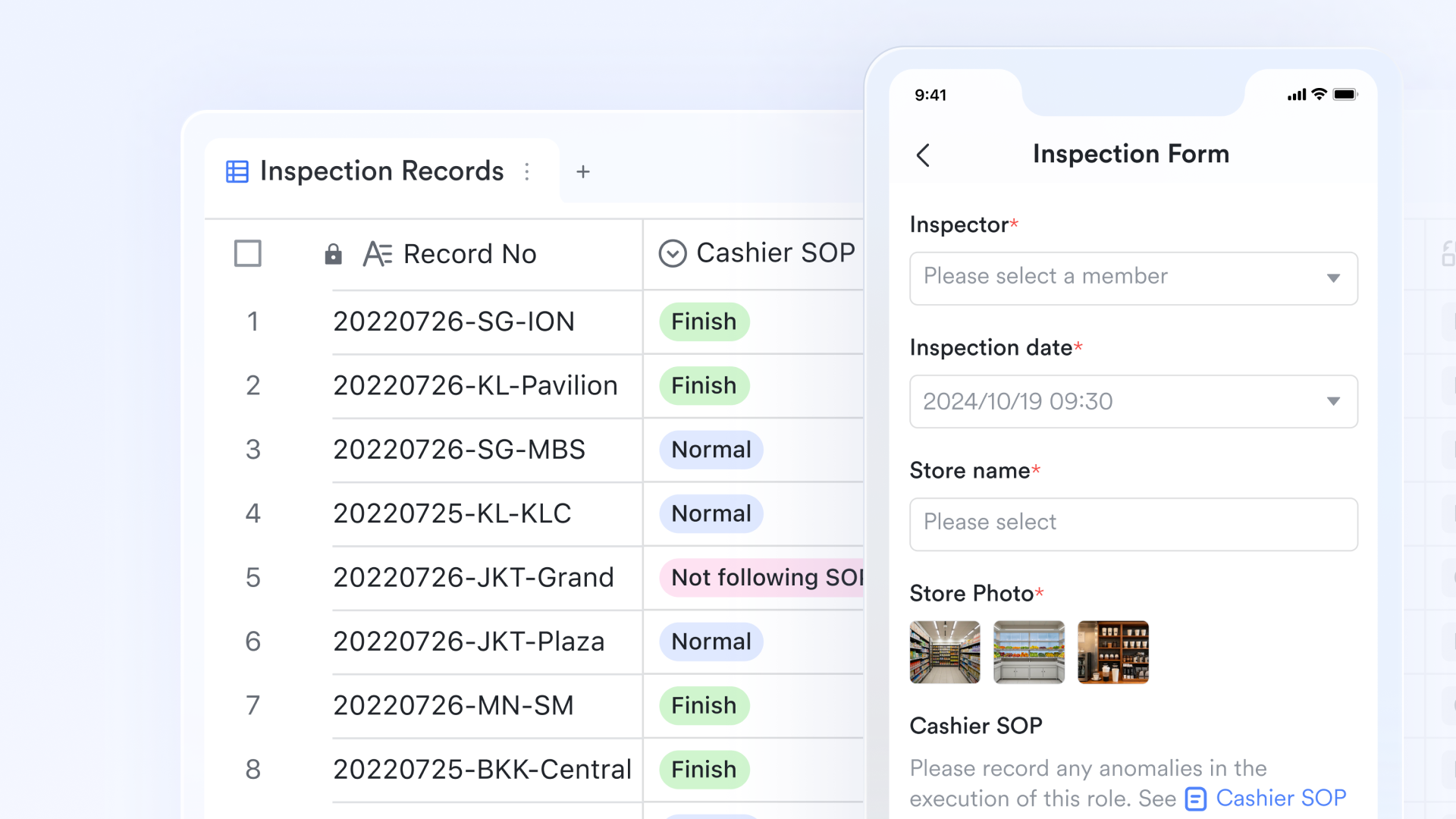
- Low-stock alerts and replenishment rules: Low-stock alerts help teams act before shortages disrupt fulfillment. By defining reorder thresholds, a warehouse and inventory management system can notify teams when stock falls below safe levels. This feature supports just-in-time replenishment strategies. Automated alerts reduce reliance on manual checks and guesswork.
- Reporting and performance insights: Reporting features transform raw inventory data into actionable insights. Warehouse managers can such as inventory turnover, fulfillment speed, and stock aging. These insights support better decision-making and continuous improvement by monitoring warehouse processes and enabling more streamlined processes. The best warehouse inventory management system provides both high-level summaries and detailed operational views.
Common mistakes when implementing warehouse inventory systems
Implementing warehouse inventory systems can unlock major efficiency gains, but many organizations struggle during execution. These challenges often stem from poor planning, limited adoption, or mismatched tool selection. Understanding common mistakes helps teams avoid costly disruptions and ensures the inventory management system for warehouse operations delivers long-term value.
- Relying on manual processes for too long: Many warehouses delay adopting structured systems and continue using spreadsheets or paper-based tracking. This approach creates data delays and increases error rates as volume grows. Manual processes also limit visibility across locations and lead to wasted time and inefficiencies. Transitioning earlier to a warehouse inventory management system reduces operational friction.
- Choosing systems that lack flexibility: Some warehouse inventory systems are too rigid for evolving workflows. When operations change, these systems require expensive reconfiguration or workarounds. Flexibility is critical for scaling and adapting processes. The best warehouse inventory management system supports customization without complexity.
- Ignoring and training: Even the most advanced inventory warehouse management system fails without user adoption. Teams often underestimate the need for onboarding and ongoing training. Clear SOPs and accessible documentation improve consistency. Adoption depends on usability as much as features. To ensure high adoption rates, it is vital to follow established during the rollout phase.
- Failing to connect inventory data with communication: Inventory data loses value when it is isolated from daily decision-making. Without real-time communication, issues escalate slowly. A warehouse and inventory management system should support collaboration. Integrated workflows prevent delays and misalignment. Integration with third-party logistics providers and other logistics processes is essential for streamlining operations, improving order fulfillment, and ensuring seamless supply chain management.
Avoid these pitfalls with an easy-to-use solution
Modern choice: How Lark supports evolving warehouse operations
Warehouse operations today demand speed, accuracy, and coordination across people, locations, and systems. As businesses move away from manual spreadsheets and fragmented tools, the need for flexible digital infrastructure becomes increasingly clear. , communication, and reporting in isolation creates delays and blind spots. This is where fits naturally into modern warehouse environments, providing a unified platform that adapts to operational complexity and can scale with a company's needs, without introducing rigid legacy constraints.
Unified inventory database and advanced fields
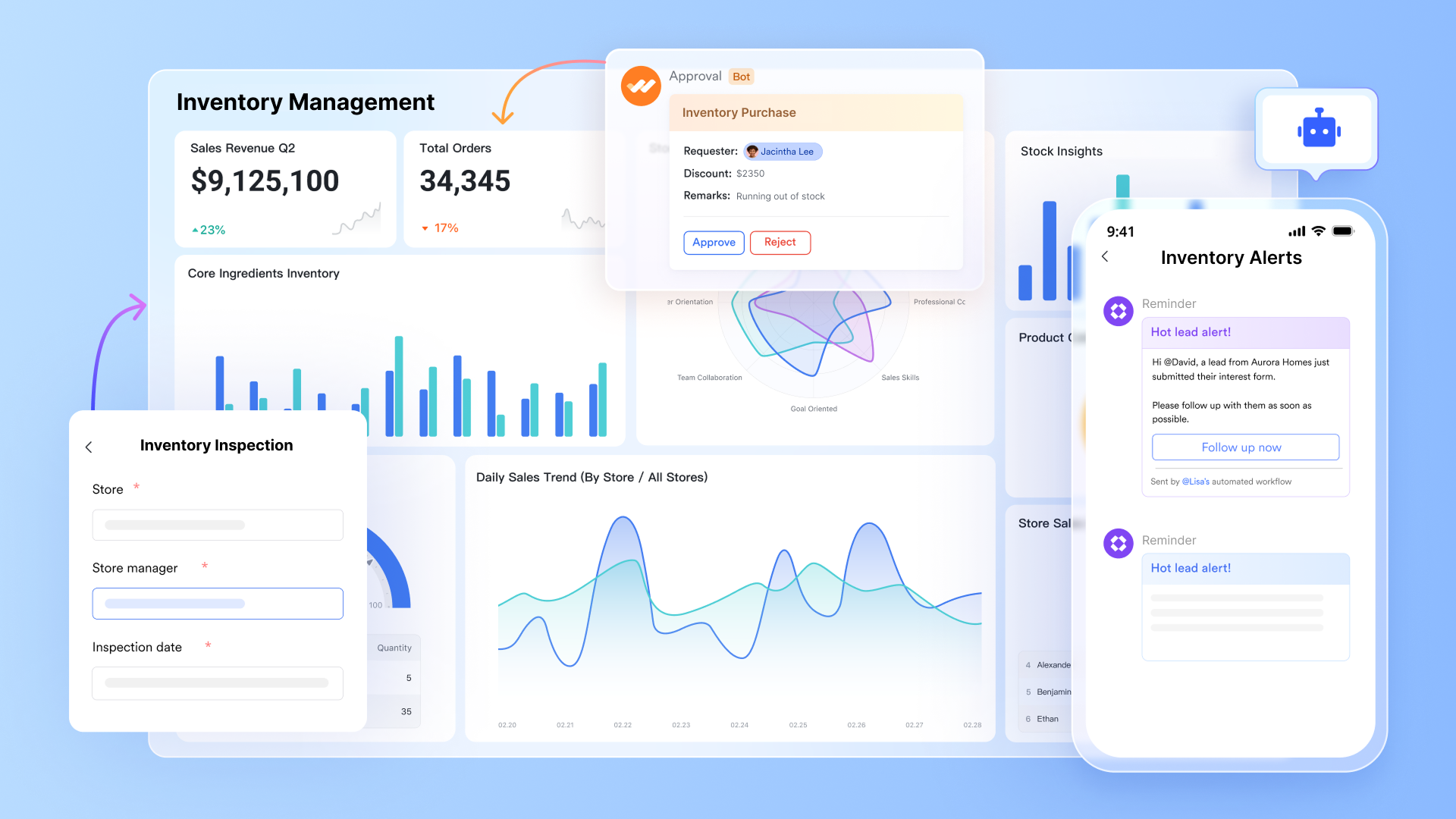
Traditional warehouse management often suffers from "data lag," where the physical stock moves but the digital record stays static. resolves this with its unified database and various fields. At Lark Base, staff can customize and import data with various fields: you can add a location field to provide the real-time location of equipment, or use the barcode field to scan barcodes or QR codes directly to log shipments, perform cycle counts, or update stock locations in real time. This ensures that the digital "single source of truth" is always aligned with the physical floor, drastically minimizing human efforts. 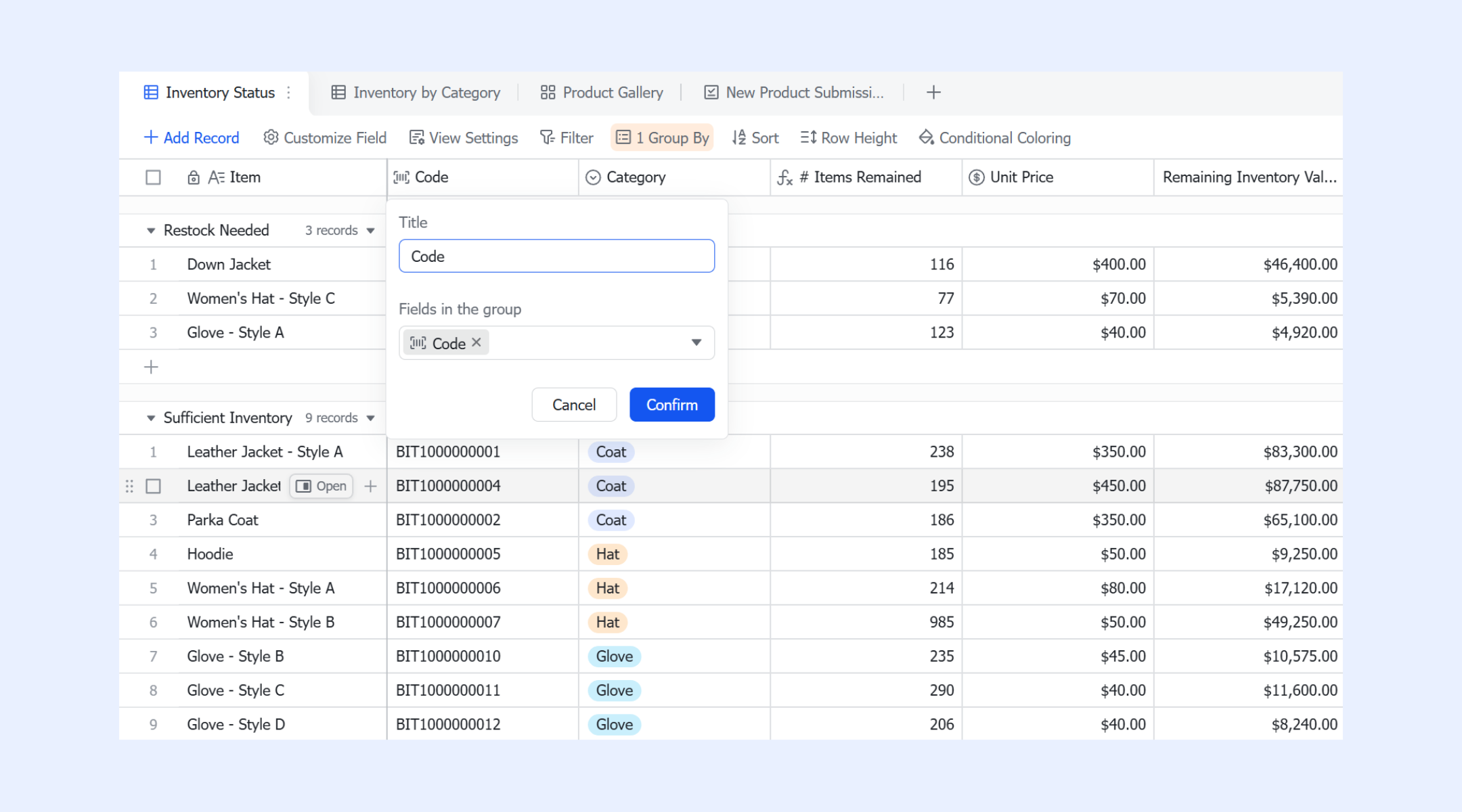
Multi-location visibility and real-time reporting
For businesses managing distributed fulfillment centers, Lark provides a holistic view of the entire supply chain. Lark Base dashboards can visualize KPIs such as inventory turnover, order fulfillment time, and space utilization across different sites. By leveraging metrics and ranking blocks, leaders can instantly switch between high-level executive summaries and granular view blocks like task lists. This real-time data allows teams to redistribute stock between locations using link and lookup fields or optimize picking paths by analyzing trends through pivot tables and slicer filters. 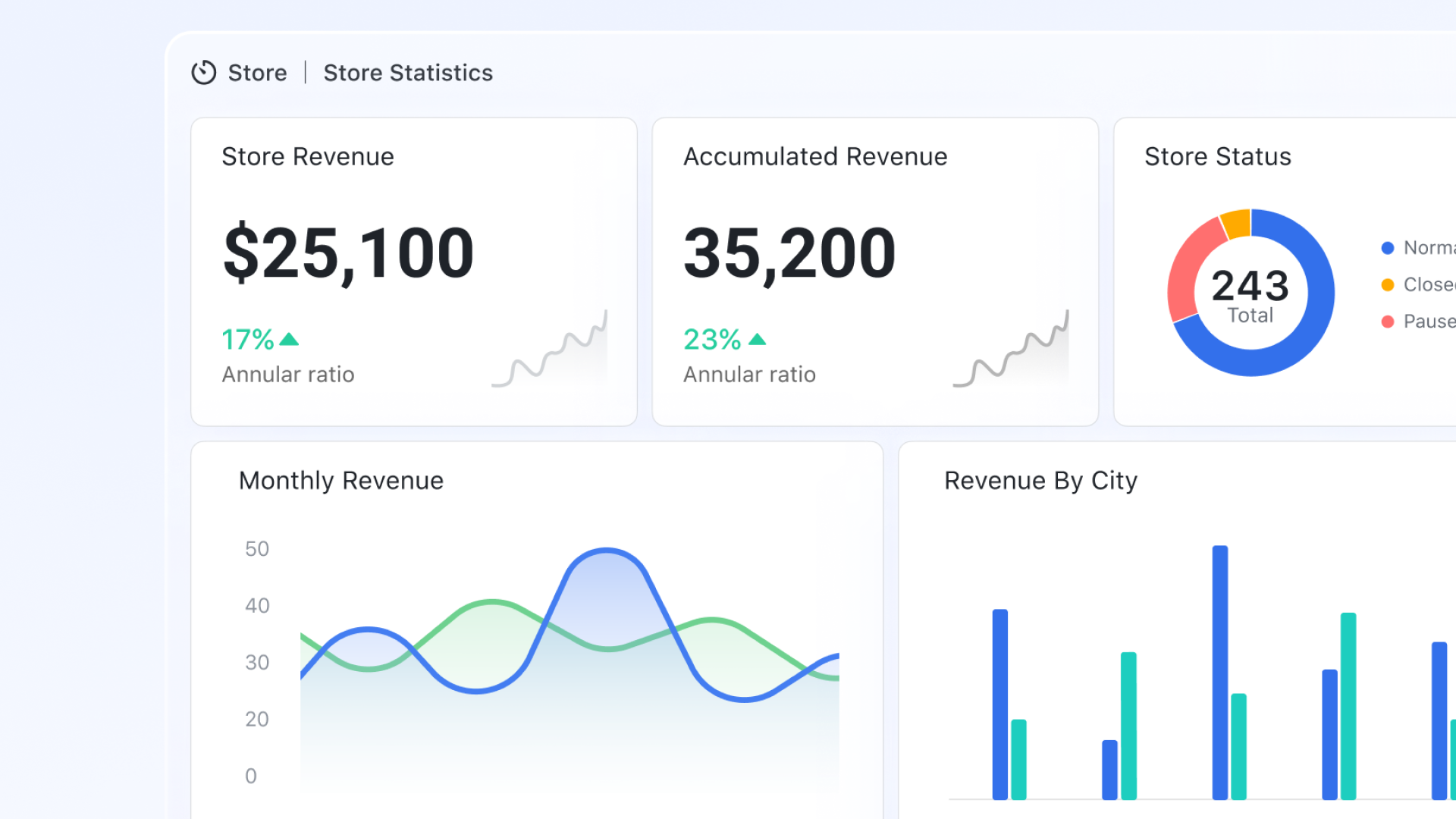
Automated workflow and low-stock alerts
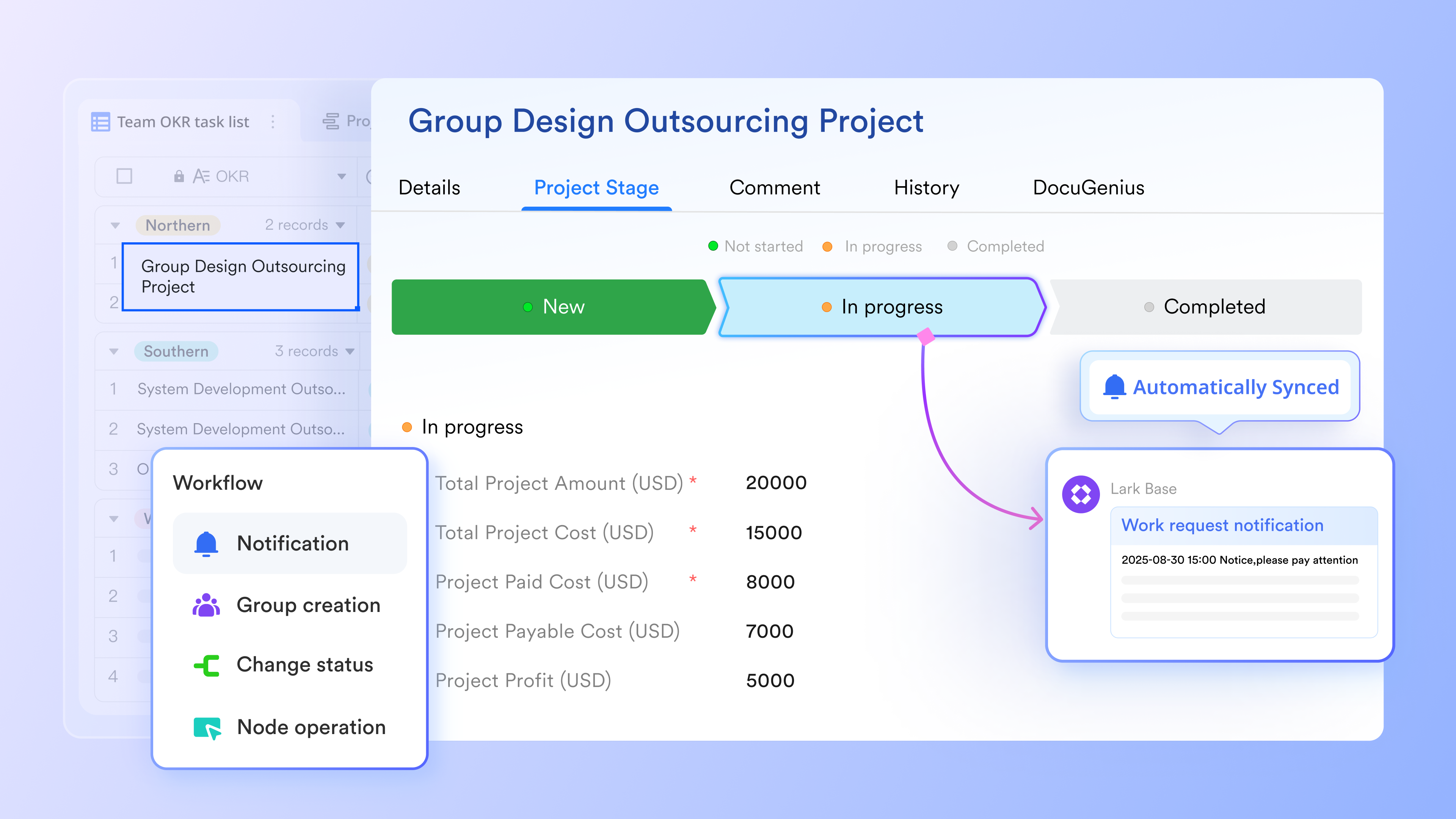
To maintain "Just-in-time" efficiency, warehouse managers must be proactive rather than reactive. With Lark Base workflow, you can set up automated rules that monitor stock levels across multiple facilities in real-time. When an item reaches a pre-defined reorder point, Lark can automatically send a notification to the procurement team via , generate a purchase order (PO) in a dedicated table, and route an approval request through to management, ensuring replenishment happens before a stockout occurs.
Centralized knowledge hub for SOPs
As warehouse operations scale, maintaining consistency across shifts and locations becomes a challenge. and serve as a centralized hub for all Standard Operating Procedures (SOPs). Whether it's safety protocols, picking routes, or equipment checklists, teams can access the most up-to-date versions instantly using advanced search. New hires can be onboarded faster with integrated training manuals organized into Wiki child pages, while "Post-Mortem" reports on shipping errors can be collaboratively edited using real-time comments and version history to improve future processes. 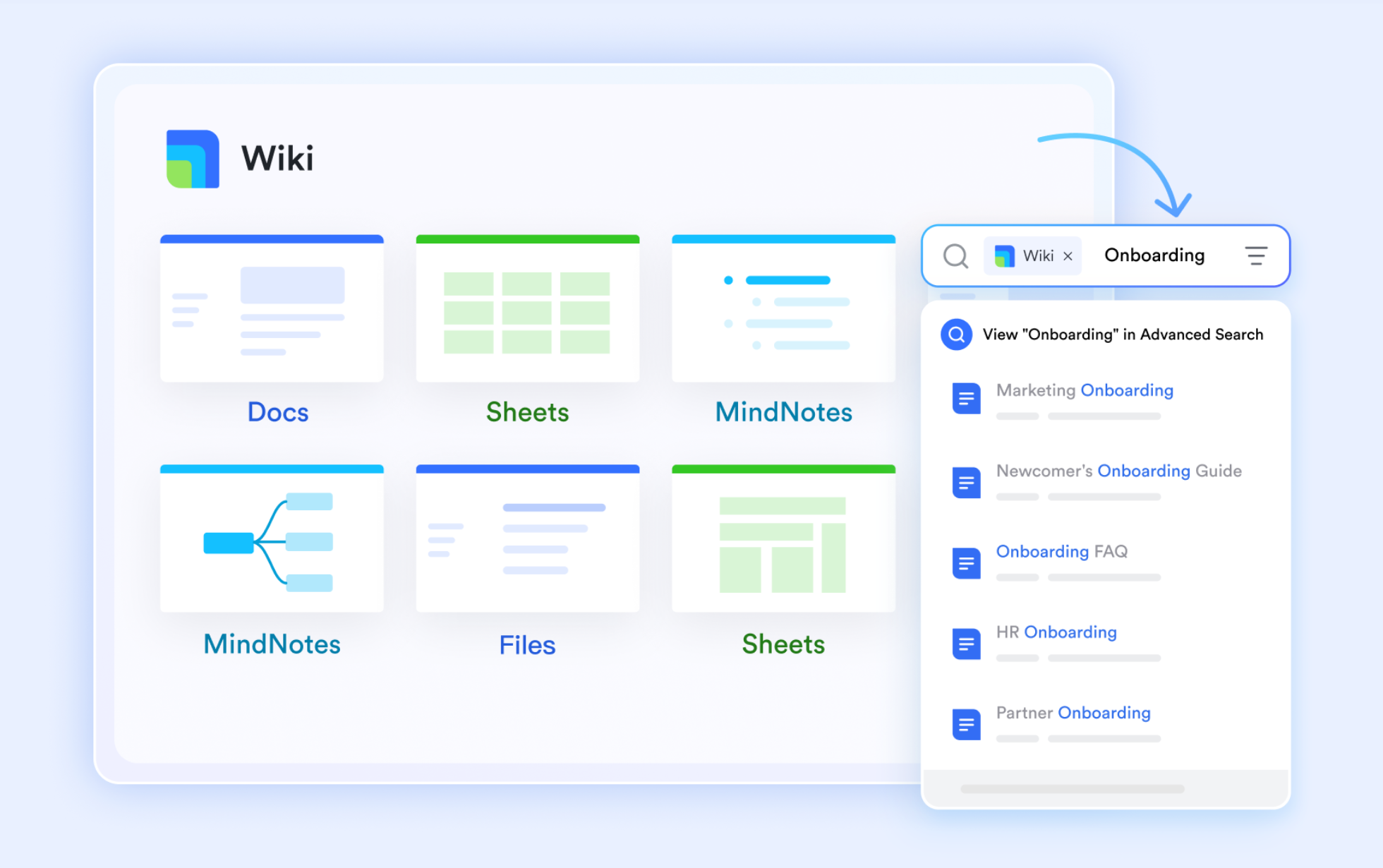
Seamless communication between the floor and the office
Communication silos between the warehouse floor and the corporate office often lead to delays in fulfillment. Lark breaks these barriers by unifying directly with operational data. If a picker identifies a damaged pallet, they can snap a photo, upload it to the Lark Base record, and instantly start a group chat with quality control and procurement teams. This contextual communication ensures that issues are resolved where the work is happening, keeping the fulfillment pipeline moving smoothly. 
:
- Starter plan: Free forever plan that includes 11 powerful tools for up to 20 users. It also comes with 100GB of storage, 1000 automation runs, AI translations, and more.
- Pro plan: $12/user/month (billed annually) for up to 500 users. It includes everything in Starter plus group calling for up to 500 attendees, 15TB of storage, 50,000 automation runs, and more.
- Enterprise plan: for custom pricing. Supports unlimited users and includes even more automation runs and advanced security, compliance, and management features.
For small teams with simple communication needs

18 months message history
1000 Base automation runs/month
2000 rows per table in Base
Most POPULAR
For companies with comprehensive collaboration and management needs
Unlimited message history
500-participant video meetings
50k Base automation runs/month
20k rows per table in Base
For large companies with advanced security and organizational management needs
Get a personalized demo and pricing
Unlimited message history
500-participant video meetings
15 TB storage + 30 GB storage/user
500k Base automation runs/month
50k Base automation runs/month
Most POPULAR
For companies with comprehensive collaboration and management needs
Unlimited message history
500-participant video meetings
50k Base automation runs/month
20k rows per table in Base
How to choose your best warehouse inventory management system
Selecting the best warehouse inventory management system requires more than comparing feature lists. Each warehouse operates under unique constraints related to size, order volume, and integration needs. Choosing the right is crucial, as it should align with your specific business requirements, such as real-time inventory tracking, integration capabilities, and hardware compatibility. A structured evaluation approach helps ensure long-term fit rather than short-term convenience.
- Assess operational complexity and scale: Start by evaluating current and future operational complexity. Single-location warehouses have different needs than multi-site distribution networks. Understanding growth plans ensures the chosen inventory management system for warehouse use can scale without disruption. Flexibility becomes increasingly important as operations expand.
- Evaluate integration requirements: Inventory systems rarely operate in isolation. Integration with , accounting, and shipping platforms is often essential. A strong inventory and warehouse management system should connect easily with existing tools. Integrating with enterprise resource planning (ERP) systems enables end-to-end business management, streamlining operations and improving data sharing. Poor integration leads to data silos and manual workarounds.
- Balance customization with usability: Highly customizable systems offer flexibility but can increase setup time and training requirements. Simpler warehouse inventory systems may be easier to adopt but less adaptable. Teams should balance configuration depth with usability to ensure long-term adoption. The goal is sustainable efficiency rather than short-term optimization.
- Consider deployment and cost structure: Deployment models such as cloud, hybrid, , or on-premise affect maintenance and scalability. SaaS provides a flexible deployment option with rapid implementation, lower upfront costs, and ongoing updates. Cost structures should align with budget constraints and growth expectations. Transparent pricing and predictable upgrades reduce long-term risk. Evaluating the total cost of ownership is critical when selecting a warehouse stock management system.
Build accuracy across warehouse workflows
Future trends in warehouse inventory management systems
Warehouse operations continue to evolve as technology and advance. Changing customer buying patterns and the rapid growth of online sales are driving the evolution of warehouse inventory management systems, pushing businesses to adapt their strategies for greater efficiency and responsiveness. Future-ready inventory systems focus on automation, intelligence, and adaptability. Understanding these trends helps organizations prepare for sustainable growth.
- Increased automation and smart workflows: Automation is becoming central to warehouse stock management system design. Automated alerts, replenishment triggers, and task routing reduce manual oversight. This trend improves speed and consistency. Automation also supports operational teams.
- Real-time data and predictive insights: Future warehouse inventory systems emphasize predictive analytics over static reporting. data feeds enable forecasting and proactive decision-making. This shifts inventory control from reactive to strategic. Predictive tools reduce both stockouts and overstocking.
- Mobile-first and distributed operations: Mobile access is no longer optional for warehouse environments. Teams expect to update inventory from anywhere on the floor. Inventory management systems for warehouse use increasingly prioritize mobile-first design. This supports faster execution and fewer delays.
- Unified platforms over siloed tools: Organizations are moving away from fragmented systems toward unified platforms. Inventory, communication, and reporting increasingly coexist in one environment. This trend improves alignment and reduces operational blind spots. Flexibility and integration define the next generation of systems.
Conclusion
A warehouse inventory management system has become a strategic operational backbone rather than a supporting back-office function. As order volumes increase and customer expectations tighten, businesses can no longer afford gaps in stock accuracy or visibility. Structured inventory systems help teams control , minimize fulfillment errors, and respond faster across single or multi-location warehouses. Warehouse management solutions and WMS systems enable businesses to manage inventory more effectively by optimizing storage, streamlining order fulfillment, and integrating advanced technologies. When implemented correctly, they create consistency, predictability, and confidence in daily operations.
As warehousing continues to evolve, static tools and disconnected processes struggle to reflect what is actually happening on the warehouse floor. Modern operations increasingly rely on flexible platforms that connect inventory data, workflows, and communication in real time. Over time, solutions like support this transition by enabling inventory and warehouse management system workflows that adapt as operations scale, change, and become more complex.
Bring visibility to inventory decisions
FAQs
What are the 4 types of inventory management systems?
The four common types include periodic inventory systems, perpetual inventory systems, barcode-based systems, and fully automated inventory systems. Each type differs in how frequently data is updated and how much manual effort is involved. Warehouses often start with simpler models and progress toward real-time systems. As operations mature, platforms like Lark help support this evolution by enabling structured, continuously updated inventory records.
What is the best warehouse inventory management system?
The best warehouse depends on factors such as warehouse size, order volume, and workflow complexity. Small operations may prioritize ease of use, while larger warehouses require automation and advanced reporting. There is no universal best option for every scenario. Many teams gradually evaluate flexible platforms like Lark as their operational needs expand.
What's the difference between WMS and warehouse inventory software?
A typically covers end-to-end warehouse execution, including labor management and routing. Warehouse inventory software focuses more narrowly on tracking stock levels and locations. In practice, modern tools increasingly combine both capabilities. Platforms like Lark reflect this shift by blending inventory tracking with communication and workflow coordination.
How often should warehouse inventory data be updated for accuracy?
Warehouse inventory data should ideally be updated in real time or immediately after each transaction. Delayed updates increase the risk of stock discrepancies and fulfillment issues. High-velocity environments benefit most from continuous updates. Mobile-friendly platforms such as Lark make real-time data capture more achievable.
How can I determine the right safety stock level for my warehouse?
levels depend on demand variability, supplier lead times, and service level targets. Historical sales data and replenishment patterns are often used to calculate appropriate buffers. Regular review is essential as conditions change. Over time, tools like Lark help teams centralize data and adjust safety stock decisions more confidently.
Related reading