


CDP vs CRM: Understanding the Difference and Building Better Customer Experiences

Cecilia Lane
Go-to-Market Associate
Aug 5, 2026
Cecilia Lane
Aug 5, 2026

20 min read


The debate around CDP vs CRM isn't just technical—it's strategic. Businesses are realizing that managing customer relationships and managing customer data are two sides of the same coin. While CRMs have long powered sales and service teams, CDPs are reshaping how marketing and analytics teams understand and activate customer insights. In my experience, the real challenge isn't choosing between the two, but aligning them to work together. Tools like Lark, for instance, are helping teams connect data and collaboration seamlessly. Let's break down what each system does—and why the difference matters more than ever.

What is a CRM and what does it do?
A Customer Relationship Management (CRM) system is the operational core for managing an organization's interactions with customers and prospects. Its primary focus is on sales, customer service, and retention—helping teams track conversations, manage pipelines, and nurture relationships over time. For most companies, a CRM acts as the single source of truth for contact details, deal progress, and communication history.
CRMs like Lark Base, Salesforce, HubSpot, or Zoho are designed to organize people and processes. They offer task automation, deal forecasting, and after-sales follow‑up management so that no opportunity slips away. When integrated with tools like email marketing platforms or communication suites, CRMs empower sales teams to personalize engagement and improve conversion efficiency.
That said, traditional CRMs often have limitations in data scope and agility. They usually record what happens after contact with the customer—such as calls, emails, or support tickets—but rarely reflect broader digital behavior like website visits, ad clicks, or mobile app events. This is exactly where Customer Data Platforms (CDPs) extend the data story.
Before we get there, it's also worth clarifying about another frequent comparison floating online—CMS vs CRM or even CMS vs CRM vs ERP. While a Content Management System (CMS) manages digital content and publishing workflow, and an Enterprise Resource Planning (ERP) system oversees core business operations, neither focuses primarily on customer relationships. So when you see "CRM vs CMS vs ERP" or "CRM vs. CMS," think of the CRM as the front‑line relationship manager rather than the backend operator or content tool.
What is a CDP and how does it work?
A Customer Data Platform (CDP) takes customer understanding several layers deeper than a CRM. Its mission is data unification—collecting, cleansing, and organizing customer data from multiple sources to create a single, persistent profile for each individual.
Where CRM data usually comes from direct interactions, CDPs merge both online and offline touchpoints: website analytics, mobile behavior, purchase history, ad engagement, and even IoT or POS systems. This unified dataset gives marketing and data teams a real-time, 360‑degree view of the customer that can power segmentation, personalization, and predictive analytics.
A well‑implemented CDP becomes the intelligence engine behind modern marketing—activating audience segments in ad platforms, tailoring email campaigns, and measuring cross‑channel effectiveness. In comparison, a CRM acts as the recordkeeper and action dashboard for human interactions, while the CDP fuels those actions with richer context.
CDPs also address growing priorities around data privacy and compliance by centralizing first‑party data and reducing dependency on third‑party cookies—critical in an era of evolving privacy laws and browser changes.
While both systems serve distinct functions, they're not mutually exclusive. Most mature organizations realize that CDPs feed insight, and CRMs drive execution. The real advantage emerges when both are connected—ideally through integrated collaboration environments like Lark that help teams align data insights with daily workflows seamlessly.
CDP vs CRM — key differences explained
Understanding the difference between a Customer Data Platform (CDP) and a Customer Relationship Management (CRM) system goes beyond their acronyms. Though both deal with customers, they serve different moments in the customer lifecycle. The CRM helps teams interact with customers; the CDP helps teams understand them.
- Purpose and core users: A CRM is designed primarily for sales, service, and account management teams. It organizes people, conversations, and deals. A CDP, on the other hand, is built for marketing, analytics, and product teams who rely on unified and enriched data to run personalized experiences.
- Data sources and structure: CRMs rely on structured and manually entered data—contact info, deal values, support logs. CDPs combine structured and unstructured data, collecting behavioral signals from websites, apps, email engagement, and more. This allows marketing teams to develop a "single customer view" that's broader than CRM's contact records.
- Real‑time vs historical data: CRMs typically capture what has already happened. CDPs work in real time, enabling dynamic segmentation, audience activation, and predictive modelling. This distinction is what empowers a marketer to adjust campaigns as behaviors change—not days later, but instantly.
- Integration and ecosystem role: The modern stack isn't CDP vs CRM, but CDP plus CRM. When unified, the CDP provides insight, the CRM executes engagement, and together they fuel end‑to‑end personalization. In fact, cross‑platform discussions like CMS vs CRM vs ERP are popular for a reason—they reflect how companies need integrated systems rather than isolated silos.
CDP and CRM: Better together, not rivals
Framing this topic as CDP vs CRM oversimplifies the modern customer ecosystem. The best customer experiences arise when insights (from the CDP) feed into interactions (in the CRM).
- Data flows both ways: A CDP consolidates behavioral data—site clicks, purchase patterns—and sends segments to the CRM, where sales teams can act on them. In return, CRM feedback refines CDP datasets for more accurate targeting.
- Shared data empowers alignment: Marketing and sales often struggle with different metrics of success. When both systems share unified profiles, teams can work from the same truth.
- Real‑world scenarios: A retailer might use a CDP to identify "high‑value dormant customers." The CRM then prompts account managers to reconnect personally, turning data insight into action.
This synergy explains why many businesses now invest in integration-first strategies. Whether your stack also includes a CMS or an ERP, the goal isn't to choose one tool but to create an ecosystem where customer intelligence drives relationship management—and vice versa.
How to choose between a CDP and a CRM
Deciding between a CDP and a CRM depends less on company size and more on data maturity and business goals. Here's a clear framework to guide your choice:
Assess your primary objective
- If your goal is sales process efficiency: Start with a CRM. It centralizes lead tracking and helps your teams manage pipelines.
- If your goal is data‑driven personalization: A CDP is the smarter investment. It connects scattered data points into actionable customer intelligence.
- If you need both: Integrate them. CRMs execute; CDPs optimize.
Consider your data complexity
Organizations with multiple touchpoints—web, mobile, retail, ads—will benefit more quickly from a CDP that unites this data. Simpler sales-led businesses might focus first on CRM adoption before introducing a data platform.
Evaluate execution alignment
A CDP without activation is underused; a CRM without intelligence is blind. The most successful setups find middle ground, often tied together through collaboration and automation layers such as Lark. A unified workspace allows marketing and sales to share the same live insights, trigger workflows, and collaborate on follow‑up tasks within one environment.
Check integration and scalability
Before committing, ensure that whichever platform you adopt integrates with your existing CMS, analytics tools, and ERP. The best system is the one that extends—not constrains—your ecosystem.
Ultimately, the smartest businesses are no longer asking "CDP vs CRM?" but "how can these systems work together to create faster, smarter, and more human customer experiences?"
The collaboration gap — bridging data and action inside teams
Even when a company successfully implements both a CDP and a CRM, a critical issue often remains unsolved: the collaboration gap. Data insights generated by marketing and analytics teams don't always reach sales or customer success teams in a way that drives direct action. This disconnect can leave valuable customer intelligence unused.
Collaboration platforms like Lark help bridge this gap through integrated workflows that link data understanding and operational execution. Instead of teams working in isolated systems, Lark enables real‑time cooperation and synchronization around customer data.
Building connected data and collaboration strategy for the future
As companies mature digitally, the line between data systems and collaboration systems continues to blur. It's no longer enough to manage customer data in silos—teams must share intelligence and act in sync. A connected strategy starts with identifying where insights are lost and ensuring that every touchpoint, tool, and person has access to consistent, current information.
Future‑ready organizations use CDP + CRM integration as their foundation, then layer collaboration platforms to create unified visibility. By centralizing first‑party data within secure environments and enabling automation through shared workspaces, teams can respond to customer needs faster, personalize experiences, and maintain regulatory compliance.
Lark embodies this shift: a workspace that blends communication, data operation, and workflow automation—helping businesses move from fragmented systems to a unified experience layer where collaboration becomes the real competitive advantage.
Unify and operationalize customer data with the right tool
While a CDP centralizes customer data and a CRM manages relationships, Lark provides the missing connective tissue—turning unified data into coordinated action through its integrated workspace.
Lark Base functions as a flexible, no‑code data hub that brings CRM and CDP data into one environment. Teams can import lead information, segment data, or campaign metrics into shared Base tables, building dynamic dashboards that stay automatically updated. Linked views and permissions ensure everyone—from marketing to sales—works off the same current dataset. Combined with automation and approval flows, Base turns data insights into real‑time actions like assigning leads or triggering notifications.
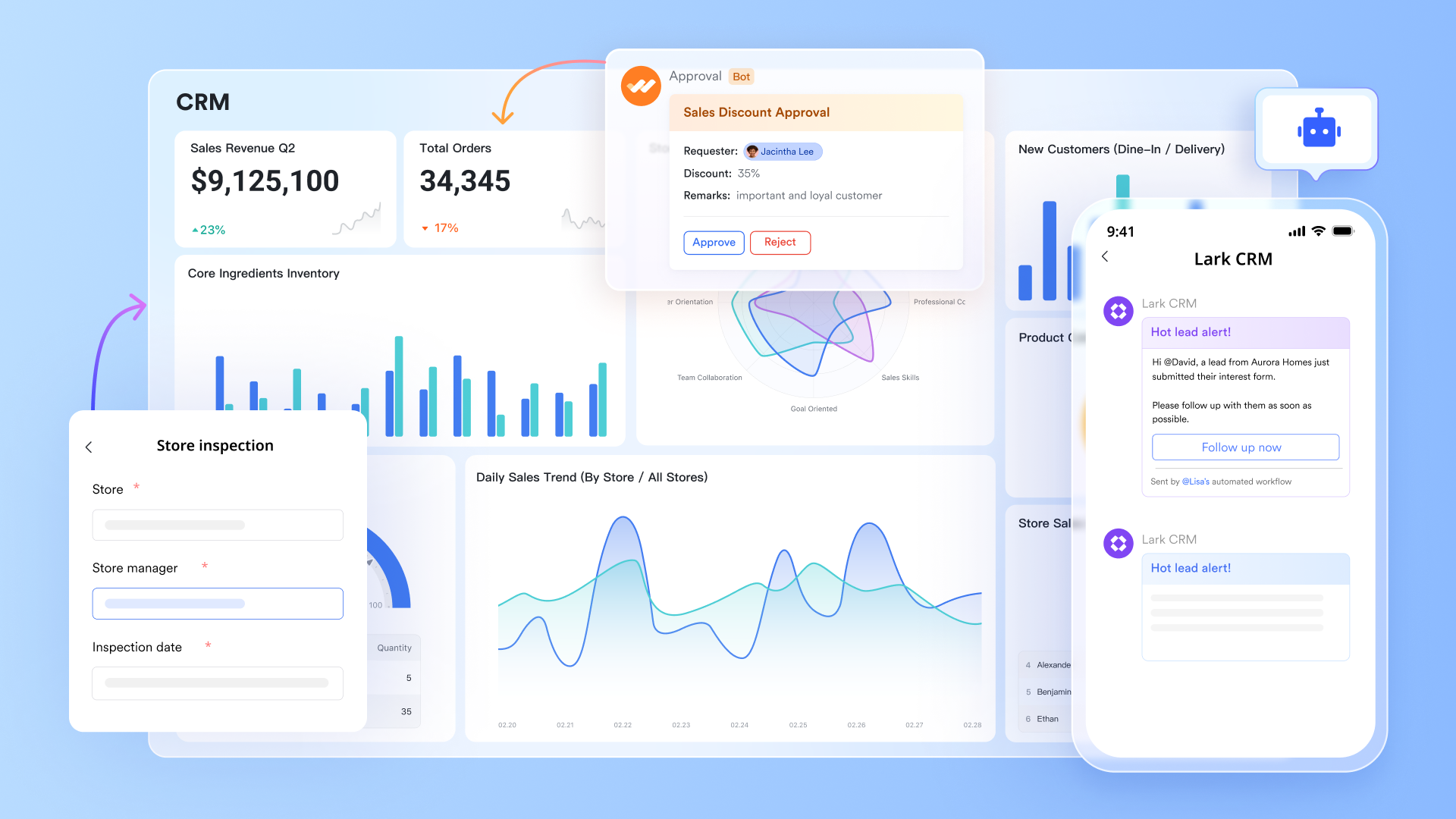
When a CDP flags high‑intent leads or churn‑risk customers, Lark Tasks and Calendar features can instantly schedule follow‑ups or create reminders for account owners. Built‑in workflow automation allows —such as new data entries in Base or form submissions—to generate tasks or send alerts, ensuring CRM opportunities are never delayed.
Lark Docs and Meetings: Contextualizing data-driven decisions
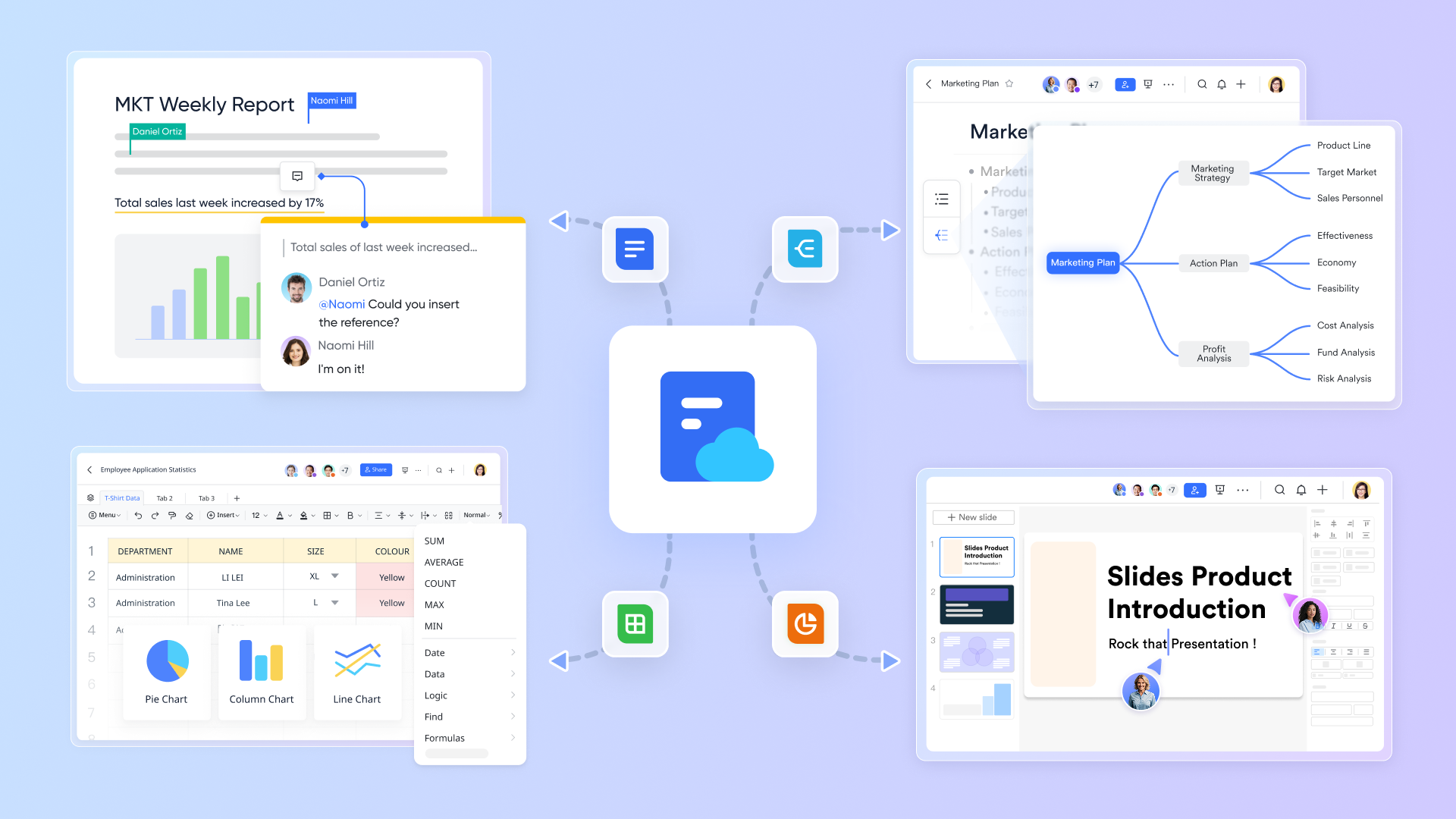
Teams can analyze customer performance reports or campaign outcomes in collaborative Lark Docs, embedding live Base views directly into documents for instant visibility. When deeper discussion is needed, Lark Meetings allows one‑click transitions from Docs or Messenger to real‑time video sessions—keeping data, context, and communication all in one place.
Lark Messenger: Driving seamless cross‑system collaboration
With Lark Messenger, notifications from CRM or CDP updates—including custom Base alerts—appear instantly in the team’s chat, enabling prompt responses without switching tools. For teams that formerly or simultaneously use other tools, Lark simplifies integration by offering multiple connectors and open APIs for seamless migration from tools like Slack and Google Workspace. Its automated data transfer and pre-built templates ensure a smooth, efficient transition without disrupting workflows.
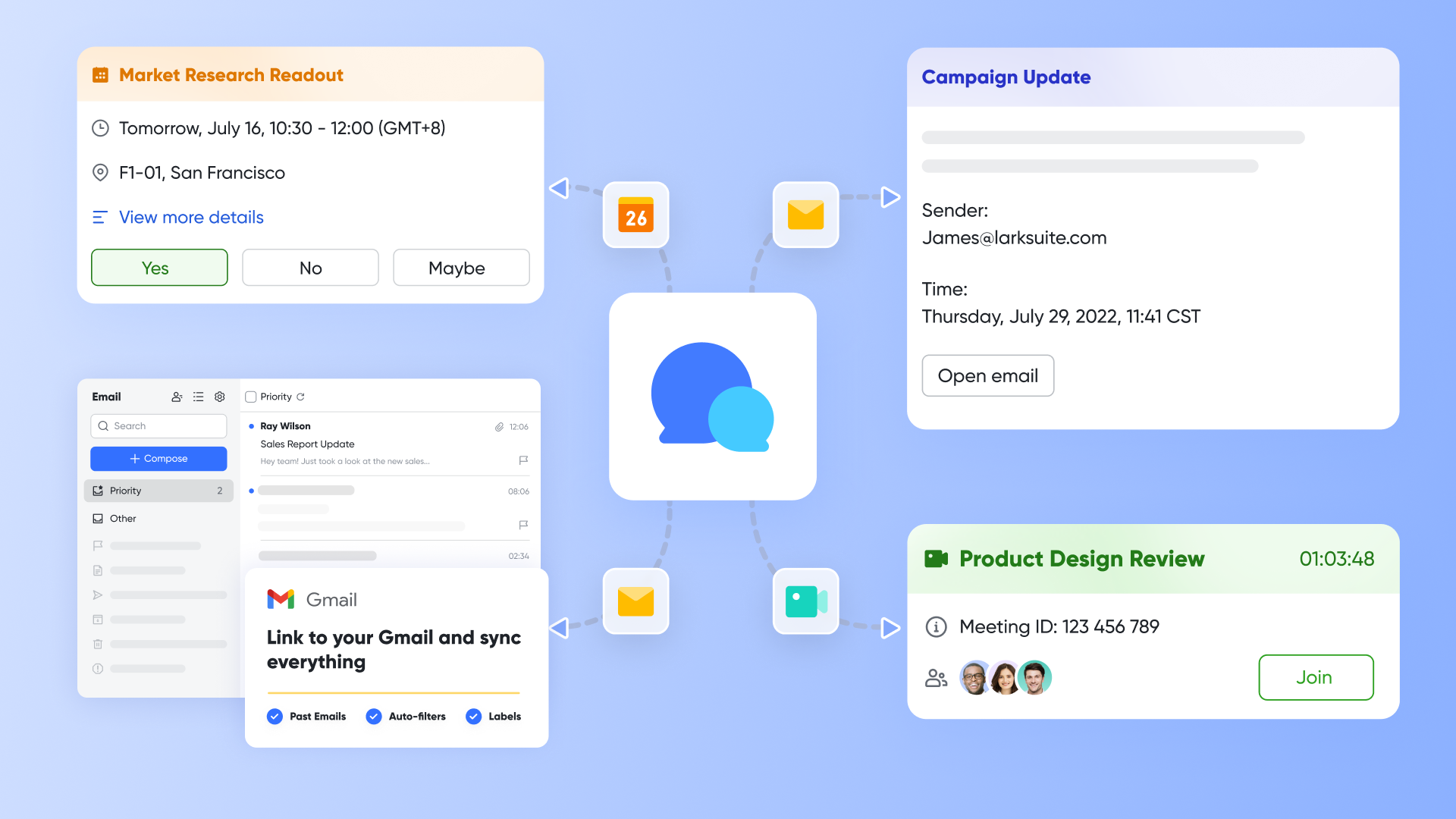
Together, these capabilities transform Lark from a communication suite into a collaboration‑driven data operations layer—bridging CRM, CDP, and team workflows so insights can translate into measurable outcomes faster and more efficiently.
- Starter plan: Free forever plan that includes 11 powerful tools for up to 20 users. It also comes with 100GB of storage, 1000 automation runs, AI translations, and more.
- Basic plan: $6/user/month (billed annually) for up to 500 users, including everything in Starter plus 1-on-1 video meetings, 5TB of storage, 1,000 automation runs, and more. To know more about Basic plan, contact our sales.
- Pro plan: $12/user/month (billed annually) for up to 500 users. It includes everything in Starter plus a group calling for up to 500 attendees, 15TB of storage, 50,000 automation runs, and more.
- Enterprise plan: Contact sales for custom pricing. Supports unlimited users and includes even more automation runs and advanced security, compliance, and management features. Before selecting a productivity suite, it's worth reviewing the latest Google Workspace pricing and ClickUp pricing plans.
Try Lark’s savings calculator: Switching to Lark’s Pro plan can lead to significant cost savings— for example, a 100-employee company using Slack, Google Workspace, and Airtable could save approximately $25,200 annually by consolidating their tools with Lark. Imagine achieving even greater efficiency by unifying your CDP and CRM within Lark’s all-in-one platform, enabling seamless data flow and deeper customer insights without the integration costs.
Real‑world use cases: CDP and CRM in sync
The synergy between a Customer Data Platform and a Customer Relationship Management system becomes most visible in real-world scenarios. When integrated well—and supported by a shared workspace—teams stop asking "which tool owns the customer" and focus instead on how customer understanding drives coordinated action.
- Marketing personalization: A marketing team uses data from its CDP to identify potential customers who have interacted with multiple digital channels but haven't converted. Those profiles are enriched in the CRM with previous conversation records, allowing sales reps to personalize outreach and improve engagement quality.
- Sales enablement: Within sales teams, CDP-driven lead scoring helps prioritize accounts in the CRM. Reps invest time in prospects with the highest probability to convert, guided by behavioral signals rather than guesswork. In addition, a ready-to-use sales tracker for lead analysis and follow ups can definitely save time for sales teams, boosting efficiency.
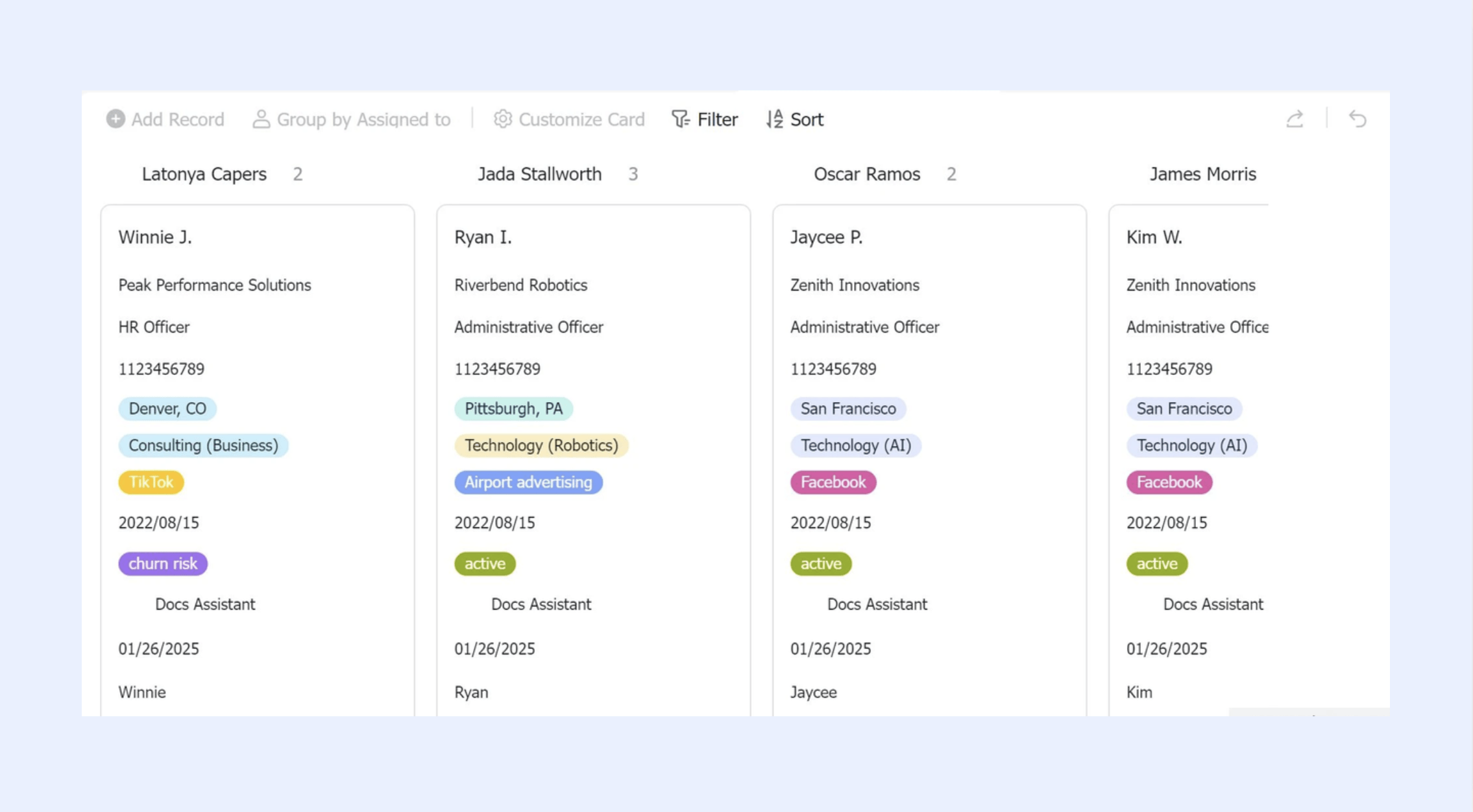
- Customer support and retention: When support teams access CDP behavioral data—such as churn risk signals—they can proactively contact customers and offer helpful solutions. Collaboration tools like Lark make it easy to share these signals in team chats or linked documents, reducing downtime between detection and response.
Together, these scenarios highlight that the future of CRM vs CDP isn't competition—it's coordination powered by intelligent, collaborative ecosystems.
Common misconceptions about CDPs and CRMs
Despite widespread discussion, CDPs and CRMs are still misunderstood. Clearing up these misconceptions can help teams focus on the real business value behind each system.
- "One platform can replace the other."
- A single tool rarely covers full data and relationship management needs. A CDP organizes data; a CRM organizes communication. Both are indispensable in their own lanes.
- "Only large enterprises need a CDP."
- Modern SMBs also benefit from unified data and first-party insights. The scale of implementation may differ, but the strategic advantage—personalized engagement—applies universally.
- "Integration is too complex."
- With open APIs, connectors, and cloud ecosystems like Lark, integration no longer requires heavy coding or expensive intermediaries. Today, data collaboration can be achieved fluidly within unified workspaces.
- "A CRM already provides a 360° view."
- While CRMs capture vital interaction history, they typically lack behavioral and cross‑channel visibility. CDPs expand this view, layering behavioral, transactional, and contextual data.
These misconceptions often stem from thinking in terms of "systems ownership" rather than "data flow." As technology evolves, businesses increasingly view CDP vs CRM as a complementary relationship—enhanced by collaboration platforms that tie insights to real‑time action.
Conclusion
Choosing between a CDP and a CRM isn't the real challenge; connecting them is. The two systems complement one another—one enlightens, the other engages. Companies that align insight with execution achieve more meaningful customer relationships and smarter growth.
Platforms like Lark make this alignment practical, providing a unified environment where data moves freely, teams collaborate intuitively, and insights become action. The future belongs to connected experiences—not just connected tools.
FAQs
What is the difference between a CRM and a CDP?
A CRM manages customer relationships—tracking interactions, leads, and pipelines—while a CDP collects and unifies customer data from multiple sources to create a single, comprehensive profile. CRMs execute engagement; CDPs drive data intelligence.
What does CDP mean in CRM?
In the context of CRM, a CDP (Customer Data Platform) refers to an integrated system that enhances CRM data by adding behavioral and engagement signals, allowing for deeper personalization and better targeting.
Is HubSpot a CDP or CRM?
HubSpot is primarily a CRM platform—focused on managing customer relationships, pipelines, and marketing automation. It includes CDP‑like features but is not a full CDP designed for large‑scale data unification.
Is Salesforce CRM a CDP?
No, Salesforce CRM is distinct from a CDP. Salesforce offers its own Customer Data Platform as a complementary product that integrates with CRM to unify and enrich customer data for more personalized engagement.
Can a company use both a CDP and a CRM together?
Yes, and most successful organizations do. A CDP gathers and unifies customer data across every channel, while a CRM uses that intelligence to manage direct interactions. When integrated, the two systems create a seamless flow—turning insights into real‑time action and improving both marketing and sales efficiency.
Is a CDP the same as a data warehouse or DMP?
No. A CDP is built specifically for managing first‑party customer data and enabling real‑time activation. A data warehouse stores historical data for analysis, and a DMP (Data Management Platform) typically focuses on anonymous third‑party advertising data. CDPs bridge both worlds by maintaining identifiable, consent‑based customer profiles used across marketing and engagement channels.
Related reading
Table of contents
Start using Lark today

Manage all your work in one place
Boost team efficiency by 10x
Save up to 70% on software costs
Table of contents
Start using Lark today
Manage all your work in one place
Boost team efficiency by 10x
Save up to 70% on software costs
Keep reading









2026 Lark Technologies Pte. Ltd.
Headquartered in Singapore with offices worldwide.






Explore: