














How to Choose a CRM: A 2026 Guide to Transforming Your Business

Cecilia Lane
Go-to-Market Associate
Sep 18, 2026
Cecilia Lane
Sep 18, 2026

16 min read


Are you ready to elevate your business and cultivate stronger customer connections? In today's dynamic landscape, simply providing quality products or services is not enough. Customer Relationship Management (CRM) systems have emerged as indispensable tools for businesses of all sizes, and selecting the right one can feel overwhelming. This guide on how to choose a CRM will arm you with the knowledge to navigate the complexities and pinpoint the perfect solution to thrive in 2025. We'll explore essential features, CRM types, and future trends to ensure you're equipped to make an informed decision that transforms the way you engage with your customers. Unlock the secrets to streamlined operations, enhanced relationships, and sustainable growth – starting today.
What is CRM?
Defining CRM
CRM, or Customer Relationship Management, is a strategy and a set of technologies focused on managing a company's interactions with current and potential customers. It’s the central hub for organizing, automating, and synchronizing sales, marketing, customer service, and technical support. More than just software, CRM represents a philosophy centered on placing the customer at the heart of all business activities. This customer-centric approach ensures that every interaction is meaningful, personalized, and contributes to long-term loyalty.
Core functionalities of a CRM
A CRM boasts a range of functionalities designed to streamline customer-related processes. Contact management enables you to store and organize detailed customer information. Lead management tracks potential customers from initial contact to conversion. Sales automation streamlines the sales process, while marketing automation helps create and execute targeted campaigns. Customer service features facilitate efficient support and issue resolution. Reporting provides insights into customer behavior and business performance. These features work in concert to enhance customer engagement and drive revenue growth.
Why is CRM essential in 2025?
In 2025, the demand for personalized customer experiences will only intensify. Customers expect businesses to understand their individual needs and preferences. A CRM provides the data and tools necessary to deliver tailored interactions that foster loyalty. Furthermore, data-driven decision-making is paramount for staying ahead of the competition. CRM's analytical capabilities enable businesses to gain valuable insights into customer behavior, market trends, and operational efficiency. Those who fail to embrace CRM risk falling behind in a world where customer-centricity and data intelligence reign supreme.

Types of CRMs: Finding the right fit for your business
Operational CRMs
Operational CRMs are designed to streamline and automate core business processes related to sales, marketing, and customer service. They excel at automating tasks such as lead scoring, email campaign management, and workflow automation. The goal is to enhance efficiency and reduce manual effort, freeing up teams to focus on strategic activities. By automating repetitive tasks, operational CRMs enable businesses to deliver consistent and timely customer interactions across all touchpoints, leading to increased customer satisfaction and revenue growth.
Analytical CRMs
Analytical CRMs focus on collecting, analyzing, and interpreting customer data to provide actionable insights. These systems offer robust reporting dashboards, data visualization tools, and customer segmentation capabilities. They help businesses understand customer behavior, identify trends, and make data-driven decisions. By leveraging the power of data analytics, businesses can optimize their marketing campaigns, improve sales strategies, and enhance customer service. This, in turn, enables them to gain a competitive edge and drive sustainable growth.
Collaborative CRMs
Collaborative CRMs prioritize communication and information sharing across different teams within an organization. They facilitate seamless collaboration between sales, marketing, and customer service departments, ensuring everyone has access to the same customer data. Key features include shared calendars, document management, and project management tools. By fostering collaboration, these systems help businesses deliver a unified and consistent customer experience across all channels, leading to increased customer loyalty and advocacy.
Specialized CRMs
Specialized CRMs are designed to cater to the unique needs of specific industries. For example, a real estate CRM might include features for managing property listings and tracking client viewings, while a healthcare CRM might focus on patient records and appointment scheduling. These industry-specific CRMs offer tailored functionalities that address the specific challenges and requirements of each sector. By providing specialized tools and workflows, they enable businesses to optimize their operations and deliver exceptional customer experiences within their respective industries.
CRM trends in 2026: Shaping the future of customer relationships
AI-powered CRM
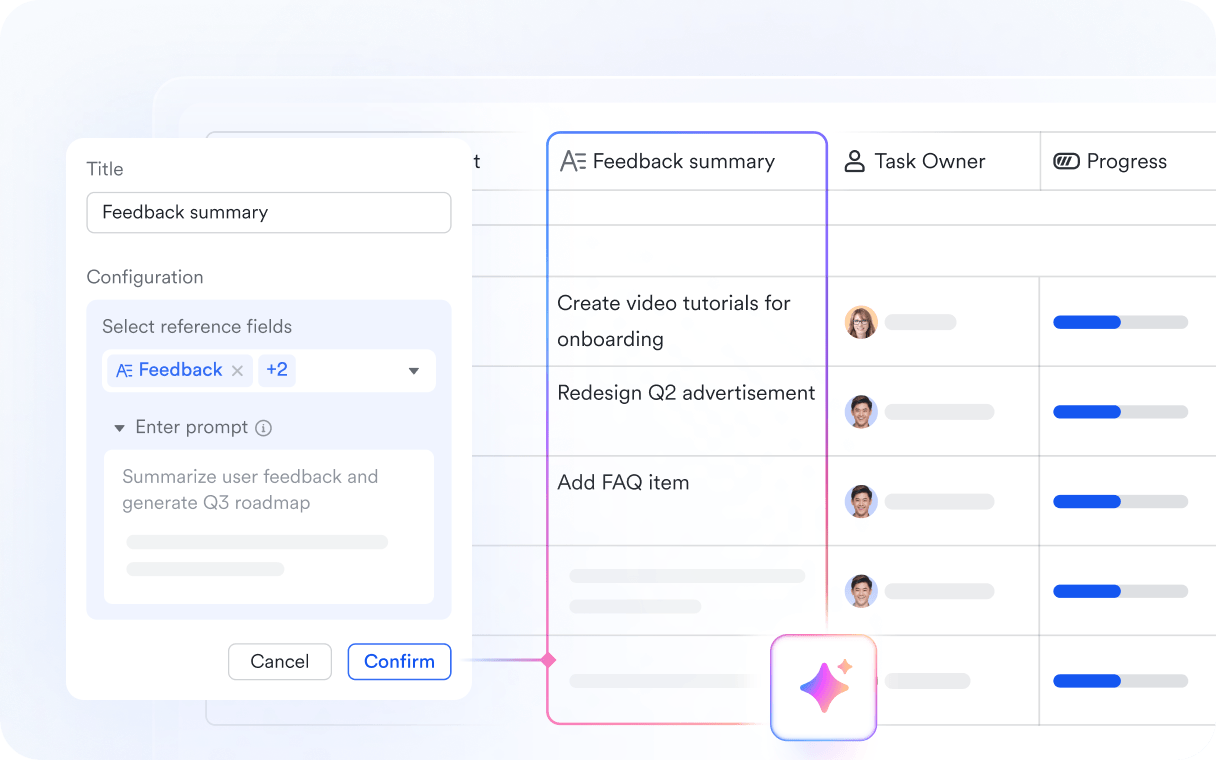
Artificial intelligence (AI) is rapidly transforming the CRM landscape, and in 2025, its influence will be even more profound. AI-powered CRMs automate tasks like lead scoring, identify patterns for predictive analytics, and provide personalized recommendations for sales and marketing teams. These capabilities enable businesses to make smarter decisions, improve customer engagement, and drive revenue growth. Many future-thinking solutions are incorporating AI to understand customer sentiment from communication and suggest next actions, greatly enhancing the efficiency of customer interactions.
Mobile CRM
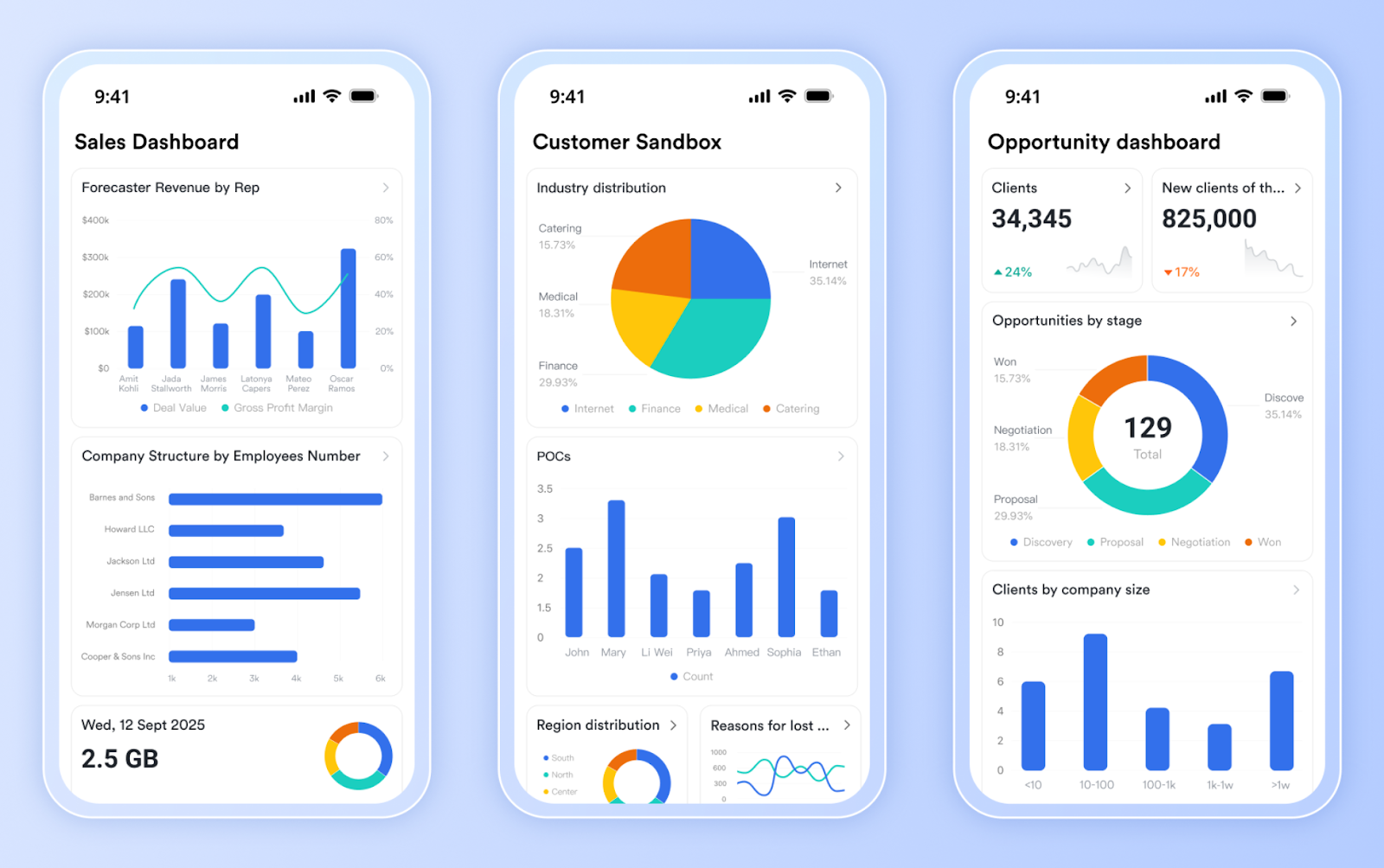
In an increasingly mobile-first world, access to CRM data and features on mobile devices is no longer a luxury but a necessity. Mobile CRMs empower sales and service teams to stay connected and productive, regardless of their location. They provide access to customer information, enable real-time updates, and facilitate seamless communication. As remote work becomes more prevalent, the ability to manage customer relationships on the go will be critical for success.
Social CRM
Social CRM involves integrating social media data into the CRM system to gain a more comprehensive understanding of customers. By monitoring social media conversations, businesses can identify customer preferences, track brand sentiment, and engage with customers on their preferred channels. This integration enables businesses to personalize their interactions and build stronger relationships. Solutions that provide unified communication across multiple channels, including social media, will be highly valued.
Hyper-personalization
Customers in 2025 expect highly personalized experiences tailored to their individual needs and preferences. Hyper-personalization involves using data to deliver targeted content, offers, and interactions across all touchpoints. CRMs are playing a crucial role in enabling this level of personalization by providing a centralized platform for collecting and analyzing customer data. Businesses that can leverage data to create relevant and engaging experiences will be well-positioned to thrive in the future.
Focus on customer experience (CX)
The customer experience (CX) will be a key differentiator in 2025, and CRMs are helping businesses prioritize CX initiatives. By providing a 360-degree view of the customer, CRMs enable businesses to understand customer needs, pain points, and preferences. This understanding allows them to deliver exceptional experiences that foster loyalty and advocacy. As businesses increasingly compete on CX, the ability to manage and optimize the customer journey will be paramount.
Factors to consider when choosing a CRM software: A checklist for success
Business needs and goals
The foundation of any successful CRM implementation is aligning your CRM selection with your specific business needs and goals. Before evaluating different software options, clearly define what you want to achieve with a CRM. Are you looking to increase sales, improve customer retention, enhance marketing efforts, or streamline customer service? Identifying your objectives will guide your selection process and ensure you choose a CRM that effectively addresses your most pressing needs.
Key features and functionalities
Once you have a clear understanding of your business needs, identify the must-have features and functionalities that are essential for achieving your goals. Consider features such as contact management, lead management, sales automation, marketing automation, customer service, and reporting. Prioritize the features that will have the greatest impact on your business and ensure that the CRM you choose offers the functionality you need to succeed.
Integration capabilities
A CRM does not operate in isolation. To maximize its effectiveness, it must integrate seamlessly with your existing tools and systems. Consider integrations with email marketing platforms, accounting software, e-commerce platforms, and other business applications. Ensure that the CRM you choose offers the integration capabilities you need to create a connected ecosystem and streamline data flow across your organization. This will eliminate data silos and improve overall efficiency.
Scalability and flexibility
Your business will evolve, and your CRM should be able to grow and adapt with you. Choose a CRM that offers scalability and flexibility to accommodate your changing needs. Consider factors such as the number of users, data storage capacity, and customization options. A scalable and flexible CRM will ensure that you can continue to leverage its benefits as your business expands and your requirements evolve.
Security and compliance
In today's digital landscape, data security and compliance are paramount. Prioritize data security and compliance with relevant regulations, such as GDPR and CCPA. Ensure that the CRM you choose offers robust security features, such as encryption, access controls, and audit trails. A secure and compliant CRM will protect your customer data and help you maintain trust and credibility.
How to achieve CRM scenario with Lark: A practical guide
360-degree customer view
The scenario: A 360-degree customer view provides a comprehensive understanding of each customer by aggregating data from various sources into a single, unified profile. This includes contact information, interaction history, purchase records, support tickets, and more. This complete view enables businesses to personalize interactions, anticipate needs, and deliver exceptional customer experiences.
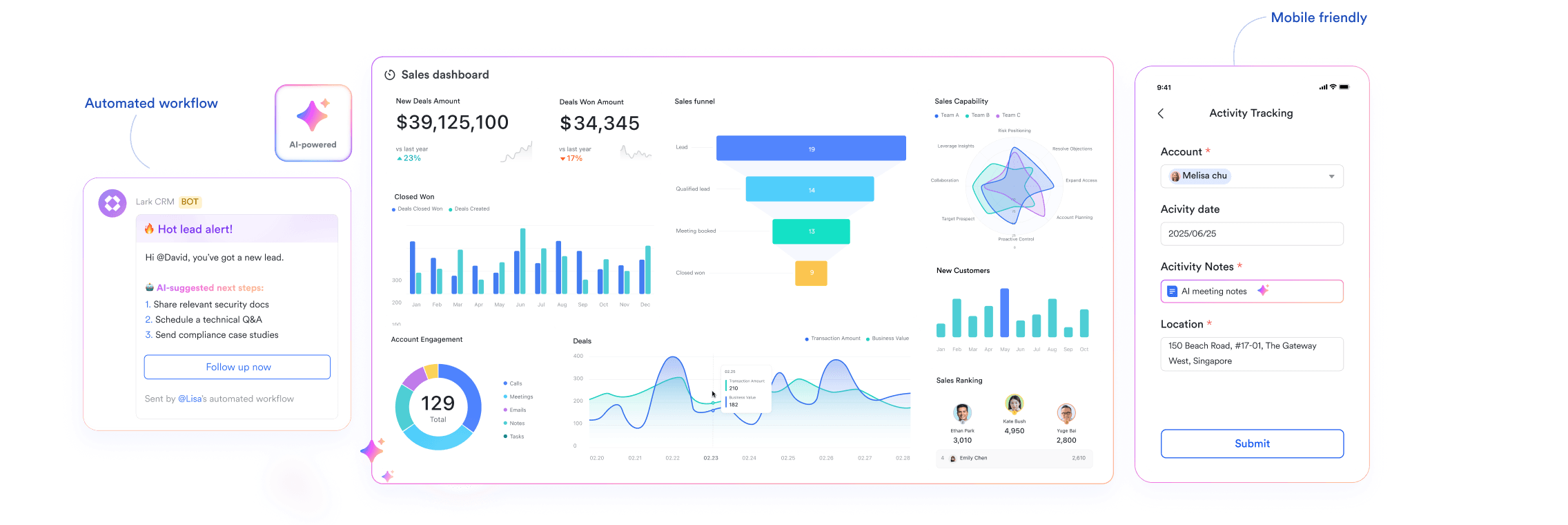
Lark's role: While not a traditional CRM, Lark facilitates creating a 360-degree view through its integrated platform.
- Use Lark Base to create a central repository for customer data. Customize fields to capture relevant information like contact details, company, purchase history, and support interactions.
- Link different data sources by establishing relations in Base. For example, link customer profiles to support tickets created within Lark Messenger or to project tasks related to onboarding.
- Utilize Lark Messenger to record all customer interactions, ensuring every communication is logged and accessible from the customer's profile.
Pipeline management
The scenario: Pipeline management involves tracking leads and opportunities as they progress through the sales process. This includes defining stages, assigning tasks, monitoring progress, and forecasting revenue. Effective pipeline management is essential for optimizing sales performance and closing more deals.
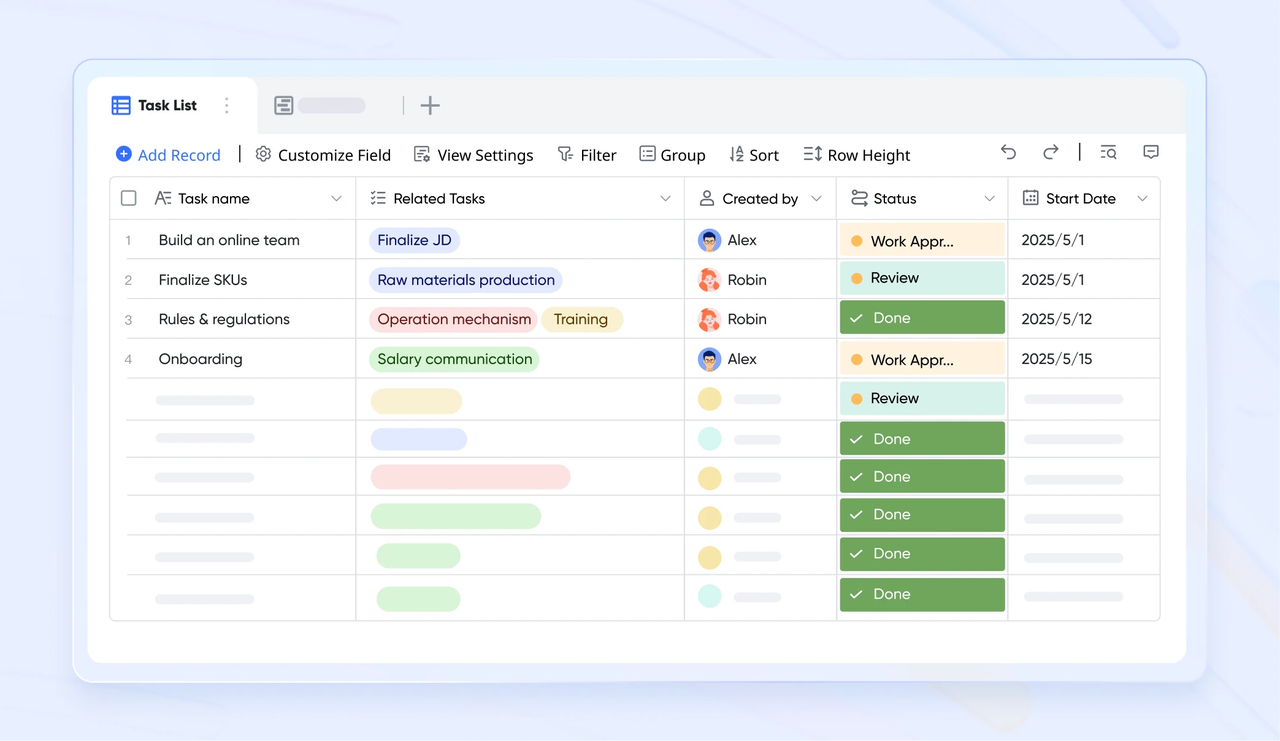
Lark's role: Lark provides tools for managing your sales pipeline visually and collaboratively.
- Use Lark Base to create a visual pipeline. Define stages such as "Lead," "Qualified," "Demo Scheduled," "Proposal Sent," and "Closed." Customize fields to track deal size, close date, and assigned salesperson.
- Utilize Lark's task management features to assign tasks to team members at each stage of the pipeline. Set deadlines, track progress, and ensure accountability.
- Unify Lark Calendar to schedule meetings and demos directly from the pipeline view, keeping everyone informed and on track.
Marketing automation
The scenario: Marketing automation involves using software to automate repetitive marketing tasks, such as email campaigns, social media posting, and lead nurturing. This frees up marketing teams to focus on strategic activities and improve campaign effectiveness.
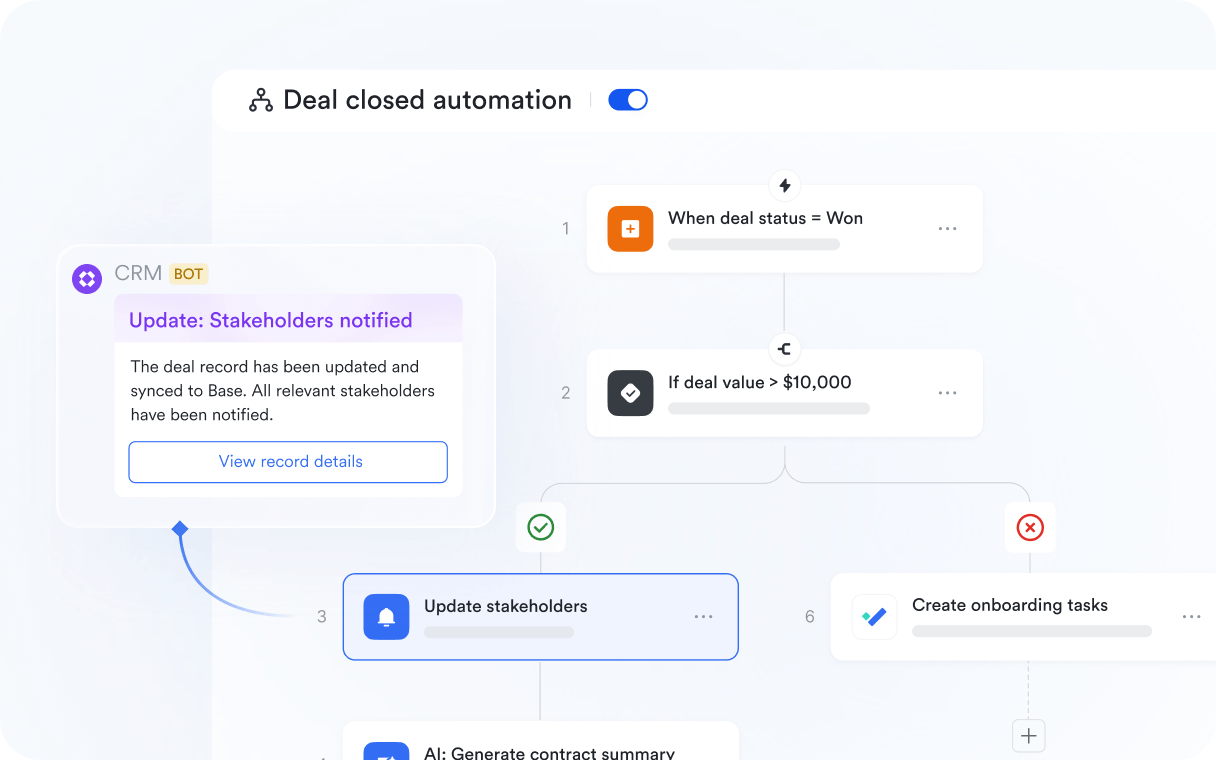
Lark's role: While Lark is not a dedicated marketing automation platform, it offers features to streamline marketing efforts.
- Use Lark Messenger to create targeted email campaigns. Segment contacts based on demographics, interests, or behavior, and send personalized messages.
- Utilize Lark Base to track campaign performance. Capture data on email opens, click-through rates, and conversions. Use this data to optimize your campaigns and improve results.
- Integrate Lark with third-party marketing automation tools using webhooks or APIs. This allows you to trigger actions in Lark based on events in your marketing automation platform, such as creating a task when a new lead is generated.
Customer service management
The scenario: Customer service management involves providing timely and effective support to customers. This includes resolving issues, answering questions, and providing assistance with products or services. Excellent customer service is essential for building loyalty and advocacy.
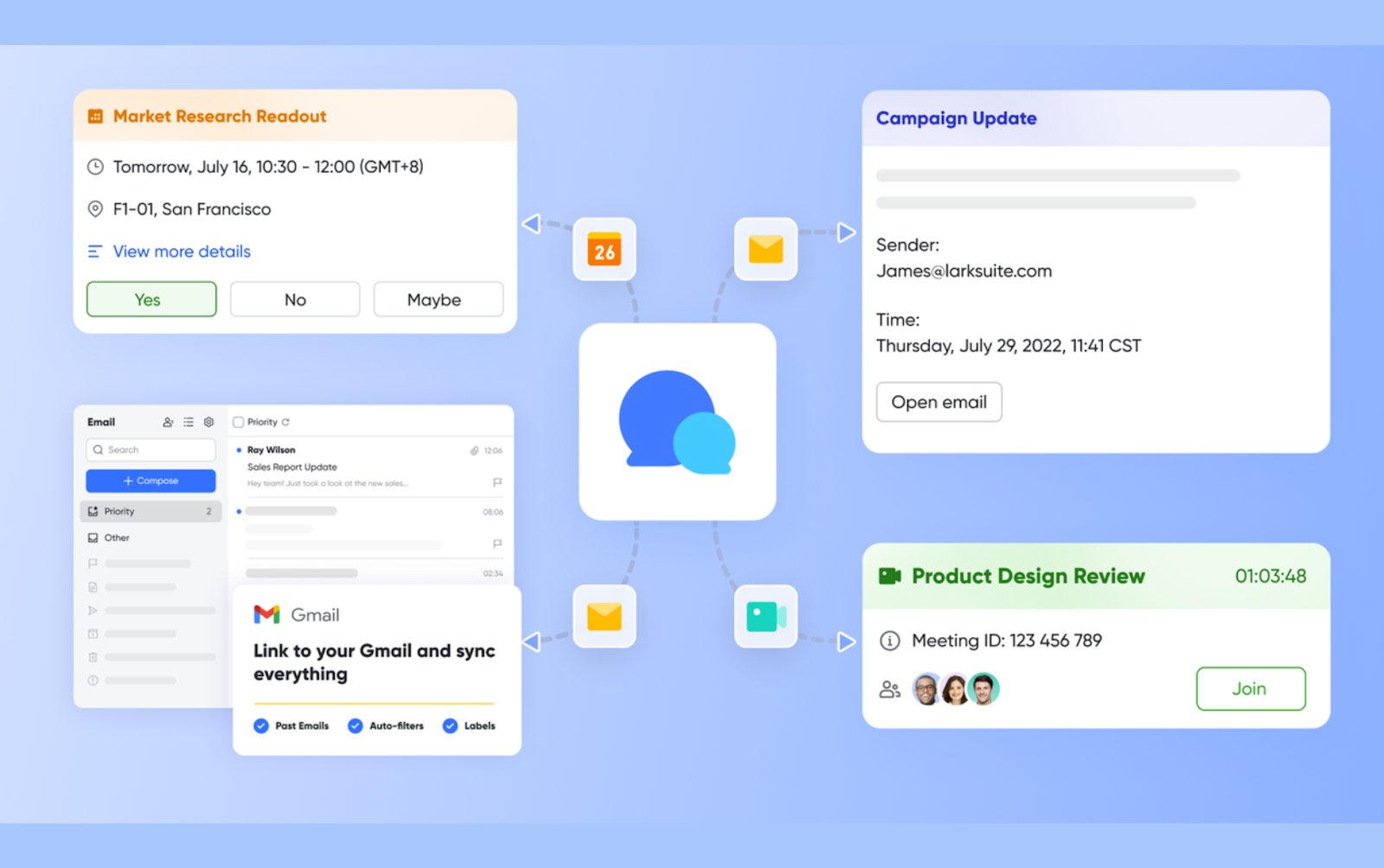
Lark's role: Lark’s communication and collaboration features can significantly enhance customer service.
- Use Lark Messenger as a central hub for customer support inquiries. Create dedicated channels for different types of support requests.
- Utilize Lark Bots to automate responses to common questions and provide self-service support.
- Use Lark wiki to create a repository of frequently asked questions, troubleshooting guides, and product documentation. This empowers customers to find answers independently and reduces the burden on support staff.
Reporting and analytics
The scenario: Reporting and analytics provide insights into business performance and customer behavior. This includes tracking key metrics, identifying trends, and measuring the effectiveness of different initiatives. Data-driven decision-making is essential for optimizing performance and achieving business goals.
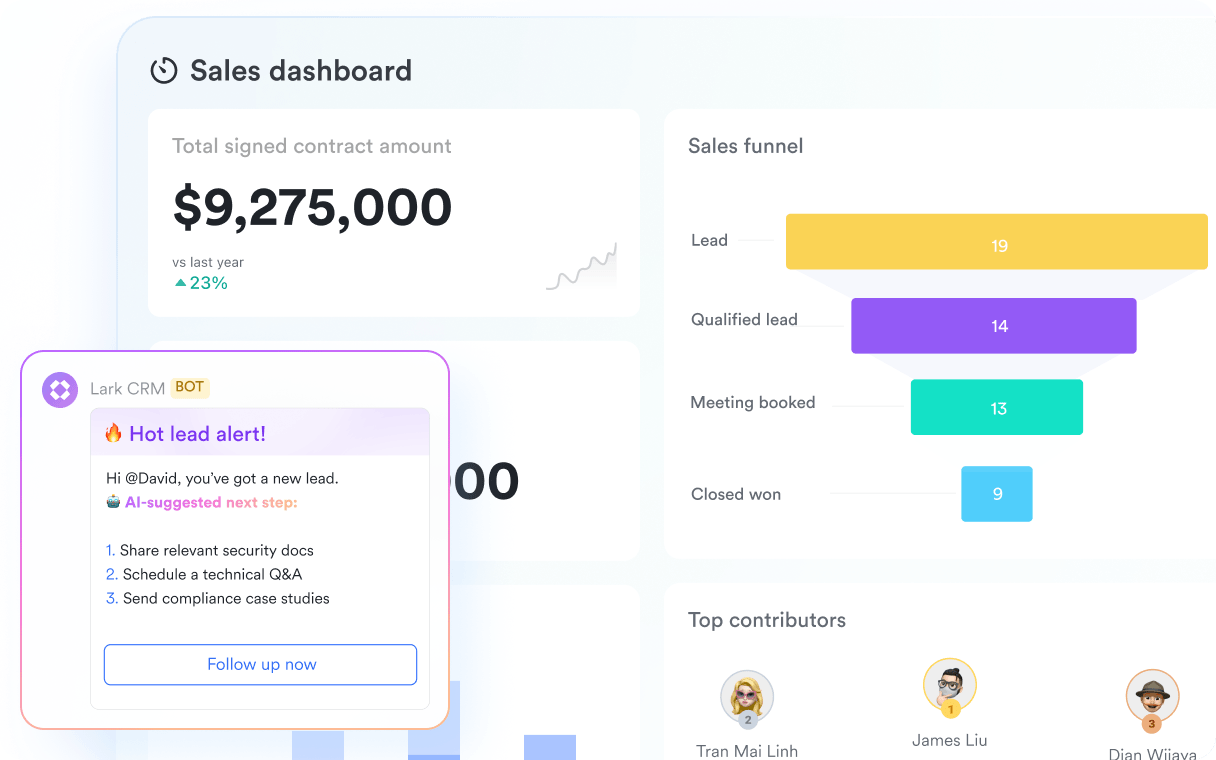
Lark's role: Lark provides data and tools for creating custom reports and dashboards.
- Use Lark Base to track key metrics related to sales, marketing, and customer service. Create custom views and charts to visualize your data.
- Utilize Lark's integration capabilities to connect with data analytics platforms. This allows you to export data from Lark and analyze it using advanced analytics tools.
- Share reports and dashboards with your team using a messaging platform. This promotes transparency and ensures everyone has access to the insights they need to make informed decisions.
Collaboration and communication
The scenario: Effective collaboration and communication are essential for providing seamless customer experiences. This involves enabling different teams to share information, coordinate activities, and work together to resolve customer issues.
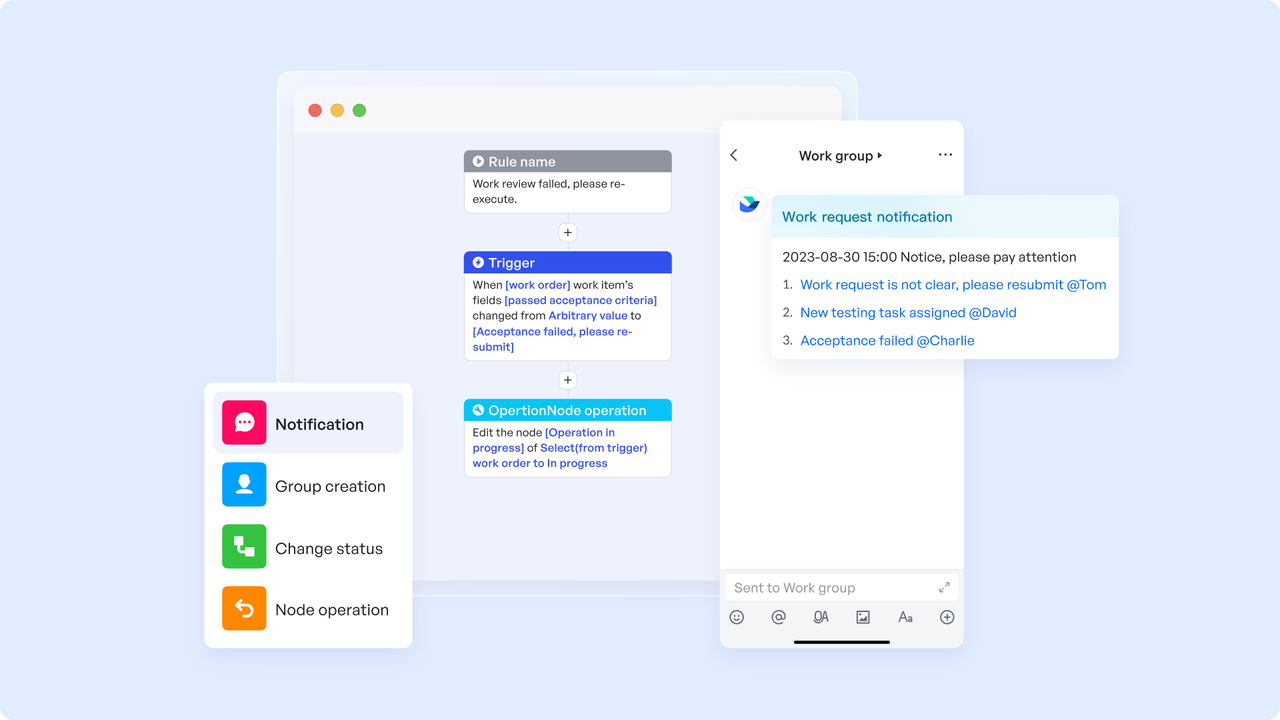
Lark's role: Lark excels at fostering collaboration and communication across teams.
- Use Lark Messenger to create dedicated channels for different projects, teams, or customer accounts. This provides a central hub for communication and ensures everyone stays informed.
- Utilize Lark Meetings to conduct virtual meetings with customers or internal teams. This facilitates face-to-face communication and strengthens relationships.
- Use Lark's document sharing features to easily share files and documents with colleagues and customers. This streamlines collaboration and ensures everyone has access to the latest information.
- Starter plan: Free forever plan that includes 11 powerful tools for up to 20 users. It also comes with 100GB of storage, 1000 automation runs, AI translations, and more.
- Pro plan: $12/user/month (billed annually) for up to 500 users. It includes everything in Starter plus group calling for up to 500 attendees, 15TB of storage, 50,000 automation runs, and more.
- Enterprise plan: Contact sales for custom pricing. Supports unlimited users and includes even more automation runs and advanced security, compliance, and management features.
Conclusion
Choosing the right CRM is a pivotal decision that can significantly impact your business's success in 2025 and beyond. By carefully considering your business needs, evaluating different CRM types, and staying abreast of the latest trends, you can select a solution that empowers your team to build stronger customer relationships, streamline operations, and drive revenue growth. Remember to prioritize user-friendliness, scalability, and integration capabilities to ensure long-term success.
As you embark on your CRM journey, consider exploring versatile platforms like Lark, which offer a range of features to support your CRM-related goals, from centralized communication to task management and data analysis. Start today and unlock the potential of customer-centricity.
FAQs
How to select the right crm?
Identify your business needs, evaluate different CRM types, consider integration, scalability, user-friendliness, and pricing. Explore versatile platforms like Lark for a comprehensive solution.
What are the 4 types of crm?
Operational CRMs automate sales, marketing, and service. Analytical CRMs analyze customer data. Collaborative CRMs enhance team communication. Specialized CRMs cater to specific industries.
What are the 4 c's of crm?
The 4 C's of CRM are Customer, Communication, Collaboration, and Customization. Lark supports all 4 C's through its integrated communication, collaboration, and customization features.
Related reading
Table of contents
Start using Lark today

Manage all your work in one place
Boost team efficiency by 10x
Save up to 70% on software costs
Table of contents
Start using Lark today
Manage all your work in one place
Boost team efficiency by 10x
Save up to 70% on software costs
Keep reading









2026 Lark Technologies Pte. Ltd.
Headquartered in Singapore with offices worldwide.






Explore: