














All-in-One CRM: The Ultimate Business Growth Solution

Cecilia Lane
Go-to-Market Associate
Sep 18, 2026
Cecilia Lane
Sep 18, 2026

20 min read


Are you tired of constantly switching between dozens of different tools just to manage your customer relationships and content? If you're like most modern business leaders, you've probably experienced the frustration of data silos, inconsistent customer experience, and the hidden costs of maintaining multiple disconnected systems. The traditional approach of using separate CRM and CMS platforms creates unnecessary complexity that slows down your team and limits your growth potential.
This is where the concept of all-in-one CRM platforms changes everything. These integrated solutions combine customer relationship management, content creation, and team collaboration into a single, seamless environment. In my experience working with businesses transitioning to unified platforms, I've seen how eliminating tool fragmentation can dramatically improve operational efficiency and customer satisfaction. Platforms like Lark represent this new generation of business tools that understand modern workflow needs, offering a cohesive approach that keeps your team focused on what matters most—building meaningful customer relationships.

What is an all-in-one CRM, and why do you need one?
In the rapidly changing business field, customer relationship management is no longer a tool exclusive to large enterprises. With technological advancements, all-in-one CRM is becoming the preferred solution for businesses of all sizes.
An all-in-one CRM is a unified platform designed to handle multiple business functions that would otherwise require several separate applications. It's not just a database of customer information; it's a central hub that seamlessly integrates communication, collaboration, project management, sales processes, and marketing.
Unlike traditional CRM systems, an all-in-one CRM breaks down information silos between departments, creating a single source of truth throughout the organization. This means that every team, from sales and marketing to customer service and project management, has access to the same customer data and can collaborate within a unified environment.
Reason 1: Avoid the hidden costs of separate systems
Using multiple independent systems may seem flexible, but it actually comes with significant hidden costs:
- Accumulated subscription fees: Managing multiple subscriptions is less cost-effective than handling one integrated subscription.
- Productivity loss: Teams spend more time switching between different tabs and applications rather than truly collaborating.
- Integration challenges: Getting different systems to communicate with each other often requires additional development and maintenance costs.
For small businesses, these hidden costs can be particularly burdensome. Choosing the best all-in-one CRM for small businesses, such as highly-regarded options in the market like Lark, HubSpot, or Salesforce, can help you avoid these hidden costs and achieve a higher return on investment. For instance, some businesses have reported reducing their annual CRM-related expenses after switching to an integrated solution.
Reason 2: Reduced operational complexity
Business operations are complex enough—your software shouldn't add to that complexity. All-in-one CRM simplifies operations by:
- Providing a unified interface: All functions are housed within one intuitive interface, reducing the learning curve and training requirements.
- Automating workflows: It automates repetitive tasks like lead tracking, follow-ups, and status updates.
- Centralizing data management: It eliminates the need for manual data synchronization between different systems, reducing errors and inconsistencies.
For example, when comparing agile CRM vs Hatchbuck, you'll find that both attempt to reduce complexity by integrating marketing and sales functions. However, true all-in-one CRM solutions like Lark go a step further by deeply integrating CRM with project management and communication tools. This operational simplification is particularly valuable for small businesses, which often lack dedicated IT teams to manage multiple complex systems.
Reason 3: Get 360-degree customer view
Perhaps the most powerful advantage of an all-in-one CRM is its ability to provide a unified customer perspective:
- Complete customer journey: Track each customer's complete interaction history from initial contact to post-sales support.
- Personalized service: Service representatives can quickly view a customer's past interaction records, enabling truly personalized service.
- Data-driven decisions: Gain deep insights into customer behavior and preferences through integrated reporting and analytics functions.
When the CRM system is combined with project management capabilities, such as in all-in-one CRM and project management solutions, this 360-degree view becomes even more comprehensive. Platforms like Lark allow teams to directly link customer deals to project timelines and team schedules, ensuring everyone is working with accurate, real-time data.
For specific industries like real estate, all-in-one real estate CRM solutions offer specialized functions tailored to industry needs, such as property listing management, buyer/seller workflows, and transaction coordination.
Why Lark is the best all-in-one CRM option?
Unified workspace ecosystems: Beyond basic integration
Modern all-in-one CRM platforms eliminate application switching by creating cohesive digital environments where sales, marketing, and support teams collaborate seamlessly. The most effective solutions combine all-in-one CRM and project management in a single workspace, ensuring customer context remains immediately accessible across all business functions without complex integrations. Lark's unified approach keeps teams aligned and projects moving forward without losing sight of customer relationships.
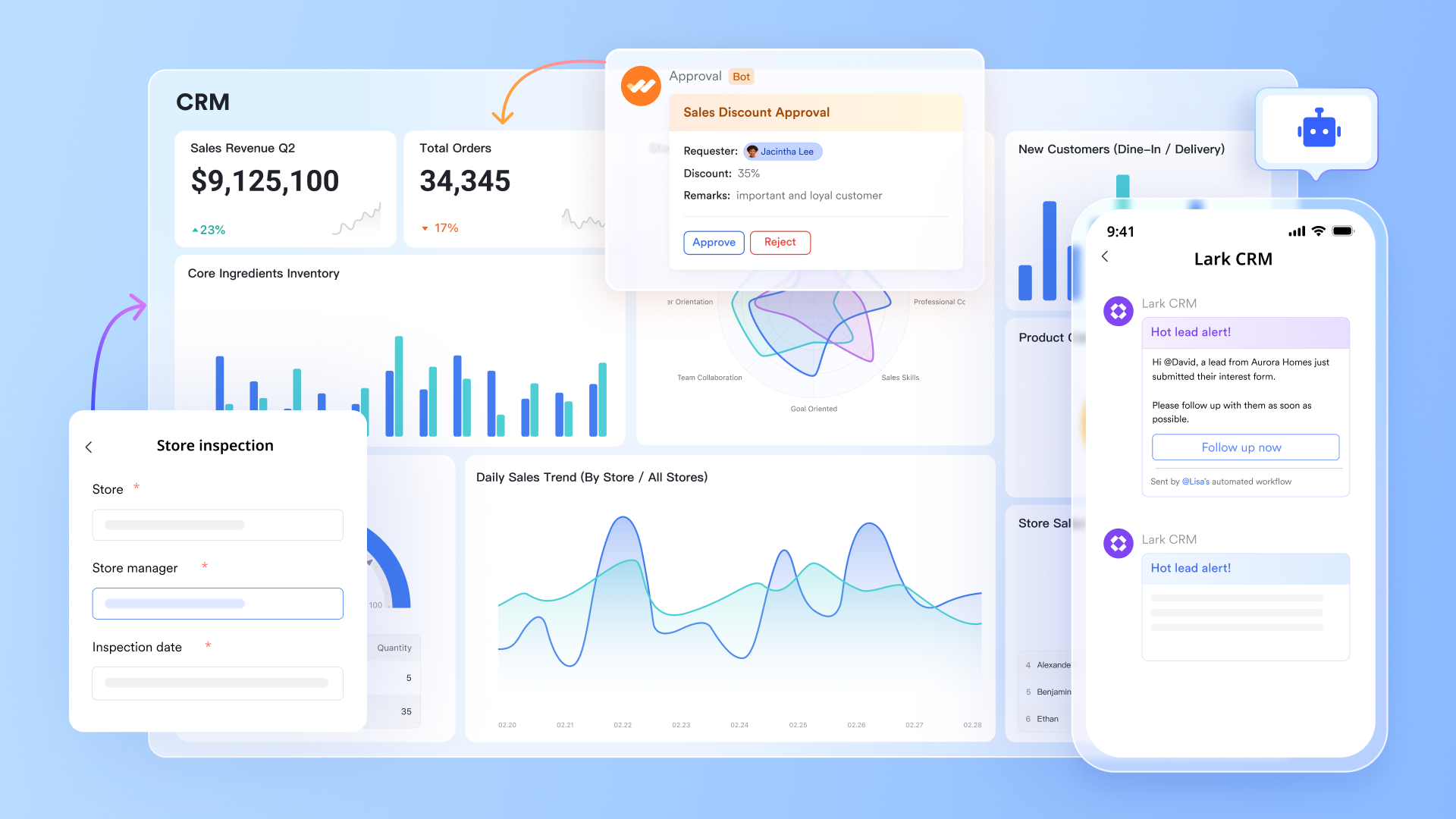
- Lark's solution: Lark delivers a truly unified workspace through its integrated ecosystem of Base, Docs, Sheets, and Messenger. Lark Base serves as the central customer database while connected applications enable seamless collaboration. Sales teams access deal information directly within , marketing creates content in Lark Docs with real-time customer insights, and support teams resolve issues without switching contexts—all within a single, consistent interface.
Real-time collaborative customer intelligence
Immediate data synchronization transforms how businesses respond to customer needs, with information flowing freely between departments without manual intervention. This real-time visibility enables timely follow-ups and personalized interactions that disconnected systems cannot support.
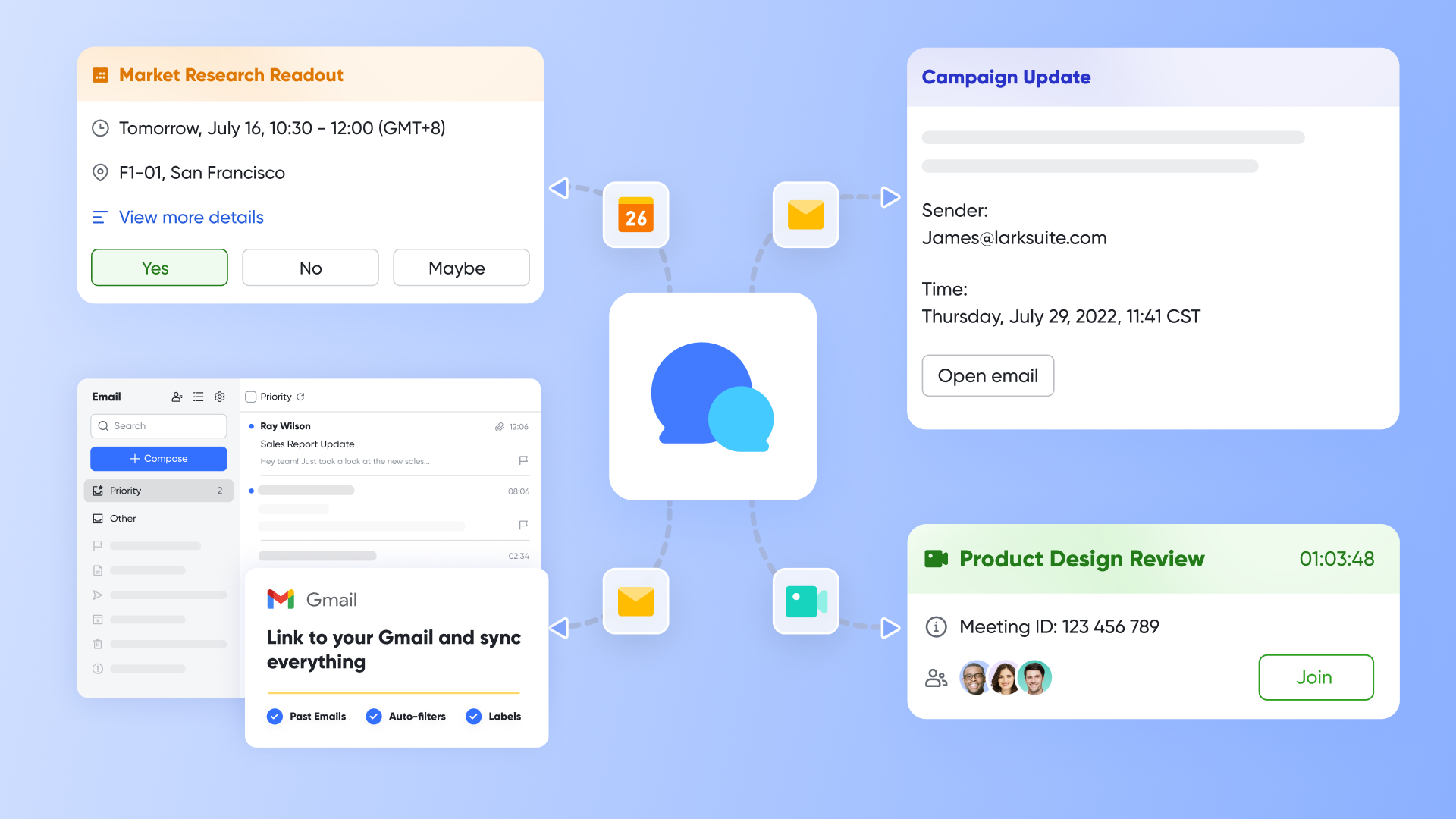
- Lark's solution: Lark's multi-dimensional architecture ensures all customer interactions—whether in Lark Messenger, email, or document collaborations—update instantly across the entire platform. When a customer engages with marketing content in Lark Docs, the sales team sees this activity immediately in their deal timelines. Support resolutions automatically update account records, ensuring every team member operates with the most current customer intelligence.
AI-powered content-customer alignment
Advanced AI capabilities analyze both customer behavior and content performance to create self-optimizing feedback loops that continuously improve marketing effectiveness. These systems automate personalization at scale, delivering relevant experiences based on individual customer preferences.
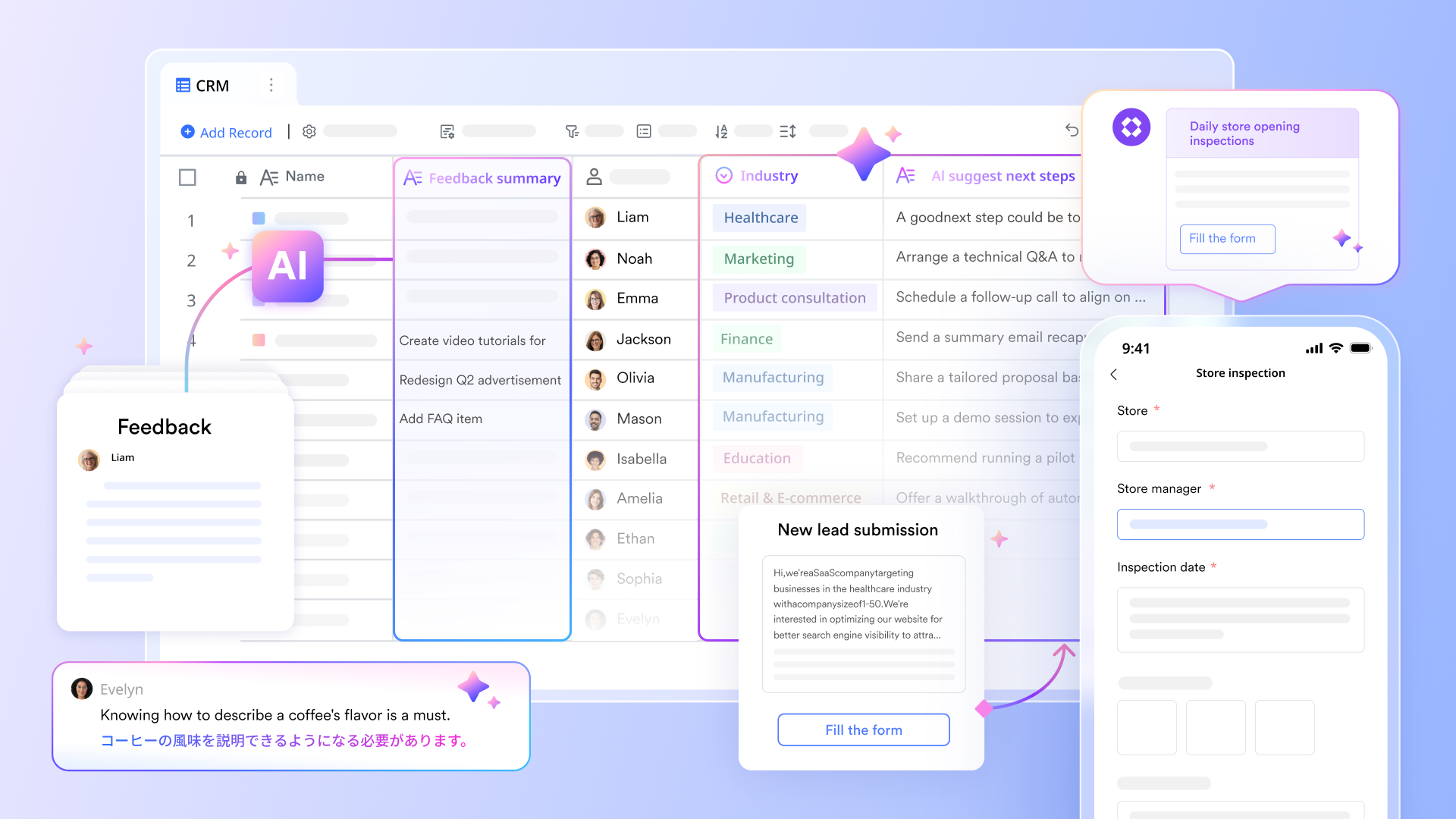
- Lark's solution: Lark's AI features analyze customer interactions across the platform to provide intelligent content recommendations and automation suggestions. The system identifies which content formats resonate with specific customer segments and automatically suggests relevant document templates or communication strategies. This AI-driven approach ensures marketing efforts align with actual customer behavior patterns, creating more effective engagement strategies without manual analysis. For example, Lark's ready-to-use AI-powered customer review analysis template helps teams not only save time on analysis, but also gain better insights for future follow-ups.
All-in-one CRM pricing plans are easy to choose:
Lark’s pricing structure is designed to simplify operations and eliminate the need for stacking multiple separated tools. Each plan provides access to a comprehensive suite of features—from collaboration and communication to workflow automation and AI capabilities—so teams don’t have to juggle extra subscriptions or waste time comparing complex add-ons. With every tier covering multiple essential business functions, Lark ensures that organizations of any size can scale efficiently without worrying about fragmented systems or confusing pricing models.
- Starter plan: Free forever plan that includes 11 powerful tools for up to 20 users. It also comes with 100GB of storage, 1000 automation runs, AI translations, and more.
- Basic plan: $6/user/month (billed annually)for up to 500 users, including everything in Starter plus 1-on-1 video meetings, 5TB of storage, 1,000 automation runs, and more. To know more about Basic plan, contact our sales.
- Pro plan: $12/user/month (billed annually) for up to 500 users. It includes everything in Starter plus a group calling for up to 500 attendees, 15TB of storage, 50,000 automation runs, and more.
- Enterprise plan: Contact sales for custom pricing. Supports unlimited users and includes even more automation runs and advanced security, compliance, and management features.
Try Lark’s savings calculator: Switching to Lark's Pro plan can lead to significant cost savings— for example, a 100-employee company using Slack, Google Workspace, and Airtable could save approximately $25,200 annually by consolidating their tools with Lark.
Critical features to look for in all-in-one CRM solutions
Mobile-first customer journey management
In today's increasingly mobile workforce, any serious all-in-one CRM for small business or enterprise solution must provide exceptional mobile experiences. This goes beyond simple mobile apps to encompass full functionality that enables teams to work effectively from anywhere. Field sales representatives need access to customer information, inventory data, and ordering capabilities while visiting client sites. Marketing managers should be able to review campaign performance and approve content from their mobile devices. This mobility ensures that business continuity doesn't suffer when team members are away from their desks.
The mobile experience must also consider customer interactions happening across multiple devices. A comprehensive all-in-one real estate CRM, for example, should track customer engagements whether they happen through mobile apps, web browsers, or in-person meetings. The system should maintain context across these touchpoints, understanding that a customer might research properties on their phone during the day but switch to a desktop computer for serious consideration in the evening. This device-agnostic approach ensures that customer journeys are tracked completely regardless of how or where interactions occur.
Advanced security and compliance integration
As businesses consolidate more customer data into single platforms, security becomes increasingly critical. The best CRM esp. all-in-one solutions build security into their architecture rather than treating it as an afterthought. This includes robust access controls that ensure team members only see information relevant to their roles, comprehensive audit trails that track every interaction with customer data, and encryption both in transit and at rest. These measures protect sensitive customer information while maintaining accessibility that makes integrated platforms valuable.
Compliance requirements add another layer of complexity that integrated platforms must address. Regulations like GDPR, CCPA, and industry-specific standards require businesses to manage customer data in specific ways. A true all-in-one CRM and project management solution should include built-in compliance features that help businesses meet these requirements without custom development. This might include automated data retention policies, consent management tools, and the ability to completely erase customer data upon request. These features become particularly valuable for businesses operating in multiple jurisdictions with different regulatory environments.
Scalability from startup to enterprise
The ideal all-in-one CRM software should grow with your business rather than requiring painful migrations as you expand. This scalability applies to several dimensions: the number of users supported, the volume of customer data managed, the complexity of automated workflows, and the geographic distribution of your team. Startups need solutions that are easy to implement and affordable to operate, while enterprises require robust functionality, extensive customization options, and enterprise-grade reliability. The best platforms serve both needs through flexible pricing and feature tiers.
Customization capabilities become increasingly important as businesses grow and their processes become more complex. While comparing options like agile CRM vs hatchbuck, businesses should consider not just current needs but future requirements as well. The ability to create custom fields, build unique workflows, and integrate with specialized industry tools ensures that the platform remains valuable as the business evolves. This flexibility prevents the need for costly workarounds or secondary systems that recreate the very integration challenges that all-in-one solutions are supposed to solve.
Implementing your all-in-one CRM strategy
Assessing your current tool landscape
Before transitioning to any best all-in-one CRM solution, businesses must conduct a thorough assessment of their existing technology stack. This audit should map every tool currently in use, identify all data flows between systems, and document the specific pain points that necessitate change. Many organizations discover they're using far more applications than they realized, with significant functional overlap between them. This assessment provides the baseline against which all-in-one CRM implementation success can be measured and helps justify the investment in a unified platform.
Migration best practices for seamless transition
The evaluation process should also identify data quality issues that might complicate migration. Inconsistent formatting, duplicate records, and incomplete information often accumulate when teams use multiple systems with different data standards. Addressing these issues before migration ensures that the new CRM all-in-one software platform starts with clean, reliable data. This cleanup process, while sometimes tedious, delivers substantial long-term benefits by improving reporting accuracy, automation reliability, and overall system performance.
A successful transition to all-in-one CRM software requires careful planning and execution to minimize business disruption. Begin with a phased approach that migrates data into logical groupings rather than attempting a complete cutover all at once. Many organizations find success starting with customer contact information, then progressively moving sales pipelines, all-in-one CRM and marketing automation rules, and finally historical interaction data. This methodical approach allows teams to validate data accuracy at each stage and address any issues before they affect larger datasets.
Industry-specific consideration
For specialized industries like real estate, implementing an all-in-one real estate CRM requires additional consideration for property-specific workflows and transaction management features. Similarly, solutions combining all-in-one CRM and project management need careful mapping of task dependencies and milestone tracking. The best CRM esp. all-in-one platforms provide industry-specific templates and migration tools to streamline this process.
Measuring success and ROI
Establishing clear success metrics before implementation ensures that your best all-in-one CRM investment delivers measurable business value. Beyond basic usage statistics, focus on outcome-oriented measurements that connect platform usage to business results. Track improvements in sales cycle length, customer satisfaction scores, marketing conversion rates, and support resolution times. These metrics demonstrate how the unified platform directly contributes to organizational objectives rather than simply tracking feature adoption.
The return on investment for all-in-one CRM extends beyond direct financial calculations to include qualitative benefits that impact long-term business health. Improved customer experiences lead to higher retention rates and increased lifetime value. Enhanced team collaboration reduces internal friction and accelerates decision-making. Better data visibility enables more accurate forecasting and strategic planning. While some benefits immediately appear on balance sheets, others accumulate gradually as the organization becomes more efficient and customer-centric.
Conclusion
The journey toward unified customer management represents more than just a technology upgrade—it's a strategic transformation that aligns your entire organization around customer success. All-in-one CRM platforms eliminate the friction and inefficiency of disconnected systems, creating seamless workflows that enhance both employee productivity and customer experience. The benefits extend beyond operational improvements to include better data-driven decisions, stronger customer relationships, and sustainable competitive advantages.
Solutions like Lark demonstrate how modern architectural approaches can create truly integrated environments where customer data flows naturally between teams and systems. The future of business technology lies in these cohesive platforms that understand work happens through collaboration, not isolation, and that the best customer experiences emerge from unified, not fragmented, approaches.
FAQs
Is all-in-one CRM suitable for small businesses?
Absolutely. Modern all-in-one CRM for small business solutions are specifically designed with scalability and affordability in mind. They offer flexible pricing tiers that allow small businesses to access enterprise-grade functionality without enterprise-level costs. The integrated approach actually benefits small teams more by eliminating the complexity of managing multiple separate systems.
How does security compare to specialized tools?
Integrated all-in-one CRM platforms typically offer superior security because they maintain consistent data governance across all functions. Enterprise-grade encryption, regular security updates, and comprehensive access controls are built into architecture rather than managed through separate security products. This unified approach reduces vulnerability points and simplifies compliance management.
What about existing integrations with other tools?
The best CRM , especially all-in-one solutions, provide extensive API capabilities and pre-built connectors for popular business applications. The platform's integration framework typically supports both cloud-based and on-premise systems, ensuring that businesses can maintain critical existing workflows while consolidating their core customer management functions.
Can we customize the platform for our industry needs?
Yes, industry-specific customization is a key strength of modern all-in-one real estate CRM and other vertical solutions. Custom fields, specialized workflows, and industry-specific automation templates allow businesses to adapt the platform to their unique processes without sacrificing the benefits of a unified system.
How long does implementation typically take?
Implementation timelines vary based on business complexity, but most CRM all-in-one deployments range from 4-12 weeks. Factors affecting duration include data migration complexity, customization requirements, and team training needs. Phased approaches often deliver value faster by prioritizing critical functions.
What customization options are available for different industries?
Lark provides extensive customization through customizable fields, industry-specific templates, and flexible workflow automation. Businesses can adapt the platform to unique industry requirements while maintaining all the benefits of a unified CRM system, ensuring both specialization and integration coexist effectively.
Related reading
Table of contents
Start using Lark today

Manage all your work in one place
Boost team efficiency by 10x
Save up to 70% on software costs
Table of contents
Start using Lark today
Manage all your work in one place
Boost team efficiency by 10x
Save up to 70% on software costs
Keep reading









2026 Lark Technologies Pte. Ltd.
Headquartered in Singapore with offices worldwide.






Explore: