














CRM Model: Types, Frameworks & How They Improve Customer Management

Ryan Tanner
Product Marketing Specialist
Sep 18, 2026
Ryan Tanner
Sep 18, 2026

20 min read


A strong CRM model helps businesses understand customers, build relationships, and create predictable processes that scale. Every company uses some form of CRM business model, even if they do not realize it. The right framework provides structure for segmentation, engagement, personalization, and long term value growth. In the early stages of this guide, we will refer gradually to tools that support CRM workflows without focusing on any one platform. Later in the article, you will see how a unified workspace like Lark can support these frameworks in practical ways.

What is a CRM model?
A CRM model is a structured framework that defines how a business attracts, manages, serves, and retains its customers. It provides clear guidance on how teams should collect information, segment audiences, personalize communication, and deliver consistent experiences across the entire customer lifecycle. By following a defined model of CRM, companies ensure that marketing, sales, support, and operations work toward the same goals using shared processes and data standards. This creates more predictable workflows, reduces confusion among teams, and improves collaboration.
A strong CRM model also helps businesses understand customer needs more accurately, allowing them to design targeted interactions that build trust and increase long term value. With a standardized approach in place, organizations can make better decisions, enhance customer satisfaction, and scale their operations more effectively through repeatable and data driven practices.
Why CRM models matter
CRM models are essential because they bring alignment and structure to how customer relationships are handled across the organization. Without a clear CRM strategy based on B2C model or B2B logic, each department may work in isolation, causing inconsistent communication and fragmented data. A structured CRM business model ensures clarity around customer stages, responsibilities, and performance indicators. Below are the core reasons why CRM models matter, with each point introduced in the same line as requested:
- Align marketing, sales, and service teams: A CRM model ensures all customer facing teams follow the same priorities, definitions, and workflows. This reduces confusion, improves collaboration, and creates a unified view of all customer interactions. By connecting segmentation and targeting efforts, companies can deliver consistent experiences across the customer journey.
- Improve customer segmentation and personalization: CRM frameworks help businesses categorize customers based on behaviors, demographics, or value levels. This enables tailored messages that fit customer needs and purchase intent. Segmentation becomes easier when teams follow a standardized CRM data model that organizes information across systems.
- Build stronger long-term relationships: A CRM model clarifies how businesses should nurture leads, engage customers, and drive loyalty. When relationship building follows repeatable steps, companies can improve trust and increase lifetime value. This also reduces churn by ensuring customers receive timely support and relevant follow-ups.
- Support data-driven decisions: With consistent data collection and analysis, CRM models empower leaders to evaluate performance accurately. Teams can use these insights to improve processes, forecast revenue, and refine customer strategies. This makes decisions more objective and reduces guesswork.
- Enable scalable customer processes: CRM models simplify how tasks, approvals, and workflows operate across teams. As the company grows, these processes remain stable and predictable. This helps businesses handle higher customer volumes without losing efficiency or quality.
- Improve lifetime value and retention: Structured CRM frameworks ensure that every interaction contributes to long-term customer satisfaction. By improving onboarding, service quality, and loyalty efforts, companies can maintain strong relationships and reduce the cost of re-acquisition.
5 Major CRM models
Each CRM model offers a different perspective on how organizations should manage customer relationships. Companies choose models based on business size, segmentation needs, customer type, and data requirements. Below are 5 models of CRM in the industry, each explained in depth with intros and structured detail.
IDIC Model (Peppers & Rogers Model)
The idic model of CRM is one of the most recognized CRM frameworks for building personalized customer relationships. It focuses on four steps that guide how companies identify, differentiate, interact, and customize their approach to each customer. This model is highly effective for personalization-based strategies and works particularly well in B2C CRM model environments. The idic model helps businesses organize customer information and create personalized engagement strategies. It emphasizes consistent data usage, segmentation accuracy, and tailored experiences. This makes it ideal for companies that prioritize individual-level understanding and long-term loyalty.
- Identify: This step focuses on gathering all relevant customer information across touchpoints. Businesses need to know who their customers are, how they behave, and how they engage with the brand. Accurate identification ensures that teams work with complete and reliable profiles supported by strong CRM data models.
- Differentiate: Customers differ in value, needs, and expectations. Differentiation helps companies categorize customers based on profitability, behavior patterns, or preferences. This enables efficient resource allocation and a more precise CRM strategy based on B2C model or B2B requirements.
- Interact: Meaningful interactions strengthen relationships and help businesses learn more about customers. The idic model requires interactions to be consistent across marketing, sales, and service. High quality interactions reduce churn and increase customer satisfaction through improved communication.
- Customize: In this stage, companies tailor products, messages, or services based on what they learned about each customer. Customization builds loyalty and drives repeat business. This step is especially useful for organizations applying targeted B2C CRM model techniques.
Gartner CRM Model (CRM Ecosystem Model)
The Gartner CRM model focuses on the entire CRM ecosystem, including people, processes, technology, and customer value. It highlights the need for cross-functional collaboration and the integration of multiple business functions. This model is suitable for companies with complex customer journeys or multiple service channels. The Gartner CRM ecosystem model looks beyond basic data management and considers how every department contributes to customer success. It aligns strategy, culture, and process design across the organization. This model is ideal for companies seeking enterprise-level structure.
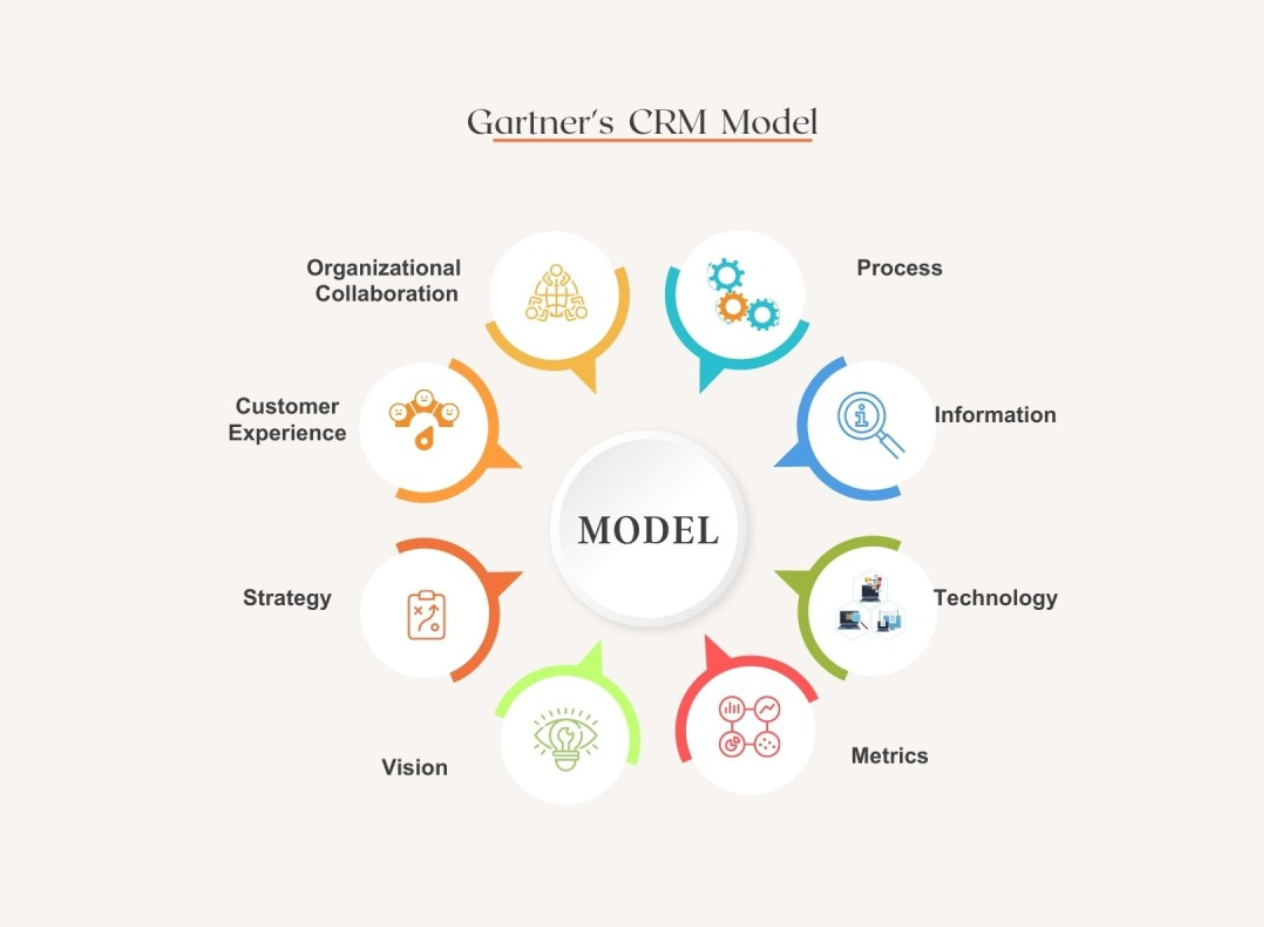
Image source: linkedin.com
- Customer value creation: The gartner model begins with understanding how the company can provide maximum value at every touchpoint. This ensures that product teams, marketing, and support work toward the same goals. When customer value is clear, CRM processes become more predictable.
- Integrated customer processes: CRM requires synchronized workflows across marketing, sales, operations, and support departments. This helps teams deliver a consistent experience throughout the customer lifecycle. Companies that use a robust CRM data model find integration easier.
- Enterprise-wide collaboration: This model emphasizes communication and coordination across the entire business. Collaboration ensures that insights and responsibilities do not remain siloed. It also allows leaders to align operational decisions with customer expectations.
- Technology and data support: Strong technology infrastructure is required to support the gartner CRM model. This includes tools for analytics, automation, and service management. With accurate data, teams can forecast needs and manage high volumes effectively.
Payne and Frow Five-Process Model
The Payne and Frow Five-Process Model is a framework for understanding Customer Relationship Management (CRM) processes. Developed by Adrian Payne and Pennie Frow, it emphasizes that successful CRM is not just about technology, but about coordinated business processes that drive customer value. The model identifies five key processes that organizations need to manage to build strong, long-term customer relationships.
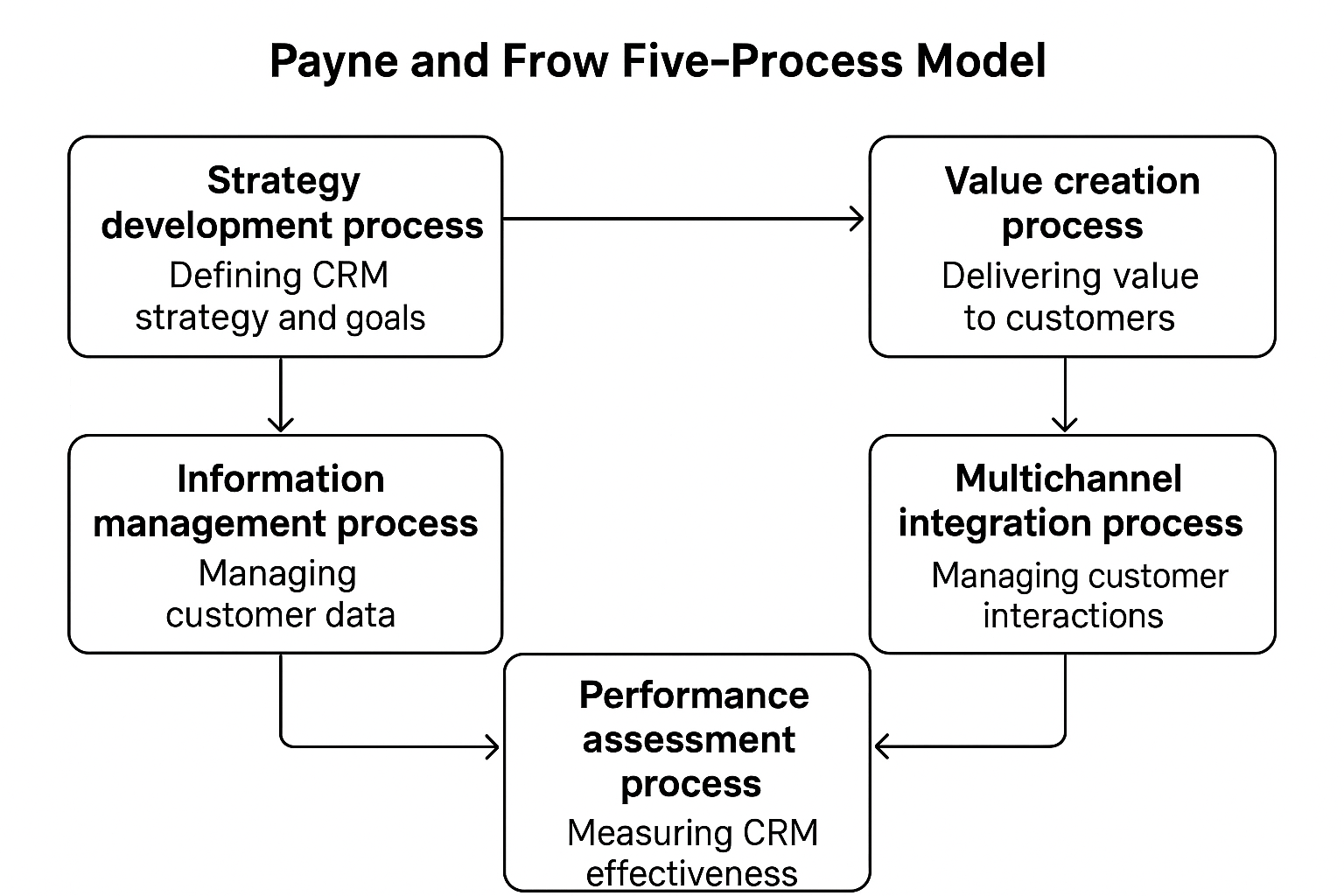
Image source: unsplash.com
- Strategy development process: The Strategy Development Process defines the overall CRM strategy and sets clear goals for managing customer relationships. It ensures that customer management aligns with broader business objectives, guiding how the organization interacts with its market. A key focus is identifying target customer segments and developing tailored value propositions for each, so that CRM efforts are purposeful and strategic.
- Value creation process: The Value Creation Process determines how the organization delivers meaningful value to its customers. This includes designing products, services, and experiences that address customer needs and expectations. By focusing on delivering the right value, organizations can strengthen customer satisfaction, loyalty, and long-term engagement.
- Multichannel integration process: The Multichannel Integration Process manages customer interactions across all communication channels, including online, offline, social media, and call centers. It ensures that messaging is consistent and the customer experience is seamless across touchpoints. Additionally, it supports channel optimization to improve engagement and operational efficiency.
- Information management process: The Information Management Process involves collecting, storing, and analyzing customer data to inform decision-making. This data supports customer segmentation, personalization, and the creation of targeted strategies. By leveraging insights from data, organizations can anticipate customer needs, enhance service, and foster stronger relationships.
- Performance assessment process: The Performance Assessment Process measures the effectiveness of CRM initiatives and tracks key metrics such as customer satisfaction, loyalty, retention, and profitability. It provides critical feedback to refine CRM strategies and processes, ensuring continuous improvement in managing customer relationships.
QCI Model (Quality Competitive Index Model)
The QCI model of CRM focuses on improving customer experience through process improvements, performance measurement, and cross-functional coordination. It places strong emphasis on operational excellence and measurable outcomes. The QCI model helps organizations build CRM strategies that rely on evidence and continuous improvement. It combines customer management processes with performance monitoring. This makes it ideal for customer-centric companies that focus on quality.
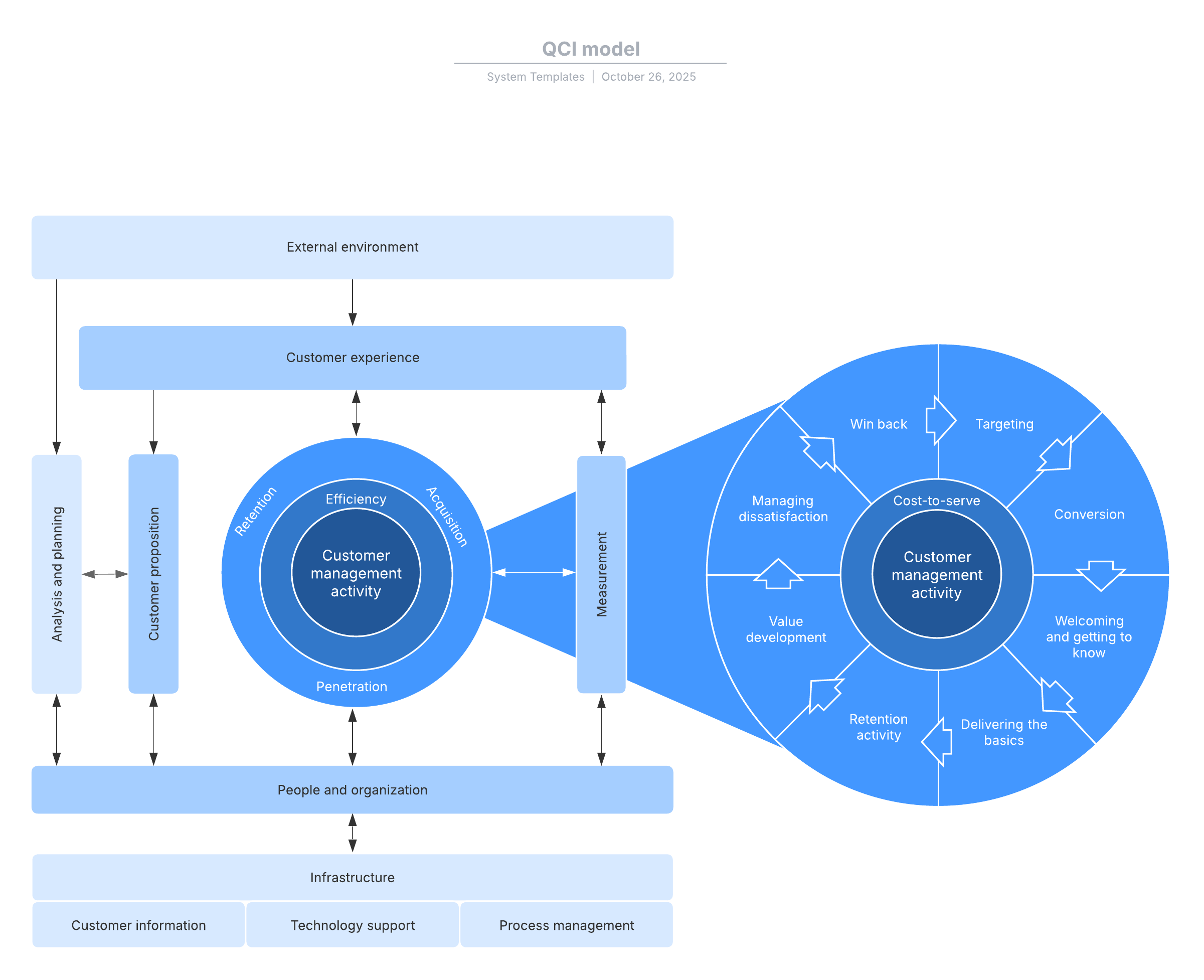
Image source: lucid.co
- Customer acquisition and retention: The QCI model emphasizes acquiring the right customers and retaining them through structured engagement plans. This supports long-term revenue growth and reduces churn. Retention improves when CRM models are followed consistently.
- Service experience management: Every customer interaction contributes to satisfaction and loyalty. This step ensures that service teams deliver consistent and high-quality experiences. Companies can refine their service strategies using performance insights.
- Data analysis and feedback: Continuous improvement requires accurate reporting and customer feedback. This step highlights the importance of measuring performance across departments. Strong analysis enables targeted improvements.
- Organizational alignment: The QCI model ensures that internal teams understand the customer's mission. Alignment helps avoid fragmented workflows and ensures that customer-facing teams follow the same strategic direction.
The CRM Value Chain Model
A CRM data model defines how customer information is structured, stored, and connected across systems. This model forms the foundation of any CRM strategy and ensures that teams have access to consistent information. The model helps businesses organize customer data using objects, relationships, and fields. It ensures that information flows smoothly across systems and departments. This makes it easier for teams to analyze customer journeys and personalize communication.
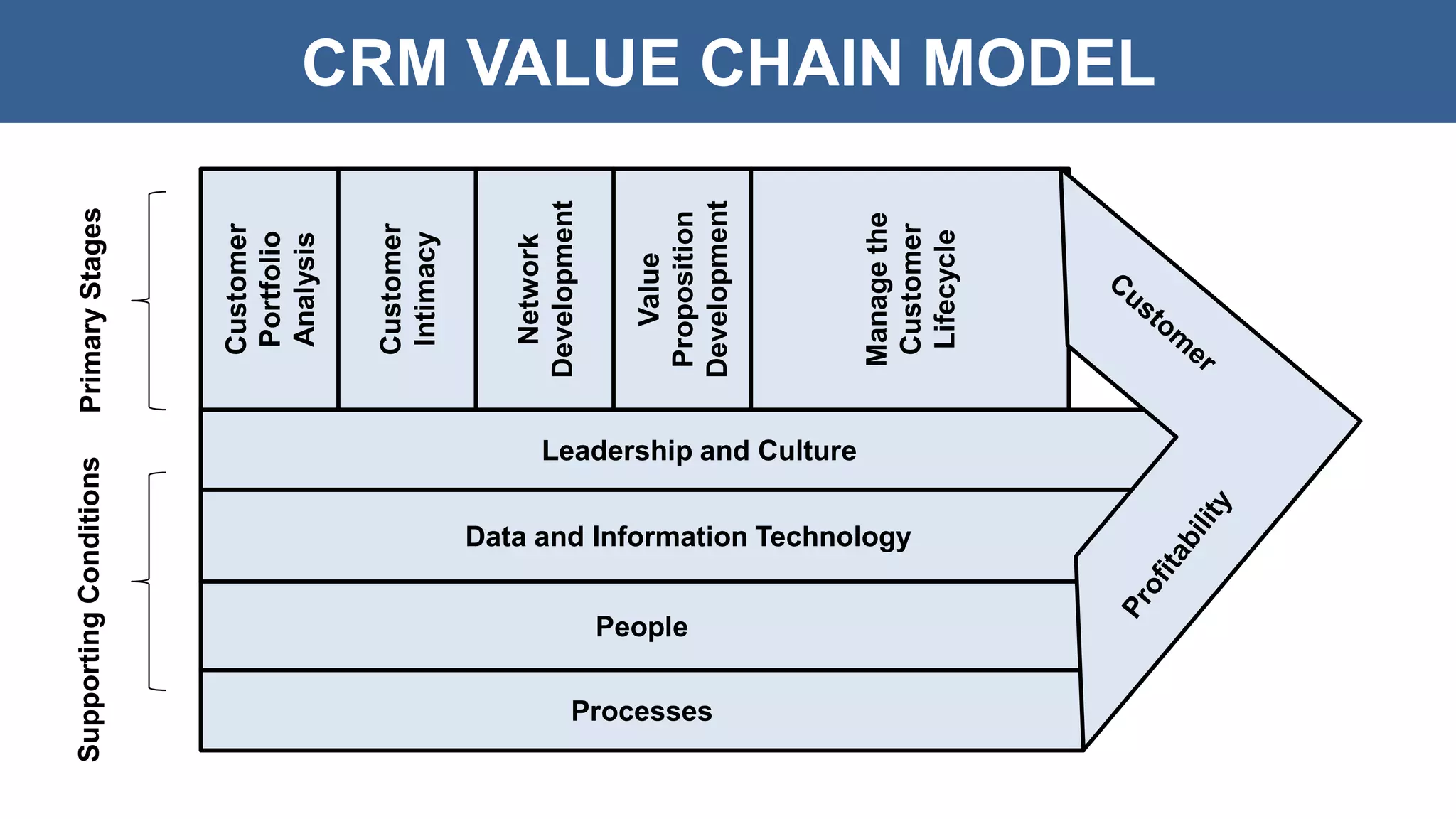
Image source: slideshare.com
- Customer portfolio analysis: Identify which customers or segments offer the greatest long-term value. This helps prioritize resources toward the most profitable or strategically important relationships.
- Customer intimacy: Build a deep understanding of customer needs, preferences, and behaviors through research and data. This enables personalized experiences and offerings.
- Network development: Develop internal and external partnerships—such as suppliers, distributors, and technology partners—to deliver value effectively to customers.
- Value proposition development: Create tailored value propositions for different customer segments. This includes designing products, services, and experiences that meet or exceed expectations.
- Manage the relationship: Implement processes, communication, and service activities that nurture long-term customer loyalty and maximize lifetime value.
When to use which CRM Model
Different CRM models serve different business needs. Choosing the right framework depends on company size, industry, data maturity, and customer expectations. Below is a simple decision guide that helps identify the best model for specific scenarios.
- Best for small businesses: Small businesses benefit from easy-to-follow and straightforward models. The idic model is often the best choice because it focuses on identification, personalization, and direct interaction. Smaller teams can implement these steps quickly. The CRM data model also helps them maintain clear records without complexity.
- Best for analytics: Companies that rely heavily on data and reporting benefit most from the QCI model. This framework emphasizes measurement, feedback loops, and optimization. It gives leaders clarity on what works and what needs improvement. The CRM data model also supports analytics-centered businesses.
- Best for customer-centric companies: Organizations that prioritize personalization or long-term relationships can focus on the idic model or Payne's CRM value chain model. These frameworks strengthen engagement and ensure customers need guide decision-making. Companies with high service dependency prefer these approaches.
- Best for enterprises: Large organizations require structured, cross-functional coordination. The Gartner CRM model is best suited for enterprises because it supports complex ecosystems, multi-channel operations, and data-heavy environments. It keeps large teams aligned around shared customer objectives.
- Best for SaaS businesses: SaaS companies need clear engagement processes and visibility across the customer lifecycle. The CRM value chain model works well because it supports recurring revenue and service-based relationships. The QCI model is also helpful because it emphasizes customer retention and customer success metrics.
Lark: A unified workspace that supports CRM-style models in execution
Using Lark, businesses can manage customer processes, communication, and operational workflows inside one connected workspace that replaces fragmented tooling. Teams can create data structures, automate actions, manage approvals, communicate in context, and document processes without switching platforms. This unified setup supports crm style models by keeping information synced, actions traceable, and collaboration simple across every stage of the customer journey. It also helps teams scale their CRM workflows faster with fewer manual steps and clearer accountability.
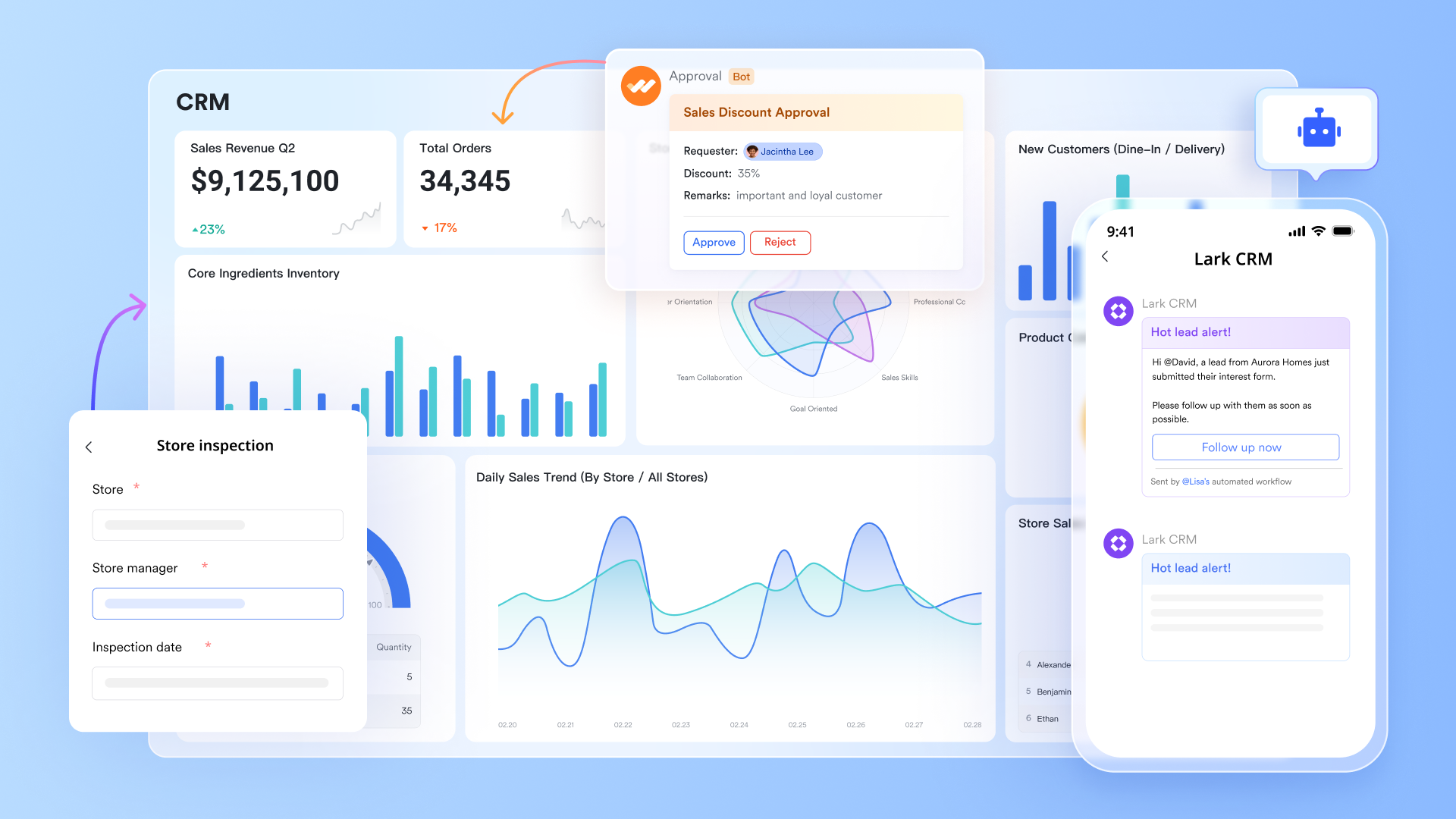
Store CRM data and build up a CRM database in Lark Base
Lark Base's drag-and-drop builder lets you easily tailor tables for scenarios like Leads, Opportunities, Clients, Follow-up Records, Orders, and Contracts. You can add flexible field types—such as text, flow, and formula fields—to capture the exact data each table requires. Flow fields help you map out step-by-step processes, assign owners, and set mandatory inputs to keep information consistent and reliable. You can also configure workflows with conditional logic and formulas to automate tasks, handle multi-stage processes, and even perform calculations like generating discounted order prices automatically.
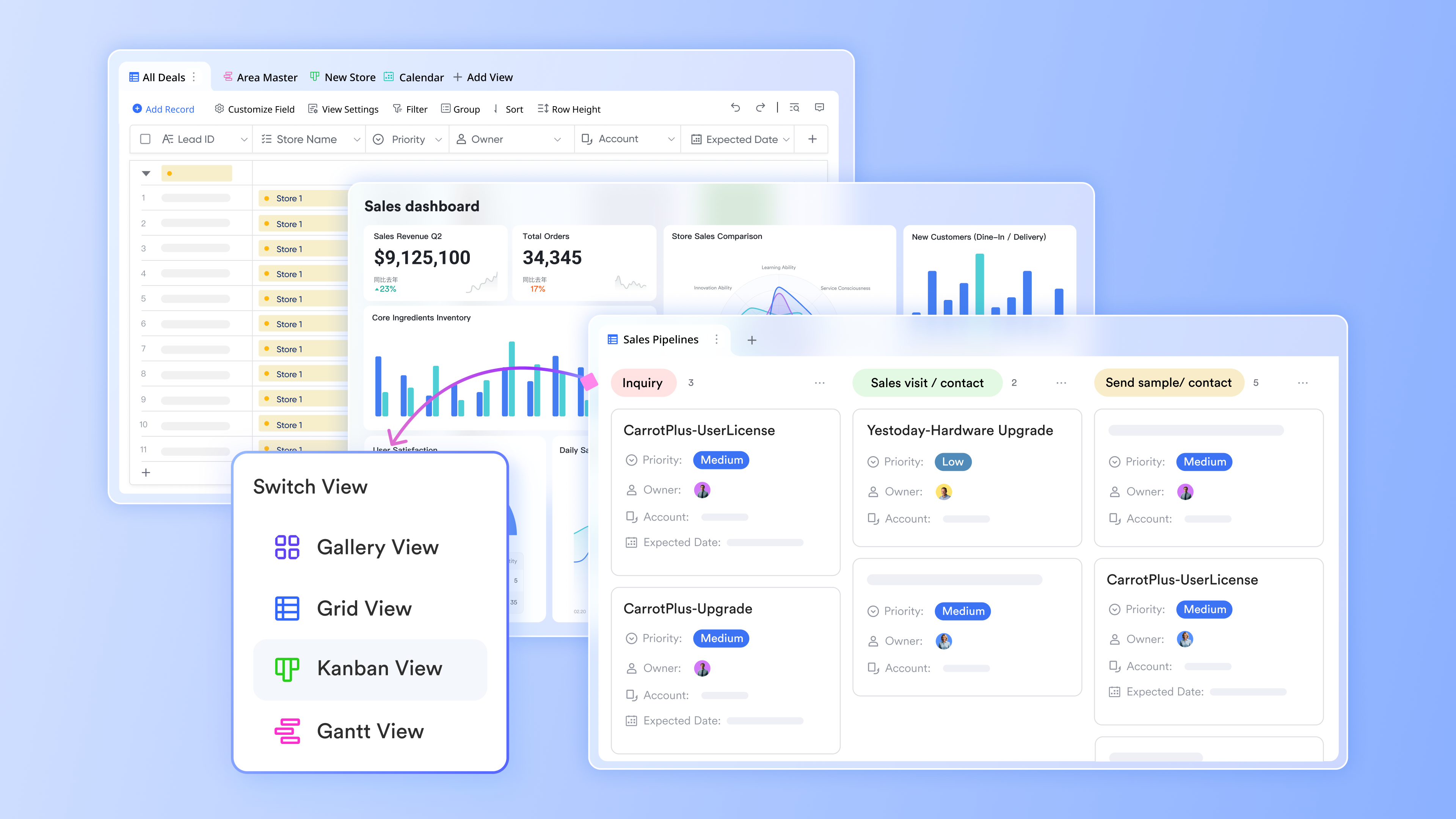
Flexible Work Mini apps configuration for CRM
Via Lark Base, teams can build lightweight Work Mini Apps that frontline staff can access directly from their phones to manage customer relationships. These mini apps display essential information such as active leads, pending opportunities, or follow-up actions, making daily work faster and clearer. Because the apps pull data from Lark Base tables, teams can customize fields, views, or workflows to match their exact operations. Lark Docs helps document these processes, so teams stay aligned.
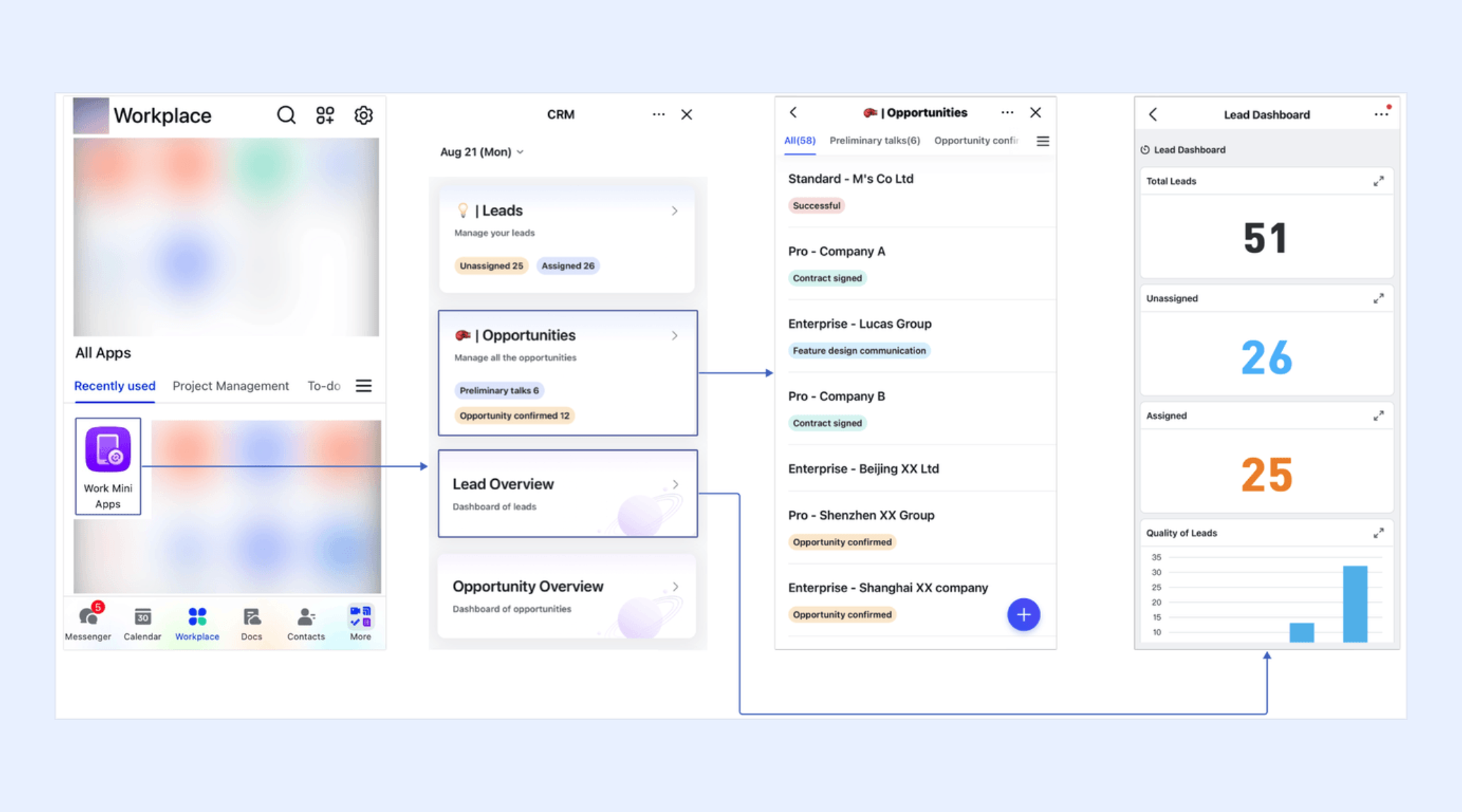
Remove repetitive tasks and workflows with automations
Lark Base automations streamline CRM workflows by handling repetitive tasks, such as follow-up reminders, stage updates, and team notifications, automatically. With conditional logic, you can route actions based on lead status, priority, or customer segment, ensuring every record moves through the right process. Workflows can also update fields, generate summaries, or trigger messages, keeping data clean and teams aligned. By reducing manual work and errors, Lark helps sales teams focus more on closing deals and less on administration.
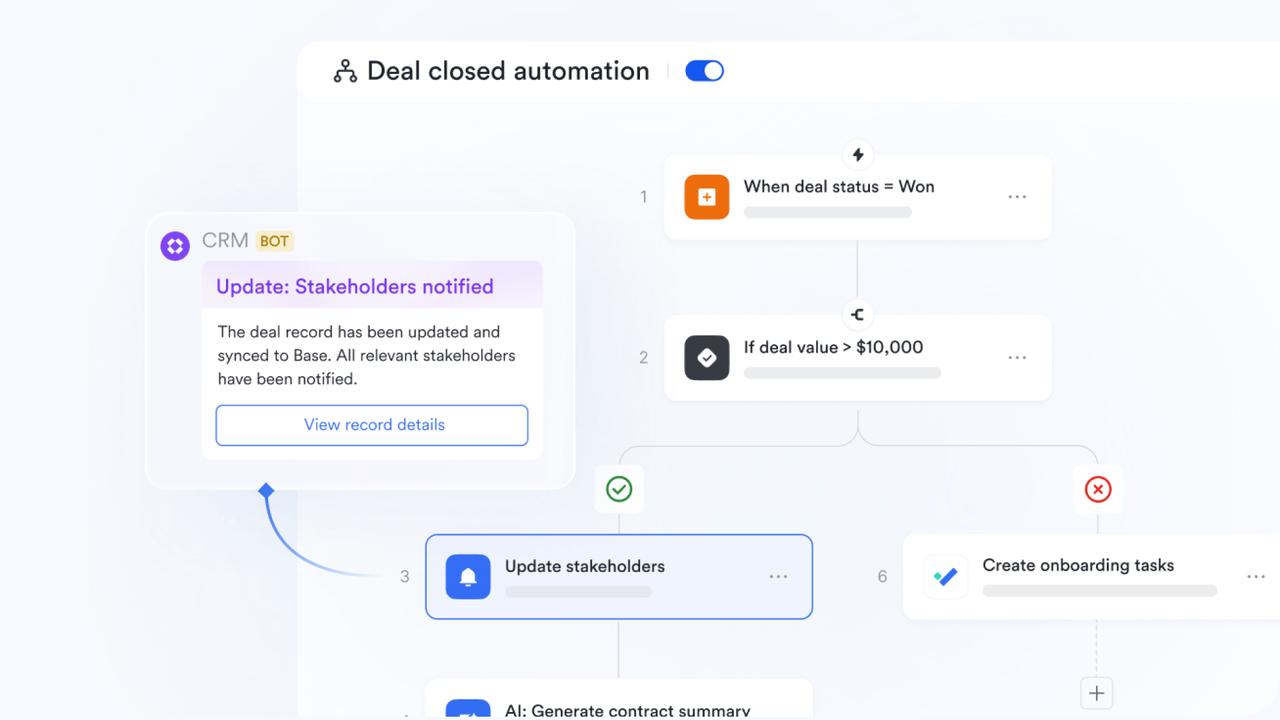
Approval processes synced with Lark Approval
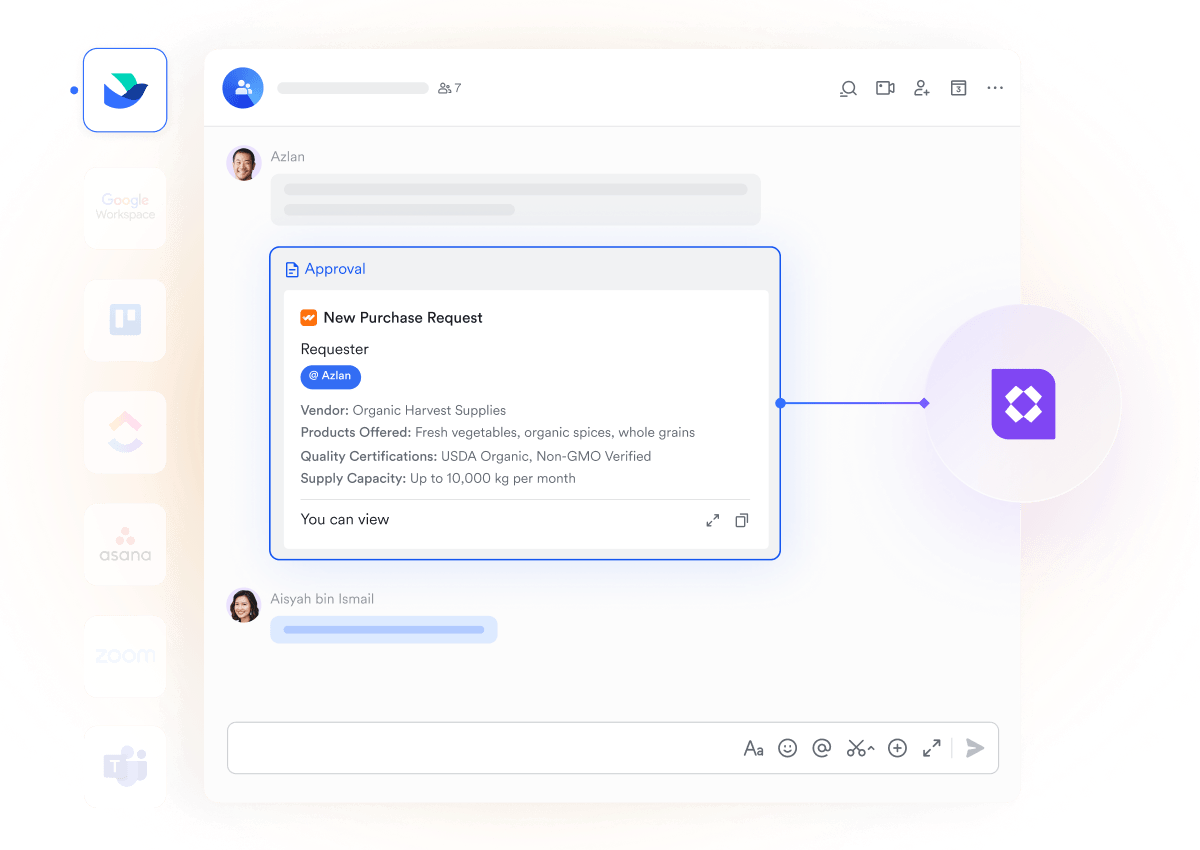
Using Lark Approval, teams can manage structured workflows for lead assignment, discount permissions, proposal reviews, or contract sign-offs. Approvers can review and respond from any device, keeping decisions moving quickly. Once approved, Lark Base updates linked CRM records automatically without manual edits. Messenger notifications keep teams aware of progress, while Lark Docs can store guidelines and approval rules for clarity. This creates reliable and traceable decision paths across customer processes.
- Starter plan: Free forever plan that includes 11 powerful tools for up to 20 users. It also comes with 100GB of storage, 1000 automation runs, AI translations, and more.
- Pro plan: $12/user/month (billed annually) for up to 500 users. It includes everything in Starter plus group calling for up to 500 attendees, 15TB of storage, 50,000 automation runs, and more.
- Enterprise plan: Contact sales for custom pricing. Supports unlimited users and includes even more automation runs and advanced security, compliance, and management features.
Best practices for implementing a CRM model
Implementing a CRM model requires consistent alignment, process clarity, and ongoing refinement. Businesses must ensure that their teams understand the chosen model and adhere to it in their daily operations. These best practices enable organizations to apply CRM frameworks effectively and achieve measurable outcomes.
- Establish cross-team alignment: CRM success requires clear roles, responsibilities, and communication channels. Teams need shared definitions of customer stages and processes. Alignment helps prevent duplication and confusion across departments. Regular syncs reinforce accountability and consistency.
- Standardize your customer stages: A CRM model should define each stage from lead to renewal. Standardization ensures that all teams follow the same steps and provide accurate updates. This improves reporting and forecasting. It also ensures customers receive consistent experiences.
- Maintain clean and consistent data: CRM performance depends heavily on data quality. Businesses should implement rules for validation, cleanup, and updates. Clean data helps teams deliver personalized communication and track performance accurately. Regular audits maintain reliability.
- Use automation to reduce manual work: Automation supports faster follow-ups and reduces the risk of missed steps. It enables consistent workflows across sales, support, and finance teams. Triggering an automated approval or automated update improves collaboration and decision-making. This helps organizations scale more easily."
- Map CRM models to measurable KPIs: Every CRM framework should connect to performance indicators. This includes metrics such as conversion rates, retention scores, and lifecycle stage velocity. Mapping KPIs ensures teams understand their impact. It also helps leaders refine processes.
- Build documentation and training frameworks: Teams need ongoing education to use CRM models effectively. Clear documentation helps new employees understand processes quickly. Training improves adoption and accuracy. This strengthens CRM performance across the organization.
Common challenges in building the CRM model
Many companies struggle to implement CRM models due to inconsistent processes, fragmented tools, and low adoption levels. These challenges can hinder customer experience and impact long-term success. Below are common issues businesses face and practical steps for resolving them.
- Data inconsistencies: Poor-quality data leads to inaccurate reporting and weak engagement. Companies should establish validation rules, standard naming conventions, and access controls. Regular cleanups help maintain accuracy. This ensures reliable forecasting and maintains high-quality data leads.
- Low adoption: Teams may resist using CRM systems if they find them difficult. Creating user-friendly workflows and providing training can improve adoption. Leadership support also increases participation. Adoption grows when CRM software unify with daily work.
- Misaligned teams: Without a unified CRM strategy, departments may follow different processes. Establishing shared goals and definitions resolves this issue. Regular alignment meetings reinforce collaboration. Cross-team dashboards also improve visibility.
- Overcomplicated processes: Excessive steps slow teams down and create confusion. Companies should streamline workflows to focus on essential tasks. Simplifying forms and stages increases productivity. This strengthens consistency across the customer journey.
- Poor reporting: Incomplete data leads to weak decision-making. Companies should invest in analytics tools and standardized dashboards. Clear reporting improves strategic planning. It also helps teams evaluate customer behavior more effectively.
- Lack of a connected workspace: Fragmented tools cause miscommunication and data gaps. Using a unified workspace helps teams maintain clarity. Centralized systems improve collaboration and reduce operational complexity. They also support consistent CRM execution.
Conclusion
CRM models enable organizations to understand their customers, structure their processes effectively, and deliver consistent experiences throughout the entire customer lifecycle. Whether you choose the idic model, CRM value chain model, QCI model of CRM, the Gartner ecosystem model, or a CRM data model, the goal remains the same: building lasting relationships supported by strong processes. With a clear framework in place, teams can personalize communication, improve efficiency, and scale their operations confidently. Toward the end of this guide, we introduced how a platform like Lark can support CRM execution using structured workflows, automation, data management, and mobile-friendly experiences. By combining the right CRM model with the right tools, businesses can improve alignment, strengthen collaboration, and increase long-term customer value.
FAQs
What is the IDIC CRM model?
The idic model CRM is a four step framework that focuses on identifying, differentiating, interacting with, and customizing experiences for customers. It supports personalization at scale and helps businesses improve engagement quality. Companies use this model to build long term relationships based on customer preferences and behavioral insights. Tools like Lark can support these processes with data organization and structured workflows.
What is the best CRM model for B2B?
B2B environments often prefer the gartner CRM ecosystem model or the CRM value chain model due to their structured approach and emphasis on cross functional collaboration. These models help teams manage complex customer lifecycles and long purchasing processes. They also support segmentation and account based strategies. Lark can assist B2B teams with streamlined workflows and centralized documentation.
What is the difference between CRM strategy and CRM model?
A CRM model provides the conceptual framework, while a CRM strategy describes how the business applies that model in daily operations. The model outlines the structure, steps, and guiding principles. The strategy defines tools, processes, and execution. Platforms like Lark help translate CRM strategy into consistent workflows.
Which CRM model focuses on customer retention?
The QCI model of CRM and the CRM value chain model place strong emphasis on retention and long term relationships. These models use data analysis, service quality improvements, and engagement plans to maintain customer loyalty. Retention metrics guide decision making at each stage. Lark can support retention workflows through automation and structured communication.
What is a CRM data model?
A CRM data model defines how customer information is stored, organized, and connected across systems. It helps teams access accurate data for segmentation, personalization, and reporting. This model includes objects, fields, relationships, and integrity rules. Platforms like Lark help teams maintain clean, connected customer databases that align with their CRM strategies.
Related reading
Table of contents
Start using Lark today

Manage all your work in one place
Boost team efficiency by 10x
Save up to 70% on software costs
Table of contents
Start using Lark today
Manage all your work in one place
Boost team efficiency by 10x
Save up to 70% on software costs
Keep reading









2026 Lark Technologies Pte. Ltd.
Headquartered in Singapore with offices worldwide.






Explore: