














How to Write A Business Case: The Complete Step-by-step Guide

Fecilia Clarke
Solutions Marketing Specialist
Sep 18, 2026
Fecilia Clarke
Sep 18, 2026

15 min read


Many of us have felt that slight sense of dread when tasked to write a business case. The process can feel intimidating, tangled in financial jargon and the pressure to persuade the management team and key decision makers. You worry your new project might be rejected, or that you’ll get lost in spreadsheets trying to prove its worth. A weak business case can stop a great idea in its tracks. But it doesn't have to be this way. This document isn't a bureaucratic hurdle; it's your most powerful instrument for building alignment, demonstrating value, and turning a concept into a funded, approved project.
This guide is designed to demystify how to write a business case. We will provide a clear, actionable framework that walks you through every essential step. We’ll cover what it is, why it's non-negotiable for any significant investment, and a detailed "how-to" for crafting a document that commands attention. With the right approach, you can build a solid business case that not only gets your project the green light but also lays the foundation for project success.
What is a business case?
At its core, a business case justifies the resources required for a project, investment, or initiative. Its primary goal is to provide executive stakeholders with the information they need to make rational and informed decisions. Think of it as the comprehensive business case that answers the fundamental question: "Why should we do this, and why should we do it now?" It’s a persuasive story backed by data, analysis, and strategic thinking that clearly shows why the expected benefits make the effort worthwhile.
It’s also important to clarify what a business case is not. Many people confuse it with a business plan, but they serve very different purposes. A business plan is a broad, strategic document that outlines the goals and operational model for an entire organization. In contrast, a project business case is focused on a single, specific initiative. For example, a business plan might detail a company's five-year vision, while a business case would argue for a particular project within that company, like purchasing a new CRM system.
Ultimately, a winning business case transcends a simple proposal. A proposal might just ask for resources, but a business case builds a complete narrative. IIt defines a business problem or opportunity, explores potential solutions—often backed by actionable data from project management tools—analyzes the financial benefits and risks, and recommends a specific path forward. The document presents all the key elements and answers the critical questions, making it the definitive source for understanding the full value and implications of approving your proposed project.

Why investing time in a business case matters
It can be tempting to view writing a business case as a delay. However, dedicating time to building a robust one is a crucial investment in your project's lifecycle. It is the foundation upon which any successful project is built, ensuring it aligns with the broader business strategy and organizational goals. The process itself forces clarity and sets the stage for success long before any work begins.
The most direct benefit is that it secures funding and the necessary resources. A compelling business case clearly demonstrates the value, making it easier for budget holders to approve the initial investment and perform the required resource allocation. But its importance doesn't end there. The process of creating the document forces all project stakeholders to align on the core problem, the proposed solution, and the definition of success. This shared understanding, established early, is critical for preventing misunderstandings later on.
Furthermore, a strong business case provides a clear baseline for measuring success. By defining the success criteria and the expected return on investment (ROI) upfront, you establish concrete metrics to evaluate the project's performance. This not only holds the project team accountable but also helps the organization learn. Skipping this step often leads to projects being rejected without fair consideration, teams working with misaligned expectations, and an inability to measure the project’s true impact on the overarching business objectives.
The pre-writing phase: How to set your business case up for success
Before you write a single word, the most crucial work begins. The secret to a successful business case often lies in the "pre-writing" phase—the strategic groundwork you lay to build momentum and gather feedback. This is where you identify a strong project sponsor—an executive leader who will champion your cause—and start to create allies. This transforms your idea from a solo effort into a shared vision supported by relevant stakeholders.
Start by socializing your idea informally. Schedule brief conversations with trusted peers and relevant team members. Frame it as seeking advice: "I've been thinking about this problem we have, and I have a rough idea. Could I get your thoughts on it?" This approach invites constructive feedback and allows you to refine your concept. You can use a tool like Lark Messenger for these quick chats, gathering informal customer feedback and internal perspectives that will strengthen your argument.

As you talk to people, you'll naturally start to identify your key stakeholders. Understanding their individual priorities is critical. The finance lead will care most about the ROI, while the head of engineering will focus on technical feasibility. As you gather this intelligence, start a living document in Lark Docs. This initial research is invaluable for tailoring your argument. You can also begin a preliminary market assessment to understand the competitive landscape and validate the opportunity. This groundwork is essential for a well-crafted business case.
The step-by-step guide to how to write a business case
With your preliminary research complete, it’s time to structure your argument. This section provides a detailed walkthrough of the key components. We'll break down each part, explain what to include, and show how integrated tools can make the process smoother.
1. Start with a powerful executive summary
The executive summary is the most important section. While it appears first, it should be written last. Many leaders will only read this section to decide if the rest of the document is worth their time. Therefore, it must be a concise and comprehensive overview of your entire proposal, summarizing all the key points and key details in one place.
Your executive summary should be no more than a page long and must clearly articulate the core message. It needs to briefly cover the problem, the recommended solution, and the key business benefits the organization will gain. Crucially, it must also include the bottom line: the total investment required and the expected return. It concludes with a clear statement of your recommendation, making it easy for a decision-maker to grasp the essence of your proposal and become an advocate.
Think of the executive summary as the "trailer" for your project. It needs to grab the reader's attention and convince them that the full story is worth their investment. It should be written in clear, confident language, focused entirely on the business value your project will deliver. A well-written summary ensures your business case answers all the high-level questions immediately.
2. Define the business problem or opportunity
Before you can present your solution, you must first convince your audience that there is a significant business problem that needs solving or a valuable opportunity that needs capturing. This section sets the stage for everything that follows. You need to articulate the "why" with unmistakable clarity and urgency.
Start by describing the current state. What specific pain point is the business experiencing? Is it a manual process that wastes time and introduces errors? Is it a gap in your product that is causing customer churn? Be as specific as possible. Instead of saying "our processes are inefficient," quantify it: "Our finance team spends approximately 40 hours per week manually reconciling invoices, leading to payment delays and supplier dissatisfaction." This detail strengthens your case.
To make your problem statement even more powerful, back it up with a mix of quantitative and qualitative data. You can use Lark Forms to quickly survey employees to gather data on how much a broken process is costing them. You can also leverage Lark's AI Meeting Notes to transcribe and summarize customer interviews, then pull powerful, direct quotes into your business case. Combining hard numbers with real human stories creates a compelling narrative that is difficult to ignore.
3. Analyze and quantify the financial impact
This section is the heart of your business case. Stakeholders need to see a clear and credible cost analysis of the project's financial impact. You must demonstrate that your initiative is a wise investment. This is where you prove that the financial benefits outweigh the costs and show the full scope of potential benefits.
The cornerstone of this section is the cost-benefit analysis. On one side, list all costs—this includes one-time costs and ongoing expenses. On the other side, detail the benefits, including direct financial gains like cost savings and increased revenue. A detailed financial analysis is non-negotiable. It should be rigorous enough to withstand scrutiny from the finance department.
This is where an unified toolset becomes a superpower. You can use Lark Base to create a central database for all your cost and benefit figures. Then, build your financial model in an embedded sheet directly within your Lark Docs. To make your analysis even more robust, you should perform a sensitivity analysis to test how your outcomes change if key assumptions (like sales forecasts or costs) prove to be inaccurate. This shows you've considered various scenarios and adds a layer of credibility.
4. Identify and evaluate your options
A credible business case demonstrates a thorough analysis by considering multiple alternative solutions. Presenting and evaluating several options shows due diligence and strengthens your final recommendation. It anticipates the question, "Have you thought about other ways to solve this problem?" and answers it proactively, exploring different potential solutions before settling on one.
You should typically analyze at least three options. The first is always the "do nothing" or status quo option, which serves as a baseline and highlights the costs of inaction. The other options might represent different approaches—for example, using internal vs. external resources, or a phased implementation versus an all-at-once rollout. For each option, analyze the pros, cons, costs, and risks. This structured comparison allows stakeholders to easily weigh the trade-offs.
After presenting the analysis, conclude with a clear and confident recommendation for your preferred solution. State which option you believe is the best path forward and provide a compelling justification. Crucially, you must explain how the project aligns with the company's overarching organization's strategic goals. This strategic link is often the deciding factor for executive approval, showing that your project contributes to the bigger picture.
5. Outline the project scope and implementation plan
Once you have convinced stakeholders of your recommended solution, their next question will be, "How will we get this done?" This section provides a high-level roadmap for the project's execution. A detailed project plan will come later, but this overview gives decision-makers confidence that you have a realistic implementation plan.
First, define the project scope. What exactly will the project deliver, and what is out of scope? This is also where you clearly state the project objectives and project aims. What are the specific, measurable outcomes you want to achieve? These expected outcomes should be directly linked to the benefits outlined earlier. Detailing the resources required is also essential here.
This section should outline the high-level timeline, major milestones, and the project team structure. While a full project charter may be developed after approval, mentioning it as a next step shows foresight. An integrated platform like Lark makes the transition from approval to action seamless. Key details from your Lark Doc can be instantly used to populate a detailed plan in Lark Base, ensuring the momentum from your approved business case is carried directly into execution.
6. Detail the risks and your mitigation strategies
No project is without risk, and pretending otherwise is a quick way to lose credibility. Performing a thorough risk assessment shows your stakeholders that you have a realistic perspective. This section demonstrates foresight and assures decision-makers that you have a plan in place to navigate challenges, increasing their confidence.
Start by brainstorming potential risks, including financial risks (e.g., the project goes over budget) and operational risks. For each identified risk, you should assess risks based on their potential impact and likelihood. This helps you prioritize which ones require the most attention. Acknowledging these possibilities doesn't weaken your case; it strengthens it.
More importantly, for each significant risk, you must propose clear mitigation strategies. This is your plan for how you will either prevent the risk from occurring or reduce its impact if it does. For example, if a risk is low user adoption, your mitigation strategy could be a comprehensive training program. Outlining these strategies shows that you are not just a dreamer but also a pragmatic planner ready to lead the project to success.
How an all-in-one tool supports your business case writing
Creating a winning business case involves much more than just writing. It requires gathering data from different departments, collaborating with stakeholders for feedback, and presenting your findings in a clear, persuasive format. Juggling disconnected tools for documents, spreadsheets, and meetings creates friction, slows down the process, and increases the risk of errors. An all-in-one platform like Lark eliminates this chaos by integrating every tool you need into a single, seamless workspace, directly addressing the core challenges of business case creation.
Consolidate your narrative with Lark Docs
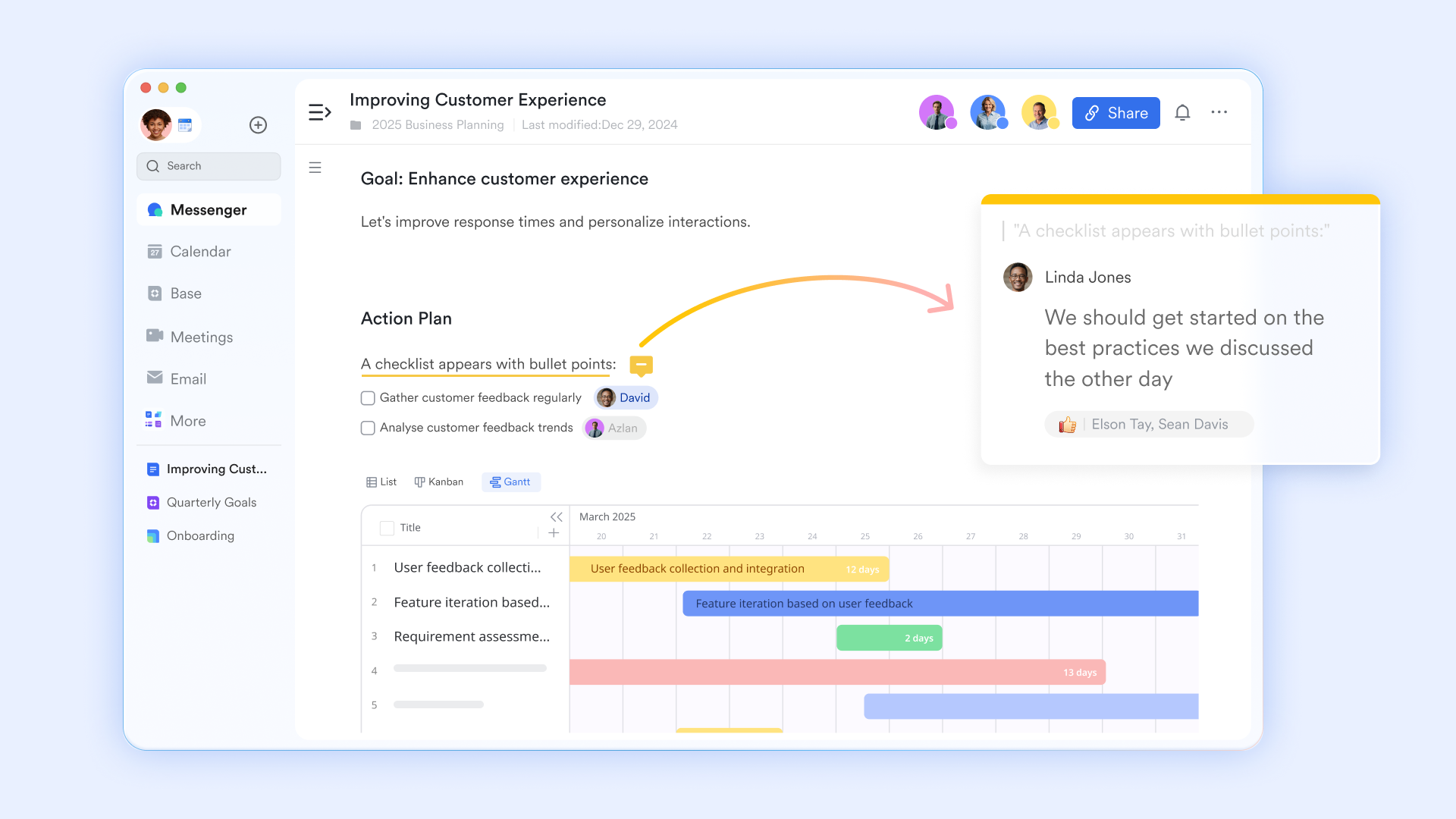
The foundation of your business case is the document itself, but it shouldn’t be a static, isolated file. With Lark Docs, you can create a living document that serves as the central hub for your entire project proposal. Instead of managing separate files for your text, financials, and project plans, you can embed them directly into one canvas. This means your financial models and data tables are not just images; they are live, interactive elements. When a number is updated at the source, it automatically refreshes in your business case, ensuring every stakeholder is always viewing the most current, accurate information.
Centralize your data with Lark Base
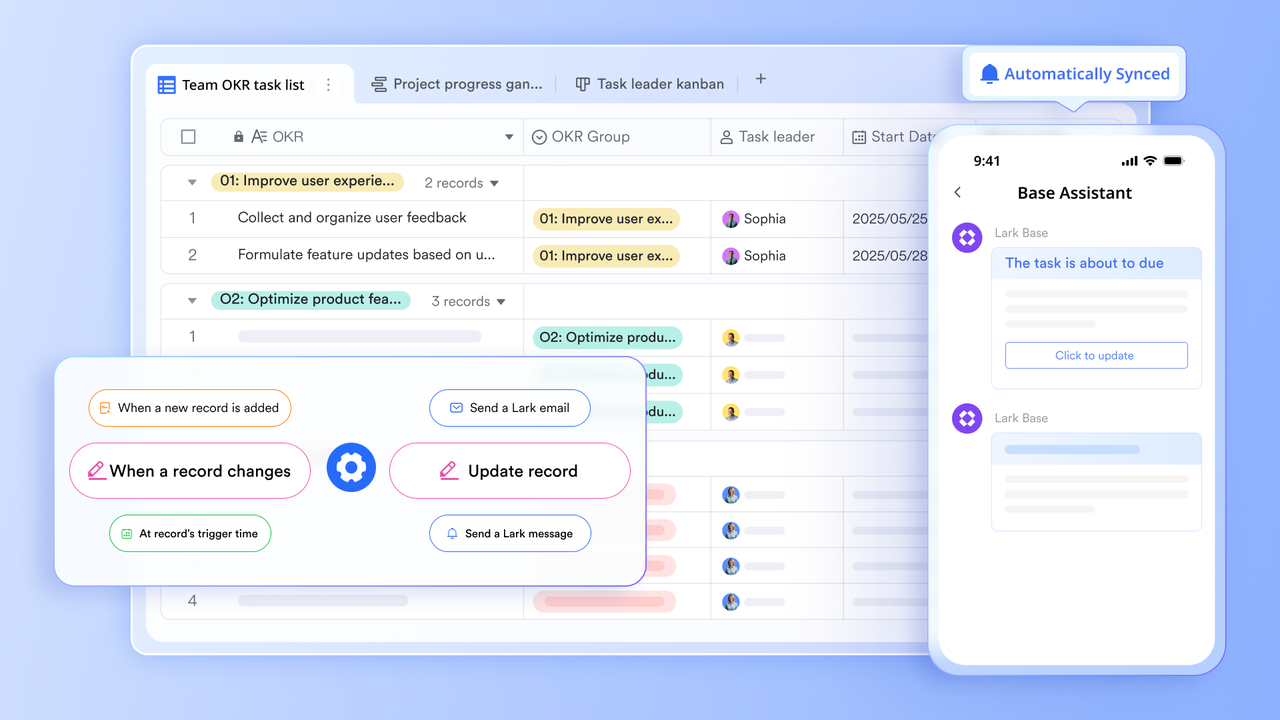
A solid business case is built on a foundation of solid data. However, gathering cost estimates, revenue projections, and market research from different teams often results in a messy collection of spreadsheets and emails. Lark Base solves this critical pain point by acting as a single source of truth. You can create a simple, customized database to collect and organize all the quantitative evidence needed for your analysis. Team members from Finance, Sales, and Operations can input their data directly into a structured, centralized location, ensuring consistency and accuracy. This organized data can then be linked directly to your Lark Doc, providing verifiable proof for every claim you make.
Align stakeholders with Lark Meetings
Securing buy-in requires clear and efficient communication with your stakeholders. Email chains for feedback and scheduling conflicts for review sessions can cause significant delays. Lark Meetings streamlines this entire alignment process. You can schedule review sessions effortlessly with Lark Calendar that shows everyone’s availability. During a meeting, you can pull your doc directly into the call to review it together in real-time. Even better, with AI-powered features, the entire meeting can be transcribed and summarized automatically, ensuring that every piece of feedback, decision, and action item is captured and distributed without any manual effort.

👉Try Lark’s Savings Calculator: Switching to Lark’s Pro plan can lead to significant cost savings— for example, a 100-employee company using Slack, Google Workspace, and Airtable could save approximately $25,200 annually by consolidating their tools with Lark.
Your business case checklist
Before submitting your document, it’s helpful to run through a final check to ensure all key components are in place. A simple business case checklist can help you avoid common mistakes and ensure your document is complete and persuasive. Have you clearly stated the business problem? Is your executive summary concise and compelling? Have you analyzed multiple solutions? Is the financial analysis robust? Does the project align with organizational goals? Answering "yes" to these questions is a good sign that your document is ready.
Conclusion
A business case is far more than corporate paperwork. It is the strategic narrative that breathes life into an idea. It’s the disciplined process of transforming a promising concept into a concrete plan that your organization can rally behind. By methodically defining a problem, quantifying the value of its solution, and building a persuasive, data-driven argument, you are not just asking for resources; you are building a compelling vision for a better future and providing a clear roadmap to get there.
We know that staring at a blank page can be daunting, but as we’ve shown, the process can be broken down into a series of manageable steps. By focusing on the underlying "why," engaging stakeholders early, and presenting a clear-eyed view of the financials, risks, and benefits, you elevate your role from that of an employee with an idea to a strategic partner driving business value.
With a structured approach, leveraging helpful resources, and using a powerful collaborative platform like Lark to support you, you are fully equipped to build an argument that is not only heard but acted upon. The journey from a simple proposal to a successful, real-world project is challenging, but it begins with a single, powerful document. Now, it's time to get that green light.
FAQs
What is an example of a business case?
An excellent example of a business case is a proposal to purchase a new Customer Relationship Management (CRM) software. The document would outline the problem, such as inefficient sales tracking and poor customer data management. It would then analyze the costs of the new software versus the expected benefits, like increased sales team productivity, higher customer retention rates, and a significant return on investment (ROI) over three years, ultimately recommending the purchase.
How to write a business case step by step?
To write a business case step by step, first define the business problem with clear data. Next, identify and analyze potential solutions, including a cost-benefit analysis for each. Then, present your recommended solution and outline a high-level implementation plan. After that, detail potential risks and your mitigation strategies. Finally, write a powerful executive summary that condenses all these key points into a brief, persuasive overview for decision-makers.
What are the 5 key elements that make a good business case?
A good business case is built on five key elements. First, a clear and compelling problem statement that establishes urgency. Second, a robust financial analysis, including a credible ROI. Third, a thorough evaluation of alternative solutions, proving due diligence. Fourth, a clear alignment with the organization's strategic goals. Finally, a realistic risk assessment with practical mitigation strategies, which builds trust and shows foresight to key stakeholders.
What are the 5 sections of a business case?
The five core sections of a standard business case are:
- Executive Summary: A concise overview of the entire case.
- Problem Statement: A detailed description of the business problem or opportunity, backed by data.
- Analysis of Options: A comparison of potential solutions, including their costs, benefits, and risks.
- Recommended Solution: A section detailing the preferred solution, its implementation plan, and financial projections.
- Risk Assessment: An outline of potential risks and corresponding mitigation strategies.
Related reading
Table of contents
Start using Lark today

Manage all your work in one place
Boost team efficiency by 10x
Save up to 70% on software costs
Table of contents
Start using Lark today
Manage all your work in one place
Boost team efficiency by 10x
Save up to 70% on software costs
Keep reading








2026 Lark Technologies Pte. Ltd.
Headquartered in Singapore with offices worldwide.






Explore: