According to industry data, 99% of marketers claim they use artificial intelligence. We are past the early adoption phase. But as teams rush to leverage ai in advertising, they hit a wall. Generating hundreds of ad variations is no longer the hard part; managing them is. In this guide, I will walk you through the current state of artificial intelligence in advertising, highlight the most effective tools for your tech stack, and show you why establishing a structured workflow is the only way to protect your brand and drive actual ROI.
Defining AI in modern advertising
To understand how to use this technology, we first need to define it clearly. Artificial intelligence in advertising refers to the use of machine learning algorithms, large language models, and predictive analytics to inform campaign strategy, optimize media delivery, generate creative assets, and analyze performance data.
Many marketers confuse modern capabilities with the advertising automation of the past decade. Ten years ago, automation meant setting up rigid, rule-based engines. If a user abandoned a shopping cart, the system triggered a specific display ad. That was pure programmatic advertising—efficient, but highly dependent on human-defined parameters.
Today's models operate differently. They do not just follow rules; they identify patterns and generate net-new outputs. Instead of waiting for a human to write ten headlines for a social media ad, modern tools create them instantly based on the landing page context. Instead of a media buyer guessing which audience segment will convert best, machine learning algorithms analyze to shift budgets dynamically.
As a marketer, you should not view this as a single software purchase you can just buy and plug in. Instead, view it as a capability layer applied across your entire campaign lifecycle—from the moment you brainstorm an angle to the final post-mortem report.
Real-world use cases of AI in advertising
When teams move beyond treating this technology as a basic chatbot and apply it to specific business problems, the results are remarkable. Here are the core areas where machine learning is currently reshaping .
Audience targeting and segmentation
Historically, marketers built audiences based on static demographics like age, location, and broad interests. Today, models analyze thousands of real-time behavioral signals to segment audiences instantly. It recognizes context. If a user is reading a highly technical blog about enterprise software, the system can serve a B2B ad tailored exactly to that technical depth, rather than serving a generic brand awareness banner.
Media buying and bidding
Programmatic bidding is now almost entirely driven by machine learning. Algorithms predict the likelihood of a conversion for every single ad impression in milliseconds. They automatically adjust your cost-per-click (CPC) bids to ensure you win the placements that matter while on low-probability clicks.
Creative generation and dynamic creative optimization (DCO)
This is where generative capabilities shine. Teams use tools to draft ad copy, generate background images, and even create dynamic video variations. With DCO, algorithms mix and match different headlines, images, and calls-to-action on the fly, serving the specific combination most likely to appeal to the individual viewer.
Mini-scenario: Think of a global beverage brand launching a summer campaign. Instead of manually editing the ad for 20 different regions, a creative director uses an image model to automatically swap out the background scenery—a beach for Miami, a park for London—and translate the voiceover. This scales asset production instantly without requiring massive manual reshoots.
Brand examples in action
To anchor these abstract concepts in reality, look at how major brands already execute them:
- Coca-Cola: In their "Create Real Magic" campaign, Coca-Cola gave digital artists access to generative platforms, allowing them to create custom artwork using iconic brand assets. This turned audience participation into a massive, automated brand awareness engine.
- Heinz: Heinz leaned into image generation early with a clever campaign where they prompted models to draw "ketchup." The system consistently generated bottles that looked exactly like Heinz, proving their brand dominance while producing highly shareable ad creatives.
- Spotify: Spotify's AI DJ is a prime example of personalized advertising and user retention. By analyzing listening habits, the system curates customized playlists interwoven with highly targeted, contextual audio ads, keeping engagement incredibly high.
These brands succeed because they do not just generate random assets; they apply machine learning to specific, measurable business goals.
Core advantages of AI-driven campaigns
When marketing teams move past the initial hype and apply machine learning to actual business operations, the benefits become highly tangible. For growth teams, the primary value of artificial intelligence is not replacing human creativity; it is amplifying output per unit of time.
- Faster asset production: In the past, writing ten variations of ad copy or storyboarding a video took days. Now, copywriters use language models to produce initial drafts in seconds. Creative teams start their work at 70% completion, focusing their energy on refinement and strategic alignment rather than staring at a blank page.
- Higher efficiency and budget utilization: Algorithms excel at . Programmatic bidding systems evaluate user behavior in real time, automatically shifting budget away from poor-performing audiences and directing it toward high-intent users, reducing wasted ad spend.
- Granular personalization: Machine learning enables dynamic scaling at a level humans cannot manage manually. Brands can take a single core message and allow algorithms to adjust the visuals, localized language, and call-to-action to match the specific profile of the viewer.
- Faster testing loops: Growth marketing relies on continuous A/B testing. Because generating test assets costs significantly less time and money now, teams run concurrent experiments, gather performance data faster, and identify winning creatives weeks earlier than traditional methods allow.
Scale AI campaigns faster with Lark
Hidden risks and operational challenges
Despite the obvious speed advantages, injecting artificial intelligence into your introduces entirely new operational hazards.
- Content homogenization: Because generative tools rely on existing data, they naturally gravitate toward average, predictable outputs. If a team relies entirely on software without human intervention, their creatives quickly become generic, causing them to blend in with competitors and lose consumer attention.
- Brand voice dilution: Speed often comes at the cost of consistency. When different team members use separate tools to generate text and visuals, the final assets can easily stray from the established brand identity. A tone that sounds slightly off erodes consumer trust over time.
- Authenticity and trust pressures: Consumers—especially younger demographics—maintain a healthy skepticism toward machine-generated content. Marketers face ongoing pressures to maintain authenticity, label their outputs clearly, and navigate the ethical use of customer data for targeting.
- Data governance: Feeding proprietary customer data into public models introduces privacy and security risks, requiring strict internal policies to ensure compliance with regional data laws.
- The human bottleneck: This is the most common failure point. When a team increases their creative output by 10x, they immediately break their traditional review processes. Managers find themselves overwhelmed by dozens of file versions scattered across emails, chat apps, and local hard drives, leading to missed errors and delayed campaign launches.
Here is the revised section with sentence case strictly applied to all headings, subheadings, and list headers. Brand names, proper nouns, and standard abbreviations remain capitalized as required by standard English grammar.
Architecting your stack: Navigating today’s flood of point solutions
The market is flooded with applications, but the most teams avoid buying random point solutions. Instead, they build a purposeful tech stack where each platform handles a specific phase of the creative pipeline:
Best for summary:
- Lark: Best for coordinating cross-functional teams, managing high-volume creative reviews, and automating human-in-the-loop brand approvals.
- OpenAI (ChatGPT/Sora): Best for rapid textual ideation, copywriting drafts, and conceptual video experimentation.
- Midjourney: Best for generating high-fidelity visual concepts, custom stock imagery, and compliant ad components.
- Canva’s Magic Studio: Best for quick template layout adaptation, rapid localized resizing, and social graphic creation.
- StackAdapt: Best for executing, targeting, and optimizing multi-channel programmatic media buying.
- Semrush (AI Visibility Toolkit): Best for evaluating organic search presence and monitoring visibility within conversational search engines.
- Zapier: Best for setting up simple automated integrations between disjointed third-party software.
- Claude Code & Replit: Best for engineering custom, internal marketing scripts, dashboards, and programmatic databases.
Media, targeting, and optimization platforms
- StackAdapt: An AI-powered advertising and orchestration platform built for planning, activating, and optimizing campaigns across multiple digital channels (including programmatic display, video, native, and email).
- Google Ads & Meta Advantage+: Native automation engines that handle automated bidding, budget allocation, and placement optimization directly within their respective ad networks. For brands looking to complement these automated tools with specialized campaign management, can be considered when planning and optimizing Meta-focused advertising strategies.
Copywriting, ideation, and editing assistants
- OpenAI’s ChatGPT, Microsoft Copilot, & Google Gemini: Highly versatile foundation models utilized for drafting copy, generating creative briefs, and mapping out structural marketing plans.
- Grammarly: A dedicated text assistant used to polish copy for grammar, style, tone, and spelling mistakes before creative assets go to production.
Image, design, and video production engines
- Midjourney & Adobe Firefly: Advanced generative image tools utilized for generating and editing custom visual elements suitable for paid media and high-converting display campaigns.
- Canva’s Magic Studio: A user-friendly design suite designed for assembling, resizing, and adapting ad creatives across various formats and social channels.
- OpenAI’s Sora: An advanced text-to-video model used for generating short-form videos and testing innovative creative concepts for social media advertising.
Visibility, automation, and custom engineering tools
- Semrush’s AI Visibility Toolkit: A specialized toolset for monitoring brand presence across search interfaces and optimizing for AI-driven search experiences.
- Zapier: A popular integration platform used to connect separate marketing applications and automate repetitive administrative tasks.
- Claude Code & Replit: Advanced code environments enabling technical marketers to build, test, and iterate on internal scripts and applications to support custom reporting, API automation, and custom creative experiments.
Core advertising tech stack comparison
To help you cut through the noise of these individual platforms and understand how they fit into your broader organization, we have benchmarked these essential tools across critical operational dimensions below.
Why Lark stands out
Lark addresses the massive fragmentation inherent in modern marketing stacks by acting as an all-in-one collaboration hub. Rather than forcing teams to pay for separate, siloed licenses for chat, document editing, task managers, and video conferencing—and then spending hours building fragile integrations via Zapier—Lark integrates these critical utilities natively. This unified infrastructure dramatically lowers the total cost of ownership (TCO), prevents version-control chaos, and ensures that high-velocity AI asset generation is met with robust human oversight.
Explore how Lark unifies marketing teams
Essential skills and strategies for effective AI adoption
Buying a subscription to a generative platform does not automatically yield a high-performing ad campaign. To use these tools effectively, marketing teams must shift their approach from simply operating software to actively guiding and managing machine output.
The most common mistake advertising directors make is starting with the tool. They hand a creative team a new video generator and say, "Let's see what this can do." This leads to aimless experimentation. Instead, you must start with the business problem.
Mini-scenario: A performance marketing team notices their cost-per-acquisition (CPA) is climbing on mobile feeds. Instead of randomly generating 100 new videos, they define the exact bottleneck: users are scrolling past the first three seconds. They then apply a specific tool to generate ten distinct visual hooks for the first three seconds of their existing winning video, running a structured A/B test to isolate the best performer.
Once the goal is clear, the team needs to develop a distinct set of skills to manage the process:
- Prompting and iteration: Knowing how to instruct a language model to produce on-brand, highly specific copy rather than generic fluff.
- Creative judgment: The ability to review 50 generated images and instantly spot the one that aligns with the campaign's emotional hook, while discarding the 49 that look slightly artificial or off-brand.
- Data reading and experiment design: Structuring tests to validate whether the generated asset actually outperforms the human-made baseline.
Beyond individual skills, leaders must establish operational guardrails. Every machine-generated asset should pass through a designated approval mechanism to verify factual accuracy, brand tone, and copyright compliance before it reaches the media buying team. A practical adoption roadmap looks like this: select a low-risk pilot scenario (testing new headlines for a retargeting ad), set a clear KPI, run the test, conduct a team review on the workflow friction, and only then expand usage to larger campaigns.
Here is the optimized section with all mini-scenarios completely removed, maintaining a professional, streamlined tone focused on workflow infrastructure and quality control.
Eliminating AI slop: Why Lark fits AI-powered advertising workflows
This brings us to the core issue facing advertising teams today: fragmented tool stacks create workflow bottlenecks. When your copywriter drafts in ChatGPT, your designer generates images in Midjourney, and your media buyer analyzes data in Google Ads, your generated assets scatter.
This creates creative chaos. Files get lost in email threads, version control disappears, and approval loops break down. To maintain production speed without sacrificing brand safety, you need a central collaboration hub. does not compete with your generative platforms; rather, it provides the structural foundation required to manage their massive output.
In high-velocity advertising, collaboration infrastructure directly dictates creative quality. Here is how Lark acts as the operating system for AI-assisted campaigns:
Taming high-volume machine generation
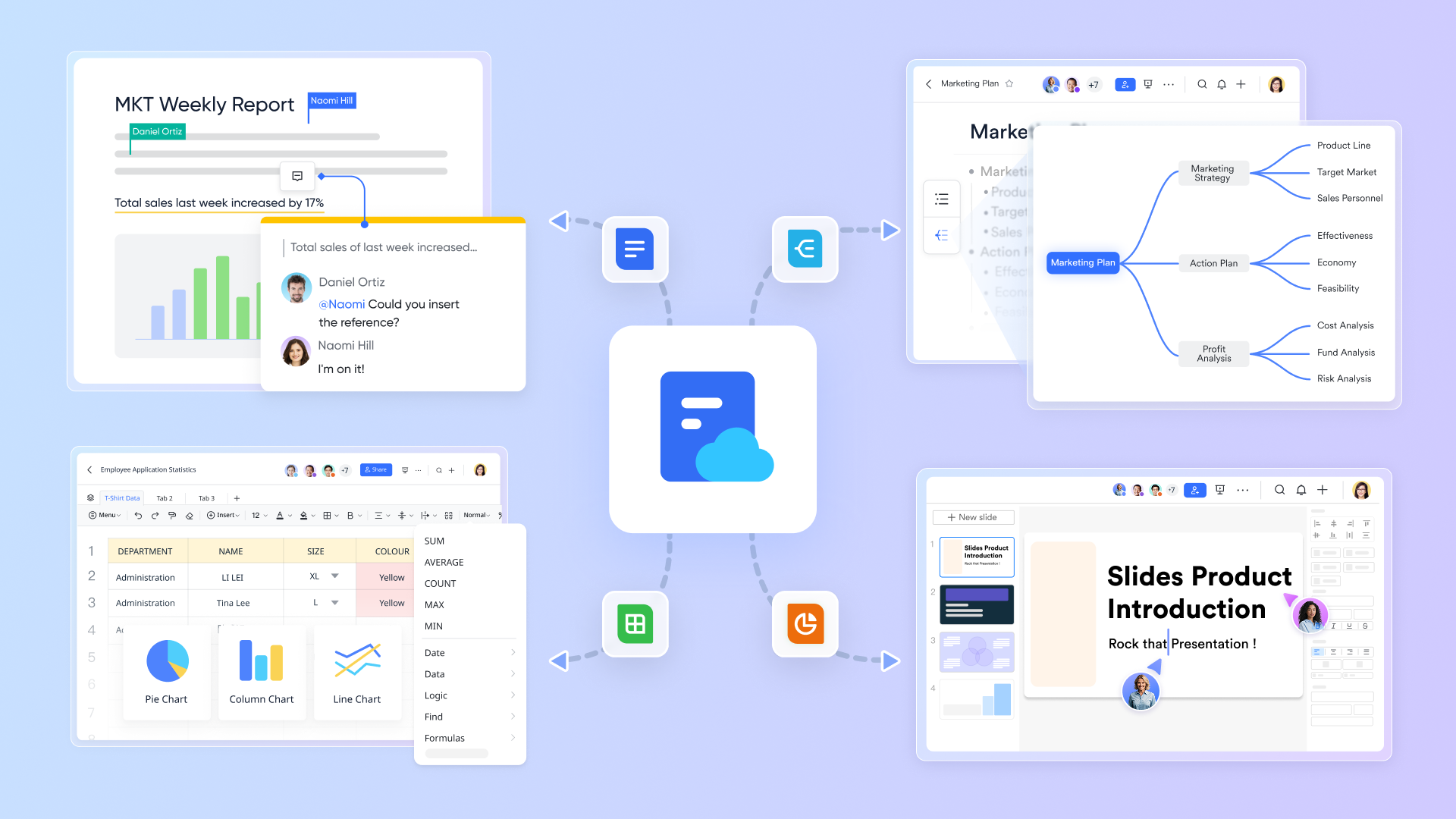
When an image model outputs 50 variations of a localized ad in seconds, dumping them into a chat channel causes immediate version-control chaos. With , teams can embed these generated assets into a single, cloud-native canvas alongside live data.
Instead of jumping between disconnected apps, team members can use to discuss creative angles, while strategists view the visual options side-by-side inside the doc. By leaving inline comments on specific AI-generated pixels or text lines, teams ensure human intent guides the final creative selection.
Enforcing human-in-the-loop approvals
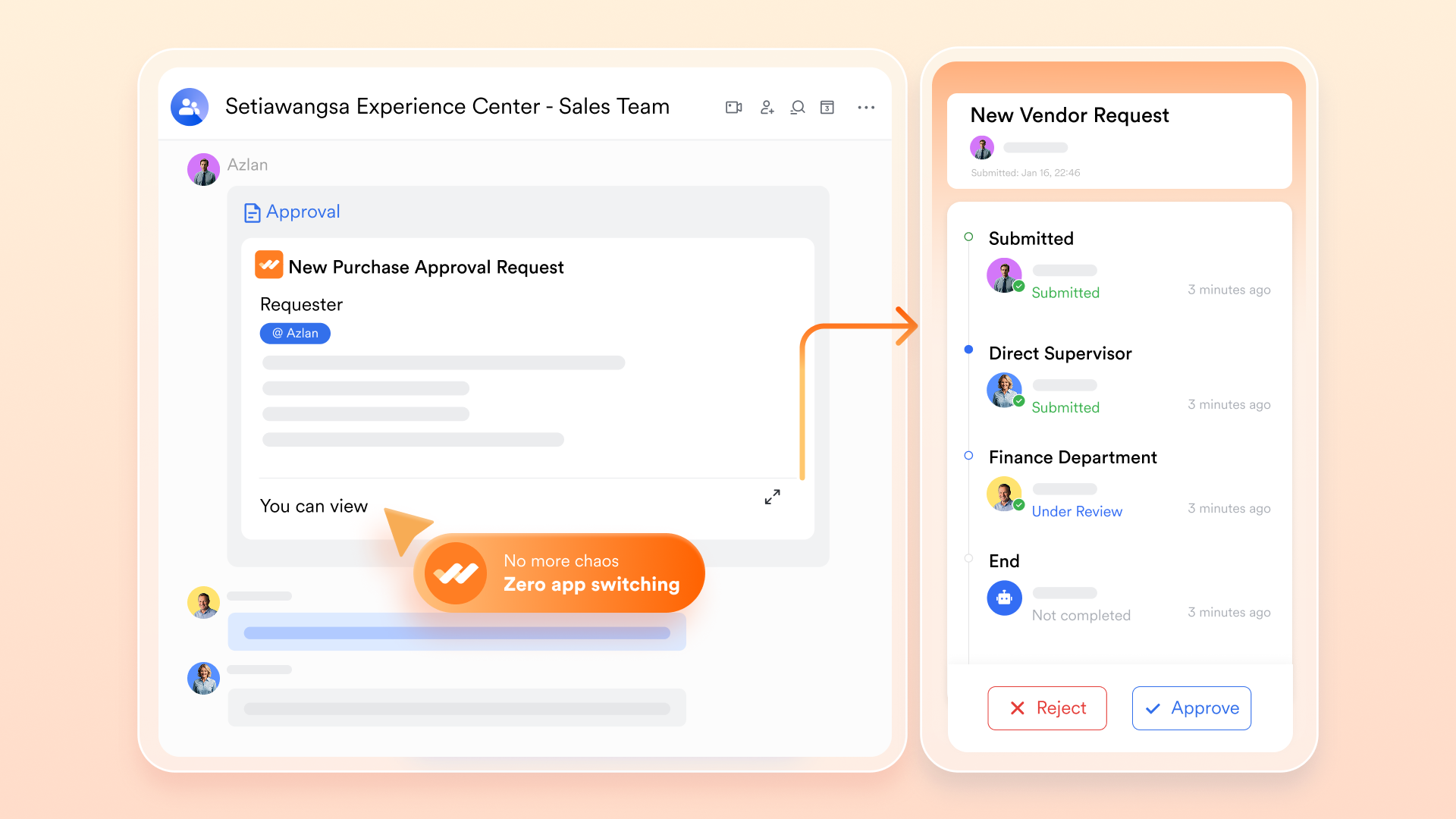
You cannot rely on a quick thumbs-up emoji to approve machine-generated assets, as models can hallucinate, generate off-brand copy, or produce non-compliant elements. Lark replaces messy email chains with automated, structured workflows.
Using , the AI-generated creative bundle is automatically routed to legal, brand, and media-buying directors before any campaign goes live. Stakeholders can review, request edits, and sign off on compliance directly within their chat feed, preventing costly brand safety errors.
Building a proprietary prompt library
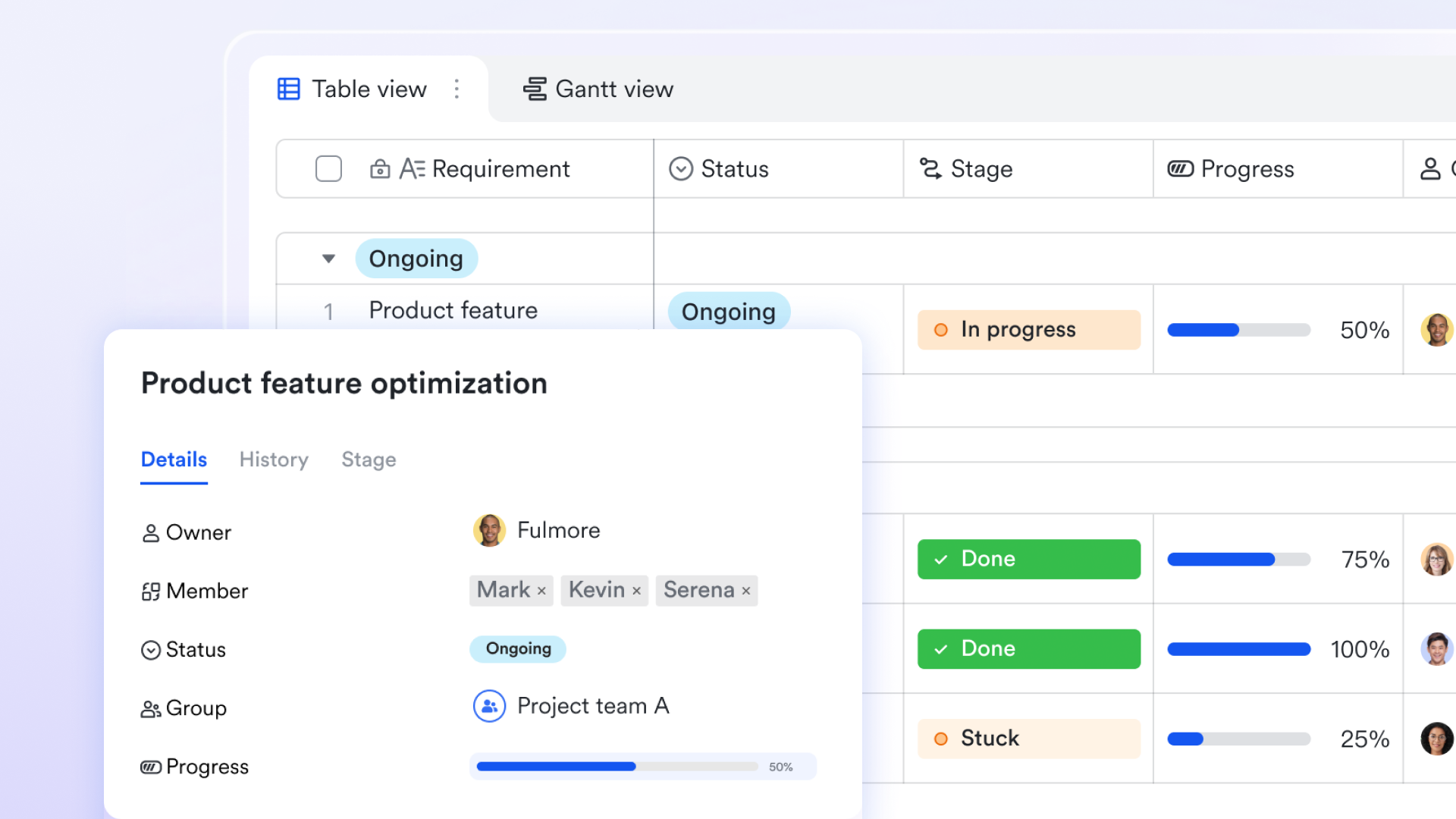
To prevent teams from starting from scratch on every campaign, successful agencies turn their prompting knowledge into reusable assets. Teams can log successful prompt variables directly in : a flexible relational database. By linking the original text prompt with the resulting generated image and its final campaign performance metrics, organizations build a searchable internal wiki. This ensures subsequent campaigns rely on proven prompt engineering rather than trial and error.
For growing agencies seeking to control software costs while scaling output, Lark provides a highly predictable pricing model that eliminates the hidden licensing fees of fragmented point solutions.
:
- Starter plan: that includes 11 powerful tools for up to 20 users. It also comes with 100GB of storage space, 1000 automation runs, AI translations, and more. No credit card needed.
- Basic plan: (billed annually) for up to 500 users. It includes everything in Starter and unlimited message history, 5TB of storage space, 1,000 automation runs, and more. Some users may need to to purchase this plan.
- Pro plan: (billed annually) for up to 500 users. It includes everything in Basic plus group calling for up to 500 attendees, 15TB of storage space, 50,000 automation runs, and more.
- Enterprise plan: for custom pricing. Supports unlimited users and includes even more automation runs and advanced security, compliance, and management features.
For small teams with simple communication needs

18 months message history
1000 Base automation runs/month
2000 rows per table in Base
Most POPULAR
For companies with comprehensive collaboration and management needs
Unlimited message history
500-participant video meetings
50k Base automation runs/month
20k rows per table in Base
For large companies with advanced security and organizational management needs
Get a personalized demo and pricing
Unlimited message history
500-participant video meetings
15 TB storage + 30 GB storage/user
500k Base automation runs/month
50k Base automation runs/month
Most POPULAR
For companies with comprehensive collaboration and management needs
Unlimited message history
500-participant video meetings
50k Base automation runs/month
20k rows per table in Base
The future landscape of AI-driven advertising
As AI adoption accelerates, the conversation is no longer just about efficiency gains today, but about how advertising will evolve in the years ahead.
Deeper AI integration: As we look further into 2026 and beyond, the role of machine learning in advertising will only deepen. Real-time optimization will become instantaneous, with predictive models adjusting bids and creative elements dynamically based on live consumer reactions in milliseconds.
Multimodal creative production: We will also see multimodal creative production become the standard. Instead of generating just text or just video, advertising platforms will simultaneously produce a cohesive blend of interactive visuals, personalized audio, and tailored copy for each specific user.
Conversational and agentic ads: search paradigms are shifting toward conversational and agentic ads, where commercial messaging appears directly within the answers provided by AI assistants.
Rising quality control demands: As the production barrier drops, the quality control barrier will rise. Platform rules, copyright laws, and consumer privacy regulations will tighten significantly. Advertising networks will likely enforce stricter disclosure requirements for machine-generated content to maintain user trust.
Process governance as the differentiator: In this future landscape, the determining factor for a successful advertising team will not be which specific model they use—since the underlying technology will be largely commoditized, but how strong their process governance is. Teams that build transparent, highly collaborative workflows today will be the ones capable of navigating the regulatory and creative complexities of tomorrow.
These shifts make one thing clear: as AI capabilities expand, success will depend not only on access to technology, but on the workflows and governance that enable teams to use it effectively.
Conclusion
AI is transforming how brands build campaigns, bringing greater speed and personalization at scale. But more variations alone do not . The real advantage comes from strong orchestration: secure, structured workflows where human judgment guides machine output. As teams adapt to this new way of working, can help streamline collaboration and make AI-driven marketing easier to manage.
Make AI teamwork work in Lark
FAQs
Is AI in advertising legal?
Yes, but marketers must carefully navigate data privacy and copyright laws. Teams need to ensure their chosen tools do not infringe on existing intellectual property, and that any customer data used for model training or targeting complies with regional regulations like GDPR or CCPA.
Will AI replace human advertisers?
No. While algorithms automate repetitive tasks like drafting copy variations or adjusting programmatic bids, they lack strategic empathy and business context. The goal of this technology is to multiply human output, allowing marketing teams to focus entirely on high-level strategy and audience psychology.
What are the best AI advertising tools?
The right choice depends on your specific bottleneck. Media buyers rely on native platform capabilities like Meta Advantage+ or Google Ads. Creative teams often use Midjourney for conceptual design, Jasper for text formatting, and LTX Studio for video production.
Should brands disclose AI-generated ads?
Yes, transparency is crucial for maintaining consumer trust. With rising skepticism toward machine-generated content—especially among younger demographics—clearly labeling these ads prevents public backlash and aligns your campaigns with increasingly strict platform regulations.
How can teams maintain brand safety with AI-generated content?
Establish strict "human-in-the-loop" workflows. Instead of publishing assets directly from a generator, use unified collaboration platforms to route all generated copy and visuals through mandatory legal and creative approval checkpoints before they ever reach the public.
Related reading