The construction industry is a massive engine of global development, but it also generates a staggering amount of debris. Studies indicate that construction and demolition (C&D) activities account for nearly one-third of the world's landfill waste. For modern contractors, construction waste management is no longer just about renting a dumpster; it is a strategic necessity that balances environmental stewardship with operational efficiency.
Moving away from the "make, use, dispose" model requires a shift in mindset. By treating waste as a resource rather than a burden, construction firms can unlock cost savings, ensure regulatory compliance, and contribute to a sustainable future. This guide explores how to master this critical process.
What is construction waste management?
Construction waste management is the systematic process of reducing, collecting, recycling, and disposing of waste generated during construction, renovation, or demolition projects. It goes far beyond simply hauling debris away. involves a hierarchy of actions designed to minimize the volume of material ending up in landfills.
At its core, this process focuses on the "3Rs": Reduce, Reuse, and Recycle.
- Source reduction: This involves preventing waste before it happens, such as ordering materials with minimal packaging or using prefabricated components.
- Salvage and reuse: This includes recovering durable items like doors, windows, or brick fixtures for use in future projects or donation.
- Recycling: This is the processing of materials like concrete, wood, and metal into new products.
Understanding the waste stream is crucial. C&D waste is typically categorized into two main types:
- Inert waste: This includes materials that do not undergo significant physical or chemical changes, such as concrete, brick, asphalt, and stone. These are often the easiest to recycle into aggregates.
- Non-inert and hazardous waste: This category includes chemically treated wood, asbestos, lead-based paint, and solvents. These materials require strict handling procedures to prevent environmental contamination and health risks.
The goal of construction waste management is to divert as much material as possible from the waste stream. In the United States, the Environmental Protection Agency (EPA) and various state bodies regulate this through the Resource Conservation and Recovery Act (RCRA), which sets the framework for managing hazardous and non-hazardous solid waste. By implementing a robust management strategy, project teams can transform potential debris into valuable commodities, closing the loop on the material lifecycle.
Manage construction waste with a clear tool
Benefits of construction waste management
Implementing a robust construction waste management strategy offers advantages that extend well beyond environmental protection. For construction business owners and , the benefits are tangible, financial, and reputational.
Economic savings and revenue generation
The most immediate benefit is the reduction of disposal costs. Landfill tipping fees are rising globally, and transporting heavy debris is expensive. By reducing the volume of waste sent to landfills, companies significantly lower these overheads. Furthermore, waste diversion can turn into a revenue stream. Materials like scrap metal, clean cardboard, and untreated timber often have market value. Selling these sorted materials to recycling facilities can offset project costs. Additionally, proper waste management allows for tax benefits in certain regions, where donations of salvaged materials to non-profits are tax-deductible.
Compliance and risk mitigation
Regulatory pressure is increasing. Local and federal governments are enforcing stricter diversion targets, and failing to comply can result in hefty fines or project shutdowns. A proactive ensures you remain compliant with laws like the RCRA and local ordinances. It also mitigates safety risks; a site cluttered with debris is a hazard for workers. Organized waste collection reduces the likelihood of trips, falls, and accidents, thereby lowering liability and insurance premiums.
Environmental impact
The environmental argument is compelling. Diverting waste preserves limited landfill space and reduces the extraction of virgin resources. For example, recycling concrete reduces the need for gravel mining, and recycling steel drastically cuts the energy required compared to producing new steel. This lowers the project's overall carbon footprint, a critical metric as the industry moves toward net-zero goals.
Enhanced brand reputation
Sustainability is a powerful differentiator. Clients are increasingly prioritizing green building standards such as LEED (Leadership in Energy and Environmental Design). Effective waste management is a prerequisite for earning LEED points, specifically under the "Materials and Resources" category. Demonstrating a commitment to sustainable practices enhances your brand's image, making your firm more attractive to eco-conscious developers and public sector clients.
Challenges in construction waste management
While the benefits are clear, the path to effective construction waste management is paved with obstacles. often face logistical, financial, and behavioral hurdles that can derail even the best-intentioned plans.
Site logistics and space constraints
One of the most practical challenges is the physical limitation of the job site. Urban construction sites often have tight footprints with little room for storage. Implementing a source-separation strategy—where different materials are sorted into separate bins (e.g., one for wood, one for metal)—requires space that may not exist. This often forces contractors to use comingled recycling, which can be less efficient and result in lower diversion rates due to contamination.
Cost and time pressures
operate on razor-thin margins and tight schedules. There is a persistent misconception that sustainable waste practices are too expensive or time-consuming. While sorting materials does require labor, the long-term savings often outweigh the initial effort. However, the immediate pressure to "get the job done" can lead crews to default to the quickest disposal method: throwing everything into a single trash dumpster.
Contamination and behavior
Successful recycling relies on human behavior. A major challenge is "bin contamination," where non-recyclable items (like lunch trash or plastic film) are thrown into clean wood or concrete bins. Once a load is contaminated, recycling facilities may reject the entire dumpster, diverting it to a landfill and charging a higher fee. Overcoming this requires consistent training and supervision, which can be difficult on transient worksites with high subcontractor turnover.
Lack of markets and infrastructure
Even if a team perfectly sorts its waste, they need somewhere to take it. In some rural or less developed regions, for recycling specific construction materials may not exist. If there is no local facility to process gypsum board or asphalt shingles, the transport costs to a distant facility may negate the environmental and economic benefits. Furthermore, the market demand for recycled materials fluctuates; if the price of scrap metal plummets, the financial incentive to recycle it diminishes.
How to manage construction waste
Creating and executing a comprehensive construction waste management strategy requires a phased approach. It begins long before the first shovel hits the ground and continues through the final handover. Here is a step-by-step framework for managing waste effectively.
Phase 1: Planning and goal setting
The foundation of success is the Waste Management Plan (WMP). This document should be integrated into the project's scope and contract documents. Ideally at the same stage you are finalising pricing with clients. Using a at this early stage ensures that waste disposal costs, hauler fees, and diversion targets are clearly scoped and communicated before work begins, avoiding disputes later.
- Set diversion targets: , such as diverting 75% of total waste from landfills. Align these goals with LEED requirements or local regulations.
- Estimate waste streams: specific projects generate specific waste. A demolition project will be heavy on concrete and steel, while a fit-out will generate cardboard and drywall. Use historical data or to forecast the types and volumes of debris you expect.
- Assign responsibility: Designate a "Waste Champion" on site. This person is responsible for monitoring bins, coordinating with haulers, and educating the crew.
Phase 2: Design and procurement
Waste prevention is superior to waste management.
- Design for standard dimensions: Architects can reduce cutoff waste by designing rooms to fit standard material sizes (e.g., 4x8 drywall sheets).
- Prefabrication: utilizing off-site manufacturing for wall panels or trusses significantly reduces on-site debris, as factories can recycle scraps more efficiently.
- Smart purchasing: Avoid over-ordering. Work with suppliers who offer "take-back" programs for packaging or pallets. Request that materials be delivered with minimal packaging protection.
Phase 3: On-site execution strategies
This is where the plan meets reality. You must decide between two primary sorting methods:
- Source separation: Crews separate materials into dedicated bins on-site (Wood, Metal, Concrete, Trash). This yields the highest revenue and recycling rates but requires significant site space and strict discipline.
- Commingled recycling: All recyclable waste goes into one bin, which is sorted off-site at a Material Recovery Facility (MRF). This saves space and is easier for workers, but typically has lower diversion rates due to contamination.
Regardless of the method, clear communication is vital. Use consistent, color-coded signage on all dumpsters. Pictures are often more effective than text, especially on multilingual job sites.
Phase 4: Vendor selection and hauling
Choose your waste haulers carefully. Do not just look at the price per haul; ask about their diversion rates.
- Verify facilities: Ask where the waste goes. A reputable hauler should provide tickets proving that the material was taken to a recycling facility, not a landfill.
- Contractual requirements: Include clauses in hauling contracts that require them to provide monthly reports on tonnage and diversion percentages.
Phase 5: Monitoring and documentation
You cannot manage what you do not measure. Throughout the project, maintain a "waste log."
- : Record the date, hauler, material type, weight, and destination for every container leaving the site.
- Conduct spot checks: Regularly inspect dumpsters before they are hauled. If you see contamination, conduct a "toolbox talk" to retrain the crew immediately.
- Final reporting: At the end of the project, compile all data into a final report. This serves as proof of compliance for green building certifications and provides a benchmark for future projects.
By rigorously following these steps, you transform waste management from a reactive headache into a proactive, value-added process.
Gain real-time construction management with a smart tool
How Lark can improve construction waste management
In the digital age, managing complex logistics with clipboards and spreadsheets is inefficient. , an all-in-one productivity suite, offers a powerful ecosystem to digitize and streamline your construction waste management workflow. By centralizing communication, documentation, and data tracking, Lark helps bridge the gap between office planning and field execution.
Centralized planning with Lark Docs
The Waste Management Plan (WMP) is a living document that needs to be accessible to everyone, from the project manager to the site superintendent.
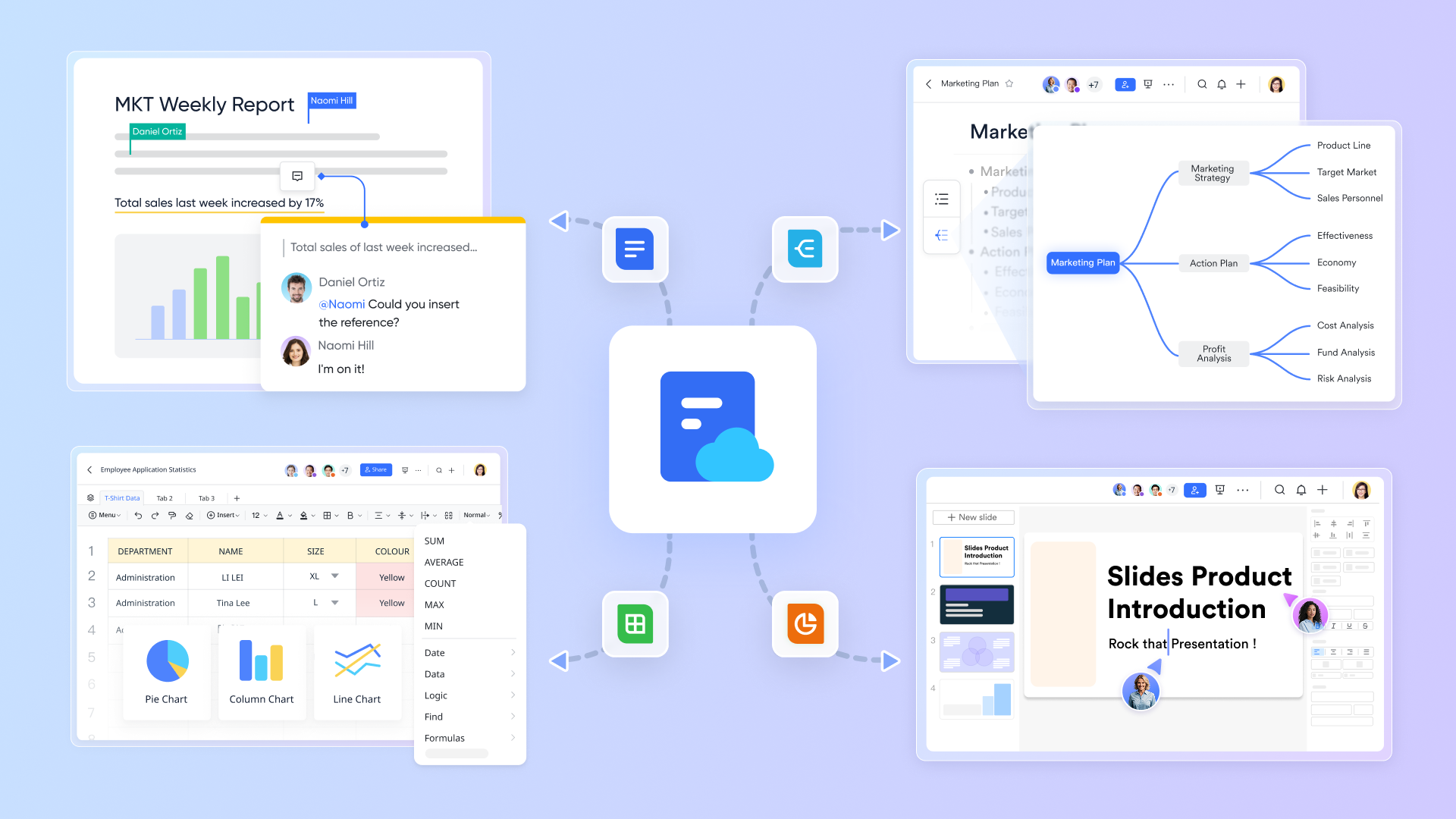
- Collaborative WMPs: Instead of a static PDF, use to create a dynamic WMP. You can insert tables, checklists, and guidelines that team members can edit in real-time.
- Mobile access: Field staff can access the plan directly on their smartphones via the Lark app. If a subcontractor is unsure which bin to use for a specific material, they can search the doc instantly rather than guessing.
Data tracking and visualization with Lark Base
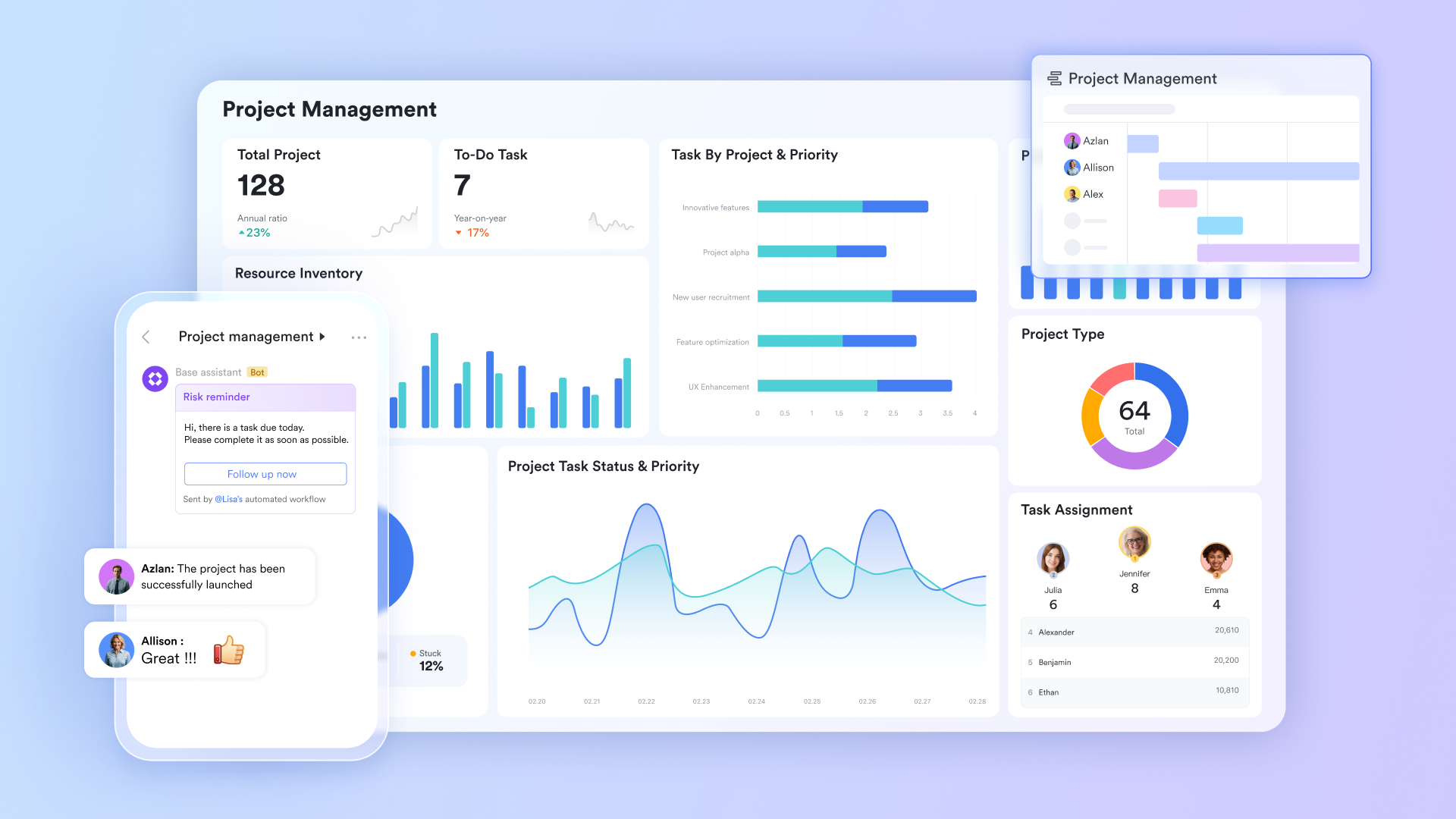
Tracking tons of concrete and steel requires a robust database. is a flexible, no-code database that serves as the "brain" of your waste operations.

- Digital waste logs: Create a "Waste Tracking" Base. Set up columns for "Date, Material Type, Hauler, Weight (tons), Cost, and Diversion Status". Instead of filing paper tickets, the site admin can input this data directly into Base.
- Automated dashboards: Lark Base can automatically visualize this data. You can build a dashboard that shows a real-time pie chart of your waste composition or a line graph tracking your diversion rate against your 75% goal. This gives instant visibility into performance without needing to crunch numbers manually.
- Vendor management: Maintain a separate table in Base for all your approved waste haulers, including their contact info, pricing, and license expirations. Link this to your waste log to track which vendor is performing best.
- Templates: Create a master WMP template in Lark Base that includes standard diversion goals and local vendor lists. This allows you to spin up a new plan for a new project in minutes.
Real-time coordination via Lark Messenger
Speed is critical on a job site. If a dumpster is full, it needs to be swapped out immediately to prevent overflow and safety hazards.

- Dedicated project threads: Create a specific chat group in for "Site Logistics."
- Photo updates: When a bin is full or if a crew member spots contamination, they can snap a photo and post it to the group. "Wood bins are 90% full, need a swap," or "Please stop putting lunch trash in the metal bin."
- Instant alerts: Work with Lark Base and Lark Messenger. Configure a bot to send an automatic alert to the chat group when waste disposal costs for the month exceed the budget.
Accountability with Lark Tasks
Ensuring compliance often falls through the cracks. Lark Tasks ensures that waste management duties are assigned and completed. 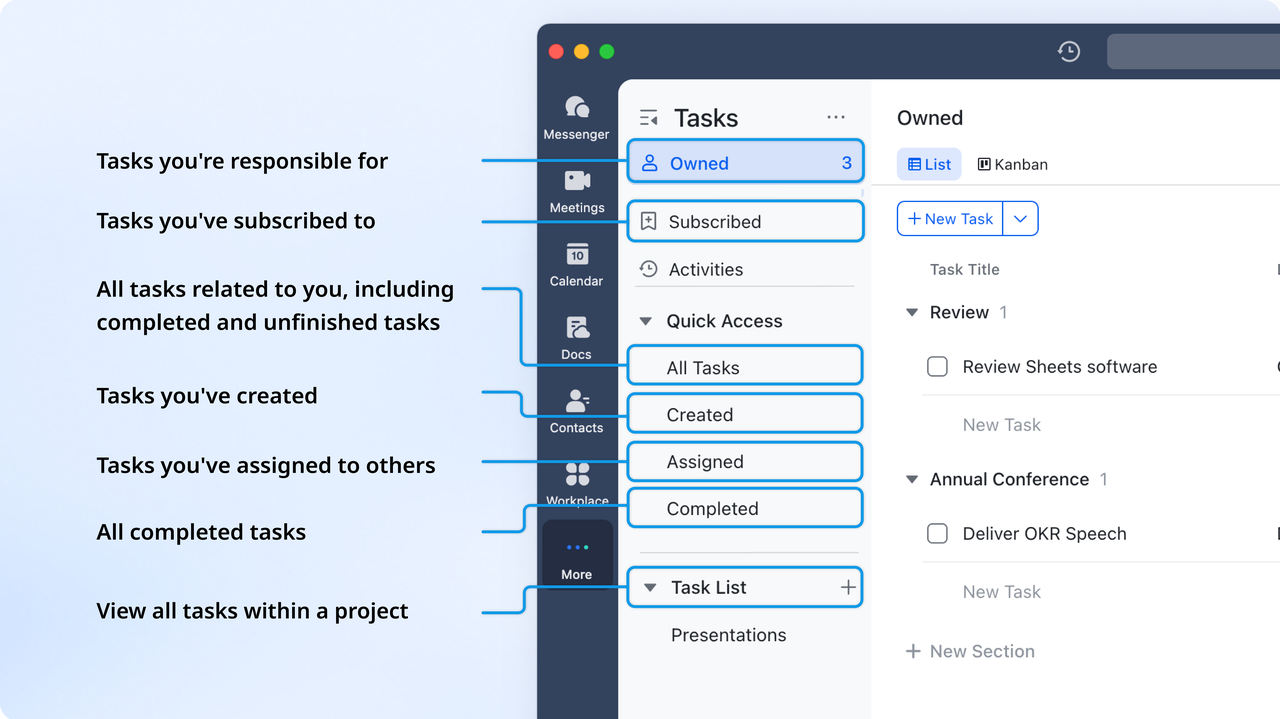
- Recurring inspections: Set up a recurring task for the site superintendent: "Weekly Dumpster Inspection." They can check a box on their phone to confirm it's done.
- Corrective actions: If contamination is found, assign a task to the specific subcontractor foreman: "Clean out plastic from wood bin by EOD." You can track the status of this task to ensure it gets done.
:
- Starter plan: Free forever plan that includes 11 powerful tools for up to 20 users. It also comes with 100GB of storage, 1000 automation runs, AI translations, and more.
- Pro plan: $12/user/month (billed annually) for up to 500 users. It includes everything in Starter plus group calling for up to 500 attendees, 15TB of storage, 50,000 automation runs, and more.
- Enterprise plan: for custom pricing. Supports unlimited users and includes even more automation runs and advanced security, compliance, and management features.
For small teams with simple communication needs

18 months message history
1000 Base automation runs/month
2000 rows per table in Base
Most POPULAR
For companies with comprehensive collaboration and management needs
Unlimited message history
500-participant video meetings
50k Base automation runs/month
20k rows per table in Base
For large companies with advanced security and organizational management needs
Get a personalized demo and pricing
Unlimited message history
500-participant video meetings
15 TB storage + 30 GB storage/user
500k Base automation runs/month
50k Base automation runs/month
Most POPULAR
For companies with comprehensive collaboration and management needs
Unlimited message history
500-participant video meetings
50k Base automation runs/month
20k rows per table in Base
Future of construction waste management
The future of construction waste management is being shaped by rapid technological advancements and a shift toward a circular economy. As the industry evolves, we are moving from simple recycling to a model where waste is designed out of the system entirely.
The rise of the circular economy
The traditional linear model (take-make-waste) is being replaced by circular construction. This involves "Design for Deconstruction" (DfD), where architects design buildings specifically to be disassembled at the end of their life. Instead of demolition balls, future projects will see buildings carefully taken apart, with components like steel beams and floor tiles tagged for direct reuse in new structures.
Technology and automation
Technology will play a pivotal role in sorting and tracking.
- AI and robotics: Advanced recycling facilities are beginning to use (AI) and robotic arms to sort C&D waste with superhuman speed and accuracy. This increases the purity of recycled materials, making them more valuable.
- IoT sensors: Smart dumpsters equipped with Internet of Things (IoT) sensors can monitor fill levels in real-time. They alert haulers exactly when a pickup is needed, optimizing truck routes and reducing carbon emissions from unnecessary transport.
- Blockchain tracking: To prevent illegal dumping, blockchain technology may soon be used to create an immutable digital ledger for waste. This would allow owners to trace every ton of debris from the site to its final processing facility, guaranteeing 100% compliance.
Industrialized construction
The shift toward modular and off-site construction will naturally drastically reduce on-site waste. In a controlled factory environment, cut-offs are minimized, and scraps are immediately recycled. As this method becomes the norm, the volume of waste leaving actual construction sites will plummet.
Turn your waste management into a digital powerhouse
Conclusion
Construction waste management is a complex challenge, but it is also a massive opportunity. By adopting a structured approach with Lark—from smart planning and design, to rigorous on-site execution—construction firms can save money, protect the environment, and build a reputation for responsibility.
The tools to succeed are already available. Whether it is leveraging advanced recycling techniques or utilizing digital platforms like Lark to streamline planning and tracking, the power to change is in your hands. The future of construction is not just about what we build, but what we leave behind. It is time to build a cleaner, more sustainable industry, one sorted bin at a time.
FAQs
What are the "3Rs" in construction waste management?
The "3Rs" framework—Reduce, Reuse, and Recycle—is the hierarchy used to minimize landfill waste. Reduce involves preventing waste before it occurs, such as ordering precise material quantities or using prefabrication. Reuse focuses on salvaging durable items like doors, windows, and fixtures for use in future projects or donations. Recycling is the process of breaking down debris like concrete, steel, and wood to manufacture new products. Following this hierarchy lowers costs and environmental impact.
Can construction waste management actually save money?
Yes, effective waste management often reduces overall project costs. While sorting requires labor, it drastically lowers "tipping fees" charged by landfills, which are rising globally. Furthermore, separating waste turns debris into a commodity; materials like scrap metal, cardboard, and untreated timber can often be sold to recycling facilities, generating revenue that offsets handling costs. Additionally, some regions offer tax deductions for donating salvaged building materials to non-profit organizations.
Is it better to separate waste on-site or use a single bin?
Source separation (sorting materials into dedicated bins on-site) is typically better because it keeps materials clean, ensuring the highest recycling rates and resale value. However, on job sites with severe space constraints, commingled recycling (placing all recyclables in one bin) is a practical alternative. While commingled recycling is easier for crews, it requires sending the waste to a specialized Material Recovery Facility (MRF) for sorting, which can sometimes result in lower diversion rates due to contamination.
What should be included in a Waste Management Plan (WMP)?
A comprehensive Waste Management Plan (WMP) acts as a roadmap for the project. It should clearly define diversion goals (e.g., diverting 75% of waste from landfills), estimate the types and volumes of waste expected, and specify the recycling facilities and haulers to be used. The plan must also outline on-site procedures for sorting and assign a specific person (a "Waste Champion") to monitor compliance, track waste tickets, and train the crew.
Related reading