














The Ultimate Guide to CRM for Tax Professionals

Fecilia Clarke
Solutions Marketing Specialist
Sep 18, 2026
Fecilia Clarke
Sep 18, 2026

16 min read


Is the rhythm of your year dictated by the chaos of tax season? For many a tax professional, the period from January to April is a blur of chasing clients for documents, managing scattered communications, and battling administrative overload, all while navigating the pressure of critical deadlines. This cycle consumes valuable time that could be spent on high-value advisory service, improving client relationships, and strategic growth. But what if there was a way to break this pattern? The most successful accounting firms aren't just working harder; they are fundamentally changing how they work by embracing technology designed for their unique challenges and business processes.
This is where a specialized Customer Relationship Management (CRM) system comes in. It’s far more than just a digital address book; a CRM for tax professionals acts as the central nervous system for your entire practice. It is a strategic tool designed to automate workflow automation, secure client data, and unify communication into a single, cohesive hub. The right CRM doesn't just manage clients — it streamlines every process from onboarding to filing, freeing up time for high-value advisory work, and helping firms coordinate more smoothly with other key resources, including the best tax filling services. This guide will walk you through what to look for, compare the top options, and show you how to choose the perfect solution to build a more efficient, profitable, and composed accounting business.

Key takeaways: Top 8 CRM for tax professionals in 2026
1. Lark: The all-in-one suite that unifies client work, communication, and collaboration
2. TaxDome: The turnkey practice management platform built specifically for tax and accounting firms.
3. Canopy: The modular practice management suite for firms that want a modern, user-friendly experience.
4. Karbon: The communication-centric work platform for collaborative firms.
5. Salesforce Financial Services Cloud: The enterprise-grade CRM for large, growth-focused firms.
6. HubSpot CRM: The marketing-focused platform with a powerful free starting point.
7. ClickUp: The ultra-flexible productivity platform for tech-savvy firms that love to customize.
8. Monday.com: The visual Work OS for firms that prioritize intuitive project management.
Top CRM tools for tax professionals: A detailed comparison
Choosing the right software is a critical business decision that will shape your firm's operations for years to come. The market is filled with options, from all-in-one platforms designed specifically for accountants to flexible, general-purpose tools that can be customized for your needs.
To help you navigate the choices, we've compared best 8 CRM solutions available for tax and accounting firms. We evaluated them based on their core features, strengths for the modern tax professional, and general pricing structure to provide a clear, comprehensive overview.
1. Lark: The all-in-one suite that unifies client work, communication, and collaboration
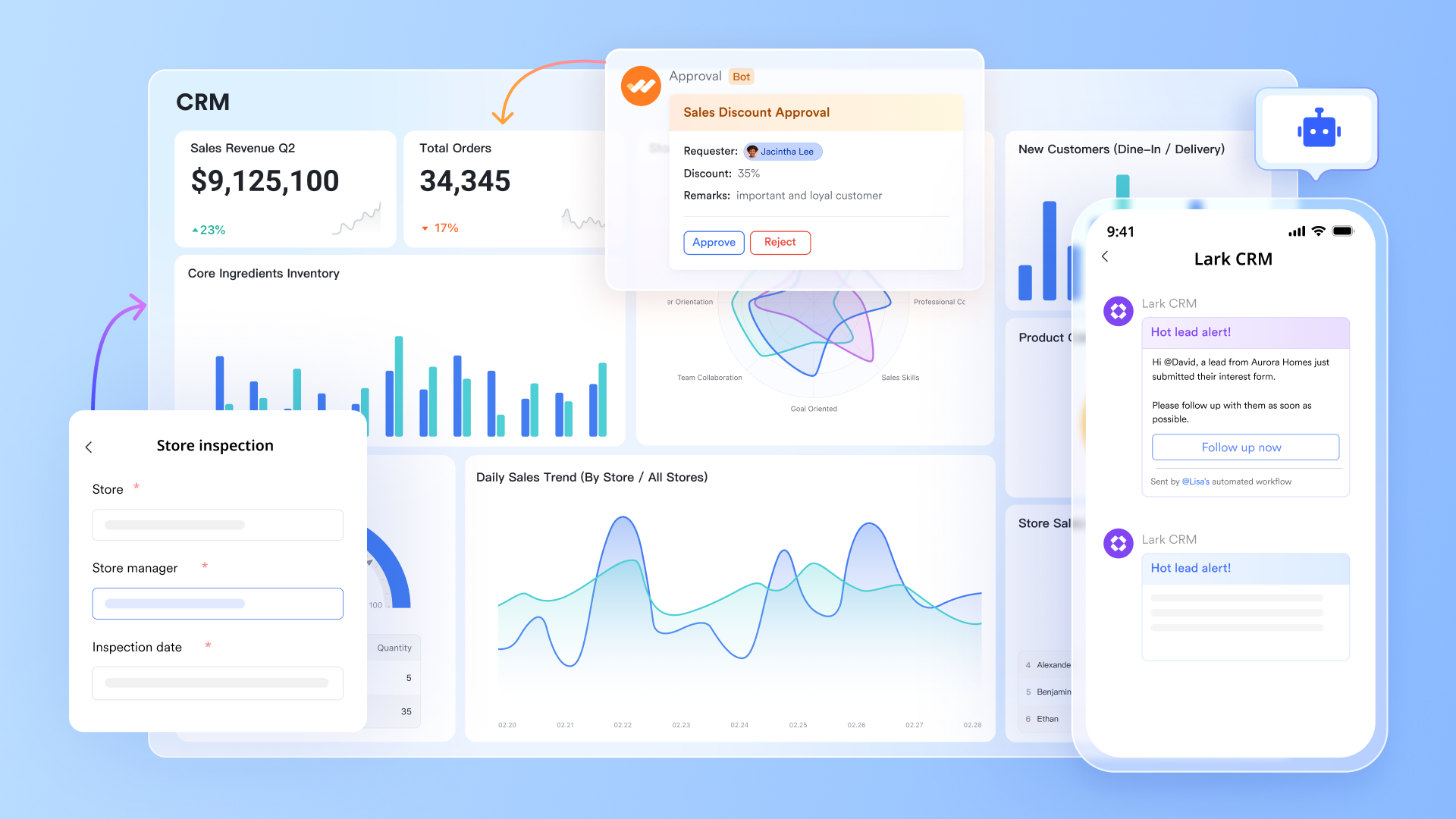
Overview:
Lark transcends the traditional definition of a CRM by offering a robust suite of tools where client management, collaboration, and communication converge. Instead of a siloed database, Lark provides a connected workspace. You can build a highly customizable client CRM directly in Lark Base, automate workflows from intake to filing, and manage every related document and conversation in one platform.
This unified approach eliminates the friction of switching between apps, creating a truly seamless operational hub for your tax practice. It's designed for firms, from small teams to medium sized businesses, that want to solve core CRM needs while fundamentally improving client engagement and how their team collaborates.
Key features:
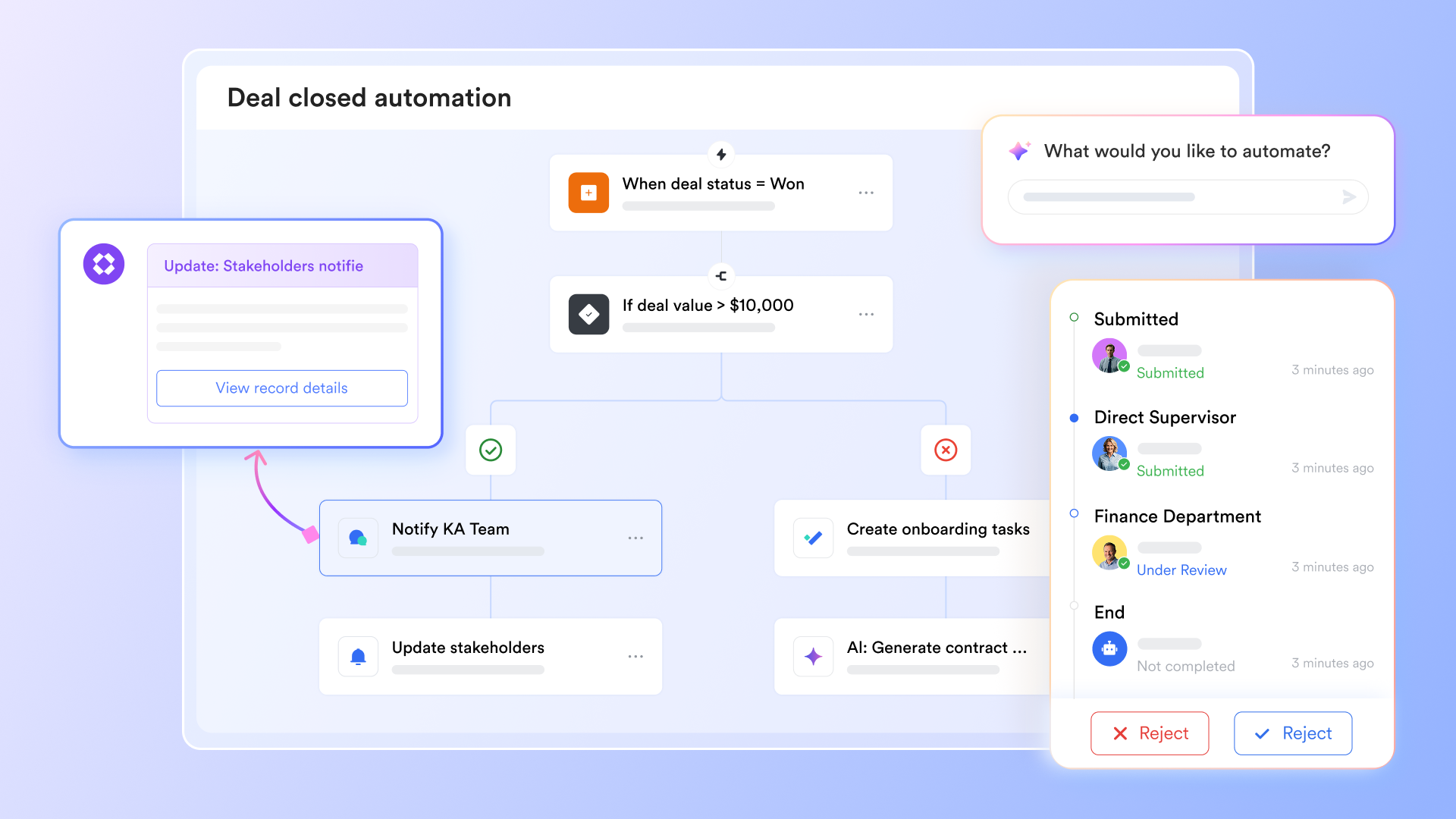
- Custom CRM & Workflow automation: Build your ideal client management system from the ground up using Lark Base. Create a powerful, flexible database to track every client detail, deadline, and status, then design automated approval that match your firm's exact processes, from onboarding to filing.
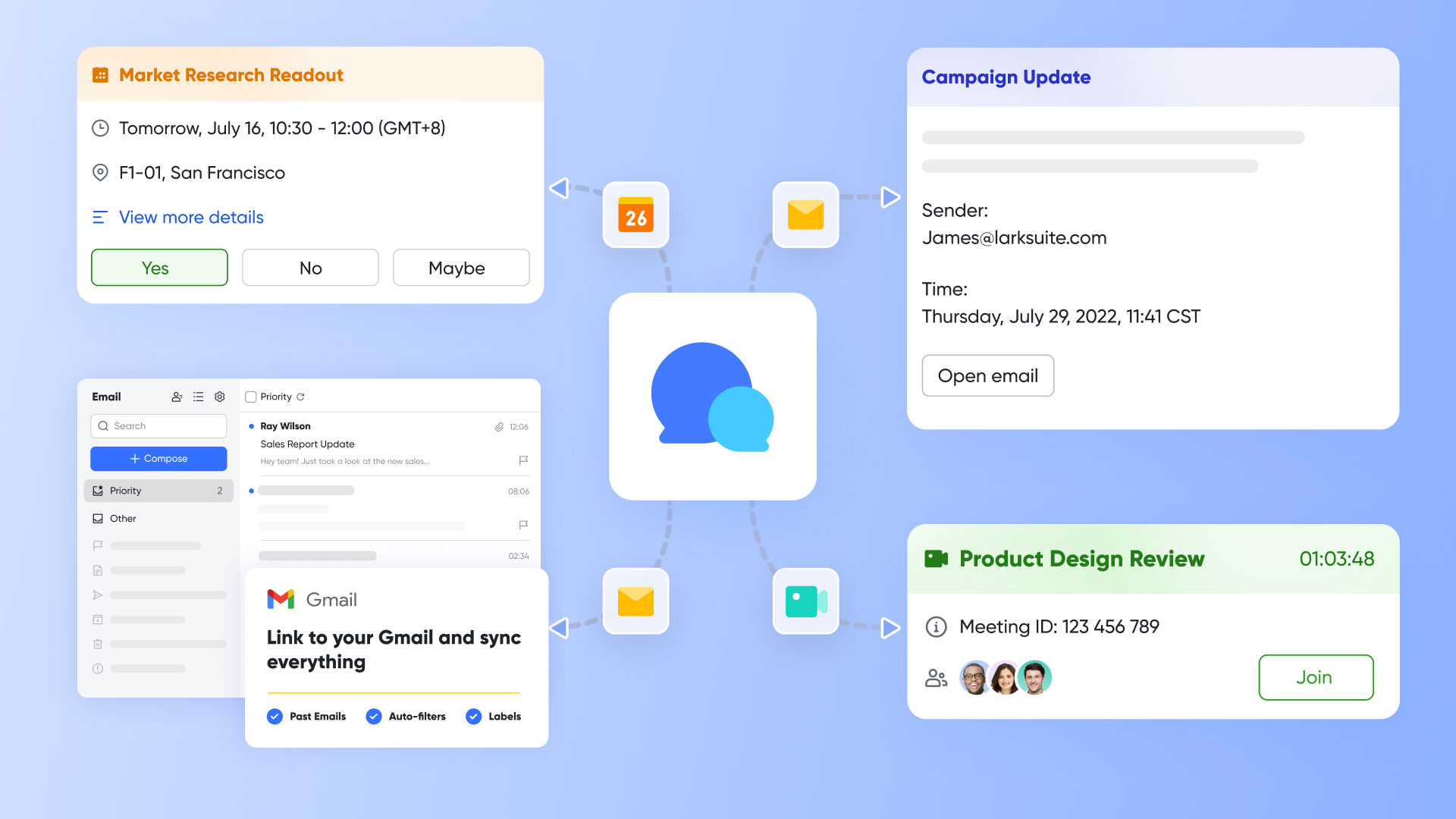
- Unified communication hub: Eliminate the need to switch between apps by bringing team chat, video meetings, email, and calendar into a single platform. Discuss client matters, host secure video calls, and manage schedules from one central hub, ending context-switching.
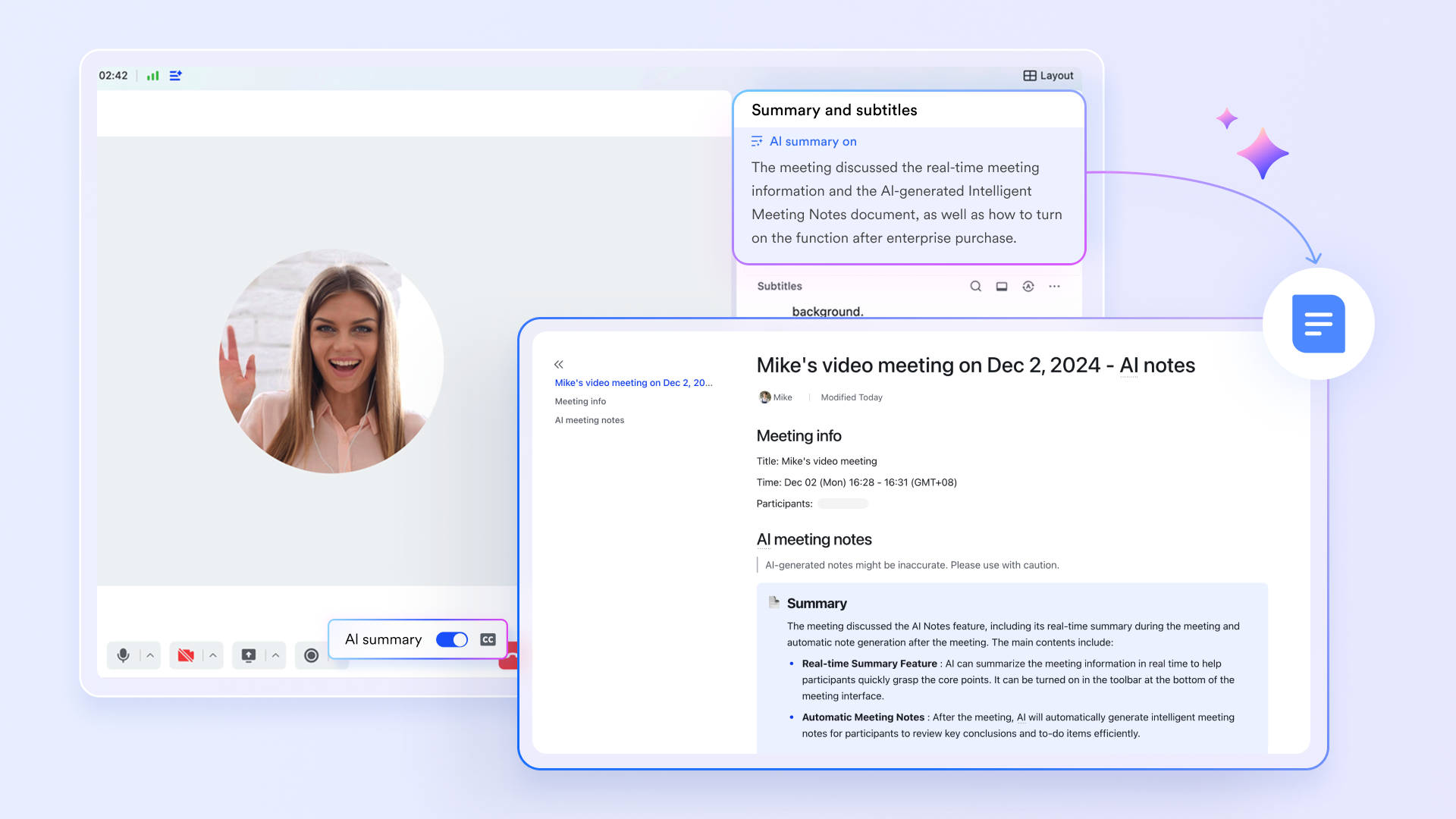
- AI-powered meetings: Never miss a critical detail from a client call again with Lark Minutes and AI Meeting Notes. Automatically generate accurate transcripts, concise summaries, and actionable to-do lists from your video meetings, ensuring perfect recall and immediate follow-through without manual note-taking.
- Collaborative document & wiki hub: Co-edit engagement letters and financial reports in real-time with Lark Docs. Build a centralized and secure knowledge base for your firm or for specific clients using Lark Wiki, eliminating version control issues and creating a single source of truth.
- Automated client onboarding: Streamline client intake with Lark Forms. Create custom, secure forms for new clients or annual data collection, and have the submitted information automatically populate your CRM in Lark Base, completely eliminating manual data entry.
Pricing:
- Free plan: Includes 11 powerful products, supporting up to 20 users, 100 GB storage, 1,000 automation runs and unlimited AI translation in chats, docs and email.
- Paid plans: Starts at $12/user/month, supporting up to 500 users. Includes unlimited message history, 50,000 automated Base workflow executions per month.
- Enterprise plan: Custom pricing.
2. TaxDome: The turnkey practice management platform built specifically for tax and accounting firms.
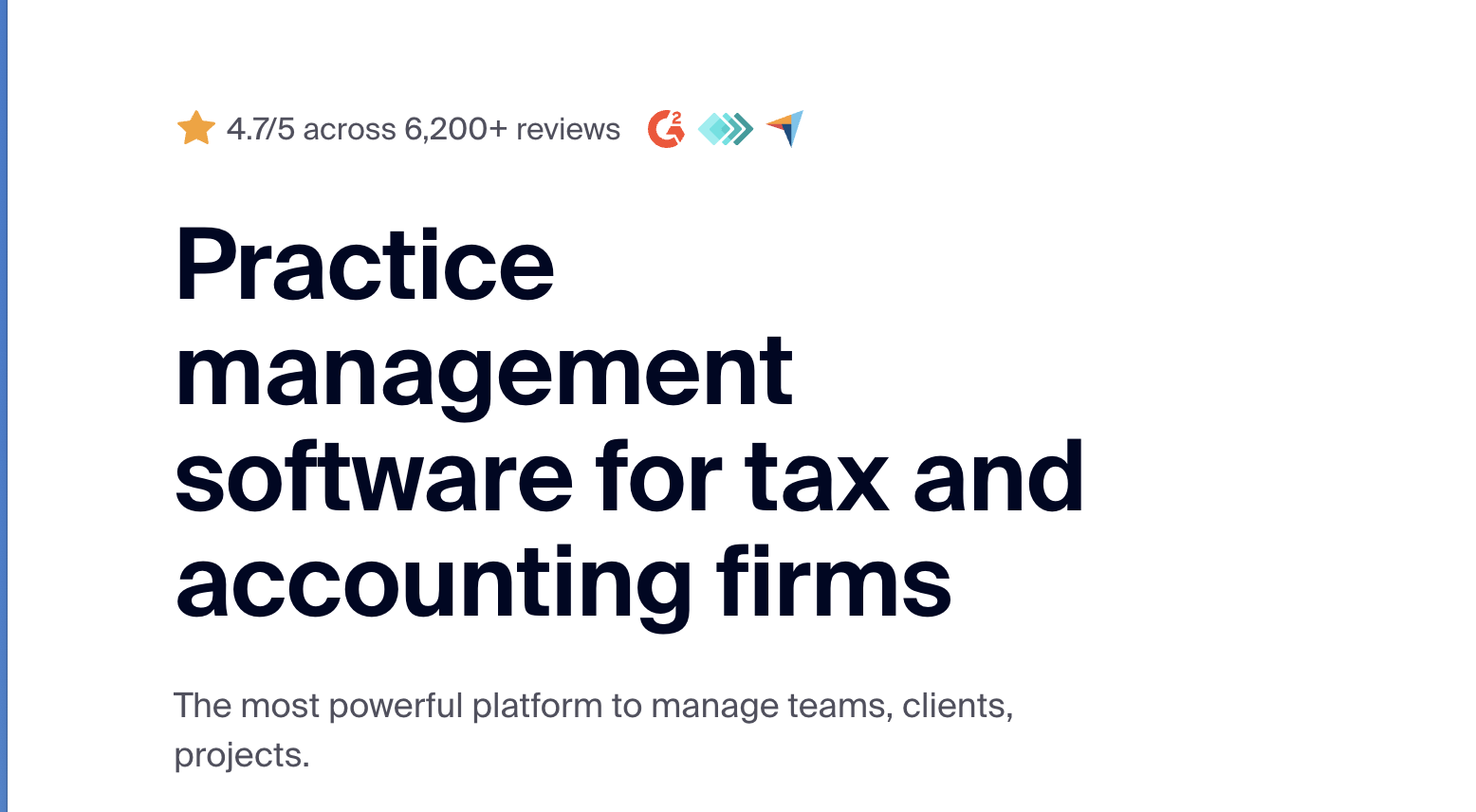
Image source: taxdome.com
Overview: TaxDome is a widely recognized all-in-one practice management platform built specifically for accountants and tax professionals. Its core strength lies in providing a comprehensive, out-of-the-box solution that covers nearly every aspect of firm operations. It bundles a CRM with a secure client portal, unlimited e-signatures, workflow automation, and billing. This integrated approach aims to replace the patchwork of different software many firms use, offering a single subscription for all essential functions. It's a strong choice for firms that want a turnkey solution designed from the ground up for the tax industry.
Key features:
- Robust client portal with secure messaging and file sharing.
- Pipeline-based workflow automation with customizable templates.
- Unlimited e-signatures compliant with IRS requirements.
- Integrated invoicing, payments, and engagement letters.
Pricing: Paid plans start at $700/year with a 3-year commitment.
3. Canopy: The modular practice management suite for firms that want a modern, user-friendly experience.

Image source: canopy.com
Overview: Canopy is another leading practice management suite designed for accounting professionals, offering a modern user friendly interface. It provides a modular approach, allowing firms to purchase the specific tools they need, such as Document Management, Workflow, and a Client Portal. This flexibility can be appealing for firms that want to adopt a new system gradually. Its CRM capabilities are tightly woven into its task management and document handling features, making it a cohesive platform for managing client work from start to finish and helping to enhance client relationships.
Key features:
- Modular system to customize the platform to your firm's needs.
- Secure client portal with client-facing task requests.
- Advanced document management with OCR capabilities.
- Time and billing features integrated with workflow tasks.
Pricing: Canopy's pricing is modular. Firms subscribe to the specific modules they need, with costs scaling based on the number of users and selected features.
4. Karbon: The communication-centric work platform for collaborative firms.
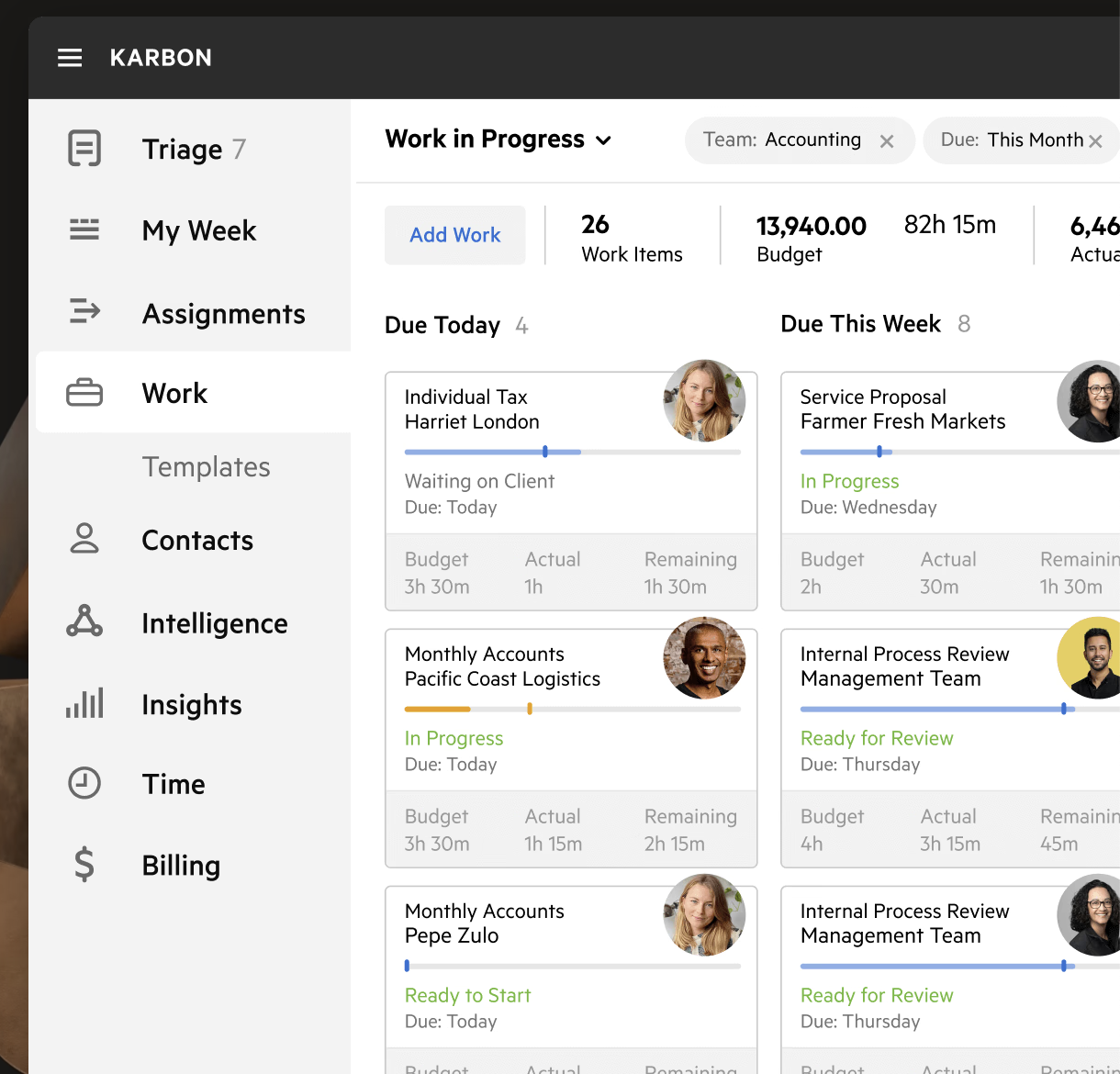
Image source: karbonhq.com
Overview: Karbon is a collaborative work management platform that positions itself as the central communication hub for accounting firms. Its unique strength is its Triage feature, which brings all emails, internal comments, and tasks into a single inbox. While it functions as a CRM by managing client data and communication, its primary focus is on workflow automation and team collaboration. Karbon is built to provide deep visibility into what the firm is working on, who is responsible, and where bottlenecks are occurring, improving overall efficiency.
Key features:
- Unified Triage inbox for managing all firm communications.
- Powerful workflow automation with extensive template libraries.
- Client tasks that allow for automatic client chasing.
- Deep analytics on firm efficiency and performance.
Pricing: Karbon's pricing is per-user, per-month, typically billed annually. It offers different tiers based on the level of features and automation required.
5. Salesforce Financial Services Cloud: The enterprise-grade CRM for large, growth-focused firms.
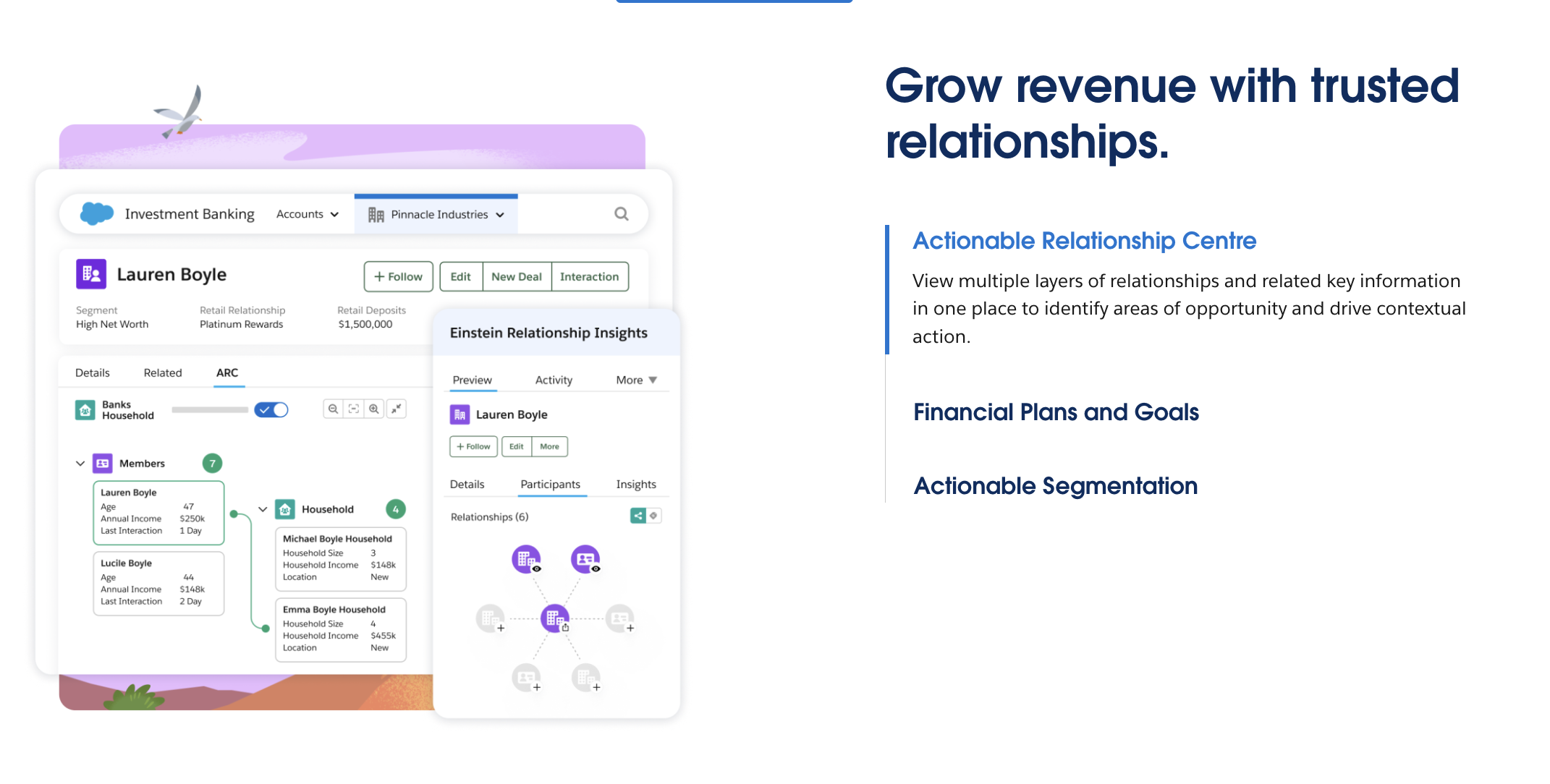
Image source: salesforce.com
Overview: Salesforce is a global leader in CRM, and its Financial Services Cloud can be adapted for accounting practices. Its strengths lie in its deep relationship tracking capabilities, powerful real time analytics, and extensive integration marketplace. This option is best suited for larger, growth-focused firms that need a highly customizable platform and have the resources to invest in its implementation, which often requires a dedicated sales process to purchase and set up. It offers a powerful form of client relationship management.
Key features:
- Advanced relationship mapping to track complex client connections.
- Powerful customization to build custom objects and workflows.
- Extensive AppExchange for third-party integrations.
- Robust reporting and dashboard analytics.
Pricing: Salesforce is a premium product. Pricing for Financial Services Cloud is on a per-user, per-month basis and is at the higher end of the market. Custom pricing is common.
6. HubSpot CRM: The marketing-focused platform with a powerful free starting point.
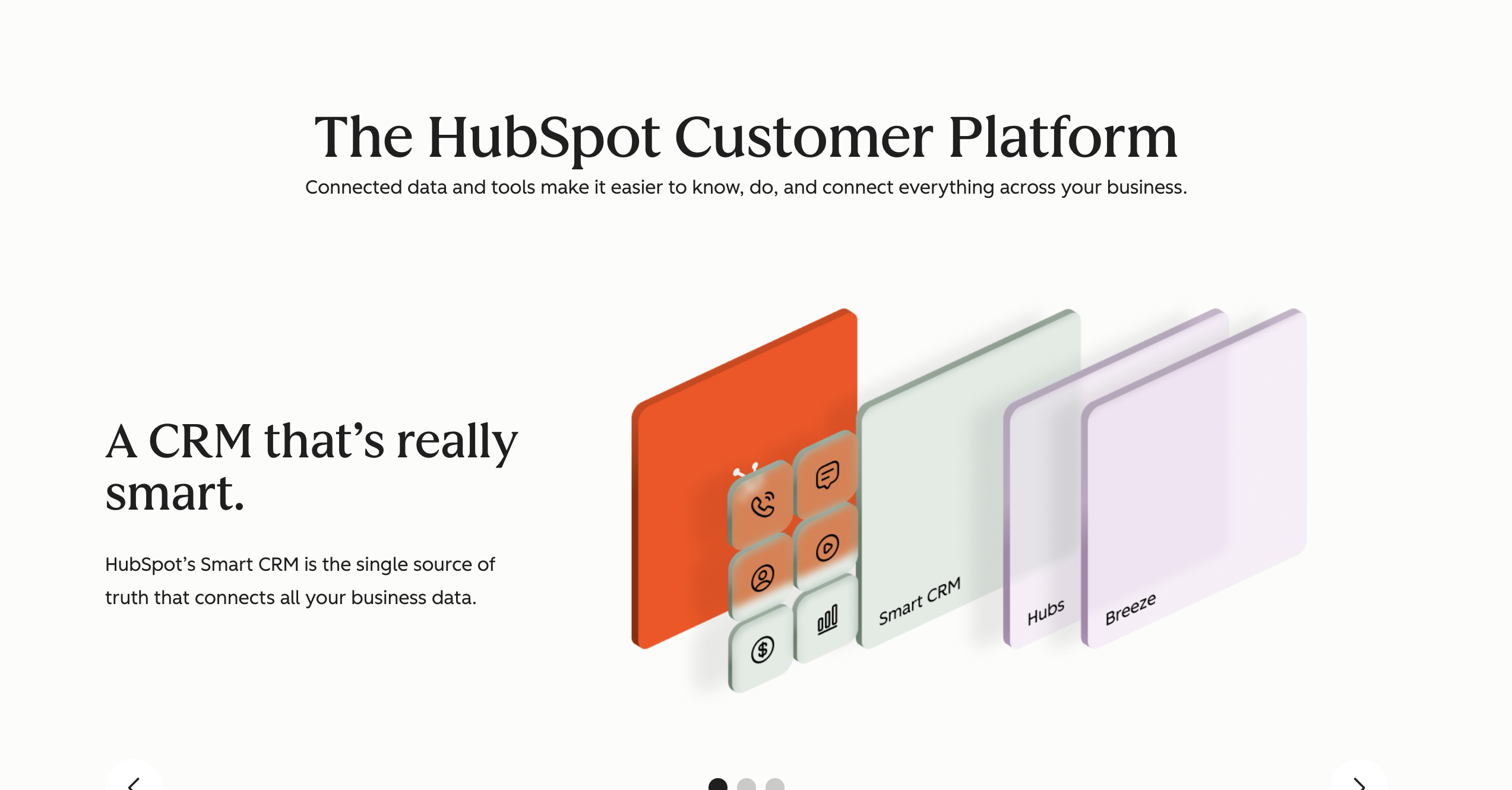
Image source: hubspot.com
Overview: HubSpot is a popular all-in-one platform known for its marketing, sales, and service tools. Its powerful free CRM offering can be a great starting point for solo practitioners and small teams. It excels at lead management and email marketing automation. To get features more aligned with tax practice management, such as advanced automation and customized objects, you would need to subscribe to its paid "Hubs." HubSpot is an excellent choice for firms focused on marketing and growing their client base.
Key features:
- Generous free version for contact and deal management.
- Excellent email marketing automation and lead generation tools.
- User friendly interface that is easy to learn.
- Large marketplace for third-party app integrations.
Pricing: HubSpot offers free fundamental CRM tools. Paid plans (Marketing, Sales, and Service Hubs) are available in tiered subscriptions that unlock more advanced features.
7. ClickUp: The ultra-flexible productivity platform for tech-savvy firms that love to customize.
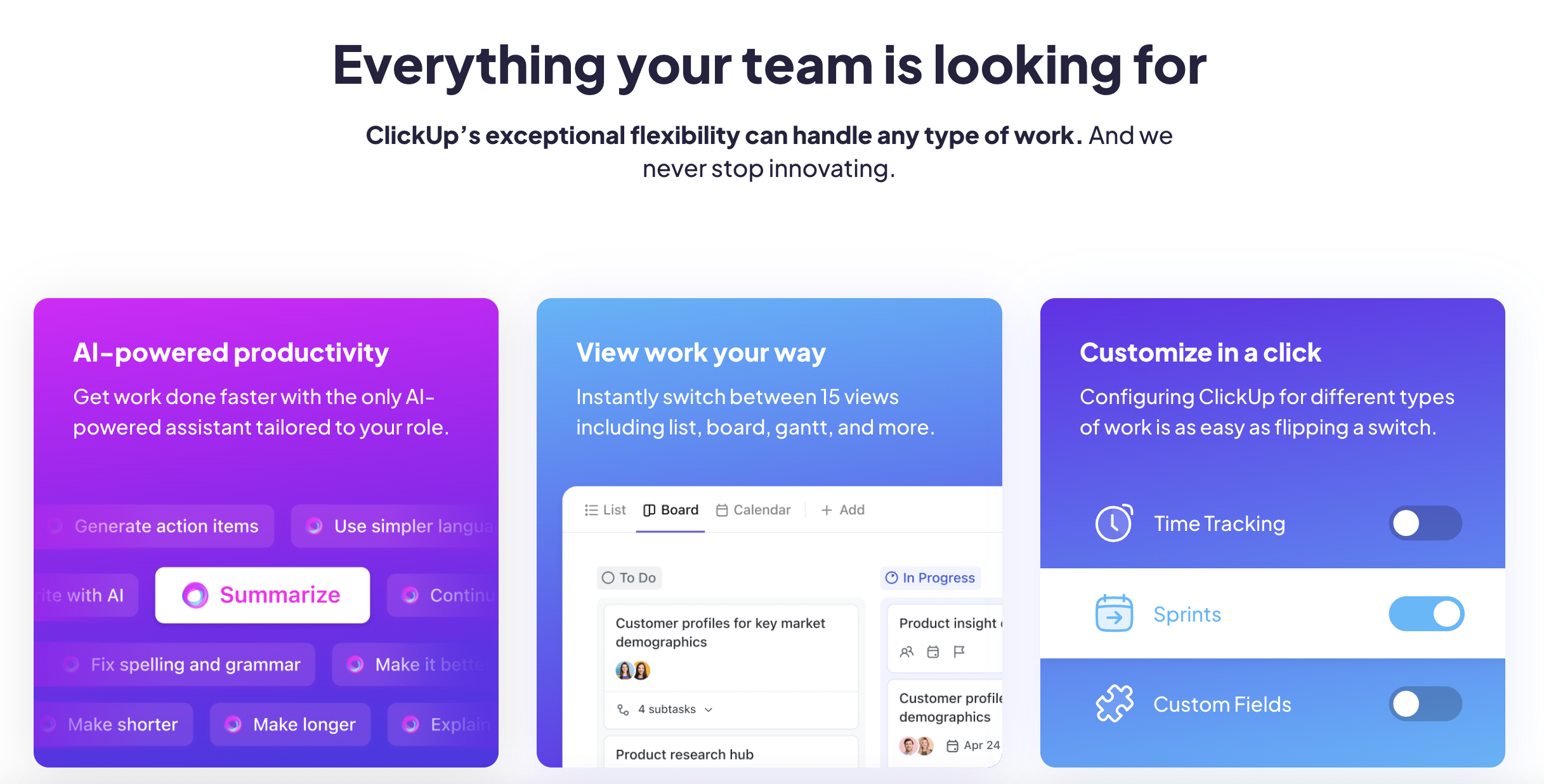
Image source: clickup.com
Overview: ClickUp is a highly flexible, all-in-one productivity platform that can be fully customized to function as a powerful CRM for tax professionals. Users can create custom fields to track client information, build complex task dependencies for tax season workflows, and use different views to manage projects. Its main advantage is its versatility and affordability. It's a great option for tech-savvy firms that enjoy building and fine-tuning their own perfect system from a set of powerful building blocks, effectively creating a highly customizable workspace for their daily operations.
Key features:
- Highly customizable tasks with custom fields, statuses, and checklists.
- Multiple project views (List, Board, Calendar, Gantt).
- Built-in document creation, whiteboards, and goal tracking.
- Affordable pricing with a feature-rich free plan.
Pricing: ClickUp has a popular "Free Forever" plan, with paid tiers, starting from $7/user/month, that add more advanced features, storage, and guest access.
8. Monday.com: The visual Work OS for firms that prioritize intuitive project management.
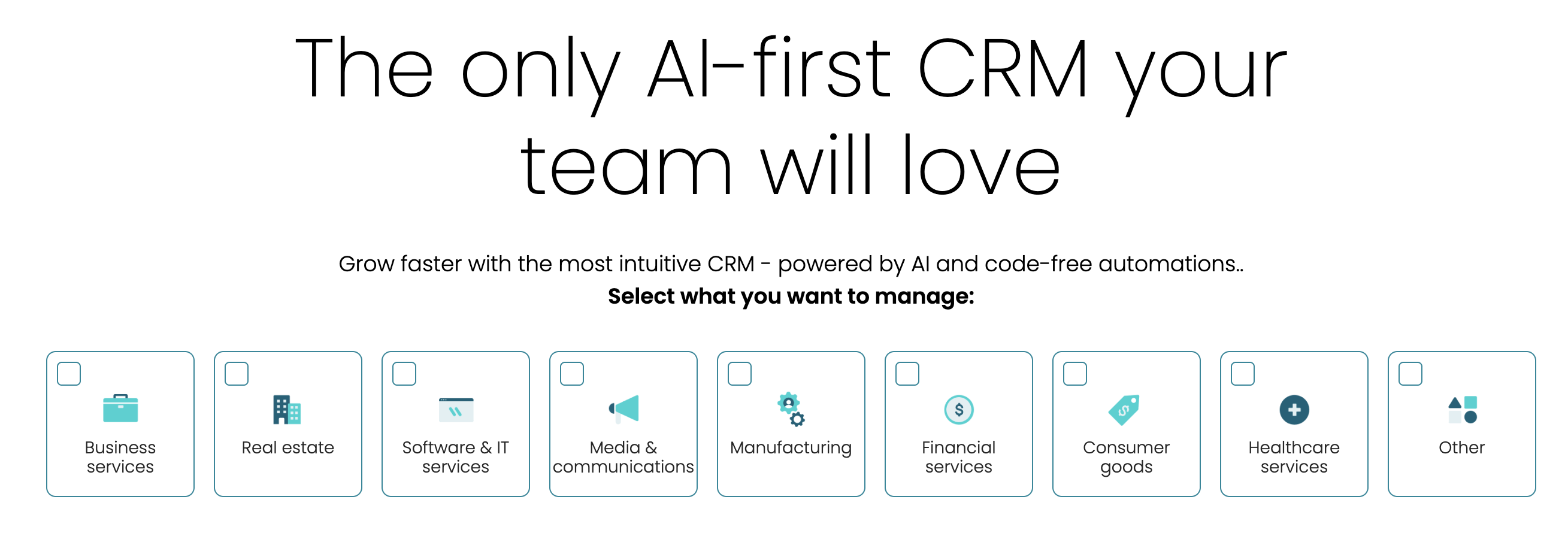
Image source: monday.com
Overview: Similar to ClickUp, monday.com is a visual and flexible "Work OS" that can be configured to serve as a CRM. Its strength lies in its colorful, intuitive interface and its robust automation and integration capabilities. Firms can build a board to manage their client pipeline, another for tax season workflow, and a third for client onboarding. Dashboards allow for high-level visualization of firm performance via real time analytics. It's a solid choice for firms that prioritize visual project management and want a system that can be adapted for many different use cases.
Key features:
- Visually appealing and intuitive board-based interface.
- Powerful automation recipes to handle repetitive tasks.
- Customizable dashboards for high-level reporting.
- Extensive library of templates for various business needs.
Pricing: Monday.com's pricing is based on the number of users and the feature tier. Paid plans start at $12/seat.month.
What exactly is a CRM for tax professionals?
At its core, a CRM system is designed to manage all the relationships and interactions that matter to your business. However, in the context of a tax and accounting practice, its role is far more specialized. Think of it as a comprehensive practice management solution that goes beyond basic client details. It's an intelligent CRM platform built to track critical filing deadlines, automate client communication, securely manage mountains of sensitive documents, and streamline the complex business processes that define your daily operations. A specialized accounting CRM understands the cyclical nature of your business and provides the accounting tools you need to master it.
Juggling spreadsheets for relationship tracking, endless email chains for communication, and different cloud storage folders for documents creates information silos and introduces significant risks. This disjointed approach is not only inefficient but also prone to human error and security vulnerabilities. A dedicated CRM for tax professionals consolidates these functions into one secure environment where you can add notes and files, creating a single source of truth that empowers your team to work with clarity and confidence, ultimately leading to higher client satisfaction.
Core features your CRM for tax professionals must have
When evaluating CRM features, it's easy to get lost in a long list of capabilities. To cut through the noise, focus on the functions that will have the most direct impact on your daily operations and your firm's specific client needs. A purpose-built CRM for tax professionals should feel like it was designed with your challenges in mind. Here are the non-negotiable features you should prioritize in your search to find the right CRM.
- Client & Contact management: This is the heart of any relationship management CRM. It must provide a centralized, detailed database for all client data, including contact information, filing history, and entity type.
- Workflow automation: Look for the ability to create customizable templates for your core processes. This ensures every step is standardized, which boosts productivity and reduces errors.
- Secure document management & Client portal: A branded, secure client portal is essential for secure file sharing. This gives clients a single, easy-to-use place to upload sensitive financial data and download completed returns.
- Task management & Deadline tracking: The system should allow you to assign tasks to team members, set dependencies, and automatically track critical tax and internal deadlines to keep everyone informed about each client's status and overall progress.
- Time tracking & Billing: To ensure profitability, you need to capture all billable hours accurately. Look for integrated time tracking that links directly to clients and tasks, along with invoicing that can generate financial reports.
- Integrations: The best accounting CRM should offer seamless integration with the other tools you rely on, especially accounting software. A key example is QuickBooks integration.
- Collaboration tools: Modern firms work as a team, and a system must facilitate seamless communication. The CRM should allow your staff to leave internal notes and discuss client files to keep everyone on the same page.
How to choose the right CRM for your tax practice
Selecting the right CRM is a strategic decision that warrants careful consideration. The perfect solution for one firm might not be the right fit for another. To make informed business decisions, you need to look beyond marketing claims and deeply assess how a platform will align with your firm's specific processes, goals, and team culture. By following a structured evaluation process, you can choose a partner that will not only solve today's challenges but also scale with you into the future, helping to enhance client relationships along the way.
Step 1: Define your core challenges and goals.
Before you look at any CRM software, look inward. What are the biggest bottlenecks in your firm? Is it disorganized document management? Inefficient internal communication? A lack of visibility into project statuses? This will help you define your client needs. Write down your top three to five pain points. This list will become your scorecard for evaluating options. Clear goals will clarify your choice and help you achieve better client satisfaction.
Step 2: Decide on your philosophy: All-in-one vs. integrated stack.
Do you prefer a single, purpose-built platform that does everything (an all-in-one)? Or do you prefer a flexible, central hub that connects to other tools (an integrated stack)? All-in-one solutions like Lark can be simpler to manage. An integrated stack requires a mindset of building and connecting your ideal CRM system.
Step 3: Scrutinize security and compliance features.
For any tax professional, security is non-negotiable. Don't just take a vendor's word for it. Ask pointed questions. Where is the data stored? Is it encrypted? What security measures and certifications do they hold? How do they enable secure access and help you stay compliant with regulations? A reputable provider will have clear, transparent answers. This is key for protecting sensitive financial data.
Step 4: Prioritize ease of use and implementation.
The most powerful CRM in the world is useless if your team finds it clunky and refuses to use it. The best CRM is the one your team adopts wholeheartedly. During trials, pay close attention to the user friendly interface. Is it intuitive? Can you find what you need without extensive training? A smooth adoption is critical for seeing a return on your investment and truly a tool that boosts productivity.
Conclusion
The conversation around technology in the accounting world is shifting. It's no longer about just finding a tool to manage a single process. The goal now is to build a truly connected firm, where information flows seamlessly, client engagement is effortless, and administrative busywork is automated away. A CRM for tax professionals is the foundational layer of this transformation. It is the core investment that enables greater operational efficiency, deeper client relationships, and sustainable, profitable growth for your entire accounting business.
By moving beyond fragmented spreadsheets and email chains to a central, intelligent platform like Lark, you are not just optimizing for the next tax season; you are building a more resilient and future-proof practice. The time you reclaim can be reinvested into the human side of your business—advising clients, mentoring your team, and thinking strategically about where you want to go next. The future of tax practice management is one of connection and clarity, and it starts with choosing the right technology partner to help you get there.
FAQs
What is the best CRM for accountants?
The best CRM for accountants is one that combines robust workflow automation, secure document management, and seamless client communication. While dedicated accounting CRMs are popular, modern all-in-one platforms like Lark offer greater flexibility. With Lark, you can build a custom CRM in Lark Base, manage tasks, and collaborate with your team and clients in one connected space, moving beyond a rigid, single-purpose tool.
What software do most tax preparers use?
Most tax preparers use a combination of tools: specialized tax preparation software (like Drake or Lacerte), accounting software (like QuickBooks), and a practice management or CRM system. Increasingly, preparers are consolidating their workflows into integrated platforms like Lark, which can connect communication, document storage, and task management, reducing the need to switch between multiple disparate applications.
What is tax CRM?
A tax CRM is a customer relationship management system tailored to the specific needs of tax professionals. It goes beyond a simple contact list to include features for tracking tax deadlines, managing client data collection, automating communication, and providing secure client portals for file sharing. Its primary goal is to streamline the entire tax preparation lifecycle, from client onboarding to final filing.
What is the best CRM for financial professionals?
The best CRM for financial professionals centralizes all client interactions and data in one secure hub. It should enhance client relationships through timely communication and provide tools for managing complex tasks. A flexible platform like Lark is ideal, as it allows professionals to create a unified workspace for each client, integrating notes, documents, communications, and meetings to deliver a truly holistic service.
Related reading
Table of contents
Start using Lark today

Manage all your work in one place
Boost team efficiency by 10x
Save up to 70% on software costs
Table of contents
Start using Lark today
Manage all your work in one place
Boost team efficiency by 10x
Save up to 70% on software costs
Keep reading









2026 Lark Technologies Pte. Ltd.
Headquartered in Singapore with offices worldwide.






Explore: