Teams often feel like they are drowning in a sea of invisible tasks and shifting priorities. Without a clear visual representation of work, bottlenecks remain hidden, and deadlines slip quietly past. Kanban project management offers a refreshing antidote to this chaos. By visualizing workflows and limiting the amount of work in progress, this method transforms abstract to-do lists into a streamlined value stream.
What is Kanban project management?
Kanban project management is a visual designed to help teams define, manage, and improve services that deliver knowledge work. Unlike traditional methods that rely on heavy upfront planning, Kanban focuses on the continuous flow of value to the customer.
To truly grasp this concept, we must look back at its origins. The framework traces its roots to the late 1940s in Japan, specifically within the Toyota production system. Toyota engineers were inspired by supermarkets, which only restocked items once customers bought them. They applied this "just-in-time" principle to manufacturing, using physical cards—called "Kanbans" (Japanese for "visual board" or "signboard")—to signal when parts were needed. This lean kanban project management approach minimized waste and ensured that inventory was never overloaded.
In the early 2000s, pioneers like David J. Anderson adapted these concepts for knowledge work and software development. In this modern context, the methodology moved from factory floors to office walls and digital screens. The physical cards became digital tasks, and the assembly line became a .
Today, a kanban project management methodology is defined by its ability to visualize work, maximize efficiency, and continuously improve. It is not merely a task list; it is a dynamic system where work items are represented visually on a for project management. This allows team members to see the state of every piece of work at any given time. By focusing on flow rather than just individual effort, Kanban empowers teams to react to changes quickly, making it a cornerstone of with kanban.
Start organizing work with simple Kanban workflows
Understanding Kanban
To effectively utilize this framework, you must look beyond the surface level of moving sticky notes across a whiteboard. Kanban project management operates on a "pull system" rather than the traditional "push system" found in many corporate environments.
In a typical push system, work is assigned to employees regardless of their current capacity. This often leads to burnout, context switching, and a pile-up of unfinished tasks. Conversely, a kanban system project management approach dictates that new work is only "pulled" into the when the team has the capacity to handle it. This fundamental shift requires a deep understanding of the board and the flow of work items.
The anatomy of a Kanban board
The central hub of this methodology is the board. Whether you are using a physical whiteboard or a digital kanban project management tool, the structure usually remains consistent. A basic board consists of three main columns: "To Do," "Doing," and "Done." However, complex projects often require more granular stages, such as "Design," "Development," "Review," or "Testing."
Each task is represented by a card containing critical information like the assignee, deadline, and description. As work progresses, the card moves from left to right. This movement provides instant visual status updates, eliminating the need for constant status meetings. When using kanban in projects, the board serves as the single source of truth.
Flow and continuous delivery
Unlike Scrum, which organizes work into time-boxed sprints (usually two weeks), Kanban is a continuous flow method. There are no "start" or "end" dates for the process itself; the work flows like a river. This makes managing projects with kanban ideal for teams that face shifting priorities or operational support work where immediate response is required.
Agile compatibility
It is important to note that Kanban is a flavor of Agile. While shares the values of adaptability and customer focus with other Agile frameworks, it is less prescriptive. It does not require specific roles like a "Scrum Master." Instead, it respects your current process and asks you to improve it incrementally. This makes it easier to adopt for organizations wary of radical restructuring. By using a project management kanban methodology, teams can evolve their processes organically, reducing resistance to change while increasing delivery speed.
Why do you need Kanban for project management?
Many teams struggle with the same fundamental issue: they are busy, yet projects seem to stall. If you find your team is constantly starting new initiatives but rarely finishing them, you likely need a Kanban project management solution.
The primary reason to adopt this method is to combat the invisibility of knowledge work. In a factory, a pile of scrap metal is an obvious bottleneck. In knowledge work, a pile of unfinished code or unreviewed documents is hidden inside hard drives or cloud servers. Kanban project management software brings these invisible blockers to the surface.
Identifying bottlenecks
Without visualization, it is nearly impossible to see where your process is breaking down. You might think your team is working too slowly, when in reality, they are churning out work that gets stuck in a "pending approval" phase for weeks. Using kanban for project management highlights these bottlenecks immediately. If you see a column on your board overflowing with cards, you know exactly where to focus your improvement efforts.
managing variability and flexibility
Modern business is unpredictable. A rigid project plan created six months ago is often irrelevant today. Kanban project methodology excels in environments where priorities change frequently. Because there are no fixed sprints, a project manager kanban user can change the priority of items in the "To Do" column at any time. As long as a task hasn't been started, it can be swapped out for something more urgent without disrupting the team's flow.
Reducing team overburdening
High burnout rates are often the result of overburdening teams with unrealistic expectations. Kanban-based project management protects the team by enforcing limits on how much work can be handled at once. By refusing to push more work onto a team that is already at capacity, you ensure that quality remains high and lead times remain predictable. This is vital for managing large scale projects with kanban, where complexity can easily lead to overwhelmed resources.
Improving predictability
Stakeholders always want to know, "When will it be done?" Traditional estimation is often a guessing game. However, a mature Kanban system uses historical data to forecast future delivery. By tracking how fast cards move across the board, you can provide data-driven answers to deadline questions, making kanban project planning far more reliable than gut-check estimates.
Key principles of Kanban project management
To successfully implement this framework, you must adhere to its core tenets. The "Kanban Method," as formalized by David J. Anderson, is built on a set of change management principles and core practices that guide Kanban project management.
These principles are divided into two categories: change management principles (how you approach the adoption) and service delivery principles (how you view the work). Adhering to these ensures that you aren't just using a board, but actually improving your kanban implementation.
Change management principles
The philosophy of Kanban is evolutionary, not revolutionary.
- Start with what you do now: You do not need to tear down your current organizational structure. Whether you are using MS Project kanban views or a simple spreadsheet, map your current process exactly as it exists.
- Agree to pursue incremental, evolutionary change: Radical changes often meet resistance. Kanban encourages small, continuous tweaks that compound over time.
- Encourage acts of leadership at every level: Improvement ideas shouldn't just come from management. A developer suggesting a new column for "Code Review" is an act of leadership.
The six core practices of Kanban
To practice kanban effectively, you must implement the following six practices:
- Visualize the workflow: This is the foundational step. You must create a visual model of your work and the process it goes through. This is usually done via a kanban project management template or software. The goal is to make the work and the visible to everyone.
- Limit Work In Progress (WIP): This is the most counter-intuitive yet powerful principle. You must set limits on how many items can be in a specific column at one time. If your "Doing" column has a limit of 3, you cannot pull a 4th item until one is finished. This stops the "starting" and forces "finishing," which is the heart of lean kanban project management.
- Manage flow: The focus should be on the movement of work items. You want work to flow through the system smoothly and predictably. By monitoring flow metrics, you can see if items are aging or getting stuck.
- Make policies explicit: Everyone on the team needs to understand the . What defines "Done"? When can a ticket be expedited? Kanban software project management tools often allow you to embed these policies directly into the board interface.
- Implement feedback loops: You need regular check-ins to review the system. These include the daily stand-up (to coordinate flow) and service delivery reviews. These loops are essential for kanban project portfolio management, where multiple streams of work interact.
- Improve collaboratively, evolve experimentally: This is the application of the scientific method (Kaizen). When you make a change to the process, you should have a hypothesis about how it will improve flow. You then measure the results to see if the experiment was successful.
How to master Kanban project management
Starting with a simple board is easy, but true mastery comes from optimizing how work flows through your system. To move beyond basic task tracking and achieve the full potential of Kanban project management, you must refine your process, manage intake effectively, and leverage advanced technology. Whether you are scaling with kanban across a large organization or optimizing a small team, the path to mastery involves four distinct stages of evolution.
Establish clear prioritization protocols
The first step in mastering kanban project planning is moving away from a flat "to-do" list. In a mature system, not all tasks hold equal weight. You must implement a structure that allows you to categorize work streams—such as separating product design from business development—and prioritize them instantly. Mastery means ensuring that high-value items never get stuck behind low-value administrative work. By using a structured approach, you ensure that critical tasks are addressed promptly, maintaining a steady, predictable workflow.
Recommended tool: The priorities kanban template helps you organize tasks into distinct categories and track progress through customizable columns, enhancing visibility for kanban multiple projects.
Standardize process lifecycles
A common mistake in kanban methodology in project management is trying to force every project into a generic "To Do – Doing – Done" workflow. Mastery involves tailoring your board to reflect the specific reality of the work being done. For complex like editorial publishing or marketing campaigns, you need to visualize the strategy over time, tracking items from initial conception all the way to final publication. This granular level of tracking ensures timely delivery and helps teams coordinate on specific formats and associated events without confusion.
Recommended tool: The content calendar template allows teams to plan and track creation seamlessly, ensuring that every stage of the lifecycle is visible and collaborative.
Unify demand management with project tracking
One of the hardest parts of managing projects with kanban is handling the "intake"—the constant stream of new requests from stakeholders. A master project manager kanban user knows that you must capture these demands efficiently before they disrupt the team's focus. This requires a system that can bridge the gap between long-term planning (Gantt charts) and daily execution (Kanban). By aligning these views, you ensure that all demands are captured, prioritized, and addressed in a timely manner, preventing the team from becoming overwhelmed by hidden work.
Recommended tool: The demand collection & management template aids teams in managing this flow by combining Gantt tracking with a progress Kanban for ultimate alignment.
Automate for continuous improvement
The final stage of mastery in kanban software project management is the elimination of waste . Once your process is defined, manual updates become a bottleneck. Modern best kanban project management tools now utilize artificial intelligence to offer intelligent suggestions and automate repetitive administrative tasks. This frees the team to focus on creative problem-solving rather than board maintenance. By identifying potential bottlenecks automatically, you can achieve true "Kaizen" (continuous improvement).
Recommended tool: The (with AI) template enhances traditional boards by automating tasks and offering a clear overview of status, saving time and improving overall efficiency.
Start Kanban project management with Lark
Finding the right tool is often the final hurdle in adopting a new methodology. While physical boards have their charm, modern distributed teams require a robust digital solution. stands out as a powerful kanban project management tool that integrates seamless communication with flexible , allowing you to turn conversation into action instantly.
Visual project control through Lark Base
At the heart of Lark's offering is , which allows you to transform static data tables into . With just a few clicks, you can switch any project list into a for project management. This feature is essential for in progress, a core principle of methodology.
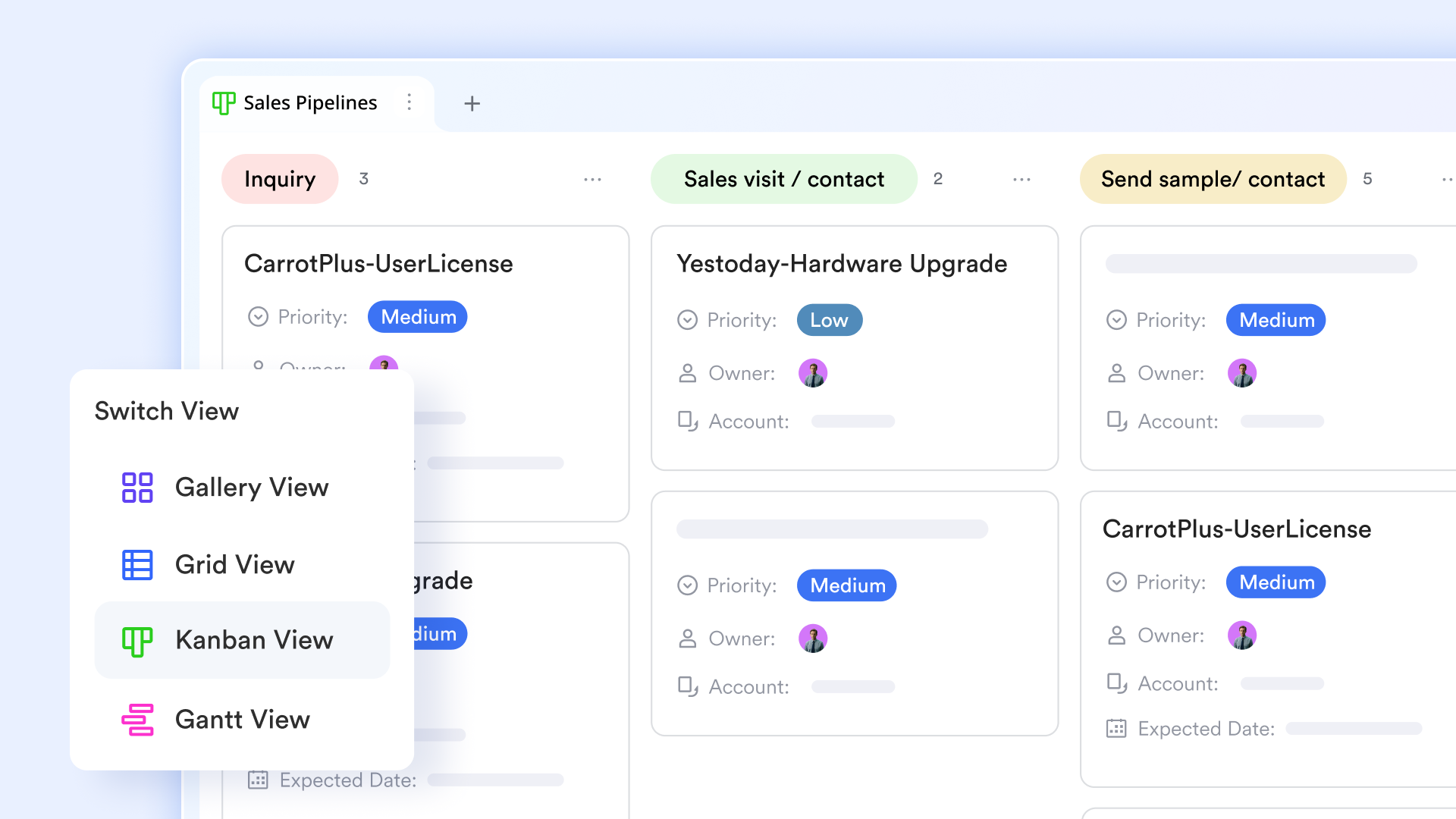
- Customizable grouping: You can group tasks by status, priority, or owner, giving you different perspectives on the same data.
- Instant clarity: Each card view displays key information—such as deadlines and blockers—so you can instantly see which tasks are stalling without digging through spreadsheets.
Streamlined task execution
For daily operations, Lark Tasks provides a dedicated space for execution. This isn't just a to-do list; it is a fully interactive system where you can manage via drag-and-drop cards. As you move a card from "Doing" to "Done," the status updates across the ecosystem, ensuring everyone stays aligned. This real-time synchronization is vital for kanban project planning, as it keeps the team focused on the most critical items without constant manual updates or status meetings. 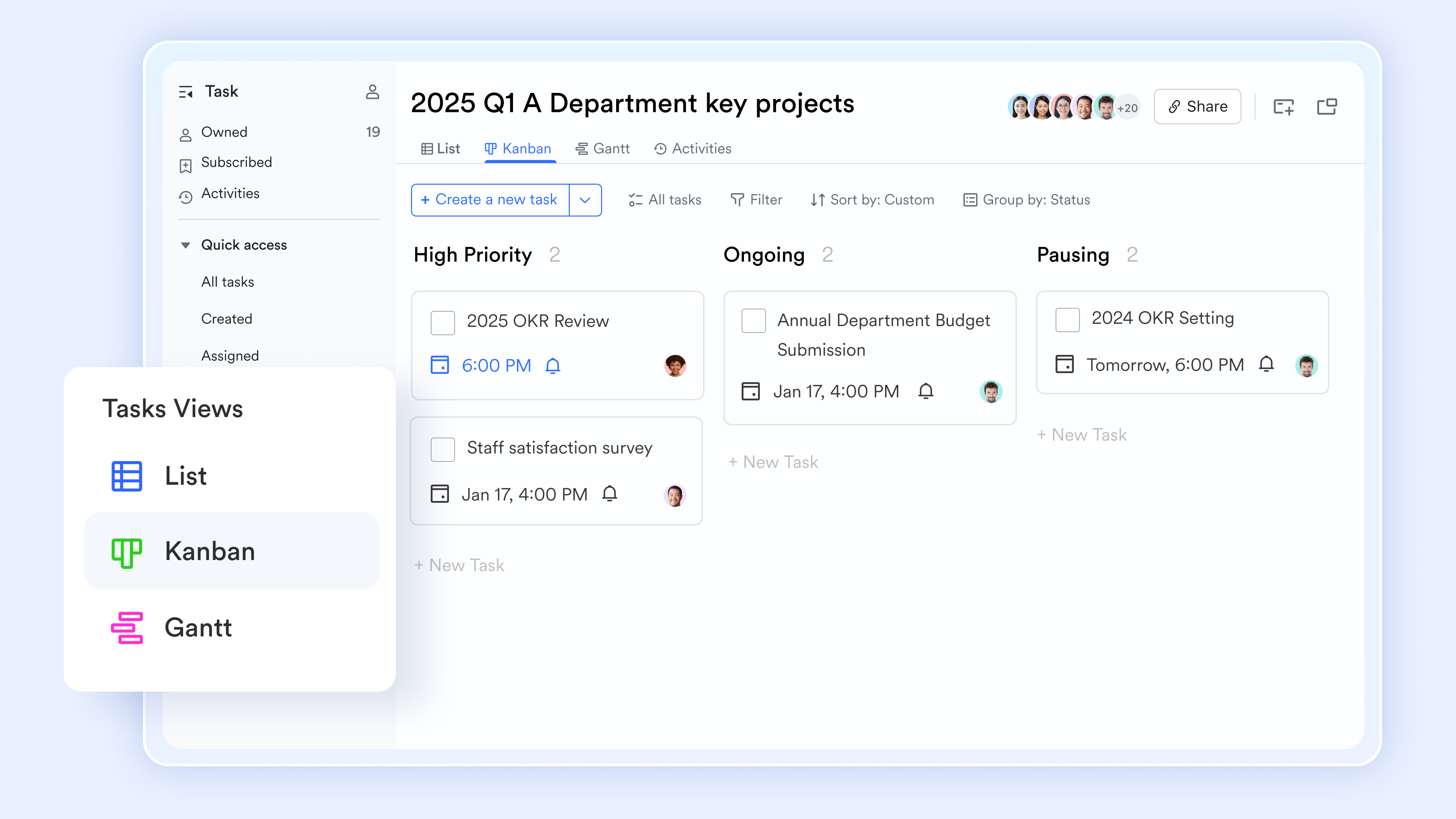
Advanced insights and connectivity
As your projects grow in complexity, simple boards might not be enough. Lark addresses this with advanced connectivity features that support kanban project portfolio management.
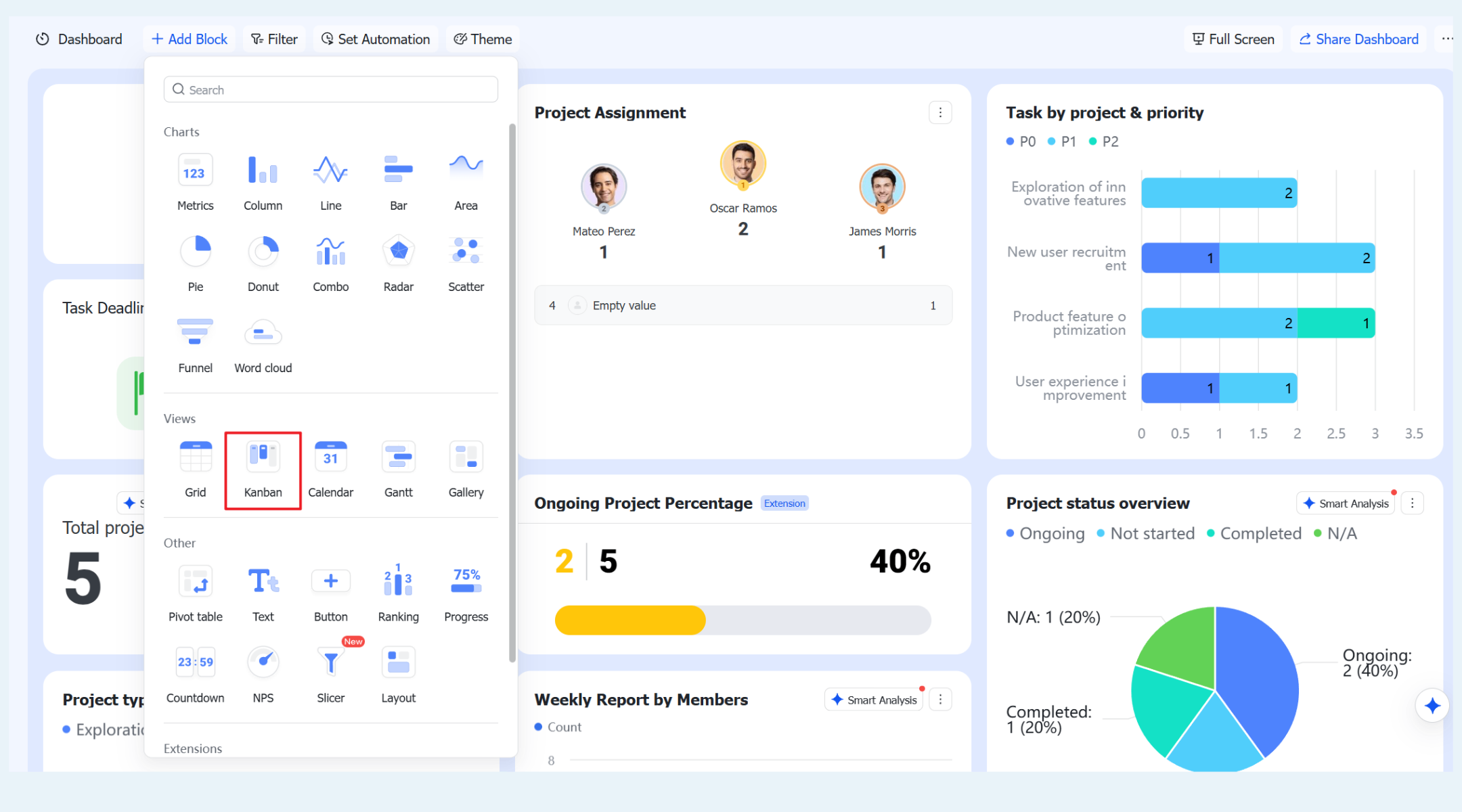
- Linked records: You can connect tasks to broader project goals or client records. This helps teams understand dependencies—seeing not just what they are doing, but why they are doing it.
- Integrated dashboards: Managers can embed Kanban views directly into Lark Base dashboards. By combining these views with charts and summary blocks, you get a real-time operational overview that highlights flow metrics and bottlenecks.
:
- Starter plan: Free forever plan that includes 11 powerful tools for up to 20 users. It also comes with 100GB of storage, 1000 automation runs, AI translations, and more.
- Pro plan: $12/user/month (billed annually) for up to 500 users. It includes everything in Stater plus group calling for up to 500 attendees, 15TB of storage, 50,000 automation runs, and more.
- Enterprise plan: for custom pricing. Supports unlimited users and includes even more automation runs and advanced security, compliance, and management features.
For small teams with simple communication needs

18 months message history
1000 Base automation runs/month
2000 rows per table in Base
Most POPULAR
For companies with comprehensive collaboration and management needs
Unlimited message history
500-participant video meetings
50k Base automation runs/month
20k rows per table in Base
For large companies with advanced security and organizational management needs
Get a personalized demo and pricing
Unlimited message history
500-participant video meetings
15 TB storage + 30 GB storage/user
500k Base automation runs/month
50k Base automation runs/month
Most POPULAR
For companies with comprehensive collaboration and management needs
Unlimited message history
500-participant video meetings
50k Base automation runs/month
20k rows per table in Base
Benefits of Kanban project management
Implementing Kanban project management brings transformative results to organizations of all sizes. While the immediate visual appeal of the board is obvious, the deeper benefits relate to efficiency, culture, and business agility.
By shifting from a push-based mentality to a pull-based flow, teams unlock a variety of advantages that traditional project management often fails to deliver. Whether you are using free kanban or an enterprise-grade solution, the following benefits are universally achievable.
Enhanced visibility and transparency
The most immediate benefit is clarity. In many projects, status reports are outdated the moment they are written. With kanban methodology in project management, the board is a real-time status report. can glance at the board and instantly see what is being worked on, what is blocked, and what is finished. This transparency builds trust between the team and management, as nothing is hidden.
Increased flexibility and agility
Market conditions change rapidly, and rigid plans can become liabilities. Because kanban project management is continuous, priorities can be reassessed constantly. If a competitor launches a new feature, can insert a counter-feature into the top of the backlog immediately. As long as the team hasn't started the old lower-priority work, the cost of switching is zero. This makes kanban in projects incredibly responsive to business needs.
Improved delivery speed
Kanban is obsessed with "Cycle Time"—the time it takes for a task to go from "started" to "finished." By limiting WIP, teams stop context switching. Research shows that multitasking drastically reduces IQ and productivity. By focusing on fewer items at once, teams finish them faster. This reduction in cycle time means value reaches the customer sooner.
Reduction of waste
is fundamentally about waste reduction. "Waste" includes partially done work, waiting time, and task switching. By visualizing queues and limiting how much work piles up, you reduce the inventory of unfinished work. This ensures that the team's energy is spent on completing tasks that generate value, rather than managing a massive backlog of half-started projects.
Better collaboration and morale
When teams are overburdened, morale suffers. The kanban method project management empowers teams to say "no" (or "not yet") when they are at capacity. This autonomy reduces burnout. Furthermore, because the board visualizes blockers, the conversation shifts from "Why are you slow?" to "How can we clear this blocker together?" This fosters a collaborative culture where the team swarms to solve problems.
Start improving your Kanban with a flexible visual system
Conclusion
Adopting Kanban project management is a powerful step toward reclaiming control over your team's workflow. By visualizing invisible tasks, limiting work in progress, and embracing continuous improvement, you move from reactive chaos to proactive delivery. Whether you are managing a small creative team or a large-scale software project, the principles of transparency and flow remain the ultimate keys to sustainable efficiency.
However, a methodology is only as good as the tools you use to implement it. You need a platform that adapts to your evolution rather than restricting it. Lark combines flexible Kanban board with seamless communication, empowering you to turn plans into action instantly. Don't let another deadline slip through the cracks—start your journey with Lark's free templates today and build a workflow method that actually works for you.
FAQs
What is a Kanban in project management?
Kanban is a visual, pull-based project management methodology designed to increase efficiency through continuous delivery and workflow visualization. Originating from Toyota, it utilizes cards and boards to manage tasks and limit work-in-progress (WIP). It serves as a flexible framework within the Agile family, focusing on continuous flow rather than rigid time constraints.
What are the 4 principles of Kanban?
The four principles of Kanban focus on evolutionary change and respecting current structures:
- Start with what you do now: Implement Kanban without immediate, drastic changes.
- Agree to pursue incremental, evolutionary change: Focus on small, continuous improvements rather than radical overhauls.
- Respect current process, roles, responsibilities, and titles: Value existing structures to encourage collaboration instead of resistance.
- Encourage acts of leadership at all levels: Promote a culture where everyone feels empowered to contribute to improvements.
What are the six-six rules of Kanban?
The six core practices (or rules) of Kanban are designed to optimize workflow:
- Visualize the workflow: Use boards and cards to see tasks and stages.
- Limit Work in Progress (WIP): Restrict "doing" items to prevent bottlenecks.
- Manage Flow: Monitor task movement for smooth, fast delivery.
- Make Process Policies Explicit: clearly define rules for execution.
- Implement Feedback Loops: Use regular reviews like stand-ups to evaluate progress.
- Improve Collaboratively, Evolve Experimentally: Use data to constantly refine the process.
Is Kanban agile or Scrum?
Kanban is Agile, but it is not Scrum. While both methodologies fall under the Agile umbrella, they function differently. Kanban is a method focused on continuous flow and flexibility, whereas Scrum is a framework organized around fixed-length, iterative "sprints." Kanban offers a more continuous approach compared to the structured, cadence-driven nature of Scrum.
Related reading