As our businesses grow and evolve, so does the complexity of our operations. We often find ourselves managing a web of tools and processes, trying to keep every department—from IT to HR to customer support—running smoothly. This challenge is precisely where a Service Management System (SMS) becomes essential. More than just a buzzword, an SMS offers a structured approach to delivering and improving services across your entire organization. In this article, we’ll explore what an SMS truly entails, why it’s no longer confined to the IT department, and how it can become a cornerstone of your operational efficiency and overall business success.
Beyond IT: Redefining service management for the modern enterprise
When many of us hear "service management," our minds often go straight to IT. This isn't surprising, as IT Service Management (ITSM) has historically been the most prominent application of these principles, focusing on how deliver and support technology services. However, the landscape of business operations has expanded significantly, and with it, the scope of service management.
Today, the concept has matured into what we call Enterprise Service Management (ESM). This isn't just a rebrand; it's a fundamental shift in perspective. ESM acknowledges that every department within an organization delivers services—whether it's HR processing an , operations managing a procurement order, or marketing handling a content request. Each of these interactions is a "service" that impacts employees, customers, and ultimately, the business's bottom line. The old way of siloed tools and processes for each department is becoming increasingly inefficient, leading to delays, frustration, and a fragmented experience for everyone involved. We're moving towards a model where unified systems help manage these diverse service demands, creating a more cohesive and productive environment.
The core components of an effective service management system
An effective Service Management System isn't just a single piece of software; it's a comprehensive framework built upon three pillars: processes, people, and technology. It’s the orchestration of these elements that allows organizations to deliver high-quality services consistently.
Why a unified SMS is a strategic imperative for growing businesses
For growing businesses, a unified SMS is not merely a convenience; it's a strategic imperative for sustainable growth. It delivers:
- Improved operational efficiency and reduced costs: Automation and standardization minimize manual errors and redundant work, optimize resource allocation, and consequently lower operational expenses.
- Enhanced customer and employee satisfaction: Rapid and consistent service responses improve the customer experience, while convenient internal services boost employee satisfaction and productivity.
- Better visibility and control over service delivery: A centralized management platform offers real-time views of all service requests and processes, enabling managers to better oversee and control service quality.
- Increased agility and adaptability to change: Standardized processes and scalable systems allow businesses to adapt more quickly to market shifts and internal demands, supporting business expansion.
- Data-driven decision making for continuous improvement: In-depth reports and analytics enable organizations to identify service bottlenecks, optimize processes, and achieve continuous improvement in service delivery.
Ready to unify your communications and drive growth
Identifying your service management needs: A departmental breakdown
Customer support teams
Customer Support teams benefit immensely from an SMS by centralizing customer inquiries, tracking service tickets, and facilitating faster, more accurate responses that strengthen . It allows for a unified view of customer interactions, helps manage service level agreements (SLAs), and can integrate with communication channels to provide a cohesive customer journey. For instance, if a customer emails with an issue, the SMS can automatically create a ticket, assign it to the right agent, and provide the agent with a history of past interactions.
Operations and administrative departments
Operations departments can leverage an SMS for a range of tasks, including facility management (e.g., requesting office repairs, booking meeting rooms), managing procurement workflows, and asset tracking. Any internal service or request that requires coordination and approval can be streamlined when paired with effective .
Marketing and sales
Similarly, Marketing and Sales can utilize an SMS for managing content requests from the sales team, processing approvals for marketing collateral, or even tracking support for event planning, supporting broader . The core idea remains: standardize, automate, and centralize internal services to reduce friction and improve delivery.
See how teams use Lark to manage day-to-day operations
Implementing a service management system: Key considerations
Successful SMS implementation requires meticulous planning and execution:
- Defining clear objectives and scope: Clearly articulate the problems you aim to solve and the goals you wish to achieve with the SMS.
- Choosing the right platform: Evaluate different solutions based on scalability, feature sets, integration capabilities, and vendor support.
- Data migration and system integration: Ensure a smooth transition of existing data and seamless integration with other critical enterprise systems.
- Training and user adoption strategies: Invest resources in comprehensive employee training and develop effective user adoption plans.
- Continuous improvement and feedback loops: SMS is not a one-time setup; it requires regular review, feedback collection, and optimization.
How Lark streamlines service delivery across your organization
Lark is an all-in-one suite designed to bring collaboration and productivity into a unified workspace, naturally extending its capabilities to streamline service management across various departments. For businesses looking to implement a comprehensive SMS, Lark offers a compelling foundation by integrating essential tools that address common service delivery challenges.
Unified workspace for communication and collaboration
provides a unified workspace combining collaborative tools like,, cloud storage,, , and , as well as operational tools like , , and attendance, into one seamless platform. This unification means that service requests and related communications don't get lost across disparate applications. When an employee raises an issue, the entire conversation, along with any relevant documents, can be managed within Lark, ensuring everyone involved has context. 
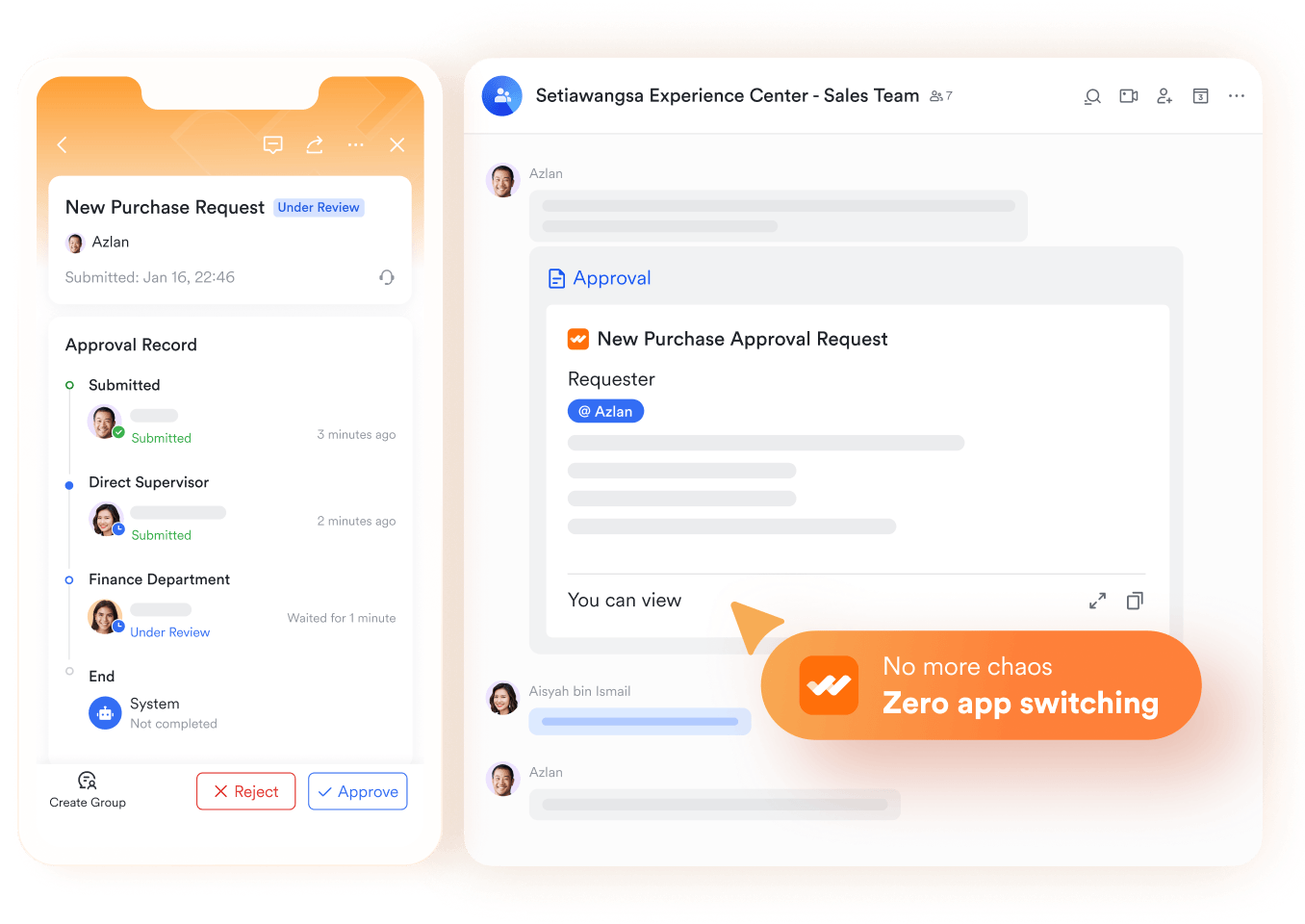
Customizable approval workflows
A core aspect of effective service management is structured approval processes, and workflows can be tailored to various service requests—from HR leave requests and procurement approvals to IT change management. These workflows ensure that requests are routed to the right stakeholders, approvals are tracked, and actions are taken promptly. This eliminates manual chasing and reduces delays inherent in traditional, paper-based, or email-only systems.
Centralized knowledge management with Wiki
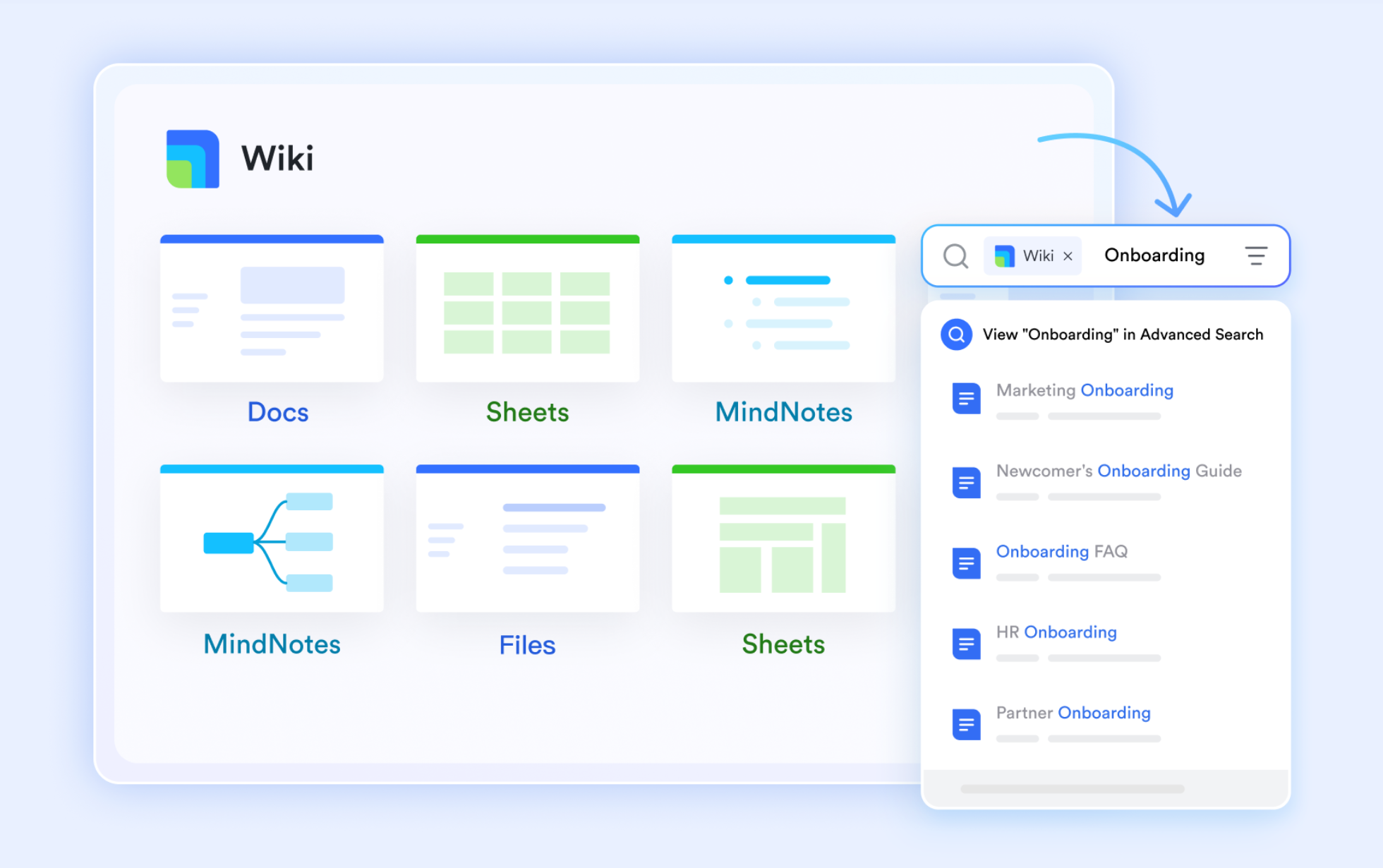
serves as an excellent knowledge management and self-service portal. Departments can create and maintain comprehensive articles, FAQs, and how-to guides for common inquiries. This empowers employees to find answers independently, significantly reducing the volume of routine service requests and allowing service teams to focus on more complex issues. For example, an HR Wiki page could detail the process for requesting parental leave, complete with forms and contact information, reducing direct inquiries to the HR team.
Many service management tasks involve repetitive actions, and Lark Tasks can be configured to handle these. This includes automatically assigning tasks based on request type, sending reminders, or escalating unresolved issues after a certain period. This reduces manual intervention, increases efficiency, and ensures consistency in service delivery. For instance, an IT request for software installation could automatically create a task for the IT technician and send a confirmation message to the employee. 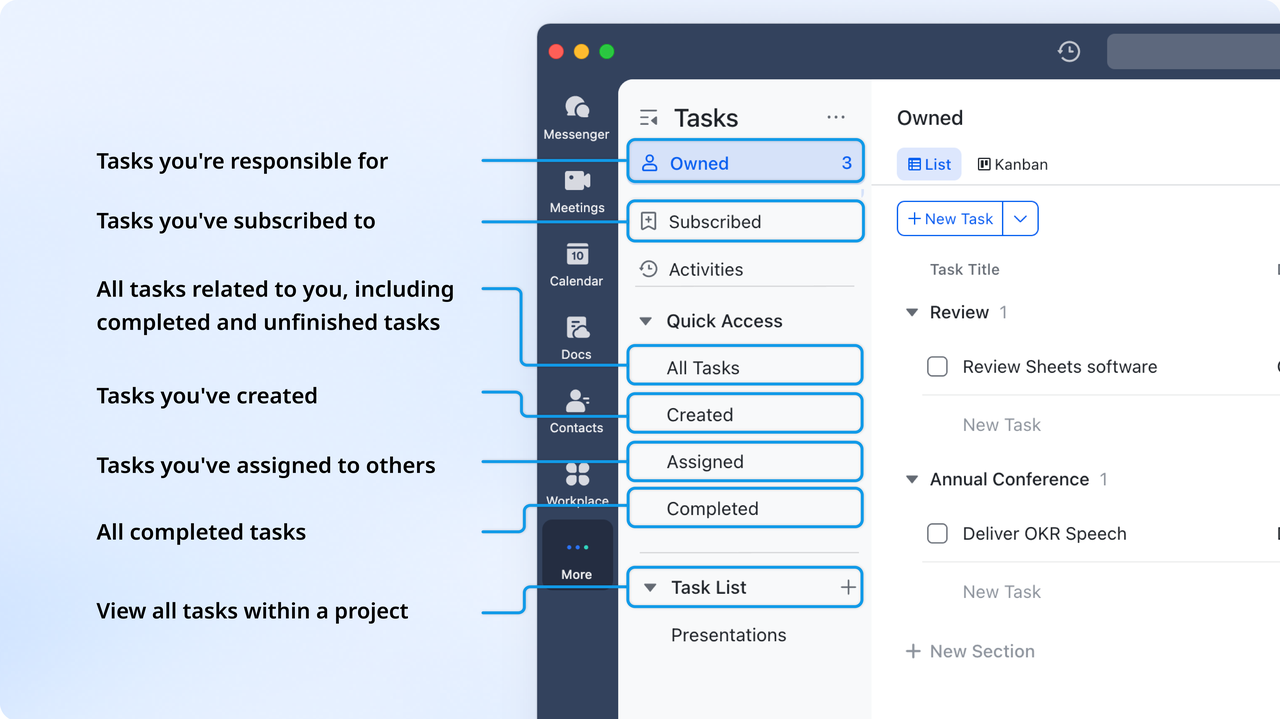
:
- Starter plan: Free forever plan that includes 11 powerful tools for up to 20 users. It also comes with 100GB of storage, 1000 automation runs, AI translations, and more.
- Basic plan: $6/user/month (billed annually) for up to 500 users. It includes everything in Starter plus group calling for up to 500 attendees, 5TB of storage, 1000 automation runs, and more. For more details, please .
- Pro plan: $12/user/month (billed annually) for up to 500 users. It includes everything in Basic plus group calling for up to 500 attendees, 15TB of storage, 50,000 automation runs, and more.
- Enterprise plan: for custom pricing. Supports unlimited users and includes even more automation runs and advanced security, compliance, and management features.
For small teams with simple communication needs

18 months message history
1000 Base automation runs/month
2000 rows per table in Base
Most POPULAR
For companies with comprehensive collaboration and management needs
Unlimited message history
500-participant video meetings
50k Base automation runs/month
20k rows per table in Base
For large companies with advanced security and organizational management needs
Get a personalized demo and pricing
Unlimited message history
500-participant video meetings
15 TB storage + 30 GB storage/user
500k Base automation runs/month
50k Base automation runs/month
Most POPULAR
For companies with comprehensive collaboration and management needs
Unlimited message history
500-participant video meetings
50k Base automation runs/month
20k rows per table in Base
Real-world impact: Scenarios where SMS makes a difference
Understanding the theoretical benefits of an SMS is one thing; seeing its impact in practical scenarios paints a clearer picture. Here are a few examples of how a well-implemented Service Management System can transform everyday business operations.
Scenario 1: Streamlining new employee onboarding (HR perspective)
is often disjointed, leading to confusion and delays. An SMS centralizes this process: IT setup, HR paperwork, and manager introductions are automatically triggered. New hires receive personalized checklists and access to self-service resources. This ensures a smooth, tracked onboarding experience, significantly improving efficiency for HR and IT, and making a positive first impression on new employees.
Scenario 2: Efficient IT support and asset management (IT perspective)
Traditional IT support often means slow responses and chaotic tracking. An SMS provides a single portal for all IT requests. Issues are automatically categorized and routed to the correct specialist, with real-time tracking for employees. The system also manages IT assets, linking equipment to users and tracking its lifecycle. This centralizes IT operations, enhances response times, and provides data for continuous improvement.
Scenario 3: Enhancing customer issue resolution (customer support perspective)
Customer inquiries often come from multiple channels, leading to fragmented communication. An SMS unifies all customer interactions into a single ticket, routed to the best agent with full customer history. Automated responses and self-help options speed up resolution. This ensures consistent, efficient customer service, while analytics help proactively improve support quality.
The future of service management: Trends and innovations
The landscape of service management is continuously evolving, driven by technology and rising expectations. Key trends are shaping the future of SMS, making it even more central to business success.
- Deeper integration of AI and machine learning: AI/ML is moving beyond basic chatbots to intelligent virtual agents that handle complex queries, predict issues, and route requests, and can closely integrate with . This frees human agents for more empathetic, higher-value interactions, transforming service from reactive to predictive.
- Predictive analytics: By analyzing historical service data, SMS can anticipate future needs or system failures, similar to how forecast customer behavior and sales opportunities. This shift from reactive problem-solving to proactive prevention minimizes disruptions and ensures smoother operations.
- Hyper-personalization: Future SMS solutions will tailor services based on individual user profiles and behaviors. This means personalized self-service portals and adaptive workflows, making every interaction more relevant and efficient for the user.
- Emphasis on experience management (XM): Beyond efficiency, the focus is increasingly on the overall service experience. Future SMS platforms will capture feedback, analyze sentiment, and continually refine the service journey, increasingly relying on , aiming for not just efficiency but also user delight. This underscores the goal of creating seamless, supportive experiences for everyone.
Conclusion
A service management system (sms) is far more than an it tool; it's a strategic framework for orchestrating efficient, high-quality service delivery across an entire organization. By unifying processes, leveraging technology, and empowering people, an sms addresses the fragmentation and inefficiencies that often plague growing businesses. It leads to tangible benefits—from reduced operational costs and streamlined workflows to significantly enhanced customer and employee satisfaction. In an increasingly complex business environment, embracing a holistic sms approach, for instance by utilizing integrated platforms like that consolidate various service functions, is not just a choice, but a fundamental step towards creating a more agile, productive, and future-ready enterprise.
Manage your service smarter with Lark
FAQs
What is a service management system?
A Service Management System (SMS) is a comprehensive framework that includes the processes, people, and technology used to design, deliver, manage, and improve services across an organization. It aims to standardize service delivery, enhance efficiency, and improve satisfaction for both internal and external customers.
What are the 5 stages of ITSM?
The IT Infrastructure Library (ITIL), a widely adopted framework for ITSM, outlines five core lifecycle stages: Service Strategy, Service Design, Service Transition, Service Operation, and Continual Service Improvement. These stages guide organizations in defining, creating, deploying, operating, and refining their IT services.
What are the 4 P's of service management?
The "4 P's" of ITIL refer to key elements that organizations should consider when planning for service management: People (individuals involved in service delivery), Products (the services and technology used), Partners (external suppliers and collaborators), and Processes (the structured activities and workflows).
What is an example of ITSM tool?
An example of an ITSM tool would be a platform designed to support IT service management processes. These tools often include features like incident management, request fulfillment, problem management, change management, and a self-service portal. Popular ITSM tools in the market include ServiceNow, Jira Service Management, and Freshservice. (Note: This is a general example; specific tool recommendations would require a detailed needs assessment.)
Related readings