














Top Staffing Agency Software:10 Leading Tools for Recruiters & Agencies

Ryan Tanner
Product Marketing Specialist
Sep 18, 2026
Ryan Tanner
Sep 18, 2026

27 min read


Staffing agencies handle multiple functions—candidate sourcing, client communication, onboarding, billing, and compliance—often across different systems, to handle the recruitment process. Staffing agency software helps bring these processes together by combining applicant tracking, scheduling, invoicing, and collaboration into one streamlined solution. Whether you run a healthcare, IT, or temporary staffing firm, using the right platform ensures smoother operations and better visibility across placements. This guide compares the 10 best staffing agency software solutions, including Lark, which offers a unified workspace for managing recruitment workflows, team communication, and back-office coordination without switching between multiple tools.
1. Lark: Unified workspace for staffing agencies and workflow coordination
2. Bullhorn: Leading recruiting and staffing CRM & operations platform
3. JobDiva: Staffing agency software with full scope for recruiting and back-office
4. Avionté: Temp and workforce hiring platform for staffing agencies
5. Manatal: Modern agency CRM & ATS with affordability
6. Zoho Recruit: Flexible recruiting and staffing agency software
7. Ceipal TalentHire: End-to-end talent acquisition and staffing platform
8. Workable: Recruiting software adaptable for staffing agencies
9. OpenHire: Staffing software focused on seasonal/volume hiring
10. TempWorks: Temp staffing and light industrial software solution

Snapshot overview of the 10 best staffing agency software
Information source: Official vendor websites
Update time: 2025-11-12
Note: Pricing and plan availability are based on publicly available data as of the update date. Actual prices may vary depending on region, user count, and billing frequency.
Why staffing agencies need specialized software
Staffing agencies operate in a complex environment where they must manage clients, candidates, placements, and payroll simultaneously. Generic HR tools often fall short in addressing the specific needs of staffing agency software, including time tracking, shift scheduling, invoicing, and credential management. In response to the shift toward on-demand labor, many firms are supplementing their core software with platforms like Instawork to access a flexible, pre-vetted pool of hourly professionals that can be deployed instantly. Specialized staffing software integrates all these functions into a single system, reducing manual data entry and errors while improving visibility across recruitment and placement workflows.
Whether it's a healthcare staffing agency software tracking licenses or an IT staffing agency software managing project-based hiring, tailored solutions ensure compliance, accuracy, and efficiency. For temporary staffing agency software, features like automated workflow, timesheets, and payroll integration are essential for handling large volumes. Ultimately, staffing agency software solutions empower agencies to streamline operations, deliver better client experiences, and scale efficiently across multiple industries and workforce models.
Full list: Top staffing agency software with reviews
1. Lark: Unified workspace for staffing agencies and workflow coordination
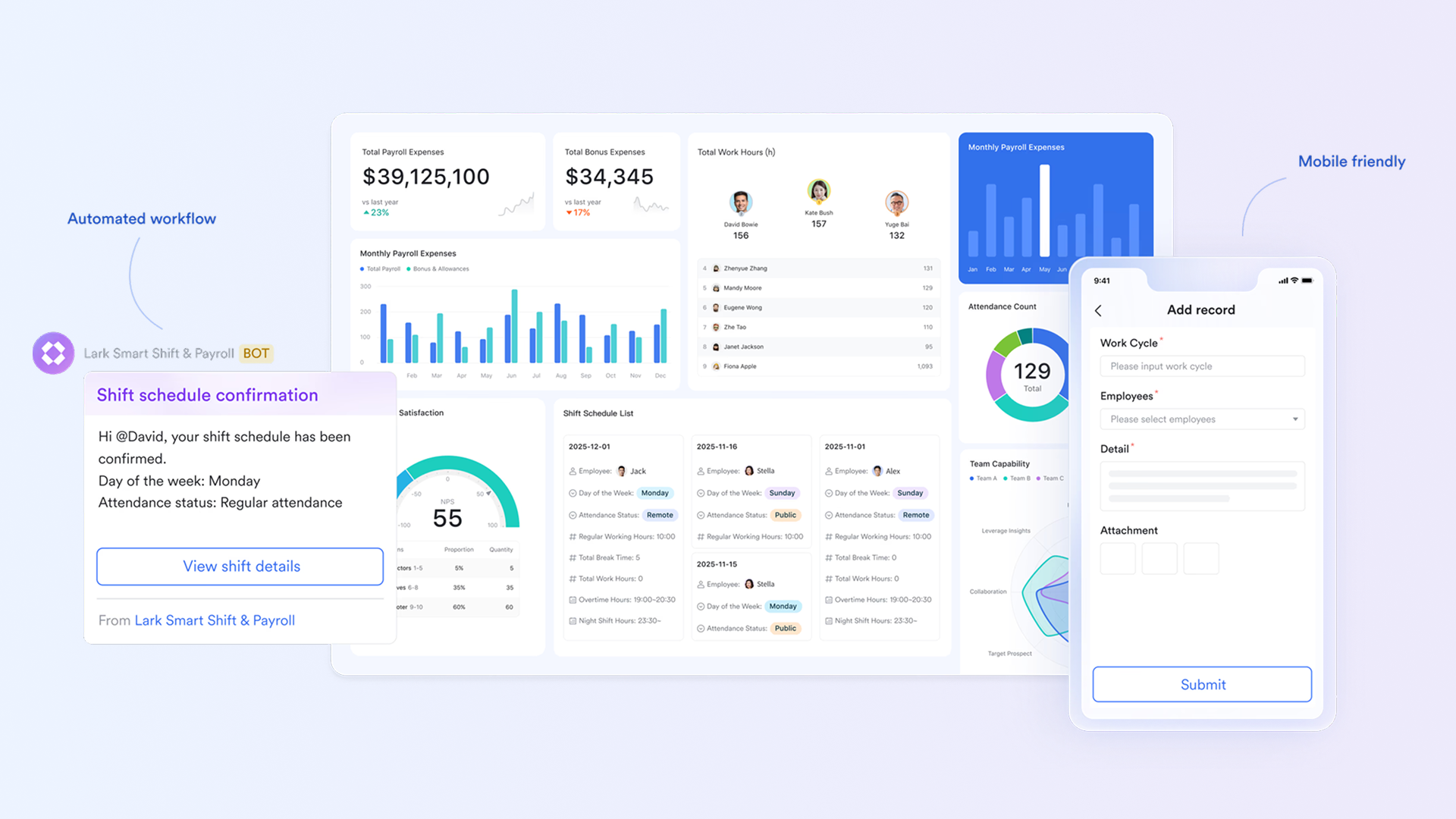
Lark helps staffing agencies manage the entire recruitment-to-placement cycle within a single connected workspace. From automating back-office workflows to coordinating client onboarding, every feature is designed to keep teams aligned and processes efficient. Recruiters can manage candidate pipelines, track interviews, and share feedback in real time. Built-in chat, video meetings, and shared docs simplify collaboration between internal teams and clients. With centralized visibility across communication, scheduling, and reporting, Lark ensures every stage of staffing runs seamlessly.
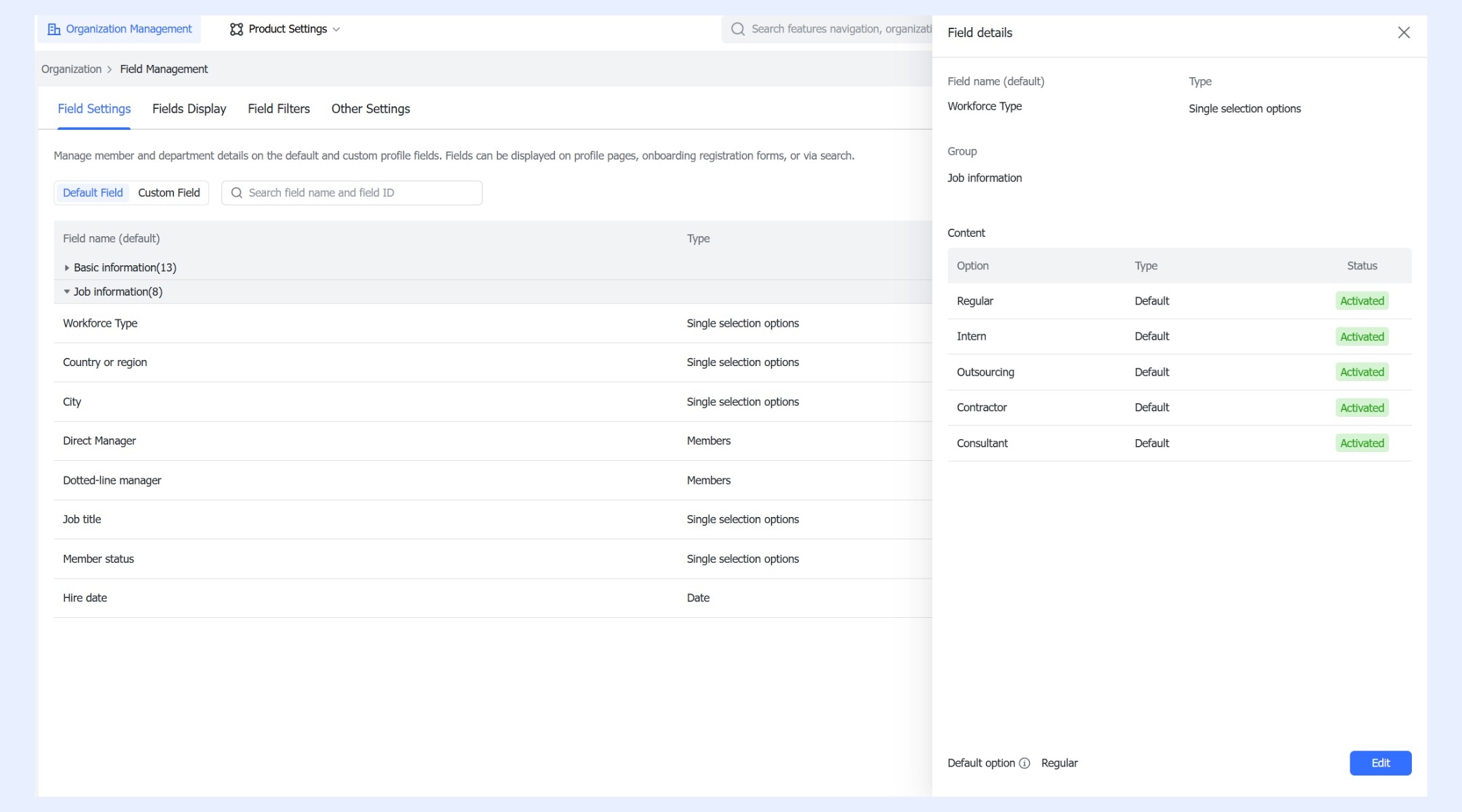
Lark Workforce Type Management: Streamlining staff organization and access
Lark's Workforce Type Management helps staffing agencies organize and manage various worker categories—such as full-time, intern, contractor, or consultant—within a single system. It automatically updates department groups when a member's type changes, keeping team structures accurate. Agencies can also restrict group access by workforce type, ensuring only relevant staff are included. This streamlines assignment management and reduces manual admin work.
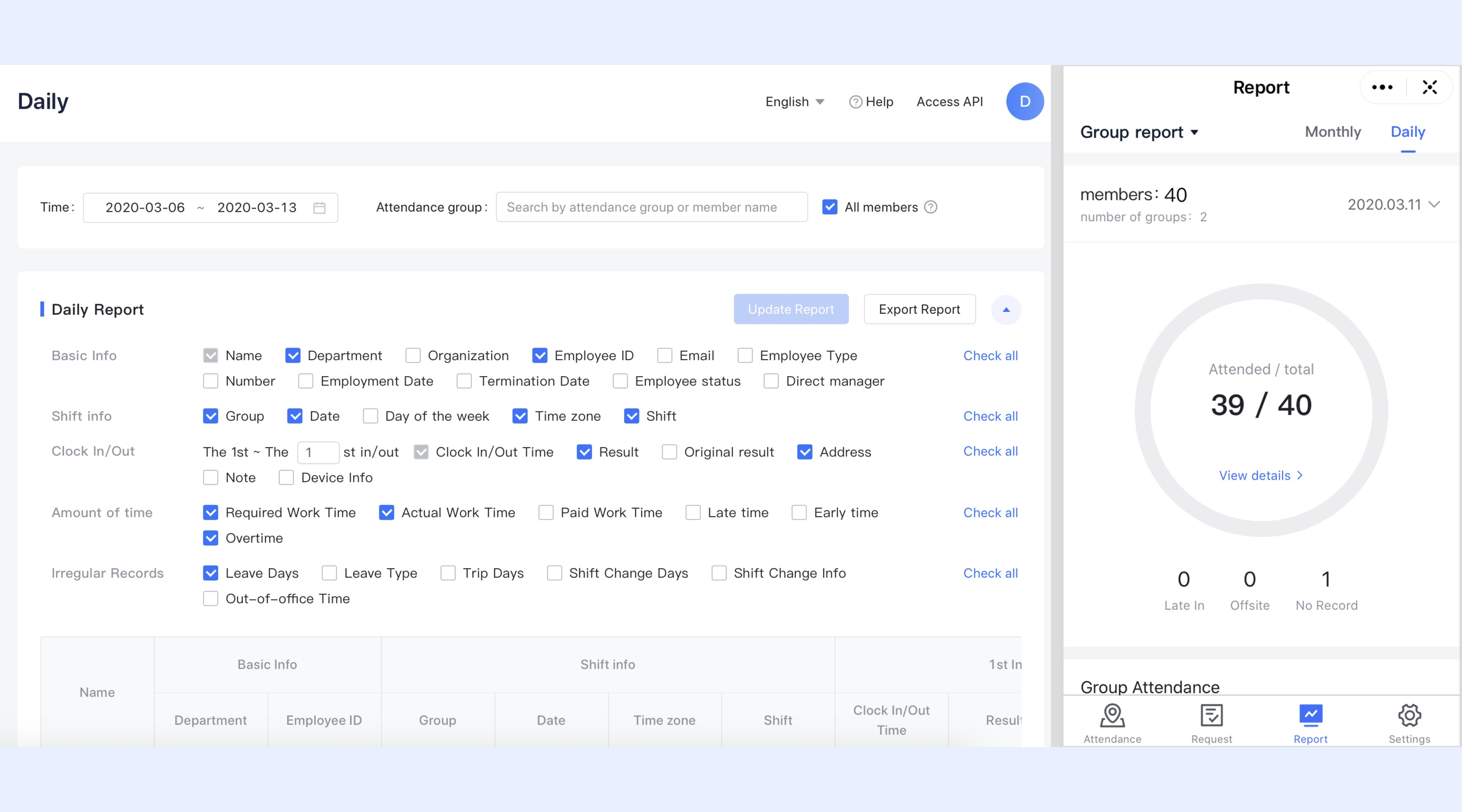
Lark Attendance: Accurate operation tracking and payroll
The Lark Attendance supports staffing agencies by offering mobile-enabled clock-in and clock-out for remote or field workers, enabling seamless tracking of assignments across locations. It accommodates flexible shifts and flextime to align with varying staffing schedules, such as temp placements or contract shifts. Managers can access detailed attendance reports and export data for billing or payroll purposes—improving accuracy and efficiency. The "external attendance" function enables personnel to log attendance remotely, supporting off-site and on-the-go staffing scenarios.
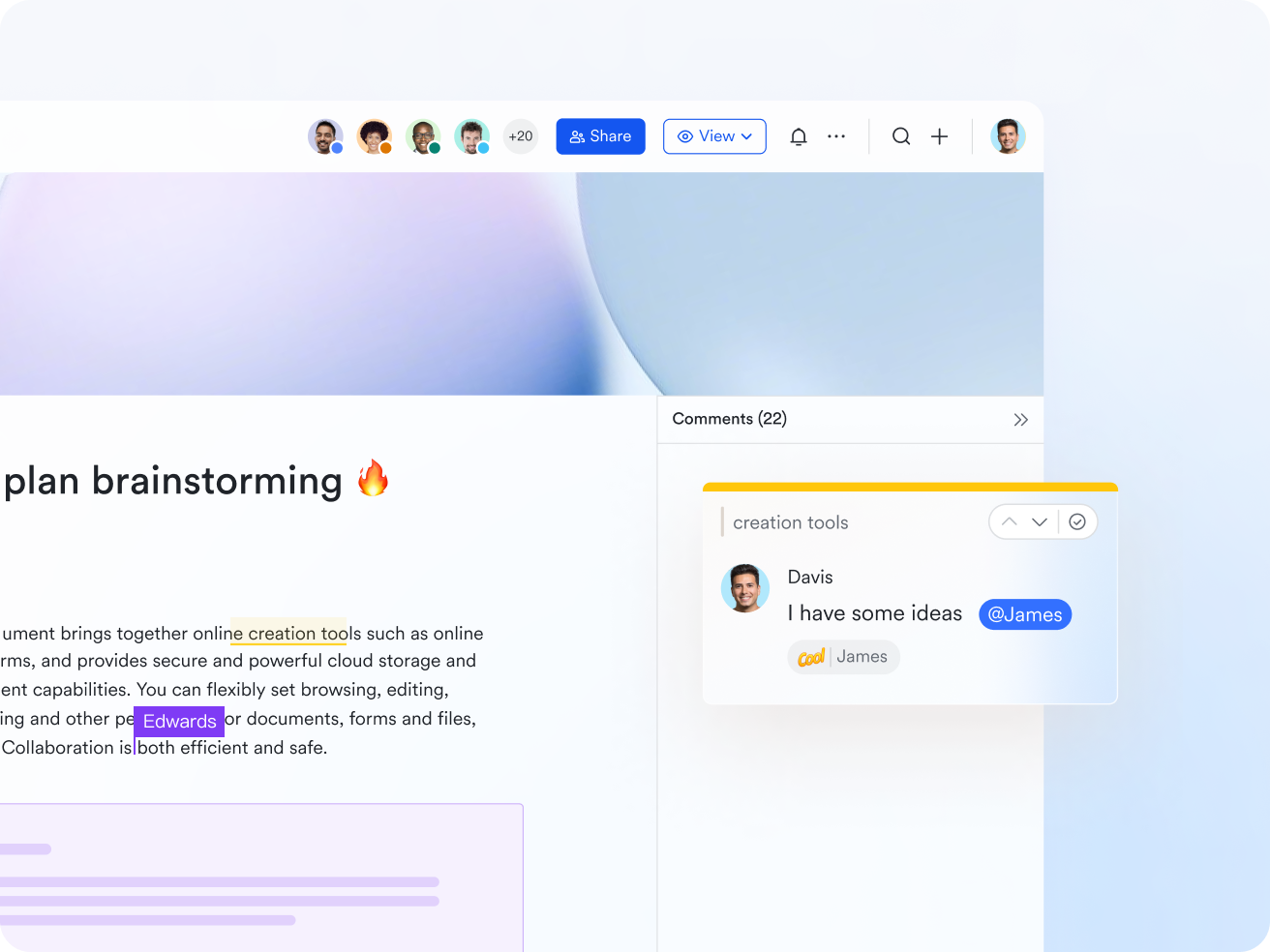
Lark Docs & Lark Wiki: Centralize collaboration and documentation across teams
Lark Docs gives recruiters, HR, and operations teams a shared workspace for real-time documentation. Job briefs, interview feedback, onboarding checklists, and client proposals can be co-edited simultaneously, reducing version confusion and email clutter. With comment threads and mentions, teams can align quickly on edits or approvals. With Lark Wik functioning as a knowledge hub, administrators can organize policy documents and procedures in a clear, hierarchical Wiki structure, making it easy for staff to find and understand regulations.
Lark Base Automations: Streamline routine operations
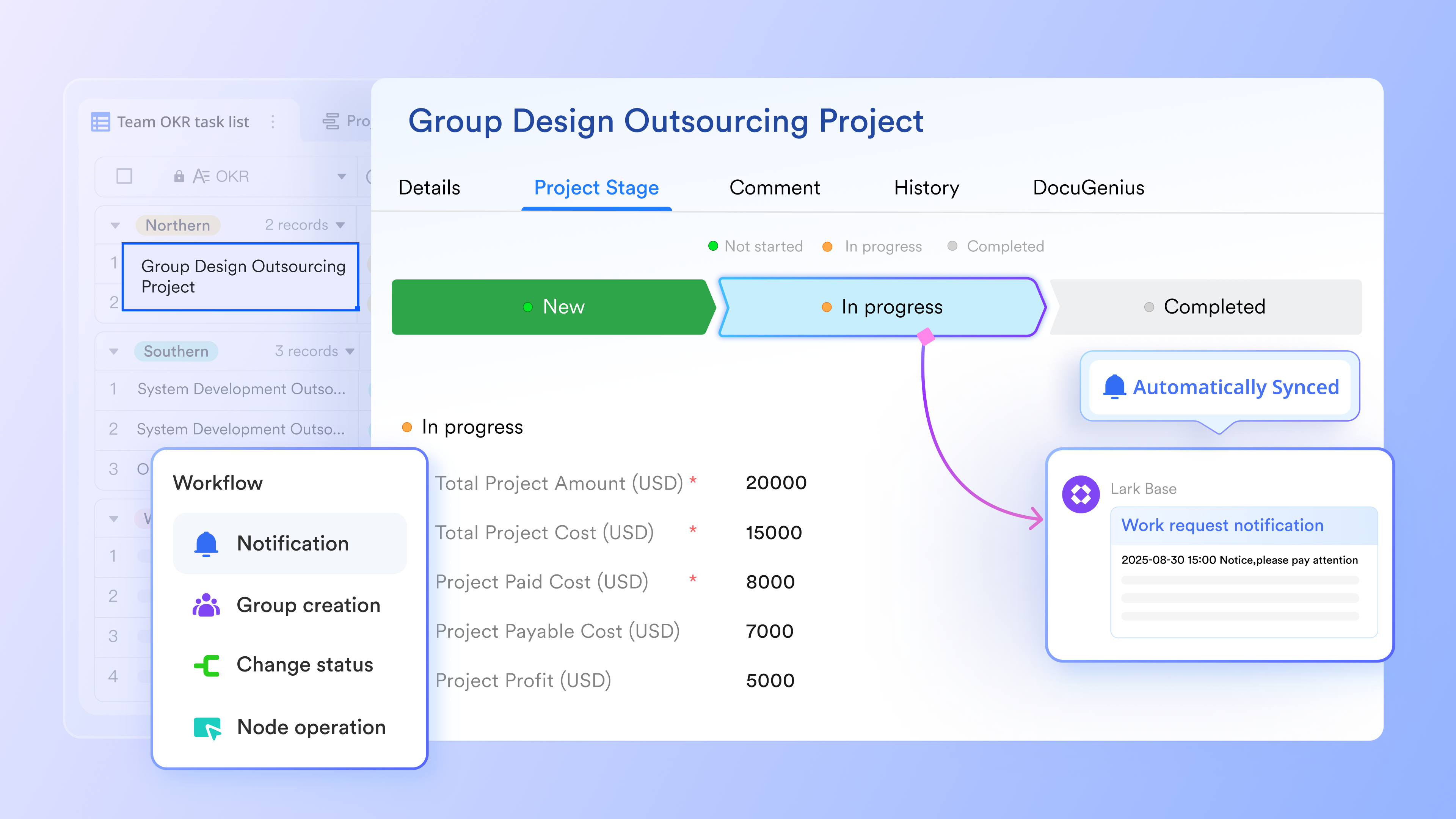
Lark Base turns repetitive tasks—like updating candidate records, sending notifications, or assigning follow-ups—into automated workflows that run on predefined triggers. Using conditional branches such as If/Else logic, staffing teams can build intelligent, multi-step processes that update data, notify recruiters, and schedule next actions automatically. For example, when a candidate's status changes to "Placed," Base can auto-create a billing record, alert the payroll team, and mark the placement as complete—no manual updates required.
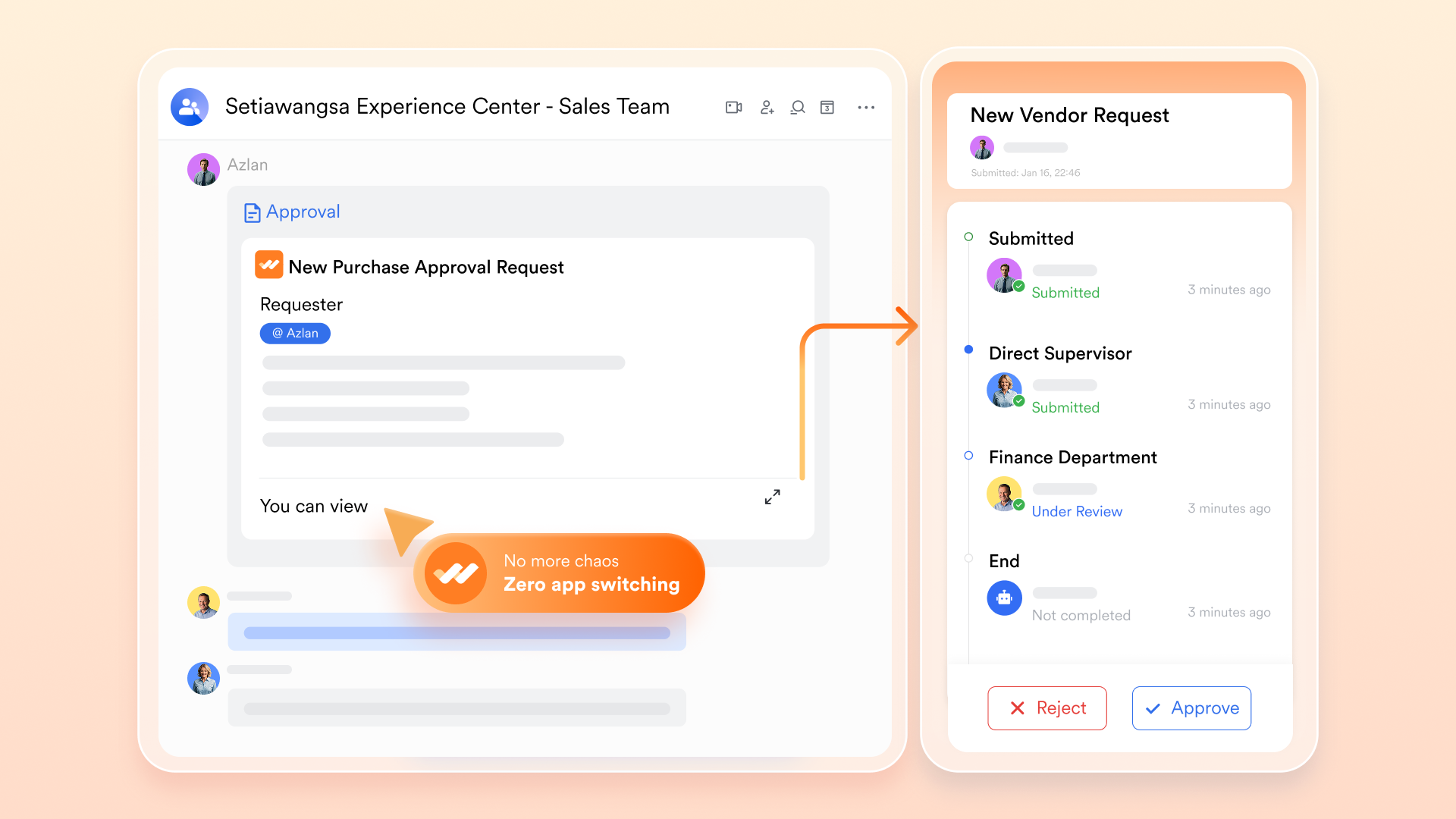
Lark Approval: Accelerate decision-making in staffing workflows
Lark Approval enables agencies to manage multi-level review processes—such as candidate selection approvals, budget sign-offs, or timesheet validations—without delay. Each approval flow can be customized to reflect organizational hierarchy and approval logic. Notifications appear directly in Messenger, allowing decision-makers to review and approve requests instantly. This speeds up internal approvals, reduces administrative lag, and ensures consistent policy compliance across all placement operations.
- Starter plan: Free forever plan that includes 11 powerful tools for up to 20 users. It also comes with 100GB of storage, 1000 automation runs, AI translations, and more.
- Pro plan: $12/user/month (billed annually) for up to 500 users. It includes everything in Starter plus group calling for up to 500 attendees, 15TB of storage, 50,000 automation runs, and more.
- Enterprise plan: Contact sales for custom pricing. Supports unlimited users and includes even more automation runs and advanced security, compliance, and management features.
2. Bullhorn: Leading recruiting and staffing CRM & operations platform
Bullhorn remains one of the most established names in the industry and is often ranked among the best staffing agency software options for end-to-end operations. Built for high-volume recruitment teams, it centralizes sourcing, client management, hiring workflows, and back-office tasks into one scalable system. With strong ATS and CRM capabilities, Bullhorn gives agencies a unified workspace to manage job orders, candidates, communication, and financials with ease.
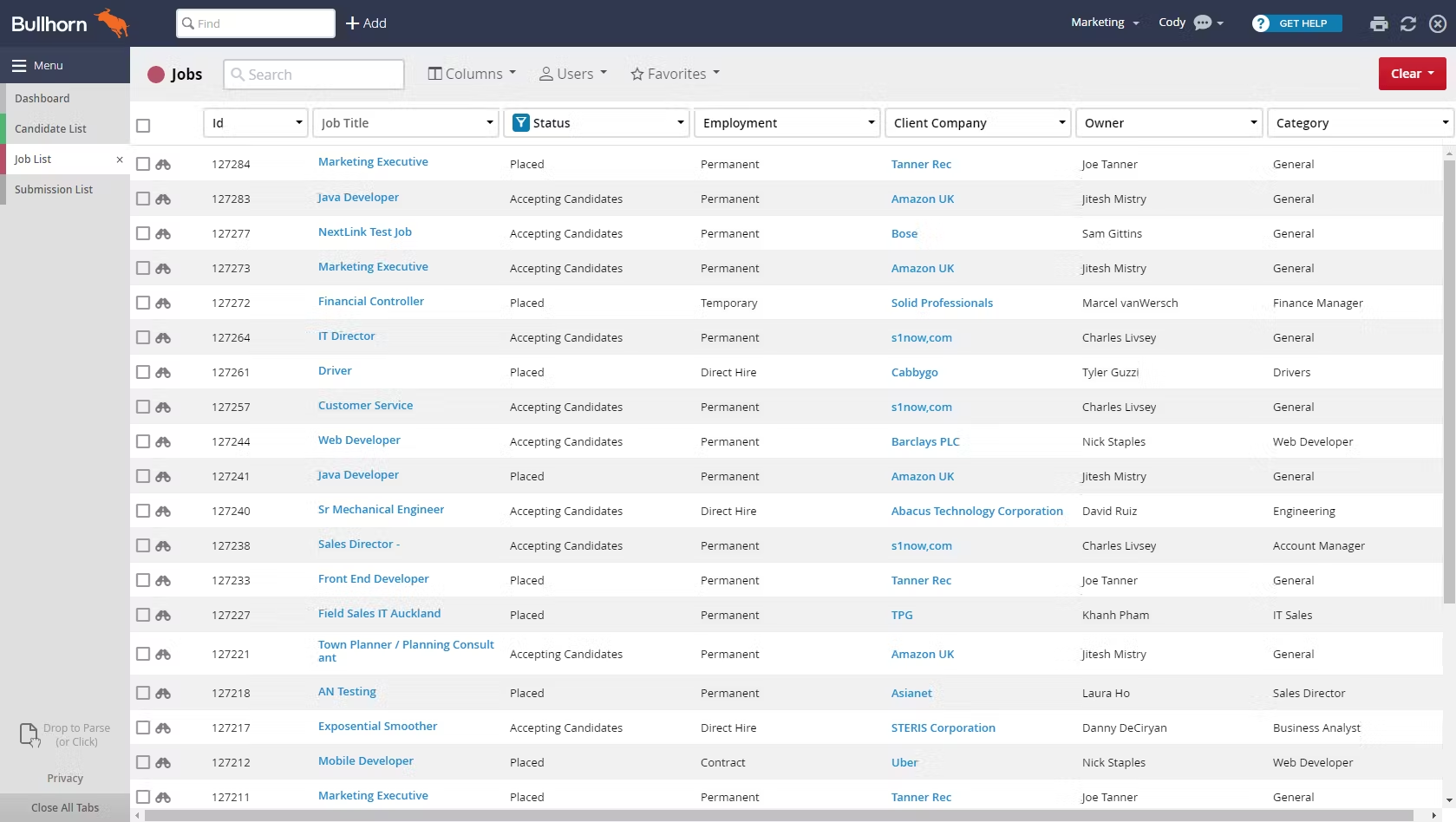
Image source: bullhorn.com
Key features:
- Comprehensive applicant tracking system (ATS) that manages every stage of recruitment, from candidate sourcing to placement confirmation.
- Built-in client relationship management (CRM) for tracking communication, job orders, and long-term client partnerships.
- Time and expense tracking with automated invoicing and payroll tools that reduce administrative overhead.
- Custom dashboards, analytics, and performance reports to monitor recruiter efficiency and placement metrics.
Pros:
- Offers one of the most scalable staffing agency software solutions, making it suitable for multi-branch or enterprise operations.
- Deep CRM capabilities enhance client management and relationship tracking.
- Strong reporting and analytics provide insights into recruiter productivity and ROI.
Cons:
- Steeper learning curve due to extensive feature depth and configuration options.
- Premium pricing may not suit smaller or budget-conscious staffing agencies.
Pricing:
- Team plan: $120–$150 per user/month (billed annually).
- Corporate plan: $200–$250 per user/month (billed annually).
- Enterprise plan: Custom pricing.
3. JobDiva: Staffing agency software with full scope for recruiting and back-office
JobDiva is a powerful enterprise platform designed for agencies that need deep recruitment, credentialing, and financial workflows. Its ability to unify ATS, CRM, onboarding, time tracking, and staffing agency billing software features makes it ideal for firms with complex operations. JobDiva is especially strong in environments that require high-volume placements, diverse client portfolios, and compliance-heavy workflows.
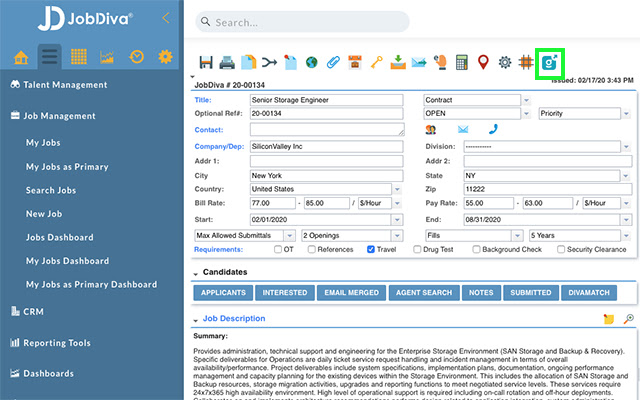
Image source: jobdiva.com
Key features:
- Integrated customer-relationship management (CRM) module tailored for staffing agencies to keep track of clients, prospects, and job orders.
- Onboarding and credentialing workflows with electronic document handling, e-Verify support, and mobile accessibility.
- Back-office financial suite ("DivaFinancials") that manages billing, payroll, timesheets, and integration with general ledger and VMS systems.
- Rich reporting and analytics with customizable dashboards, over 1,000+ pre-built reports, and deep business intelligence to monitor recruiter performance and client profitability.
Pros:
- Combines ATS, CRM, and staffing agency payroll software capabilities, giving agencies true end-to-end operational coverage.
- Advanced search and harvesting tools help agencies fill jobs faster and tap into large talent pools.
- Strong vendor management system (VMS) integration and global/cloud architecture ideal for multi-region agencies.
Cons:
- User interface and navigation can feel dated and may require significant training for new users.
- High complexity and broad feature set may be overkill for small agencies or those with simpler workflows.
Pricing:
- Base platform: $120-$200 per user/month (billed annually).
- Enterprise/Global plan: Custom pricing.
4. Avionté: Temp and workforce hiring platform for staffing agencies
Avionté is built for agencies running large temp or contract workforces and is widely recognized as a leading temp staffing agency software solution. It connects candidate sourcing, onboarding, mobile time tracking, payroll, and workforce scheduling in one system. With tools designed specifically for fast-moving temp environments, Avionté helps agencies coordinate shifts, fill jobs quickly, and maintain day-to-day workforce visibility.
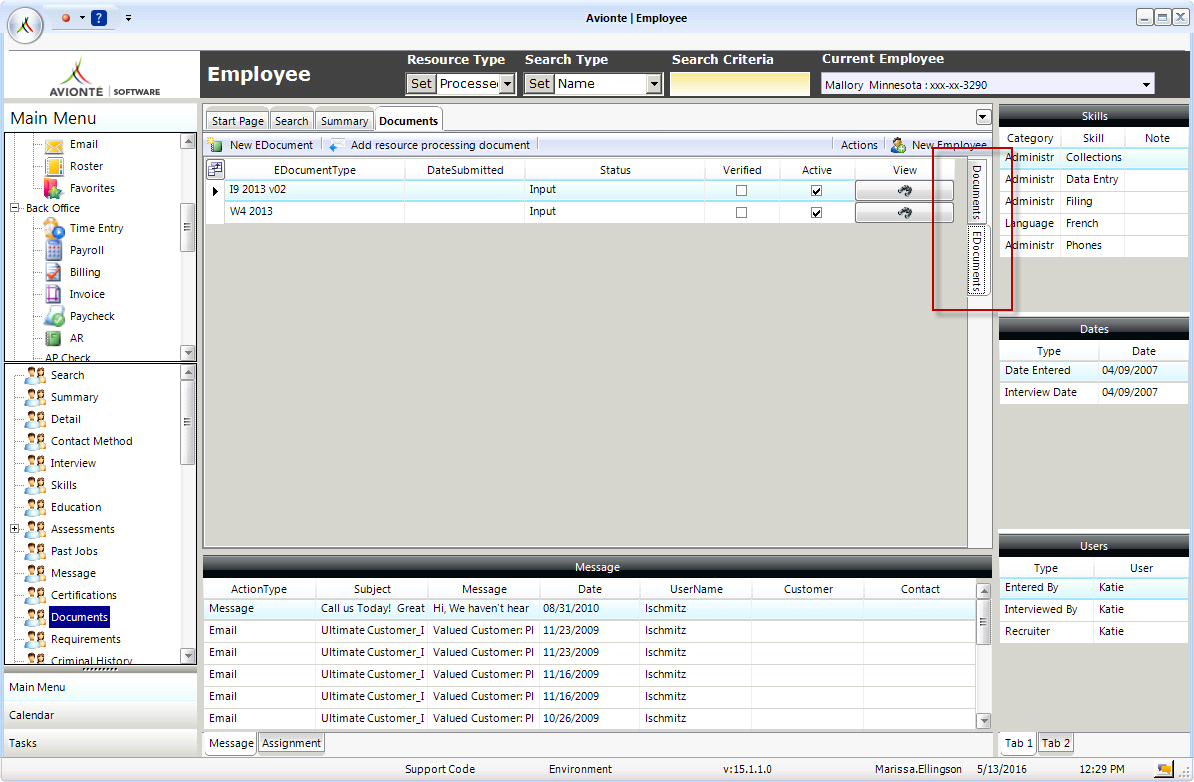
Image source: avionte.com
Key features:
- Integrated time and attendance, payroll, and billing functions to streamline the complete workforce management process
- Mobile talent engagement app that allows candidates to view jobs, log hours, access pay details, and complete onboarding from anywhere
- In-depth reporting and analytics dashboards that track key metrics like placement success, fill rates, and financial performance
- Integration-ready API system that connects easily with job boards, vendor systems, and external payroll or accounting tools
Pros:
- Highly effective for temp and shift-driven agencies due to integrated staffing agency time and attendance software capabilities.
- Ideal for temporary staffing agencies managing large candidate volumes or multiple client locations
- Strong mobile access and talent engagement features improve worker experience and agency responsiveness
Cons:
- Pricing and deployment may be costlier compared to smaller ATS-focused systems
- Some users find the interface less intuitive during the initial onboarding phase
Pricing:
- Standard plan: $100 per user per month (billed annually).
- Professional plan: $150–$200 per user per month (billed annually).
- Enterprise plan: Custom pricing.
5. Manatal: Modern agency CRM & ATS with affordability
Manatal offers an intuitive ATS + CRM platform that works especially well for niche verticals, including tech hiring and software engineer staffing agency workflows. It simplifies sourcing, client management, and candidate screening through AI recommendations, social data enrichment, and customizable pipelines. With a clean interface and budget-friendly plans, Manatal is a strong option for smaller agencies and startups.
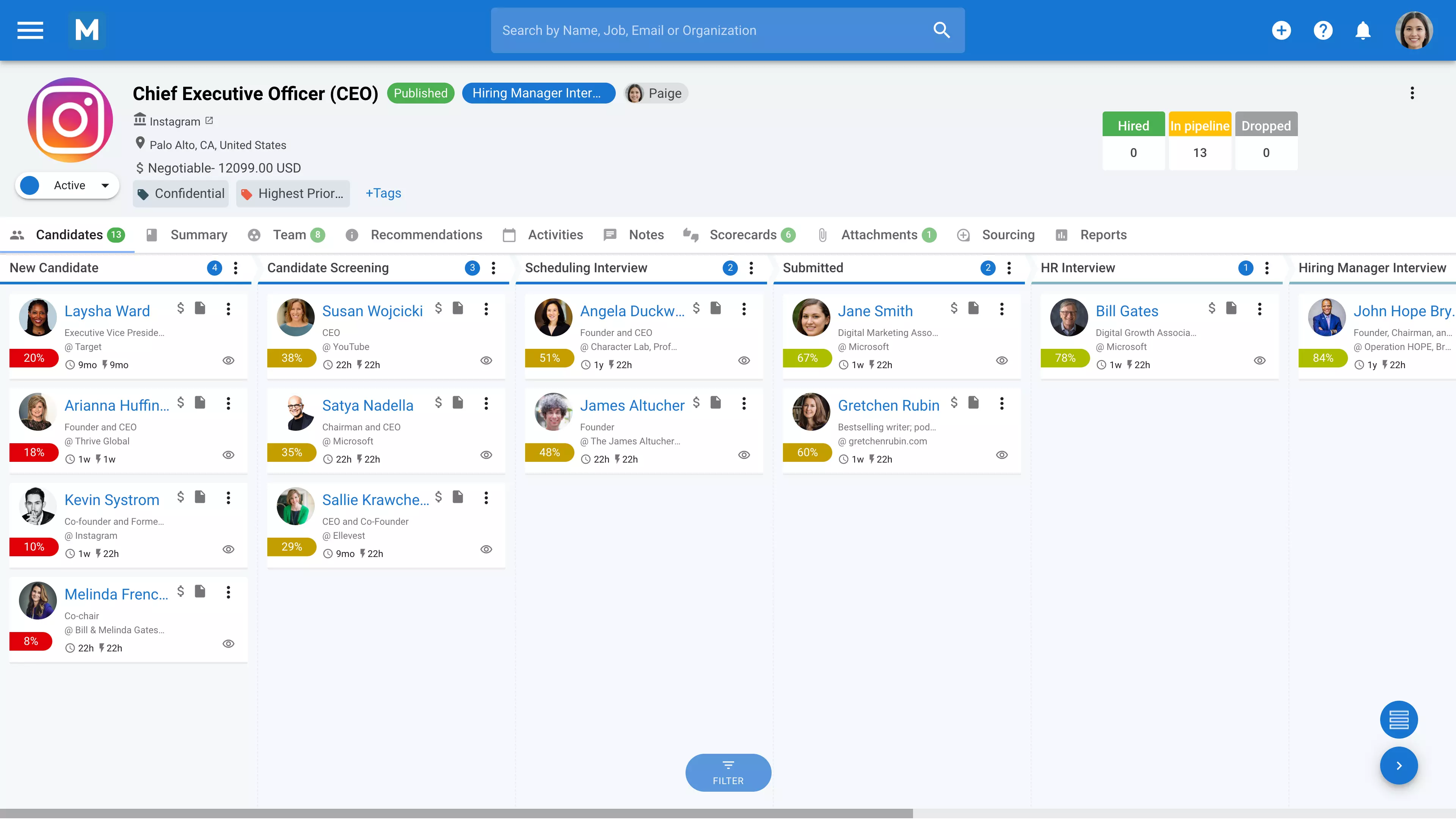
Image source: manatal.com
Key features:
- Drag-and-drop job pipelines and advanced ATS that make it easy to track candidates through your hiring stages and source from channels like LinkedIn, GitHub and niche boards.
- Built-in CRM linking job orders with client engagements, candidate history, and automated outreach so your agency can handle both client and candidate relationships in one system.
- AI-powered candidate scoring and job-matching suggestions that surface top talent quickly, plus enrichment from public profiles automatically to reduce manual input.
- Career-page builder, multi-channel posting, email/SMS campaigns and workflow automation enabling agencies to scale sourcing and screening without extra tools.
Pros:
- Ideal for a software staffing agency needing AI-powered candidate scoring and faster sourcing.
- User-friendly interface and quick setup compared to enterprise systems—reduces time to ramp up.
- Strong feature set for candidate sourcing, CRM and analytics—covers much of the staffing lifecycle in one platform.
Cons:
- Higher-tier features (e.g., single sign-on, open API access, user groups) require upgrading to more expensive plans—so full functionality may cost more.
- Interface and workflows aimed at smaller teams; may lack some of the depth and back-office staffing features required by large enterprise agencies.
Pricing:
- Professional plan: $15 per user per month (billed annually).
- Enterprise plan: $35 per user per month (billed annually).
- Enterprise plus plan: $55 per user per month (billed annually).
6. Zoho Recruit: Flexible recruiting and staffing agency software
Zoho Recruit provides a flexible, all-in-one recruiting system suitable for agencies across industries—including those in high-compliance segments like healthcare staffing agency software. It brings candidate sourcing, assessments, client CRM, and workflow automation together in a customizable environment. Zoho is especially valuable for agencies that need both power and affordability in a cloud-based solution.
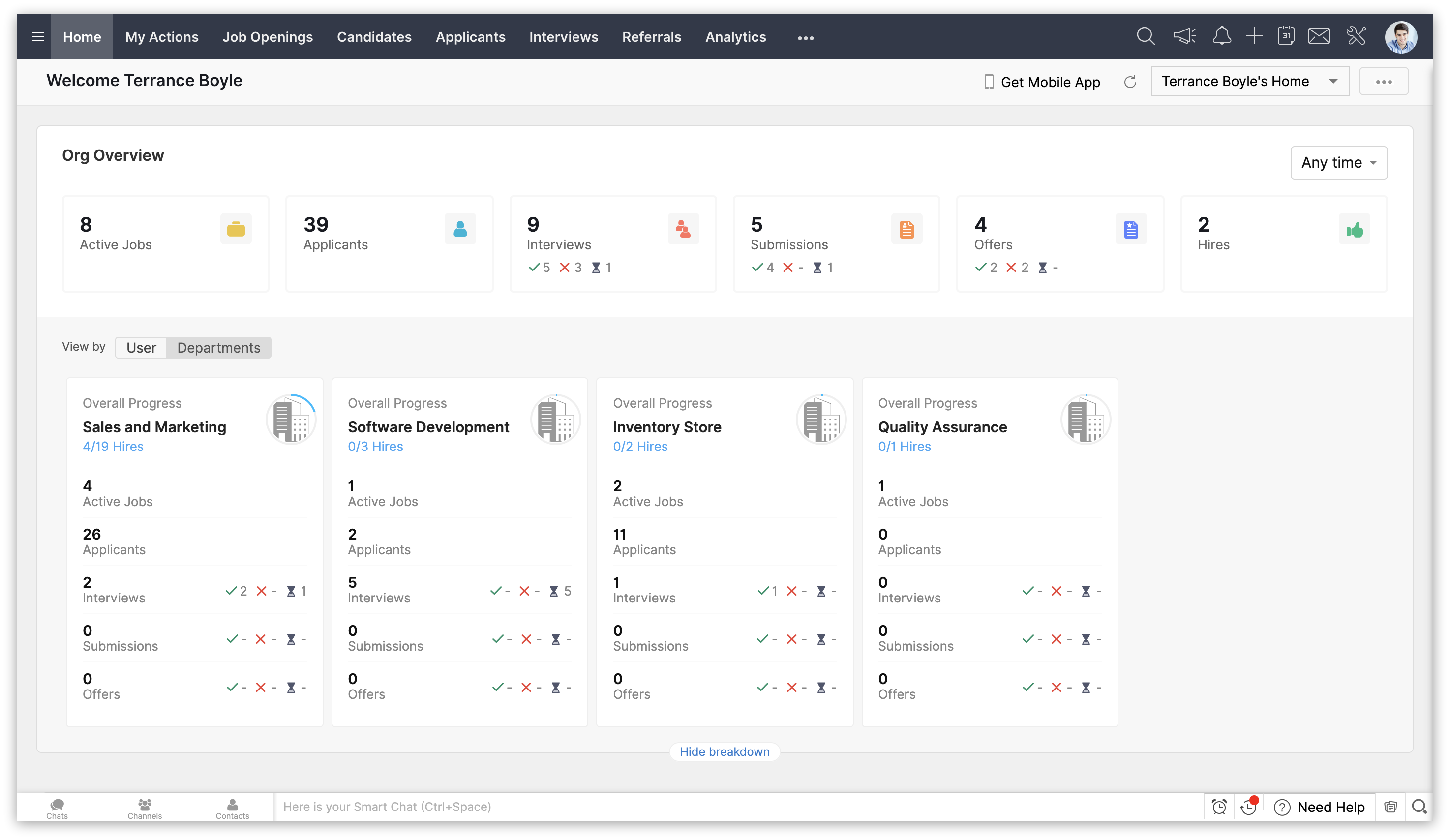
Image source: zoho.com
Key features:
- CRM features tailored for staffing agencies: manage clients, job orders and candidate relationships in one database; provide candidate and client portals for self-service.
- Screening, interview and assessment tools: built-in assessments, one-way and live video interviews, background check workflows, and branded career pages.
- Automation of hiring pipelines and workflows: customize job pipelines, triggers, alerts and task assignments so recruiters spend less time on manual updates.
- Reporting and analytics dashboards: built-in and custom reporting to monitor key staffing metrics such as placements, time-to-fill, source efficiency and recruiter productivity.
Pros:
- Highly flexible recruitment software for staffing agency teams covering perm, temp, and niche hiring models.
- Highly configurable and flexible for different agency models—perm, temp, volume, niche technical staffing—without needing heavy custom development.
- Rich set of integrations and mobile support that allow remote recruiting, candidate engagement and multi-channel sourcing.
Cons:
- Some agencies report that the CRM side is less sophisticated than purpose-built client-CRM platforms, so heavy client-sales workflows may feel constrained.
- While very configurable, the number of options and setup needed may require more time for full adoption especially for smaller teams.
Pricing:
- Standard plan: $25–30 per user/month (billed annually).
- Professional plan: $50–60 per user/month (billed annually).
- Enterprise plan: $75–90 per user/month (billed annually).
7. Ceipal TalentHire: End-to-end talent acquisition and staffing platform
Ceipal TalentHire is engineered for full-cycle staffing operations and is widely used as an IT staffing agency software solution due to its strengths in sourcing technical talent. With built-in ATS, CRM, credentialing, onboarding, and VMS connectivity, Ceipal supports high-volume recruiting and multi-client environments. Its analytics and automation capabilities help agencies scale efficiently across global teams.
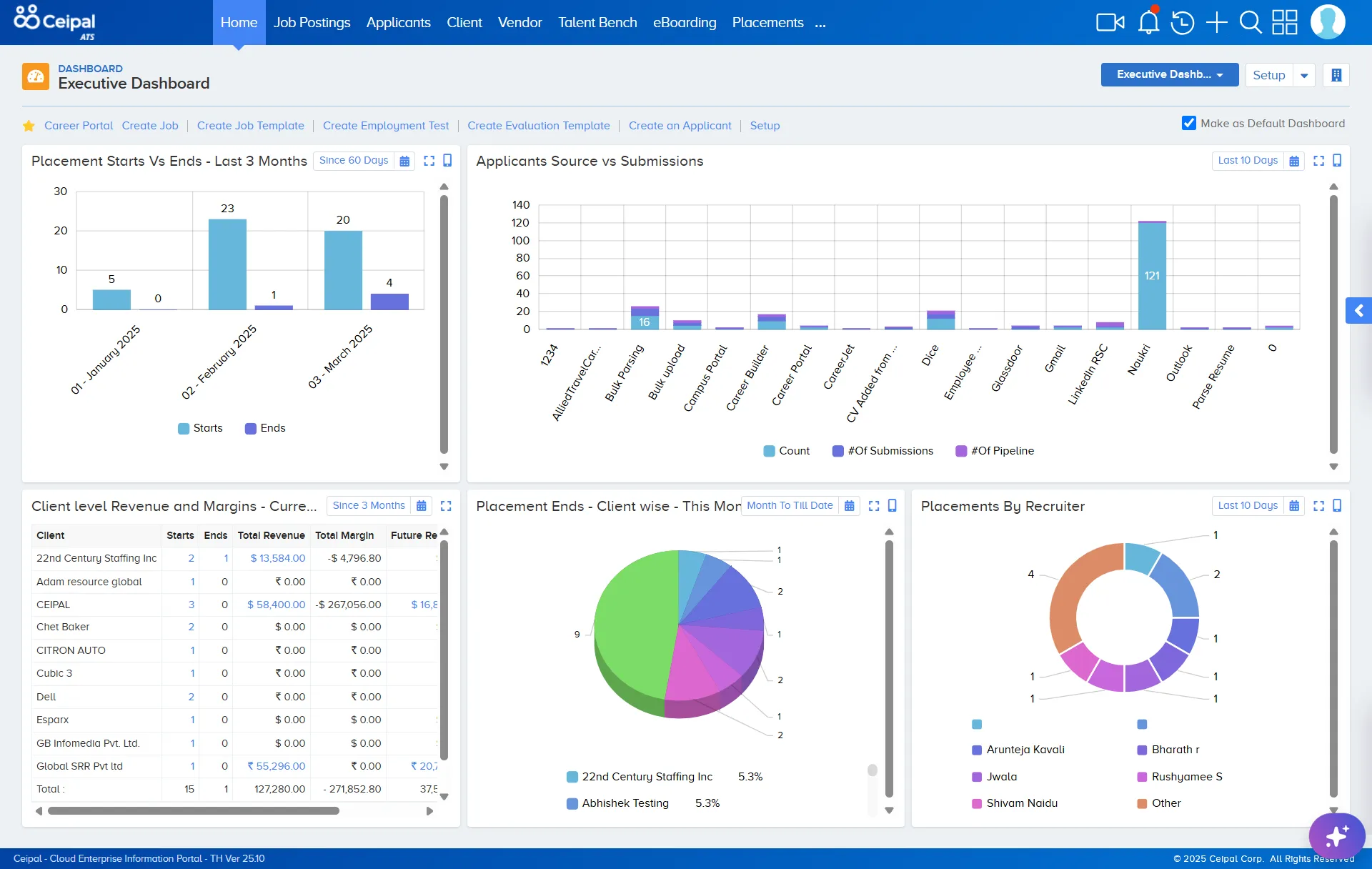
Image source: ceipal.com
Key features:
- Applicant tracking and candidate sourcing toolkit that includes job posting to 250+ boards and social channels, semantic search, and resume parsing to speed up hiring cycles.
- CRM and client management module to link job-orders, clients, vendors, and talent pools all within one unified database for better relationship visibility.
- Onboarding and credentialing workflows with e-signatures, document management, and mobile access so new hires can be ready for placement quicker.
- Integrated placement, billing and margin tracking dashboard that allows agencies to monitor markups, placements, and revenue performance in real-time.
Pros:
- A powerful all-in-one agency staffing software platform combining ATS, CRM, and workforce management.
- Strong integration ecosystem (job boards, VMS, mobile) which suits agencies operating in multiple industry verticals or with distributed teams.
- Designed to support scalability for medium to large agencies with multiple users and global operations.
Cons:
- Feature-rich platform means there is a learning curve; setup and training may require more investment than basic ATS tools.
- Smaller agencies with very simple workflows may find some modules unnecessary or under-utilized.
Pricing:
- Basic tier: $24 per user per month (billed annually).
- Mid tier: $21 per user per month (billed annually).
- Large agency tier: $19 per user per month (billed annually).
8. Workable: Recruiting software adaptable for staffing agencies
Workable is a modern hiring platform that adapts well to small and mid-sized agencies looking for lightweight staffing agency recruiting software. It simplifies job posting, candidate pipelines, interview coordination, and communication, making it easy for recruiters and clients to collaborate. Workable excels as a plug-and-play solution for agencies that prioritize speed and usability.
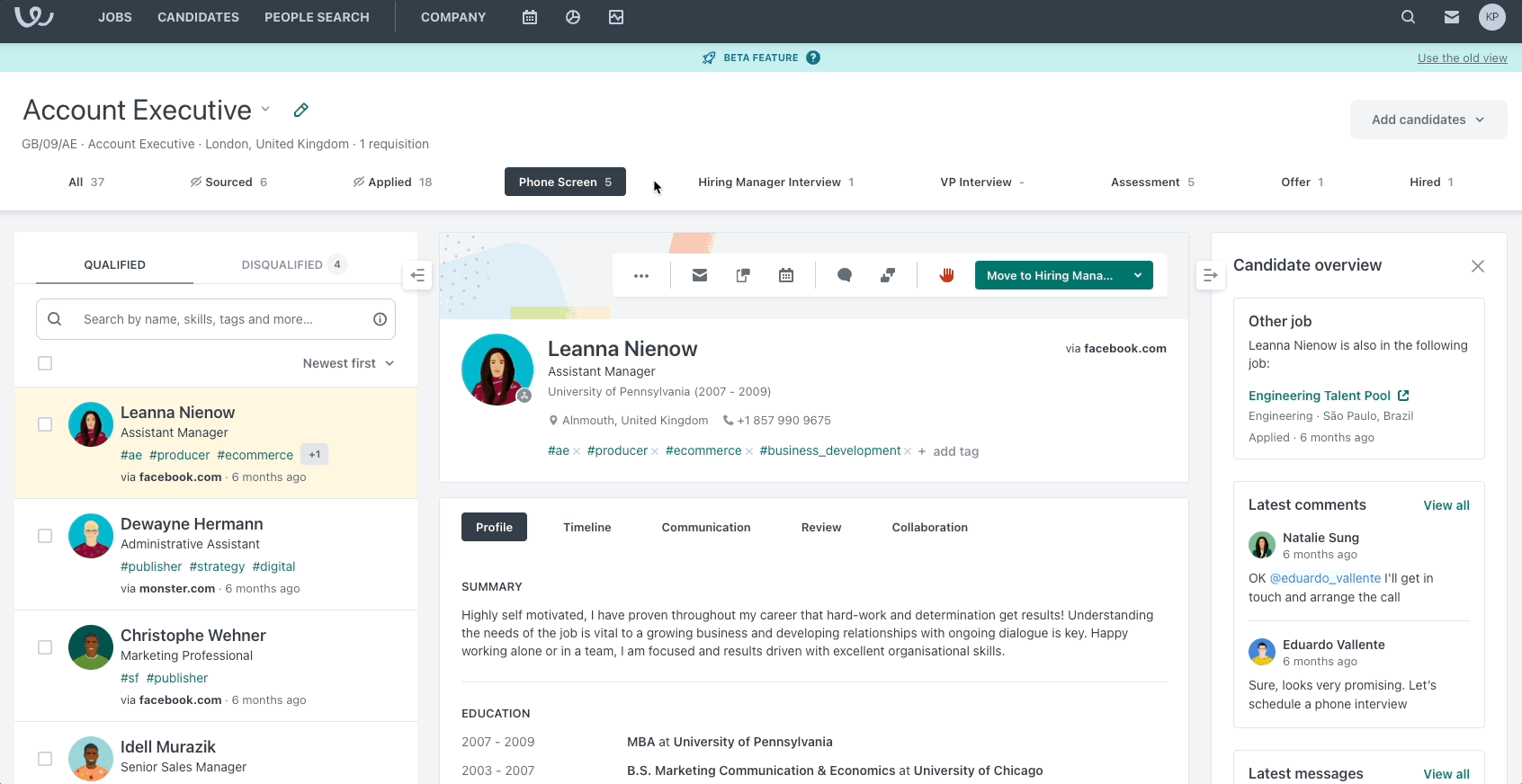
Image source: workable.com
Key features:
- Multi-channel job posting and sourcing helps agencies reach candidates across boards, social platforms, and referrals, consolidating applicants into a single pipeline.
- Collaborative hiring tools allow recruiters and clients to share feedback, schedule interviews, and track candidates seamlessly in real time.
- AI-driven candidate recommendations enhance shortlisting accuracy, while built-in scheduling tools save administrative time.
- Analytics dashboards display essential metrics like time-to-fill, recruiter efficiency, and sourcing performance for continuous optimization.
Pros:
- Great choice for teams seeking staffing agency software small businesses can adopt with minimal setup.
- Flexibility to be used for both permanent and temporary roles across various industries.
- Good value for smaller staffing agencies looking to modernize their recruiting operations.
Cons:
- Lacks depth in dedicated staffing-agency features such as full billing/invoicing or time & attendance management.
- Customization options and advanced analytics are more limited than enterprise-grade staffing platforms.
Pricing:
- Starter/Basic plan: $15 per user per month (billed annually).
- Professional plan: $39 per user per month (billed annually).
- Enterprise plan: Custom pricing.
9. OpenHire: Staffing software focused on seasonal/volume hiring
OpenHire is tailored for high-volume recruitment and excels as staffing agency event software for agencies managing large hiring cycles, seasonal roles, or event-based staffing. It supports bulk job management, mass applicant processing, credential tracking, and scheduling workflows that scale quickly. The platform is ideal for agencies handling hundreds or thousands of applicants at once.
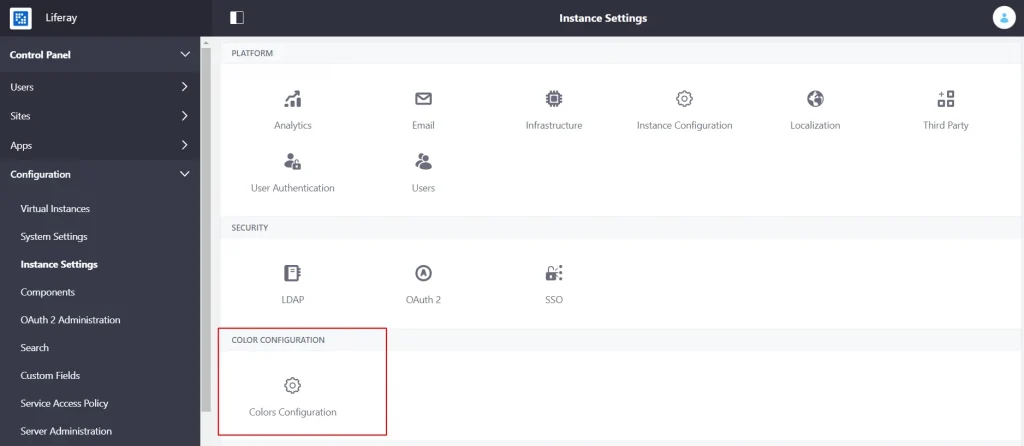
Image source: openhire.com
Key features:
- Bulk job posting and massive applicant intake tools allow agencies to manage hundreds or thousands of candidates quickly from one requisition.
- Volume-centric screening and scheduling workflows that automate interview slots, assess multiple candidates at once, and funnel approvals efficiently.
- Credentialing and compliance tracking tailored for seasonal workforces or temp staffing, including document verification and expiry reminders.
- Scheduling and shift management features that support high-turnover or cyclical staffing models common in warehouse, retail or event staffing environments.
Pros:
- Works well as warehouse staffing agency software thanks to bulk applicant processing and shift workflows.
- Workflow templates and automation reduce manual effort when managing large numbers of candidates and job orders.
- Recruitment pipeline built for scale and speed, reducing time-to-fill even when hundreds of roles are open at once.
Cons:
- May lack depth in back-office billing, payroll or long-term placement management compared to full staffing agency software solutions.
- Less suited for boutique agencies focused on highly specialised permanent placements or low-volume workflows.
Pricing:
- Starter plan: $99/month (billed annually).
- Professional plan: $299/month (billed annually).
- Enterprise plan: Custom pricing.
10. TempWorks: Temp staffing and light industrial software solution
TempWorks specializes in supporting hourly, shift-based workforce operations and is a top choice for temporary staffing agency software requirements. It combines applicant tracking, payroll, time tracking, mobile check-ins, and client portals to manage light industrial, logistics, and manufacturing staffing. Its full back-office suite makes it especially valuable for agencies coordinating large distributed workforces.
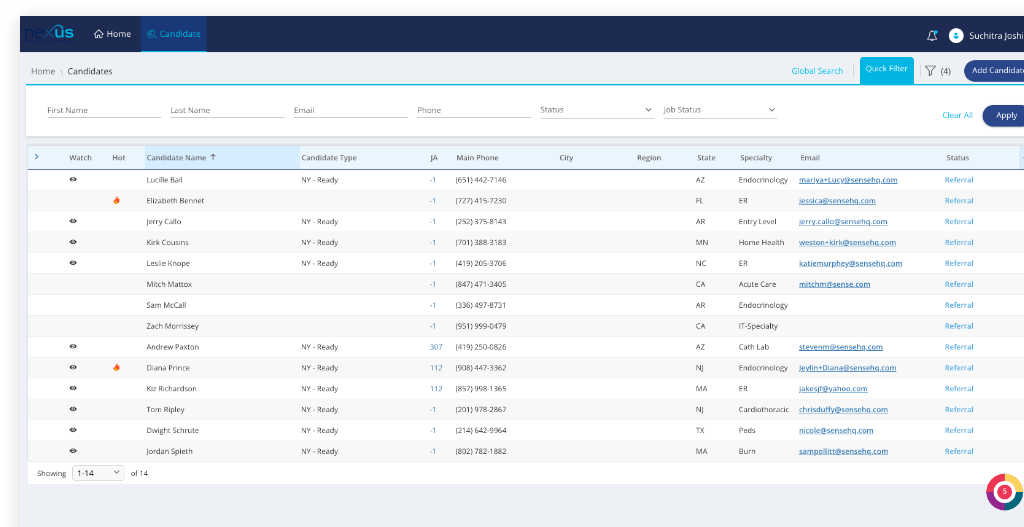
Image source: tempworks.com
Key features:
- Applicant tracking and job-order management that centralizes job orders, candidate submissions, and placement workflows so recruiters and operations teams see the full pipeline from sourcing to deployment.
- CRM and client relationship features enabling recruiters and account managers to track open orders, monitor branch performance, view job-fill metrics, and manage customer portals for clients to log assignments and approvals.
- Payroll, billing and time-attendance tools including mobile app clock-in/out, QR or PIN punches, geofencing/facial recognition, direct integration into timesheet review, client invoicing and payroll processing.
- Mobile and self-service portals for employees and clients where temp workers can view assignments, submit hours, check pay stubs; clients can monitor job orders, hours, and invoices in real time.
Pros:
- Functions as full staffing agency back office software, including payroll, invoicing, and margin tracking.
- Strong mobile experience and self-service portals that improve candidate and client engagement, making tedious tasks like timesheet submission and pay-stub access simpler.
- Real-time visibility into job orders, placements, time & attendance data, enhancing operational insight and supporting branch-level tracking at scale.
Cons:
- The interface and workflows may feel less modern compared to newer SaaS-only platforms; some users report slower performance or dated UI elements.
- Because it covers both front-office and back-office functions, setup and configuration can require significant time and resources—small agencies with minimal requirements may find it more than they need.
Pricing:
- Entry/Standard plan: $100 per user per month (billed annually).
- Mid-tier plan: $150–$200 per user per month (billed annually).
- Enterprise plan: Custom pricing.
How to choose the right staffing agency software
Choosing the right staffing agency software begins with understanding your agency's specific needs, scale, and client base. The ideal platform should align with how your team sources candidates, manages placements, and coordinates billing or payroll. From medical staffing agency software to warehouse staffing agency software, every sector demands unique features that simplify compliance and daily workflows. Below are the essential factors to evaluate before investing in your next solution.
- Recommend key criteria: The best staffing agency recruiting software should combine sourcing, applicant tracking, and workforce management into one connected system. Look for capabilities such as scheduling and time & attendance tracking, billing and invoicing tools, and onboarding and credentialing modules. Strong reporting and analytics help agencies assess recruiter performance, time-to-hire, and overall profitability. Together, these functions ensure transparency, accountability, and faster placement cycles across all staffing operations.
- Consider size and specialization: Your agency's focus determines which staffing agency software solutions will fit best. For instance, healthcare staffing agency software must handle license expirations and credential tracking, while software engineering staffing agencies require CRM-style tools to manage long-term client projects. Smaller agencies benefit from lightweight, cloud-based platforms designed for scalability and ease of use. Choosing software that reflects your agency's specialization helps reduce administrative friction and improve placement outcomes.
- Budget & deployment: Cost and scalability play a major role in your decision. Some free staffing agency software plans provide a strong starting point but may lack advanced features like payroll or reporting. Mid-sized firms often prefer cloud-based solutions for flexibility and remote access, while larger agencies may opt for staffing agency back-office software with on-premises deployment for added control. Always consider future growth and ensure your system can scale seamlessly as your team and placements expand.
- Integration and automation: A high-performing staffing agency management software should connect candidate, client, and internal workflows without creating data silos. Look for systems that sync placement records, timesheets, and invoices across departments in real time. Platforms that support built-in communication and document sharing—such as staffing agency database software—reduce manual updates and improve visibility across your operations. This interconnected structure ensures a smoother experience for recruiters, clients, and candidates alike.
Implementation best practices for staffing agency software
Implementing staffing agency software requires more than just installing a new tool—it demands alignment between processes, people, and data. A structured rollout ensures your teams transition smoothly, systems work cohesively, and every stakeholder benefits from improved visibility and efficiency. When done right, implementation turns technology into a growth enabler, helping agencies boost placements and streamline compliance.
- Define your core workflows: Start by mapping your recruitment lifecycle—from candidate sourcing and screening to placement, timesheet submission, and invoicing. Understanding each touchpoint helps configure the software for your agency's actual processes. This ensures automation supports your existing workflow instead of disrupting it.
- Clean and migrate your data: Before migration, audit your candidate, client, and placement records to remove duplicates or outdated information. Clean data improves system performance and reports accuracy. Properly mapping fields during import ensures continuity across applicant tracking, billing, and credentialing modules.
- Train your team and define permissions, user roles, and dashboards: Conduct role-based training so recruiters, account managers, and administrators each know their tools and limits. Defining permissions prevents data overlap while maintaining compliance with access controls. Custom dashboards can further help teams focus on key performance metrics relevant to their roles.
- Use pilots and phased rollout: Avoid a full-scale launch right away—start with a smaller workflow such as temporary staffing or scheduling. A pilot phase allows you to identify configuration gaps and collect feedback early. Once stable, extend rollout to additional modules for a smooth transition.
- Monitor adoption and continuously review metrics: Track critical metrics such as fill rate, time-to-placement, and invoice accuracy to assess adoption and performance. Regular reviews help refine processes and identify training needs. Continuous feedback loops ensure long-term optimization and sustained ROI from your staffing software.
Conclusion
Choosing the right staffing agency software goes beyond comparing feature lists—it's about aligning the platform with your agency's structure, industry focus, and growth vision. Whether your agency specializes in permanent placements, temporary assignments, healthcare staffing, or tech recruitment, the ideal system should unify operations and remove friction across sourcing, onboarding, timesheets, and invoicing.
Many platforms focus only on recruitment, but modern solutions like Lark take it further by integrating collaboration, scheduling, client communications, and team coordination within a single connected workspace. This unified approach not only reduces administrative load but also enhances transparency and speed across the entire placement lifecycle. By prioritizing clarity, scalability, and usability, agencies can future-proof their operations and maintain a competitive edge in a rapidly evolving market.
FAQs
Can staffing agency software handle both permanent and temporary placements?
Lark and other leading staffing agency software solutions are designed to manage both permanent and temporary placements with ease. They allow recruiters to configure workflows for each model, supporting job requisitions, scheduling, timesheets, and invoicing in one system. Whether your agency handles contract workers, seasonal staff, or full-time hires, the software adapts seamlessly to diverse needs. This flexibility helps agencies maintain consistency across placements and reduce the complexity of managing mixed workforce types.
Is there staffing agency software free of cost for small firms?
Yes, some staffing software platforms provide free or low-cost entry plans aimed at startups or small recruitment firms. However, these versions often include limited features and may cap the number of users, job postings, or integrations. Before adopting one, agencies should confirm that essential modules—like scheduling, invoicing, and candidate management—are included. Choosing scalable software ensures you can upgrade as your agency grows.
How important is scheduling and time & attendance in staffing agency software?
Scheduling and time-tracking are vital for agencies handling hourly, shift-based, or high-volume placements. These features enable recruiters to assign shifts, capture mobile timesheets, and monitor attendance in real time. Integrated project management tools reduce manual data entry errors, enhance payroll accuracy, and improve client satisfaction. Ultimately, these modules provide the operational visibility that agencies need to manage large, distributed workforces effectively.
Does staffing agency software help with compliance and credential tracking?
Yes, compliance and credential management are core components of many staffing software platforms, particularly for healthcare and skilled trade agencies. They track licenses, certifications, background checks, and expiration dates to ensure placements meet regulatory requirements. Automated reminders prevent compliance lapses and simplify audit preparation. This minimizes legal risks while maintaining agency credibility with clients and regulators alike.
Do staffing agencies need separate software for invoicing and payroll?
Not necessarily—comprehensive staffing agency software often integrates invoicing, billing, and payroll within the same system. This unified approach connects time tracking, placement data, and client billing for seamless financial operations. Agencies benefit from reduced manual work, fewer data mismatches, and faster payment cycles. By keeping all financial processes in one place, agencies gain better control over revenue and profitability.
Related reading
Table of contents
Start using Lark today

Manage all your work in one place
Boost team efficiency by 10x
Save up to 70% on software costs
Table of contents
Start using Lark today
Manage all your work in one place
Boost team efficiency by 10x
Save up to 70% on software costs
Keep reading








2026 Lark Technologies Pte. Ltd.
Headquartered in Singapore with offices worldwide.






Explore: