














SugarCRM vs Salesforce: The definitive 2026 comparison guide

Matthew Sia
Product Marketing Manager
Sep 18, 2026
Matthew Sia
Sep 18, 2026

23 min read


Choosing a CRM is a critical decision that can either unlock growth or waste resources. In the vast CRM marketplace, where a full analysis might involve a salesforce vs microsoft dynamics vs sugarcrm comparison, two names represent distinct philosophies: SugarCRM, which champions flexibility, and Salesforce, the market leader known for its powerful cloud ecosystem.
This guide moves beyond a surface-level feature list. It provides an in-depth, practical comparison of SugarCRM vs Salesforce, analyzing core features, the true cost of ownership, and user experience to help you confidently decide which platform is the best fit for your business.

What is SugarCRM?
SugarCRM offers a different value proposition, centered on flexibility and customer-centricity. It began as an open-source project, and that spirit of adaptability remains at its core. SugarCRM's mission is to "let the platform do the work," automating as much as possible to give users a clearer, more predictive picture of the customer journey.
Where Salesforce provides a vast, somewhat rigid structure, SugarCRM provides a powerful, pliable framework. It is known for its deep customization capabilities, allowing businesses to tailor the platform to their unique processes without extensive coding. This makes it particularly appealing for organizations with complex or non-standard workflows that do not fit neatly into a predefined box. SugarCRM also offers more flexibility in deployment, with options for cloud hosting or on-premises installation, giving businesses ultimate control over their data and infrastructure. It positions itself as a cost-effective and agile alternative to larger, more restrictive platforms.
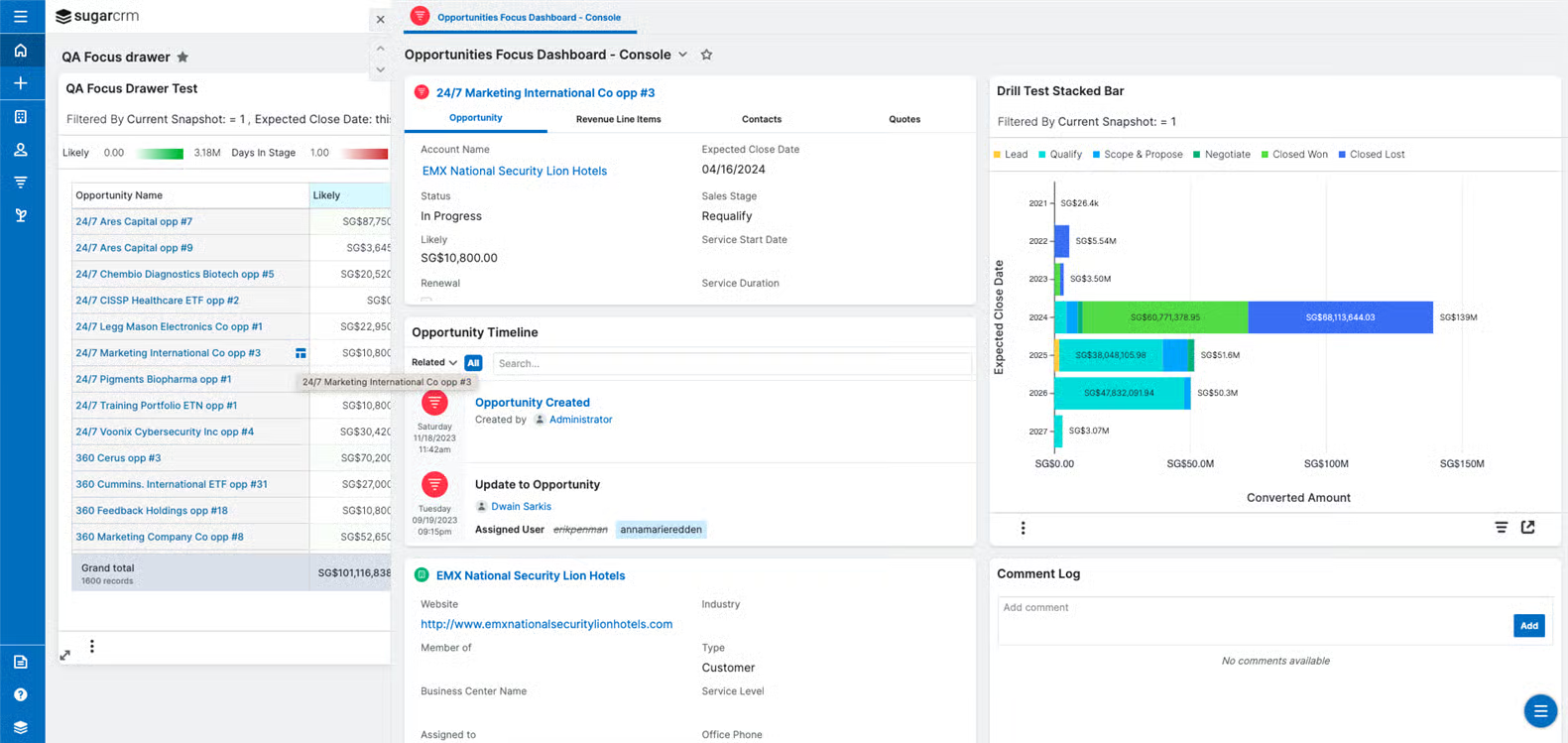
Image source: sugarcrm.com
What is Salesforce?
Salesforce is the dominant force in the CRM industry. It was a pioneer of the Software-as-a-Service (SaaS) model, delivering enterprise-grade software through the cloud. At its core, Salesforce is a powerful, scalable, and data-driven platform designed to provide a 360-degree view of the customer.
Its reputation is built on the breadth of its capabilities. The platform extends far beyond core sales functions, with dedicated "Clouds" for service, marketing, commerce, analytics, and more. This ecosystem is further expanded by the AppExchange, a massive marketplace of third-party applications that can be integrated into Salesforce to add almost any functionality imaginable. Historically, its power and complexity made it the go-to choice for large enterprises, but with different editions and pricing tiers, it now actively courts businesses of all sizes. To many, Salesforce is synonymous with CRM itself.
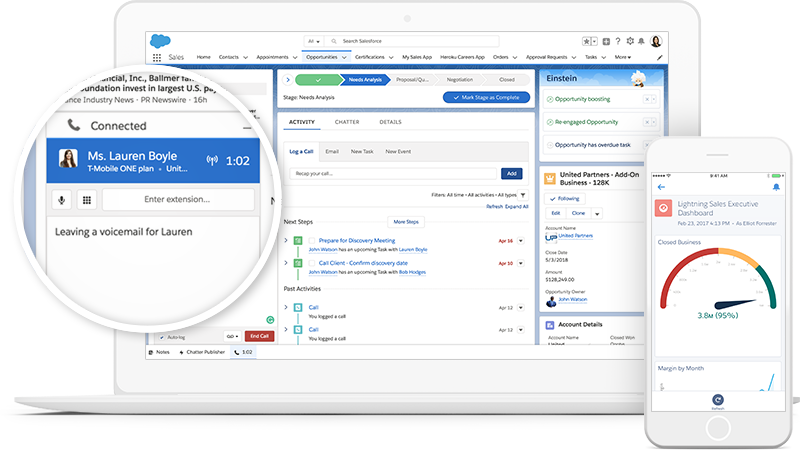
Image source: salesforce.com
SugarCRM vs Salesforce: Core features
While high-level philosophies are important, the decision often comes down to specific features and functionalities. A modern CRM is expected to be an all-in-one solution for every customer-facing team. Here's how the Salesforce CRM vs SugarCRM matchup looks across the most critical business functions.
A quick glance at core features comparison
Sales automation and pipeline management
Both platforms excel at core sales functions, but they differ in presentation and approach.
Sugar Sell, the sales automation product from SugarCRM, offers powerful tools with a focus on information clarity and user flexibility. It provides comprehensive lead, account, and opportunity management. Its dashboards are highly configurable, allowing teams to surface the data that is most relevant to them. SugarCRM emphasizes "time-aware" intelligence, meaning it tracks changes to customer data over time, providing deeper insights into pipeline health and customer engagement. The experience is less about following a prescribed path and more about equipping the user with all the necessary information to make the best decision.
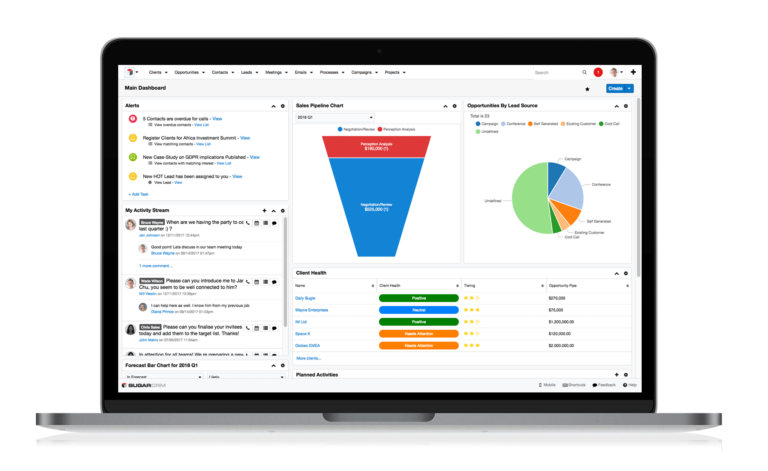
Image source: sugarcrm.com
Salesforce Sales Cloud, on the other hand, is renowned for its robust pipeline management tools. Its user interface, known as Salesforce Lightning, provides a highly visual and intuitive way to track leads, opportunities, and contacts. The path and guidance features allow managers to embed key steps and best practices directly into the workflow, ensuring process consistency. Forecasting is a major strength, with sophisticated tools for analyzing the pipeline and predicting revenue. The platform provides a guided experience, leading reps through a structured sales process.
Marketing automation capabilities
Connecting marketing efforts with sales results is a key function of any modern CRM.
Sugar Market is SugarCRM's all-in-one marketing automation solution. It is designed to be more straightforward and tightly integrated with Sugar Sell from the outset. It provides a comprehensive set of tools for email campaigns, landing pages, social media management, and lead nurturing. A key feature is its AI-powered predictive analytics, which helps marketers identify the most engaged leads and understand which campaigns are driving the most revenue. For many businesses, Sugar Market offers the majority of the functionality they need in a more accessible and cost-effective package.
Salesforce offers a formidable marketing suite in comparison, primarily through its Marketing Cloud and Account Engagement (formerly Pardot) products. These are sophisticated, enterprise-grade platforms designed for complex, multi-channel campaign management, advanced email automation, and deep analytics. Pardot is typically geared towards B2B marketing automation, while Marketing Cloud is a broader B2C platform. These are powerful but are often sold and implemented as separate, integrated products.
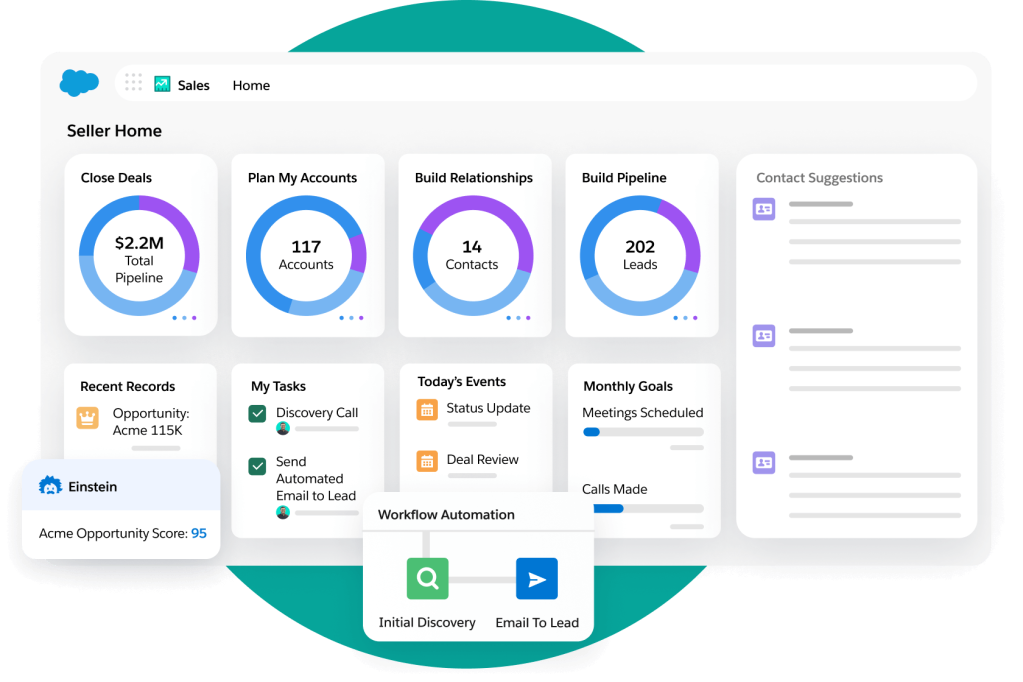
Image source: salesforce.com
Customer service and support modules
A customer's journey doesn't end after the sale. Post-purchase support is where loyalty is truly forged.
Sugar Serve is SugarCRM's answer to customer service management. It provides a consolidated agent workbench that gives service representatives a complete view of the customer's history and interactions. It includes all the essential tools for case management, SLA monitoring, and knowledge base creation. Sugar Serve focuses on empowering agents with context, making their interactions more efficient and empathetic, providing a robust and cost-effective solution for most businesses' customer support needs.
Salesforce Service Cloud is the industry standard for enterprise customer service. It is a comprehensive solution for managing support cases across any channel, from phone and email to social media and live chat. Its strengths lie in its powerful case routing, extensive knowledge base capabilities, and AI-powered chatbots. It is designed for high-volume contact centers and service teams that need to adhere to strict service-level agreements (SLAs).
Reporting and analytics
If you can't measure it, you can't manage it. Reporting and analytics are what turn CRM data into actionable business intelligence.
SugarCRM provides robust, built-in reporting and analytics. Users can easily create custom reports and dashboards to monitor sales performance, marketing ROI, and service efficiency. The focus is on accessibility and delivering actionable insights without requiring a data scientist. For most standard business reporting needs—pipeline analysis, activity tracking, win/loss reasons—Sugar's tools are more than sufficient and generally considered easier to master for the average business user.
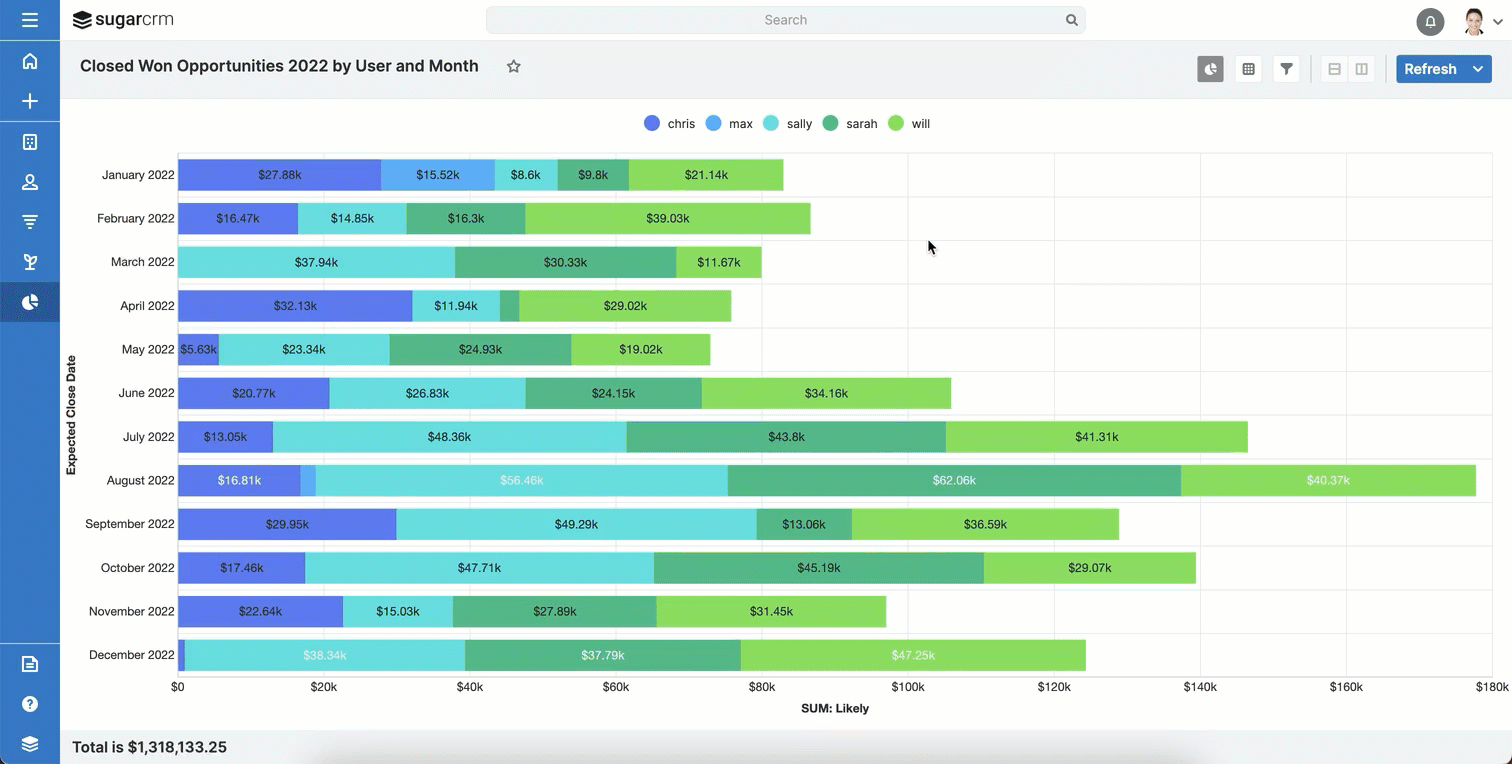
Image source: sugarcrm.com
Salesforce's reporting capabilities, in contrast, are extensive and powerful. Users can build highly detailed reports and dashboards to visualize almost any data point within the system, and its analytics tools can uncover deep insights. For even more advanced needs, Salesforce offers Tableau (a separate acquisition), a leading business intelligence platform. This power, however, can come with a steep learning curve.
Customization and flexibility
This area represents the most significant philosophical divide in the salesforce vs sugarcrm debate.
SugarCRM's core identity is built on open architecture and flexibility. Customization is a fundamental aspect of the platform. Administrators can easily add custom fields, create new modules, and modify layouts with user-friendly tools. Because of its open-source roots, developers can access and modify the underlying code, allowing for virtually limitless customization. Furthermore, SugarCRM offers deployment flexibility: use their cloud, a private cloud, or on-premises. This level of control is a major differentiator.
Salesforce also allows for extensive customization, but it happens within the confines of its proprietary platform. Administrators can use point-and-click tools like the Lightning App Builder to change page layouts and create automations. For more complex logic, developers must use Salesforce's proprietary language, Apex. This creates a powerful but walled garden—customizations are deep but dependent on the Salesforce ecosystem and specialized developer skills.
SugarCRM vs Salesforce: Implementation, ease of use, and support
The long-term success of a CRM depends on more than just its features; it depends on how successfully it can be integrated into the business.
The implementation journey: What to expect
SugarCRM implementations can be more flexible. While certified partners are available and recommended for complex projects, the platform's relative simplicity and open nature mean that businesses with in-house IT resources may be able to handle much of the configuration and data migration themselves. This can significantly reduce upfront costs and speed up the time to value.
A typical Salesforce implementation for a mid-sized company, however, is a structured project often lasting several months and managed by a certified consulting partner. The process involves extensive discovery, configuration, data migration, and training. It is thorough but can be slow and expensive.
User interface and ease of use
Ease of use is subjective, but general trends can be observed. The SugarCRM interface is often described as straightforward and intuitive. It presents a large amount of information in a clean format, and users often praise its fast performance. The learning curve is generally considered less steep than Salesforce's, making it easier for teams to adopt quickly.
The Salesforce Lightning interface is also modern, clean, and highly visual. Its component-based dashboards are easy to read. However, for a basic user, the sheer number of tabs, options, and objects can be overwhelming.
Comparing customer support models
Both companies provide standard online support packages that include access to a community portal, knowledge base, and online case submission. For more direct and responsive support, both offer tiered premium support plans at an additional cost. These plans provide access to phone support, faster response times, and, at the highest levels, a designated success manager. It is crucial for businesses to evaluate the standard support offering and realistically budget for a premium plan if uptime and quick issue resolution are critical.
SugarCRM vs Salesforce: Pricing and total cost of ownership
Pricing is one of the most significant factors in the sugarcrm vs salesforce debate. However, looking at the sticker price of a license is only the beginning of the story. A savvy buyer must consider the Total Cost of Ownership (TCO).
Breaking down SugarCRM pricing tiers
SugarCRM uses a per-user, per-month pricing model that is often perceived as more straightforward. Products like Sugar Sell, Sugar Market, and Sugar Serve are priced separately, but the tiers for each are generally all-inclusive. This means when you buy a specific edition of Sugar Sell, for example, you get all of its advertised features without needing to pay for numerous add-ons. This predictability is a major selling point.
1. Sugar Sell (Sales Module)
2. Sugar Market (Marketing Module)
- $1,000/month (for 10,000 contacts, unlimited users)
- Additional contacts: $150/month/10,000 contacts
3. Sugar Serve (Service Module)
- $80/user/month (same price as Sugar Sell Professional)
- Includes complete case management, omnichannel support, SLA management
Image source: sugarcrm.com
Update time: 2025-11-13
Breaking down Salesforce pricing tiers
Salesforce pricing is also tiered and billed per user, per month. For Sales Cloud, this typically ranges from a basic "Starter suite" to the "Pro suite," "Enterprise," "Unlimited" and "Agentforce 1 sales"editions. The catch is that many crucial functionalities, such as advanced marketing automation (Pardot/Account Engagement) or customer service (Service Cloud), are separate products with their own per-user pricing. The cost can escalate quickly as a business grows and requires more of the platform's capabilities.
Image source: salesforce.com
Update time: 2025-11-13
Beyond the license: Calculating your total cost of ownership
The true cost of a CRM goes far beyond the monthly license fee. This is where TCO becomes a critical calculation. Factors to consider include:
- Implementation costs: Does the platform require a certified implementation partner? Salesforce implementations, especially for the Enterprise edition, almost always do, which is a significant upfront cost. SugarCRM can also be implemented by partners, but simpler setups can often be handled in-house, providing more options.
- Customization and development: If you need custom functionality, Salesforce requires specialized Apex developers, who command high salaries. SugarCRM's use of common programming languages like PHP can make finding developer talent more accessible and cost-effective.
- Third-party add-ons: The Salesforce AppExchange is vast, but many of the essential apps that extend functionality come with their own per-user subscription fees. This "app tax" can substantially increase the monthly TCO.
- Support plans: Both platforms offer standard support, but for faster response times and dedicated support, businesses must upgrade to premium support plans, which represent a significant percentage of the total license cost.
- Training and adoption: A complex platform requires more extensive employee training. The costs of initial training and ongoing user adoption efforts should be factored into the overall investment.
When considering the full TCO, a platform that seems more expensive upfront might be cheaper in the long run if it includes more out-of-the-box functionality and requires less paid customization.
Which CRM is right for your business?
After this extensive comparison of SugarCRM vs Salesforce, the choice comes down to a clear assessment of your organization's scale, complexity, budget, and culture.
Choose SugarCRM if...
- Your organization is a small to medium-sized business or a mid-market company that needs a powerful yet cost-effective solution.
- Your business has unique or complex processes that require a highly customizable platform you can tailor to your exact needs.
- You prioritize data control, deployment flexibility (cloud or on-premises), and a predictable cost structure.
- Your team values ease of use and a more straightforward user experience that can drive faster adoption.
Choose Salesforce if...
- Your organization is a large or rapidly scaling enterprise that needs a proven, powerful, and highly scalable platform.
- Your business model fits relatively standard sales, service, and marketing processes that align with Salesforce's structured workflows.
- You value a massive, pre-built ecosystem of third-party applications on the AppExchange and need extensive integration options.
- You have a dedicated budget and IT resources to manage the implementation, ongoing administration, and potential development costs.
A powerful platform to replace SugarCRM and Salesforce
The traditional CRM model, whether from Salesforce or SugarCRM, is built on a central database that must be integrated with a separate suite of communication and productivity tools. This creates inherent friction. Teams document their work in one place (the CRM) but perform their work in others (chat apps, email, document editors). This constant context switching is not just inefficient; it creates data silos and incomplete customer records.
A new paradigm addresses this challenge directly: the truly unified workspace. Lark is not another CRM that bolts onto other applications; it is an all-in-one platform where CRM functionality, communication, and collaboration coexist natively. It reimagines CRM not as a separate system of record, but as an integrated layer within the digital environment where work actually happens.
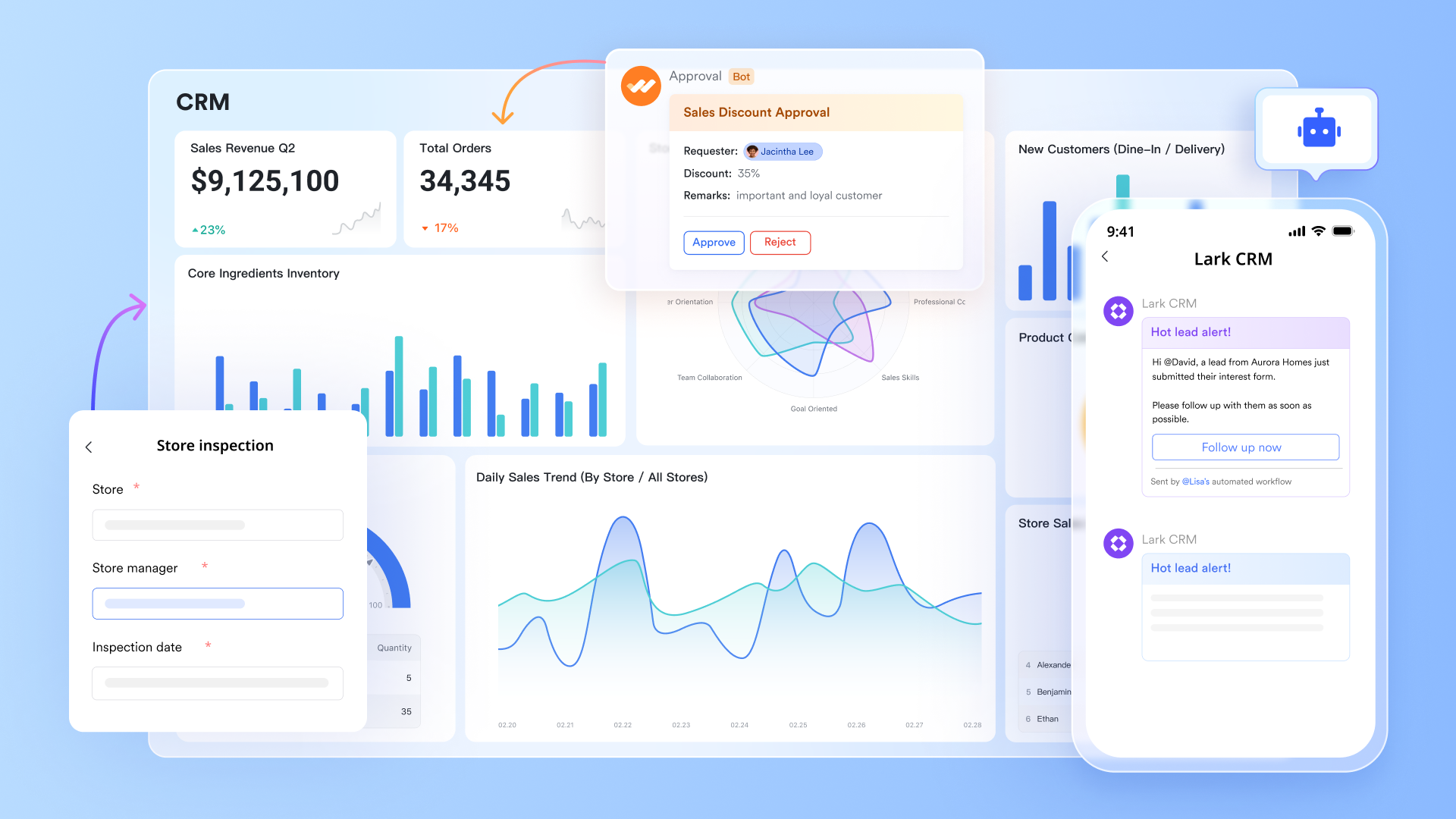
A flexible CRM to meet your need
Lark's power as a CRM stems from its core component, Lark Base. Lark Base is a sophisticated, user-friendly relational database built directly into the platform. Instead of being locked into predefined objects like "Leads" or "Opportunities," teams can build their own custom data tables or start from templates to create a CRM that perfectly matches their business logic.
This is how it comes together in practice:
The CRM database: A team can create a "Contacts" table, an "Accounts" table, and an "Opportunities" table within Lark Base. These tables can be linked together, so each opportunity is connected to a specific account and multiple contacts. Custom fields for anything from deal size and stage to product interest and next-steps can be added with a few clicks, no admin or developer required.
Connecting communication: A sales representative can be in a Lark Messenger group discussing a deal. They can "@" mention the specific opportunity record directly from Lark Base in the conversation. This creates a clickable link, bringing the full context of the CRM record into the chat. Vice versa, the chat conversation itself can be linked back to the opportunity record, creating a complete, chronological history of all discussions.
Integrating collaboration: When it is time to create a proposal, the sales rep creates Lark Docs. This document is a living file that can be linked to the opportunity in Base. The entire team—sales, legal, and engineering—can then collaborate within that single document, leaving comments, suggesting edits, and holding discussions directly on the page. The final version and all its associated conversations are automatically part of the customer's history. Scheduling a client demo is done in Lark Calendar, which a meeting event can be linked to.
Instead of a CRM being a place to log work after the fact, the CRM becomes an active participant in the work itself.
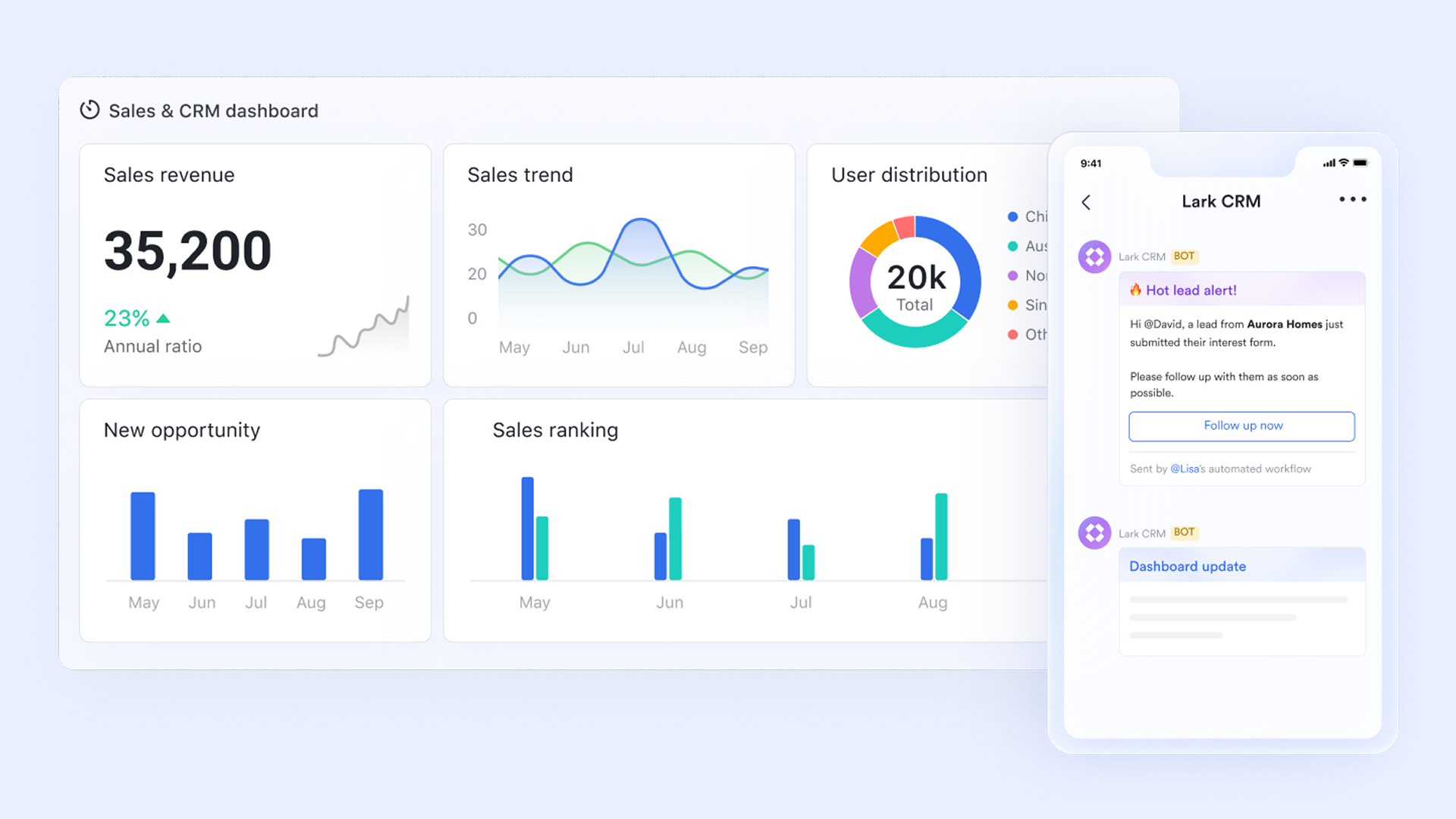
Contextual collaboration replaces activity logging
In a traditional CRM like Salesforce or SugarCRM, a sales rep finishes a call or an internal strategy session and then navigates to the opportunity record to log an activity. They might write a note like, "Discussed pricing with the team on Slack. We decided to offer a discount." This summary is brief, lacks nuance, and the rich context of the actual discussion is lost in a separate application.
Lark completely upends this model. That same pricing discussion happens in a Lark Messenger group. The conversation thread, with all its back-and-forth, supporting data, and final decision, is linked directly to the opportunity record in Lark Base. It is not a summary of the conversation; it is the conversation, preserved in its entirety as a "living record." When a manager reviews the deal a month later, they can read the actual discussion, understand the reasoning behind the discount, and see who was involved.
This creates a level of context and transparency that is impossible to achieve through manual activity logging. The "why" behind every decision is automatically captured and preserved, creating an invaluable, searchable knowledge base around every customer relationship.
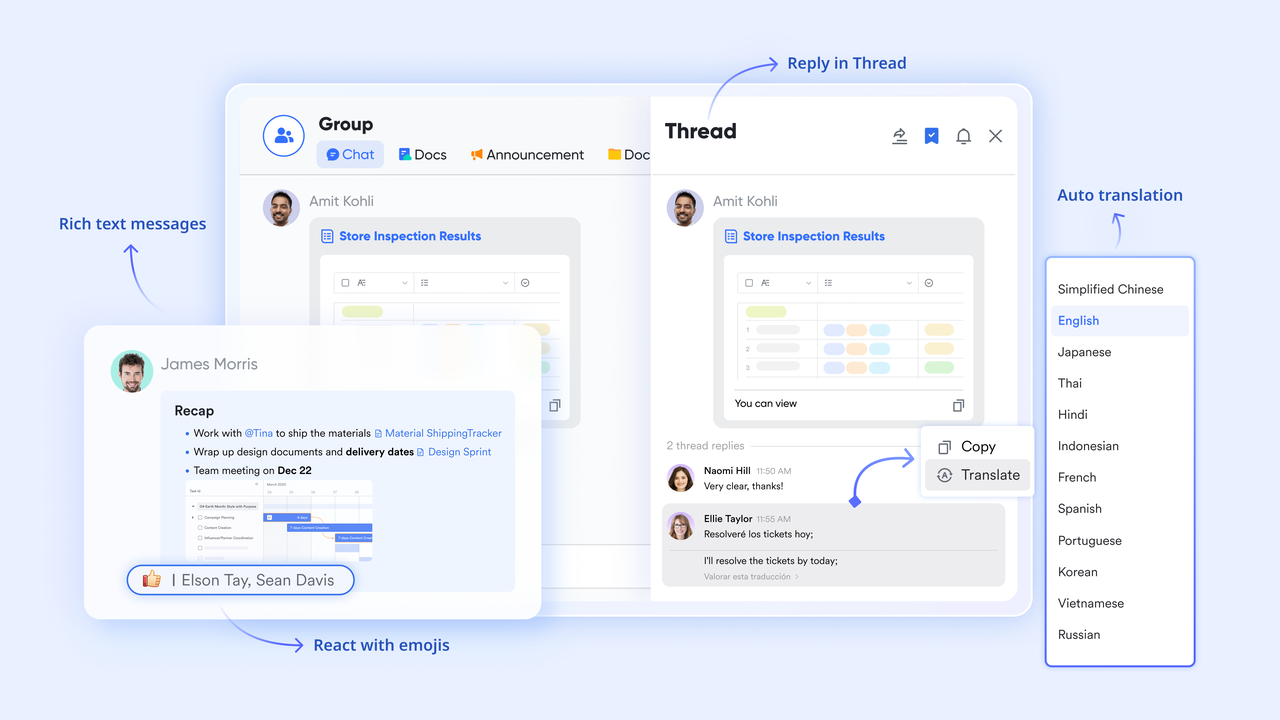
Truly unified workflow without the "integration tax"
Salesforce's greatest strength is its AppExchange, and SugarCRM also offers many integrations. However, every integration represents a point of friction and a potential cost—an "integration tax." This tax comes in the form of subscription fees for third-party apps, maintenance to keep the connections working, and the small but constant mental load of switching between different user interfaces. A workflow might start in Salesforce, move to Slack, then to Google Docs, and back to Salesforce, with data being manually copied or relying on a fragile connector at each step.
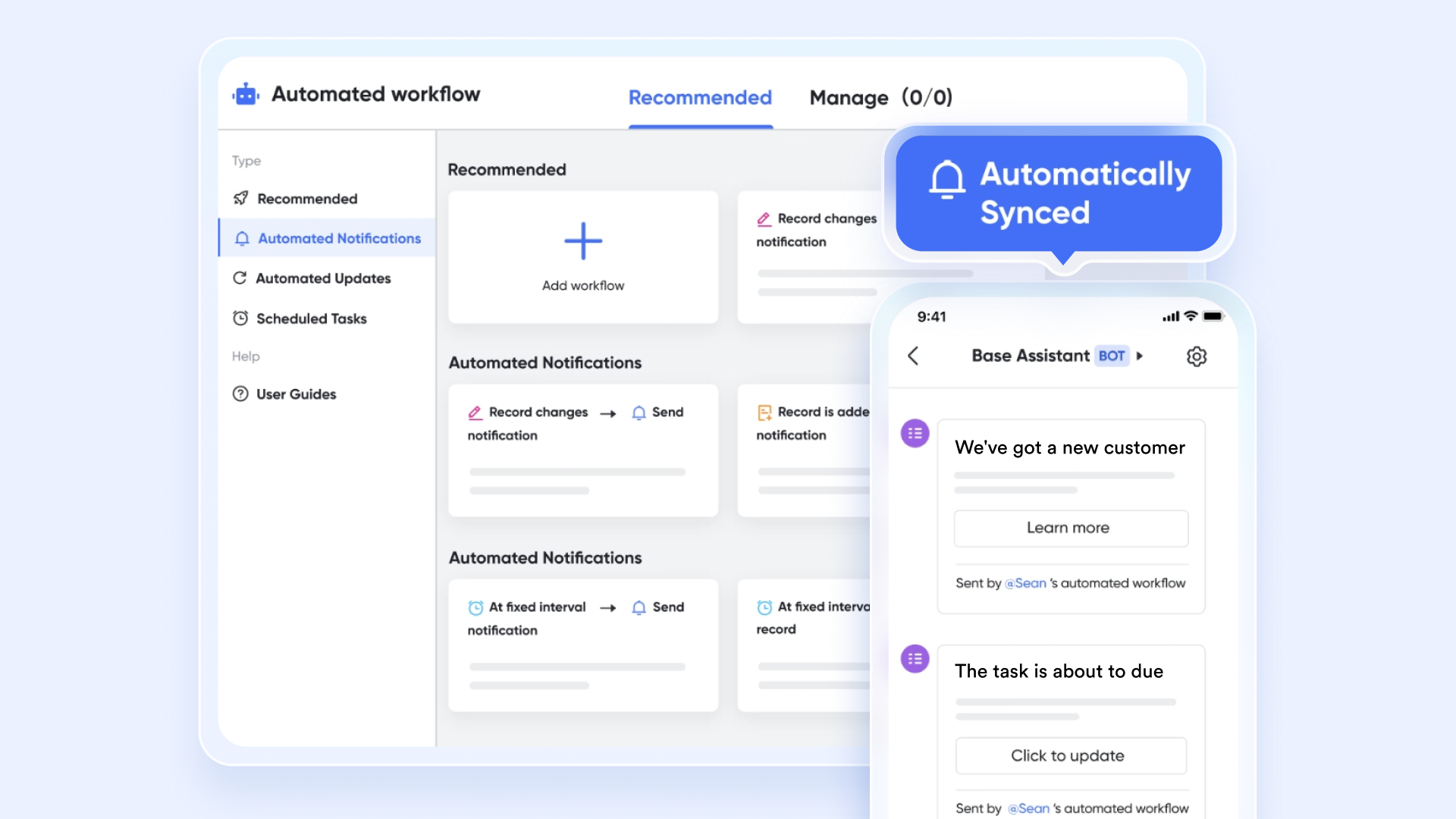
Lark has no integration tax for its core functions because it is a single, unified platform. An automation can be set up in minutes without any code: when an opportunity's status in Lark Base is changed to "Closed-Won," an automatic notification can be posted in the "sales-wins" Lark Messenger group, a new record can be created in the "Onboarding" table, and a task can be assigned to the finance team to generate an invoice.
This entire workflow happens instantly and seamlessly within one application. There are no separate apps to pay for, no APIs to manage, and no connectors to break. This native, frictionless automation saves money, reduces administrative overhead, and ensures that critical handoffs between teams never get dropped.
Agile, no-code data management vs. rigid object administration
In both Salesforce and SugarCRM, modifying the core structure of the CRM can be a heavy lift. Adding a new set of fields, changing a process, or creating a new "custom object" to track something specific often requires a trained administrator or even a developer. This creates bottlenecks, slows down innovation, and prevents teams from quickly adapting the CRM to changing business needs.
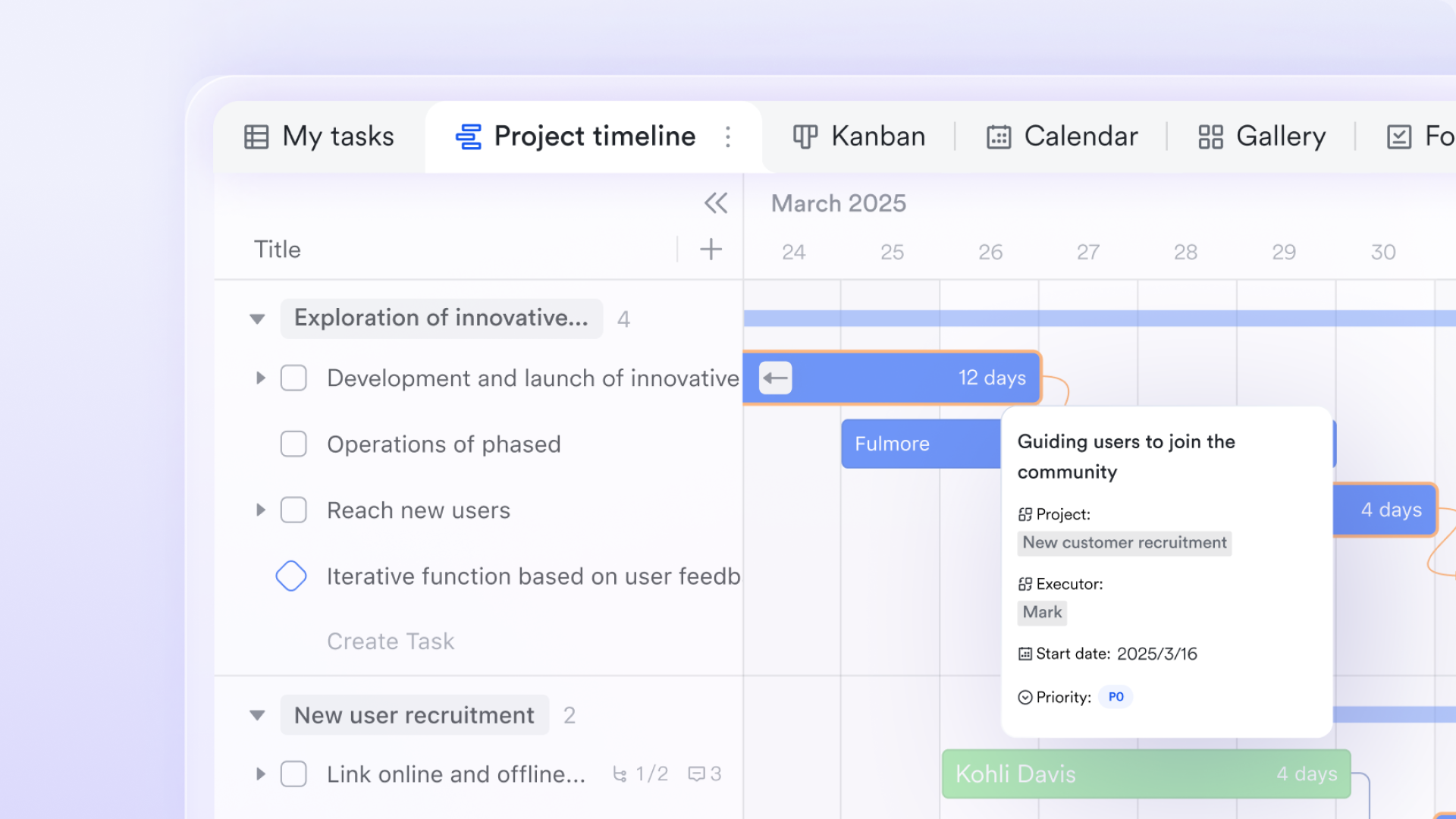
Lark Base democratizes data management. A sales manager who decides they want to start tracking competitor presence in deals can, in moments, add a "Competitors" field to their Opportunities table. If they want to build a sophisticated system to track post-sale implementation projects, they can create an entirely new "Projects" table and link it to the "Accounts" table themselves. They can build different views of their data—a Kanban board of deal stages, a calendar of closing dates, a gallery of client logos—without filing a single IT ticket.
This agility is a profound advantage. It empowers the people closest to the customer to shape their tools in real-time. The CRM ceases to be a rigid system imposed by the IT department and becomes a flexible, living workspace that evolves alongside the business. This fosters a sense of ownership and drives user adoption far more effectively than any top-down mandate ever could.
- Free plan: Includes 11 powerful products, supporting up to 20 users, 100 GB storage, 1,000 automation runs and unlimited AI translation in chats, docs and email.
- Basic plan: $6/user/month (billed annually) for up to 500 users. Includes everything in Starter plus unlimited message history, 5TB storage, 1,000 automation runs, and more. Some users may need to contact sales to purchase.
- Pro plans: $12/user/month, supporting up to 500 users. Includes unlimited message history, 50,000 automated Base workflow executions per month.
- Enterprise plan: Contact sales for custom pricing. Supports unlimited users and includes even more automation runs and advanced security, compliance, and management features.
Conclusion
The decision between SugarCRM and Salesforce is a choice between flexibility and structured power, a dynamic that sits at the heart of the broader salesforce vs sugarcrm vs microsoft dynamics debate. SugarCRM offers a customizable, user-friendly, and cost-effective platform, while Salesforce provides an immensely powerful, scalable, and market-leading ecosystem.
Ultimately, the best CRM is the one your team consistently uses. Instead of just buying a better database, consider a platform that makes your team more connected and productive. By unifying your CRM with chat and collaboration in one seamless workspace, Lark is built to be the platform your team will actually love to use.
FAQs
How does SugarCRM compare to Salesforce?
SugarCRM compares to Salesforce primarily on the axis of flexibility versus structure. Salesforce provides a powerful, all-encompassing, and structured ecosystem ideal for large-scale operations that can benefit from a guided process. SugarCRM, in contrast, offers a highly flexible and customizable open platform, giving businesses deep control over their workflows and data, which is often favored by companies with unique processes.
Who is Salesforce's biggest competitor?
From a traditional market share perspective, Salesforce's biggest competitors are other large enterprise software vendors like Microsoft, SAP, and Oracle. However, a more modern view suggests the biggest competitor isn't another CRM brand, but the inefficiency that all standalone CRMs create. The real challenge for modern teams is the productivity drain from constantly switching between their CRM, chat apps, and documents. This reframes the competitive landscape, where the true alternative is a unified platform like Lark that eliminates this friction by natively combining CRM, communication, and collaboration.
Is SugarCRM a good CRM?
Yes, SugarCRM is considered a very good CRM, especially for businesses that prioritize flexibility and a predictable total cost of ownership. Its strengths lie in its deep customization capabilities, open architecture, and robust core features for sales, marketing, and service. It is an excellent choice for small to mid-market companies or enterprises with unique business processes that do not fit into a standard, out-of-the-box model.
What is the #1 CRM in the world?
By global market share, Salesforce is the #1 CRM in the world, a testament to its powerful platform and extensive ecosystem. However, leadership in market share doesn't automatically translate to leadership in workflow efficiency for every business. The critical question for a company is not "Who is the biggest?" but "What will drive the highest adoption and productivity for my team?" This shifts the focus to platforms like Lark, where CRM functionality is seamlessly woven into the daily collaborative workflow, tackling the core challenge of user adoption head-on.
Related reading
Table of contents
Start using Lark today

Manage all your work in one place
Boost team efficiency by 10x
Save up to 70% on software costs
Table of contents
Start using Lark today
Manage all your work in one place
Boost team efficiency by 10x
Save up to 70% on software costs
Keep reading


Lark recognized in 2023 Gartner® Collaborative Content Workspaces and Meeting Solutions reports
Lark, the global superapp for productivity, is delighted to announce it receives recognition in the Gartner's 2023 Innovation Insight for Collaborative Content Workspaces and Market Guide for Meeting Solutions.





2026 Lark Technologies Pte. Ltd.
Headquartered in Singapore with offices worldwide.






Explore: