














Brainstorming Techniques That Actually Work: A Guide for Modern Teams

Fecilia Clarke
Solutions Marketing Specialist
Sep 18, 2026
Fecilia Clarke
Sep 18, 2026

15 min read


Ever left a group brainstorming session feeling like it was a waste of time? You're not alone. We've all been in that group setting, physical or virtual, where a call for creative ideas slowly devolves into awkward silence, is dominated by the same few voices recycling the same ideas, or produces a flurry of sticky notes that end up in a drawer, never to be seen again. Many teams struggle to harness the true potential of collaborative idea generation, often ending up with more frustration than inspiration. It's a common challenge that can leave even the most enthusiastic teams feeling deflated and stuck in a creative rut, questioning the value of these sessions altogether.
The problem isn't that traditional brainstorming techniques are a flawed concept. The challenge lies in our approach. In a world of hybrid work, diverse thinking styles, and complex problems, the old model of simply putting everyone in a room and asking them to shout out ideas is no longer enough. This guide offers a better way forward. We won't just provide a long list of techniques. We will explore how to strategically choose the right creative technique for your specific challenge, the cognitive science that makes these methods effective, and most importantly, how to turn ideas from breakthroughs into tangible results, all supercharged by a unified platform.
What is brainstorming and why it matters more than ever
At its heart, brainstorming is a method for creative problem solving. It's a structured process designed to generate as many ideas as possible around a specific topic or question within a judgment-free environment. Coined by advertising executive Alex F. Osborn in the 1940s, the practice is built on four foundational principles:
- Go for quantity over quality in the initial stage.
- Welcome unconventional or wild ideas.
- Defer all judgment and criticism.
- Build upon or combine the ideas of others.
These rules are designed to disarm our internal critics and create a space of psychological safety where creativity can flourish without inhibition.
While these principles are decades old, their relevance has never been greater. Today, the ability to innovate, adapt, and solve complex challenges is not a luxury—it's a core operational necessity. Effective brainstorming techniques are the engine that drives this capability. It’s a powerful tool for fostering team alignment, ensuring that different perspectives are not only heard but actively sought out. More than just a meeting, it's a collaborative ritual that, when done right, strengthens team cohesion, surfaces unexpected solutions, and lays the groundwork for meaningful progress on your most important goals.
The modern workplace demands a more sophisticated approach to this foundational practice. With teams distributed across cities and time zones, a simple whiteboard is no longer the single source of truth. We need digital spaces that can support both real-time and asynchronous contribution, accommodating different communication styles and creative thinking preferences. The true power of brainstorming is unlocked when we move beyond simply generating ideas and start building an integrated system for capturing, refining, prioritizing, and executing them. It transforms from a fleeting moment of inspiration into a sustainable, repeatable process for turning imagination into impact.

Common brainstorming sessions
While the core goal is always to get ideas flowing, not all common brainstorming sessions are created equal. They are typically tailored to address specific types of challenges, falling into two main categories: broad idea generation and focused problem-solving. Understanding the difference is key to structuring a session for success.
Idea generation sessions: Unleashing creative potential
This type of session is all about exploration and quantity. The primary purpose is to generate a wide array of new ideas, pushing the boundaries of what's possible without immediate concern for feasibility. Think of it as casting the widest possible net. These sessions are perfect for the early stages of a project, such as envisioning new products, brainstorming marketing campaign themes, or imagining future features. The emphasis is on getting the creative juices flowing, encouraging wild ideas, and creating a safe space where no concept is too "out there." The success of idea generation relies heavily on deferring judgment and using creative brainstorming techniques that encourage free-flowing creativity from all group members.
Problem-solving sessions: Tackling known challenges
In contrast, a problem-solving session is more analytical and focused. It begins after a specific issue has already been identified—for example, declining user engagement or an inefficient internal workflow. The goal here is not just to generate ideas, but to dissect the known problem and generate feasible, creative solutions. These sessions often employ more structured brainstorming techniques, such as root cause analysis (the "5 Whys") or reverse brainstorming, to break down the issue from different angles. It’s about channeling creativity to find practical answers. This approach thrives on bringing together different perspectives to ensure the problem is fully understood and the proposed solutions are robust and well-vetted.
Why traditional brainstorming fails (and how to fix it for good)
We’ve all experienced the symptoms of a failed brainstorming session: the awkward silences, the feeling of being talked over, or the sense that the group is just going in circles. These aren't just feelings; they are the result of well-documented psychological phenomena that can derail group creativity. Understanding these common pitfalls is the first step toward fixing them. By diagnosing the root cause of our brainstorming frustrations, we can intentionally select techniques and tools designed to counteract them, creating a truly productive and inclusive environment for idea generation.
Production blocking
One of the most significant hurdles is known as production blocking. This occurs because only one person can effectively speak at a time in a group setting. While you are politely waiting for your turn, you might forget your brilliant idea, be distracted by someone else's contribution, or lose your creative momentum. The conversational "traffic jam" inherent in unstructured vocal brainstorming significantly limits the total number of ideas the group can produce. The fix for this is to introduce structured, silent, or parallel forms of contribution. Tools like collaborative Lark Docs, where everyone can type their ideas simultaneously, completely eliminate this bottleneck, allowing for a much higher volume of idea generation in the same amount of time.
Evaluation apprehension
Next is evaluation apprehension, a fancy term for the simple fear of looking foolish. This fear of judgment is a powerful creative inhibitor. When participants are worried that their nascent ideas will be criticized or dismissed, they tend to self-censor, holding back the unconventional, "wild" ideas that often lead to true breakthroughs. Traditional brainstorming can amplify this fear, especially in hierarchical teams. The solution is to create psychological safety through anonymity and structure. Brainwriting and other silent techniques, where ideas are submitted in writing before any discussion, are incredibly effective. Using Lark Forms to collect initial ideas anonymously before a session can also help ensure that contributions are judged on their merit, not on who suggested them.
Social loafing
Another common issue is social loafing, the tendency for some individuals to contribute less effort when working in a group than they would if working alone. In a large, unstructured brainstorming session, it's easy for less assertive or engaged team members to fade into the background, relying on others to carry the creative load. This results in a smaller, less diverse pool of ideas. The fix is to build individual accountability into the process. Assigning pre-work, using round-robin techniques where everyone must contribute, or breaking a large group into smaller sub-groups are effective strategies. Within Lark, you can assign specific sections of a brainstorming document to individuals to ensure everyone prepares and contributes their unique perspective.
Cognitive fixation
Finally, groups often suffer from cognitive fixation, also known as groupthink or anchoring. This is the tendency for the first few ideas shared to disproportionately influence the rest of the conversation, anchoring the group's thinking in a narrow channel. Once a popular idea is on the table, it becomes cognitively difficult for the team to break away and explore radically different paths. To counteract this, you must introduce techniques that force a shift in perspective. Methods like Role Storming (imagining a problem from a customer's or competitor's viewpoint) or using creative constraints can effectively break this mental logjam. A well-facilitated session, guided by a clear agenda in a Lark Doc, can intentionally steer the team through different creative exercises to prevent them from getting stuck.
Core brainstorming techniques
Now that we have a framework for choosing the right approach, let's dive into the core brainstorming techniques that can transform your sessions from stagnant to spectacular. These aren't just theoretical concepts; they are practical, battle-tested brainstorming methods designed to overcome the common hurdles we discussed earlier. Each one offers a unique structure to guide your team's energy, encourage diverse ideas, and push beyond the obvious first few ideas. By mastering these, you'll be equipped to facilitate a successful brainstorming session every time, whether you're in a group setting or ideating on your own.
Brainwriting: a silent technique for ensuring every voice is heard
Imagine a group brainstorming session where there’s no awkward silence, no one gets talked over, and even the most introverted team members contribute their best creative ideas. That's the power of brainwriting. This simple yet profound technique shifts the initial idea generation from verbal to written. Instead of speaking, each participant writes down their ideas independently. It’s a powerful method to ensure the entire group contributes, preventing the session from being dominated by quick thinkers or personality bias.
This tried and true method directly solves the problems of production blocking and evaluation apprehension. Since everyone is contributing simultaneously, you can generate many ideas in a very short amount of time. The silence encourages deeper focus, allowing thoughts to flow without interruption. How does it work? In a physical brainstorming meeting, you might have team members write down, for example, three ideas on post it notes and then pass them around the group for others to build upon. This process of sharing and adding to other ideas is a core part of the exercise.
How to do it with Lark: Brainwriting is perfectly suited for a digital environment. Before your next session, create a simple table in Lark Docs. Assign a row to each of the group members. Set a time limit of 10-15 minutes and ask everyone to silently fill their row with as many brainstorming ideas as they can, adding bullet points for clarity. This technique encourages participants to contribute ideas they might otherwise withhold. After the timer goes off, the group discusses all the ideas, which are now presented anonymously and on equal footing, leading to more objective evaluation and richer discussion. It's an excellent brainstorming exercise to get the creative juices flowing.
Reverse brainstorming: a creative technique for anticipating problems
Sometimes, the best way to find a brilliant solution is to think about how you would create the absolute worst outcome. This is the central premise of reverse brainstorming. Instead of asking, "How can we achieve our goal?", you flip the script and ask, "What could we do to completely fail?" or "What would cause this project to be a total disaster?" This approach encourages the team to think about a brainstorming topic from different angles, surfacing potential risks, obstacles, and bad ideas that might otherwise go unaddressed in the pursuit of purely positive thinking.
This problem-solving technique is exceptionally useful for risk management, quality control, and pre-mortem analysis before launching a major project. It taps into our natural ability to spot problems and allows for a cathartic, often humorous, session where team members are free to imagine worst-case scenarios. Once you have a robust list of potential problems, the group discusses them and then flips the exercise back, brainstorming creative solutions for each identified risk. The first idea might be a major flaw, and the second idea is a solution to mitigate it.
How to do it with Lark: Use Lark Docs to create two distinct sections for your reverse brainstorming session. In the first section, pose your negative question and have the team populate it with potential problems. Once you’ve exhausted all the ways your project could fail, move to the second section. Here, you'll turn those problems into challenges. For example, a problem like "Poor communication with stakeholders" becomes a challenge: "How can we ensure stakeholders are always informed and aligned?" This technique encourages a proactive and resilient mindset, helping you build a more robust plan.
Mind mapping: a visual brainstorming technique for connecting ideas
Not all new ideas arrive in a linear, organized fashion. More often, they come as a web of interconnected thoughts. Mind mapping is a visual, creative brainstorming technique that embraces this non-linear process. It’s a powerful method to explore a central concept, organize complex information, and spark creativity by visualizing the relationships between different pieces of information. It’s far more dynamic than simple free writing, allowing your thoughts flow onto the page in a structured yet organic way.
The brainstorming process starts with a single brainstorming topic in the center of your canvas. From there, you draw branches to major sub-topics and then create smaller branches for related details, thoughts, and ideas. This visual hierarchy helps make sense of complex subjects and often reveals surprising connections that a simple list couldn't. It's one of the most effective brainstorming tools for both individual exploration and group collaboration, as it creates a shared visual language for the team.
How to do it with Lark: You don’t need a physical whiteboard to create a powerful mind map. You can build one collaboratively right inside a Lark Doc. Start a new document for your group brainstorming, insert a board, create a mind map and place your central theme at the core. During Lark Meetings, share the Doc and have team members add branches and nodes in real-time. This visual collaboration keeps everyone engaged and helps build a shared understanding of the topic, making it one of the most effective creative brainstorming techniques for complex projects.
Starbursting: a question-based technique for thorough idea exploration
Often, the quality of our answers is determined by the quality of our questions. Starbursting is a unique group brainstorming technique that focuses entirely on generating questions rather than answers. It's an invaluable exercise for the early stages of exploring a new product, project, or idea, ensuring you've examined it from every possible angle before committing resources. This method forces a team to think critically and deeply, moving beyond surface-level assumptions.
The technique uses a visual of a six-point star. At the center, you write down your topic or idea. Each point of the star represents a category of questions: Who? What? When? Where? Why? and How? The team then focuses exclusively on generating as many brainstorming questions as possible for each category. For example, under "Who?", you might ask, "Who is the target audience?" "Who are our key stakeholders?" and "Who will lead this project?" The goal is to create a comprehensive list of inquiries that will guide your future research and planning.
How to do it with Lark: Starbursting is an excellent activity for both live and asynchronous work. Create a Starbursting template in Lark Docs with the six question categories as headers. You can assign different team leaders or members to each category and give them time to prepare ideas and questions independently. This allows for deeper thought and ensures a wider range of inquiries. Once the questions are collected, you can schedule a follow-up session to begin answering them, turning your comprehensive inquiry into a solid action plan.
Role storming: shifting perspectives to overcome personality bias
One of the biggest blockers to innovative ideas is our own ingrained perspective. Role storming, a variation of brainstorming, is designed to shatter that limitation. Instead of asking team members to brainstorm from their own point of view, this technique asks them to step into someone else's shoes. This could be the persona of a key customer, a major competitor, a skeptical investor, or even a different department head. This act of adopting a new identity can liberate participants from their usual constraints and personality bias.
This method is incredibly effective for generating diverse ideas and fostering empathy. When you're forced to think like a frustrated customer, you start to see product flaws you previously overlooked. When you brainstorm as a competitor, you might uncover strategic threats and opportunities. This shift in viewpoint is a powerful way to unlock creative solutions and overcome cognitive fixation. It's a fun and engaging exercise that encourages participants to think differently and challenge the status quo. Some variations, like figure storming (where you ask what a famous historical figure or celebrity would do), can push the boundaries even further.
How to do it with Lark: You can facilitate a powerful role storming session within Lark Messenger. Create a separate chat group for each persona you want the team to embody (e.g., "The New Customer," "The Competitor's CEO"). Assign team members to each group and instruct them to brainstorm ideas and discuss the topic exclusively from within that persona's mindset. This creates distinct, focused conversations. Later, you can bring everyone back into a main chat or Lark Meeting to share the insights generated from each of the different perspectives, creating a rich and multi-faceted understanding of the challenge.
How to choose the right brainstorming technique for your challenges
The key to unlocking breakthrough ideas isn't just knowing a lot of brainstorming techniques; it's knowing which one to deploy for a specific situation. Choosing your method with intention is the difference between a directionless conversation and a focused, productive session. Simply picking a technique at random is like using a hammer for every problem—you might get some results, but you'll miss the precision and effectiveness of a tailored approach. To make a strategic choice, we recommend considering four key factors that will help you align your technique with your goal, your team, and your context.
Consider the problem type
What are you trying to achieve? Are you looking for small, incremental improvements to an existing process, or are you searching for a disruptive, game-changing innovation? For incremental refinement, techniques that encourage deep analysis and problem-solving, like Reverse Brainstorming, can be highly effective. For blue-sky innovation, you'll want to use methods that encourage wild ideas and new perspectives, such as Mind Mapping or Role Storming. Matching the technique to your desired outcome sets a clear direction and focuses your team’s creative energy where it will have the most impact.
Evaluate your team context
This includes practical considerations like your team's size and physical location. A technique that works well for a small, co-located team of five might be chaotic for a group of twenty. More importantly, in today's workplace, you must consider if your team is in-person, fully remote, or a hybrid of the two. For remote and hybrid teams, techniques that thrive in a digital, asynchronous environment are essential.
Understand team dynamics
Is your team new and still building trust, or are they a long-established group with strong opinions? Are they composed mostly of outspoken extroverts, or do you have a blend of quiet, reflective introverts? For newer or more reserved teams, anonymous and structured techniques can help build psychological safety and encourage participation. For a highly vocal team, a strong facilitator using a structured method like Round Robin can ensure the conversation doesn't get derailed. Choosing a technique that complements your team's personality will foster a more inclusive and effective brainstorming environment.
Be realistic about your time and resource constraints
Do you have a tight 30-minute window to generate some quick ideas, or do you have the luxury of a multi-hour workshop? Some techniques, like Rapid Ideation, are designed for speed and high-energy bursts of creativity. Others, like Starbursting, require a more deliberate and time-consuming deep dive into a topic. Your available time is a critical constraint that should guide your selection. Using a pre-made template can significantly speed up the setup process, allowing you to devote more of your valuable meeting time to the creative work itself.
By thoughtfully considering these four factors—problem type, team context, team dynamics, and time constraints—you can move from simply hosting a brainstorming session to architecting a targeted, effective creative experience. The following table provides a quick guide to help you match some popular techniques to these variables, setting your team up for a more successful and rewarding outcome.
How to empower your brainstorming with Lark
The most effective brainstorming techniques are supercharged when they are supported by tools that remove friction and connect every stage of the creative process. A truly powerful brainstorming tool does more than just capture ideas; it creates a unified environment for ideation, organization, communication, and execution. Lark, one of the best project management tools, is designed to be this single, unified platform. It empowers your team by transforming disjointed brainstorming activities into a seamless workflow, ensuring that the creative spark from your session is never lost in translation between different apps and that your best ideas are given a clear path to becoming reality.
Lark Docs: your canvas for collaborative ideation and visual thinking
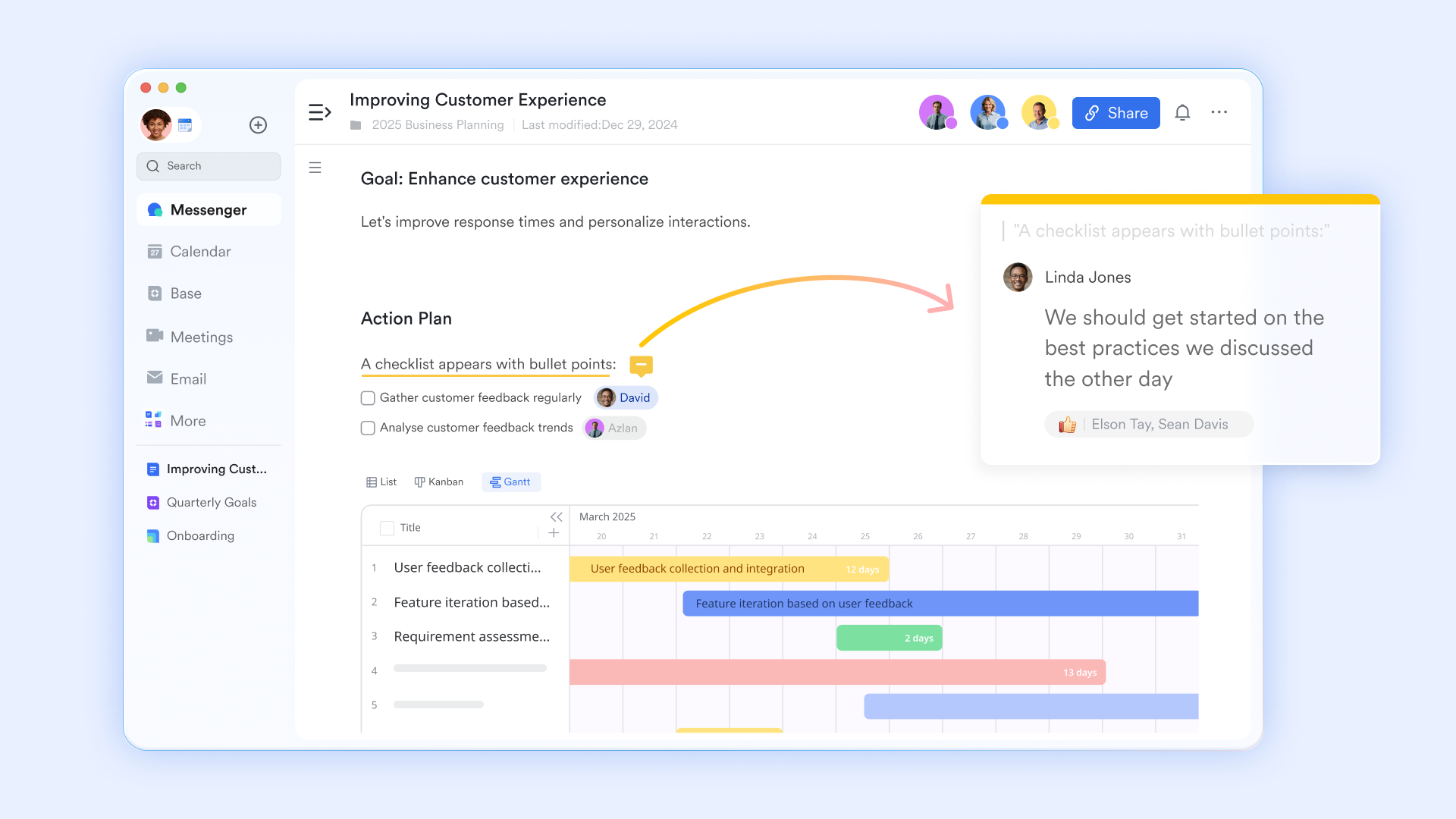
The foundation of any great brainstorming session is a shared space where ideas can be captured and built upon. Lark Docs elevates this experience beyond a simple document. It becomes a living canvas where your team can collaborate in real-time. Team members can simultaneously discuss ideas verbally while typing, commenting, and adding content. This is perfect for brainwriting sessions, where everyone can contribute their thoughts at once without interruption. Furthermore, you can create interactive mind mapping diagrams directly within the Doc, providing a visual way to organize thoughts and draw connections, turning a flat document into a dynamic space for creative thinking.
Lark Base: organizing ideas and tracking progress
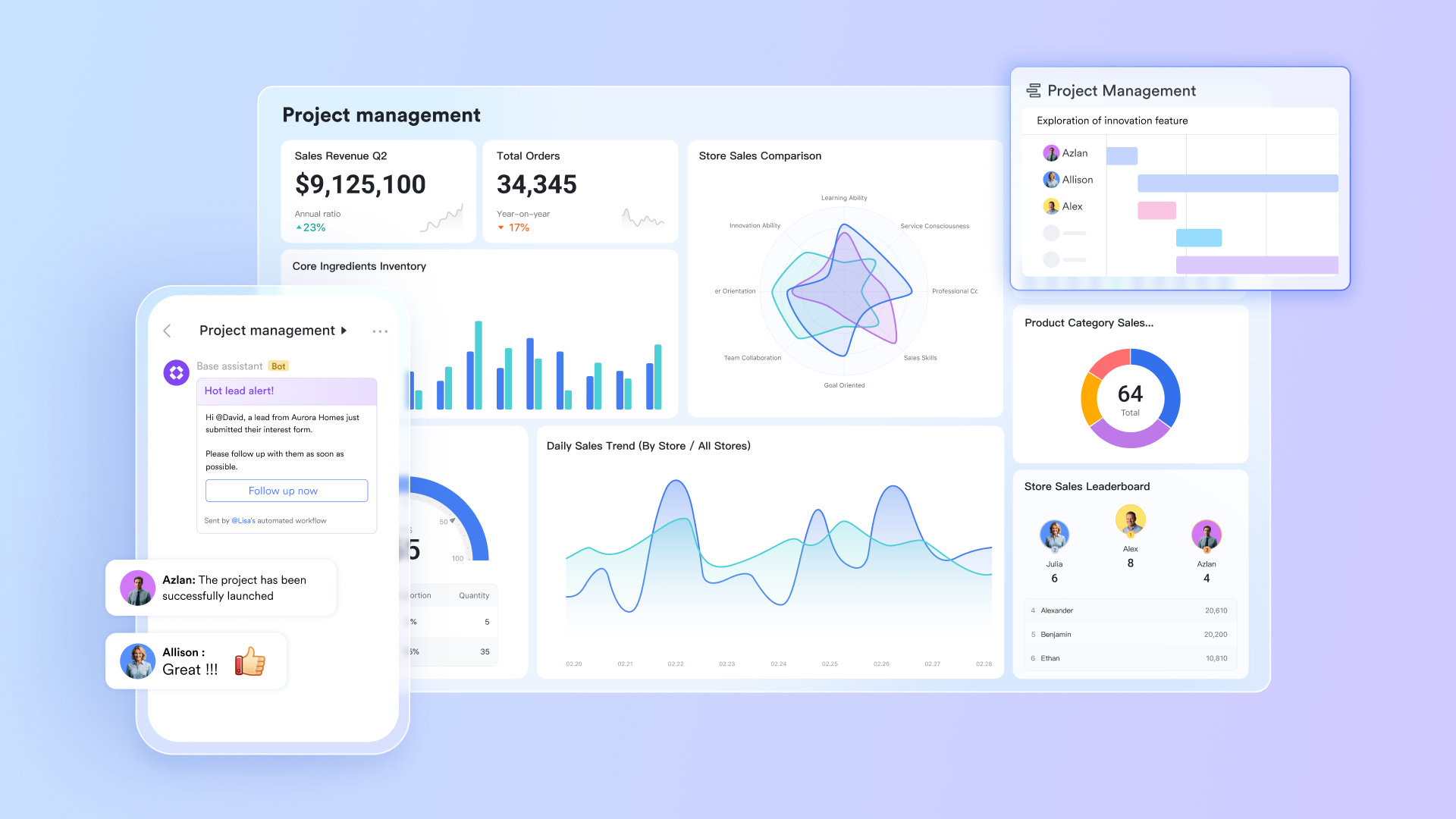
A common failure point in the brainstorming process is the chaos that follows a productive session. A flurry of great ideas without a system for organization quickly loses momentum. This is where Lark Base provides critical structure. You can move your top brainstorming ideas from a Doc into a powerful, flexible Base table. Here, you can create custom fields to prioritize and evaluate each idea, add voting buttons for the team to rank their favorites, and assign owners. Lark Base provides a high-level view of your entire innovation pipeline, allowing team leaders and members to track the progress of an idea from a nascent concept to a fully developed project, ensuring no great idea falls through the cracks.
Lark Messenger, Mail, and Meetings: seamless communication for continuous creativity
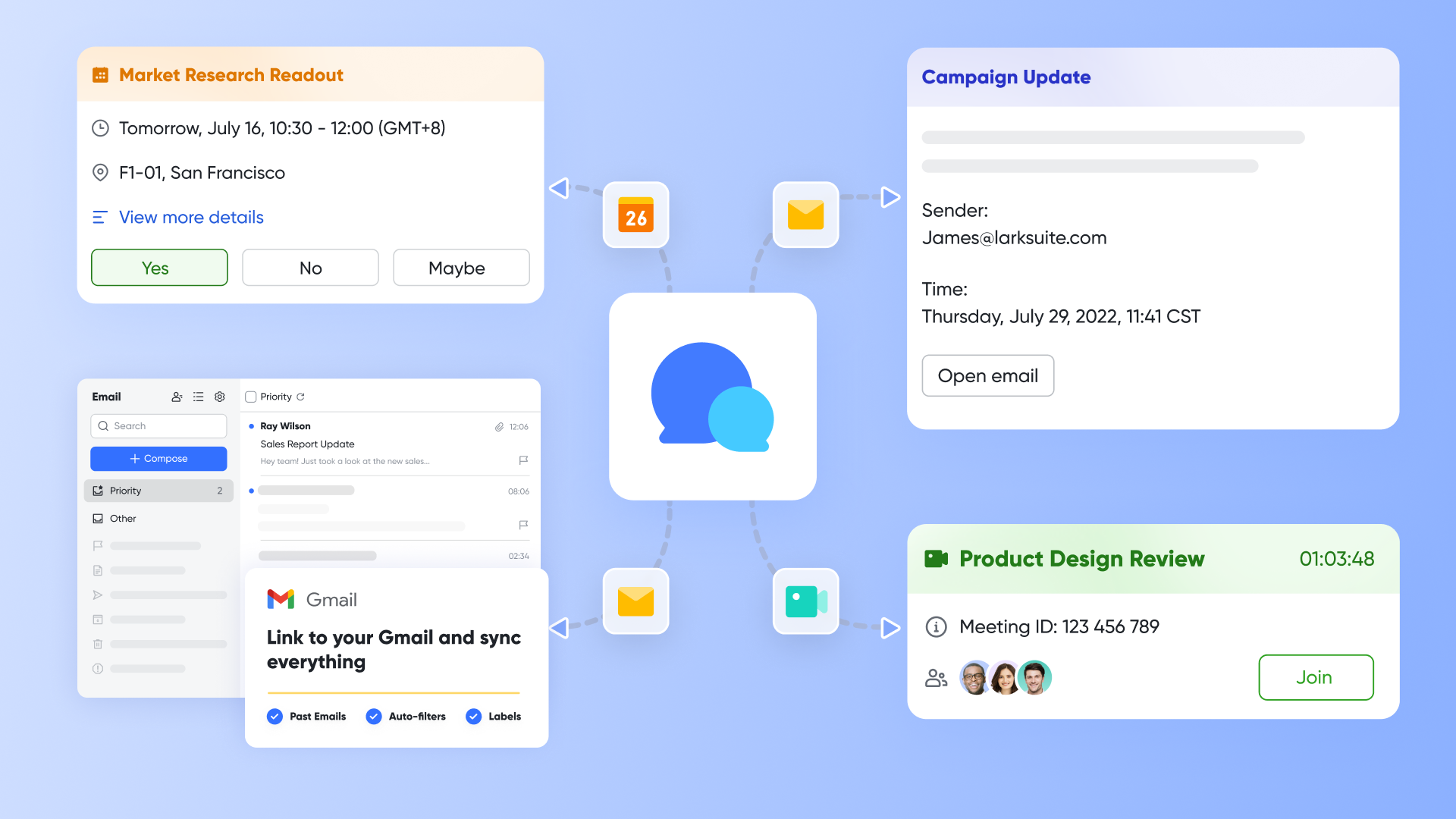
Creativity doesn't just happen in scheduled meetings. Lark Messenger, Mail, and Meetings work together to create a continuous loop of communication that supports the entire brainstorming lifecycle. You can initiate a brainstorming topic in a Lark Messenger group for asynchronous input, allowing team members across different time zones to contribute when inspiration strikes. Any relevant emails or external research found can be forwarded directly into the group chat using Lark Mail, keeping all inspiration in one place. And when it’s time for a live discussion, you can launch a Lark Meeting directly from the chat, with the full conversation history and all shared documents instantly available, ensuring every discussion is efficient, contextual, and productive.
- Free plan: Includes 11 powerful products, supporting up to 20 users, 100 GB storage, 1,000 automation runs and unlimited AI translation in chats, docs and email.
- Paid plans: Starts at $12/user/month, supporting up to 500 users. Includes unlimited message history, 50,000 automated Base workflow executions per month.
- Enterprise plan: custom pricing.
Conclusion
Mastering a few most brainstorming techniques, like round robin brainstorming or rapid ideation, is a fantastic start. Whether you're using gap analysis or the eidetic image method, having a toolkit of brainstorming activities is essential. But building a true and lasting culture of innovation requires more than just a set of exercises. It requires a commitment to creating an environment where creative thinking is the norm, not the exception, and a system that ensures those sparks of creativity are nurtured into impactful outcomes.
By choosing the right techniques for the right challenges and leveraging a truly unified platform like Lark, you transform brainstorming from an isolated event into a continuous, powerful cycle of creativity and progress. This is how you stop just talking about innovative ideas and start building them. Now, go turn those possibilities into your next breakthrough.
FAQs
What is a brainstorming technique?
A brainstorming technique is a structured method used to generate a large number of creative ideas in a short amount of time. It encourages free thinking and withholds criticism to foster an open environment. When writing a case study, these techniques can help you uncover unique story angles, identify the most compelling data points, and find powerful ways to frame your customer’s success.
What are the four steps of brainstorming?
The four fundamental steps of brainstorming are: 1) Prepare: Define the problem you need to solve, like "finding the core story for our case study," and gather a diverse group. 2) Generate: Produce as many ideas as possible without judgment. 3) Discuss & Refine: Group similar ideas, clarify points, and begin to evaluate their potential. 4) Select: Choose the best idea(s) to move forward with.
What is the SWOT method of brainstorming?
The SWOT (Strengths, Weaknesses, Opportunities, Threats) method is a strategic analysis framework. When brainstorming for a case study, you can use it to analyze your chosen customer story. Identify its Strengths (e.g., strong data), Weaknesses (e.g., no quotes), Opportunities (e.g., repurposing for social media), and Threats (e.g., the story being too complex) to create a well-rounded and impactful final piece.
What are the four examples of brainstorming activities?
Four common brainstorming activities include: 1) Mind Mapping: Visually organizing ideas around a central concept, like your case study's main result. 2) Round Robin Brainstorming: Each person shares one idea at a time in turn. 3) Reverse Brainstorming: Instead of solutions, you brainstorm potential problems. 4) Starbursting: Focusing on generating questions rather than answers about your case study topic.
Related reading
Table of contents
Start using Lark today

Manage all your work in one place
Boost team efficiency by 10x
Save up to 70% on software costs
Table of contents
Start using Lark today
Manage all your work in one place
Boost team efficiency by 10x
Save up to 70% on software costs
Keep reading








2026 Lark Technologies Pte. Ltd.
Headquartered in Singapore with offices worldwide.






Explore: