As we move deeper into 2026, the evolving work landscape makes effective employee performance management more critical than ever. Annual reviews alone no longer suffice to drive employee growth and organizational success—instead, businesses of all sizes are embracing dynamic, continuous performance management strategies powered by technology that enables real-time feedback, transparent goal-setting, and ongoing development.
In this comprehensive guide, I aim to help you navigate the wide range of employee performance management software options on the market. We'll explore why these tools are indispensable, which features truly matter, and how to choose a solution that empowers your teams. My goal is to equip you with the insights needed to make an informed decision, ensuring your chosen software unlocks your team's potential and aligns individual efforts with your broader business objectives.
What is a performance management system?
A is a software tool or digital infrastructure designed to help organisations evaluate employee performance, set goals, and facilitate continuous feedback. It serves as a critical tool for improving employee engagement, boosting retention, and fostering a fair, transparent, and high-performing workplace.
Traditionally, performance management focused on infrequent, backwards-looking annual reviews. However, modern performance management systems have evolved into a continuous performance infrastructure that helps organisations understand, guide, and improve performance in real-time. This shift is from mere evaluation to enablement, where systems continuously capture signals from goals, check-ins, feedback, learning activities, and engagement data.
Why modern performance management software matters
The landscape of work has evolved, rendering traditional annual performance reviews largely ineffective. Modern performance management software addresses these critical shortcomings by shifting the focus from sporadic evaluations to continuous engagement, and it matters now more than ever due to several key factors:
- Failure of traditional reviews: The traditional annual review, while once a staple, often falls short in today's fast-paced business environment. These infrequent evaluations mean that issues often go unaddressed for months, leading to significant loss of opportunity for course correction and growth. They can be demotivating for employees due to delayed feedback and provide little actionable guidance for managers, becoming backward-looking assessments rather than forward-looking development discussions.
- Facilitating continuous engagement and feedback: Modern performance management software addresses these shortcomings by shifting the focus from sporadic evaluations to . It facilitates a culture where feedback is timely, goals are transparently tracked, and development is an ongoing conversation, enabling proactive adjustments and improvements.
- Boosting agility and responsiveness: This agility is vital for employee morale and organizational effectiveness. For example, a manager can provide immediate feedback on a presentation, help refine techniques based on real-time data, and adjust quarterly targets as market conditions change, allowing teams to quickly adapt strategies.
See why teams choose Lark for performance management
Top 20 employee performance management software in 2026
Choosing the right employee performance management software is a pivotal decision for any organization aiming to foster growth, enhance productivity, and cultivate a thriving work environment. As the demands of the modern workplace evolve, so too do the capabilities of these essential tools. This comprehensive overview explores 20 leading platforms in 2026, offering insights into their core strengths, unique approaches, and ideal use cases.
1. Lark: Unified workspace for embedded performance management
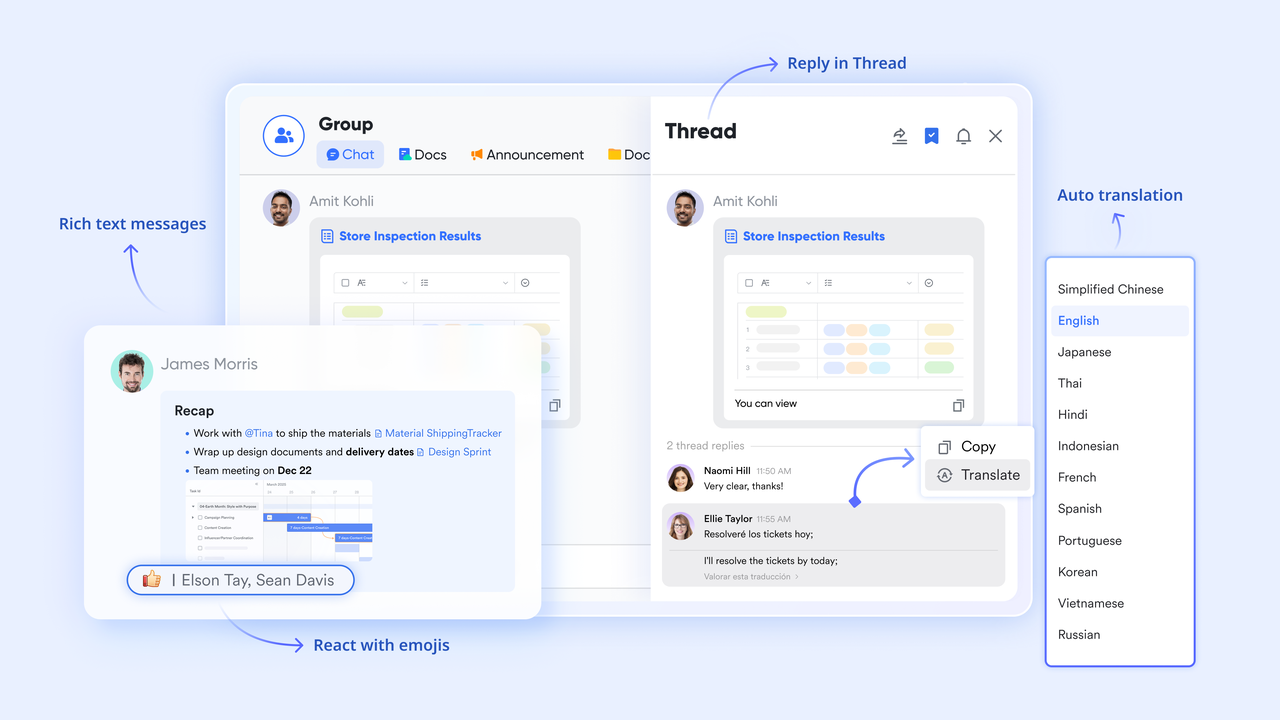
is an all-in-one digital workspace that unifies messaging, video calls, cloud documents and sheets, calendar, email, wiki, approvals, OKR tracking, and in one place. It solves the problem of fragmented tools and frequent context-switching for organizations. Teams can set and track OKRs naturally in the same environment where they communicate, collaborate and manage projects. This unified approach removes the pain of performance management feeling like a separate administrative burden. Lark OKR supports transparent goal setting and progress monitoring, aligning individuals and teams with strategic objectives. Its also builds a culture of continuous feedback, making performance discussions part of daily work rather than formal scheduled events. You can gather feedback with Lark Docs, hold virtual 1:1s via video calls, and automate performance reminders with approval workflows.
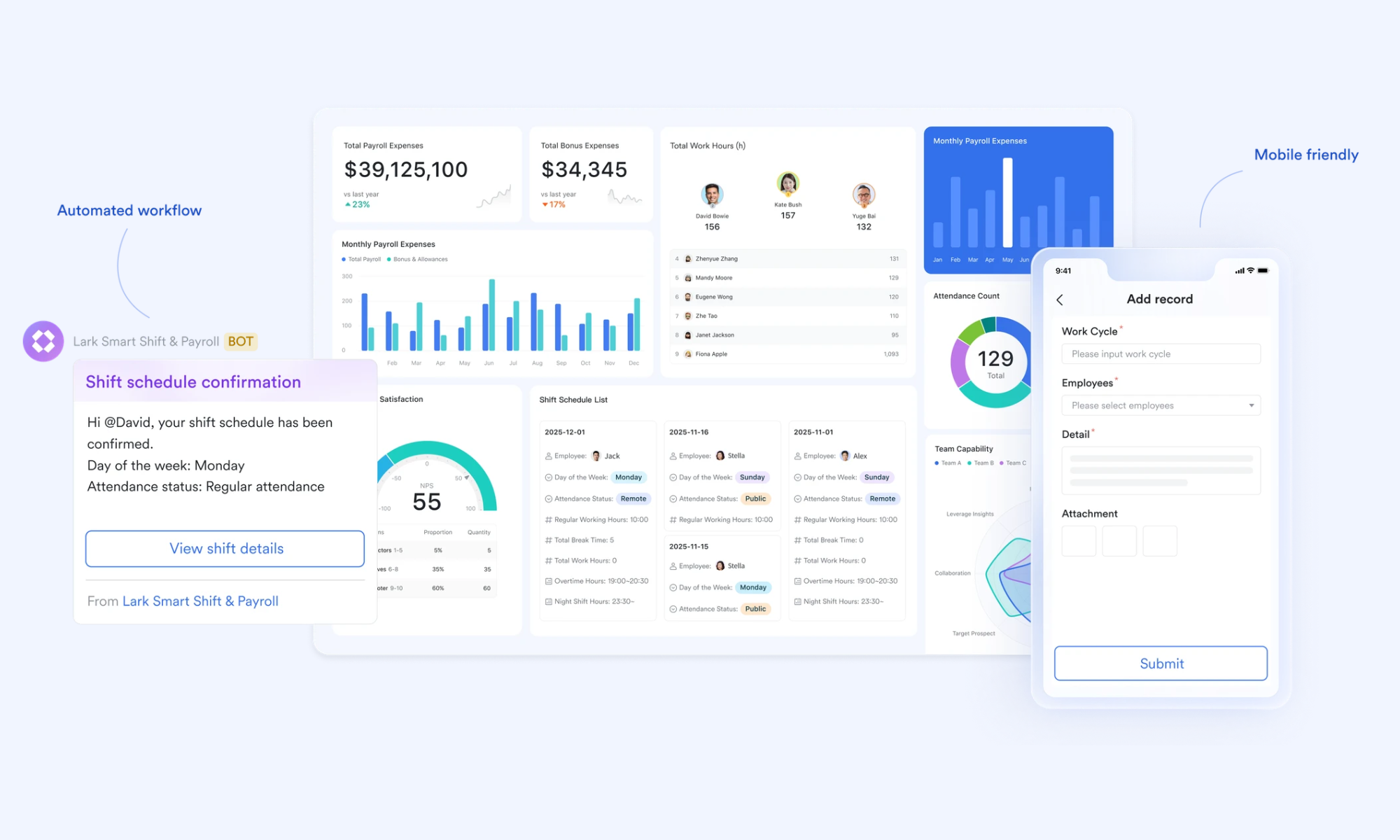
Pros:
Align strategic goals with daily work seamlessly
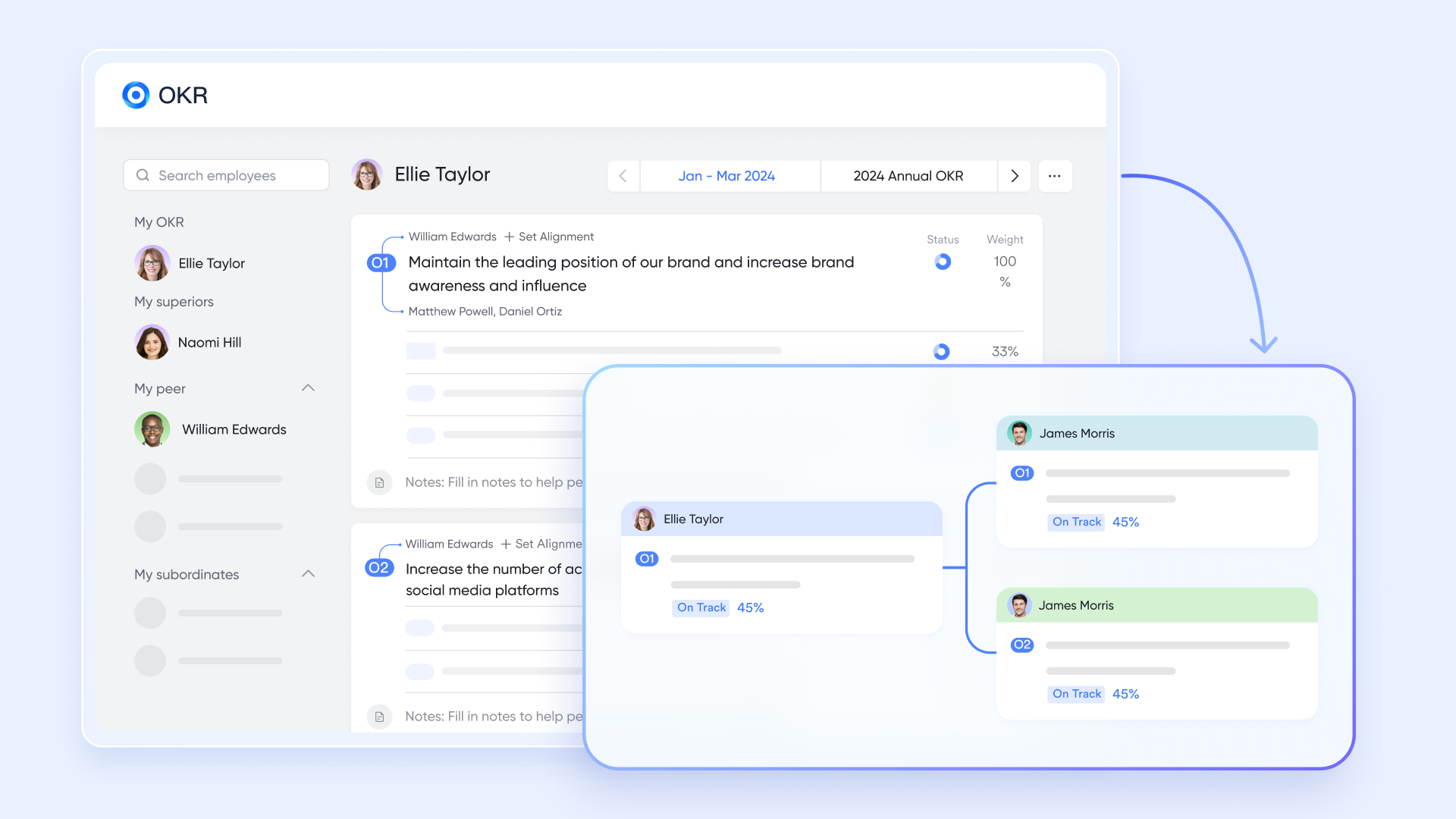
Performance management starts with everyone understanding how their goals connect to the company's strategy. provides a central goal management module where organizations can set, align, and track objectives at the company, department, and individual levels. You can see progress on all key results in one view, ensuring everyone works toward the same direction. More importantly, OKRs can be embedded directly into . When writing project documents or weekly reports, you can update progress with one click. Goal tracking becomes part of daily work, not an extra task at the end of the month.
Run every stage of the review cycle with automated workflows
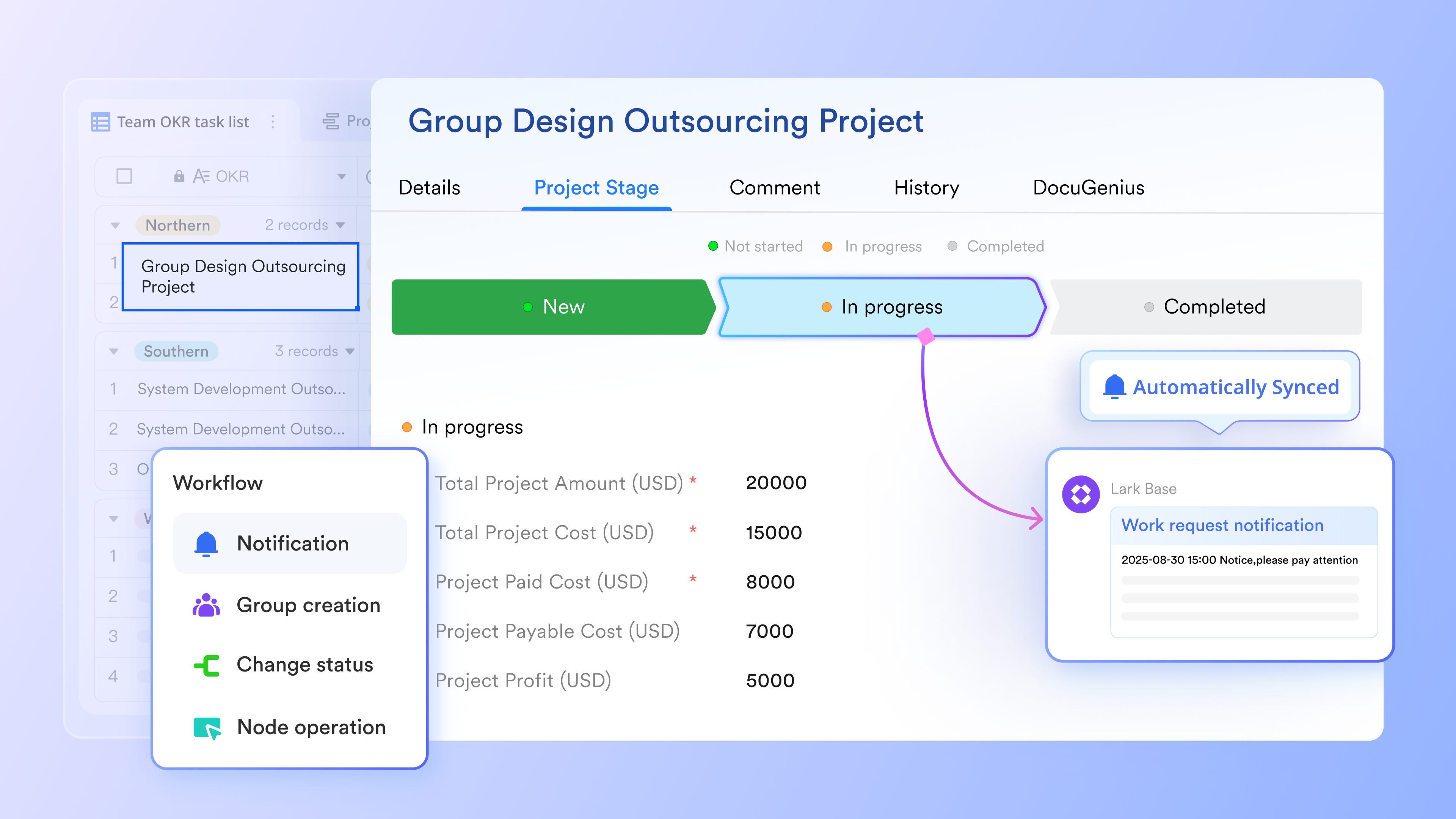
From self-assessments and 360-degree feedback collection to manager calibration, performance review cycles involve multiple steps. Manual coordination takes time, and things often get missed. With , you can build customized automated workflows for your entire review process. Set up triggers: when a self-assessment status changes to "Complete," the system automatically sends feedback collection links to the designated group. When all feedback is collected, it automatically notifies managers to start calibration. You can also create visual dashboards to track completion status, participation rates, and pending items in real time. This automation frees HR and team leads from chasing updates, letting them focus on meaningful employee development conversations.
Gain team health and individual development insights with data dashboards
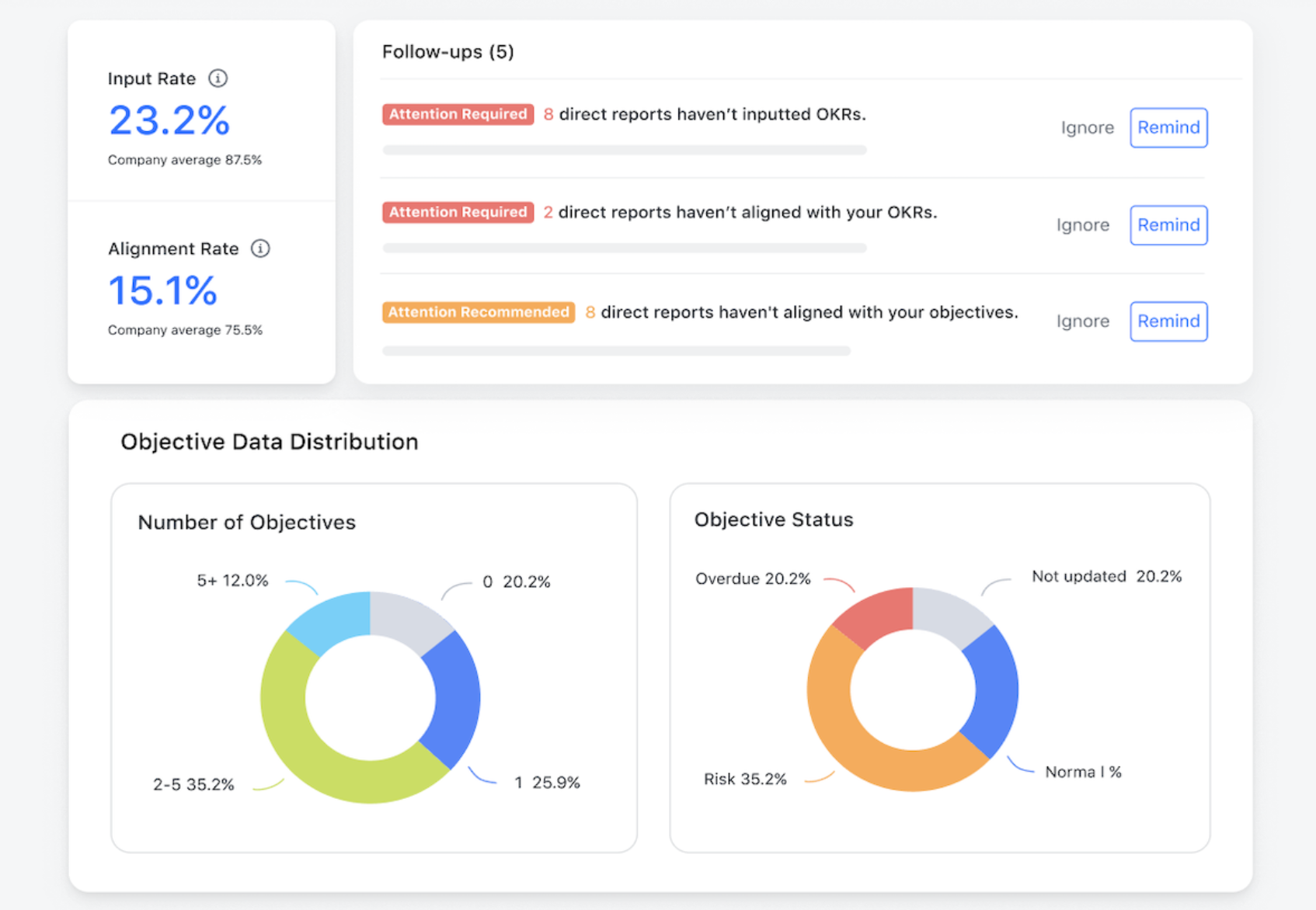
Managers need real-time visibility into team performance, not just reports at quarter end. 's dashboards provide multi-dimensional team insights. You can see core metrics like OKR completion rates, alignment rates, and recent progress updates—all compared to company averages. The dashboard automatically flags "attention items," such as members who haven't updated progress recently or goals that aren't properly aligned. Managers can send reminders directly from the dashboard. You can also drill down into each team's data or switch to a person view to analyze individual objective counts, alignment status, and last update dates. This real-time, visual data helps managers spot issues early and offer support.
Build recognition and feedback into daily communication
Performance culture isn't just about formal reviews—it thrives on daily encouragement and conversation. makes recognition and feedback a natural part of team dialogue. Team members can publicly praise colleagues' contributions in chats, using emojis and quick comments to show appreciation. These positive interactions boost morale and also serve as rich material for peer feedback during formal reviews. When feedback and recognition happen naturally within the workflow, a culture of continuous improvement truly takes root.
Cons:
- Learning Curve for Feature Depth: With so many integrated features, new users might experience an initial learning curve to fully explore and utilize Lark's extensive capabilities. However, its intuitive design and comprehensive help center make this transition manageable.
The verdict: Lark is an excellent choice for growing SMEs to large enterprises, especially remote/hybrid teams, that aim to embed performance management within their daily collaborative workflows rather than relying on a standalone tool. It excels by offering a cost-effective, unified platform that naturally facilitates continuous feedback, transparent goal alignment, and efficient communication, overcoming the challenges of tool sprawl.
:
- Starter plan: Free forever plan that includes 11 powerful tools for up to 20 users. It also comes with 100GB of storage, 1000 automation runs, AI translations, and more.
- Basic plan: $6/user/month (billed annually) for up to 500 users. It includes everything in Starter plus group calling for up to 500 attendees, 5TB of storage, 1000 automation runs, and more. For more details, please .
- Pro plan: $12/user/month (billed annually) for up to 500 users. It includes everything in Basic plus group calling for up to 500 attendees, 15TB of storage, 50,000 automation runs, and more.
- Enterprise plan: for custom pricing. Supports unlimited users and includes even more automation runs and advanced security, compliance, and management features.
For small teams with simple communication needs

18 months message history
1000 Base automation runs/month
2000 rows per table in Base
Most POPULAR
For companies with comprehensive collaboration and management needs
Unlimited message history
500-participant video meetings
50k Base automation runs/month
20k rows per table in Base
For large companies with advanced security and organizational management needs
Get a personalized demo and pricing
Unlimited message history
500-participant video meetings
15 TB storage + 30 GB storage/user
500k Base automation runs/month
50k Base automation runs/month
Most POPULAR
For companies with comprehensive collaboration and management needs
Unlimited message history
500-participant video meetings
50k Base automation runs/month
20k rows per table in Base
2. Mitratech: Empowering goal setting, structured performance management
Mitratech provides comprehensive talent management solutions that often include robust performance management capabilities. Their platforms are designed to help organizations streamline goal setting, conduct structured performance reviews, and facilitate ongoing feedback. A core strength of Mitratech's offering lies in its ability to align individual and team objectives with broader organizational goals, ensuring that employee efforts directly contribute to strategic outcomes. The software typically supports various performance appraisal methods, 360-degree feedback, and continuous check-ins, allowing for a more transparent and developmental approach to performance. Mitratech often caters to mid-to-large enterprises, providing features that integrate performance data with other HR functions.
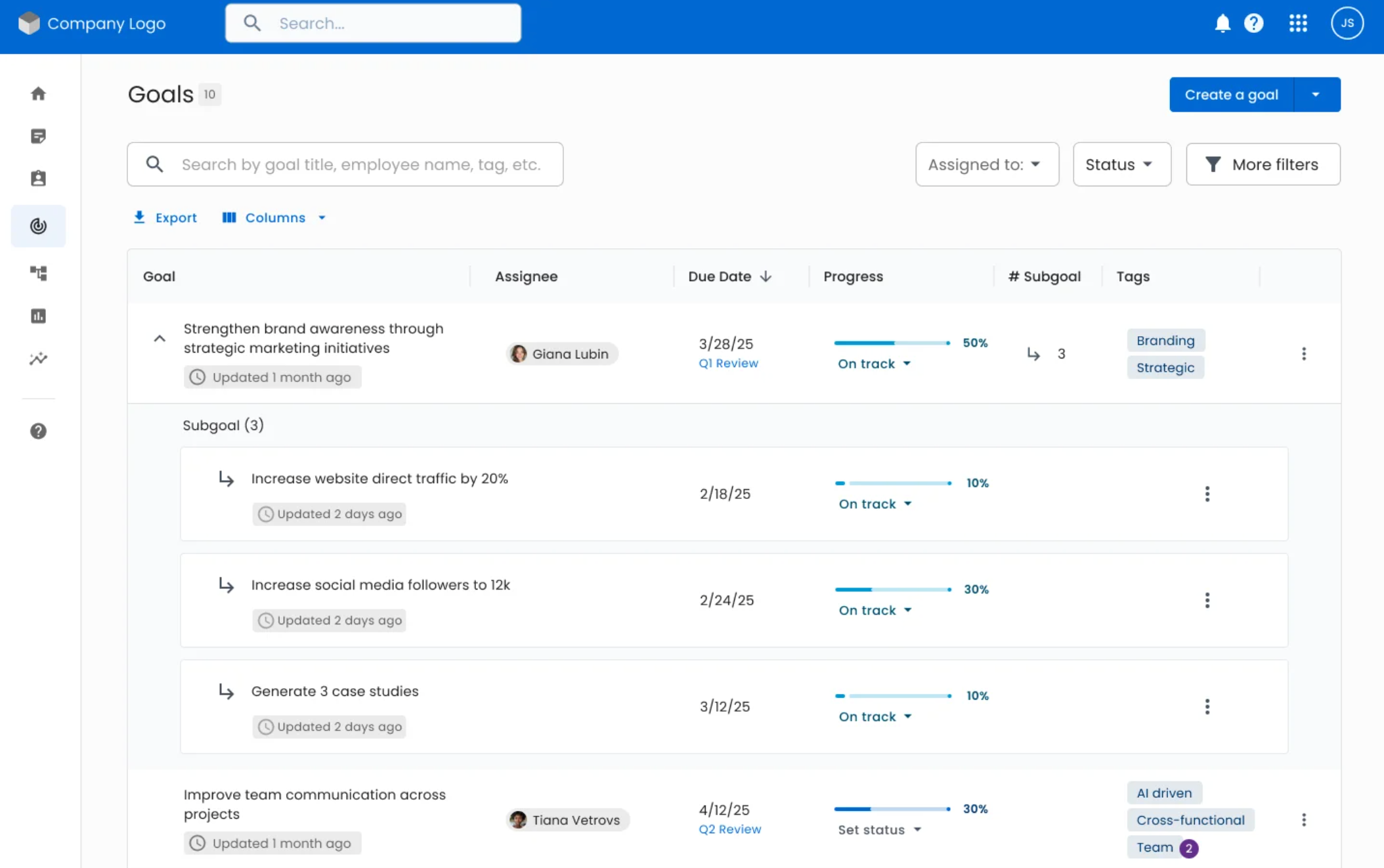
Image source: mitratech.com
Pros:
- Strong focus on goal alignment with organizational objectives.
- Facilitates efficient performance review processes.
- Supports continuous feedback and 1:1 meeting management.
Cons:
- Specific pricing details often require direct contact, lacking transparency.
- The depth of integration with broader HR ecosystems may vary.
The verdict: Mitratech is well-suited for organizations that prioritize robust goal setting and a structured approach to performance reviews, particularly those aiming for strong alignment between individual and company-wide objectives. It shines in environments where clear, measurable goals are paramount to success.
Pricing:
3. Performance Pro: Tailored for individual competency development
Performance Pro specializes in providing highly customizable performance review and competency management systems. This platform is designed to help organizations precisely define, assess, and develop specific employee skills and behavioral competencies. It allows for the creation of tailored review forms that can delve into individual strengths and areas for development, moving beyond generic appraisals. Performance Pro supports objective setting, continuous feedback, and various review cycles, including 360-degree feedback, ensuring a comprehensive evaluation. Its focus on individual development plans makes it a valuable tool for HR departments dedicated to talent nurturing, succession planning, and creating a skills-based workforce.
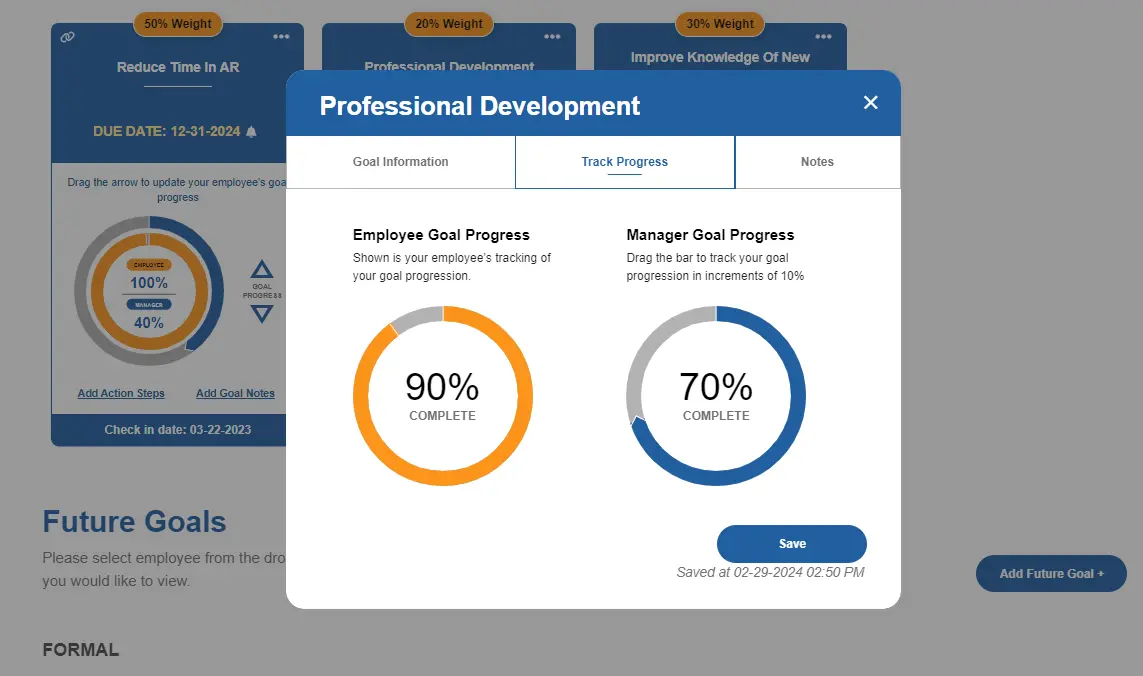
Image source: cusg.com
Pros:
- Exceptional for assessing and developing individual competencies.
- Highly customizable performance review templates.
- Supports objective goal setting and tracking.
Cons:
- May require significant upfront configuration for specific competency frameworks.
- Broader integration capabilities with other HR platforms are not detailed.
The verdict: Performance Pro is an ideal solution for organizations that place a high value on detailed individual competency development and require highly customizable review processes to match their unique skill frameworks. It is particularly beneficial for driving targeted employee growth.
Pricing:
4. Quantum Workplace: Centered on employee engagement and talent
Quantum Workplace offers a powerful platform that seamlessly integrates performance management with employee engagement and talent analytics. This holistic approach helps organizations understand not only "what" employees achieve but also "how" they feel about their work and the company culture. It provides tools for performance reviews, goal setting (including OKRs), 1:1s, and continuous feedback, all designed to foster individual and team growth. Crucially, Quantum Workplace connects these performance aspects with robust employee surveys, sentiment analysis, and action planning tools, allowing HR leaders to gain deep insights into employee sentiment and its impact on performance, retention, and overall organizational health.
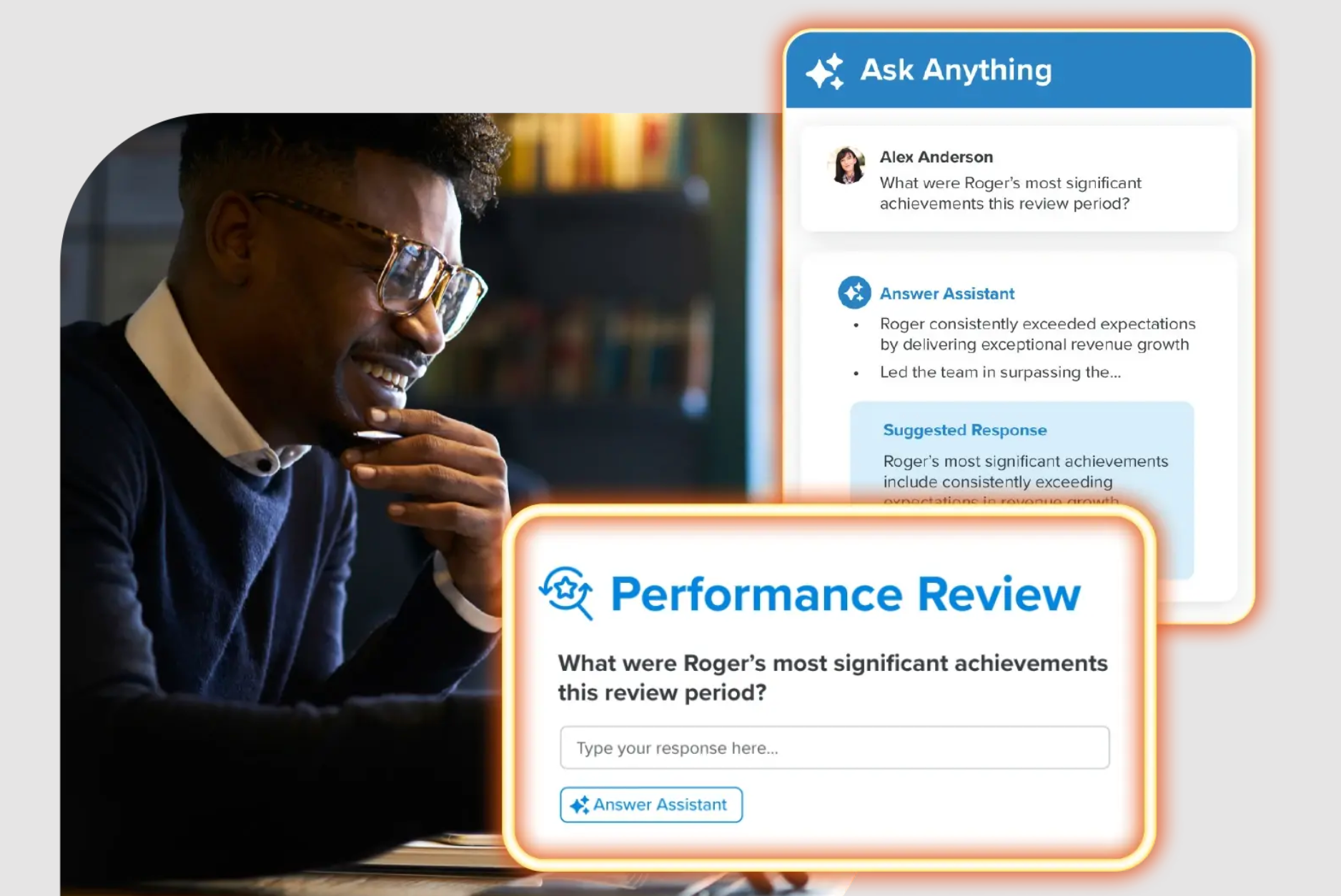
Image source: quantumworkplace.com
Pros:
- Strong integration of performance management with employee engagement.
- Offers comprehensive survey and analytics tools.
- Supports goal setting, reviews, and continuous feedback.
Cons:
- Its extensive engagement features might be more than needed for simpler performance management requirements.
- Pricing models and transparency are not explicitly detailed in the files.
The verdict: Quantum Workplace is best suited for organizations that view performance management as an integral part of a larger employee engagement strategy, seeking to understand and improve both "what" employees achieve and "how" they feel. It's excellent for fostering a positive and high-performing culture.
Pricing:
5. Betterworks: Enterprise-scale OKR alignment, continuous performance
Betterworks is a leading platform specializing in Objectives and Key Results (OKRs) and continuous performance management, particularly geared towards enterprise-level organizations. Its core strength lies in enabling companies to set, track, and align strategic objectives across the entire workforce, ensuring that every individual's contribution is linked to overarching business goals. Beyond robust OKR tracking, Betterworks provides features for real-time feedback, agile check-ins, 1:1 meeting management, and structured performance reviews, all designed to support an ongoing cycle of improvement. The platform offers sophisticated analytics and reporting to monitor goal progress and performance trends, empowering leaders with data-driven insights.
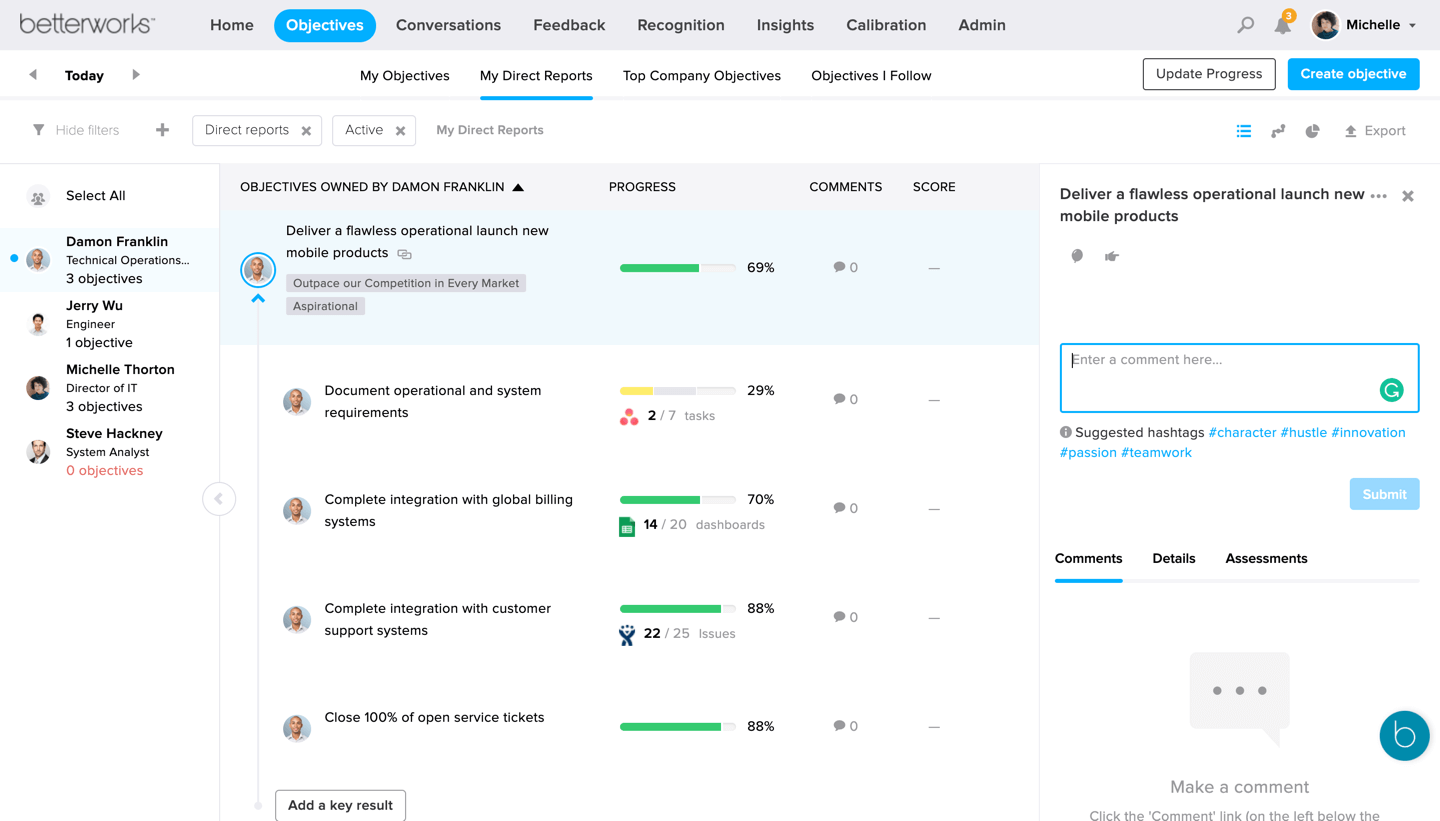
Image source: betterworks.com
Pros:
- Excellent for enterprise-level OKR implementation and alignment.
- Supports continuous performance management with real-time feedback.
- Robust analytics and reporting for large organizations.
Cons:
- May be overly complex or cost-prohibitive for smaller businesses.
- Specific pricing requires direct engagement, common for enterprise solutions.
The verdict: Betterworks is the ideal solution for large enterprises and organizations that are deeply committed to OKRs and require a powerful, scalable platform to drive strategic alignment and continuous performance across their entire workforce.
Pricing:
6. SimplyMerit: Specializing in performance-linked compensation strategies
SimplyMerit is a specialized platform designed to streamline and optimize the compensation planning process, with a strong emphasis on linking pay to performance. It helps organizations manage merit increases, bonuses, and long-term incentives based on employee performance data, ensuring fairness, transparency, and strategic alignment in reward distribution. The software typically integrates with existing HR systems to pull performance ratings and compensation data, allowing HR and management to model various scenarios, analyze pay equity, and make data-driven decisions that motivate and retain top talent. SimplyMerit addresses a crucial aspect of performance management often handled manually or in disparate systems.
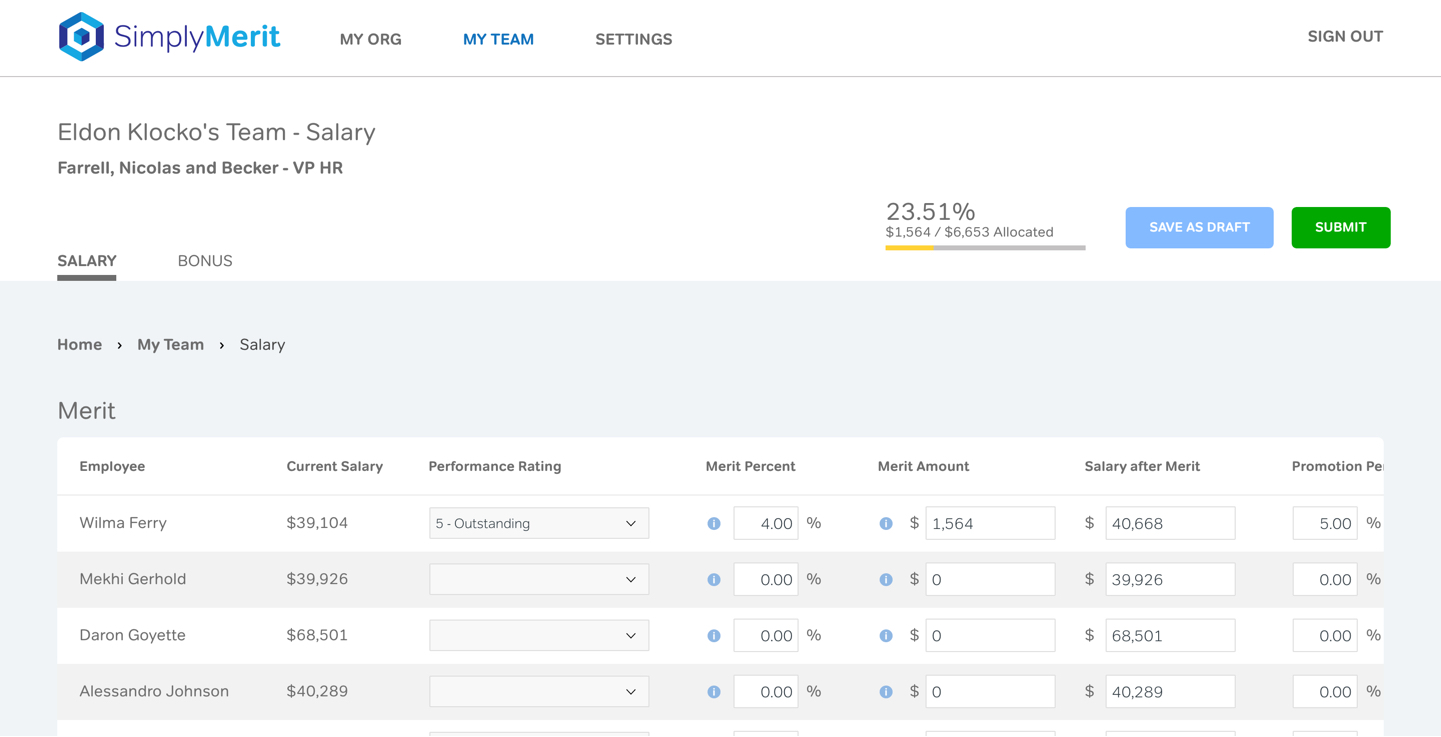
Image source: simplymerit.com
Pros:
- Strong specialization in integrating performance data with compensation planning.
- Aids in fair and data-driven merit allocation.
- Supports strategic talent retention through effective reward systems.
Cons:
- May have a narrower focus on compensation, potentially requiring other tools for broader performance management features.
- Specific feature depth beyond the compensation strategy is not detailed.
The verdict: SimplyMerit is best suited for organizations where a precise, data-driven link between employee performance and compensation is a top priority, ensuring that reward structures effectively incentivize and retain high-performing individuals.
Pricing:
- Starting at $7,840.00 per year.
7. Deel HR: Championing continuous feedback for agile teams
Deel HR, while primarily known for global payroll and compliance for international workforces, is increasingly expanding its offerings to include broader HR functionalities, such as performance management, often with a focus on continuous feedback. For companies managing distributed or remote teams across borders, Deel HR aims to provide tools that facilitate ongoing communication, informal feedback exchange, and regular check-ins. This approach supports a culture of transparency and agility, enabling managers to provide timely input and employees to receive consistent guidance, which is crucial for development in dynamic work environments.
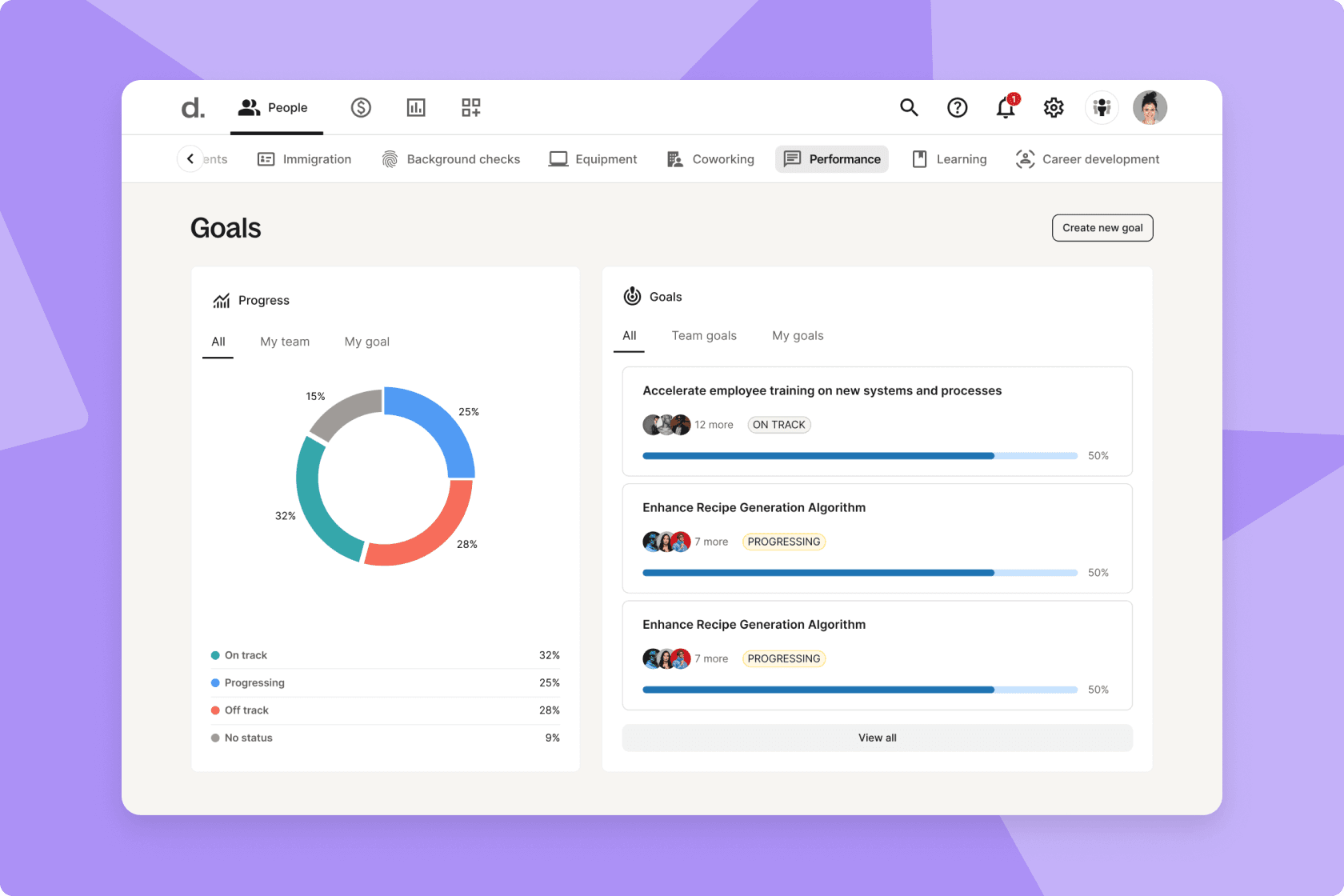
Image source: deel.com
Pros:
- Strong focus on facilitating continuous feedback.
- Promotes a culture of open and timely communication.
- Aids in real-time performance adjustments and development.
Cons:
- May have a less comprehensive suite of features for highly structured, traditional performance reviews.
- Detailed pricing and broader HR functionalities are not specified in the documents.
The verdict: Deel HR is an excellent choice for organizations that are committed to fostering a culture of continuous feedback and require a streamlined platform to support ongoing communication and real-time employee development.
Pricing:
- Hire: Standard starting at $599/employee/month; Enterprise starting at $899/employee/month; Hire US PEO Employees at $125/employee/month.
- Manage: Deel HR for $5/employee/month; Recruit for $14/employee/month; Develop for $22/employee/month.
- Pay: Global starting at $29/employee/month; US starting at $24/employee/month.
- Equip: Starter for $45/employee/month; Growth for $125/employee/month; Scale for $133/employee/month.
8. Workleap: Driving employee engagement and development
Workleap (formerly GSoft), through its suite of HR tech products like Officevibe, focuses on enhancing employee experience, engagement, and development, which inherently supports performance management. While not a standalone performance review tool in the traditional sense, its offerings facilitate continuous feedback, 1:1 discussions, goal setting, and pulse surveys. These features help managers stay connected with their teams, understand employee sentiment, identify development needs, and foster a culture of psychological safety and growth. Workleap's tools empower employees by giving them a voice and managers by providing actionable insights to support their teams effectively.
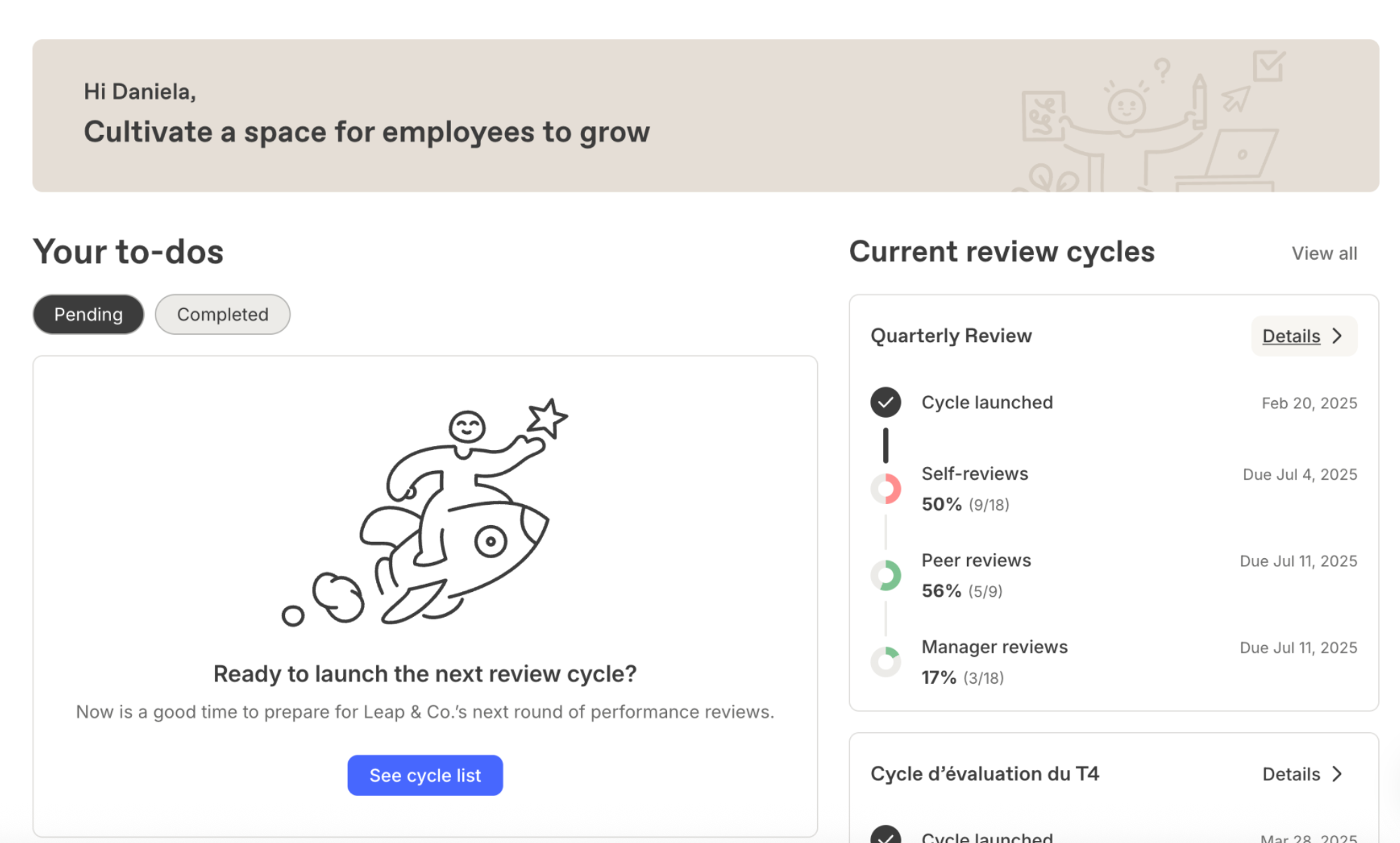
Image source: deel.com
Pros:
- Strong emphasis on employee engagement and continuous feedback.
- Provides actionable insights for managers to support their teams.
- Facilitates psychological safety and development culture.
Cons:
- May require integration with other HR systems for a full performance management suite.
- Specific pricing models and detailed feature breakdowns need direct inquiry.
The verdict: Workleap is ideal for organizations prioritizing employee engagement and a culture of continuous development, seeking tools that provide frequent insights into employee sentiment and facilitate ongoing manager-employee conversations.
Pricing:
- Officevibe: $5/user/month, 10 users minimum, billed annually.
- Performance: $5/user/month, 10 users minimum, billed annually.
- Compensation: $5/user/month, 10 users minimum, billed annually.
9. Workable HR: Streamlining recruiting, potential basic PM
Workable is primarily known as a comprehensive recruiting software that streamlines the hiring process from sourcing to onboarding. While its core strength lies in applicant tracking and talent acquisition, it may offer basic performance-related functionalities or integrations with broader HR suites to manage employee data post-hire. Its direct performance management features for reviews, goal setting, or continuous feedback are typically limited, as it focuses on getting the right talent in the door efficiently. For organizations with simple performance tracking needs that are heavily invested in optimizing their hiring process, Workable might serve as a foundational HR platform.
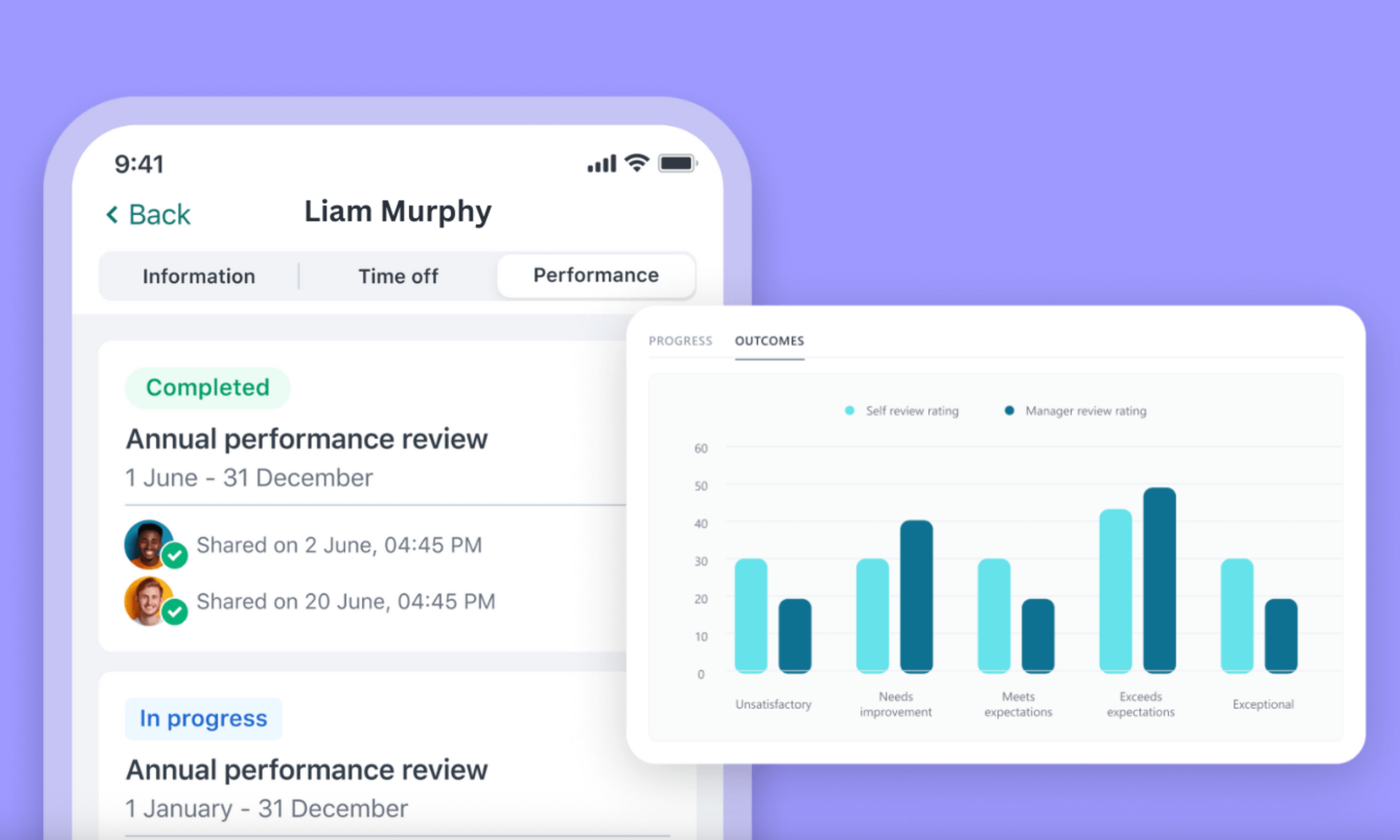
Image source: workable.com
Pros:
- Excellent for end-to-end recruitment and applicant tracking.
- Streamlines onboarding processes.
- Centralizes candidate and new hire data.
Cons:
- Limited dedicated performance management features (e.g., reviews, OKRs).
- Organizations would likely need separate software for comprehensive PM.
The verdict: Workable HR is best suited for organizations whose primary HR focus is on efficient recruitment and hiring, with performance management being a secondary need that might be addressed through integrations or very basic internal tracking.
Pricing:
- Standard: Starts from $299/month, billed annually.
- Premier: Starts from $599/month, billed annually.
- Enterprise: Starts from $719/month, billed annually.
10. Humanyze: AI-driven analytics for workplace collaboration insights
Humanyze is a unique platform that uses AI-driven analytics to provide insights into workplace collaboration and communication patterns. Instead of directly managing performance through reviews or goal setting, Humanyze analyzes passive data (like email and calendar metadata, meeting participation) to map out how teams interact, identify influential individuals, uncover communication bottlenecks, and understand the impact of work dynamics on productivity. This "organizational network analysis" helps leaders make data-informed decisions about team structure, workflow optimization, and improving overall organizational effectiveness, indirectly contributing to enhanced performance by optimizing the work environment itself.
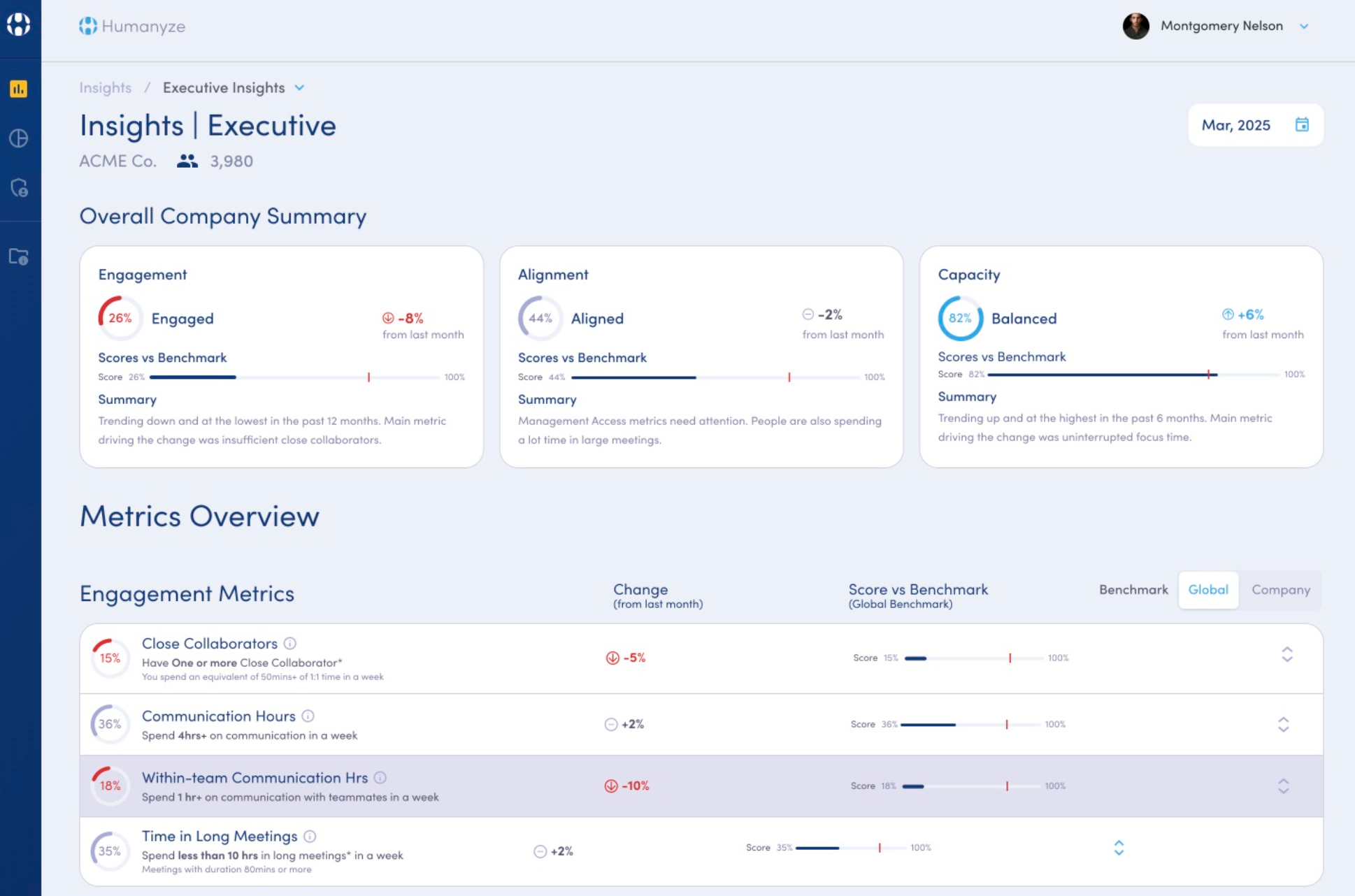
Image source: humanyze.com
Pros:
- Offers unique AI-driven insights into workplace collaboration.
- Helps optimize team dynamics and communication flows.
- Provides data to indirectly enhance productivity and performance.
Cons:
- Not a direct performance management tool for reviews or goal setting.
- Requires integration with communication channels to gather data.
The verdict: Humanyze is ideal for organizations seeking advanced, data-driven insights into team collaboration and communication patterns to indirectly improve performance, especially for those looking to optimize work environments and identify high-performing team dynamics.
Pricing:
- Pulse Core: $1798 per year.
- Pulse Plus: $4798 per year.
- Pulse Elite: $9798 per year.
- Pulse Enterprise: Custom pricing.
11. PerformYard: Best for customizable review processes
PerformYard is a dedicated performance management platform renowned for its exceptional flexibility and highly customizable review processes. It empowers organizations to design performance appraisal cycles that perfectly align with their unique culture and operational needs, whether they prefer quarterly check-ins, annual reviews, project-based assessments, or a hybrid approach. The platform provides robust tools for goal setting, continuous feedback, and 360-degree feedback, ensuring a comprehensive and ongoing dialogue around performance. Its intuitive interface simplifies the often-complex task of managing evaluations, reducing administrative burden for HR and managers while promoting fairness and transparency.
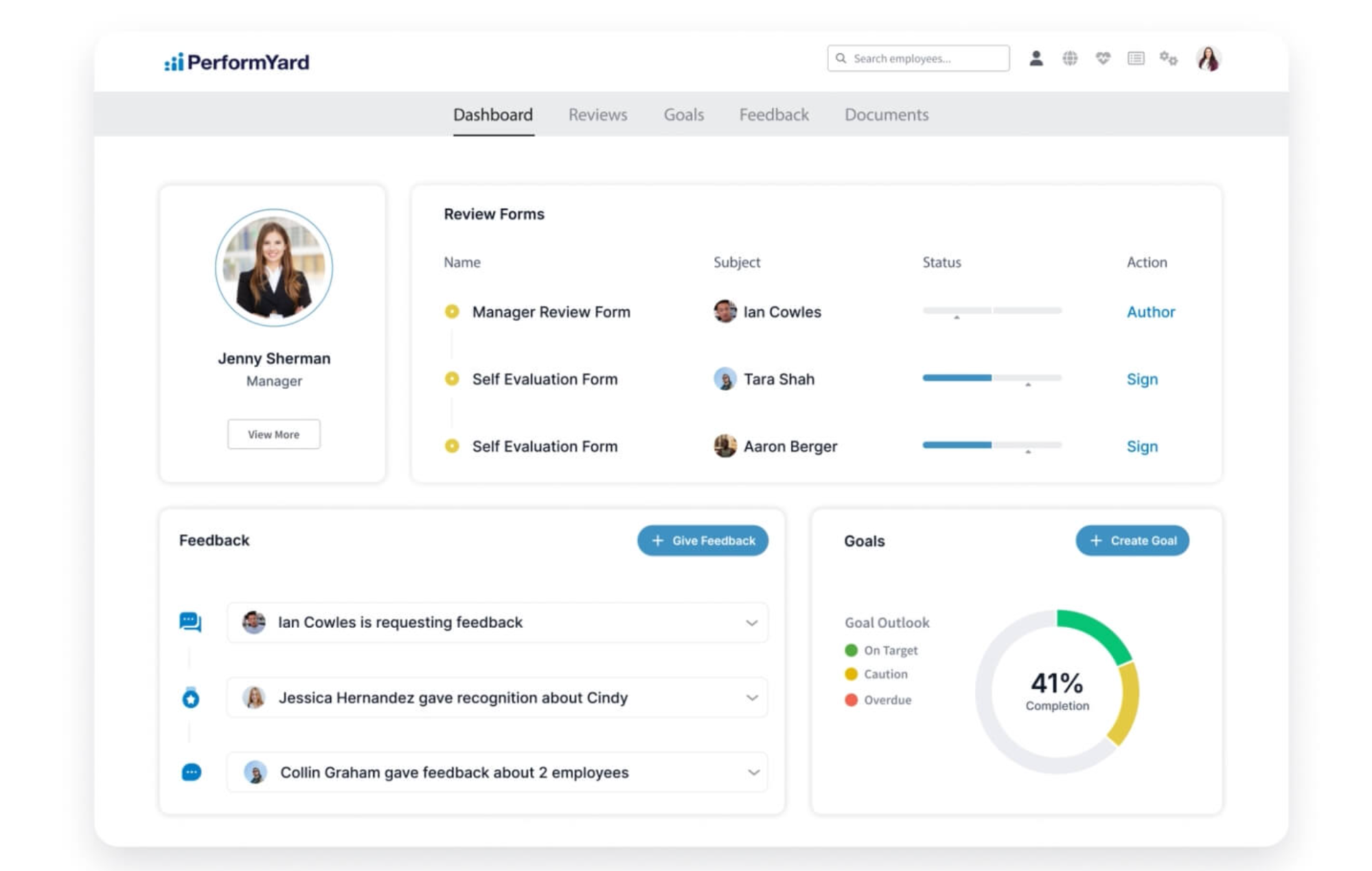
Image source: performyard.com
Pros:
- Exceptional customization options for performance review processes.
- Supports various review cycles and feedback mechanisms.
- Offers goal setting, 360-degree feedback, and continuous feedback.
Cons:
- Organizations without clearly defined processes might need significant upfront configuration.
- Specific pricing details often require direct contact with the vendor.
The verdict: PerformYard is the ideal solution for organizations that require a highly adaptable and customizable platform to manage their performance reviews, allowing them to precisely align the software with their unique performance management philosophy and workflows.
Pricing:
- Performance Management: $5-10/person/month, billed annually.
- Add-ons: Performyard AI for $1-3/person/month, billed annually; Employee Engagement for $1-3/person/month, billed annually; Meetings for $2-4/person/month, billed annually; Surveys for $2-4/person/month, billed annually.
12. EquityHR: Integrated HCM for core HR and talent
EquityHR typically refers to Human Capital Management (HCM) software solutions that provide a comprehensive suite of HR functionalities. While specific offerings vary by vendor under this umbrella term, an EquityHR platform would generally integrate core HR functions like payroll, benefits administration, time and attendance, with talent management modules that include performance management. Its performance features would likely support goal setting, employee reviews, and potentially continuous feedback, all within a unified system. The strength of such platforms lies in centralizing employee data and HR processes, reducing manual efforts, and ensuring compliance. It caters to organizations looking for an all-encompassing HR solution rather than a standalone performance tool.
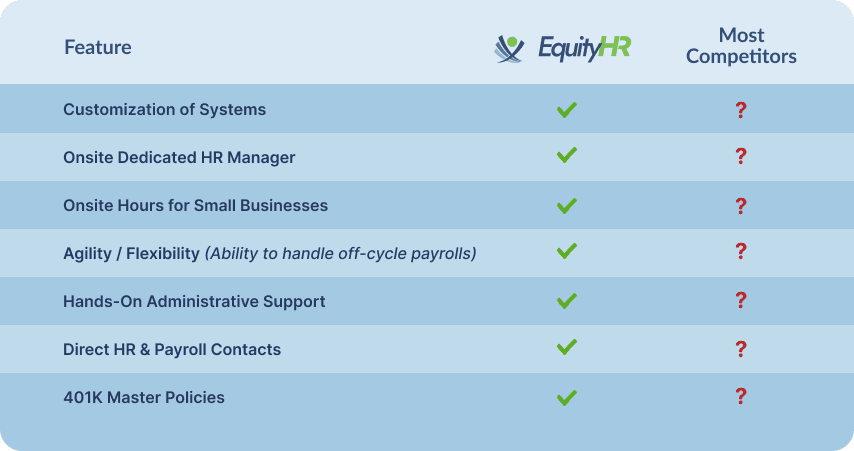
Image source: equityhr.com
Pros:
- Comprehensive suite integrating core HR with talent management.
- Centralizes employee data for efficiency and compliance.
- Reduces administrative burden through unified processes.
Cons:
- Performance management features might be less specialized than dedicated tools.
- Implementation can be complex due to the breadth of features.
The verdict: EquityHR solutions are best suited for organizations seeking a complete Human Capital Management suite that integrates core HR functions with performance management, aiming for a unified and streamlined approach to managing their workforce.
Pricing:
13. Insightful: Workforce analytics for productivity, efficiency
Insightful (formerly known as Workpuls) is primarily a workforce analytics and employee monitoring software. While it doesn't directly offer traditional performance management features like goal setting or formal reviews, it provides data that can be highly relevant to performance. The platform monitors employee activity, tracks application usage, time spent on tasks, and can generate reports on productivity and efficiency. These insights can help managers understand work patterns, identify areas for improvement, and inform coaching conversations. It's often used by organizations looking for data-driven insights into how their teams are working, though its use for performance management should be approached carefully, focusing on objective data and not solely on surveillance.
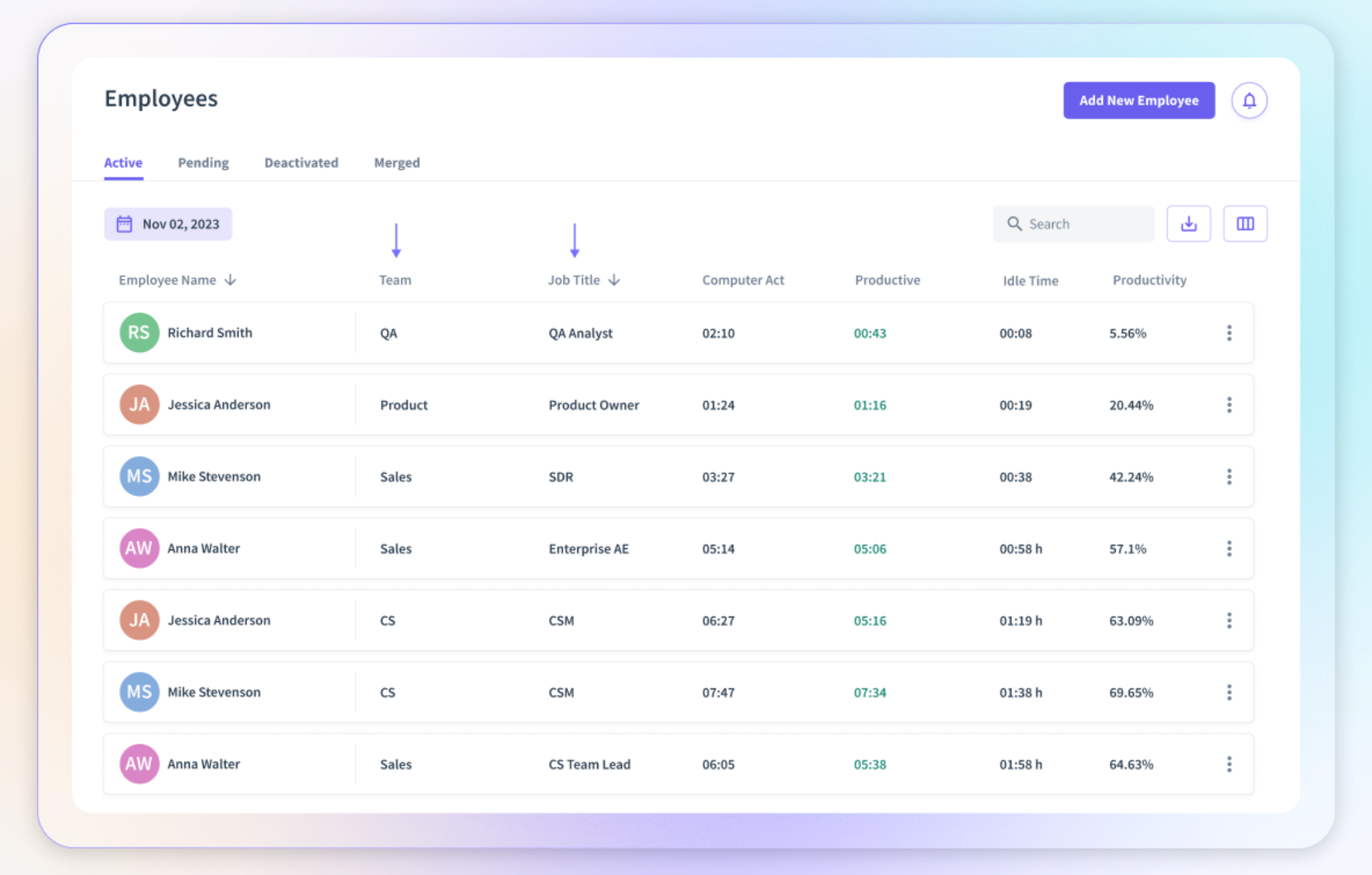
Image source: insightful.com
Pros:
- Provides objective data on employee activity and productivity.
- Helps identify workflow inefficiencies and areas for improvement.
- Offers insights for data-driven coaching and team optimization.
Cons:
- Not a direct performance management tool for reviews or goal setting.
- Can raise privacy concerns if not implemented transparently and ethically.
The verdict: Insightful is best for organizations that want data-driven insights into workforce productivity and efficiency to inform performance discussions and optimize workflows, provided they prioritize ethical implementation and transparency with employees.
Pricing:
- Productivity Management: $6.4/seat/month, billed annually.
- Time Tracking: $8/seat/month, billed annually.
- Process Improvement: $12/seat/month, billed annually.
- Enterprise Solution: Custom pricing.
14. Lattice: Comprehensive people management and engagement
Lattice stands out as a leading people success platform, offering a comprehensive suite for performance management, employee engagement, and growth. It integrates various HR functions into a single platform, facilitating continuous performance reviews, objective (OKR) setting and tracking, 1:1 meeting agendas, and employee engagement surveys. Lattice's strength lies in providing a structured yet flexible framework that fosters ongoing feedback and development conversations. Its robust analytics offer HR leaders and managers deep insights into employee sentiment, performance trends, and professional growth, enabling data-driven talent decisions and helping cultivate a high-performing culture.
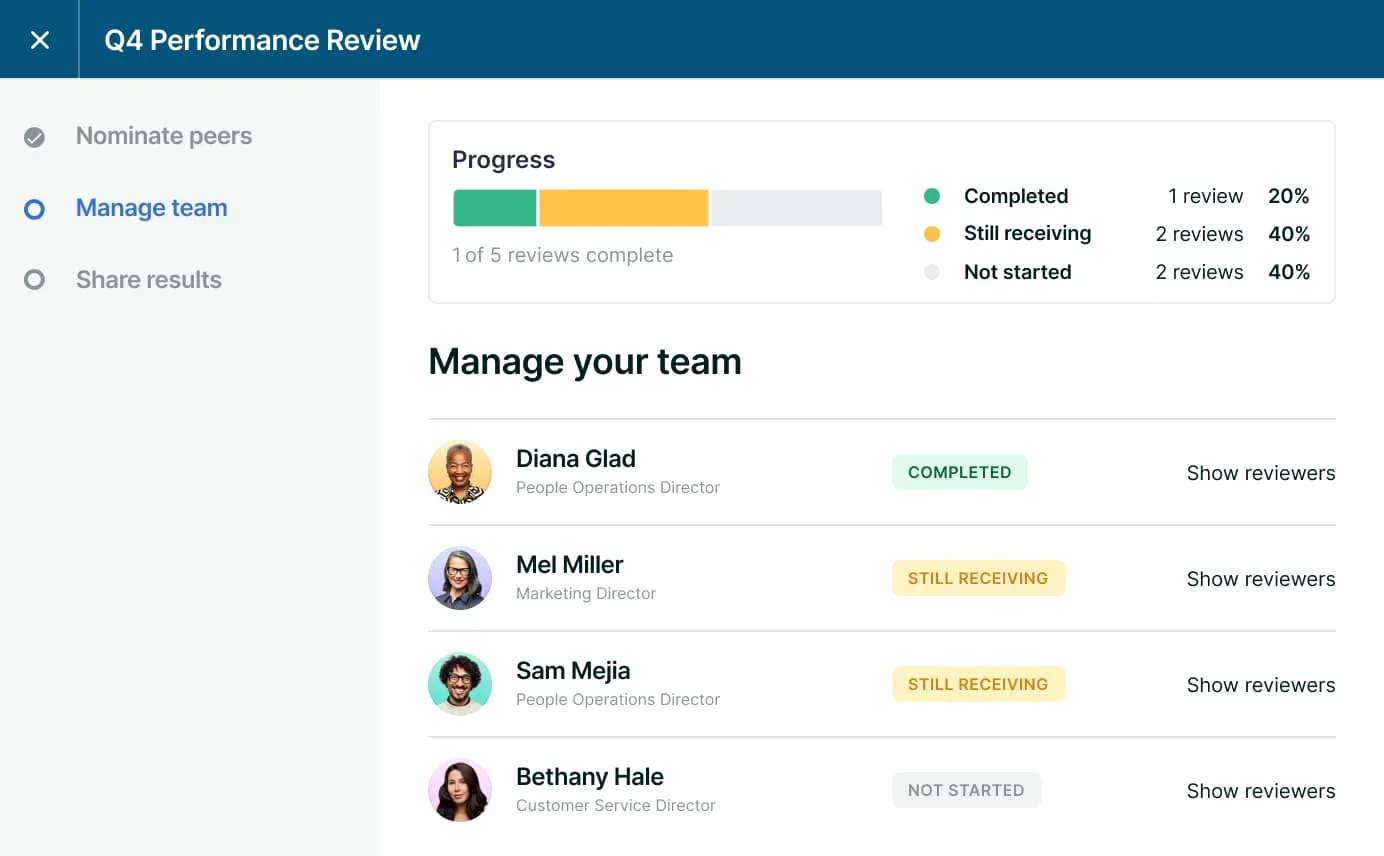
Image source: lattice.com
Pros:
- Comprehensive suite covering performance, engagement, and development.
- Robust analytics for data-driven HR decisions.
- Supports continuous feedback and structured 1:1s.
Cons:
- May present a steeper learning curve for smaller organizations.
- Pricing is typically geared towards mid-to-large enterprises.
The verdict: Lattice is an excellent choice for organizations seeking a comprehensive and integrated platform to manage performance, foster engagement, and drive employee development, especially well-suited for growing and larger enterprises.
Pricing:
- Foundations: $11/seat/month, billed annually.
- Add-ons: Engagement for $4/seat/month, billed annually; Grow for $4/seat/month, billed annually; Compensation for $6/seat/month, billed annually.
15. Sage: Integrated HR, payroll, and talent solutions
Sage is a global provider of business management software, including comprehensive HR solutions that often feature integrated performance management capabilities. Their HR platforms are designed to streamline the entire employee lifecycle, from recruitment and onboarding to payroll, benefits, and talent development. Within their HR suite, Sage's performance management modules typically support goal setting, performance reviews, 360-degree feedback, and continuous performance tracking. The key benefit of Sage is the tight integration with other HR and financial functions, centralizing data and processes for greater efficiency and compliance, making it a strong choice for organizations looking for a unified business solution.
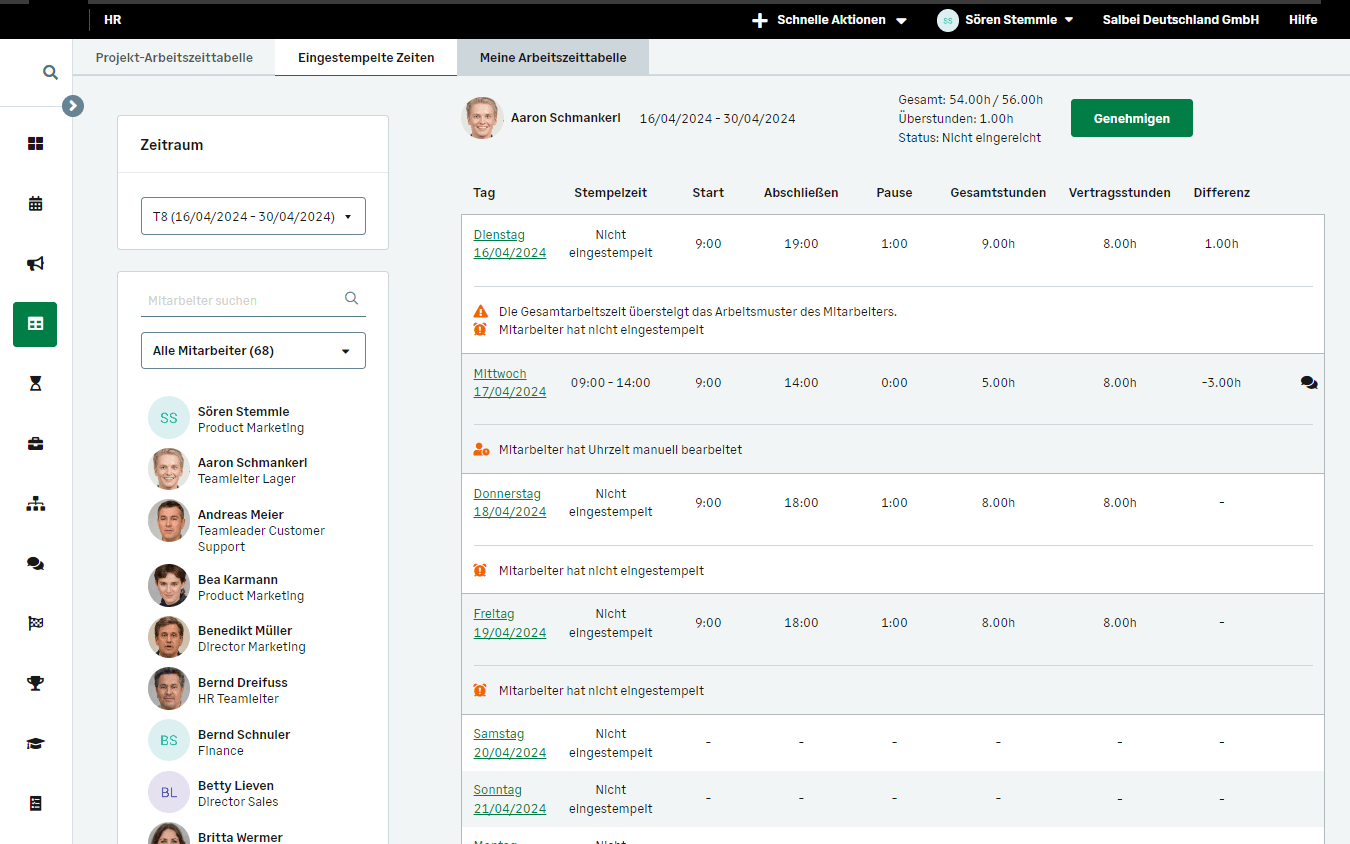
Image source: sage.com
Pros:
- Deep integration with Sage's broader HR and financial suites.
- Comprehensive features for core HR and talent management.
- Streamlines processes and centralizes employee data.
Cons:
- Performance management features might be less specialized than dedicated tools.
- Implementation can be complex due to the breadth of features.
The verdict: Sage's HR solutions are well-suited for businesses already using or considering Sage for their accounting and payroll needs, seeking an integrated platform that connects performance management with their broader HR and financial operations.
Pricing:
- Pro Accounting: $124.42/month, billed annually.
- Premium Accouting: $169.33/month, billed annually.
- Quantum Accouting: 253.42/month, billed annually.
16. 15Five: Fostering engaged, high-performing teams
15Five is a leading continuous performance management platform that champions employee engagement and growth through regular check-ins and feedback. Its unique "15Five" methodology encourages employees to spend 15 minutes weekly answering key questions about their progress, challenges, and morale, with managers spending 5 minutes to review and respond. This approach fosters frequent communication, proactive problem-solving, and a culture of psychological safety. Beyond weekly check-ins, 15Five offers comprehensive features for OKR tracking, 1:1 meetings, performance reviews, and employee engagement surveys, all designed to create highly engaged and high-performing teams.
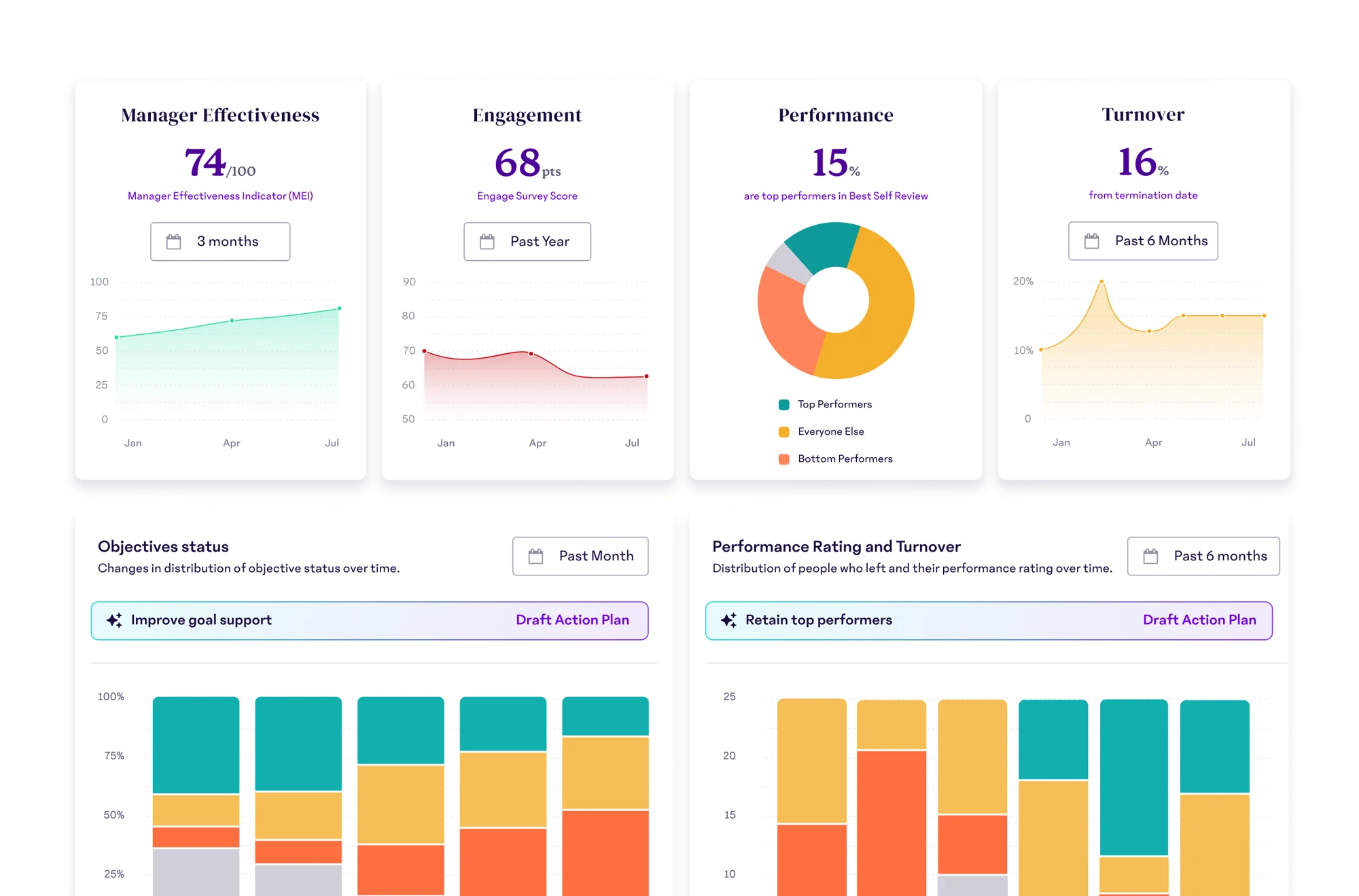
Image source: 15five.com
Pros:
- Strong emphasis on continuous feedback and employee engagement.
- Effective methodology for regular check-ins (15Five format).
- Combines OKR tracking with performance and engagement features.
Cons:
- Organizations new to continuous feedback might need cultural adaptation.
- Specific pricing details are not explicitly detailed in the files.
The verdict: 15Five is an excellent choice for organizations aiming to build a culture of continuous feedback and engagement, particularly those ready to adopt a structured approach to regular communication and transparent goal setting.
Pricing:
- Engage: $4/user/month, billed annually.
- Perform: $11/user/month, billed annually.
- Total Platform: 16/user/month, billed annually.
17. Leapsome: Integrated platform for performance, engagement, learning
Leapsome provides an all-in-one platform for performance management, employee engagement, and learning & development, designed to create a continuous cycle of growth. It offers robust tools for running effective performance reviews, managing Objectives and Key Results (OKRs), gathering continuous feedback, facilitating 1:1 meetings, and conducting engagement surveys. What sets Leapsome apart is its ability to seamlessly connect these different aspects of employee development, ensuring that feedback directly informs learning paths and that performance is aligned with strategic objectives. It empowers employees with clear goals and development opportunities, while providing managers and HR with actionable insights to drive talent success.
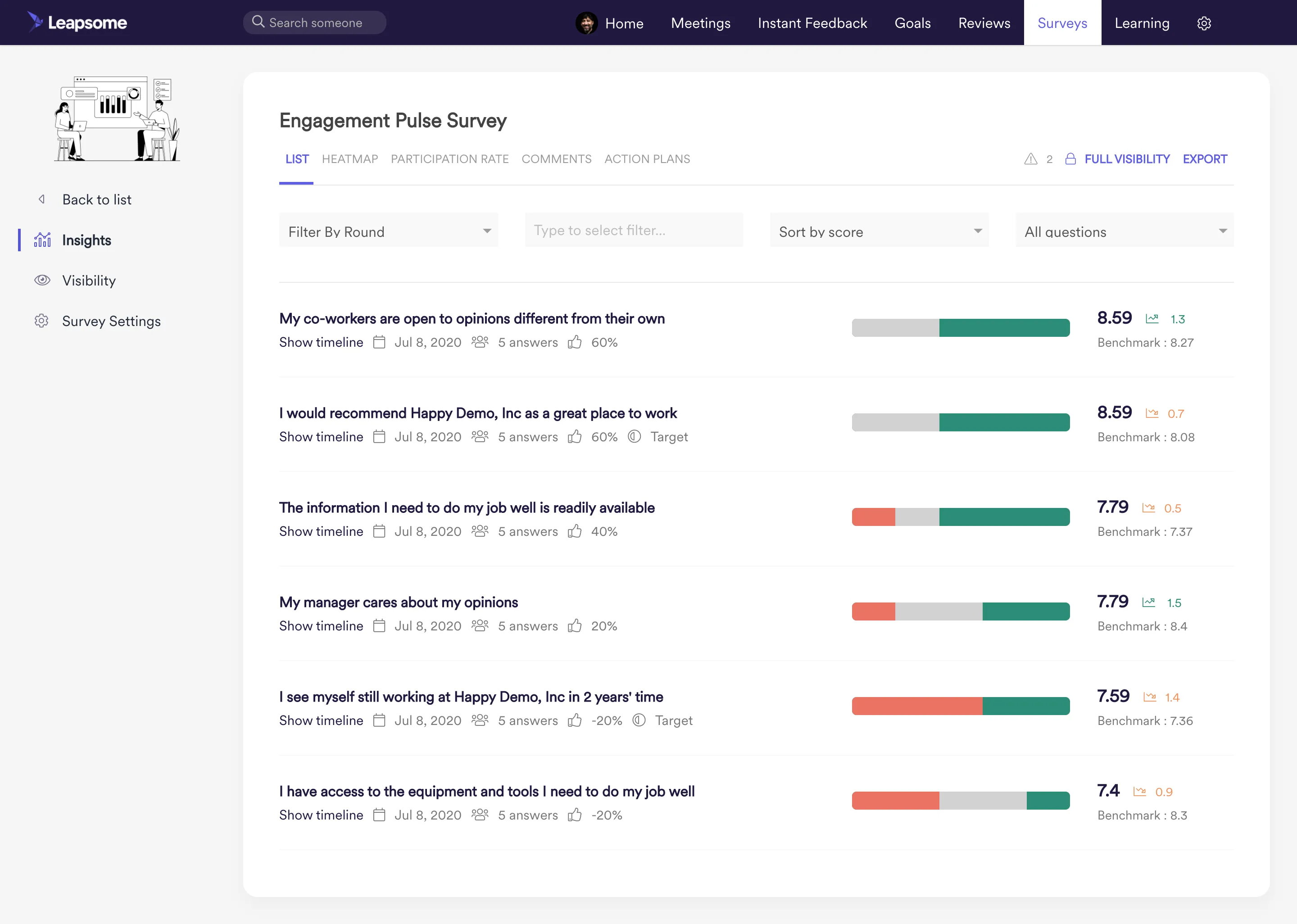
Image source: leapsome.com
Pros:
- Integrated approach to performance, engagement, and learning.
- Supports OKR management and continuous feedback.
- Aids in creating a continuous cycle of employee development.
Cons:
- Its broad feature set might require significant investment in training.
- Pricing transparency for all tiers is not always public.
The verdict: Leapsome is an ideal choice for organizations looking for a deeply integrated solution that ties performance management directly into employee engagement and learning & development, fostering a holistic approach to talent growth.
Pricing:
18. Peoplebox.ai: AI-powered OKR, performance, engagement
Peoplebox.ai offers an AI-powered platform for Objectives and Key Results (OKRs), performance management, and employee engagement. It focuses on helping teams set ambitious goals, track progress effectively, and ensure alignment across the organization. The platform utilizes AI to provide insights into employee performance, identify trends, and automate aspects of the feedback process. It supports continuous feedback, 1:1 meetings, and structured performance reviews, all designed to foster a culture of transparency and growth. Peoplebox.ai aims to simplify complex performance processes, making it easier for managers to support their teams and for employees to stay motivated and aligned.
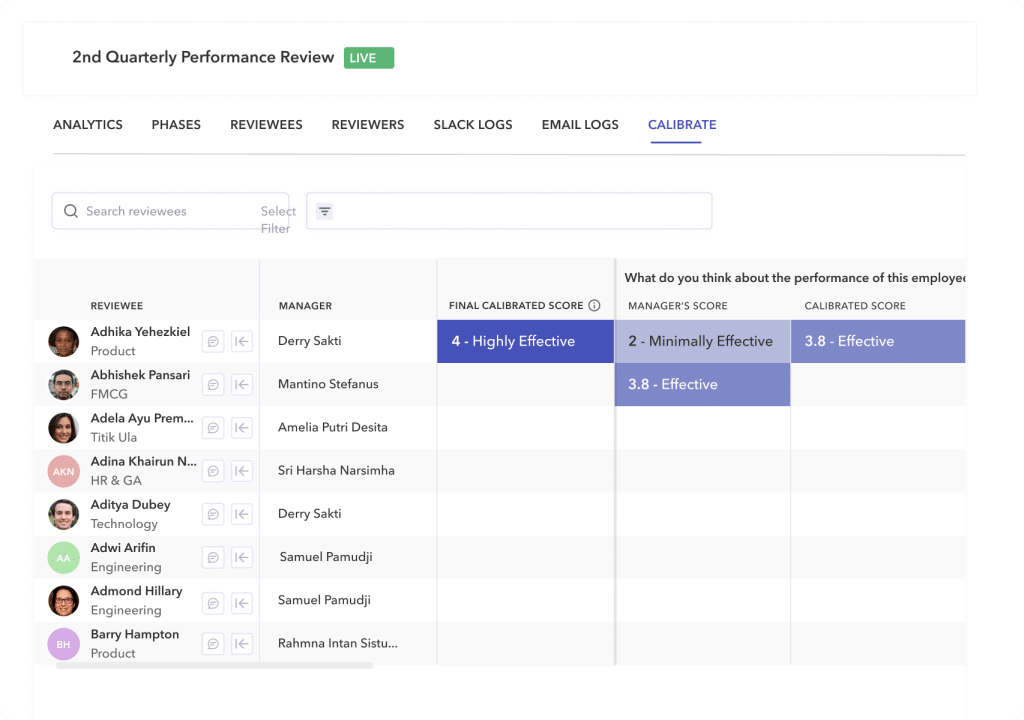
Image source: peoplebox.com
Pros:
- AI-powered insights for OKR and performance management.
- Strong focus on goal setting and organizational alignment.
- Supports continuous feedback and transparent reviews.
Cons:
- As a newer player, long-term market reputation might still be building.
- Specific pricing details often require direct consultation.
The verdict: Peoplebox.ai is an excellent fit for organizations seeking an AI-enhanced platform to streamline OKR management and performance processes, particularly those valuing data-driven insights and continuous employee development.
Pricing:
- Performance Management: $8/emp/month, billed annually.
- Add-ons: Individual Development Plans for $3/emp/month, billed annually; Engagement for $2/emp/month, billed annually; 360 Degree for $8/emp/month, billed annually; Compensation for $5/emp/month, billed annually.
19. Effy AI: AI-powered performance reviews, feedback
Effy AI is a platform specializing in AI-powered performance reviews and feedback, aiming to make these processes more efficient, objective, and insightful. It leverages artificial intelligence to analyze feedback, identify key themes, and suggest areas for development, reducing bias and saving HR and manager time. The platform supports various feedback types, including 360-degree reviews and continuous feedback, providing tools for structured conversations and goal setting. Effy AI is designed for organizations looking to modernize their performance review process with intelligent automation, ensuring that feedback is always actionable and contributes effectively to employee growth.
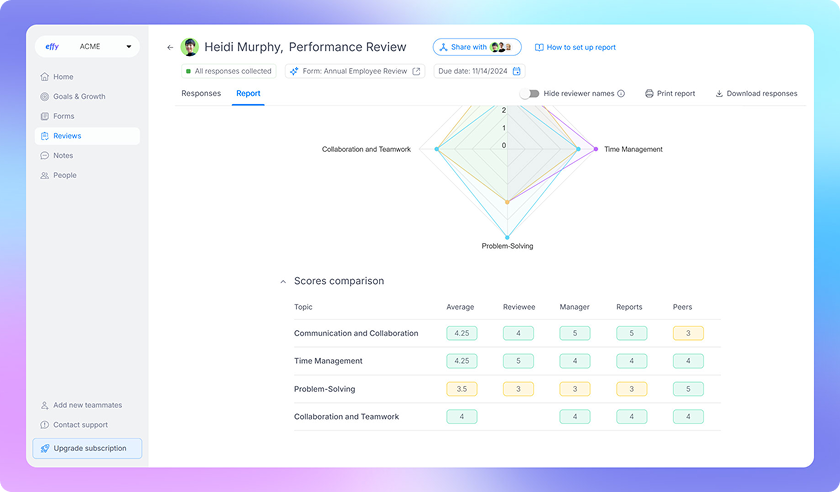
Image source: effy.ai
Pros:
- AI-powered analysis to enhance objectivity and efficiency of reviews.
- Reduces bias and identifies key development themes.
- Supports various feedback types and goal setting.
Cons:
- Reliance on AI might require trust in the underlying algorithms.
- Specific pricing and broader HR integrations are not always transparent.
The verdict: Effy AI is ideal for organizations seeking to leverage artificial intelligence to automate and enhance their performance review process, aiming for more objective, data-driven, and efficient feedback cycles.
Pricing:
- One-time review: $3/seat/month, billed annually.
- Continuous review: $6/seat/month, billed annually.
- Performance suite: $9/seat/month, billed annually.
20. Small Improvements: Making performance management simple, effective
Small Improvements is a platform dedicated to making performance management simple, humane, and effective. It offers a user-friendly suite of tools for continuous feedback, 1:1 meetings, objective (OKR) setting, and streamlined performance reviews. The platform's design philosophy emphasizes ease of use and adoption, encouraging frequent communication and transparent goal setting without unnecessary complexity. Small Improvements helps organizations foster a culture where feedback is a regular occurrence, development is continuous, and employees feel valued and aligned. It's particularly well-suited for small to medium-sized businesses (SMBs) looking to implement modern performance practices efficiently.
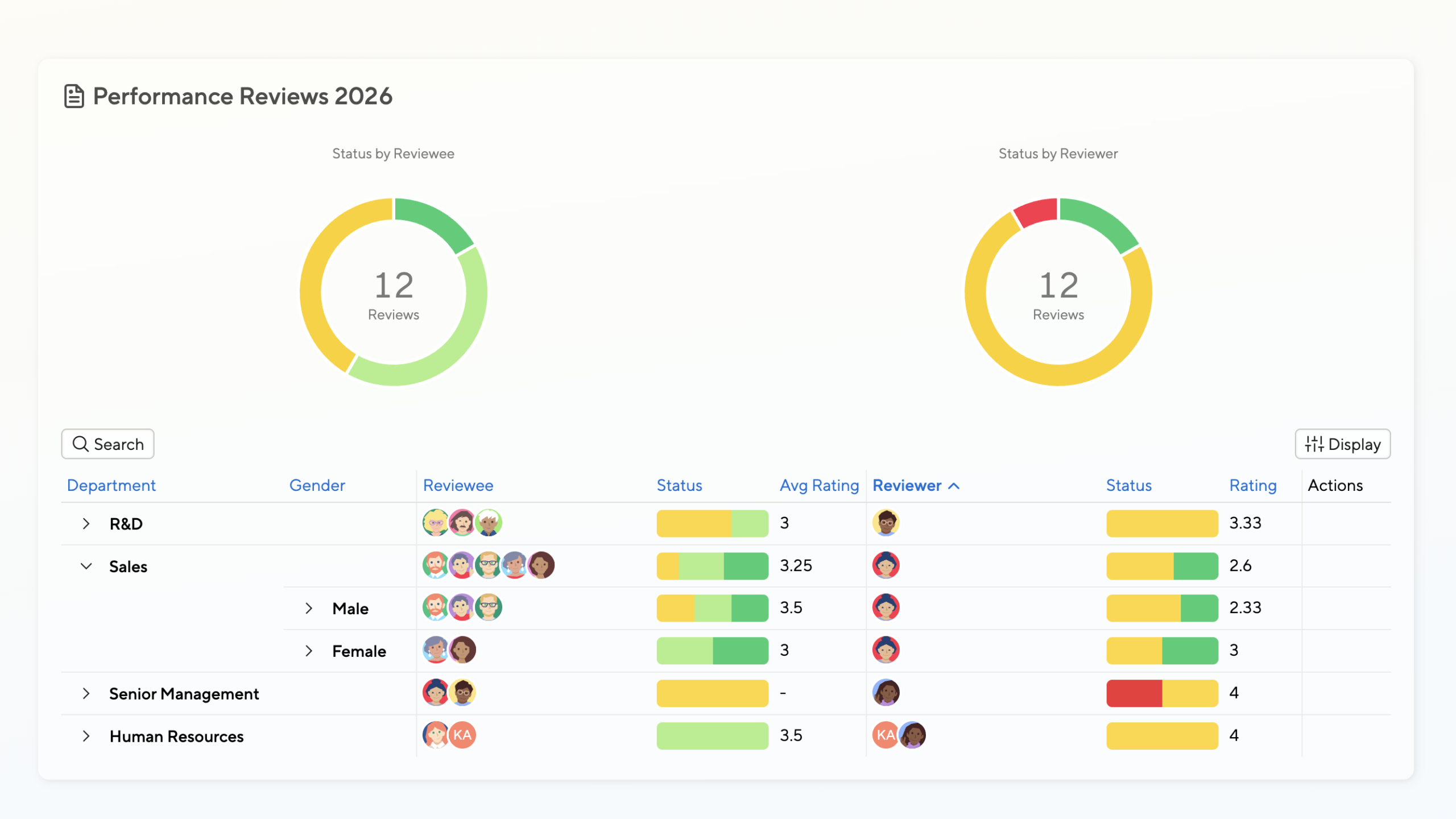
Image source: smallimprovements.ai
Pros:
- User-friendly interface, promoting high adoption.
- Focus on simple, effective, continuous feedback and 1:1s.
- Supports objective setting and streamlined performance reviews.
Cons:
- May lack some of the advanced, deep analytics found in enterprise solutions.
- Specific pricing structures are not explicitly detailed in the provided materials.
The verdict: Small Improvements is ideal for organizations, especially SMEs, seeking a straightforward, intuitive platform to implement modern performance management practices like continuous feedback and objective setting without overwhelming complexity.
Pricing:
- Launch: $3/user/month, billed annually.
- Grow: $6/user/month, billed annually.
- Elevate: $9/user/month, billed annually.
Try the best employee performance management software
Key features to look for in employee performance management software
When evaluating employee performance management software, the sheer volume of features can feel overwhelming. However, focusing on a few core capabilities will ensure you invest in a solution that genuinely meets your organizational needs. From my perspective, these are the non-negotiables:
- Goalsetting & : At the heart of effective performance management is clear goal alignment. Look for software that allows employees and managers to collaboratively set, track, and regularly update individual, team, and organizational goals, including Objectives and Key Results (OKRs). This transparency ensures everyone understands how their work contributes to the bigger picture. For instance, a marketing team might track an OKR like "Increase MQLs by 15% this quarter" and link individual tasks directly to this objective within the software.
- & 1:1s: The move away from annual reviews necessitates robust tools for ongoing dialogue. Prioritize platforms that facilitate real-time feedback (both formal and informal), enable easy scheduling and documentation of one-on-one meetings, and provide a repository for continuous performance notes. This ensures that constructive criticism and recognition are delivered promptly, maintaining relevance and impact.
- Performance reviews & 360-degree feedback: While continuous feedback is crucial, structured reviews still have their place. The best software offers flexible templates for formal performance reviews, supporting self-assessments, manager evaluations, and multi-rater feedback (360-degree). This comprehensive approach provides a holistic view of an employee's performance from various perspectives, such as peers, direct reports, and even external stakeholders.
- Reporting & analytics: What gets measured gets managed. Powerful analytics tools are essential for identifying trends, understanding individual and team performance, and spotting potential issues early. Look for customizable dashboards, historical data tracking, and the ability to generate reports on goal attainment, feedback frequency, and development progress. This data empowers HR and leadership to make informed, strategic decisions.
Common challenges of performance management
Despite the advancements in performance management software, organizations frequently encounter several challenges with performance management, especially when relying on outdated or inefficient processes. These challenges often hinder effective employee development and organizational growth. Common challenges include:
- Infrequent and inconsistent feedback: Traditional annual reviews often mean feedback is delayed, inconsistent, or unclear, failing to capture real-time performance insights. This infrequent feedback prevents employees from course-correcting proactively and can lead to a lack of engagement.
- Lack of trust and transparency: Many employees and managers express a lack of trust in their organization's performance management processes. If evaluations are perceived as biased, unfair, or lacking transparency, it can lead to disengagement and skepticism.
- Disconnected goal systems: Difficulty in aligning individual or team goals with broader company objectives means employees may not understand how their work contributes to strategic outcomes. Disconnected goal systems make it hard to track progress and adapt strategies effectively.
- Administrative burden and manual effort: Without the right tools, performance reviews can be time-consuming, requiring extensive manual effort from HR professionals and managers. Chasing feedback in spreadsheets, inconsistent evaluations, and managing disconnected systems lead to administrative headaches rather than focusing on people development.
- Inadequate support for : Traditional methods often fail to support distributed teams effectively. Managing performance across different locations and time zones without digital tools can lead to disconnect, lack of visibility, and inconsistent engagement.
Overcome these common obstacles with Lark
How to choose the best employee performance management software
Selecting the ideal employee performance management software is a strategic decision that can profoundly impact your organization's culture, productivity, and employee retention. It's not a one-size-fits-all choice. Here's a structured approach I recommend to guide your decision-making process:
- Identify your specific needs and goals: Begin by clearly defining why you need software. Are you primarily looking to streamline annual reviews, foster continuous feedback, improve goal alignment, or enhance employee development? What are your biggest pain points with your current process? Document your must-have features versus nice-to-haves. For instance, a growing startup might prioritize ease of use and affordability, while a large enterprise might need robust security features and complex integration capabilities.
- Consider your team size and structure: The best solution for a 50-person startup may not be suitable for a 5,000-person multinational corporation. Evaluate whether the software scales with your anticipated growth and supports your organizational structure, including remote, hybrid, or geographically dispersed teams. Ensure it can handle different reporting lines and access permissions effectively.
- Assess ease of use and user adoption potential: Even the most feature-rich software is useless if employees and managers struggle to use it. Prioritize platforms with intuitive interfaces, clear workflows, and minimal training requirements. Conduct pilot programs with a subset of users to gather feedback on usability. A high adoption rate is key to realizing the software's benefits.
- Prioritize vendor support and security features: Investigate the vendor's reputation for customer support, including response times, available resources (knowledge base, tutorials), and implementation assistance. Equally important are security protocols, data privacy compliance (e.g., , SOC 2), and data backup policies. This is especially crucial given the sensitive nature of performance data.
Conclusion
The journey to unlocking your team's full potential in 2026 demands a sophisticated approach to employee performance management. We've seen how the traditional annual review has given way to continuous feedback, data-driven insights, and integrated workflows – all powered by innovative software solutions. Whether your organization opts for a dedicated performance management system or leverages a robust, all-in-one productivity suite like , the underlying goal remains the same: to foster a culture of growth, transparency, and alignment.
The right software acts as a catalyst, transforming performance from a periodic assessment into an ongoing conversation, deeply embedded in the daily fabric of work. By carefully considering your unique needs, budget, and desired level of integration, you can select a tool that not only streamlines HR processes but also empowers your employees, drives engagement, and ultimately propels your business forward. The investment in the right employee performance management software isn't just about efficiency; it's about investing in your people, their development, and the sustained success of your organization.
Start improving performance management right now
FAQs
What is employee performance management software?
Employee performance management software is a digital tool designed to help organizations streamline, track, and enhance employee performance. It typically includes features for goal setting, feedback (continuous, 360-degree), performance reviews, recognition, and analytics, moving beyond traditional annual appraisals to foster ongoing development and engagement.
How often should performance reviews be conducted with software?
With modern performance management software, the trend has shifted from annual reviews to more frequent, continuous feedback. While formal reviews might still happen quarterly or biannually, the software enables ongoing check-ins, 1:1 meetings, and real-time feedback, making performance management an everyday activity rather than an isolated event.
Can performance management software help with remote teams?
Absolutely. Performance management software is particularly beneficial for remote and hybrid teams. It provides the necessary structure and transparency for goal alignment, facilitates asynchronous and synchronous feedback, and ensures consistent communication, helping managers stay connected with their distributed workforce and track progress effectively regardless of location.
What's the difference between performance management and talent management software?
Performance management software specifically focuses on improving individual and team performance through goal setting, feedback, and reviews. Talent management software is a broader category that encompasses performance management, but also includes other HR functions like recruitment, onboarding, learning and development, compensation, and succession planning, offering a more holistic view of the employee lifecycle.
Is a unified platform better than a standalone PM tool?
The "better" choice depends on your organization's specific needs. A unified platform like Lark offers cost-efficiency and reduces context-switching by unifying collaboration, communication, and performance-related features into a single suite. This is often ideal for teams struggling with tool sprawl. A standalone PM tool provides deep, specialized functionality exclusively for performance management, which might be preferred by organizations with highly complex, unique, or mature performance frameworks that require specific, intricate configurations.
Related reading