Modern teams rarely struggle with a lack of work. They struggle with deciding what deserves attention first. As work becomes more collaborative, digital, and fast-changing, task prioritization turns into a daily challenge rather than a one-time planning exercise. Teams juggle requests from customers, stakeholders, managers, and systems at the same time. Without clear task prioritization strategies, effort spreads thin and important work gets delayed.
Many teams start with simple lists or spreadsheets, then gradually experiment with task prioritization tools and templates. Over time, they realize that prioritization is not only about urgency. It is about impact, ownership, dependencies, and execution context. Platforms like Lark often appear later in this journey, helping teams move from static lists to connected, adaptable work task prioritization.
Turn complex task priorities into clear action
What is task prioritization
Task prioritization is the process of deciding the order in which tasks should be worked on based on defined criteria. In theory, prioritization sounds straightforward. In practice, it breaks down under real-world conditions. However, real work is rarely linear. New requests appear mid-sprint. Dependencies change. Stakeholders escalate issues without context. Teams often rely on personal judgment rather than shared task prioritization methods. This leads to conflicting priorities across individuals and teams.
Another reason task prioritization fails is that it is treated as a one-time decision. Priorities are set during planning, then forgotten as execution unfolds. Without visibility and adjustment mechanisms, even well-designed systems lose effectiveness. This is why modern teams increasingly look for that adapts as work changes.
Three types of task prioritization methods
Task prioritization methods provide structured ways to decide what should be done first. Each method suits different types of work, team maturity, and decision speed. Understanding when to use which approach helps teams avoid rigid or misaligned prioritization.
Many teams combine multiple techniques rather than relying on one framework. For example, a team may use a matrix for strategic planning and simpler rules for daily execution. The goal is not perfection but consistency. Below are widely used methods and the contexts where they work best. Below are widely used task prioritization methods and the contexts where they work best:
Eisenhower matrix task prioritization
The Eisenhower matrix task prioritization model divides tasks into four quadrants based on urgency and importance. It helps teams distinguish between work that feels urgent and work that truly matters. This method is especially useful for leaders and knowledge workers managing mixed responsibilities. Teams benefit from this method when decision speed is critical. It provides quick clarity during high-volume workdays. However, it relies heavily on subjective judgment, which can differ across team members. Without shared definitions, alignment issues can appear. Over time, teams often complement the Eisenhower matrix task prioritization approach with clearer ownership rules or task prioritization software to maintain consistency across the organization.
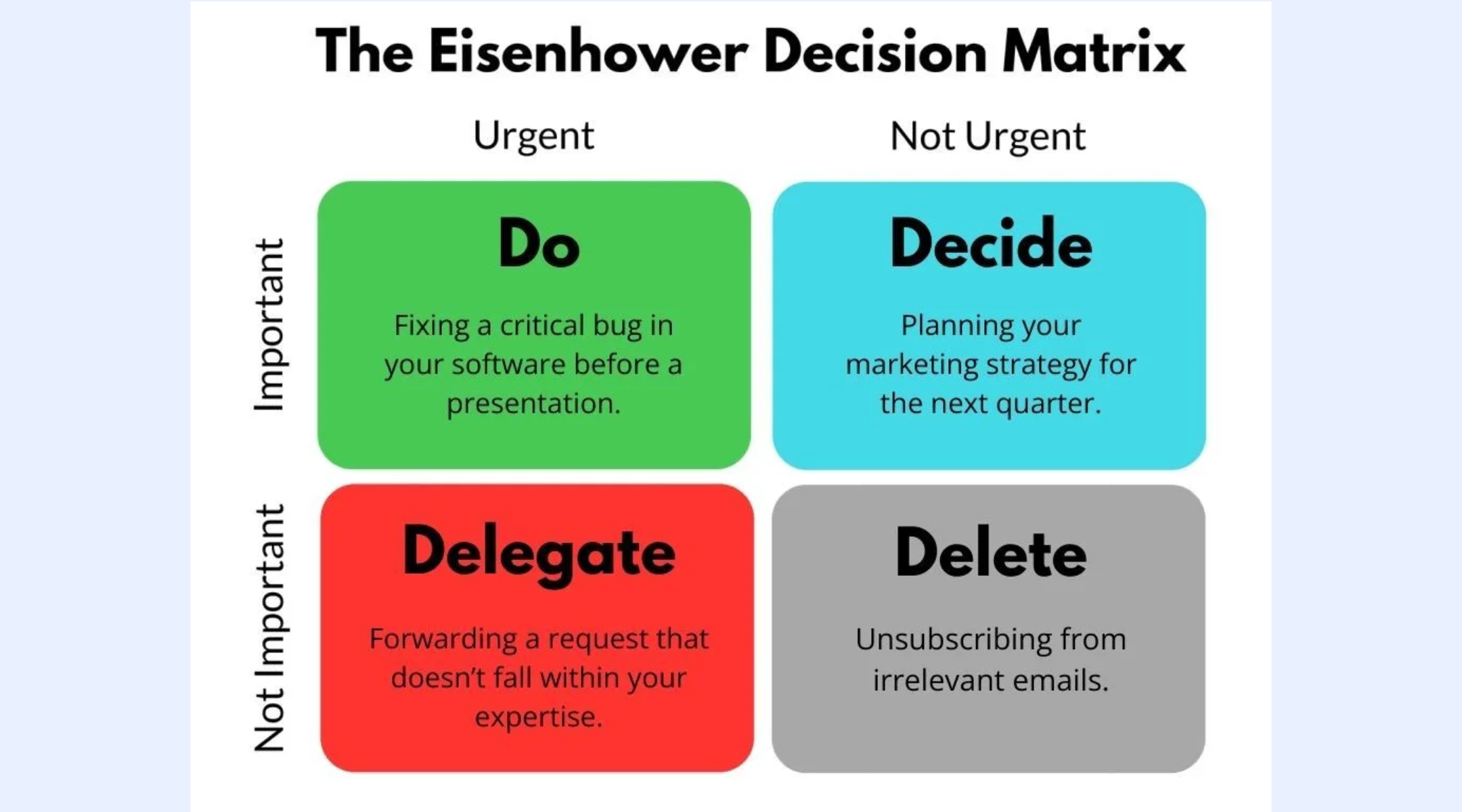
Image source: luxafor.com
MoSCoW prioritization matrix
MoSCoW categorizes tasks into must-haves, should-haves, could-haves, and will-not-haves. This task prioritization technique works well for and scope planning. It helps teams make explicit tradeoffs. This method is effective when teams need stakeholder alignment. It encourages conversations about constraints and capacity. However, it can feel abstract during daily execution if not tied to timelines or dependencies. Teams often pair MoSCoW with a task prioritization template or visual boards to ensure categories translate into real work sequencing.
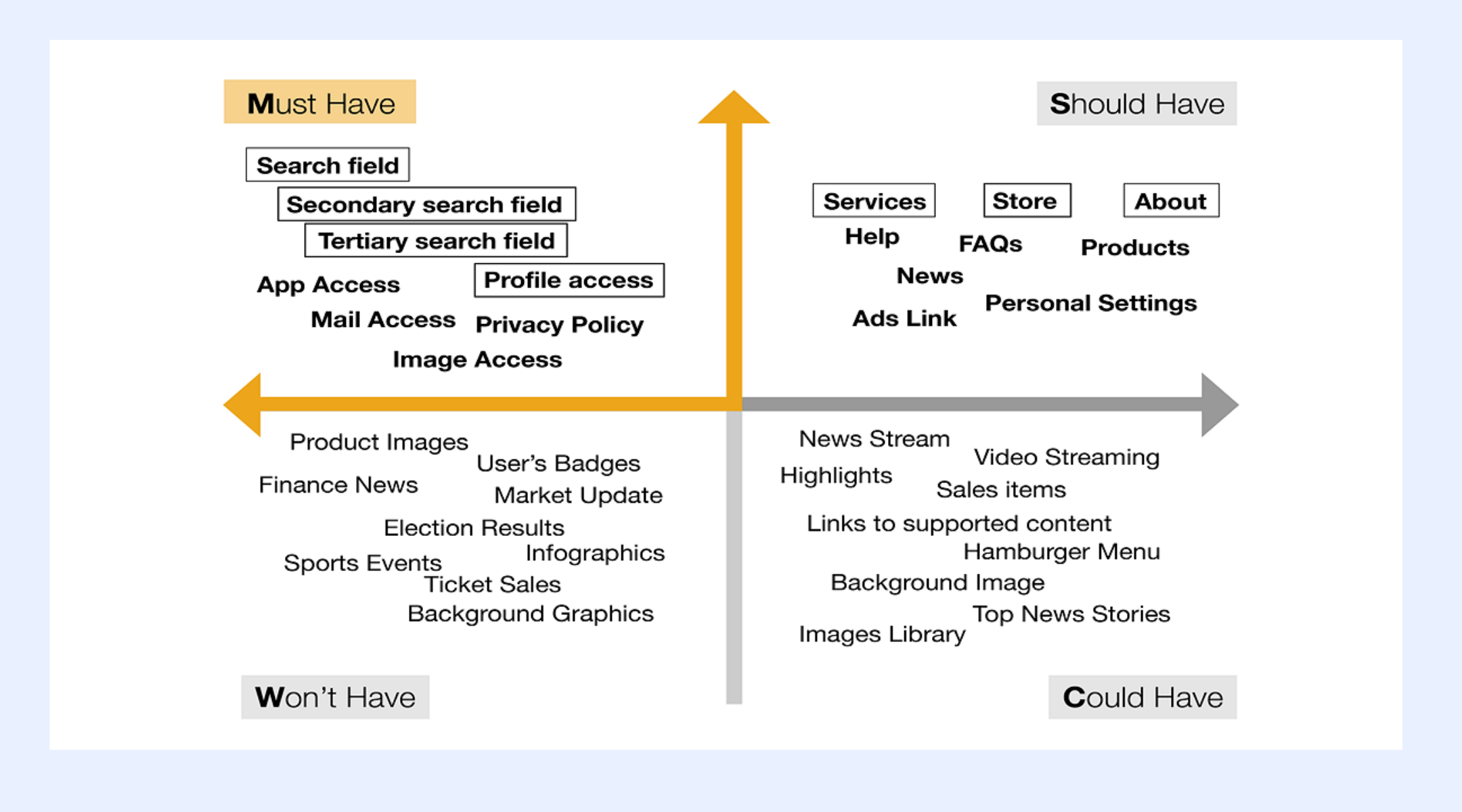
Image source: wondershare.com
Value versus effort scoring
This ranks tasks based on expected impact relative to required effort. This method supports data-driven management and encourages teams to focus on high-leverage work. It works well for product, operations, and improvement initiatives. When supported by , scoring becomes easier to revisit and adjust as assumptions change.
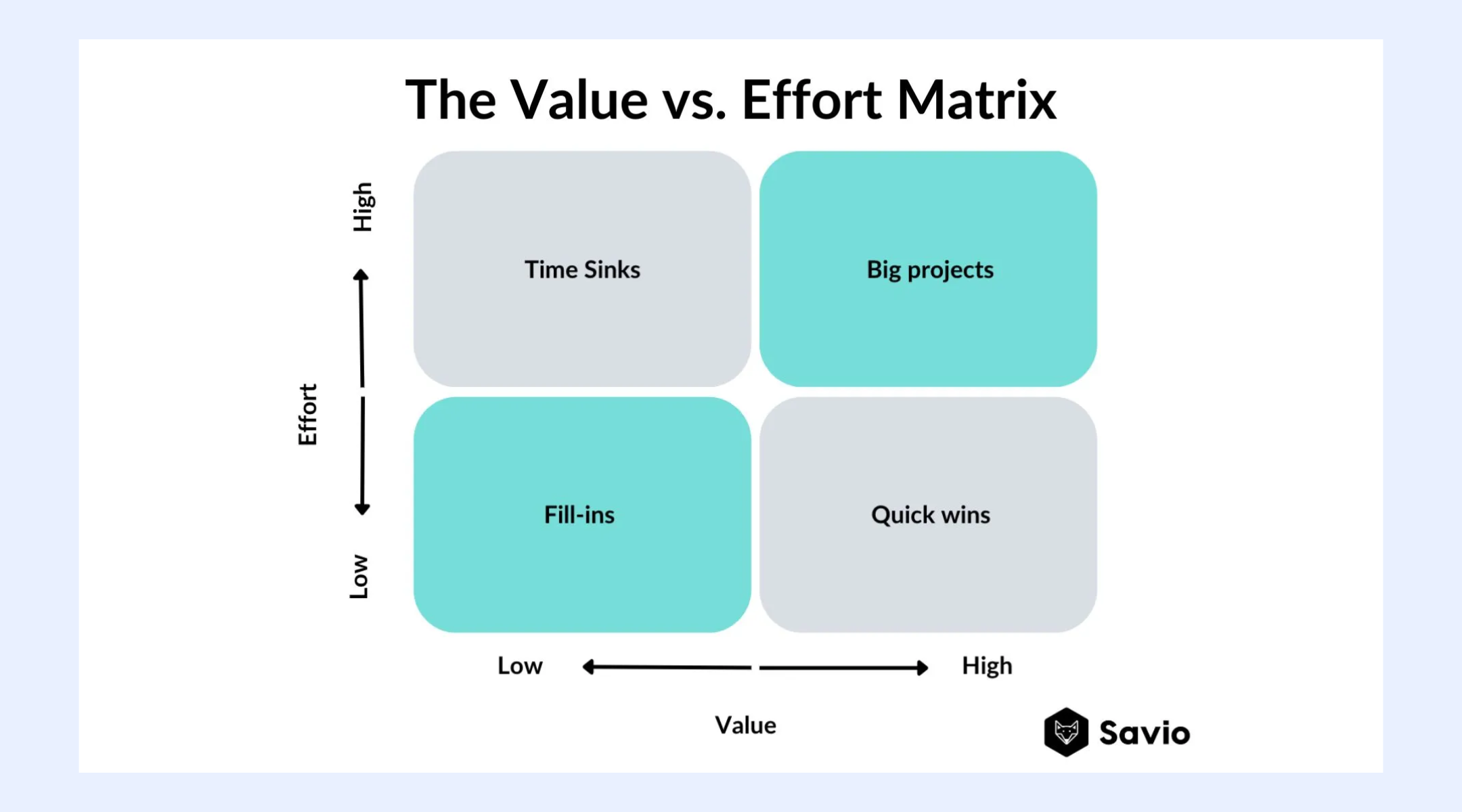
Image source: savio.io
Task prioritization matrix explained with practical examples
A task prioritization matrix is a that helps teams compare tasks using two or more criteria. Common axes include urgency versus importance, value versus effort, and impact versus risk. This approach turns subjective decisions into shared discussions. Teams can clearly see why some tasks matter more than others. As a result, task prioritization techniques become more consistent and easier to revisit.
Practical examples of using a task prioritization matrix
- planning: A marketing team uses a task prioritization matrix based on value versus effort to compare campaign optimizations, content updates, and new launches. High-value, low-effort tasks such as improving landing page copy or refining email subject lines are prioritized first. Larger launches with higher effort and uncertain impact are scheduled later or split into smaller initiatives.
- Product backlog refinement: A product team applies a task prioritization matrix using customer impact and development complexity. Bug fixes affect many users but require minimal engineering effort to rise to the top. Feature requests with high complexity and limited reach are deprioritized until capacity and clarity improve.
- Sales operations planning: A sales operations team evaluates tasks using urgency versus business impact. Updating pricing or proposal materials before a key deal closes ranks higher than long-term reporting improvements. Lower-impact administrative work is postponed when deadlines allow.
- Internal process improvement: An operations team compares improvement initiatives using impact versus risk. Process changes that reduce errors with minimal disruption are prioritized early. High-risk changes that affect multiple systems are delayed until better data and preparation are available.
- Cross-functional project coordination: A uses a task prioritization matrix based on dependency weight and stakeholder visibility. Tasks that unblock other teams or enable downstream work are prioritized first. Work with limited dependencies and lower visibility is scheduled around higher leverage priorities.
Task prioritization strategies for fast-changing work
Fast-changing environments require flexible task prioritization strategies. Traditional planning cycles struggle to keep up with shifting inputs, dependencies, and . Teams need prioritization that evolves with execution.
Effective task prioritization strategies focus on signals rather than fixed rankings. These signals may include blocked dependencies, missed deadlines, workload imbalance, or customer impact. When signals change, priorities adjust. Teams also benefit from shorter review cycles. Instead of quarterly reprioritization, they revisit priorities weekly or even daily. This approach reduces the cost of being wrong and keeps work aligned. increasingly supports these strategies by surfacing patterns and risks that humans might miss.
Task prioritization mistakes you should notice
Even experienced teams fall into common prioritization traps. These mistakes often stem from good intentions but poor execution mechanisms. Recognizing these patterns helps teams course-correct early.
- Over-prioritizing urgency over impact: Teams often respond first to the loudest request rather than the most valuable work. Urgent tasks feel safer to complete, even if their long-term impact is low. This habit leads to reactive work patterns and stalled strategic initiatives. Over time, teams feel busy but unproductive. Clear task prioritization strategies help counter this behavior. Impact-based task prioritization methods encourage teams to pause and assess value before acting.
- Treating priorities as static decisions: Many teams set priorities during planning and rarely revisit them. This assumes that conditions remain stable, which is rarely true. When new information emerges, static priorities create friction. Teams either ignore changes or quietly break the plan. Both outcomes reduce trust in prioritization. Dynamic task prioritization software supports continuous adjustment without chaos.
- Lack of ownership and visibility: Priorities lose meaning when ownership is unclear. Tasks appear important, but no one feels accountable for progress. Limited visibility worsens the issue. Team members do not see how their work affects others. Dependencies remain hidden until delays occur. Work task prioritization improves when ownership, status, and context are visible to everyone.
- Prioritization without execution tracking: Prioritization alone does not guarantee results. Without , teams cannot tell whether priorities are progressing as expected. This gap leads to false confidence. Leaders assume important work is moving forward until deadlines are missed. Connecting task prioritization tools with execution data closes this loop.
Avoid these issues in your task prioritization planning
How Lark supports dynamic task prioritization at scale
As teams grow, task prioritization becomes harder to manage with disconnected tools. Lists, chats, documents, and timelines often live in separate systems. This fragmentation makes it difficult to maintain shared priorities. addresses this challenge by connecting tasks with a real work context. Instead of forcing teams to adopt rigid frameworks, Lark supports flexible task prioritization methods that adapt to different workflows. Priorities are not isolated labels but signals tied to projects, people, and outcomes.
Unified task management hub for assignment, monitoring, & execution
In the Lark ecosystem, Lark Tasks functions as the unified . Using custom fields, you can categorize tasks by priority or risk level, which you can then use to group, sort, and filter your view in a checkbox-style interface. Capacity management is clarified through role-based views (Owned, Assigned, Subscribed), allowing leaders to see workload distribution. Finally, the native provide real-time data on execution progress, helping you detect bottlenecks and dynamically rebalance priorities to keep your team focused on the most impactful work. 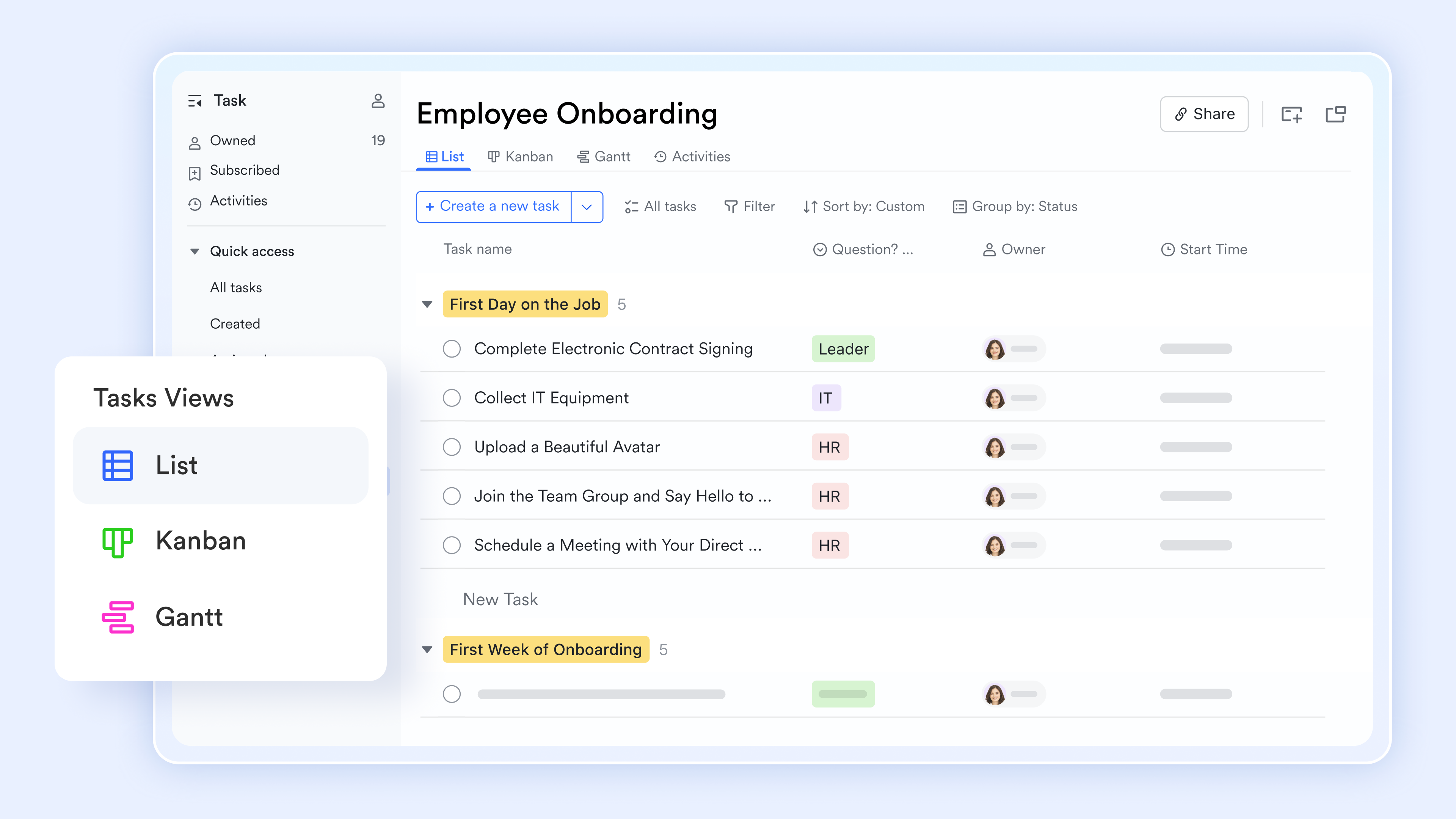
Priority changes are reflected instantly across views and teams
Lark Tasks supports multiple synchronized views of the same task data, including list view, Kanban view, and Gantt view. When a task's priority, status, or deadline changes in one view, the update is reflected everywhere in real time. This eliminates version drift, a common problem when teams maintain separate priority lists. A reprioritized task automatically reshapes project timelines, board order, and personal task lists, ensuring that everyone works from the same priority signal without manual coordination. 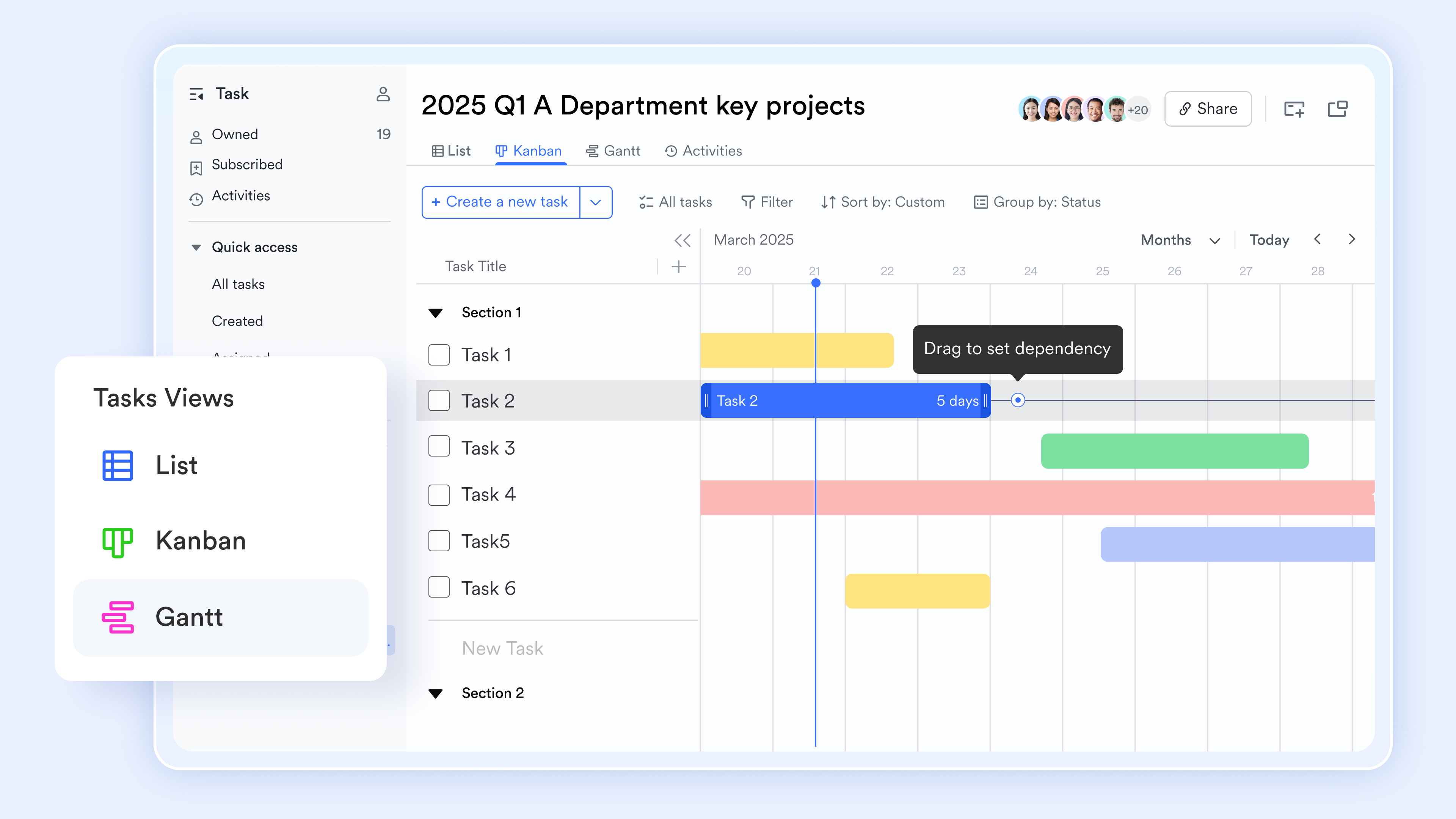
Tasks connected to real project context, not isolated lists
In Lark, tasks do not exist as standalone checklist items. Tasks can be created from your daily chat, your personal documents, email, or workflow logic in Base. Every task can be linked directly to project records in Lark Base, related documents in Lark Docs, conversations in Lark Messenger, and the timeline display in Lark Calendar. This means a task always carries its full context, objectives, dependencies, owners, and reference materials without switching For prioritization, this matters because teams don't rank tasks based only on due dates. They prioritize based on project phase, business impact, stakeholder visibility, and dependencies that are visible directly within the task itself. 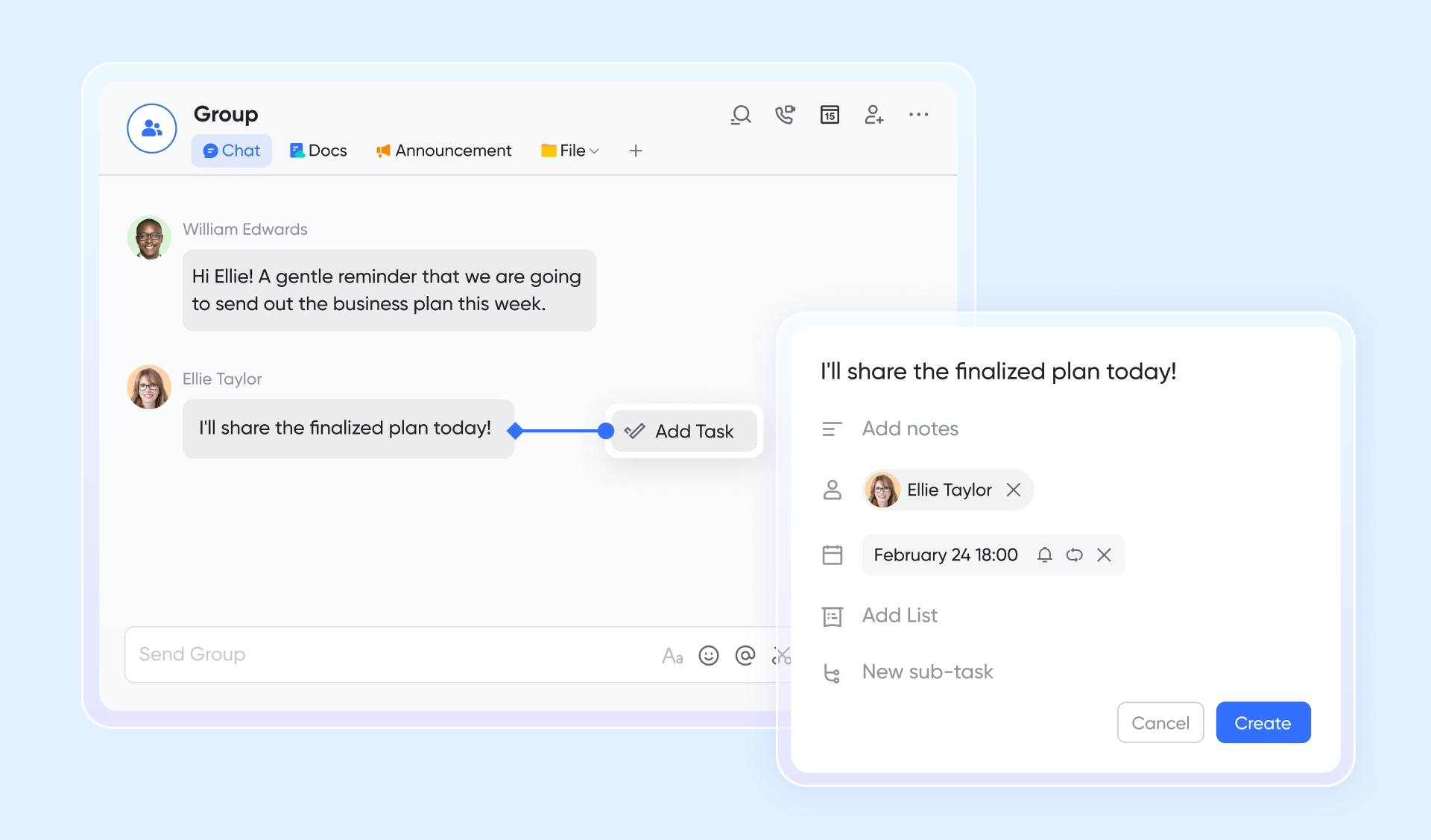
Automated workflow that reduces decision fatigue
Lark Base workflows streamline task prioritization through advanced conditional branching and IF/Else nodes that automatically route urgent items to specialized paths. This logic allows for complex multi-step processes, such as escalating overdue tasks or notifying specific stakeholders based on priority fields. The visual canvas interface makes it easy to manage these hierarchies and adjust logic as project needs evolve. By replacing multiple manual steps with , it ensures critical tasks are surfaced efficiently while staying within your annual plan's automation limits. 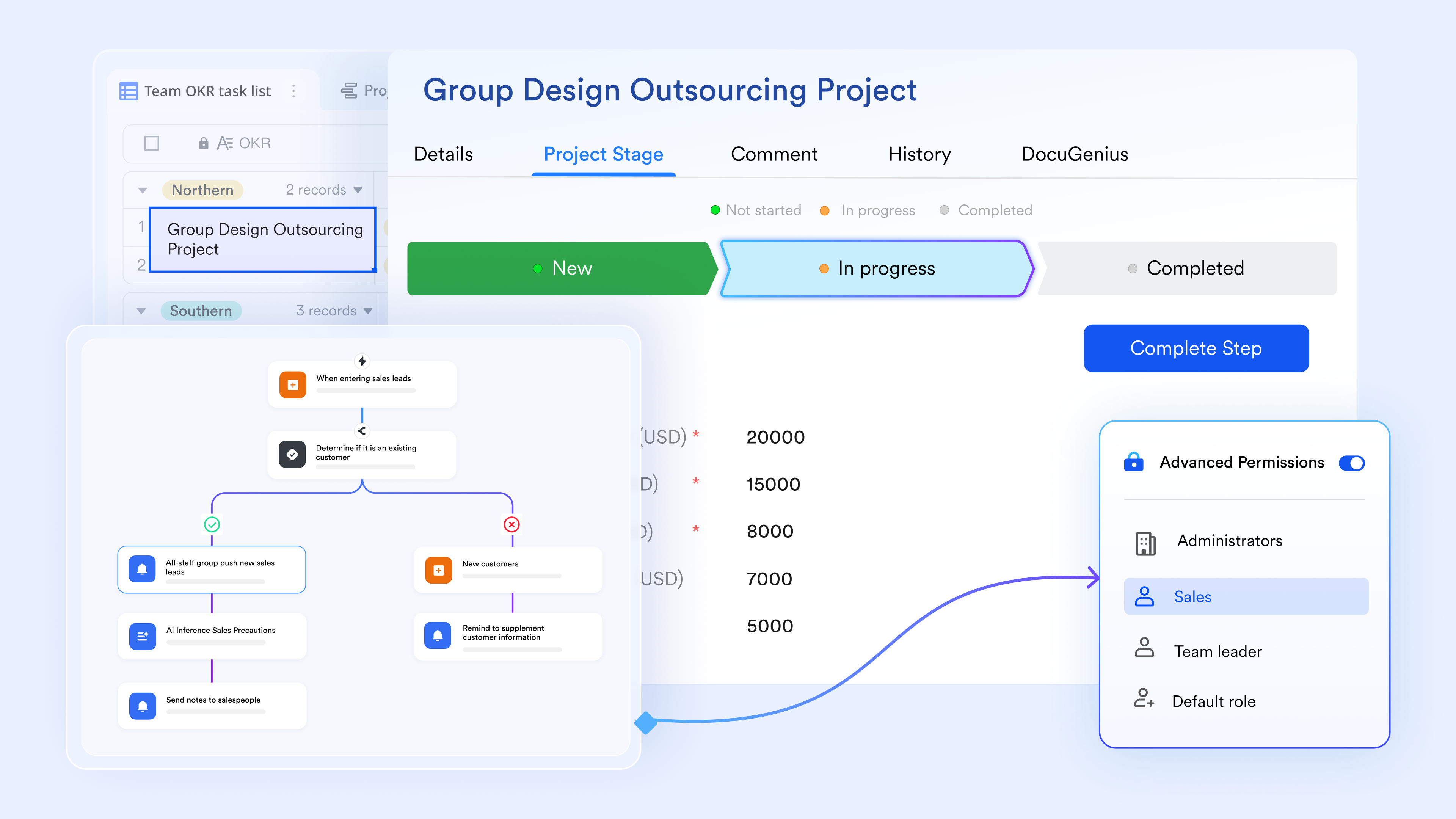
:
- Starter plan: Free forever plan that includes 11 powerful tools for up to 20 users. It also comes with 100GB of storage, 1000 automation runs, AI translations, and more.
- Pro plan: $12/user/month (billed annually) for up to 500 users. It includes everything in Starter plus group calling for up to 500 attendees, 15TB of storage, 50,000 automation runs, and more.
- Enterprise plan: for custom pricing. Supports unlimited users and includes even more automation runs and advanced security, compliance, and management features.
For small teams with simple communication needs

18 months message history
1000 Base automation runs/month
2000 rows per table in Base
Most POPULAR
For companies with comprehensive collaboration and management needs
Unlimited message history
500-participant video meetings
50k Base automation runs/month
20k rows per table in Base
For large companies with advanced security and organizational management needs
Get a personalized demo and pricing
Unlimited message history
500-participant video meetings
15 TB storage + 30 GB storage/user
500k Base automation runs/month
50k Base automation runs/month
Most POPULAR
For companies with comprehensive collaboration and management needs
Unlimited message history
500-participant video meetings
50k Base automation runs/month
20k rows per table in Base
Choosing the right task prioritization method for your team
Selecting a task prioritization approach is not about following a single framework or trend. Different teams face different levels of complexity, decision speed, and coordination needs. The most effective task prioritization methods align with how work actually flows, who makes decisions, and how often priorities change. Understanding these differences helps teams apply structure without adding unnecessary friction.
- Individual contributors vs managers vs : Individual contributors usually benefit from simple task prioritization methods that focus on personal workload, deadlines, and immediate impact. Managers need broader task prioritization techniques that highlight dependencies, capacity, and risk across people. Cross-functional teams require shared task prioritization tools that align different roles around common outcomes and reduce conflicting priorities.
- Small teams vs complex organizations: Small teams often succeed with lightweight task prioritization templates and informal discussions because communication is direct. As organizations grow, this approach breaks down. Larger and more complex teams need standardized task prioritization software to maintain consistency, visibility, and alignment across departments and projects.
- Matching prioritization methods to workflow maturity: Early-stage teams tend to experiment with basic task prioritization methods that emphasize speed and clarity. As workflows mature, teams benefit from more structured task prioritization strategies that include dependency tracking, review cycles, and automation signals. The right method evolves as the team's way of working becomes more defined.
Conclusion
Task prioritization is not about doing more work. It is about doing the right work at the right time with shared clarity. As teams grow and work becomes more interconnected, static lists and one-size-fits-all approaches fall short. Effective task prioritization strategies adapt to change, surface impact, and stay connected to execution.
Modern teams increasingly rely on task prioritization tools and software that reflect how work actually happens. Visibility, context, and adjustment matter more than rigid frameworks. adds another layer by reducing noise and highlighting risk.
Platforms like often enter the picture once teams feel the limits of manual prioritization. By connecting tasks, people, and projects, teams can move from reactive urgency to intentional focus. Over time, task prioritization becomes less about constant decision-making and more about sustained progress.
Keep your tasks organized and execute them in order
FAQs
How often should task priorities be revisited in agile teams?
benefit from frequent priority reviews, often weekly or even daily. Task prioritization methods work best when treated as living decisions. Changes in scope, dependencies, or feedback should trigger reassessment. Task prioritization software helps teams revisit priorities without disruption.
Can task prioritization reduce burnout and overload?
Yes, effective work task prioritization reduces overload by making tradeoffs visible. Teams stop trying to do everything at once. Clear priorities protect focus and energy. Over time, better task prioritization strategies support healthier workloads.
How do teams prioritize tasks when everything feels urgent?
When everything feels urgent, teams need impact-based task prioritization techniques. A task prioritization matrix helps distinguish urgency from importance. Shared criteria reduce . Task prioritization tools reinforce consistency.
What role does dependency tracking play in prioritization?
Dependencies reveal which tasks unblock others. Without dependency visibility, teams misjudge priority. Task prioritization software that tracks dependencies helps teams focus on work that enables progress. This reduces downstream delays.
How do distributed teams maintain shared priority alignment?
Distributed teams rely on shared visibility rather than constant meetings. Task prioritization tools provide a single source of truth. Clear ownership and updates keep everyone aligned. Platforms like Lark support this by connecting tasks with communication and context.
Related reading





























