Project execution is a critical phase in the project management lifecycle, where plans are put into action to achieve project goals. This stage involves a meticulous approach to coordinating resources, managing teams, and ensuring that tasks are completed on time and within budget. The ability to execute projects effectively can determine the success or failure of an organization.
Understanding the intricacies of project execution management can empower project managers and teams to navigate challenges, enhance collaboration, and drive results. This guide will explore the key components, methodologies, and best practices associated with executing projects successfully.
See how an excellent tool promotes project execution
What is project execution?
Project execution refers to the process of implementing the created during the planning stage. It is the phase where all the planning efforts are put to the test, and actual work begins. During this phase, teams outlined in the project execution plan, monitor progress, and make necessary adjustments along the way.
The project management execution phase involves various critical activities, including , team coordination, and communication with stakeholders. Unlike initiation or planning, which focus on defining objectives and strategies, the execution phase is all about action. It translates theoretical plans into tangible results.
Key objectives during the execution phase of a project include:
- Delivering project outputs as per specifications
- Ensuring efficient use of resources
- Maintaining quality and performance standards
- Keeping stakeholders informed and engaged
In summary, project execution is the heartbeat of project management, as it transforms ideas into reality and aligns efforts with strategic objectives.
Importance of project execution
The execution phase in project management plays a pivotal role in achieving overall project success. Here are several reasons why effective project execution is essential:
- Achievement of goals: A solid execution strategy ensures that the project manager and team focus on meeting objectives, making sure on time and per the project plan.
- Resource management: Effective allocation and coordination of resources—time, budget, and personnel—are vital during execution. Strong management helps prevent overruns and ensures optimal funding and staffing.
- : Maintaining open communication with stakeholders throughout the execution process fosters trust and manages expectations. Engaged stakeholders can provide valuable feedback, which is essential for addressing challenges.
- : Continuous tracking of project progress against the initial plan allows for timely adjustments. This proactive approach enhances the likelihood of successful project delivery.
- Building team morale and cohesion: Successful execution fosters team dynamics, as seeing progress boosts morale and motivation. A cohesive team can significantly improve output quality and overall performance.
Project execution is not merely a logistical step in project management; it is a crucial element that determines whether the project meets its goals. By focusing on effective project management execution strategies, organizations can improve performance, satisfy stakeholders, and achieve meaningful results.
Experience effective project execution right now
Key components of project execution
Successful project execution is rooted in several key components that work together to ensure the project's objectives are met. Understanding these components can significantly enhance the effectiveness of the execution phase of project management. Here are the critical elements of project execution:
- Project execution plan: The project execution plan serves as a roadmap for the project management execution phase, outlining how the project will be implemented. This plan includes details on scope, resources, timelines, and processes for managing risks and quality.
- Team roles and responsibilities: Clearly defining team roles is essential for ensuring accountability and collaboration. Each team member should understand their responsibilities as well as how their contributions fit into the overall project goals. The execution plan should specify who does what, creating a structured approach to .
- Resource allocation: Effective resource allocation involves assigning the right amount of people, tools, and budget to tasks without overcommitting or underutilizing resources. Proper resource management ensures that the project execution runs smoothly and adheres to its schedule.
- Monitoring and reporting: Continuous monitoring of progress is crucial to identify any deviations from the project execution plan. Regular status updates and help keep stakeholders informed and ensure that any issues are detected and addressed promptly.
- Risk management: and developing strategies to mitigate them is essential throughout the execution of the project. A proactive approach to risk management involves anticipating challenges and putting measures in place to avoid or minimize their impact.
- Stakeholder communication: Regular communication with stakeholders fosters transparency and engagement. Being proactive in conveying the project's progress and challenges helps build trust and ensures that stakeholders remain aligned with project goals.
By focusing on these key components, project managers can lead their teams effectively through the complexities of project execution.
Methodologies for effective project execution
Project execution methods and methodologies provide structured approaches that help teams navigate the complexities of a project. Choosing the right methodology can significantly impact the efficiency and effectiveness of project execution. Here's an overview of several popular methodologies:
Agile: is a flexible project management methodology that promotes iterative development and collaboration. In agile, projects are broken into smaller segments called sprints, enabling teams to adapt quickly to changes and incorporate feedback continuously. This is particularly beneficial in dynamic environments where requirements may evolve.
Scrum: Scrum is a framework under agile methodology that emphasizes teamwork and iterative progress. It organizes work into sprints and involves regular meetings, called "scrums," to discuss progress and challenges. Scrum teams often utilize boards and tools, like those available in Lark, to enhance collaboration and track progress effectively.
Learn more about Scrum 👉
Learn more about Agile 👉
Waterfall: The waterfall methodology is a linear approach where project phases flow sequentially from one to the next. Each phase must be completed before moving to the following one, making it ideal for projects with well-defined, stable requirements. However, it may lack the flexibility to adapt to changes during execution.
Learn more about Waterfall 👉
Kanban: Kanban focuses on visualizing work and managing flow. Teams use boards to represent tasks and track their status. This approach emphasizes continuous delivery and helps identify bottlenecks by allowing teams to visualize workflows and limit the amount of work in progress.
Learn more about Kanban 👉
Lean: Lean is centered on minimizing waste while maximizing value. Lean methodologies seek to streamline processes and eliminate non-value-added activities. By focusing on efficiency, teams can enhance productivity during the execution phase.
Learn more about Lean 👉
Six Sigma: This methodology aims at improving quality by minimizing defects and inconsistencies. Six Sigma uses statistical analysis and data-driven approaches to identify areas of improvement, ensuring that projects are executed with high standards.
Learn more about Six Sigma 👉
PRINCE2: PRINCE2 (Projects in Controlled Environments) is a structured project management method that provides a clear framework for project implementation. It emphasizes organization and control, making it suitable for projects that require high levels of governance.
Hybrid: As the name suggests, the hybrid methodology combines elements of agile and waterfall. This approach allows teams to choose the best aspects of each methodology to suit specific project needs. Hybrid models can enhance flexibility while maintaining structural integrity, catering to diverse project requirements.
PMBOK: The Project Management Body of Knowledge (PMBOK) provides guidelines and best practices for project management. While not a methodology per se, PMBOK encompasses various aspects of project execution, such as scope, time, cost, and , offering essential tools for project managers.
By selecting the appropriate methodology or combination of methodologies for project execution, organizations can optimize their strategies for managing tasks and resources, ensuring that they not only meet project goals but also achieve high levels of efficiency.
Apply these methodologies with a powerful tool
Strategies for successful project execution
Effective strategies are essential for ensuring a successful project execution. Employing a well-rounded approach can significantly improve a project team's ability to deliver on time and meet quality expectations. Here are several key strategies that enhance the effectiveness of project execution.
Strategy 1: Develop a clear project execution plan
A detailed project execution plan serves as the foundation for all project activities. It should include specific goals, tasks, timelines, resources, and . Effective planning allows the team to understand their responsibilities and how those fit into the broader project objectives.
Strategy 2: Ensure effective communication
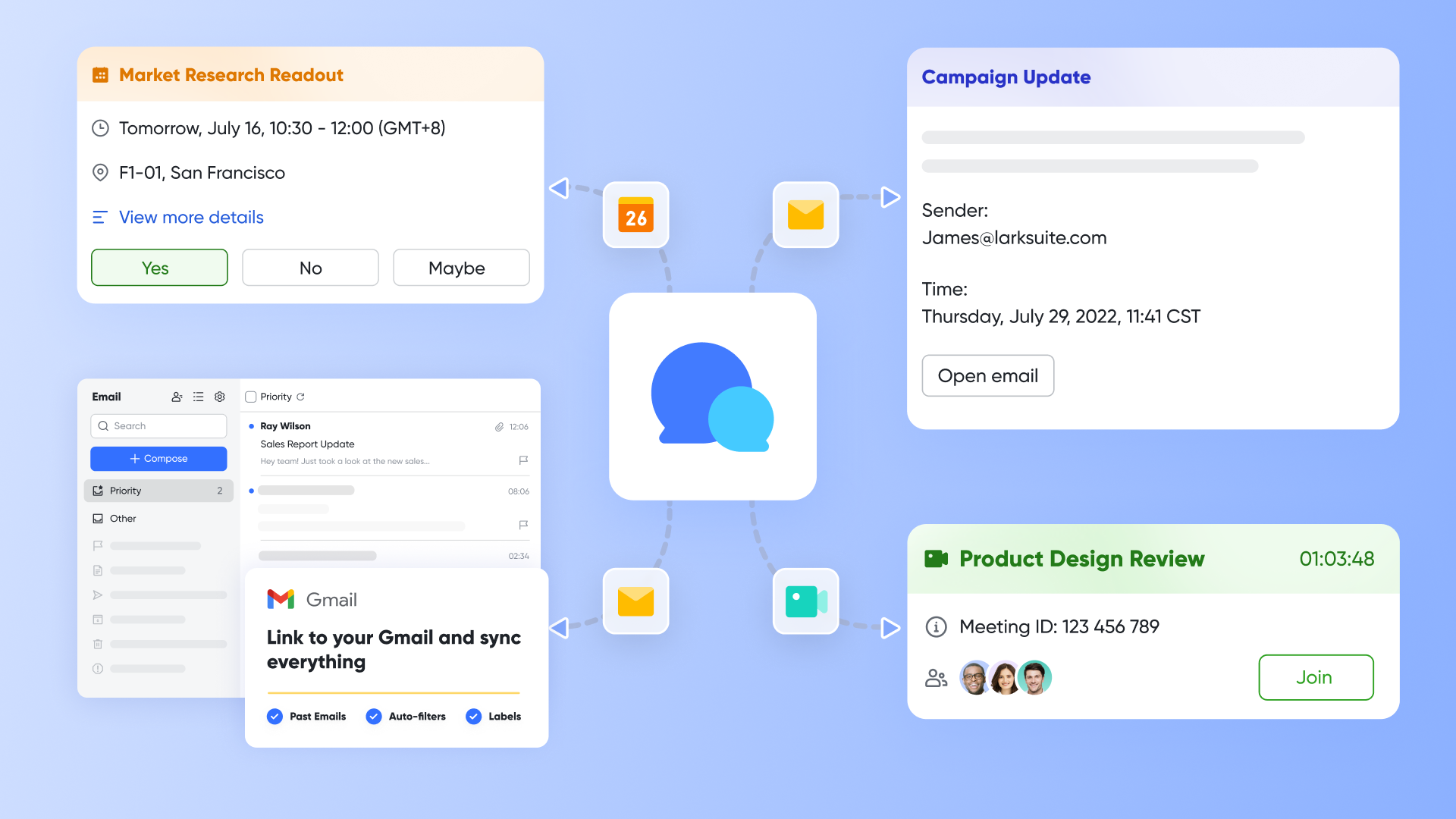
Communication is the cornerstone of project execution. for team members and stakeholders. Regular check-ins—whether daily stand-ups or weekly progress reports—allow teams to align on objectives, discuss roadblocks, and celebrate progress. What deserves specially mentioning is Lark's unified communication features, such as and , can help maintain open lines of dialogue, ensuring everyone is on the same page.
Strategy 3: Establish measurable KPIs
should be established before the execution phase begins. These metrics will help track progress against goals. KPIs should be specific, measurable, achievable, relevant, and time-bound (SMART). Regularly measuring these indicators allows for timely evaluations and course corrections as necessary. Features like Lark OKR can help you track KPI effectively.
Strategy 4: Foster a collaborative team environment
A collaborative team atmosphere empowers members to contribute ideas and solutions, leading to higher productivity and creativity. Encourage collaboration by setting up shared workspaces, such as project boards and repositories enable seamless .
Strategy 5: Utilize agile methodology
allows teams to be flexible and responsive during project execution. Agile emphasizes iterative progress, allowing for quick adjustments based on feedback and changing requirements. This strategy is especially beneficial in rapidly evolving industries where adaptability is key. Implementing agile principles can help teams maintain a focus on delivering value incrementally while learning from each iteration.
Strategy 6: Implement risk management practices
should be an ongoing process throughout the execution phase. Identifying potential risks early and developing mitigation plans allows teams to address challenges before they escalate. Regularly revisiting the risk management framework ensures that new risks are identified and that strategies are updated. Tools like Lark provide multiple risk management templates, enhancing transparency and accountability.
Strategy 7: Encourage continuous learning and feedback
Establish a culture that values continuous improvement through feedback. Encourage team members to reflect on their experiences and share lessons learned. Holding retrospective meetings after significant milestones allows for critical analysis of what worked and what didn't. The insights gathered can inform future project executions, fostering a culture of growth and adaptability.
Strategy 8: Adapt to stakeholder feedback
Engaging with stakeholders during execution allows project teams to align project outcomes with stakeholder expectations. Regular status updates should be shared, and mechanisms should be established for stakeholders to provide feedback. This ongoing communication can lead to improved satisfaction and better alignment with project goals.
Strategy 9: Maintain flexibility
While having a structured plan is vital, being flexible is equally important. Projects often encounter unexpected changes, such as or resource availability. Team members should be encouraged to think creatively and adapt their approaches as necessary to meet project goals without compromising quality.
By employing these strategies during the project execution phase, project managers can create a structured yet adaptable framework that enhances the team's ability to deliver successful outcomes. This proactive approach not only addresses challenges effectively but also fosters collaboration and encourages continuous improvement.
Implement these proven strategies for project execution
How to manage project execution effectively with Lark
Effective project execution demands real-time visibility, seamless collaboration, and structured processes to maintain momentum. can not only help you achieve successful project execution with above strategies, but also provide specific solutions to transform daily management from a reactive chore into a . Here's how its core functionalities drive successful execution.
Gain a real-time view of project health
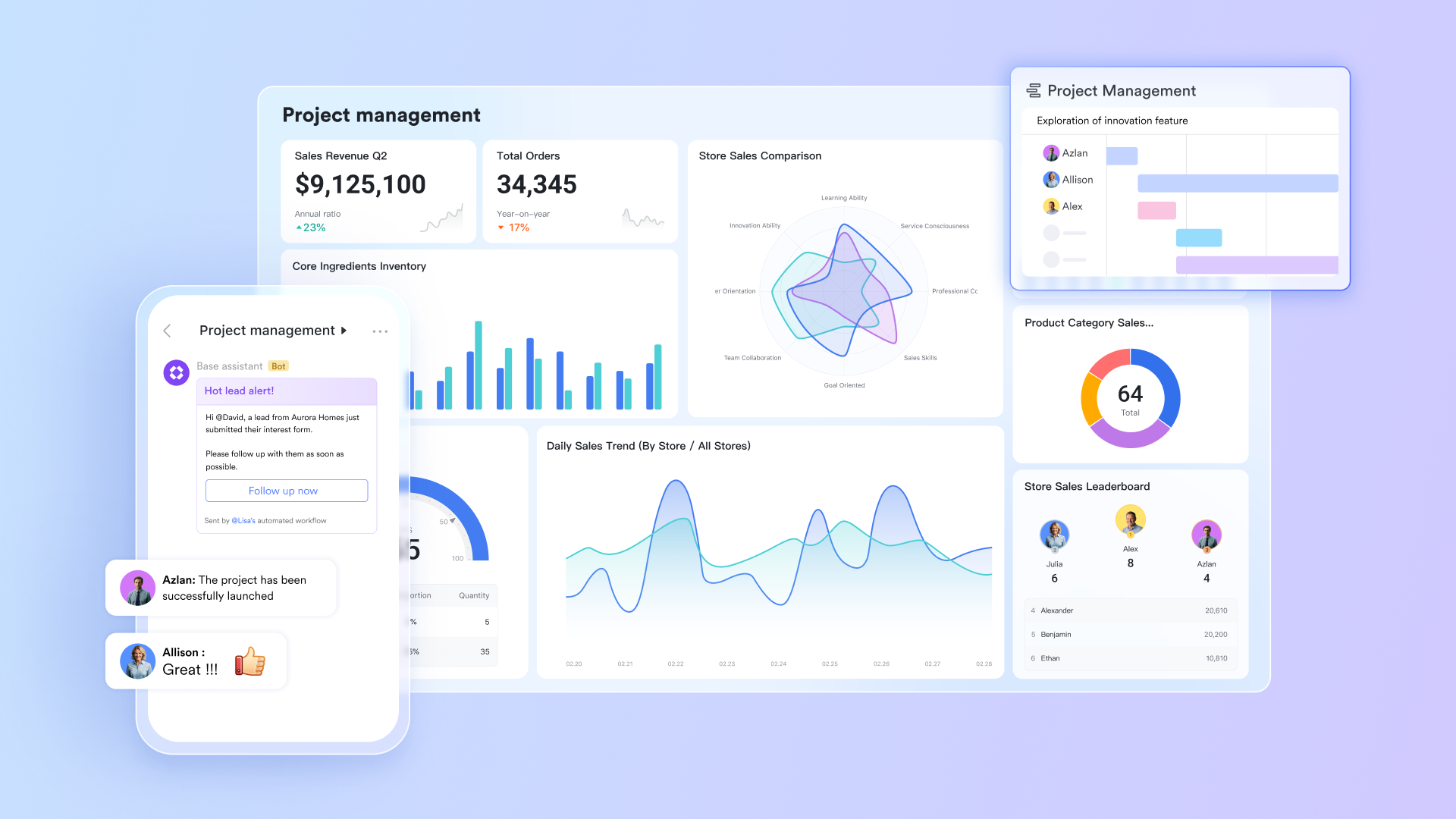
Micromanaging tasks is inefficient, but losing oversight is risky. strikes the perfect balance through customizable fields and powerful views, enabling you to build a tailored project monitoring system.
Core fields for execution control: Beyond basic task names, you can define fields critical for monitoring: Status (Not Started, In Progress, Blocked, Done), Priority (High, Medium, Low), Percent Complete, Owner, Due Date, and a Milestone field to group key deliverables. This structured data is the foundation for all insights. Multi-perspective views for instant insight: The magic lies in viewing the same dataset through different lenses tailored to various needs. The Kanban view, grouped by the Status field, gives a crystal-clear picture of workflow bottlenecks. The Gantt view, linked to Due Date and task dependencies, provides an intuitive timeline to track schedule adherence and critical path. The Calendar view shows deadlines at a glance, while a Gallery view can be used to showcase design assets alongside their review status. 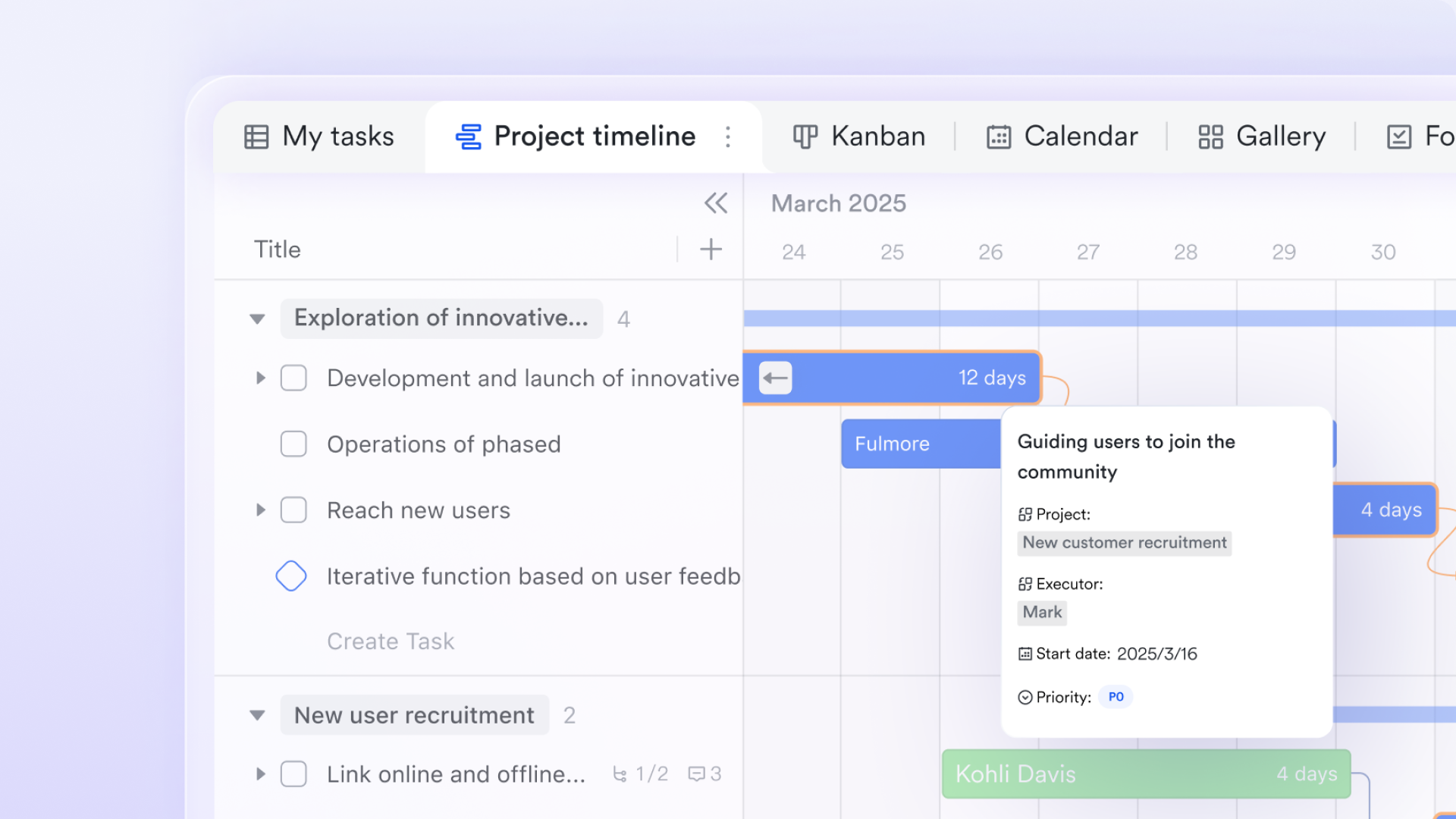
Automated monitoring with rules: To move from passive tracking to active management, you can set automation rules. For example, you can create a rule: "When a task's Due Date is within 2 days and its Status is not 'Done,' automatically send a reminder to the Owner and post an update in the project chat." This turns your Base from a static tracker into an intelligent monitor that surfaces risks proactively. 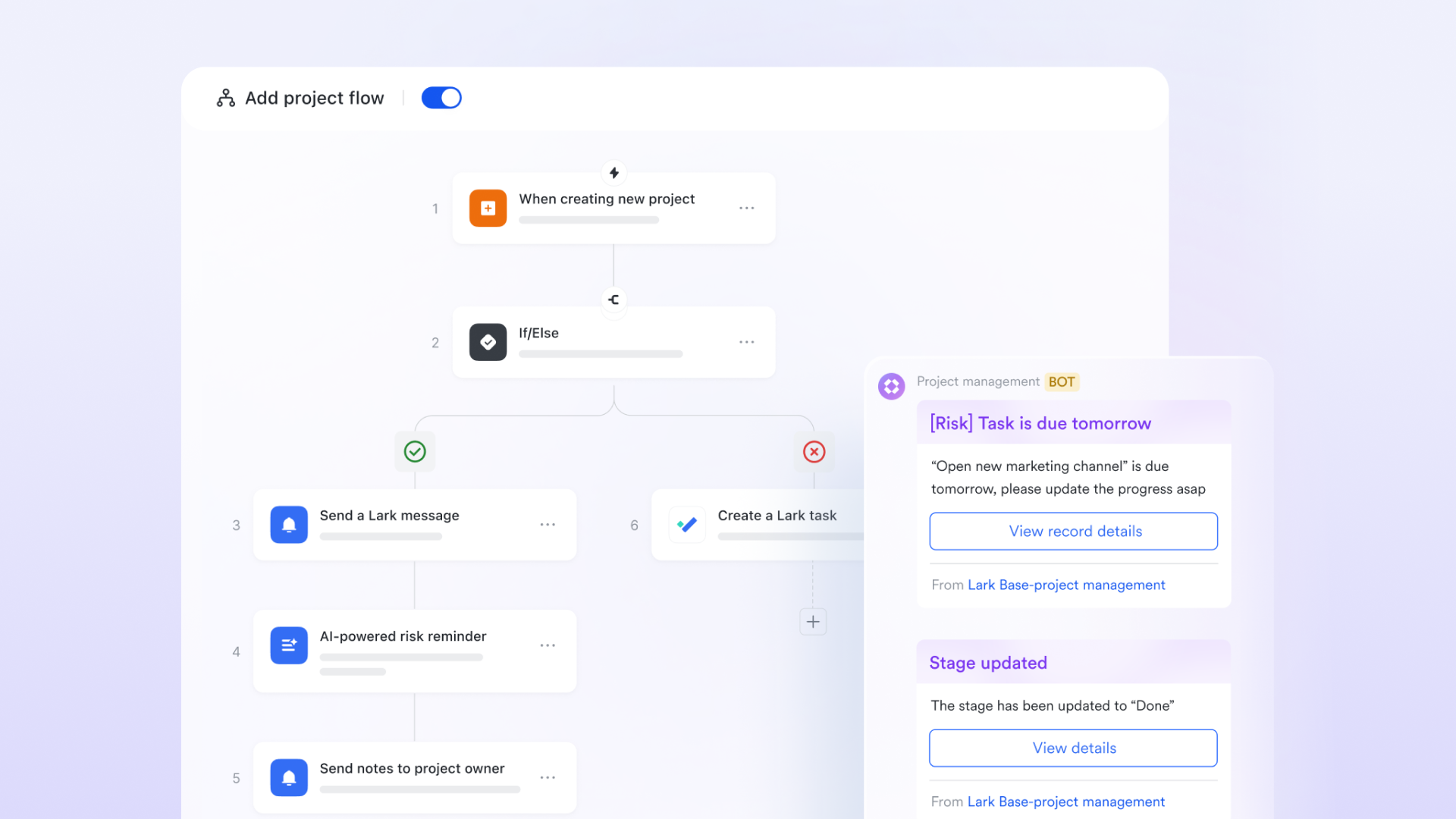
Build dynamic monitoring dashboards: Lark Base dashboards transform project monitoring from reliance on periodic reports to real-time visual oversight. It aggregates multi-dimensional data to generate key metric views in real time, such as task completion rates, delay alerts, and resource utilization. This allows managers to grasp the overall project health at a glance and instantly identify execution bottlenecks and risks, ensuring the process remains controlled. 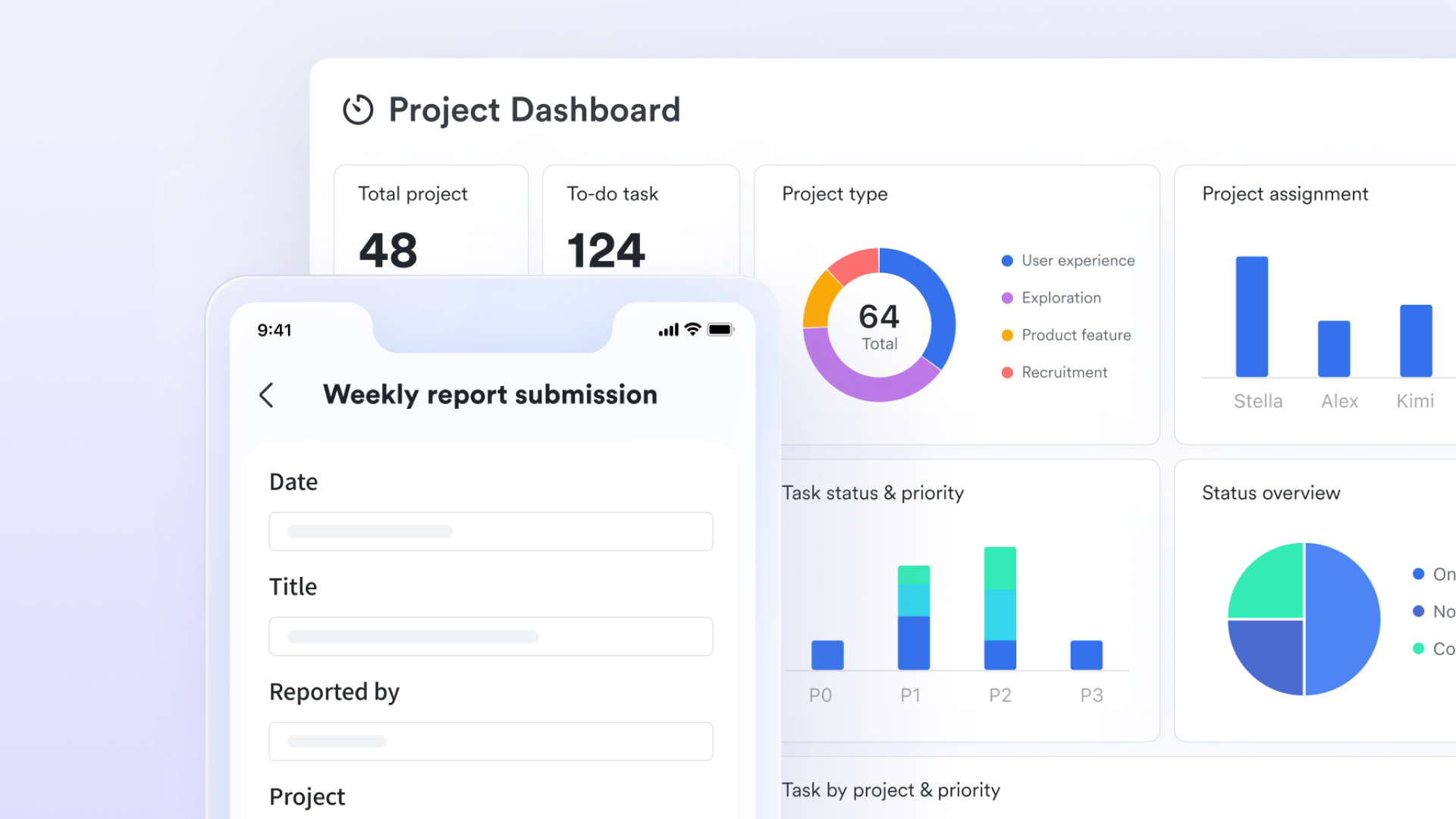
Seamlessly collaborate with external partners
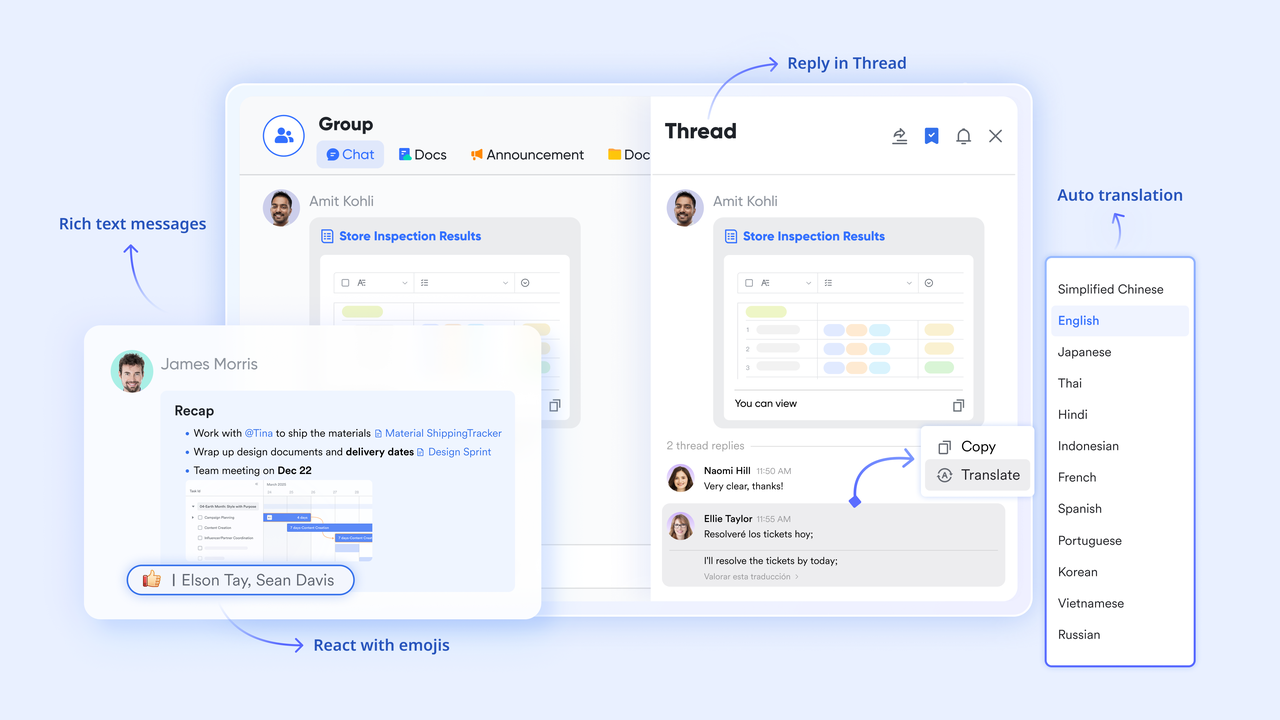
To maintain execution velocity, seamless information flow with clients and vendors is critical. When a client's crucial update arrives via , it can be forwarded directly into the relevant project group chat with one click. This instantly aligns the entire internal team on the external request, allowing for immediate discussion, task assignment, and decision-making within the chat thread, eliminating silos and delays.
Clear communication is the bedrock of execution, especially with global partners. facilitates this with built-in real-time translation during chats. Team members and external contractors can each type in their native language; messages are automatically translated, ensuring urgent queries are understood accurately by all parties. This prevents costly misunderstandings and keeps collaborative work moving forward smoothly, without the friction of language delays.
Align execution consensus with a centralized document hub
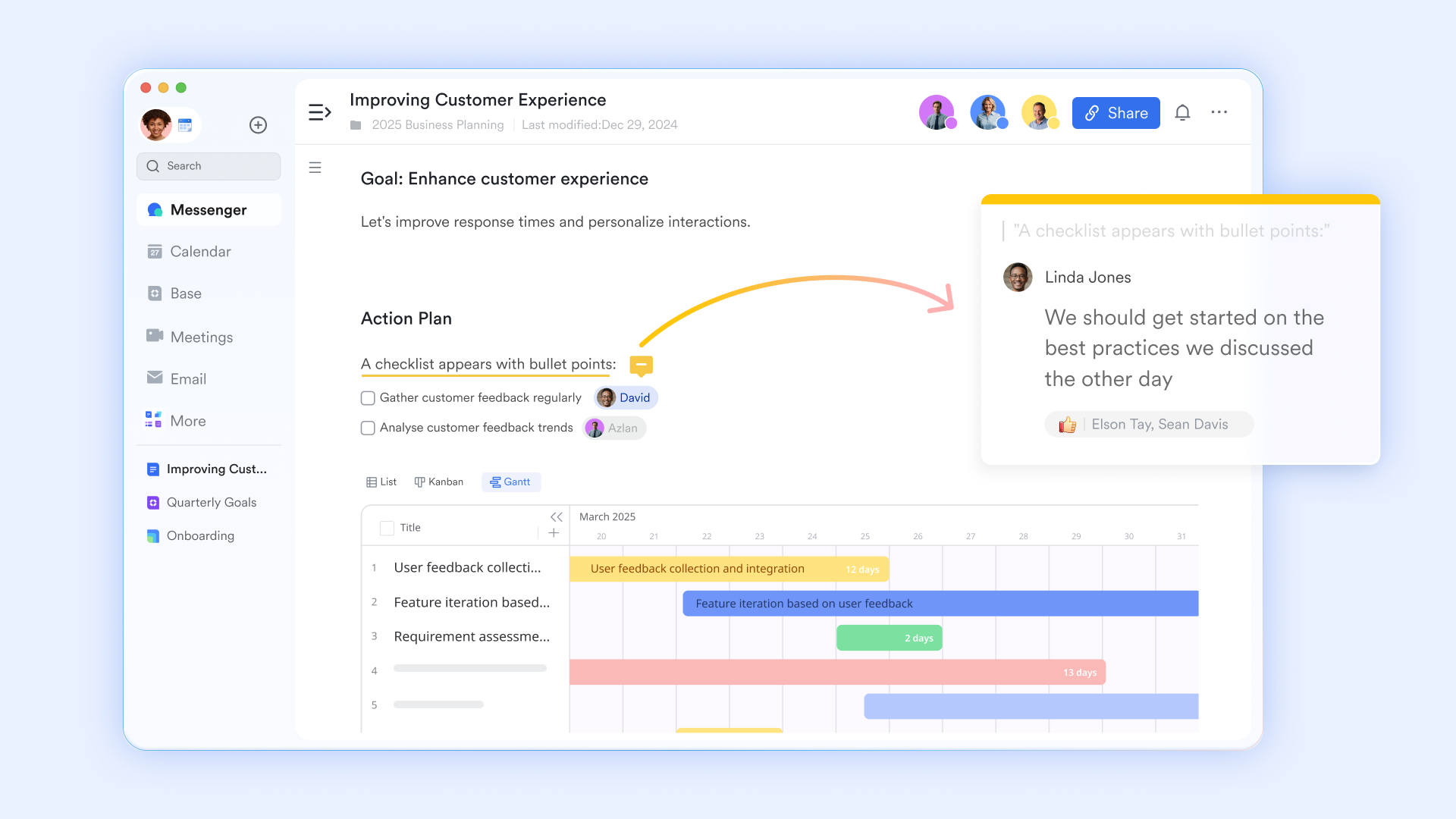
Clear, accessible information is the oxygen of execution. Confusion over the latest requirements or decisions can derail even the best-laid plans. serves as the single source of truth for all project artifacts. Instead of scattering briefs, specs, and meeting notes across drives and emails, teams co-edit living documents in one place.
Utilizing features like clear table of contents, comment threads on specific paragraphs, and @mentions to assign feedback, everyone works from the same page—literally. This ensures that when a developer is implementing a feature or a marketer is drafting a launch plan, they are always referencing the most current, approved information, eliminating costly rework due to misalignment.
Drive action from every meeting with structured outcomes
Meetings are essential for execution but often become time sinks with vague outcomes. The practice of using a shared Doc as the meeting agenda ensures focus. During the meeting, the real-time transcription and automatically highlight key discussion points and, most importantly, detect action items.
With one click, these detected action items can be converted into tracked Tasks with a designated owner and deadline, which can be posted to the relevant chat group. This creates a closed loop from discussion to delegated responsibility, ensuring no decision or "to-do" falls through the cracks after the call ends. 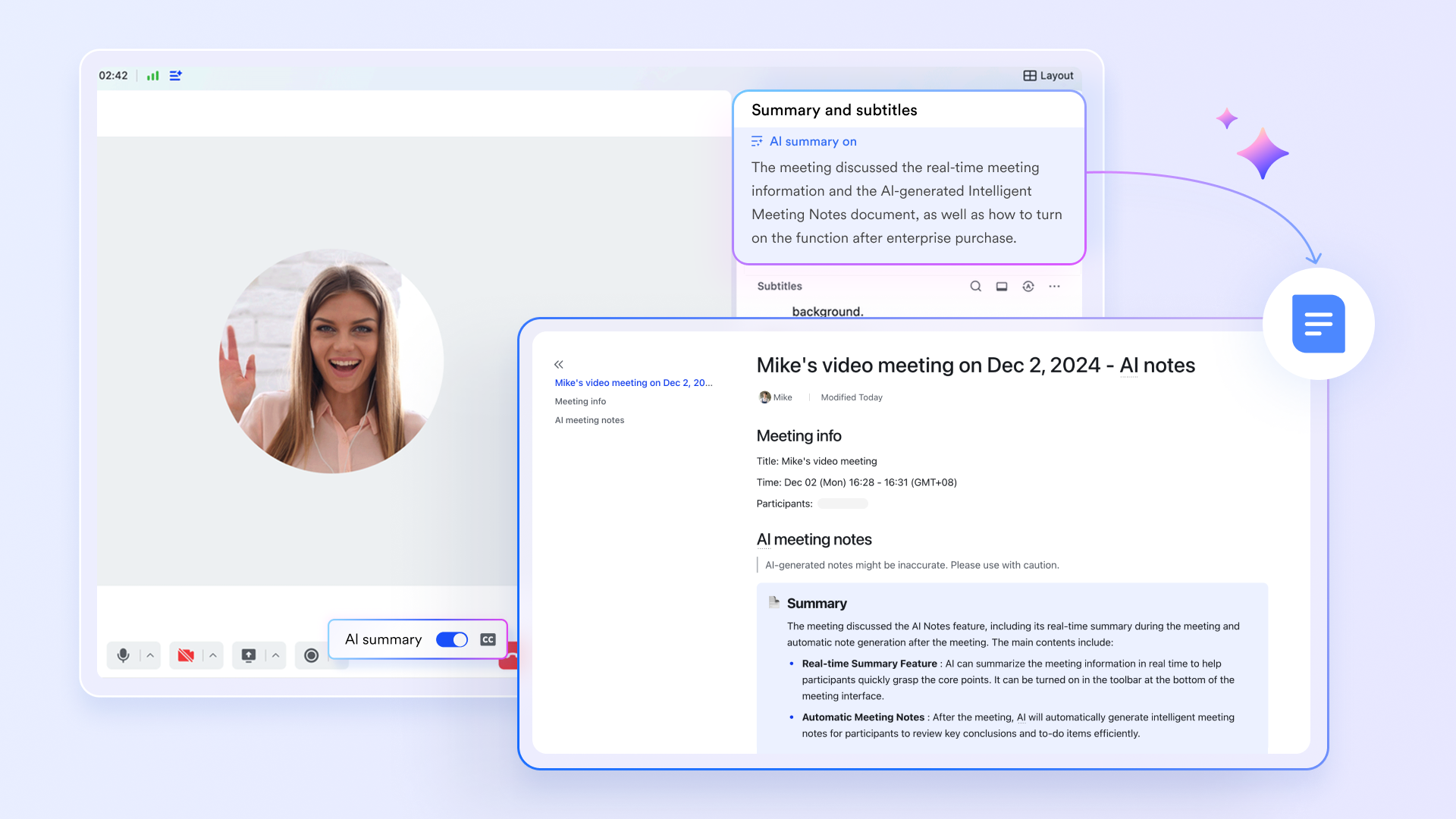
Here is Lark's detailed pricing plans:
- Starter plan: Free forever plan that includes 11 powerful tools for up to 20 users. It also includes 100GB of storage, 1,000 automation runs, AI translations, and more.
- Pro plan: $12/user/month (billed annually) for up to 500 users. It includes everything in Starter, plus group calling for up to 500 attendees, 15 TB of storage, 50,000 automation runs, and more.
- Enterprise plan: for custom pricing. Supports unlimited users and includes even more automation runs and advanced security, compliance, and management features.
For small teams with simple communication needs

18 months message history
1000 Base automation runs/month
2000 rows per table in Base
Most POPULAR
For companies with comprehensive collaboration and management needs
Unlimited message history
500-participant video meetings
50k Base automation runs/month
20k rows per table in Base
For large companies with advanced security and organizational management needs
Get a personalized demo and pricing
Unlimited message history
500-participant video meetings
15 TB storage + 30 GB storage/user
500k Base automation runs/month
50k Base automation runs/month
Most POPULAR
For companies with comprehensive collaboration and management needs
Unlimited message history
500-participant video meetings
50k Base automation runs/month
20k rows per table in Base
Challenges faced during project execution
Despite careful planning and organization, numerous challenges can arise during the execution phase of a project. Understanding these challenges can help project managers prepare and adapt effectively. Some common challenges include:
- Scope creep: This occurs when additional tasks or features are added without corresponding adjustments to resources, timelines, or budgets. To manage scope creep, it is essential to have a clear project scope and communicate any changes effectively to all stakeholders.
- Resource allocation issues: Insufficient resources can lead to delays and affect the quality of deliverables. Conversely, over-allocation can exhaust team members and lead to burnout. This requires careful monitoring and adjustment throughout the execution phase.
- Budget overruns: A lack of meticulous can result in overspending, affecting project profitability. Project managers must continuously track expenses and make adjustments to stay within the budget.
- Communication breakdowns: Ineffective communication can result in misunderstandings and misaligned efforts among team members. Implementing and tools is vital to ensure everyone is aligned with the project's objectives.
Overcoming challenges during project execution requires a proactive approach. Tools like can facilitate better communication, real-time collaboration, and , making it easier for teams to adapt and respond to issues as they arise. By leveraging such technologies, project managers can enhance their ability to navigate the complexities of project execution successfully.
Avoid common execution challenges with Lark
Best practices for project execution
To complement the strategies for successful project execution, implementing best practices can further enhance efficiency and outcomes. Here are some recommended best practices:
- : Ensure that timelines for deliverables are realistic and achievable. Involving the team in the planning process can give a better understanding of what is achievable within the given timeframe.
- Maintain flexibility: While having a solid project execution plan is essential, being adaptable to changes is equally important. Projects often encounter unexpected issues that require revised plans. Embracing change and being willing to pivot as necessary can lead to better outcomes.
- Conduct regular progress reviews: Periodically review the project's status against the execution plan. These reviews can help identify potential roadblocks early, allowing teams to address issues before they escalate. By using project management features within , teams can facilitate these reviews efficiently.
- Celebrate milestones: Recognizing and celebrating milestones reinforces team cohesion and morale. Acknowledging achievements can motivate team members and create a positive atmosphere throughout the project execution phase.
- : Keeping thorough documentation ensures that all aspects of the project are recorded. This helps in tracking progress and serves as a reference for future projects. Utilizing collaborative can streamline this process.
- Encourage open feedback culture: Foster an environment where team members feel comfortable providing feedback and suggesting improvements. This openness can lead to innovative solutions and enhance team dynamics.
By implementing these best practices into project execution, teams can enhance their overall performance, improve collaboration, and drive project success. Staying committed to these practices allows teams to navigate the complexities of project execution while adapting to evolving needs.
Conclusion
Effective project execution is crucial for achieving successful outcomes, and leveraging the right tools can make a significant difference. Lark offers a comprehensive suite of features that enhance communication, collaboration, and task management, empowering teams to navigate the complexities of project execution with ease. By adopting Lark, you can streamline your workflows, improve team dynamics, and drive your projects to successful completion. Start using today to transform your project execution process!
Elevate your project execution to the next level
FAQs
What are the 5 stages of project execution?
The five stages of project execution typically include: 1) Initiation – defining the project; 2) Planning – outlining scope, resources, and timelines; 3) Execution – implementing the project plan; 4) Monitoring and Controlling – tracking progress and making adjustments; 5) Closure – finalizing the project and reviewing outcomes. Using tools like Lark during these stages can enhance collaboration and streamline processes.
Is project execution a skill?
Yes, project execution is a crucial skill that involves coordinating resources, managing teams, and ensuring tasks are completed on time and within budget. Strong organizational, communication, and problem-solving skills are essential for effective project execution, and platforms like Lark can help enhance these skills through improved collaboration and task management.
What is an example of the project execution phase?
An example of the project execution phase could be a team launching a new marketing campaign. This involves executing the marketing plan, coordinating team efforts, creating campaign materials, and monitoring progress. Utilizing Lark helps facilitate real-time collaboration, track tasks, and manage communications effectively throughout this phase.
What is a project execution strategy?
A project execution strategy outlines the approach and methods that will be used to implement the project plan successfully. It includes resource allocation, scheduling, risk management, and communication plans. By utilizing tools like Lark, teams can enhance their execution strategy by ensuring transparency, facilitating collaboration, and providing easy access to necessary documents and updates.
Related reading