


17 Best Contract Lifecycle Management Software

Ryan Tanner
Product Marketing Specialist
Aug 5, 2026
Ryan Tanner
Aug 5, 2026


Key takeaways: Top 5 software for contractor project management
Overview of the 5 best platforms for contract lifecycle management

What is contract lifecycle management software?
Top 17 tools people use for contract lifecycle management
1. Lark: A collaboration platform supporting flexible contract management
- It breaks down silos by allowing teams to draft, discuss, and redline contracts in real-time within a single, integrated workspace.
- Granular access controls ensure that sensitive financial terms are only visible to authorized personnel while keeping the broader team informed.
- You can store pre-approved "Standard Clauses" on a Wiki that the sales team can easily search and copy into their drafts.
- Beginners may find that using advanced features takes time. However, Lark Help Center provides step-by-step guides.
- Starter plan: Free forever plan that includes 11 powerful tools for up to 20 users. It also includes 100GB of storage, 1,000 automation runs, AI translations, and more.
- Basic plan: $6/user/month (billed annually) for up to 500 users. It includes everything in Starter plus group calling for up to 500 attendees, 5TB of storage, 1000 automation runs, and more. For more details, please contact sales.
- Pro plan: $12/user/month (billed annually) for up to 500 users. It includes everything in Basic, plus group calling for up to 500 attendees, 15 TB of storage, 50,000 automation runs, and more.
- Enterprise plan: Contact sales for custom pricing. Supports unlimited users and includes even more automation runs and advanced security, compliance, and management features.
Starter
For small teams with simple communication needs
$0
/ user / month

Pro
For companies with comprehensive collaboration and management needs
$12
/ user / month
Enterprise
For large companies with advanced security and organizational management needs
Get a personalized demo and pricing
Pro
For companies with comprehensive collaboration and management needs
$12
/ user / month
2. DocuSign CLM: Enterprise-grade contract automation platform
- Automates contract creation, negotiation, approval, and signature workflows with configurable templates, clause libraries, and enterprise-grade security controls.
- Built-in AI insights analyze contract data, highlight risks, and surface key terms to accelerate reviews and improve decision-making.
- Advanced reporting dashboards provide visibility into contract performance, bottlenecks, obligations, and renewal timelines across departments and regions.
- Deep integrations with CRM, ERP, and procurement tools centralize contract data and synchronize workflows across sales, finance, and legal teams.
- Robust compliance, audit trails, and security features make it highly suitable for regulated industries and global enterprise environments.
- An extensive integration ecosystem seamlessly connects with major business platforms such as Salesforce, SAP, Microsoft, and other enterprise systems.
- Scales effectively for organizations managing high volumes of complex contracts across multiple departments, geographies, and regulatory requirements.
- Higher pricing tiers and licensing complexity may be challenging for small or mid-sized organizations with limited budgets.
- Implementation, customization, and integration often require dedicated IT resources or professional services for optimal performance and adoption.
- Personal plan: $10 per user per month (billed annually).
- Standard plan: $25 per user per month (billed annually).
- Business pro plan: $40 per user per month (billed annually).
- Enhanced plan: Custom pricing.
3. Ironclad: Digital contracting platform for legal teams
- The collaborative contract editor enables legal and business teams to draft, comment on, and redline agreements in real time.
- AI-powered contract review highlights risky clauses, missing terms, and deviations from standard legal language.
- Automated approval workflows route contracts to appropriate stakeholders based on rules, values, and contract types.
- A central contract repository provides searchable storage, reporting dashboards, and lifecycle tracking for all agreements.
- Intuitive interface designed for both legal and business users, reducing reliance on manual email-based contract processes.
- Strong workflow automation helps accelerate deal cycles while maintaining legal review and compliance standards.
- Scalable architecture supports growing contract volumes across multiple departments and business units.
- The pricing structure may be better suited to mid-sized and enterprise organizations than to smaller teams.
- Advanced configuration and integrations may require implementation support for complex enterprise environments.
- The app provides quote-based pricing based on requirements and size.
4. Icertis: Global enterprise contract intelligence platform
- AI-powered clause analysis automatically reviews contracts, identifies risks, and ensures alignment with corporate standards and regulatory requirements.
- The global contract repository supports multilingual, multicurrency, and region-specific compliance across complex international business operations.
- Advanced workflow automation manages approvals, negotiations, and obligation tracking across procurement, sales, legal, and finance teams.
- Deep integrations with ERP, CRM, and supply chain platforms provide end-to-end visibility into contract-driven business processes.
- Highly scalable architecture designed for large enterprises managing complex, high-volume contracts across multiple regions and regulatory frameworks.
- Strong AI and analytics capabilities provide deep insights into contract risks, obligations, and performance trends.
- Extensive integration options connect seamlessly with major enterprise systems like SAP, Oracle, and Microsoft platforms.
- Implementation can be complex and time-consuming due to extensive configuration and enterprise-level customization requirements.
- Pricing and deployment models may be less suitable for small or mid-sized organizations with simpler contract needs.
- The app provides quote-based pricing based on requirements and size.
5. Conga: Revenue-driven contract management software
- End-to-end quote-to-cash automation connects contract creation, pricing, approvals, and billing within a unified revenue management workflow.
- AI-powered contract analytics identify risks, highlight key clauses, and provide insights into revenue-impacting contract terms.
- Deep Salesforce integration synchronizes contract data with CRM records, improving visibility across sales, legal, and finance teams.
- Automated approval workflows route contracts based on deal size, discount thresholds, or compliance requirements across departments.
- Strong alignment with revenue operations accelerates deal cycles and improves contract-to-cash efficiency.
- Native Salesforce integration provides seamless data synchronization for organizations already using the CRM ecosystem.
- Scalable platform supports complex pricing models, approvals, and high contract volumes across enterprise sales teams.
- Best suited for Salesforce-centric organizations, with less value for companies using other CRM ecosystems.
- Implementation and customization may require technical resources, especially for complex quote-to-cash configurations.
- The app provides quote-based pricing based on requirements and size.
6. SpotDraft: AI-powered contract lifecycle management for modern legal teams
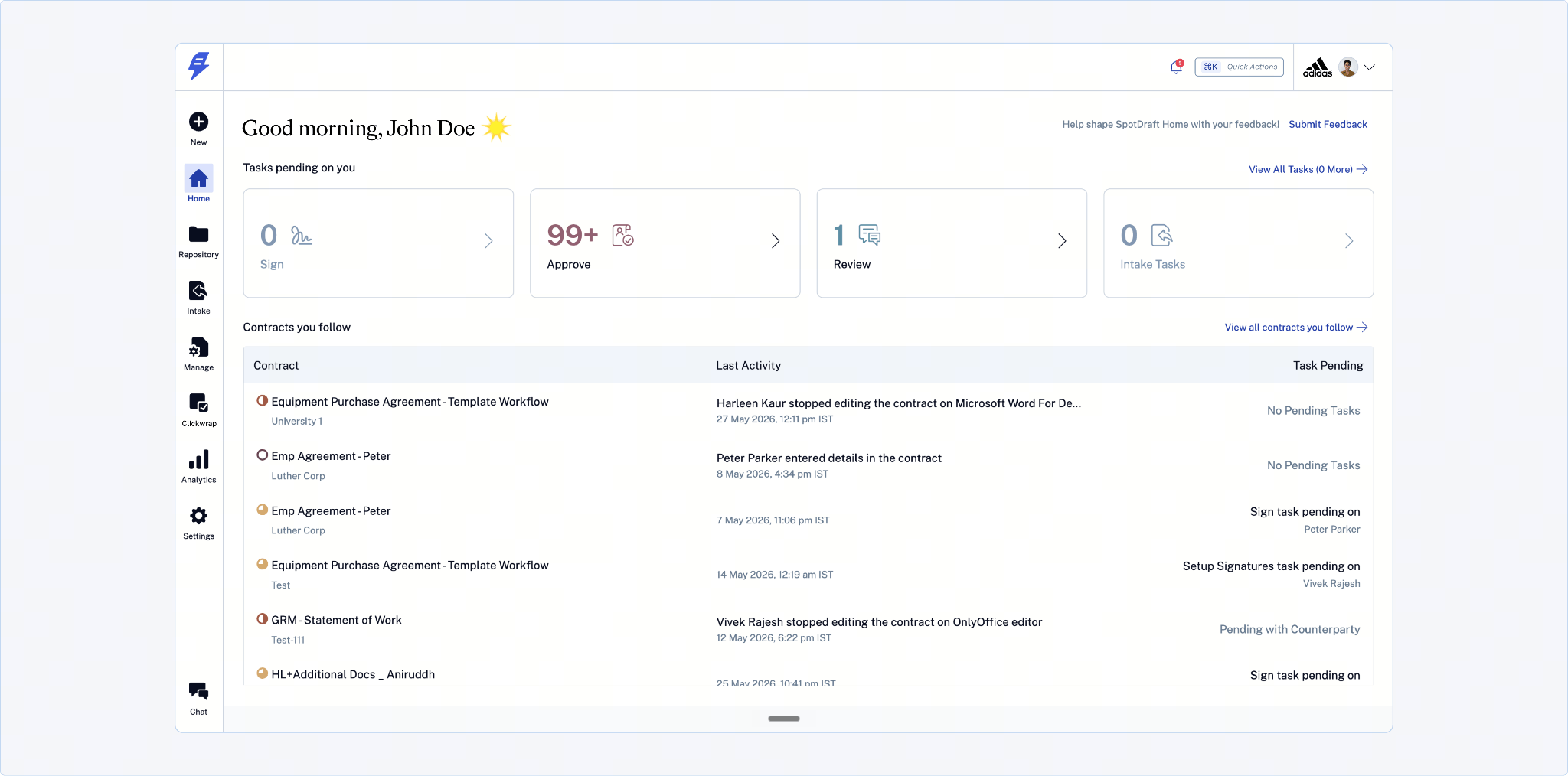
- Built with AI at its core to automate contract drafting, review, negotiation, obligation management, and insights across the contract lifecycle.
- Search, analyze, and extract key terms, obligations, risks, and commercial insights from contracts using natural language.
- Standardize intake, approvals, reviews, and execution with configurable workflows that reduce turnaround times and eliminate bottlenecks.
- Store and organize all contracts in a centralized repository with powerful search, metadata extraction, reminders, and reporting.
- Enable legal and business teams to collaborate seamlessly while enforcing playbooks, approval policies, and standardized contracting processes.
- Connect with CRM, procurement, eSignature, productivity, and business systems to fit naturally into existing workflows.
- Easy-to-use interface designed for both legal and business users.
- Strong AI capabilities that reduce contract turnaround time and manual reviews.
- Flexible workflow automation for legal, sales, procurement, HR and finance teams.
- Scales well from growing companies to large enterprises.
- Advanced enterprise implementations may require configuration and onboarding support.
- Custom pricing means costs aren't publicly available.
- SpotDraft offers custom pricing based on company size, contract volume and business requirements. Contact the sales team for a personalized quote and product demo.
7. Oneflow: AI contract lifecycle management
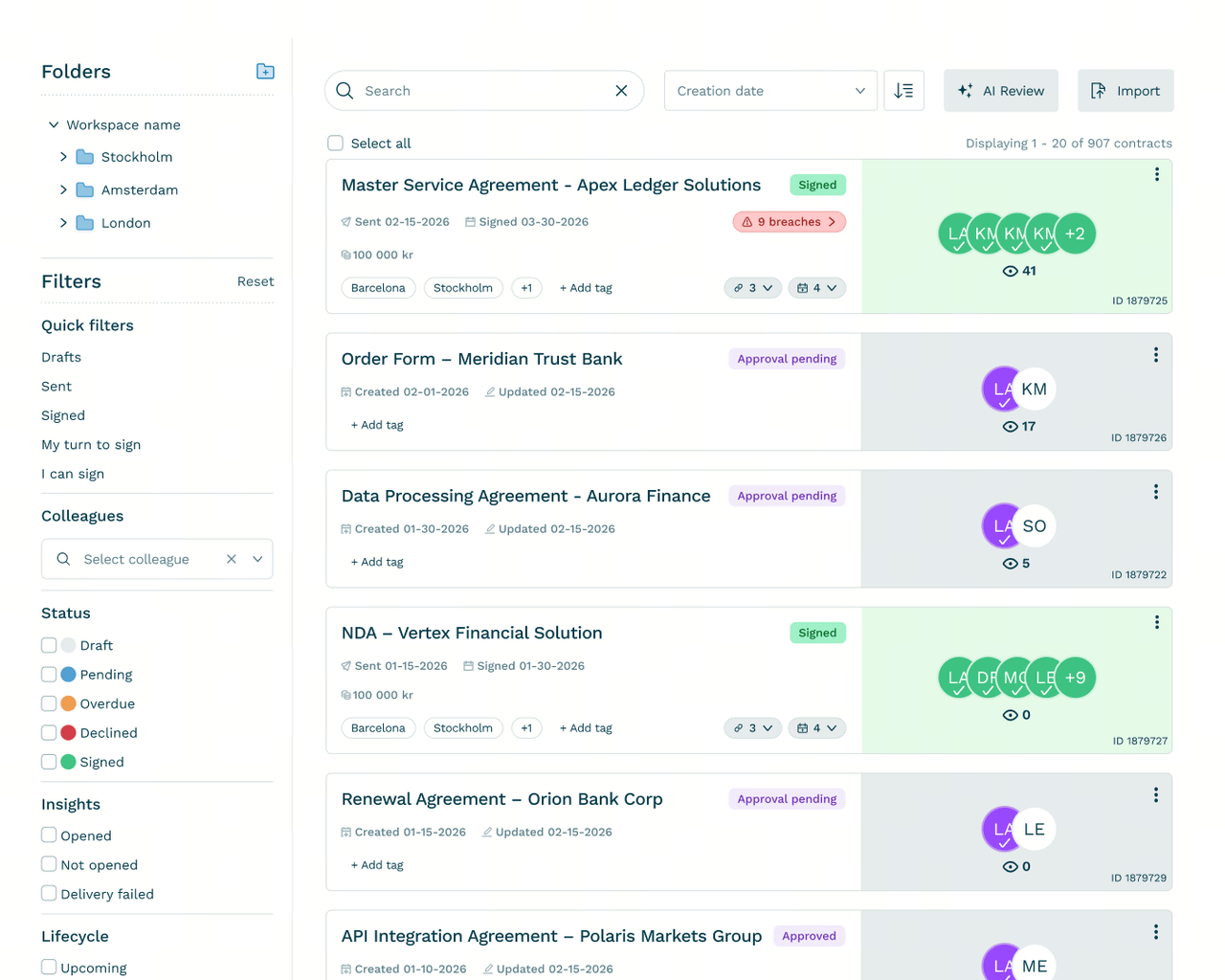
- Transforms static contracts into dynamic data that not only helps avoid version nightmares, but can also be used to search, tag and understand the contracts you store.
- Supports a single source of truth - with deep bi-directional integrations with major CRMs as well as other business systems, data can flow automatically across systems and departments - improving operational efficiency across the entire organization.
- Helps organizations stay compliant with role-based access controls, configurable data retention policies, audit logs, and more.
- Streamlines collaboration - with real-time editing, comments, version control, alerts, notifications and more, Oneflow allows users to work in a single platform, and execute faster.
- Centralizes all your contacts in a searchable repository
- Deep bi-directional integrations that ensure that contract data is consistent across systems in all stages of the contract lifecycle
- Easy to use and much more user friendly than some more complex CLM systems
- No separate product catalog needed — CRM serves as the single source of truth
- If you are looking for a CLM primarily for legal, the capabilities might not be advanced enough
- Limited workflow automation capabilities compared to more robust CLM solutions
- A free 14-day trial of all of Oneflow’s functionalities
- The Business plan is priced at $292 per month, billed annually and includes 5 users. It is ideal for teams that want to connect contracts to the processes that drive revenue, control costs, and ensure compliance.
- For enterprises ready to run contracts as a core business system across regions, processes, and teams, you can contact sales for a custom quote.
8. PandaDoc: Sales-oriented contract automation tool
- Drag-and-drop document builder with reusable templates and content libraries enables fast, consistent proposal and contract creation across teams.
- Built-in e-signature capabilities enable users to securely send, track, and sign agreements without requiring third-party tools.
- Real-time document analytics notify senders when recipients open, view, comment, or complete signature actions on contracts.
- CRM and payment integrations connect contracts to sales pipelines, invoices, and customer records for streamlined revenue workflows.
- An intuitive interface reduces training time and empowers sales teams to generate professional contracts independently and quickly.
- Combines document automation, workflow tracking, and e-signature functionality within one unified platform for simplicity.
- Flexible pricing plans make it accessible for startups, small businesses, and growing sales-focused organizations.
- Limited advanced compliance controls compared to enterprise-grade contract lifecycle management platforms.
- May lack deep customization and governance features required by highly regulated industries.
- Starter plan: $19 per seat per month (billed annually).
- Business plan: $49 per seat per month (billed annually).
- Enterprise plan: Custom pricing.
9. Agiloft: Customizable contract management system
- A highly configurable contract management platform allows organizations to design custom workflows, data fields, and approval processes without coding.
- A centralized repository stores contracts, with advanced search, reporting, and version control to improve visibility and compliance.
- Automated workflows manage approvals, notifications, and obligation tracking across legal, procurement, and finance teams.
- Open API and integration capabilities connect the system with CRM, ERP, and other enterprise business applications.
- Extensive customization options make it suitable for organizations with complex or unique contract management requirements.
- Strong workflow automation reduces manual processes and improves contract turnaround times across departments.
- Flexible deployment and configuration support both mid-sized businesses and large enterprises.
- Initial configuration can be complex and may require dedicated setup time or specialist support.
- The user interface may feel less modern than those of newer, design-focused contract management platforms.
- The app provides quote-based pricing based on requirements and size.
10. ContractWorks: Simple and secure contract repository
- A central contract repository with powerful search functionality enables quick retrieval of agreements and key contract information.
- Automated alerts and reminders notify users about upcoming renewals, expirations, and important contract milestones.
- Role-based permissions ensure secure access control and protect sensitive contract data across departments.
- Audit trails record contract activity history, supporting compliance requirements and internal governance transparency.
- Easy implementation and intuitive interface make it accessible for small and mid-sized businesses.
- Strong focus on secure storage and document organization without unnecessary complexity.
- Transparent pricing structure simplifies budgeting and subscription planning decisions.
- Limited advanced workflow automation compared to comprehensive enterprise contract lifecycle management platforms.
- Fewer AI-driven analytics and clause intelligence features than modern AI-focused competitors.
- The app provides quote-based pricing based on requirements and size.
11. Gatekeeper: Vendor and contract management platform
- A central vendor and contract repository provides searchable storage, performance data, and relationship insights across all suppliers.
- Automated workflows manage contract approvals, onboarding, and renewals with configurable rules for procurement and legal teams.
- Vendor performance tracking links contract terms to KPIs, enabling organizations to evaluate supplier reliability and service quality.
- Integrations with procurement, finance, and CRM tools synchronize contract data across core business systems.
- Combines vendor management and contract lifecycle capabilities in one platform, improving procurement visibility and supplier governance.
- Intuitive dashboards provide clear insights into supplier performance, contract value, and renewal timelines.
- Scalable architecture supports organizations managing large, complex vendor ecosystems across multiple departments.
- Advanced configuration and integrations may require additional setup time for complex enterprise environments.
- Some advanced analytics and AI features may depend on higher-tier plans or add-ons.
- The app provides quote-based pricing based on requirements and size.
12. SAP Ariba: Procurement-centered contract platform
- Integrated sourcing and contract management connect procurement events, negotiations, and finalized agreements within unified enterprise workflows.
- Centralized contract repository supports compliance tracking, document versioning, and global regulatory requirements across regions.
- Supplier collaboration tools enable secure communication, document exchange, and performance alignment between buyers and vendors.
- Deep integration with SAP ERP systems synchronizes contract data with procurement, finance, and supply chain operations.
- Strong integration of the procurement ecosystem ensures seamless alignment among sourcing, contracting, and supplier management processes.
- Scalable infrastructure supports multinational enterprises with complex regulatory and operational requirements.
- Comprehensive compliance and audit capabilities enhance governance across global procurement networks.
- Implementation can be resource-intensive, especially for organizations without existing SAP infrastructure.
- Platform complexity may require specialized training and ongoing administrative support.
- The app provides quote-based pricing based on requirements and size.
13. Sirion: AI-driven supplier contract lifecycle solution
- AI-driven contract intelligence extracts clauses, obligations, and risks from agreements to improve visibility and oversight of compliance.
- Performance management tools link contractual commitments to operational metrics to effectively monitor supplier service levels.
- Automated workflow engine manages approvals, amendments, renewals, and compliance tracking across procurement and legal teams.
- A centralized repository with advanced analytics provides actionable insights into contract value, risks, and supplier performance trends.
- Strong focus on supplier performance and obligation tracking improves accountability and contract value realization.
- Advanced AI capabilities enhance contract review accuracy and risk identification across large agreement portfolios.
- Designed for large enterprises managing complex outsourcing, procurement, and vendor ecosystems globally.
- Implementation complexity may require significant configuration and integration planning for enterprise environments.
- A pricing structure may be more suitable for large organizations than for smaller businesses.
- The app provides quote-based pricing based on requirements and size.
14. Evisort: AI-native contract intelligence platform
- AI-powered contract analytics automatically extracts clauses, metadata, and obligations from uploaded agreements, eliminating the need for manual tagging.
- A centralized searchable repository enables teams to quickly locate key terms, renewal dates, and compliance-related provisions.
- Automated alerts and dashboards track obligations, expirations, and contract risks across enterprise portfolios.
- Integrations with CRM, ERP, and collaboration tools synchronize contract insights across legal, procurement, and finance teams.
- The rapid-deployment model enables organizations to gain contract visibility without lengthy implementation cycles.
- Strong AI extraction capabilities reduce manual data entry and improve contract review efficiency.
- A user-friendly interface supports both legal and business users in managing high contract volumes.
- Advanced customization options may be more limited than those of highly configurable enterprise platforms.
- Pricing transparency may require direct consultation for detailed enterprise-level cost structures.
- The app provides quote-based pricing based on requirements and size.
15. Juro: Browser-based collaborative contract tool
- A browser-based contract editor enables collaborative drafting, commenting, and redlining directly within the platform, eliminating the need for external document exchanges.
- Structured smart templates standardize agreements, reduce drafting errors, and accelerate contract creation across legal and sales teams.
- Automated approval workflows route contracts to stakeholders based on predefined rules, thresholds, and organizational hierarchies.
- Native e-signature functionality and CRM integrations streamline contract execution and synchronize data across business systems.
- Intuitive modern interface encourages adoption among cross-functional teams without extensive training requirements.
- Fast implementation timeline makes it suitable for startups and growing mid-sized organizations.
- Strong collaboration capabilities improve contract visibility and reduce reliance on email negotiations.
- Limited enterprise-grade customization compared to highly configurable global contract management platforms.
- Advanced AI-driven analytics features may be less comprehensive than specialized contract intelligence solutions.
- The app provides quote-based pricing based on requirements and size.
16. LinkSquares: Legal analytics contract platform
- AI-powered analytics automatically extract clauses, metadata, and key terms from contracts to provide searchable insights across portfolios.
- Visual dashboards display risk exposure, renewal timelines, and obligation tracking for improved legal decision-making.
- Automated alerts notify teams about expirations, compliance milestones, and performance-related contractual commitments.
- Integrations with CRM, ERP, and document management systems synchronize contract intelligence across business operations.
- Strong AI extraction reduces manual contract review and improves visibility into contractual risks.
- Intuitive reporting tools help legal teams quickly analyze agreement trends and compliance metrics.
- Rapid deployment enables organizations to centralize and efficiently analyze legacy contracts.
- Advanced workflow automation may be less robust than comprehensive enterprise contract lifecycle platforms.
- Customization and scalability options may require higher-tier enterprise subscription plans.
- The app provides quote-based pricing based on requirements and size.
17. CobbleStone: Compliance-driven contract management solution
- Centralized repository stores contracts, tracks versions, and enables advanced search for clauses, terms, and metadata across contracts.
- Configurable workflows automate approvals, obligations, and notifications to ensure contract compliance and timely execution.
- Contract compliance tools enforce policies, document retention rules, and audit trails to support legal and regulatory requirements.
- Integrations with CRM, ERP, and procurement systems synchronize contract data and streamline business processes across teams.
- Strong compliance and governance capabilities help organizations manage risk and audit readiness effectively.
- Configurable platform supports tailored workflows that align with internal policies and approval hierarchies.
- Secure repository with audit trails improves visibility and accountability throughout the contract lifecycle.
- Advanced customization and integrations may require more implementation time and technical support.
- The user interface may feel less modern than those of newer contract management platforms.
- The app provides quote-based pricing based on requirements and size.
Key features of modern contract lifecycle management software
- Centralized contract repository: A centralized repository ensures that every agreement is stored in a single, secure, searchable location. Teams can quickly access the latest versions, track contract status, and avoid duplicate or lost critical documents. Many systems also connect with contact resource management software to link contracts with the right stakeholders and owners.
- AI clause library: An AI-powered clause library helps legal teams standardize contract language and reduce drafting time. It can recommend pre-approved clauses, flag risky terms, and maintain consistency across agreements. This feature is especially useful in environments that rely on contractor safety management software, where specific compliance clauses must appear in every contract.
- Automated approval routing: Automated routing sends contracts to the right stakeholders based on value, risk, or contract type. This eliminates manual follow-ups and shortens approval cycles. Organizations using contract labour management software benefit from automated approvals for large volumes of workforce or vendor agreements.
- Role-based access control: Role-based access ensures only authorized users can view, edit, or approve specific contracts. This protects sensitive data and maintains clear responsibility across departments. It also works well when integrated with customer contact management software to control access based on customer ownership or account roles.
- Audit trail logging: Audit trails automatically record every contract action, including edits, approvals, and signatures. This creates a clear history for compliance reviews and dispute resolution. It also supports internal governance by showing who made changes and when.
- Obligation tracking: It helps teams monitor key deliverables, payment schedules, and service commitments in contracts. Automated reminders ensure that responsibilities are fulfilled on time. This reduces the risk of penalties, disputes, or missed performance targets.
Emerging trends in the contract management software market
- AI contract summarization: AI-powered summarization tools instantly extract key clauses, risks, and obligations from lengthy agreements. This reduces manual review time and enables executives to quickly understand contractual exposure. Advanced models can compare summaries across portfolios to identify inconsistencies and gaps in standardization.
- Predictive renewal intelligence: Predictive analytics forecast renewal outcomes based on performance, usage, and negotiation history. Systems recommend whether to renegotiate, terminate, or expand agreements before deadlines approach. This proactive insight helps businesses prevent unwanted auto-renewals and improve vendor leverage.
- ESG and compliance tracking: CLM platforms increasingly monitor environmental, social, and governance commitments embedded within contracts. Automated alerts track regulatory changes and ensure clauses align with evolving compliance standards. Organizations gain better transparency into sustainability obligations and third-party accountability metrics.
- Contractor safety documentation workflows: Modern tools integrate safety certifications, insurance documents, and compliance records directly within contract workflows. Automated reminders ensure vendors maintain updated safety documentation before project execution. This reduces operational risk and supports industries requiring strict contractor oversight.
- Contract labour management automation: Automation streamlines onboarding, approvals, and documentation for temporary and contract workforce agreements. Integrated tracking ensures labor terms align with statutory regulations and internal policies. This improves visibility into workforce costs, obligations, and contract labour management compliance.
- Risk heat-mapping dashboards: Visual dashboards map contractual risks across regions, vendors, and agreement types. Color-coded heat maps instantly highlight high-risk clauses, concentration exposure, and compliance gaps. These insights support strategic decision-making and strengthen enterprise-wide contract governance.
Conclusion
FAQs
How much does contract lifecycle management software cost?
What industries benefit most from contract labour management software?
Can contract lifecycle management software support contractor safety compliance?
How does AI improve contract clause analysis accuracy?
What is the difference between contract lifecycle management and CRM contract tracking?
Related reading

Start using Lark today

Manage all your work in one place
Boost team efficiency by 10x
Save up to 70% on software costs
Start using Lark today
Manage all your work in one place
Boost team efficiency by 10x
Save up to 70% on software costs
Keep reading







2026 Lark Technologies Pte. Ltd.
Headquartered in Singapore with offices worldwide.





