














Best Hive Alternatives for 2026: Top 11 Project Tools

Cecilia Lane
Go-to-Market Associate
Sep 18, 2026
Cecilia Lane
Sep 18, 2026
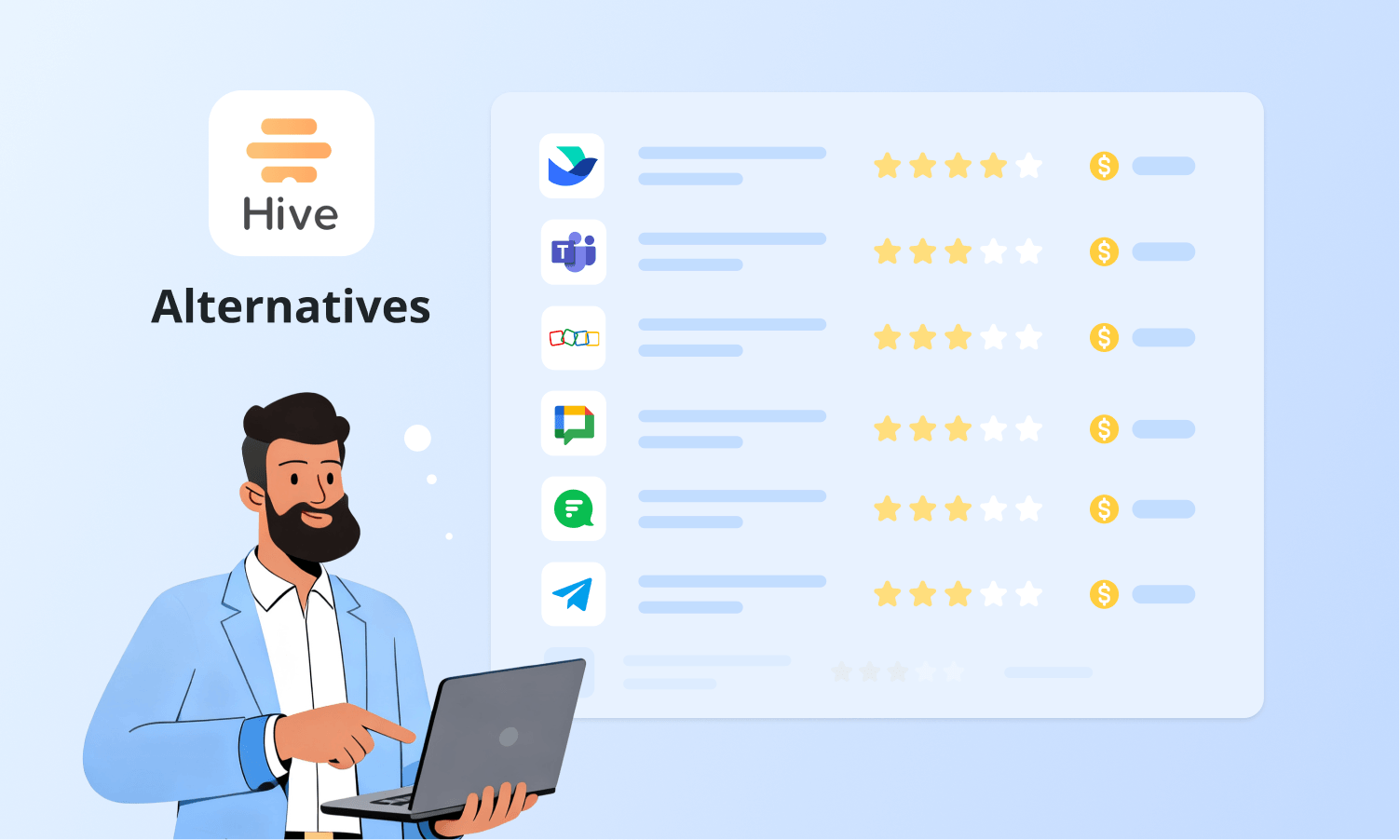


- Lark – All‑in‑one collaboration and communication platform
- ClickUp – Deeply customizable productivity system
- Asana – Streamlined workflow and goal management tool
- Monday.com – Visual and automated project tracking software
- Wrike – Enterprise‑ready work and analytics solution
- Trello – Lightweight and intuitive Kanban board system
- Worksection – Balanced tool for teams managing time and budgets
- Notion – Flexible workspace for notes, docs, and tasks
- Smartsheet – Spreadsheet‑style platform for structured projects
- Basecamp – Communication‑driven tool for organized teamwork
- Flutter – Agile‑first solution tailored for developer collaboration
Quick Comparison Table: 5 Hive Alternatives at a Glance

What is Hive
- Project planning tools: Hive provides multiple ways to visualize and manage work — including Kanban boards for agile teams, Gantt charts for timeline tracking, table and calendar views for detailed scheduling. Hive allows users to create and manage a project schedule, making it easy to adapt timelines and routines as project needs change. This flexibility helps teams plan projects the way they actually work, rather than being forced into a fixed structure.
- Automation workflows: A core feature highlighted on Hive's platform is its automation engine ("Hive Automate"), which helps users eliminate repetitive manual tasks. Teams can create triggers and rules so that actions such as task updates, approvals, or notifications happen automatically. This reduces administrative overhead and ensures consistency across complex workflows, particularly useful for marketing or operations teams.
- Collaboration features: Hive emphasizes keeping communication close to the work itself. Each project and task includes comment threads, attachments, and tagging functions so users can share updates without leaving the workspace. The platform also integrates with popular communication tools like Slack and video‑conferencing apps, providing smoother collaboration between internal and external stakeholders.
- Analytics and reporting: Hive's analytics dashboard enables teams to measure progress in real time. Users can track metrics such as task completion rates, project timelines, and employee productivity. Reports can be customized and exported, which helps managers identify bottlenecks or resource gaps quickly. This data‑driven insight supports better decision‑making and continuous improvement over multiple projects.
What to look for in a great Hive alternative
- Ease of use and onboarding: Look for an intuitive user experience with minimal learning time. Platforms with drag‑and‑drop interfaces or quick setup templates often drive faster adoption and higher engagement.
- Integrated communication tools: Real‑time chat, video calls, and comments should live in the same workspace as your tasks and documents. This reduces interruptions and ensures every project update remains visible to the team.
- Multiple project views: The best alternatives support several layouts — Kanban, Gantt, timeline, or list — so teams can visualize workloads however they prefer. Flexibility here helps align different roles, from designers to analysts.
- Automation and AI assistance: Modern tools now include automated task creation, reminders, and reporting driven by AI. This not only saves time but helps maintain consistency across recurring workflows and campaigns.
- Customizable dashboards and reports: Teams benefit from analytics that adapt to business goals. Ensure the platform can highlight insights such as task bottlenecks, project delays, or resource trends without complex configuration.
- Transparent and scalable pricing: Effective collaboration should be affordable and flexible. Check whether the tool offers a free tier or scalable plans that fit your company's growth without forcing long‑term commitments.
- Pricing scalability: Some smaller organizations and startups find Hive's pricing structure less flexible compared with freemium or modular competitors. As teams grow and new workspaces are added, costs can increase significantly — making other pricing models, such as those offered by Lark, more attractive. Additionally, some users seek alternatives to avoid hidden fees or unexpected costs that can arise as their needs expand.
- Hive pricing (billed annually): Free for up to 10 members; $5/user/month for Starter plan, $12/user/month for Teams plan, and Enterprise pricing requires contacting sales. Organizations planning a digital workplace upgrade often start by examining Google Workspace pricing and ClickUp pricing.
- If you need to know Hive's pricing model, check: Hive Pricing: Complete Breakdown and Best Alternative
The 11 best Hive alternatives for 2026
1. Lark — the all‑in‑one collaboration hub
- Starter plan: Free forever plan that includes 11 powerful tools for up to 20 users. It also comes with 100GB of storage, 1,000 automation runs, AI translations, and more.
- Basic plan: $6/user/month (billed annually) for up to 500 users, including everything in Starter plus 1-on-1 video meetings, 5TB of storage, 1,000 automation runs, and more. To know more about Basic plan, contact our sales.
- Pro plan: $12/user/month (billed annually) for up to 500 users. It includes everything in Basic plus a group calling for up to 500 attendees, 15TB of storage, 50,000 automation runs, and more.
- Enterprise plan: Contact sales for custom pricing. Supports unlimited users and includes even more automation runs and advanced security, compliance, and management features.
Starter
For small teams with simple communication needs
$0
/ user / month

Pro
For companies with comprehensive collaboration and management needs
$12
/ user / month
Enterprise
For large companies with advanced security and organizational management needs
Get a personalized demo and pricing
Pro
For companies with comprehensive collaboration and management needs
$12
/ user / month
2. ClickUp — best for customization and visibility
- Custom hierarchy: Spaces, folders, lists, and subtasks can be structured for any organization, from departments to agile squads. This hierarchy is what makes ClickUp appealing to teams managing diverse project types.
- Docs, dashboards, and whiteboards in one place: Create project briefs or brainstorming boards side by side with execution workflows, ensuring all context stays aligned.
- Advanced automation and AI: Users can set rules and triggers to assign tasks, move statuses, or send messages automatically. AI writing and summarization now help with updates, goal progress, and idea generation.
- Comprehensive view options: ClickUp supports over a dozen work views — including List, Kanban, Calendar, Gantt, Box, Mind Map, and Timeline — letting teams visualize processes however they prefer.
- Performance tracking and reporting: Built‑in goals, time tracking, and workload charts allow teams to measure efficiency in real time.
- Free plan: Ideal for individuals or very small teams that need basic, limited task management.
- Unlimited plan: Priced at $7 per user per month
- Business plan: For $12 per user per month
- Enterprise plan: Custom pricing
3. Asana — best for structured workflow management
- Goals and portfolio alignment: Asana allows teams to link projects to top‑level company goals so progress can be tracked from individual task to organizational strategy — a unique strength for scaling or distributed teams.
- AI‑powered workflows: The new Asana Intelligence feature automatically creates task descriptions, predicts due dates, and provides insights across multiple projects. It turns unstructured plans into data‑driven actions.
- Versatile project views: Users can switch between Gantt‑style Timelines, Kanban Boards, Lists, or Calendar views to match team preferences while maintaining consistency across departments.
- Advanced reporting and universal dashboards: Real‑time data displays measure workload, milestones, and blockers across projects — no manual updates required.
- Extensive integrations: Asana connects natively with tools such as Slack, Google Drive, Jira, and Salesforce to ensure work visibility across your entire digital ecosystem.
- Personal: Free for 2 users
- Starter: $10.99/user/month
- Advanced: $24.99/user/month
- Enterprise: Custom pricing
4. Monday.com — best for automation and team visibility
- Modular Work OS architecture: Monday.com provides building blocks (boards, columns, automations, dashboards) that allow teams to design workflows tailored to any use case — from creative planning to IT support.
- Powerful automation engine: The platform's "if‑this‑then‑that" logic automates routine actions like task assignments, approvals, or deadline updates. Its new AI capabilities, including Monday AI Assistant, help summarize updates and generate action items.
- Cross‑department dashboards: Visual summaries consolidate work from multiple teams — marketing, sales, product — offering executives real‑time performance visibility without switching tools.
- Seamless integration ecosystem: Connects with over 200 tools including Excel, Microsoft Teams, Slack, and Google Workspace, centralizing communication and data flow.
- Enhanced collaboration features: In‑board comments, file previews, and real‑time updates keep communication close to the work itself.
- Free for 2 users
- Standard: $12/user/month
- Pro: $19/user/month
- Enterprise: Custom pricing
5. Wrike — best for enterprise-level visibility and control
- Wrike Work Intelligence: Its proprietary AI layer analyzes activities to surface risks, predict delays, and suggest task adjustments before problems arise.
- Customizable work item types: Teams can tailor workflows, task templates, and approval chains for different business functions, ensuring each department works its way without losing alignment.
- Advanced resource and capacity planning: Interactive workload charts and performance analytics make it easier to distribute and balance responsibilities dynamically.
- Real-time dashboards and 360° visibility: Every project updates live with progress tracking and key metric dashboards to support data-driven decision-making.
- Built-in automation: Rule-based automation reduces manual work, while integrations with platforms like Salesforce and Adobe Creative Cloud keep data unified.
- Free plan with limited functions; free trial for other plans
- Team: $10/user/month, 2-15 users
- Business: $25/user/month, 5-200 users
- Enterprise & Pinnacle: Custom pricing
6. Trello — best for simplicity and visual organization
- Visual Kanban system: Trello's card-based interface allows teams to map workflows visually, track progress at a glance, and move tasks effortlessly across stages.
- Multiple project views: Beyond classic boards, Trello now includes Timeline, Table, Dashboard, Calendar, and Map views — giving users multidimensional oversight without sacrificing clarity.
- AI and automation tools: Butler Automation and integrated AI features automatically assign tasks, archive cards, set reminders, or generate summaries to reduce repetitive management.
- Power-Ups and integrations: With 200+ Power-Ups, Trello extends into Slack, Google Drive, Jira, and more — blending communication, documentation, and project tracking.
- Cross-device synchronization: Whether on desktop or mobile, Trello ensures seamless task updates and notifications across all devices, maintaining accessibility and collaboration continuity.
- Free: Up to 10 collaborators per Workspace
- Standard: $5/user/month
- Premium: $10/user/month
- Enterprise: Need to contact sales. For 500 users, estimated at $16.5/user/month
7. Worksection — best for growing teams managing time and budgets
- Integrated time and cost tracking: Worksection embeds timers directly in tasks, automatically generating cost summaries by project and team. This real-time linkage between time and finance metrics helps maintain budget control.
- Visual Gantt and Kanban boards: Teams can plan sequential workflows with Gantt charts or manage agile pipelines in Kanban mode. Worksection's dual layout flexibility supports both deadline-driven and continuous delivery teams.
- Project transparency: Color-coded tags, 24/7 project status views, and automatic progress updates keep managers informed without requiring manual check-ins.
- Client collaboration portals: External clients can access progress-tracking dashboards, submit feedback, or approve deliverables directly in the system, improving transparency in agency workflows.
- Financial reporting and document storage: Built-in reporting tools summarize project budgets, expenses, and performance metrics, while integrated storage (including FTP) centralizes project documentation.
- Free 14-day trial only
- Mini: $5/user/month (10 users)
- Basic: $4/user/month (20 users)
- Business: $3/user/month (50 users)
- Premium: $7/user/month
8. Notion — best for flexibility, documentation, and connected workspaces
- Database-driven workspace: Notion's core strength lies in relational databases, allowing teams to create tasks, clients, notes, or assets and link them dynamically through filterable tables, boards, and formulas.
- Collaborative docs with real-time editing: Users can co-edit documents, add inline comments, and mention teammates — enabling asynchronous yet deeply contextual collaboration.
- Template and automation ecosystem: Ready-made templates for product management, roadmaps, CRM, or OKRs save setup time, and third-party automations (via Notion API and Notion AI) expand workflow potential.
- Notion AI: Context-aware assistance helps users summarize notes, extract action items, or rewrite content instantly — enhancing productivity directly within documents.
- Cross-platform modularity: Integrates seamlessly with Slack, Google Drive, and Figma while maintaining powerful offline access for mobile and desktop users.
- Free personal plan for individuals
- Plus: $10/user/month
- Business: $20/user/month
- Enterprise: Custom pricing
9. Smartsheet — best for spreadsheet‑style, data‑driven project control
- Familiar yet powerful grid interface: Smartsheet expands the utility of spreadsheets, allowing rows to represent actionable tasks enriched with attachments, comments, and dependencies.
- Smartsheet AI: Built‑in generative AI delivers instant insights by summarizing project data, identifying risks, and suggesting improvements across sheets or dashboards.
- Dynamic views and collaboration layers: Beyond grid view, teams can visualize progress through card (Kanban), calendar, Gantt, and dashboard modes with real‑time data sync.
- Automation builder: Rule‑based triggers eliminate repetitive steps such as reminders, approvals, or data routing, helping teams operate efficiently at scale.
- Advanced governance and integrations: Enterprise‑grade controls ensure secure sharing and compliance; native integrations with Microsoft 365, Google Workspace, Tableau, and Salesforce keep all systems unified.
- Pro: $9/user/month
- Business: $19/user/month
- Enterprise & Advanced Work Management plan: Custom pricing
10. Basecamp — best for communication‑first project collaboration
- Message boards and automatic check‑ins: Replace scattered emails by holding discussions per project. Daily or weekly check‑ins keep everyone informed without micromanagement.
- To‑dos, schedules, and doc storage: All project materials — tasks, files, due dates — live together, promoting transparency while reducing tool fragmentation.
- Campfire group chat and pings: Instant messaging stays closely tied to the work context so discussions remain searchable and actionable.
- Client access: Basecamp allows external client collaboration under clear boundaries, improving accountability and communication flow.
- Basecamp 4's "Card Table" and timeline views: Recent enhancements merge agile card workflows with the traditional Basecamp simplicity.
- Free: one project at a time
- Plus: $15/user/month
- Pro Unlimited: $299/month/organization
11. Flutter — best for agile and developer‑oriented collaboration
- Sprint‑native boards: Flutter's backlog and sprints offer real‑time burndown analytics, release tracking, and automated ticket prioritization — all natively integrated into its interface.
- Code synchronization: Developers can link Git commits, pull requests, and branches directly to tasks, ensuring traceability from requirement to deployment.
- Automated reporting: AI‑enhanced activity summaries transform commit history, issue status, and sprint velocity into actionable insights.
- DevOps integrations: Integrates seamlessly with GitHub, Bitbucket, and CI/CD pipelines, connecting planning with release management.
- Developer collaboration tools: Inline code discussions and shared technical docs foster collaboration without leaving the workspace.
How to choose the right Hive alternative for your team
Option A: Lark for teams that want everything in one place
Option B: ClickUp for teams that need customizable project architecture
Option C: Asana for organizations seeking strategic visibility
Conclusion
FAQs
What is the best alternative to Hive?
Is there anything better than Hive?
Is there an alternative to the Hive app?
Which Hive alternatives are free to use?
What features should I prioritize when switching from Hive?
Related reading

Start using Lark today

Manage all your work in one place
Boost team efficiency by 10x
Save up to 70% on software costs
Start using Lark today
Manage all your work in one place
Boost team efficiency by 10x
Save up to 70% on software costs
Keep reading


Lark recognized in 2023 Gartner® Collaborative Content Workspaces and Meeting Solutions reports





2026 Lark Technologies Pte. Ltd.
Headquartered in Singapore with offices worldwide.





