Every project manager strives for a successful project. But what does it truly mean to achieve project success, and more importantly, how do we accurately measure it? In today's dynamic business environment, measuring project success goes far beyond simply completing tasks on time and within budget. It's about delivering tangible value, satisfying stakeholders, and driving organizational growth. This article will delve into the intricacies of measuring the success of a project, providing a comprehensive guide to defining, tracking, and achieving your project goals.
What is project success?
is a multifaceted concept that extends beyond the traditional iron triangle of scope, time, and cost. While these elements remain crucial, a truly successful project delivers significant value to its stakeholders and aligns with the overarching strategic objectives of the organization. It's about meeting and, ideally, exceeding expectations.
Imagine a scenario where a project delivers exactly what was requested, on schedule and within the allocated budget. On the surface, this might appear successful. However, if the delivered product or service fails to solve the end-user's problem, doesn't generate the anticipated revenue, or leaves the team feeling burnt out and dissatisfied, can it truly be called a success? The answer, in modern , is often no.
Project success is, therefore, the objective assessment of a project's performance and outcomes against its initially defined goals and objectives. It encompasses not only the efficient execution of tasks but also the realization of intended benefits and the creation of lasting value. This often means considering both quantitative measures, such as financial returns and schedule adherence, and qualitative aspects, like customer satisfaction and team morale. Ultimately, a successful project is one that leaves all key stakeholders — from clients to team members — feeling that their investment, whether it be time, money, or effort, has yielded a worthwhile return. Each project has unique goals and objectives, meaning its definition of success will also differ.
Discover your project success journey here
Why measure project success?
Measuring project success is not merely an academic exercise; it's a critical component of effective that drives continuous improvement and ensures strategic alignment. By systematically evaluating project outcomes, organizations can gain invaluable insights that inform future decisions and optimize resource allocation through the following mechanisms:
- Validates the effectiveness of strategies: Without clear metrics, it's impossible to objectively determine whether a project has truly achieved its intended purpose. This measurement provides the needed to assess what worked well and what didn't, allowing project managers and teams to refine their approaches and implement best practices in subsequent endeavors. It helps answer the fundamental question: did we achieve what we set out to do, and if so, how well?
- Enables informed, data-driven decisions: Instead of relying on gut feelings or anecdotal evidence, project leaders can use concrete performance indicators to guide their choices. This is particularly vital when it comes to resource planning, , and risk management. Understanding the return on investment (ROI) from past projects, for example, can directly influence the prioritization and funding of future initiatives.
- Ensures accountability and transparency: It provides a clear framework for communicating progress and results to all stakeholders, fostering trust and alignment. When everyone understands how success is defined and measured, it creates a shared sense of purpose and empowers teams to focus on what truly matters. This transparency also helps in setting realistic expectations and managing potential challenges proactively, ensuring that projects not only deliver on their promises but also contribute meaningfully to the organization's strategic goals.
The characteristics of project success
Project success is rarely attributable to a single factor; instead, it emerges from a careful balance of several interconnected characteristics. These foundational elements work in concert to create a robust framework for measuring project success and ensuring overall effectiveness. Understanding these characteristics is key to delivering projects that truly make an impact.
- Time management and deadlines: Meeting project deadlines involves more than simply hitting the final completion date. It encompasses the efficient tracking of , including milestone achievements, phase completions, resource allocation schedules, and stakeholder review periods. Effective time management requires meticulous planning and regular monitoring of progress against established timelines, often requiring buffer periods for unexpected delays while maintaining steady progress.
- Cost control and budget management: Projects must deliver value within approved financial parameters. This involves careful consideration of resource expenses, equipment and material costs, external contractor fees, overhead costs, and contingency funds. Modern project success metrics extend beyond mere budget adherence to encompass the return on investment (ROI) and long-term financial benefits, justifying project expenses and demonstrating tangible business value.
- Scope definition and control: The project scope clearly outlines the boundaries and deliverables, preventing "feature creep" and ensuring resources remain focused on essential elements. Successful scope management demands detailed documentation of requirements, robust change control procedures, regular scope reviews, and unequivocal stakeholder agreement on deliverables. When scope changes become inevitable, their impact on other success characteristics must be meticulously assessed and adjustments made accordingly.
- Quality standards and assurance: They determine whether project deliverables meet and exceed . Strong quality management involves defining clear quality standards, implementing regular quality checks, establishing rigorous testing procedures, and setting performance metrics alongside user acceptance criteria. These quality standards must align with project objectives while remaining achievable within time and budget constraints. Regular quality assessments are crucial for identifying issues early and maintaining high standards throughout the .
Balancing these four characteristics is often the most challenging aspect of , as their relative importance can vary significantly between projects. For instance, a mission-critical software update might prioritize quality over cost, while a time-sensitive market launch could emphasize deadlines over scope. True project success hinges on finding the right equilibrium among these characteristics, always with an eye toward meeting stakeholder expectations and delivering sustained business value.
Test these characteristics in your PM journey
Ways to measure project success
Effectively measuring project success requires a comprehensive approach, employing a variety of metrics and evaluation techniques tailored to the specific nature of each project. These methods can broadly be categorized into quantitative "hard criteria" and qualitative "soft criteria," both essential for a holistic understanding of a project's impact.
For projects following waterfall methodology
Scope, schedule, and cost are typically defined at the outset for projects following a . Here are several key performance indicators (KPIs) are commonly used:
Schedule variance (SV): This metric indicates the difference between the planned work and the actual completed work at a given time, where a positive SV means the project is ahead of schedule, while a negative SV suggests delays.
Actual cost (AC): This is the total amount of money spent on a project up to a specific point.
Cost variance (CV): This represents the difference between the expected cost and the actual cost, with a positive CV signifying the project is under budget, while a negative CV indicates it's over budget.
Planned value (PV): This is the estimated value of work that should have been completed by a specific time.
Earned value (EV): This measures the progress made on a project in terms of the budget allocated to the completed work.
Schedule performance index (SPI): Calculated as EV / PV, SPI measures the efficiency of work completion relative to the plan, where an SPI of 1.0 means on schedule, while less than 1.0 indicates delays.
Cost performance index (CPI): Calculated as EV / AC, CPI measures cost efficiency, with a CPI of 1.0 meaning on budget, while less than 1.0 signals cost overruns.
Estimate at completion (EAC): This is an updated total cost estimation for the project upon completion.
Project margin: This tracks the difference between a project's earnings and its delivery costs, providing a clear view of profitability.
For agile projects
embrace flexibility and iterative development. Different metrics are more appropriate:
Story points: These estimate the workload for a task, considering time, effort, and risk.
Velocity: This represents the work a team can complete within a specific period (e.g., a sprint), measured in story points.
Burndown charts: These are graphical representations tracking remaining work over time, counting down to completion.
Cumulative flow diagrams: Similar to burndown charts, these track the amount of work remaining, counting up over time, and are useful for identifying bottlenecks.
Lead time: This is the duration from task identification to completion.
Cycle time: This is the time taken to complete a task once work begins, excluding waiting time.
Defect density: This measures the number of defects per unit of code or delivered output.
Beyond these specific metrics, measuring project success also involves considering broader criteria:
Cost and profitability (ROI): This involves ensuring the project not only stays within budget but also generates a healthy return on investment by tracking expenses and comparing actual profits against estimated ones.
Customer satisfaction: This is a critical qualitative measure, often gauged through surveys, feedback, and proactive engagement.
Team satisfaction: This refers to the well-being and engagement of the project team, measured through regular check-ins, surveys, and fostering effective communication.
Output quality: This pertains to the inherent quality of the deliverables, assessed through internal reviews, 360-degree feedback, and comparison against industry standards.
Continual improvement (Kaizen): This involves adopting a mindset of small, regular improvements across all aspects of a project, by consistently seeking marginal gains in schedule adherence, profitability, and satisfaction, and validating improvements against past projects.
The choice of metrics should align with the project's specific purpose, desired outcomes, and methodology. A balanced approach that combines both quantitative (hard criteria) and qualitative (soft criteria) measurements will provide the most accurate and comprehensive view of measuring project success. Hard criteria, such as financial targets and time-based measurements, offer clear, numbers-based evidence of performance. Soft criteria, like stakeholder satisfaction and team development, address less tangible but equally crucial aspects, often measured through surveys or ratings.
Measure project success with Lark
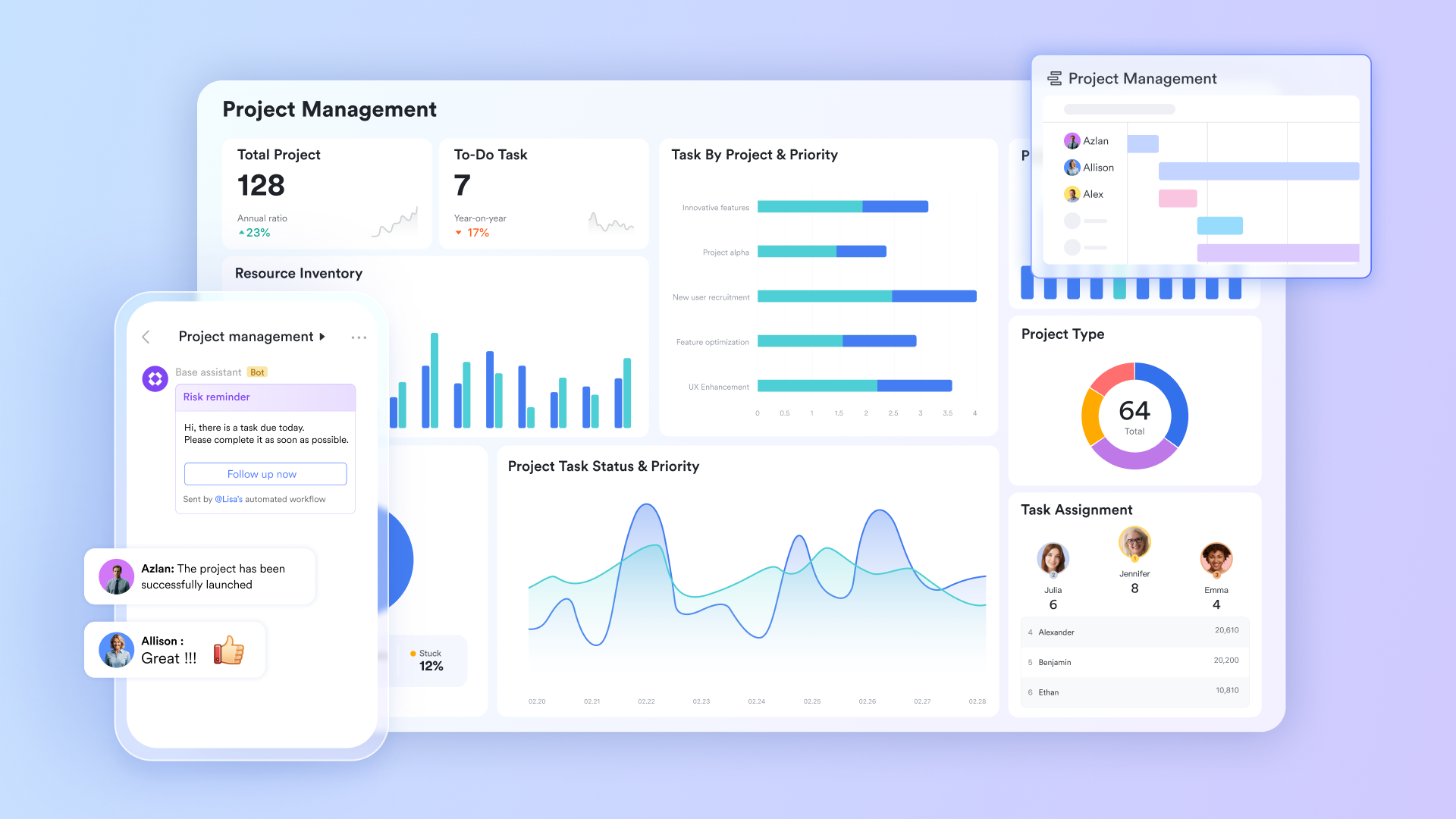
In an increasingly complex project landscape, the you use can significantly impact your ability to effectively measure project success. While no tool can magically define success for you, the right platform can transform vague goals into actionable metrics, foster collaboration, and ensure that your project's achievements are consistently tracked and celebrated. Lark, an all-in-one collaboration suite, provides the integrated features necessary to streamline your approach to measuring success of a project, from initial definition to post-project analysis.
Many teams find themselves struggling with common pain points: unclear objectives, inconsistent tracking of progress, and feedback that arrives too late to make a meaningful difference. These issues are often symptoms of poorly defined or executed project success criteria. addresses these challenges by offering a cohesive environment where success criteria are not just documented but actively integrated into the daily workflow, making them clearer, more actionable, and easier to sustain throughout the .
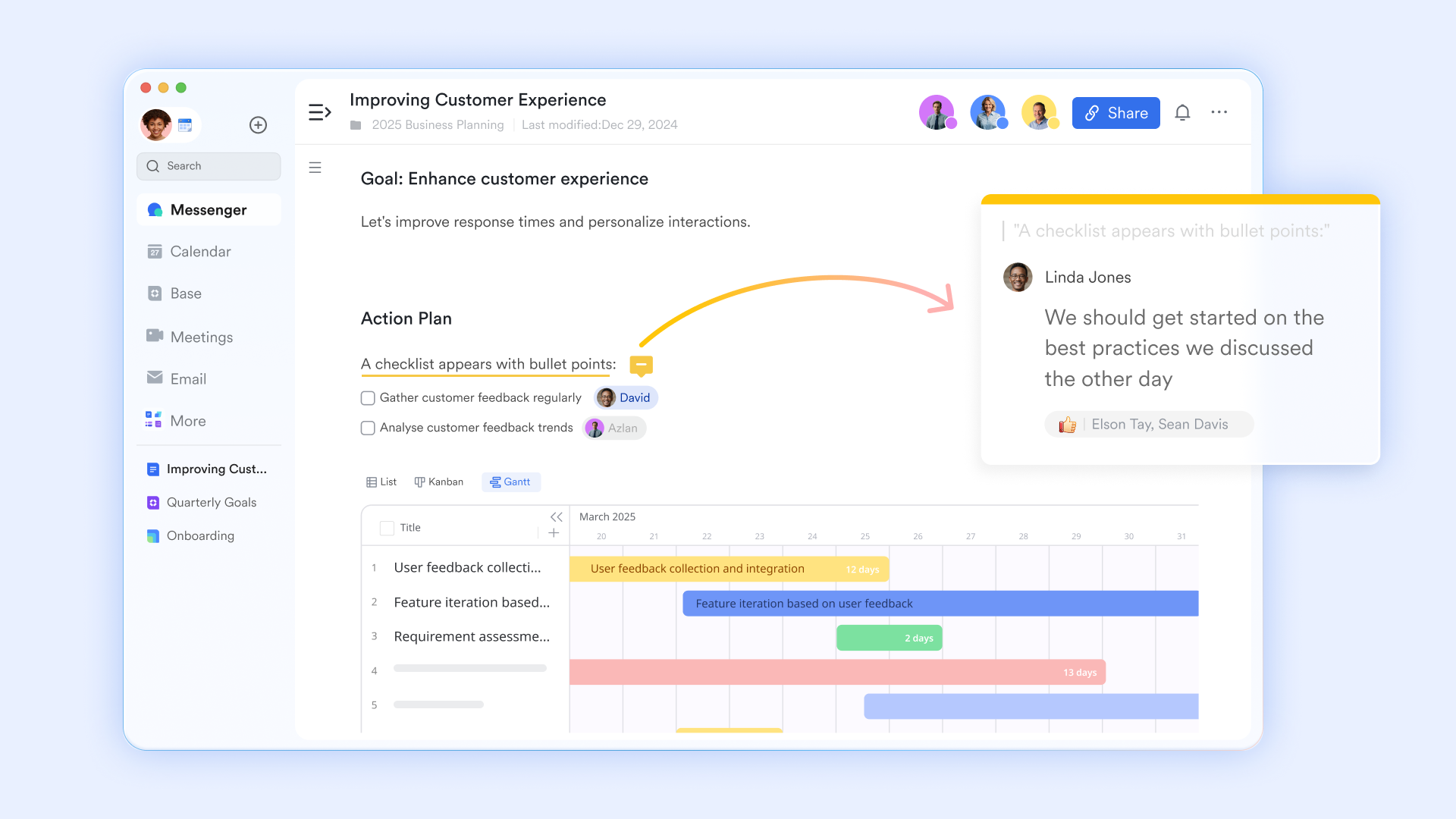
Establishing your project's North Star with Lark Docs
Projects often start with great enthusiasm but little precision. Kickoff meetings might produce high-level aspirations like "deliver value" or "improve efficiency," but these statements frequently lack the concrete criteria needed to truly measure project success. As the project progresses, different team members can interpret these goals in varied ways, leading to misalignment that only becomes apparent much later in the project, often during critical review stages or even post-delivery.
transforms this process by turning static goals into an interactive workspace. Instead of burying criteria in a file folder, you can use Lark Docs to co-edit success metrics in real-time during your kickoff call. Features like inline comments allow stakeholders to debate and clarify specific KPIs instantly, while @mentions ensure specific team members acknowledge their ownership of key results. You can even insert rich media or tables to visualize complex metrics directly within the document. This turns your success criteria into a living dashboard rather than a forgotten file, ensuring your team has a single, actionable source of truth to revisit throughout the project lifecycle.
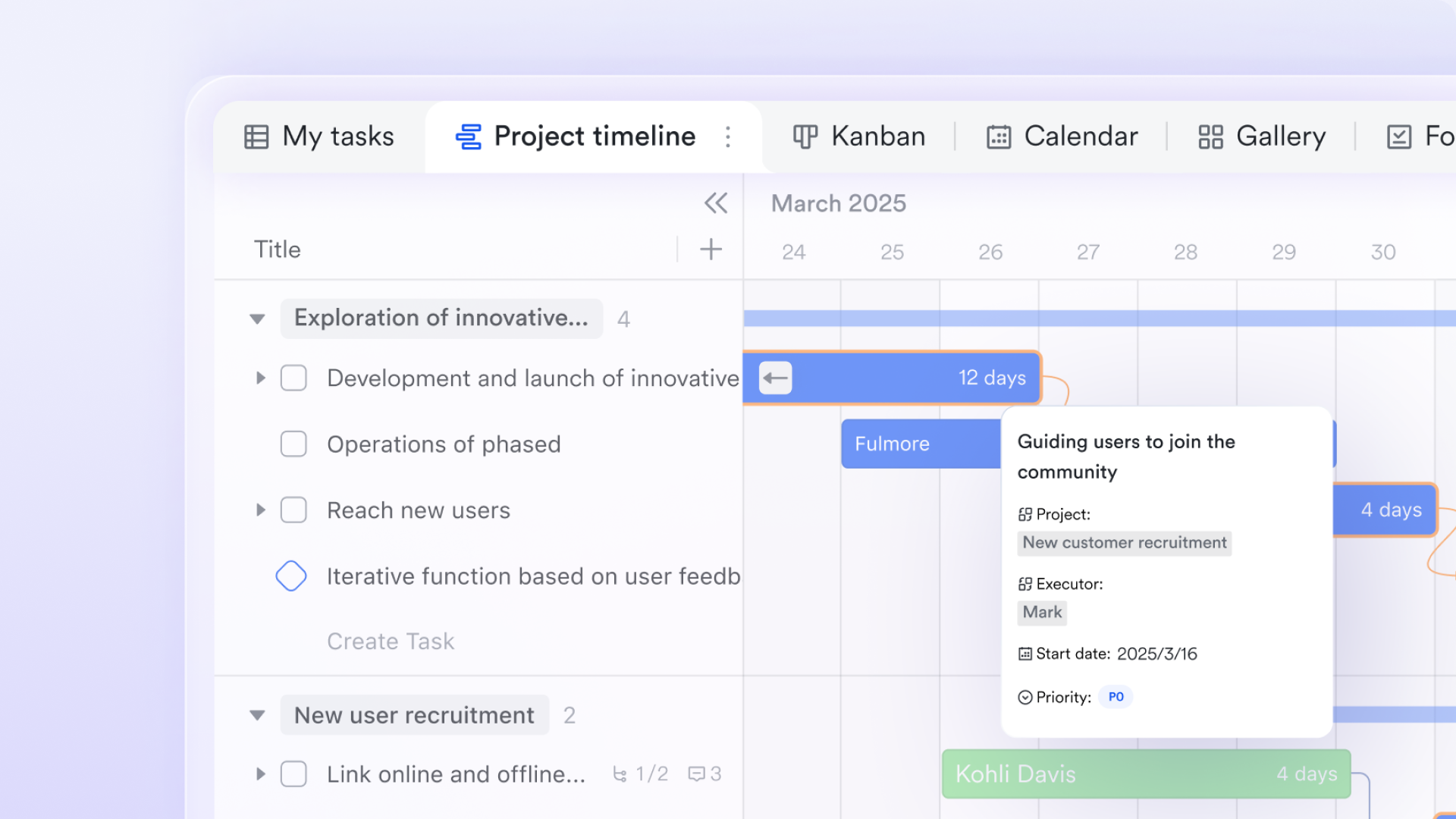
Transforming criteria into trackable actions with Lark Base
Even when project teams meticulously define their success criteria, the challenge of consistent measurement often persists. Criteria might reside in well-crafted documents, but the actual project progress and data live elsewhere, making evaluation subjective and inconsistent. This is particularly evident in complex projects, where success metrics can span technical readiness, user adoption, and operational stability. Without a structured system, teams might inadvertently measure what is easiest to track rather than what truly matters for project success.
provides the solution by enabling teams to translate abstract success definitions into structured, measurable execution. Within Lark Base, you can model each success criterion as a structured field, linking it directly to owners, related tasks, and current status. By leveraging Lark Base, progress, ownership, and status can be monitored , transforming success criteria from a post-project discussion point into an integral part of everyday decision-making. This structured approach complements qualitative discussions by providing concrete data, making any project success criteria template far more effective when embedded within a system that supports continuous updates, accountability, and clear visibility. This greatly enhances the ability to truly measure project success with tangible data.
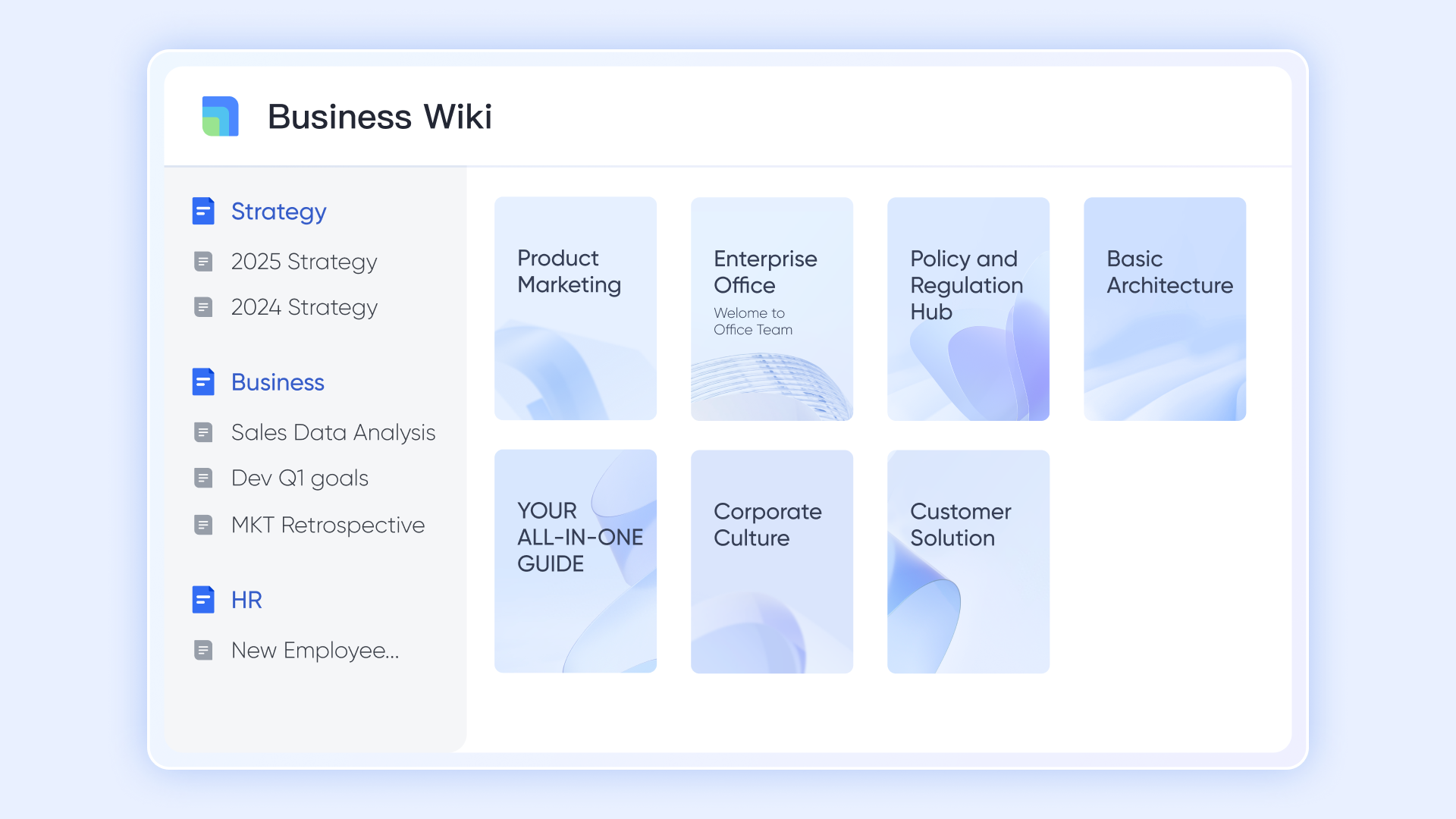
Centralizing success knowledge with Lark Wiki
A common pitfall for many projects is that even well-defined success criteria often end up scattered across various documents or tools, losing visibility as the project advances. Consequently, these criteria are rarely referenced in day-to-day decisions, leading to misalignment, subjective evaluations, and sometimes even a redefinition of "success" after the project is ostensibly complete. This challenge is amplified in cross-functional or distributed teams, where diverse stakeholders might hold different interpretations of what project success entails. Without a single, accessible source of truth, project criteria for success can remain theoretical rather than actionable.
offers a powerful solution by providing a centralized, trusted space where project success criteria remain visible, contextual, and actively used throughout the . Teams can document and maintain their success criteria alongside project goals, key decisions, and all supporting context. Furthermore, success criteria within Lark Wiki can be easily linked to related documentation, , and post-project retrospectives, evolving them from into living references. By centralizing and contextualizing success criteria, Lark Wiki helps teams move beyond implicit assumptions to achieve a shared, explicit understanding.
:
- Starter plan: Free forever plan with 11 powerful tools for up to 20 users, 100GB storage, 1,000 automation runs, AI translations, and more. No credit card needed.
- Pro plan: $12/user/month (billed annually) for up to 500 users. Includes everything in Starter plus group calling for up to 500 attendees, 15TB storage, 50,000 automation runs, and more.
- Enterprise plan: for custom pricing. Supports unlimited users and includes advanced automation, security, compliance, and management features.
For small teams with simple communication needs

18 months message history
1000 Base automation runs/month
2000 rows per table in Base
Most POPULAR
For companies with comprehensive collaboration and management needs
Unlimited message history
500-participant video meetings
50k Base automation runs/month
20k rows per table in Base
For large companies with advanced security and organizational management needs
Get a personalized demo and pricing
Unlimited message history
500-participant video meetings
15 TB storage + 30 GB storage/user
500k Base automation runs/month
50k Base automation runs/month
Most POPULAR
For companies with comprehensive collaboration and management needs
Unlimited message history
500-participant video meetings
50k Base automation runs/month
20k rows per table in Base
Common challenges and how to overcome them
Even with the clearest definitions and most robust metrics, measuring project success can be fraught with challenges. Recognizing these obstacles and equipping ourselves with strategies to overcome them is crucial for maintaining project momentum and achieving desired outcomes.
- Stakeholder misalignment: Different stakeholders often harbor competing priorities and expectations. For instance, senior management might prioritize financial returns, while end-users focus on functionality and ease of use. This divergence can lead to confused project direction and conflicting success measures. To overcome this, implement structured stakeholder management processes, including regular alignment meetings to identify and resolve conflicting priorities early on. Document all stakeholder requirements and create a clear hierarchy of success criteria, ensuring everyone understands which metrics take precedence when conflicts arise.
- Unrealistic expectations: Stakeholders sometimes demand outcomes that exceed project constraints or organizational capabilities, often stemming from market pressures or an incomplete understanding of project limitations. To manage this, base your success criteria on solid and proven capabilities. Present stakeholders with benchmark data from similar projects and create detailed feasibility analyses that clearly illustrate the relationships between resources, time, and achievable outcomes. This evidence-based approach helps set realistic expectations for measuring success of a project.
- Scope changes: They are an almost inevitable part of , but they can invalidate originally defined success criteria. As requirements evolve, previously established metrics might no longer accurately reflect project reality or business needs. To address this, establish a robust change management process that explicitly includes success criteria revision. When scope changes occur, automatically trigger a review of related success criteria, document the impact of these changes on metrics, and obtain stakeholder approval for any revised criteria.
- Metric clarity issues: Vague or poorly defined metrics create confusion and hamper progress. Without clear measurements, teams struggle to track their performance and demonstrate success. The solution lies in defining specific, measurable indicators for each success criterion. Replace subjective statements with quantifiable metrics. For example, instead of "improve customer satisfaction,"the aim for "achieving a customer satisfaction score of 4.5/5 within three months of launch." This adheres to the SMART (Specific, Measurable, Achievable, Relevant, Time-bound) criteria framework.
- Technology integration challenges: Digital transformation initiatives can introduce complex measurement requirements that existing systems struggle to track. The remedy involves investing in appropriate measurement tools and platforms and providing thorough training for teams on how to effectively use these new systems to collect and interpret . Consider implementing automated data collection and analysis tools to reduce manual effort and improve accuracy.
Achieve project success with an all-in-one tool
Conclusion
Effectively measuring project success is no longer a luxury but a necessity for any organization aiming for consistent growth and strategic achievement. It transcends merely checking boxes for on-time and on-budget delivery, delving into the true value delivered, stakeholder satisfaction, and alignment with overarching business objectives. By embracing a holistic approach like Lark that integrates both quantitative and qualitative measures, teams can gain profound insights into their performance, identify areas for improvement, and build a strong foundation for future endeavors. This commitment to rigorous evaluation ensures that every project not only meets its immediate goals but also contributes meaningfully to the organization's long-term vision, making measuring the success of a project an indispensable practice in today's competitive landscape.
FAQs
How do "hard" and "soft" criteria contribute to understanding project success?
Effectively measuring project success requires a comprehensive approach, employing a variety of metrics and evaluation techniques tailored to the specific nature of each project. These methods can broadly be categorized into quantitative "hard criteria" and qualitative "soft criteria," both essential for a holistic understanding of a project's impact. Hard criteria, such as financial targets and time-based measurements, offer clear, numbers-based evidence of performance. Soft criteria, like stakeholder satisfaction and team development, address less tangible but equally crucial aspects, often measured through surveys or ratings. By thoughtfully selecting and consistently tracking these diverse indicators, organizations can gain a truly insightful picture of their project's success.
What are key differences between Waterfall and Agile project metrics?
For projects following a Waterfall (predictive) methodology, where scope, schedule, and cost are typically defined at the outset, several key performance indicators (KPIs) are commonly used: Schedule variance (SV), Actual cost (AC), Cost variance (CV), Planned value (PV), Earned value (EV), Schedule performance index (SPI), Cost performance index (CPI), Estimate at completion (EAC), and Project margin. In contrast, for Agile (adaptive) projects, which embrace flexibility and iterative development, different metrics are more appropriate: Story points, Velocity, Burndown charts, Cumulative flow diagrams, Lead time, Cycle time, and Defect density. The choice of metrics should align with the project's specific purpose, desired outcomes, and methodology.
What broader factors beyond specific metrics determine project success?
Beyond specific metrics, measuring project success also involves considering broader criteria such as cost and profitability (ROI), which ensures the project generates a healthy return on investment. Customer satisfaction is a critical qualitative measure, often gauged through surveys and feedback. Team satisfaction, referring to the well-being and engagement of the project team, is also vital. Output quality pertains to the inherent quality of deliverables, assessed through internal reviews and industry standards. Finally, continual improvement (Kaizen) involves adopting a mindset of small, regular improvements across all aspects of a project to consistently seek marginal gains.
Related reading