Successful project delivery rarely happens by accident; it requires a precise balance of leadership and analytical oversight. While managers steer the team, project controllers ensure the ship stays on course financially and operationally. If you have ever wondered how complex initiatives stay within budget and on schedule, the answer often lies in the diligent work of these specialists. In this guide, we will explore the nuances of this role, how it differs from project management, and why it is indispensable for modern organizations looking to scale efficiently.
What are project controllers?
At its core, the role of a project controller is defined by a focus on data, compliance, and the quantifiable health of a project. Unlike general management roles that focus heavily on people and deliverables, project controllers are the financial and operational conscience of an initiative. They are the professionals responsible for planning, monitoring, and reporting on the specific metrics that determine whether a project is viable.
You can think of a project controller as an independent auditor who works internally. They provide an objective view of project performance, detached from . Their primary mandate is to generate accurate information that allows decision-makers to steer the project correctly. This involves setting up the structures for cost control, schedule adherence, and risk analysis before a project even kicks off.
In many organizations, project controllers report to a or a finance department rather than the project manager directly. This structural separation is intentional. It ensures that the reporting on budget burn rates, resource utilization, and forecasting remains unbiased. When a project manager is deeply invested in getting a feature released, they might be optimistic about the timeline. A project controller, however, looks at the historical data and current trends to provide a realistic forecast, flagging potential overruns before they become critical issues.
The scope of this role can vary depending on the industry. In construction or engineering, a project controller might focus heavily on material costs and supply chain logistics. In software development or IT, the focus might shift toward resource hours and scope creep. Regardless of the sector, the fundamental definition remains the same: they are the guardians of the project's scope, schedule, and budget, using rigorous analytical methods to maintain control. They bridge the gap between the chaotic reality of project execution and the rigid requirements of financial planning.
See how structured controls improve project outcomes
Differences between project managers and project controllers
While they often work side-by-side, the distinction between a project manager and a project controller is vital for organizational clarity. Both roles aim for project success, but they approach it from fundamentally different angles and have distinct spheres of influence.
The primary difference lies in their focus. A project manager is people-oriented and task-driven, focusing on "how" to get the work done. A project controller is data-oriented and analytical, focusing on "how well" the project is performing against the plan.
Distinct responsibilities
To understand the separation of duties, it helps to look at what each role is accountable for on a daily basis:
- : This role is akin to the captain of a ship. They are responsible for leading the team, communicating with stakeholders, removing roadblocks, and ensuring the final deliverables meet quality standards. They own the execution. If a team member is underperforming or a client changes a requirement, the project manager handles the immediate resolution.
- Project controller: This role acts more like the navigator or the financial officer. They own the data. They do not typically direct the team's daily tasks. Instead, they monitor the impact of those tasks on the budget and schedule. If the client changes a requirement, the project controller calculates the financial impact and updates the forecast.
Authority and reporting lines
Another key area of divergence is where their authority comes from. Project managers usually have direct authority over the project team and the execution process. They make decisions about who does what. Project controllers, conversely, exercise authority through information. They often hold a "functional" authority, meaning they can mandate how data is reported or which tools are used for tracking, but they rarely tell a developer or engineer what to build.
Reporting lines also reinforce this separation. Project managers often report to a or business unit leader interested in the deliverable. Project controllers frequently report to a finance director or a centralized PMO. This ensures that if a project is failing financially, the controller can raise a red flag without fear of conflict with the project manager who might want to downplay the issue.
Qualitative vs. quantitative
The mindset required for each role differs significantly. Project management is often qualitative; it involves negotiation, motivation, and leadership soft skills. Project control is heavily quantitative. It relies on variance analysis, earned value management, and hard statistics. A project manager might say, "The team is feeling confident about the deadline." A project controller will counter with, "Current velocity data suggests a 15% probability of missing the deadline based on the last three sprints."
By separating these duties, organizations create a system of checks and balances. The project manager drives progress, while the project controller ensures that progress is sustainable and aligned with the organization's financial realities.
What do project controllers do?
The daily life of a project controller is diverse, involving a mix of strategic planning, detailed analysis, and constant communication with stakeholders. Their work spans , from the initial bid or proposal phase all the way through to project closure and review. To truly understand the value they bring, we must look at the specific tasks they handle.
Here are the primary functions that define what do project controllers do in a professional setting.
Project planning and setup
Before the work begins, the controller is instrumental in establishing the baseline. This is the standard against which all future performance will be measured.
- : They work with technical leads to build detailed cost estimates, ensuring that labor, materials, and overhead are accurately accounted for.
- Schedule development: They assist in creating the master schedule, identifying the critical path—the sequence of tasks that dictates the project's duration.
- : They help organize the project into manageable chunks (work packages) and assign cost codes to each, enabling granular tracking later on.
Cost management and forecasting
Once the project is underway, cost control becomes the central activity. This is not just about bookkeeping; it is about looking forward.
- Tracking actuals: The controller monitors expenses as they occur, verifying invoices and timesheets against the original plan.
- Variance analysis: They constantly compare the "budgeted cost of work performed" against the "actual cost of work performed." If a variance exceeds a certain threshold, they investigate the cause.
- : This is perhaps the most critical task. Using current data, they predict the final cost of the project. This involves updating the Estimate at Completion (EAC) and Estimate to Complete (ETC), giving stakeholders an early warning if the budget is at risk.
Schedule monitoring
Time is money, and project controllers act as the timekeepers. They ensure that slippage in one area doesn't unknowingly derail the entire timeline.
- Progress updates: They collect status data from team leads to update the schedule percentage complete.
- Trend analysis: By analyzing the rate of progress, they can identify negative trends—such as a specific phase consistently taking 20% longer than planned—and model the impact on the final delivery date.
Risk and change management
Projects rarely go exactly according to plan. Project controllers manage the turbulence caused by changes and risks.
- Change : When the scope changes, the controller quantifies the cost and schedule impact. They ensure that no extra work is done without a crucial approval and budget adjustment.
- Risk assessment: They maintain the risk register, assigning financial values to potential risks and tracking the budget reserves set aside to handle them.
Reporting and compliance
Finally, the controller is the storyteller of the project's status, translating raw data into actionable insights for executives.
- Dashboard creation: They design and maintain dashboards that show like Cost Performance Index (CPI) and Schedule Performance Index (SPI).
- Audit support: They ensure that all project documentation and financial records meet internal and external audit standards.
Through these diverse activities, project controllers provide the visibility required to keep complex projects from spiraling out of control.
Necessary skills of project controllers
Because this role sits at the intersection of finance, management, and operations, it requires a unique blend of hard technical skills and soft interpersonal abilities. A successful project controller must be comfortable crunching numbers in isolation but equally capable of explaining those numbers to a non-financial audience.
To thrive in this position, professionals typically need to cultivate the following competencies:
- Analytical thinking: This is the bedrock of the profession. Controllers must be able to look at large datasets, identify patterns, and spot anomalies. They need to understand cause-and-effect relationships, such as how a delay in procurement might ripple through the budget three months later.
- Proficiency in project management software: Modern control is digital. The mastery of tools like , Primavera P6, or integrated ERP systems like SAP or Oracle is essential. Furthermore, advanced Excel skills (pivot tables, macros) remain a staple for custom modeling.
- Financial acumen: Understanding accounting principles is non-negotiable. Controllers must grasp concepts like accruals, capitalization, cash flow analysis, and revenue recognition to report accurately.
- : Data is useless if it cannot be understood. Controllers must be able to translate complex financial jargon into clear, concise language for project managers and executives. They need the confidence to deliver bad news—such as budget overruns—clearly and constructively.
- Attention to detail: In project control, a small error in a formula or a misplaced decimal point can lead to million-dollar mistakes in forecasting. A rigorous commitment to accuracy is required.
- Problem-solving: When the data shows a project is off track, the controller acts as a troubleshooter. They shouldn't just report the problem; they should be able to model various "what-if" scenarios to help the team find a recovery plan.
Developing these skills transforms a project controller from a simple data entry clerk into a strategic partner who actively drives project success.
Master all those skills in one platform
Lark: A smart choice for project controllers
For project controllers, the biggest enemy is often fragmented data. When schedule information lives in one tool, budget tracking in another, and communication in a third, creating an accurate forecast becomes a manual, error-prone nightmare. addresses this challenge by bringing planning, execution, and reporting into a single workspace, giving controllers the live visibility they need to maintain strict oversight without slowing down the team.
Structured data for accurate forecasting
A controller's ability to predict outcomes depends entirely on the quality of their data. Lark replaces loose spreadsheets with rigid, structured records that serve as a reliable single source of truth for your project baselines.
Dynamic scheduling with : You can define project work using structured records where every task includes specific start dates, dependencies, and owners. The automatically visualizes these relationships, showing the critical path clearly. If a task is delayed, the system instantly highlights the downstream impact, allowing you to update your Estimate at Completion (EAC) based on reality rather than guesswork.

Clear ownership: With Lark Tasks, every line item in your plan translates into an executable action with a designated owner. This linkage ensures that the work being done aligns perfectly with the master project structure, reducing the "scope creep" that often flies under the radar in less integrated systems. 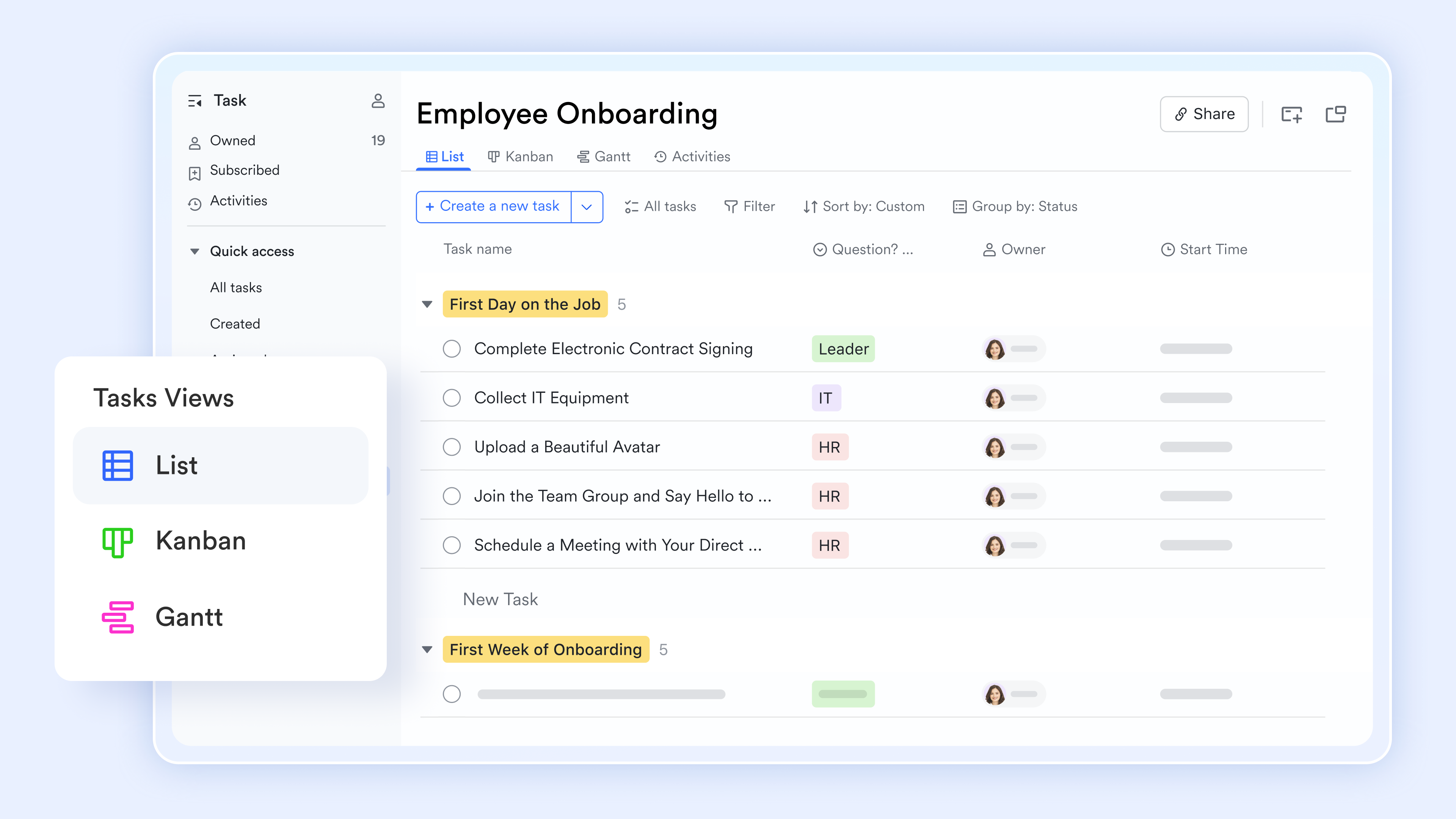
Real-time visibility and reporting
Instead of spending days compiling static weekly status reports that are outdated the moment they are sent, project controllers can use Lark to provide stakeholders with a live window into project health.
Live dashboards: Lark Base dashboards convert raw project data into actionable insights instantly. You can —such as adherence, task completion rates, and risk indicators—in one centralized view. Because these dashboards pull directly from active records, they update continuously as work progresses, enabling faster variance analysis. 
Living documentation: allows you to maintain risk logs and control reports that evolve alongside the project. By embedding live data and task lists directly into your documents, you ensure that your reporting remains connected to the actual execution state.

Automated governance and compliance
Project control is largely about ensuring that processes are followed. Lark Base workflows automates the governance side of the role, reducing the need for manual policing and ensuring that compliance is baked into the workflow. Automated workflows: You can define specific rules to enforce control processes, such as notifying stakeholders when a budget threshold is approached or automatically generating approval tasks for scope changes. This ensures that handoffs and reviews happen consistently, maintaining the integrity of your audit trail.

Contextual coordination: keeps communication tied directly to project execution. When a decision is made to reallocate resources, the discussion happens right next to the data record. This preserves the context for future audits, helping you understand why a variance occurred, not just that it occurred.

:
- Starter plan: Free forever plan that includes 11 powerful tools for up to 20 users. It also comes with 100GB of storage, 1000 automation runs, AI translations, and more.
- Pro plan: $12/user/month (billed annually) for up to 500 users. It includes everything in Starter plus group calling for up to 500 attendees, 15TB of storage, 50,000 automation runs, and more.
- Enterprise plan: for custom pricing. Supports unlimited users and includes even more automation runs and advanced security, compliance, and management features.
For small teams with simple communication needs

18 months message history
1000 Base automation runs/month
2000 rows per table in Base
Most POPULAR
For companies with comprehensive collaboration and management needs
Unlimited message history
500-participant video meetings
50k Base automation runs/month
20k rows per table in Base
For large companies with advanced security and organizational management needs
Get a personalized demo and pricing
Unlimited message history
500-participant video meetings
15 TB storage + 30 GB storage/user
500k Base automation runs/month
50k Base automation runs/month
Most POPULAR
For companies with comprehensive collaboration and management needs
Unlimited message history
500-participant video meetings
50k Base automation runs/month
20k rows per table in Base
Why are project controllers important?
In an era where projects are becoming increasingly complex and budgets are tighter than ever, the role of the project controller has shifted from a luxury to a necessity. Without dedicated project control examples of failure are easy to find: massive infrastructure projects billions over budget or IT rollouts that are years late.
Project controllers act as the early warning system for an organization. By rigorously monitoring metrics, they provide the foresight needed to pivot before a small issue becomes a disaster. For instance, a project manager might be optimistic that a delayed task can be caught up next week. A project controller, analyzing the team's historical velocity, can demonstrate mathematically that catching up is unlikely without additional resources. This objective insight allows leadership to make informed decisions—like cutting scope or adding budget—while there is still time to act.
Furthermore, they enforce accountability. When everyone knows that a project controller is tracking every hour and every dollar, there is a natural psychological effect that encourages efficiency. They ensure that resources are not wasted and that the project remains aligned with the business case that justified it in the first place.
Ultimately, project controllers protect the organization's profit margins. By preventing , minimizing schedule delays, and ensuring accurate billing, they directly contribute to the bottom line. They provide the confidence stakeholders need to invest in large-scale initiatives, knowing that there is a dedicated guardian ensuring the investment yields the intended return.
Conclusion
Project controllers serve as the vital link between ambitious planning and realistic execution. By rigorously monitoring budgets, schedules, and risks, they ensure that organizations don't just finish projects, but finish them profitably and sustainably. As we have explored, this role requires a distinct blend of analytical precision and strategic foresight that goes beyond standard management tasks.
However, even the most skilled controller needs the right environment to thrive. Lark empowers these professionals by transforming static data into real-time insights, ensuring your team maintains visibility and control from start to finish. If you are ready to elevate your project governance with a unified workspace, consider adopting Lark to drive efficiency and transparency across your portfolio.
Monitor performance of project controller now
FAQs
What does a project controller do?
A project controller acts as the financial and operational auditor of a project, distinct from the project manager who leads the team. Their primary role is to ensure the project remains viable by monitoring the scope, schedule, and budget. They establish performance baselines, track actual costs against the plan, and forecast future trends to predict the final outcome. Additionally, they handle risk assessment and change management, quantifying the impact of any deviations. By providing objective, data-driven insights, they enable stakeholders to make informed decisions to keep the project on track.
What are the 5 project controls?
While frameworks may vary slightly, the five core pillars of project control essential for successful delivery include:
- Planning and scheduling: Developing the master schedule, work breakdown structure (WBS), and critical path.
- Cost management: Estimating budgets, tracking expenditures, and forecasting final costs.
- Risk management: Identifying, analyzing, and mitigating potential financial and operational threats.
- Change management: Documenting and assessing the impact of scope changes on cost and time.
- Performance reporting: communicating project health through KPIs, dashboards, and compliance audits to ensure transparency.
What skills do you need to be a project controller?
To thrive as a project controller, professionals need a strong mix of hard and soft skills. Analytical thinking is paramount for interpreting complex datasets and spotting trends. Financial acumen is required to understand accounting principles and cash flow. Proficiency in project management software (such as Primavera P6, Microsoft Project, or advanced Excel) is non-negotiable for modeling. Furthermore, strong communication skills are essential to translate technical data into clear insights for executives, while attention to detail ensures that forecasts and reports are accurate enough to drive high-stakes business decisions.
Related reading