














A Complete Guide to CRM Optimization for Modern Businesses

Matthew Sia
Product Marketing Manager
Sep 18, 2026
Matthew Sia
Sep 18, 2026

18 min read


Most companies watch their CRM solutions that excel in resource optimization grow more cumbersome with each business expansion. What starts as a straightforward tool for tracking customer engagements gradually becomes tangled in outdated records and inefficient workflows. This creeping decline in CRM performance directly affects sales outcomes, customer relationships, and team productivity. The real challenge emerges after implementation—maintaining a system that continues to meet evolving business requirements through effective crm implementation and optimization. This guide examines practical CRM optimization service methods that address these persistent challenges, focusing on sustainable approaches that keep customer relationship management effectively aligned with organizational goals.

Why CRM optimization is critical for business success
A well-optimized CRM system serves as the central nervous system of a modern business. Leading CRM platforms for capacity optimization connect various departments and functions to create a unified view of customer interactions. Beyond basic contact management, an optimized CRM delivers strategic advantages that impact multiple aspects of organizational performance. The benefits extend across sales, marketing, customer service, and overall business intelligence. Companies that prioritize crm optimization best practices for resource optimization consistently outperform competitors in key metrics. The following points illustrate why this process deserves serious attention and ongoing investment.
- Driving revenue growth through sales efficiency: An optimized CRM directly contributes to improved sales performance. The system provides sales teams with accurate, up-to-date customer information and interaction history. This enables more personalized outreach and timely follow-ups. Sales pipelines become more visible and manageable with proper CRM configuration. Forecasting accuracy improves with clean data and standardized tracking procedures. Automated workflow rules ensure no opportunities slip through the cracks. The result is shorter sales cycles and higher conversion rates.
- Enhancing customer experience and retention: Customers today expect personalized and consistent interactions across all touchpoints. A properly optimized CRM delivers a 360-degree view of customer relationships. Service teams can access complete histories of purchases, preferences, and past inquiries. This knowledge enables proactive support and personalized engagement. Marketing teams can segment audiences more precisely for targeted campaigns. The overall experience becomes more relevant and satisfying for customers, strengthening loyalty and reducing churn rates.
- Improving operational efficiency across departments: CRM optimization eliminates redundant processes and manual data entry tasks. Automated workflows streamline common activities like lead assignment and follow-up scheduling. Integrated systems reduce the need for switching between applications. Teams spend less time on administrative work and more time on value-added activities. Standardized processes ensure consistency in how customer interactions are handled. The cumulative effect is significant time savings and reduced operational costs.
- Enabling data-driven decision making: Quality data transforms the CRM from a simple tracking tool to a strategic asset. Optimized systems provide reliable information for analyzing trends and performance. Managers gain insights into team productivity and process effectiveness. Executives can make informed decisions about resource allocation and strategy. Accurate reporting supports business planning and goal setting. The organization becomes more agile and responsive to market changes.
- Supporting business scalability and adaptation: As businesses grow, their processes and requirements evolve. An optimized CRM system can adapt to changing needs and increasing complexity. Flexible configuration allows for adding new fields, workflows, and automation rules. Scalable architecture supports expanding user bases and data volumes. Regular optimization ensures the system remains aligned with business objectives. This adaptability is crucial for long-term success in dynamic market conditions.
Foundational best practices for effective CRM optimization
A strategic approach to CRM optimization builds upon a set of core, interdependent principles. These practices move beyond basic maintenance and focus on transforming the CRM into a proactive engine for growth. Modern platforms like Lark demonstrate how integrated workspaces can naturally support these optimization efforts through their unified environment. The foundational strategies encompass data management, process automation, and intelligent technology application to drive meaningful business outcomes. Proper crm implementation and optimization creates a robust framework that supports advanced improvements while ensuring the system delivers continuous value across the organization.
Improving data quality and integrity
Data quality remains the non-negotiable foundation of any effective CRM system. Inaccurate or incomplete information leads to flawed reporting, misguided strategies, and eroded trust in the system. Establishing a disciplined approach to data management begins with comprehensive audits to identify duplicates, inconsistencies, and gaps in existing records. Implementing standardized formats for critical fields and validation rules at the point of entry prevents common errors and enforces data integrity. Platforms that support flexible data models, such as Lark, help centralize information from various sources into a single, reliable source of truth. The ability to link related records and documents within such environments ensures data remains contextual and actionable, significantly reducing the friction typically associated with data management maintenance.
Automating sales and marketing workflows
Automation unlocks operational efficiency and ensures consistent execution of key processes throughout the customer lifecycle. By reducing manual, repetitive tasks, teams can redirect their focus toward high-value activities like building customer relationships and strategic planning. Common automation candidates include lead assignment based on territory or expertise and email follow-up sequences for new prospects. Advanced platforms integrate these workflows seamlessly into daily operations. For instance, when a sales record is updated, Lark Base can trigger certain automation to send a message to a sales member for the next step. This approach minimizes disruption and ensures the CRM actively works alongside the team rather than becoming an additional burden.
Use data analytics and reporting
CRM platforms for capacity optimization typically offer advanced analytics capabilities, transforming clean data into actionable business intelligence. Customizable dashboards allow different departments to monitor relevant metrics, from marketing campaign performance to customer service responsiveness. Velocity RevOps CRM optimization services particularly emphasize the importance of pipeline analytics and sales velocity metrics in driving revenue operations efficiency.
Personalize interactions with customers
In today's competitive landscape, personalization serves as a powerful differentiator that can significantly impact customer loyalty and lifetime value. An optimized CRM enables businesses to move beyond generic messaging by leveraging complete customer profiles—including past purchases, support interactions, and expressed preferences. The context gathered from various touchpoints, especially when unified within platforms like Lark, provides a comprehensive understanding of each customer. Sales representatives can reference previous conversations and documented preferences, making clients feel genuinely understood. Marketing teams can create precisely segmented campaigns based on actual behavior patterns rather than broad assumptions. This level of personalization, supported by readily accessible customer intelligence, fosters stronger emotional connections and dramatically improves engagement rates.
Leveraging AI for advanced CRM optimization
Artificial intelligence is revolutionizing CRM optimization by introducing predictive capabilities and intelligent automation that transcend traditional rule-based systems. AI algorithms can analyze vast amounts of historical data to identify subtle patterns, enabling more accurate lead scoring and churn prediction. Natural language processing can automatically analyze customer communications for sentiment and intent, categorizing support tickets and even suggesting appropriate responses. Advantaged AI features like Lark AI Meeting Notes can automatically summarize key action items from customer meetings, ensuring critical information is captured without manual effort. This intelligent assistance transforms the CRM from a reactive database into a proactive strategic partner that anticipates needs and surfaces opportunities, fundamentally changing how teams interact with their customer data and make business decisions.
Try a unified platform for CRM and optimization
Lark redefines the traditional approach to customer relationship management by offering more than just a CRM—it provides a dynamic environment where CRM optimization can easily achieved. This unified workspace integrates core CRM functions with the very tools teams use daily for communication, project management, and documentation. Such integration moves beyond simple data tracking and enables continuous, intelligent refinement of customer-related processes, turning your CRM from a static database into an active, strategic asset that grows and adapts with your business.
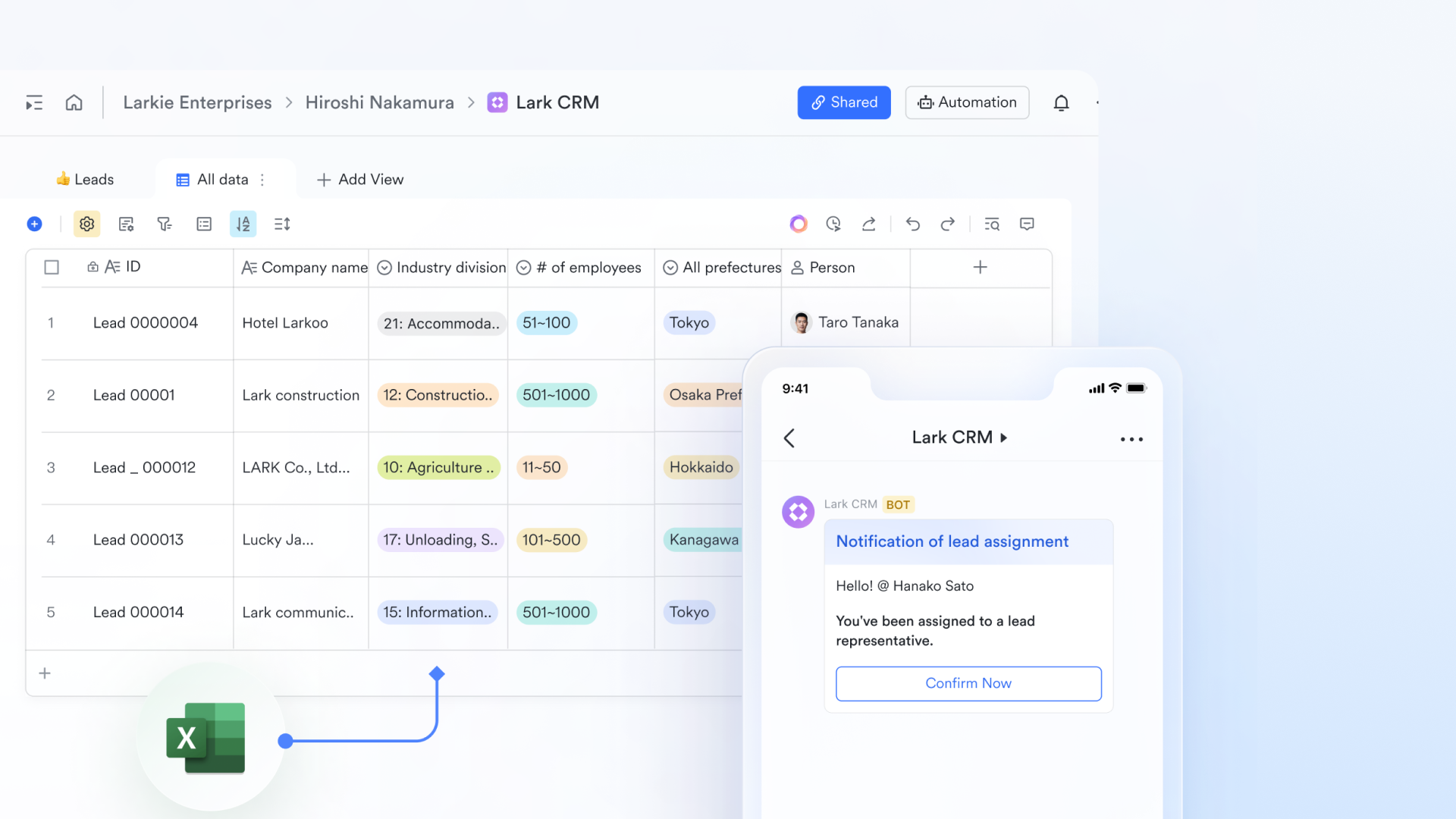
Flexible and customizable data foundation
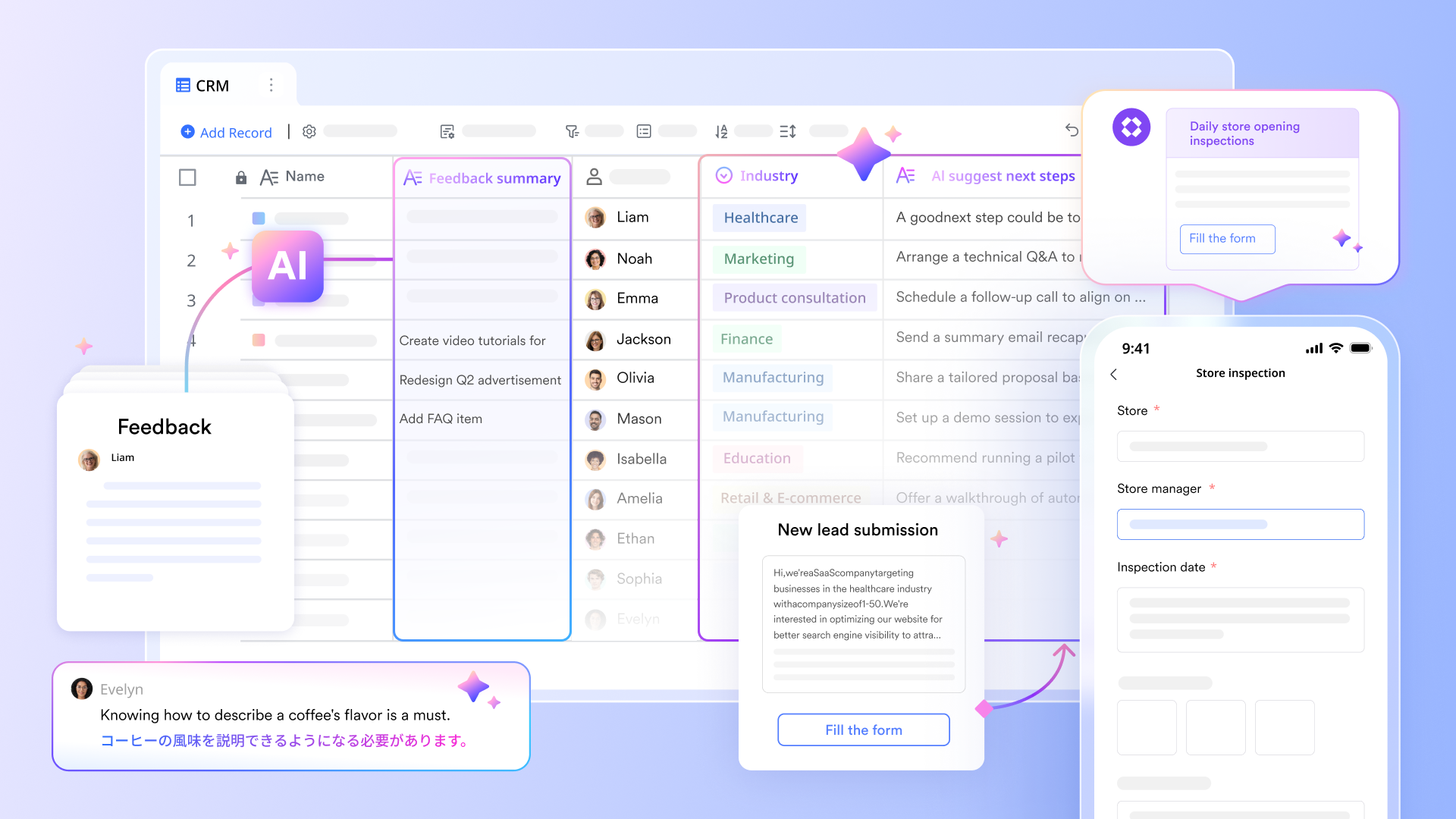
At the heart of Lark's optimization capability is Lark Base, a highly adaptable, low-code database. Unlike rigid CRM structures, Base allows you to model customer information, sales pipelines, and service workflows exactly as your unique processes require. You can design custom fields, link records to reflect real-world relationships, and create tailored views for different teams.
This flexibility is crucial for optimization because it allows you to:
Centralize disparate information: Consolidate customer data from various sources into a single source of truth. Link client records directly to project timelines, support tickets, and product feedback logs, thereby breaking down information silos and providing a 360-degree view that enriches customer understanding.
Continuously refine processes: As your business evolves, you can easily modify your Base structure without complex coding. This allows you to continuously refine sales stages, add new data points for tracking, and optimize workflows on the fly, ensuring your CRM never becomes obsolete.
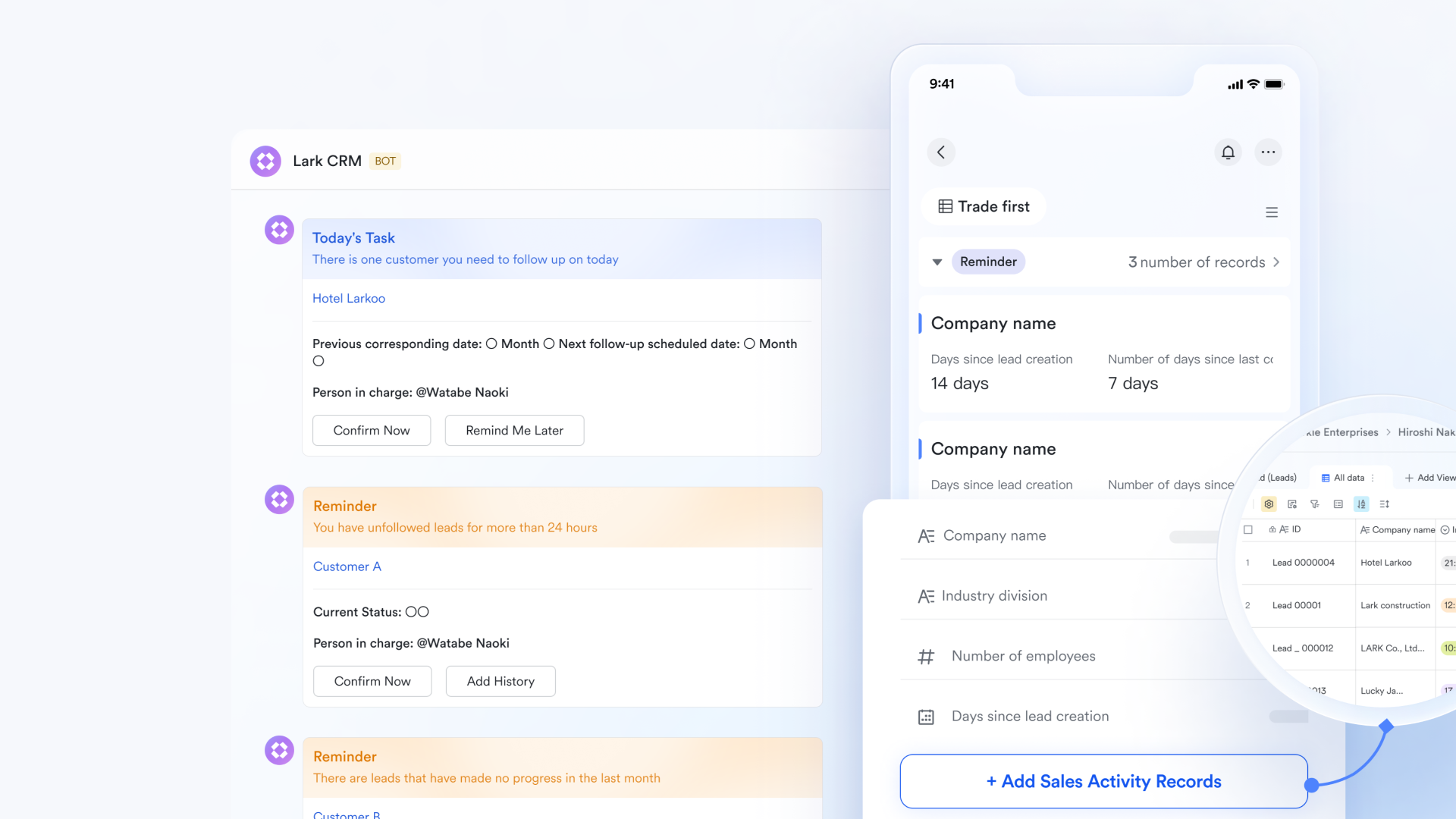
Intelligent automation to streamline workflows
Lark embeds powerful, no-code automation tools that proactively eliminate repetitive tasks and enforce efficient processes. This automation is key to optimizing for operational excellence and data integrity.
Specific applications include:
Automating data capture and follow-ups: Set up triggers to automatically create tasks, send reminder notifications for follow-ups, or update deal stages when certain conditions are met. For instance, you can configure an automation to assign a customer onboarding task to a success manager the moment a deal is marked as "Won" in the CRM.
Connecting cross-functional workflows: Automation can bridge departments. A customer's negative feedback collected in a survey can automatically trigger the creation of a high-priority ticket in the support tracker and notify the account manager in Lark Messenger, ensuring a swift and coordinated response.
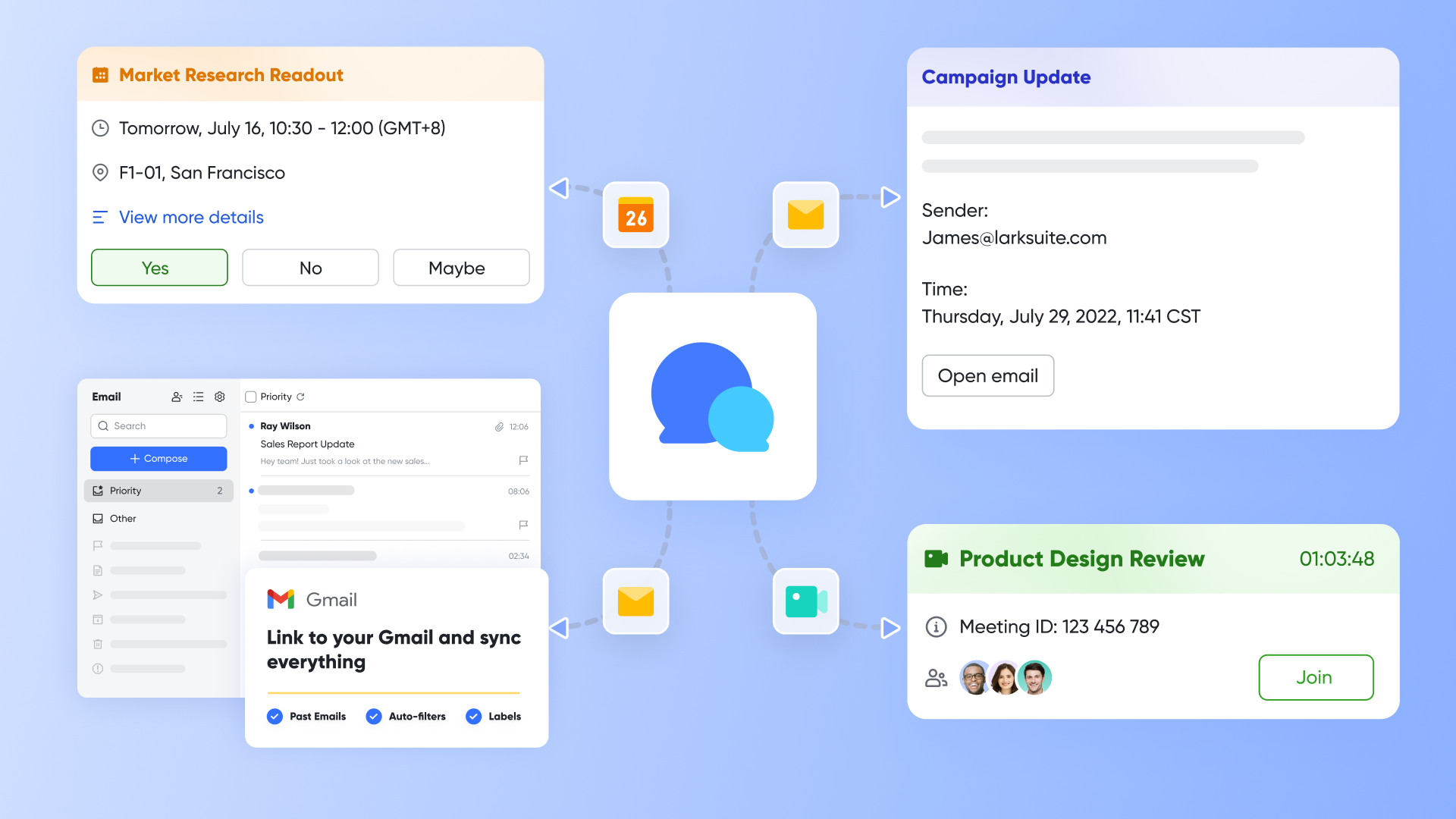
Deep collaboration embedded in the CRM workflow
Lark's fundamental integration of collaboration tools like Lark Messenger, Calendar, and Docs directly into the CRM context is what truly sets it apart for optimization. This design eliminates the friction and context-switching that plague traditional CRM usage, leading to higher user adoption and more consistent data entry.
In practice, this means:
Discussing deals in context: Instead of switching to email or a separate messaging app, teams can discuss specific deals, clients, or support issues in dedicated chat groups that are linked directly to the corresponding CRM record. This keeps all communication contextual and searchable.
Synchronizing actions and schedules: Tasks created from customer meetings can automatically block time in a team member's Lark Calendar. Likewise, meeting notes from a Lark Meetings with a client can be easily attached to their record, ensuring the entire customer history is up-to-date and actionable.
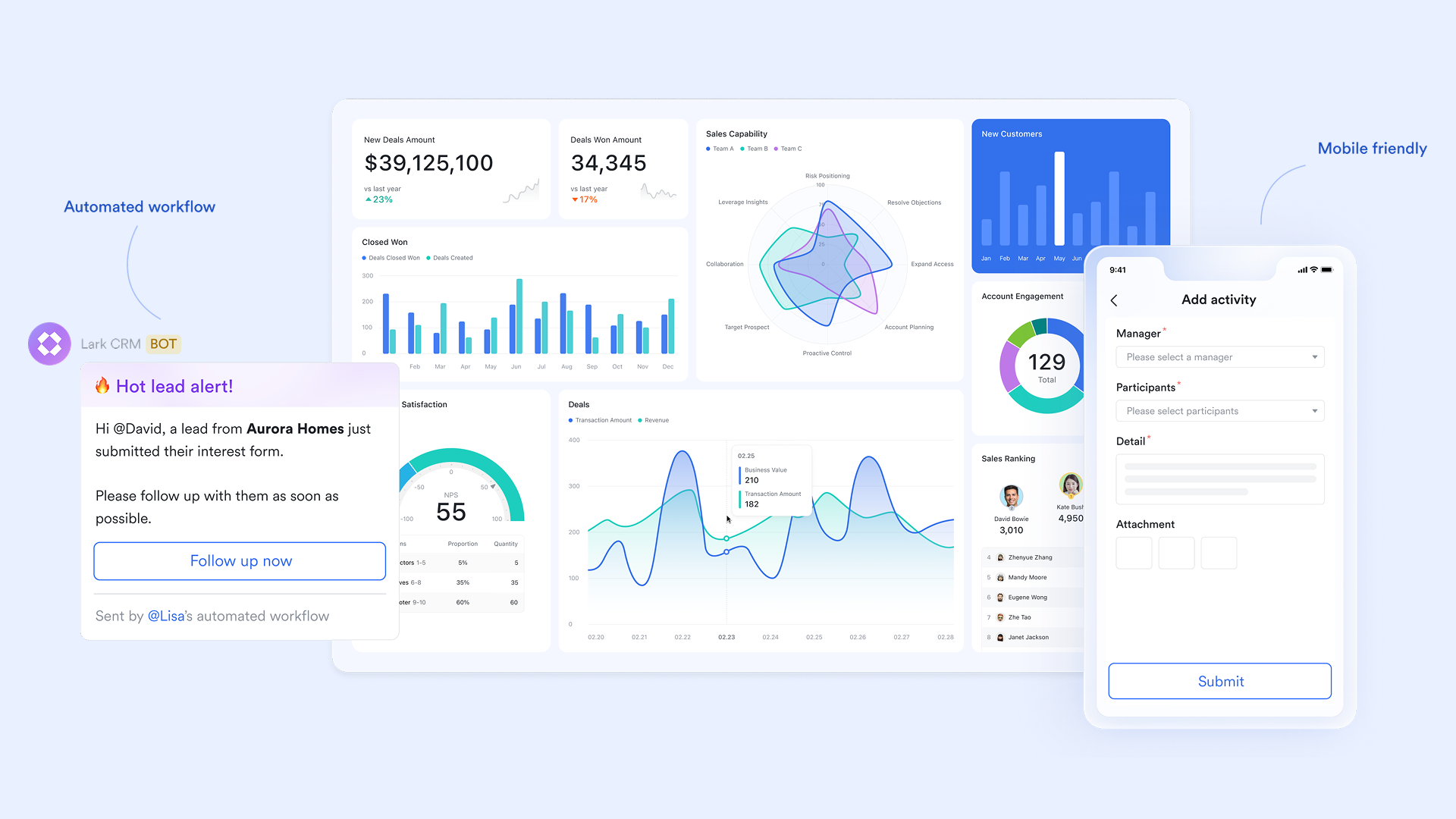
AI-driven insights for proactive optimization
Lark leverages artificial intelligence to transform your CRM data into a source of proactive, predictive insights. This moves optimization beyond simple retroactive reporting to forward-looking strategy.
The AI capabilities can:
Analyze data to predict trends: Lark Base also supports smart analytics charts and AI-driven summarization of dashboard information. You can utilize this intelligent analysis capability to quickly understand the data presented in the charts, extract key insights, and forecast future trends for your projects.
Automate routine summaries: Lark AI Meeting Notes can automatically extract key decisions and action items, updating CRM records without manual effort and ensuring critical information is never lost.
- Free plan: Includes 11 powerful products, supporting up to 20 users, 100 GB storage, 1,000 automation runs and unlimited AI translation in chats, docs and email.
- Pro plans: $12/user/month, supporting up to 500 users. Includes unlimited message history, 50,000 automated Base workflow executions per month.
- Enterprise plan: Contact sales for custom pricing. Supports unlimited users and includes even more automation runs and advanced security, compliance, and management features.
In essence, Lark is not a CRM that you also have to optimize. It is a unified platform where the very architecture—built on a flexible data foundation, intelligent automation, seamless collaboration, and AI—is designed for continuous and effortless optimization, enabling businesses to build more intelligent and responsive customer relationships.
Common CRM optimization challenges and how to overcome them
Despite recognizing the importance of CRM optimization, many organizations face significant implementation hurdles that can undermine the effectiveness of even the most sophisticated systems. These challenges typically stem from technological limitations, human factors, and process issues, requiring a combination of strategic planning, appropriate tools, and organizational commitment to overcome successfully.
- Data fragmentation and quality issues: Businesses often struggle with inconsistent, duplicate, or outdated information scattered across multiple systems, leading to unreliable reporting and poor decision making as departments maintain separate databases with conflicting customer records. Alongside maintaining accurate records, organizations should implement dark web monitoring to identify compromised business credentials or exposed customer information that could undermine CRM security and data integrity. Establishing centralized data management with standardized entry protocols and validation rules addresses this challenge, while features like Lark Base offer flexible data models that unify information from various sources through customizable fields and linked records, creating a single source of truth.
- User resistance and adoption barriers: Employees frequently resist using CRM systems due to perceived complexity or time requirements, viewing data entry as administrative burden rather than value-added activity, especially when faced with complex interfaces and cumbersome processes. Simplifying the user experience through role-based interfaces and demonstrating individual benefits improves adoption, while integrating CRM updates into natural workflow conversations.
- System rigidity and configuration limitations: Many CRM systems prove difficult to customize as business needs evolve, with out-of-the-box solutions failing to accommodate unique processes or industry requirements, while over-customization can create fragile systems that are hard to maintain. Adopting platforms that balance flexibility with usability through regular process reviews helps identify necessary configuration changes, enabling continuous optimization aligned with business process improvements while maintaining system stability through modular structures that support evolving requirements.
How to measure CRM optimization success
Effective CRM optimization requires clear measurement to validate efforts and guide future improvements. Tracking the right metrics helps businesses understand their return on investment and identify areas needing adjustment. The most meaningful measurements focus on user engagement, data quality, and business outcomes.
- User adoption and activity: User engagement levels directly reflect CRM effectiveness. Key metrics include daily active users, feature utilization rates, and record completion percentages. Systems that integrate naturally into existing workflows typically show higher adoption rates. For example, when CRM updates happen within communication platforms like Lark Messenger, usage tends to increase organically as teams avoid switching between applications.
- Data quality and completeness: CRM value depends entirely on data reliability. Regular assessments should track duplicate records, missing critical fields, and data accuracy rates. Establishing a data quality scorecard with weighted elements helps prioritize improvement areas. Consistent measurement reveals whether optimization efforts are producing cleaner, more actionable customer information.
- Sales performance metrics: Optimized CRMs should demonstrate tangible impact on revenue generation. Essential metrics include lead conversion rates, sales cycle length, and win rates. Comparing these indicators before and after optimization provides clear evidence of effectiveness. Pipeline velocity - how quickly opportunities advance through stages - offers particular insight into process improvements.
- Customer satisfaction indicators: CRM optimization should ultimately enhance customer experience. Tracking customer satisfaction scores, retention rates, and support ticket resolution times helps connect internal improvements to external results. Integrating CRM data with customer feedback systems creates a complete picture of how optimization affects relationship quality.
Building a continuous CRM optimization cycle
CRM optimization is not a one-time project but an ongoing, strategic effort. As market dynamics shift and customer expectations evolve, your CRM system—an essential hub for customer data and cross-team collaboration—must adapt to stay valuable. A static CRM risks inefficiencies, poor data quality, and missed opportunities to enhance customer experiences.
Core implementation points:
1. Establish a regular review process to assess CRM performance. Set up a structured cadence (e.g., monthly quick checks and quarterly deep dives) to evaluate key metrics like data accuracy, user adoption rates, and workflow alignment with business goals.
2. Conduct quarterly audits to identify emerging issues and optimization opportunities. Focus on critical areas: data integrity (duplicate or incomplete records), feature utilization, system integrations, and compliance with data privacy rules.
3. Gather user feedback to understand usage challenges and improvement suggestions. Use surveys, short interviews, or in-app forms to capture insights from frontline users (sales, support, marketing) who interact with the CRM daily.
4. Test new features and workflows before full-scale rollout. Pilot changes with a small group of users to validate efficiency and address unforeseen issues, ensuring a smooth transition for the entire team.
5. Form a cross-functional team for optimization initiatives. Include representatives from sales, marketing, customer service, and IT to own the roadmap, coordinate changes, and ensure stakeholder needs are met.
This iterative approach keeps the CRM dynamic and user-centric, aligning closely with organizational goals. It also fosters a culture of continuous improvement, empowering teams to leverage the CRM for better decision-making, stronger customer relationships, and sustained growth.
Conclusion
CRM optimization represents an ongoing journey rather than a final destination. The strategies outlined—from establishing data quality foundations to leveraging AI capabilities—provide a framework for continuous improvement that adapts to changing business needs. Success requires consistent measurement, regular refinement, and choosing platforms that support rather than hinder optimization efforts. For organizations seeking to unify their approach, Lark provides an integrated environment where CRM optimization happens naturally through seamless collaboration, intelligent automation, and flexible data structures. Begin your optimization journey today by evaluating one key area for improvement, and consider how unified platforms like Lark can transform your customer relationship management from a maintenance challenge into a competitive advantage.
FAQs
What is CRM optimization?
CRM optimization is the ongoing process of refining your customer relationship management system to maximize its efficiency and value. It involves improving data quality, streamlining workflows, and enhancing user adoption. The goal is to ensure the CRM evolves with business needs and drives better customer experiences and revenue growth.
What does CRM mean?
CRM stands for Customer Relationship Management. It refers to the strategies, practices, and technologies that companies use to manage and analyze customer interactions and data throughout the customer lifecycle. The ultimate goal is to improve business relationships, drive growth, and enhance customer retention.
What are the 4 types of CRM?
The four primary types are operational, analytical, collaborative, and strategic CRM. Operational CRM automates customer-facing processes like sales and service. Analytical CRM focuses on analyzing customer data for insights. Collaborative CRM facilitates interaction across different departments. Strategic CRM centers on developing customer-centric business strategies.
What are the 4 pillars of CRM?
The four essential pillars are technology, process, people, and customer. Technology encompasses the CRM platform and its features. Process involves the workflows and procedures for customer management. People refers to internal team adoption and skills. Customer focuses on delivering exceptional experiences and building lasting relationships.
Related reading
Table of contents
Start using Lark today

Manage all your work in one place
Boost team efficiency by 10x
Save up to 70% on software costs
Table of contents
Start using Lark today
Manage all your work in one place
Boost team efficiency by 10x
Save up to 70% on software costs
Keep reading









2026 Lark Technologies Pte. Ltd.
Headquartered in Singapore with offices worldwide.






Explore: