Customer Relationship Management (CRM) systems have evolved far beyond simple contact databases. Today, businesses are looking for platforms that do more than track interactions; they help teams drive execution, improve collaboration, and support growth. As workflows become more complex, staying up to date on the latest CRM trends is essential for teams aiming to streamline operations and enhance customer relationships. From AI-powered productivity tools to flexible, collaborative workspaces, the CRM landscape is rapidly changing. In this guide, we'll explore 10 key CRM trends shaping how organizations manage data, workflows, and team collaboration in modern business environments.
Build CRM workflows that teams enjoy using
Why CRM trends are changing faster than expected
CRM trends are evolving rapidly as the way teams sell, market, and collaborate continues to change. Traditional were built for structured sales processes and long planning cycles, but modern businesses prioritize speed, flexibility, and real-time execution. As a result, trends in CRM now focus less on data storage and more on how work actually gets done.
One major driver is the rise of AI and CRM, which has shifted expectations around productivity, automation, and insight delivery. Instead of , teams want AI that supports daily workflows. At the same time, rising costs tied to users, data volume, and customization have pushed companies to explore new CRM approaches that scale more efficiently.
According to broader CRM industry analysis and ongoing CRM news, teams are also frustrated by fragmented tools and rigid systems. These pressures are accelerating the adoption of flexible platforms that combine collaboration, automation, and real-time visibility, reshaping CRM trends faster than ever before.
Top CRM trends shaping how teams work today
The latest CRM trends reflect a fundamental shift in how organizations manage growth, customer relationships, and internal workflows. Instead of serving as passive databases, modern CRM platforms are evolving into active work systems that connect data, collaboration, and execution. These CRM trends highlight what teams now expect from technology supporting fast-moving, cross-functional work.
1. CRM platforms are shifting from record-keeping to execution
For years, CRMs primarily functioned as systems of record, storing contact details, deal stages, and activity logs. Today, the CRM industry is moving toward platforms that actively support execution by connecting records to tasks, owners, and next steps. This shift ensures that data updates trigger action rather than sitting idle in reports. Teams now expect CRMs to guide follow-ups, clarify accountability, and support day-to-day work. As a result, CRM success is increasingly measured by execution quality rather than reporting depth.
2. AI in CRM is moving beyond predictions to daily productivity
Early AI and CRM use cases focused on forecasting, , and pipeline predictions. While those capabilities remain valuable, teams now want AI that supports daily productivity. This includes summarizing meetings, highlighting key changes, surfacing risks, and reducing manual data entry. The latest trends in CRM show AI becoming more embedded in everyday workflows rather than being reserved for managers or analysts. By removing routine busywork, AI helps teams focus on customer engagement and follow-through.
3. Collaboration-first CRM experiences are becoming the norm
Modern revenue teams rarely work in silos, yet many traditional CRMs separate data from communication. New CRM marketing trends emphasize collaboration-first experiences where discussions happen directly alongside records. Sales, marketing, and customer teams can comment, share context, and align decisions without switching tools. This approach reduces miscommunication and speeds up execution. As collaboration becomes central to CRM workflows, platforms that integrate messaging and shared context are gaining wider adoption.
4. No-code and flexible CRM structures are replacing rigid pipelines
Fixed pipelines and hard-coded schemas struggle to keep pace with evolving sales motions. One of the most visible trends in CRM is the move toward no-code customization and flexible data structures. Teams want to adjust fields, views, and workflows without technical help or system rebuilds. This flexibility supports multiple sales models, regional variations, and changing customer journeys. As a result, CRMs are becoming adaptable frameworks rather than rigid systems.
5. Automation is becoming lighter, faster, and more practical
Automation has long promised efficiency, but overly complex rule engines often create friction. The latest trends in CRM favor lightweight automation focused on clear, practical outcomes. Simple triggers, such as reminders, status updates, or notifications, help reduce repetitive work without overwhelming users. This approach makes automation easier to adopt and maintain. Instead of replacing human judgment, modern supports consistency and timeliness in everyday workflows.
6. CRM data visibility prioritizes live views over static reports
Static reports are increasingly out of sync with the pace of modern business. Today's CRM industry emphasizes real-time visibility through live dashboards and dynamic views. As data changes, insights update instantly, giving teams an accurate picture of pipeline health, workload, and risks. This shift reduces reliance on manual reporting and exports. Live visibility allows leaders and teams to respond faster and make decisions based on current, not historical, information.
7. CRM adoption is now driven by user experience, not feature count
A long CRM technology no longer guarantees successful adoption. Teams consistently choose tools that are intuitive, fast, and easy to use. Poor user experience leads to incomplete data, inconsistent updates, and low engagement. Modern CRM platforms prioritize clean interfaces, simple interactions, and flexible views. As a result, user experience has become one of the strongest predictors of CRM success.
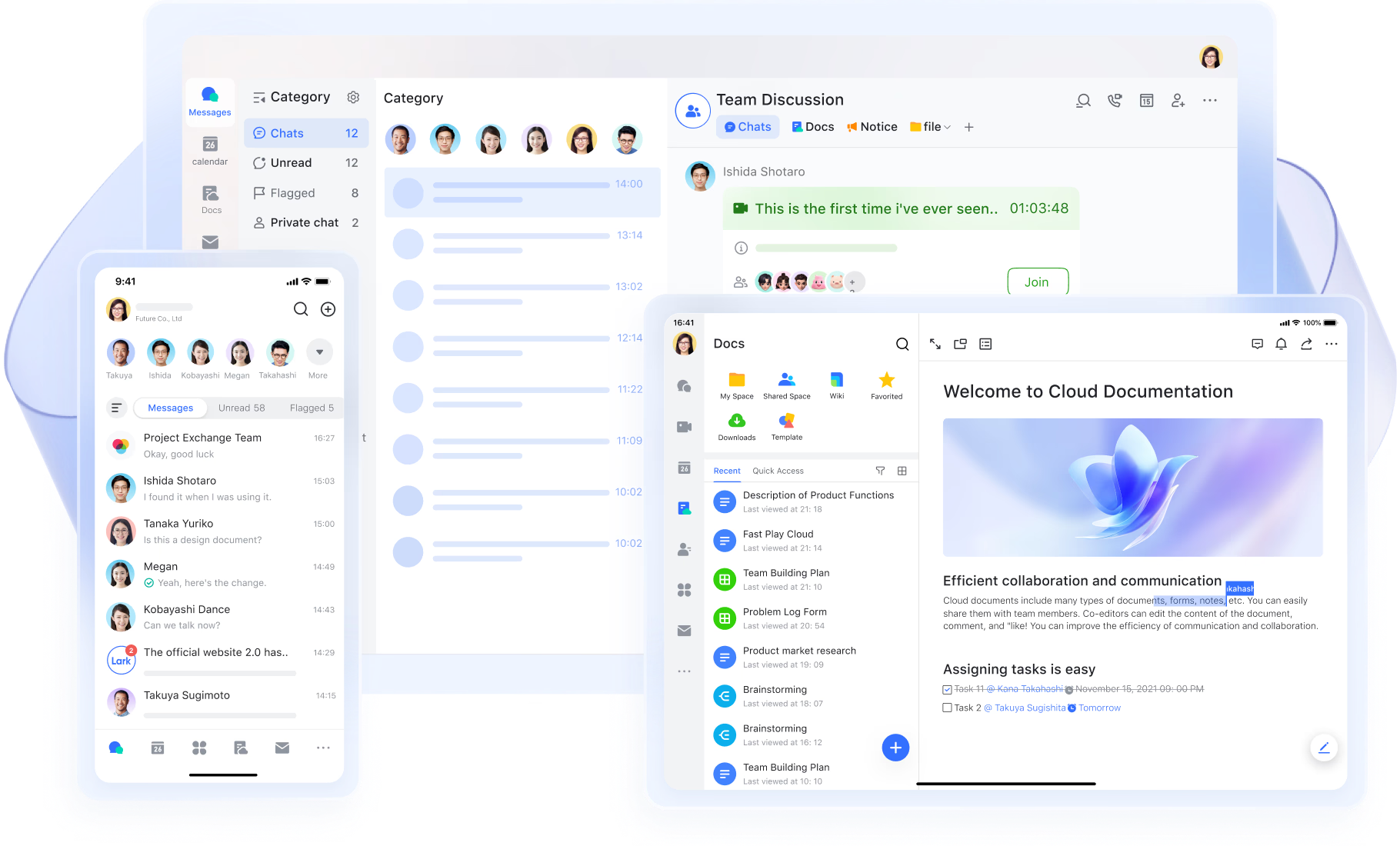
8. Unified workspaces are replacing tool-heavy CRM stacks
Many organizations rely on separate tools for CRM, chat, documents, and . This fragmentation slows work and creates information gaps. One of the strongest CRM trends is the shift toward unified workspaces, such as and Coda, which bring these functions together. When communication, data, and execution live in one environment, teams move faster and lose less context. This consolidation also reduces tool sprawl and operational complexity.
9. Industry-specific CRM workflows are gaining importance
Generic CRMs often fail to reflect how different industries operate. Modern CRM examples increasingly show industry-specific workflows tailored to retail, SaaS, services, and other sectors. These workflows align CRM structures with real business processes rather than forcing teams to adapt to generic models. Industry relevance improves usability and data quality. As expectations rise, flexibility alone is no longer enough; context matters.
10. CRM buying decisions focus on workflow fit, not brand size
Brand recognition used to dominate CRM buying decisions. Today, CRM news and market analysis indicate that teams are prioritizing workflow fit over vendor size. Organizations evaluate how well a CRM supports daily collaboration, execution, and visibility. If a platform aligns with how teams actually work, adoption and value increase. This shift is redefining what selection.
Why modern teams are rethinking traditional CRM platforms
As CRM trends continue to evolve, many teams are questioning whether conventional CRM platforms still fit how they work today. Rising complexity, cost pressures, and disconnected workflows are pushing organizations to rethink their .
- Complexity vs. speed trade-offs: Traditional CRM systems often prioritize configuration depth over usability. While powerful, this complexity slows teams down and creates friction in daily workflows. Modern trends in CRM show teams favoring faster execution and simpler systems that support momentum rather than heavy .
- High costs tied to scale and data volume: As companies grow, many CRMs become significantly more expensive due to per-user pricing, data limits, and add-on features. These rising costs have become a significant concern across the CRM industry. Teams are increasingly evaluating new CRM options that scale more predictably without penalizing growth.
- Growing frustration with fragmented tools and workflows: Many CRMs require additional tools for communication, documentation, and task tracking. This fragmentation creates context switching and reduces productivity. According to ongoing CRM news, teams are seeking more unified platforms that connect data, collaboration, and execution in one place.
Design CRM workflows that adapt as you grow
Action time: Seize the CRM trends and practice them with Lark easily
As evolve toward execution, collaboration, and flexibility, tools that combine these capabilities in one environment are gaining attention. Modern teams need systems that connect data, communication, and daily work without adding complexity. aligns with these CRM trends by supporting adaptable workflows, , and practical automation. Rather than functioning as a traditional CRM, it reflects how teams increasingly manage customer-related work today.
From data tracking to real execution
Instead of treating CRM data as static records, Lark supports execution through Lark Base, where teams can build to manage leads, deals, accounts, or . Each record can include owners, statuses, priority fields, due dates, attachments, and linked documents. Teams can connect records to Lark Tasks for follow-ups and following actions, ensuring every update leads to clear ownership and execution. This approach aligns CRM data with daily work rather than isolating it in reports. 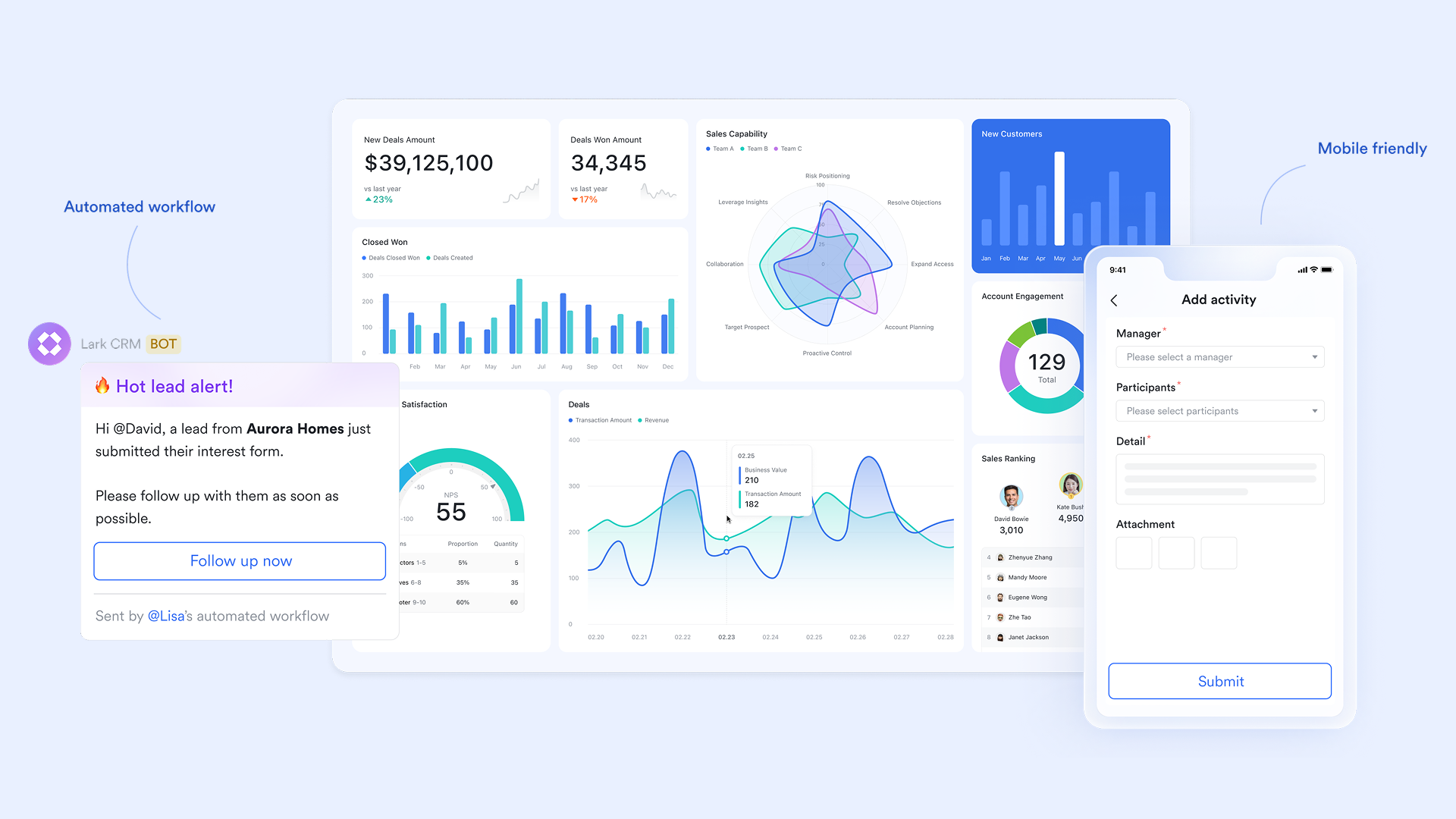
CRM structures that adapt as your processes evolve
Using , teams can customize CRM structures with flexible fields, including text, numbers, dropdowns, dates, attachments, and formulas. Multiple views, including grid, Kanban, and calendar views, allow teams to in different ways without duplicating data. As sales motions or customer processes change, teams can update fields and views without rebuilding the system. This flexibility reflects the trend away from rigid CRM schemas toward adaptable workflows. 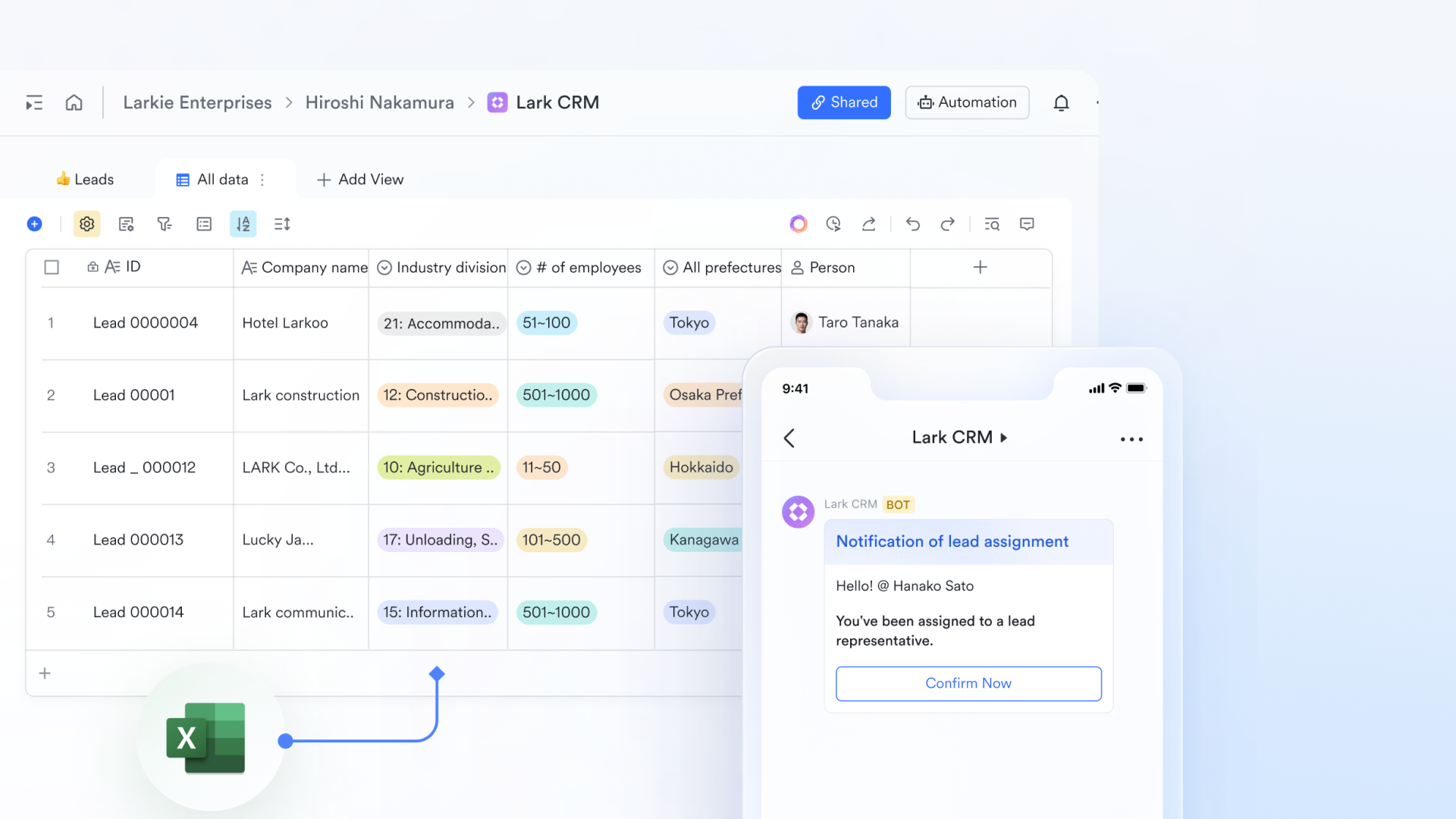
AI that removes busywork and simplifies data management
Lark Base's AI field shortcuts are powerful tools that significantly streamline and filtering, specifically through automated data processing. These shortcuts act as specialized fields that leverage AI to process raw data quickly. For example, tools like the Categorization and Smart Tags shortcuts automatically classify data (like customer inquiries or lead types) according to custom rules you define. Also, the smart extraction shortcut directly aids in importing and cleaning data by extracting specified key information—such as contact names, dates, or numbers—from large blocks of text imported into a Base field. 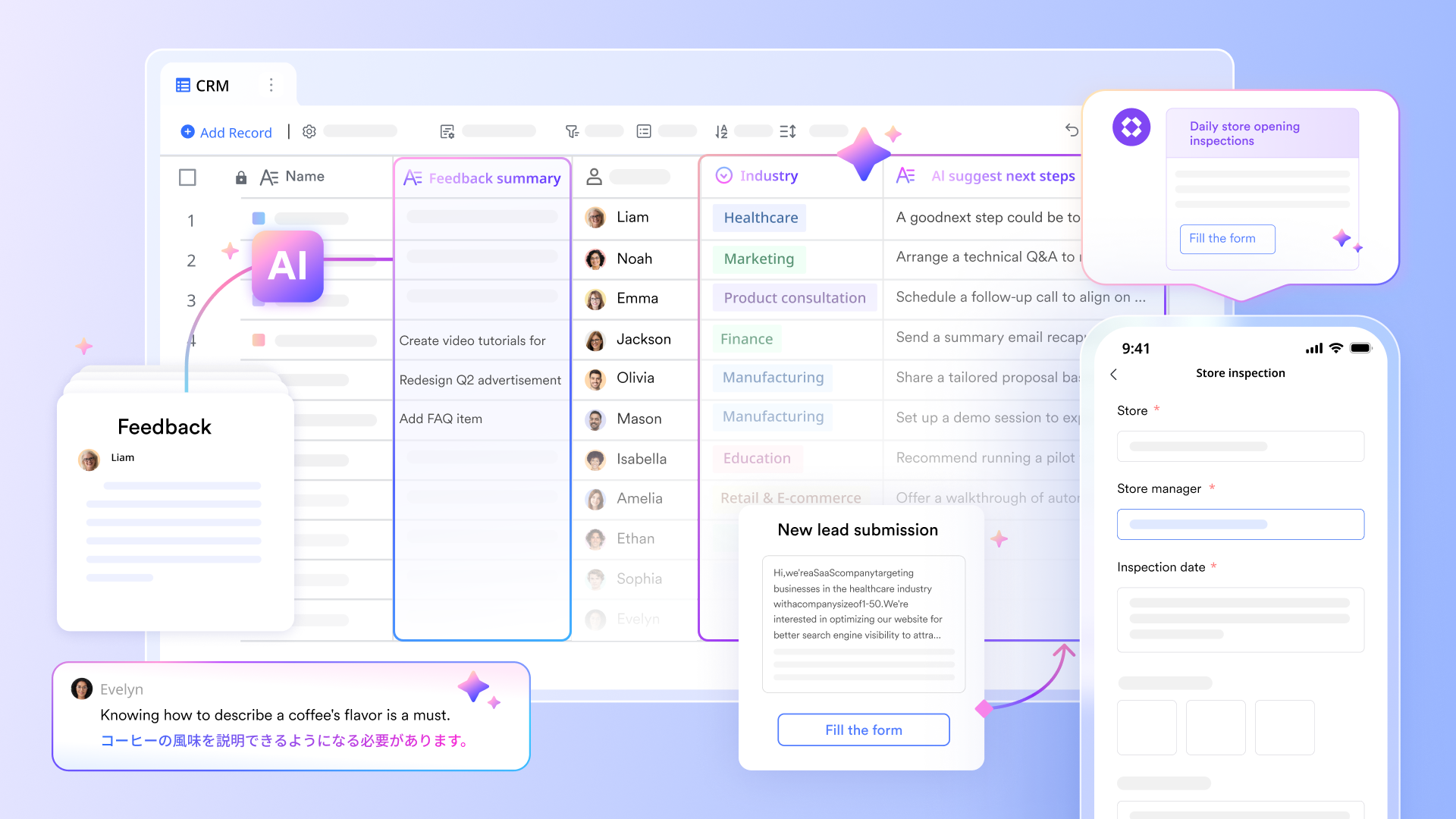
Real-time visibility for accurate data display
Lark Base dashboards are crucial for real-time visibility and data monitoring, transforming raw data into various analytical blocks to monitor operations. This feature supports 36 block types, including powerful metric blocks that calculate totals and averages and display comparative data with built-in trend charts. Furthermore, dashboards offer comprehensive data monitoring through visuals, such as funnel charts to track , progress charts for goal tracking, and view blocks to integrate both summarized metrics and the underlying data records into a single, unified view. 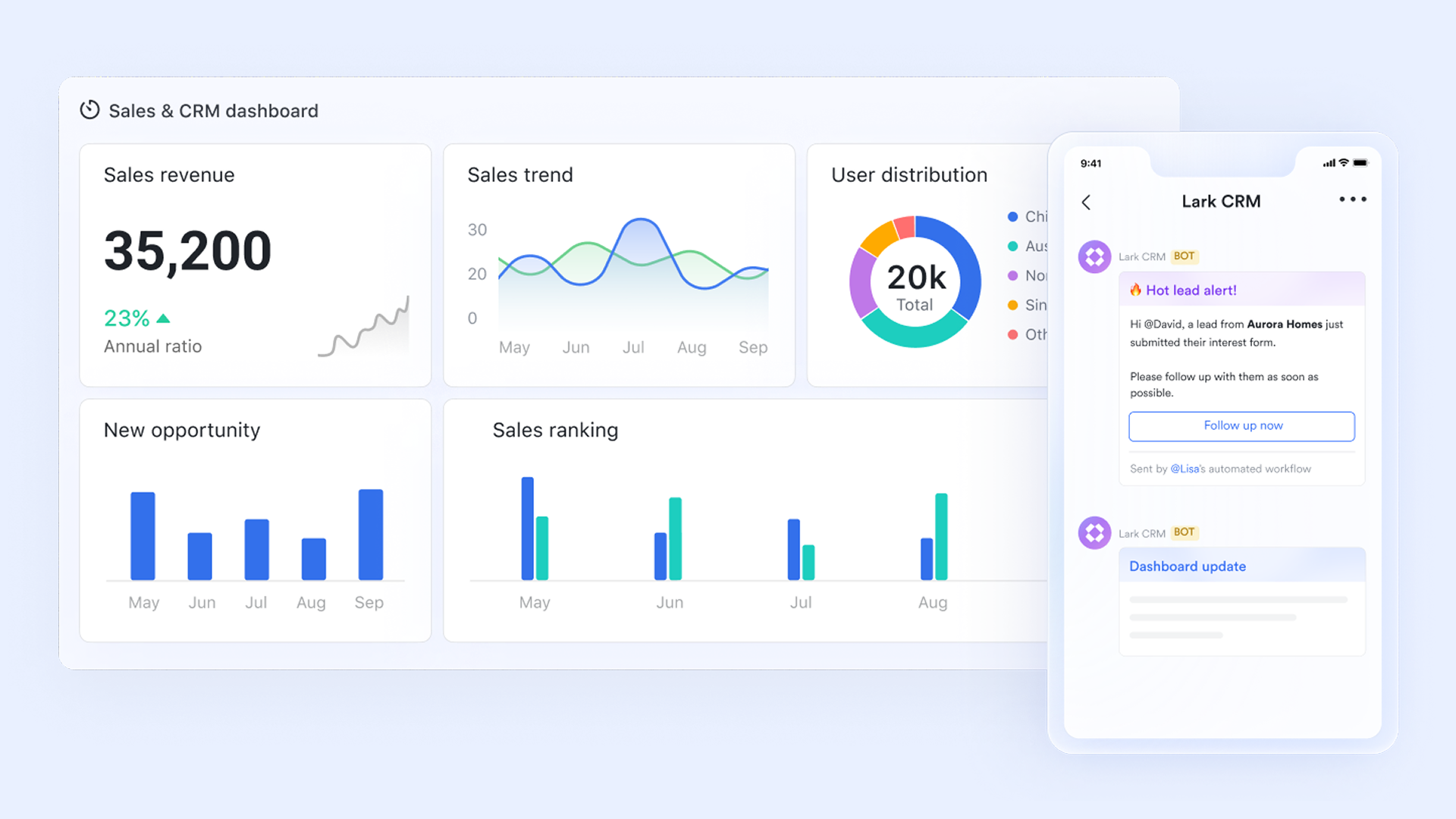
Automation that simplifies work instead of adding complexity
Lark Base automations allow streams to trigger actions such as sending notifications, updating fields, or reminding owners when conditions are met. For example, when a deal status changes or a deadline approaches, the system can automatically notify relevant team members. These automations focus on practical steps that reduce manual work, rather than complex rule engines that require ongoing maintenance. 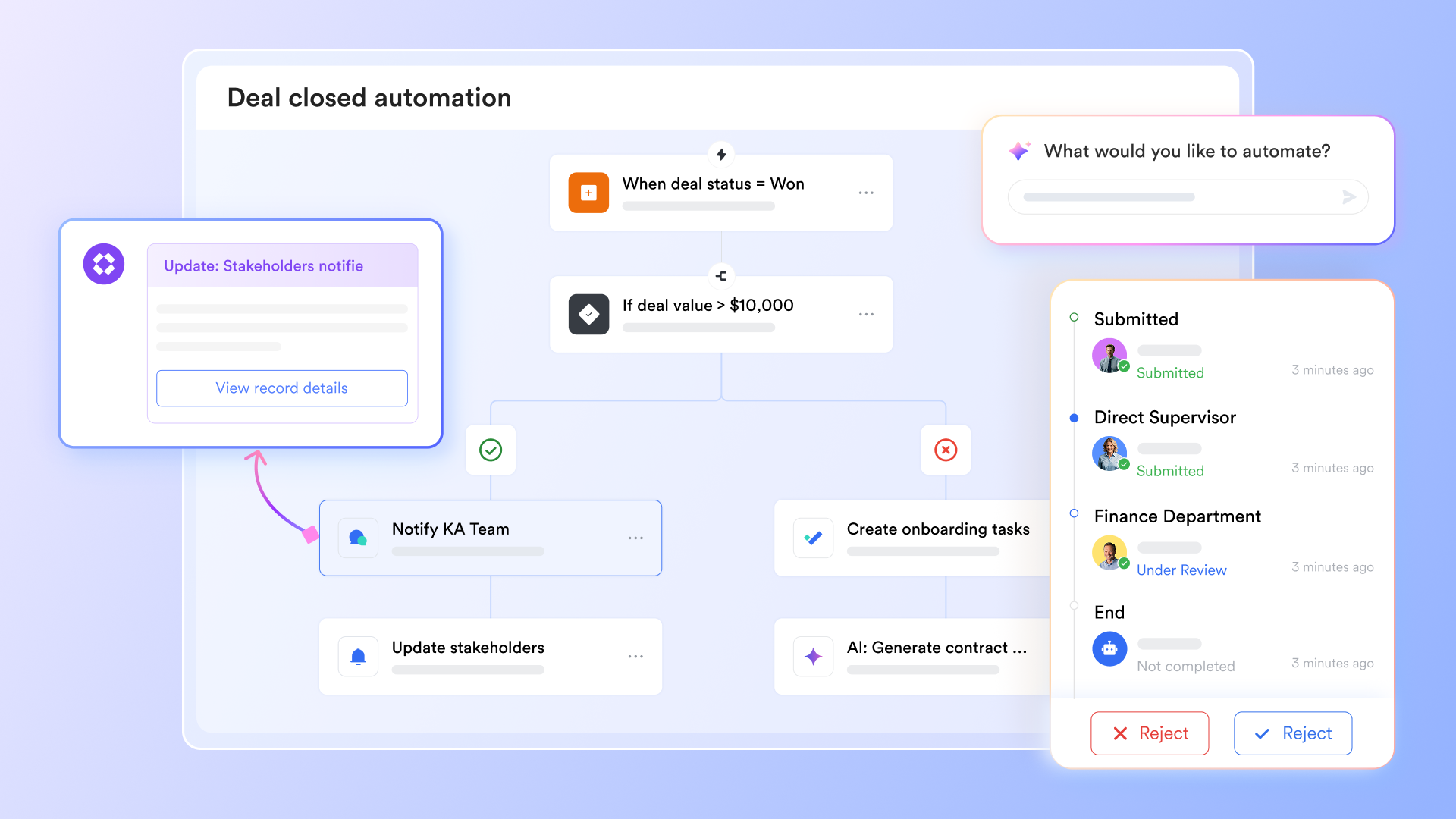
Built for collaboration across the entire revenue team
Lark enables collaboration through , where real-time chats, threads, mentions, and file sharing stay closely connected to the work context. Sales, marketing, and customer teams can discuss deals, campaigns, or accounts without switching tools. Messages can reference docs, tasks, or Base records, keeping conversations tied to execution. This design supports where communication happens alongside data, not separately from it. 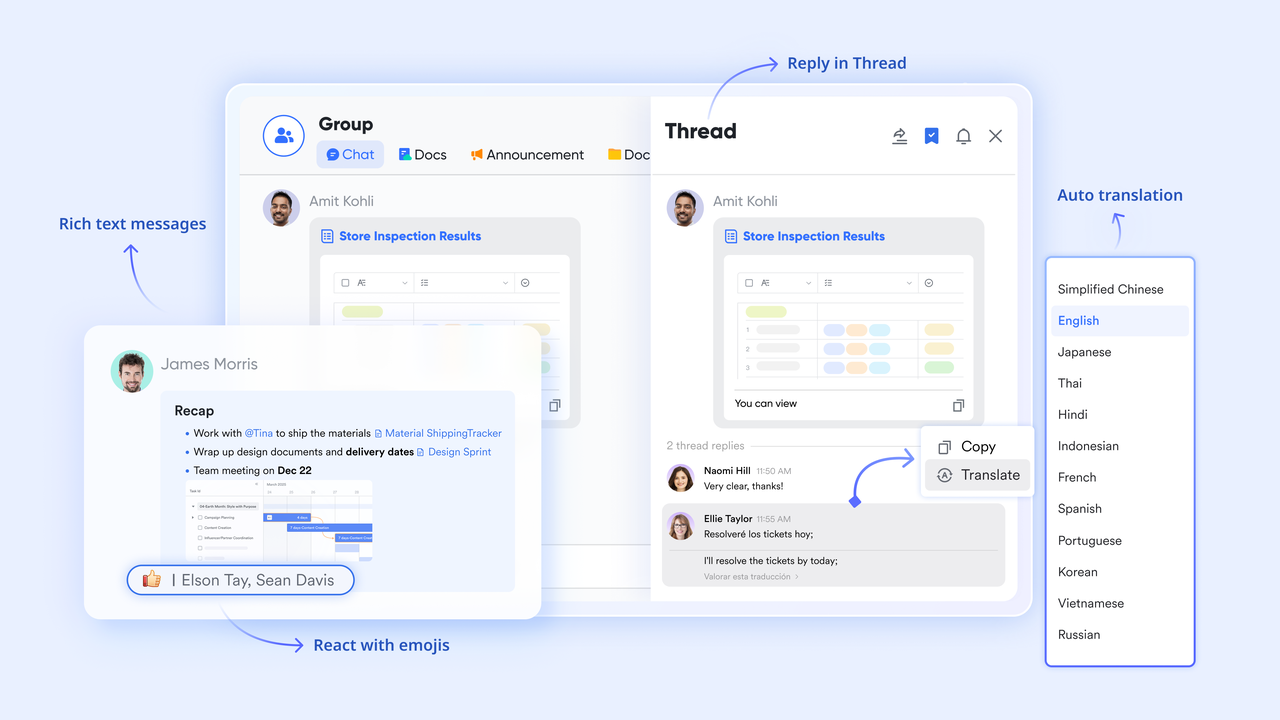
:
- Starter plan: Free forever plan that includes 11 powerful tools for up to 20 users. It also comes with 100GB of storage, 1000 automation runs, AI translations, and more.
- Basic plan: $6/user/month (billed annually) for up to 500 users. It includes everything in Starter plus group calling for up to 500 attendees, 5TB of storage, 1000 automation runs, and more. For more details, please .
- Pro plan: $12/user/month (billed annually) for up to 500 users. It includes everything in Basic plus group calling for up to 500 attendees, 15TB of storage, 50,000 automation runs, and more.
- Enterprise plan: for custom pricing. Supports unlimited users and includes even more automation runs and advanced security, compliance, and management features.
For small teams with simple communication needs

18 months message history
1000 Base automation runs/month
2000 rows per table in Base
Most POPULAR
For companies with comprehensive collaboration and management needs
Unlimited message history
500-participant video meetings
50k Base automation runs/month
20k rows per table in Base
For large companies with advanced security and organizational management needs
Get a personalized demo and pricing
Unlimited message history
500-participant video meetings
15 TB storage + 30 GB storage/user
500k Base automation runs/month
50k Base automation runs/month
Most POPULAR
For companies with comprehensive collaboration and management needs
Unlimited message history
500-participant video meetings
50k Base automation runs/month
20k rows per table in Base
CRM examples: How modern CRM trends show up in real workflows
Understanding CRM trends is easier when viewed through real-world workflows. Modern CRM examples show how teams move beyond static records to systems that support execution, collaboration, and visibility. These workflows reflect how sales, marketing, and operations actually work today. By focusing on practical use cases, teams can better evaluate which CRM approaches align with their daily needs. Conclusion
CRM trends are reshaping how teams manage customers, workflows, and growth. From execution-focused platforms and AI-driven productivity to flexible structures and unified workspaces, modern CRMs are designed around how teams actually work. As businesses move away from rigid systems and fragmented tools, workflow fit, usability, and real-time visibility have become central to CRM success. These trends signal a broader shift in the CRM industry toward simplicity, collaboration, and speed. Platforms that align data with daily execution help teams stay adaptable as expectations evolve. An approach reflected in how modern teams are increasingly working with tools like .
See how modern CRM workflows actually work
FAQs
How do CRM trends differ between sales-led and product-led companies?
Sales-led companies focus on pipeline visibility, deal execution, and relationship tracking, while product-led companies emphasize usage data and . Current trends in CRM show that sales teams are adopting execution-driven tools, while product-led teams are seeking flexible data models. These differences shape CRM marketing trends and influence how CRM workflows are designed.
What role does CRM play in cross-functional decision-making?
CRM increasingly acts as a shared source of truth across teams. According to CRM industry analysis and ongoing CRM news, modern platforms connect sales, marketing, and operations through real-time data. With integrated communication and execution, teams can align decisions faster, using shared context rather than isolated reports or dashboards.
Are lightweight CRMs replacing traditional enterprise systems?
Lightweight tools are not entirely replacing , but they are gaining adoption. The latest trends in CRM, including insights often highlighted in CRM trends McKinsey, show growing demand for simpler, faster platforms. Many organizations now adopt a new CRM approach that prioritizes usability and workflow alignment over heavy customization.
How do CRM trends affect data governance and compliance?
As CRMs move toward live views, automation, and collaboration, governance becomes more critical. Modern CRM technologies list solutions that must balance flexibility with access controls and auditability. While real-time data improves decision-making, teams must ensure compliance standards are upheld as workflows become more dynamic and distributed.
What skills will CRM users need as automation increases?
As AI and CRM capabilities expand, users need skills beyond data entry. Interpreting automated insights, configuring no-code workflows, and collaborating across teams are becoming essential. Many CRM examples show success tied to adaptability, critical thinking, and comfort with automation rather than traditional CRM administration skills.
Related reading