














Effective Project Estimation Techniques for Managers

Matthew Sia
Product Marketing Manager
Sep 18, 2026
Matthew Sia
Sep 18, 2026

13 min read


Accurate project estimation is vital for project success. It involves predicting the resources, time, and costs required to complete a project. Effective estimations allow project managers to allocate resources efficiently, manage stakeholder expectations, and minimize risks. This blog explores various project estimation techniques that can enhance planning and execution across a range of industries, from software engineering to construction. By understanding different approaches, managers can make informed decisions that lead to successful project outcomes.

What is project estimation?
Project estimation is the process of developing an approximation of the time, effort, and costs required to complete a project or a specific project activity. This estimation is critical for project planning, as it helps stakeholders understand the scope and scale of work involved. Accurate estimations facilitate better budgeting, scheduling, and resource allocation, ultimately contributing to overall project success.
Several factors influence project estimation, including:
- Project complexity: More complex projects often require more detailed estimates.
- Team experience: A skilled team may produce more accurate estimates than a less experienced one.
- Historical data: Past project performance can aid in forecasting future efforts.
- Stakeholder input: Engaging with stakeholders can provide insights that enhance estimation accuracy.
The primary goal of project estimation is to provide realistic expectations to all project stakeholders, ensuring everyone is aligned on goals and deliverables. With a solid foundation in estimation, project managers can navigate uncertainties and challenges, leading to more successful project outcomes.
Why project estimation is important
Project estimation is a vital component of effective project management. It serves as the backbone of planning and decision-making throughout the project lifecycle. Here are several reasons why accurate project estimation is crucial for success:
- Resource allocation: Accurate project estimation enables managers to allocate resources efficiently. By understanding the time and effort needed for various tasks, they can determine the right number of team members required, assign roles appropriately, and allocate budgets effectively. This ensures that the necessary personnel and resources are available to meet deadlines.
- Budget management: Accurate estimates help create realistic budgets that encompass all project expenses. By analyzing historical data, project managers can develop forecasts that prevent budget overruns, thereby enhancing financial control and aligning stakeholder expectations with available resources.
- Timeline clarity: Clear estimates provide a better understanding of project timelines. With defined timelines, teams can schedule milestones effectively, set deadlines, and coordinate efforts. This reduces the risk of missed deadlines and enhances stakeholder satisfaction.
- Risk management: Estimating tasks and their durations helps identify potential risks early. With realistic planning, managers can pinpoint areas needing more attention or resources, allowing them to develop proactive strategies to mitigate complications.
- Stakeholder communication: Effective estimation fosters clear communication with stakeholders. Well-researched and detailed estimates help set realistic expectations and demonstrate an understanding of project complexities, building trust and ensuring stakeholder support throughout the project.
- Continuous improvement: Accurate estimations contribute to ongoing improvement within project teams. By analyzing the accuracy of estimates post-project, teams can learn from past experiences and refine their estimation processes, promoting a culture of continuous enhancement in project management practices.
Who should estimate projects
Estimating projects involves the collaboration of various stakeholders, each bringing unique perspectives and insights. Here are some key roles that should be involved in the estimation process:
- Project managers: They oversee the entire estimation process, coordinating inputs, analyzing requirements, and synthesizing information to create realistic estimates.
- Team members: Those who will execute project tasks offer valuable insights based on their expertise and experience, helping create more accurate and practical estimates.
- Subject matter experts (SMEs): SMEs provide essential knowledge in specialized areas, ensuring that estimates reflect industry standards and best practices.
- Stakeholders: Engaging stakeholders, including clients and senior management, ensures that their expectations and requirements are considered, leading to aligned project objectives.
- Financial analysts: For projects with significant financial components, these analysts can provide insights into budgets and funding needs, ensuring that estimates are financially sound.
When should project estimation take place
Effective project estimation is not a one-time activity but a process that should occur at various stages throughout the project lifecycle. Here's a breakdown of when estimations should take place:
- Initial planning: Early estimates are made during project kickoff to outline timelines, resources, and budgets based on project objectives and scope.
- During execution: Continuous estimation is necessary to adjust for changes in project scope, requirements, and resources as the project unfolds.
- Milestone reviews: Estimation should happen at key milestones to assess progress and realign future estimates based on actual performance.
- Before significant changes: When project scope or resources shift dramatically, new estimates should be conducted to evaluate the impact and adjust expectations.
- Post-completion: Analyzing estimates against actual outcomes after project completion helps identify areas for improvement and refine future estimation processes.
Key project estimation techniques
When it comes to project estimation, there are several techniques that project managers can use. Understanding these estimation methods is key to selecting the right approach for specific project needs. Here are some of the most commonly used project estimation techniques.
1. Top-down estimation
Top-down estimation involves making high-level estimates based on overall project scope and objectives. Project managers typically utilize historical data from similar projects, expert judgment, and stakeholder input to develop these estimates. This method is quick and provides a general idea of project costs and timelines, making it ideal for early project phases when detailed information may not be available.
Action steps:
- Define project objectives: Begin by clearly outlining the high-level objectives and deliverables of the project.
- Engage stakeholders: Hold discussions with key stakeholders, including clients and team leads, to gather initial inputs and expectations.
- Draw from historical data: Look at similar past projects to generate a baseline for costs and timelines. Use percentages or rough estimates to allocate budget and time to each segment.
- Refine with team input: Share the initial estimates with your team for feedback, ensuring they reflect realistic workload and timelines.
Advantages:
- Quick to implement
- Useful for making initial budgetary and scheduling decisions
- Allows for swift adjustments based on early insights
Disadvantages:
- May lack precision due to its high-level nature
- Can overlook specific details and tasks
2. Bottom-up estimation
Bottom-up estimation is a more granular approach that involves breaking down the entire project into smaller tasks and estimating the resources, time, and costs required for each task. This technique is often seen as more accurate, as it considers specific deliverables and activities. Once individual estimates are gathered, they are rolled up to provide an overall project estimate.
Action steps:
- Task breakdown: Decompose the project into detailed tasks and subtasks. Use Work Breakdown Structures (WBS) for organization.
- Individual task estimation: Estimate the time, resources, and costs for each task. Consider using historical performance data for accuracy.
- Aggregate estimates: Sum the individual estimates to formulate the overall project estimate. Ensure all necessary expenses, including overheads and contingencies, are included.
- Validation and review: Conduct a review session with team members to validate the estimates, making adjustments as necessary based on insights and expertise.
Advantages:
- Greater accuracy due to detailed task analysis
- Better alignment with resource availability and timelines
- Allows for a more thorough understanding of project requirements
Disadvantages:
- Time-consuming and labor-intensive
- May require more initial effort and collaboration
3. Analogous estimation
Analogous estimation utilizes historical data from previous similar projects to estimate the duration and cost of the current project. By drawing connections between past and present projects, managers can develop estimates based on lessons learned, successes, and failures.
Action steps:
- Identify similar projects: Select past projects that closely resemble the current project in scope, complexity, and environment.
- Analyze historical data: Gather relevant data on these projects, including timelines, costs, resource allocation, and any challenges faced.
- Adjust for differences: Make necessary adjustments to the data to account for differences in context, technology, or team efficiency. This might involve percentage adjustments based on improvements or declines in performance.
- Apply data: Use the adjusted figures as a basis for your current project's estimates, ensuring clarity on the sources and rationale used.
Advantages:
- Quick and easy method when historical data is available
- Useful for projects with similarities to past initiatives
Disadvantages:
- May not account for unique project variables
- Can lead to inaccuracies if historical data is not relevant
4. Parametric estimation
In parametric estimation, project managers use statistical models and parameters to create estimates. This method involves identifying variables that influence project costs and timelines, such as productivity rates or costs per unit. By applying these parameters to project requirements, managers can derive estimates based on quantifiable data.
Action steps:
- Collect historical data: Gather extensive data on similar projects, focusing on measurable parameters that affect cost and time (e.g., cost per square foot for construction projects).
- Develop parametric models: Create formulas or algorithms that tie specific project parameters to costs and timelines, based on historical performance.
- Benchmarking: Use industry benchmarks to refine your parameters, ensuring they reflect current market rates and trends.
- Estimate using parameters: Apply the parametric models to your current project, adjusting input variables as needed to reflect the current project's unique conditions.
Advantages:
- Provides a more data-driven approach to estimation
- Can be highly accurate if relevant parameters are identified
Disadvantages:
- Requires access to comprehensive data sets
- May not be applicable for all project scenarios
5. Three-point estimation
Three-point estimation incorporates uncertainty by considering three scenarios for each task: the best-case (optimistic) scenario, the worst-case (pessimistic) scenario, and the most likely scenario. This technique utilizes a weighted average, allowing for a more nuanced estimate that takes into account potential risks and uncertainties.
Action steps:
- Define estimates: For each task, develop three estimates:
- Optimistic estimate (O): The best-case scenario where everything goes according to plan.
- Pessimistic estimate (P): The worst-case scenario considering potential setbacks.
- Most likely estimate (M): The most realistic estimate based on typical conditions.
- Calculate expected value: Use the following formula to determine the expected duration: Expected Duration=(O+4M+P)/6
- Review estimates: Discuss these estimates during team meetings to incorporate diverse perspectives and refine the numbers based on group consensus.
Advantages:
- Provides a balanced view of potential project outcomes
- Useful for projects with significant uncertainty
Disadvantages:
- Requires careful judgment in defining scenarios
- May complicate simple projects needing straightforward estimates
6. Expertise-Based Estimation
Expertise-based estimation relies on the knowledge and experience of individuals with industry or technical expertise. This technique ensures that estimates reflect the realities of the project environment.
Action steps:
- Assemble expert panel: Gather a group of experts relevant to the project. This can include team members, external consultants, or stakeholders with specialized knowledge.
- Conduct workshops: Organize sessions to share insights, discuss potential challenges, and evaluate different facets of the project. Encourage open dialogue to extract valuable information.
- Document input: Collect and document the experts' views and estimates systematically to ensure transparency and accountability in the estimation process.
- Integrate feedback: Incorporate their insights into your overall estimates, adjusting figures as necessary based on their recommendations.
Advantages:
- Experts bring valuable knowledge and experience to the table, leading to more accurate and realistic estimates based on real-world scenarios.
- Engaging experts helps in identifying potential risks and challenges early in the estimation process, allowing for proactive mitigation strategies.
Disadvantages:
- Estimates can be influenced by personal opinions or biases of the experts involved, which may skew accuracy.
- Gathering expert input can be time-consuming and may require significant coordination and scheduling efforts, potentially delaying the estimation process.
Improve project estimation accuracy with Lark
As the complexities of project management grow, leveraging unified project management tools can significantly enhance the accuracy of project estimation. Lark offers a suite of features designed to facilitate collaboration, streamline communication, and provide essential data analysis. Here's how these capabilities contribute to more effective project estimation.
Centralize historical data
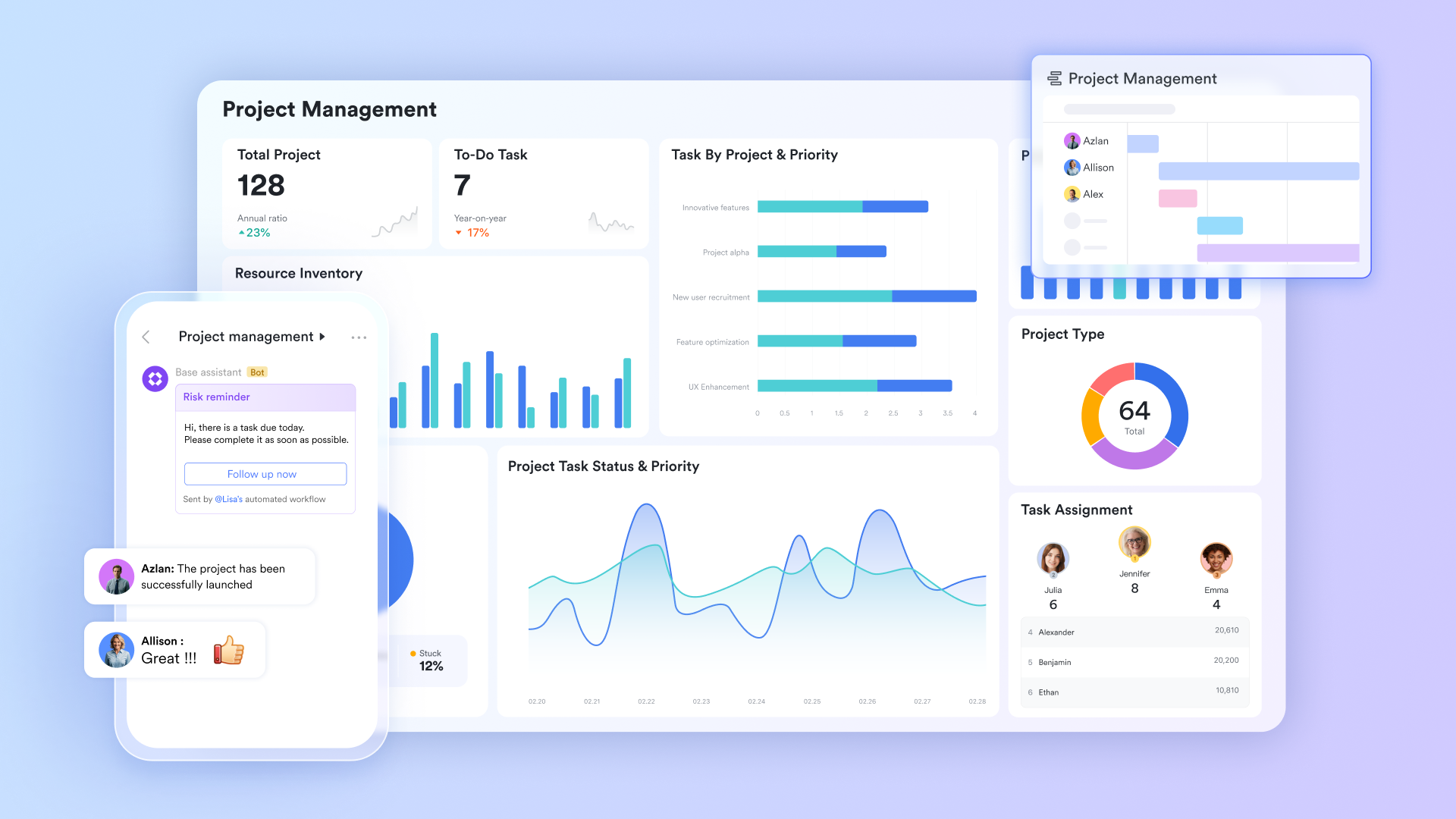
Traditional project estimation often relies on personal experience or isolated data fragments, lacking systematic historical data support, which leads to large estimation deviations. Lark Base can build a team-specific project historical database. You can create a "Project Review and Estimation Benchmark" table to structurally record key attributes of past projects: such as project type, number of core features, technology stack used, team size, planned hours versus actual hours, and main causes of delays.
When starting a new project estimate, the team no longer has to guess. You can immediately filter for similar historical projects in Base, whose actual time data provides a strong reference benchmark for new tasks. This insight directly guides more realistic budgeting for the current project. This essentially turns implicit team experience into explicit, queryable, and analyzable data assets.
Eliminate ambiguity through real-time collaboration
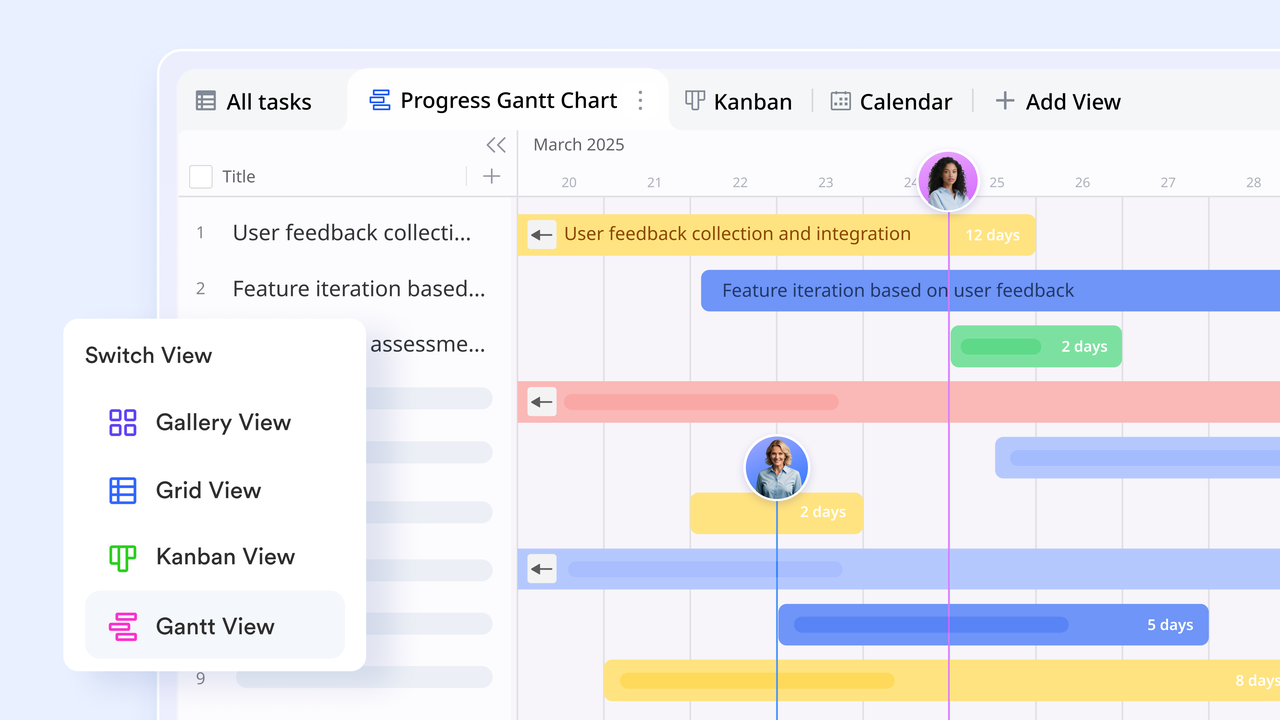
Inaccurate estimates often stem from inconsistent understanding of requirements. Traditional document back-and-forth confirmation is inefficient, and ambiguities are easily left unresolved. Using Lark Docs for real-time requirements and clarification can fundamentally reduce room for error.
The product manager can write preliminary requirements into a shared document and directly @mention relevant development and testing leads. All parties can comment and ask questions on specific paragraphs within the same document, with the entire discussion process. This interaction quickly exposes potential misunderstandings and technical complexities, prompting requirements to become clear and specific before estimation. A requirements document that has been thoroughly discussed through collaboration and has no open questions will naturally lead to more accurate corresponding effort assessments.
Visualize deviations
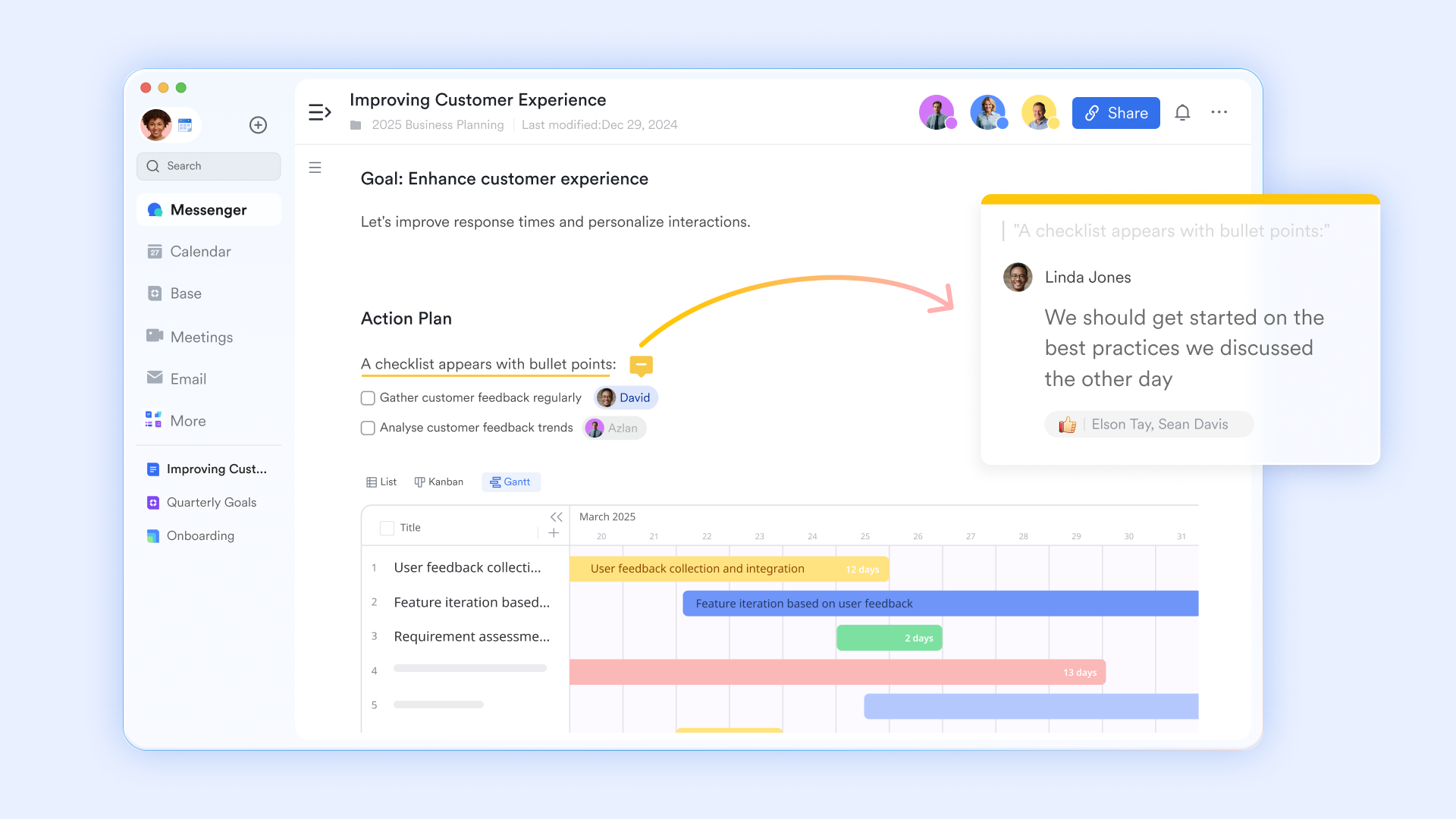
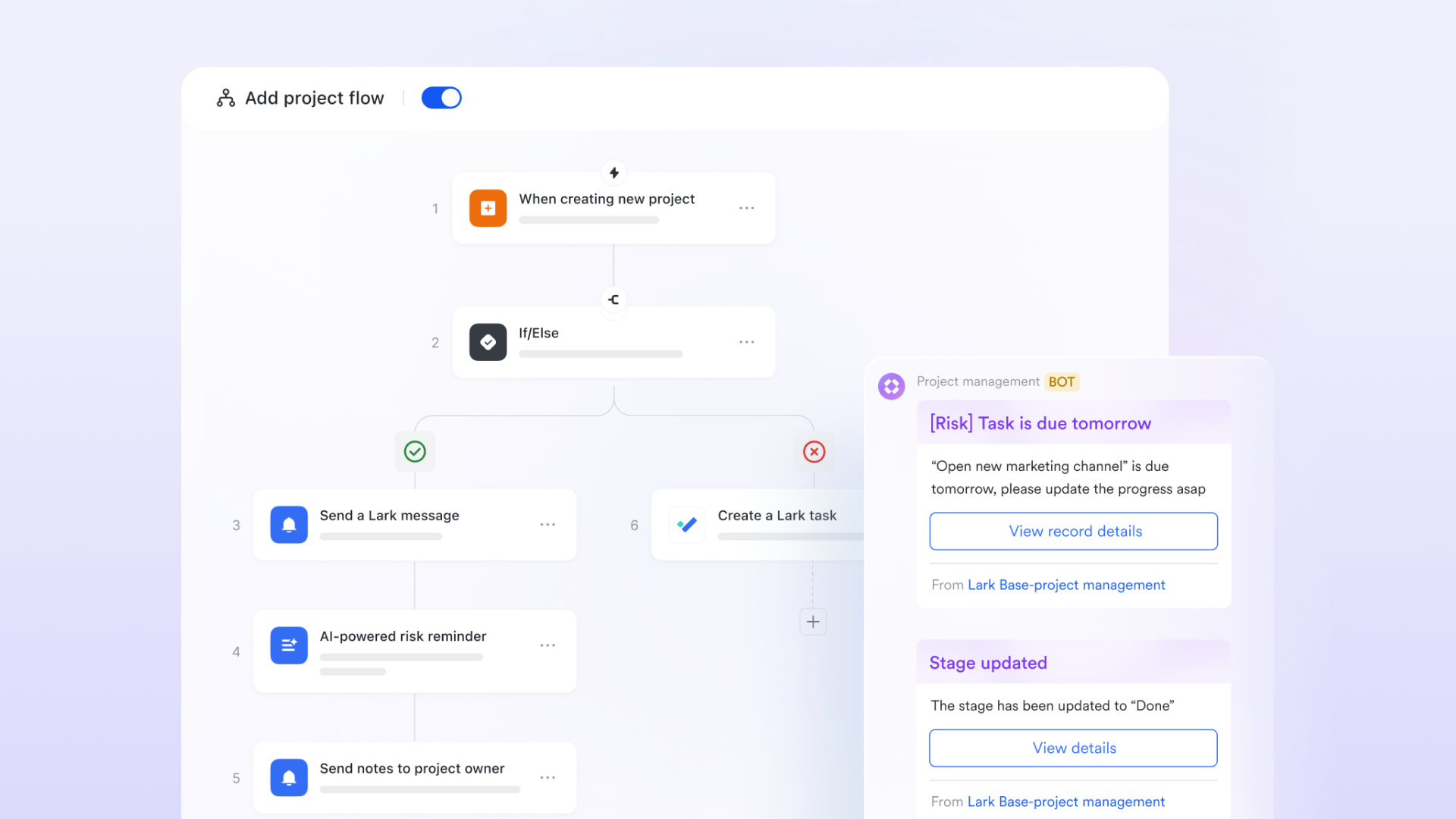
Static estimates often need adjustment in dynamic projects. Lark Base's dashboards and automation rules enable visual monitoring of estimation health. You can create a project monitoring dashboard with the core metric being "task schedule deviation."
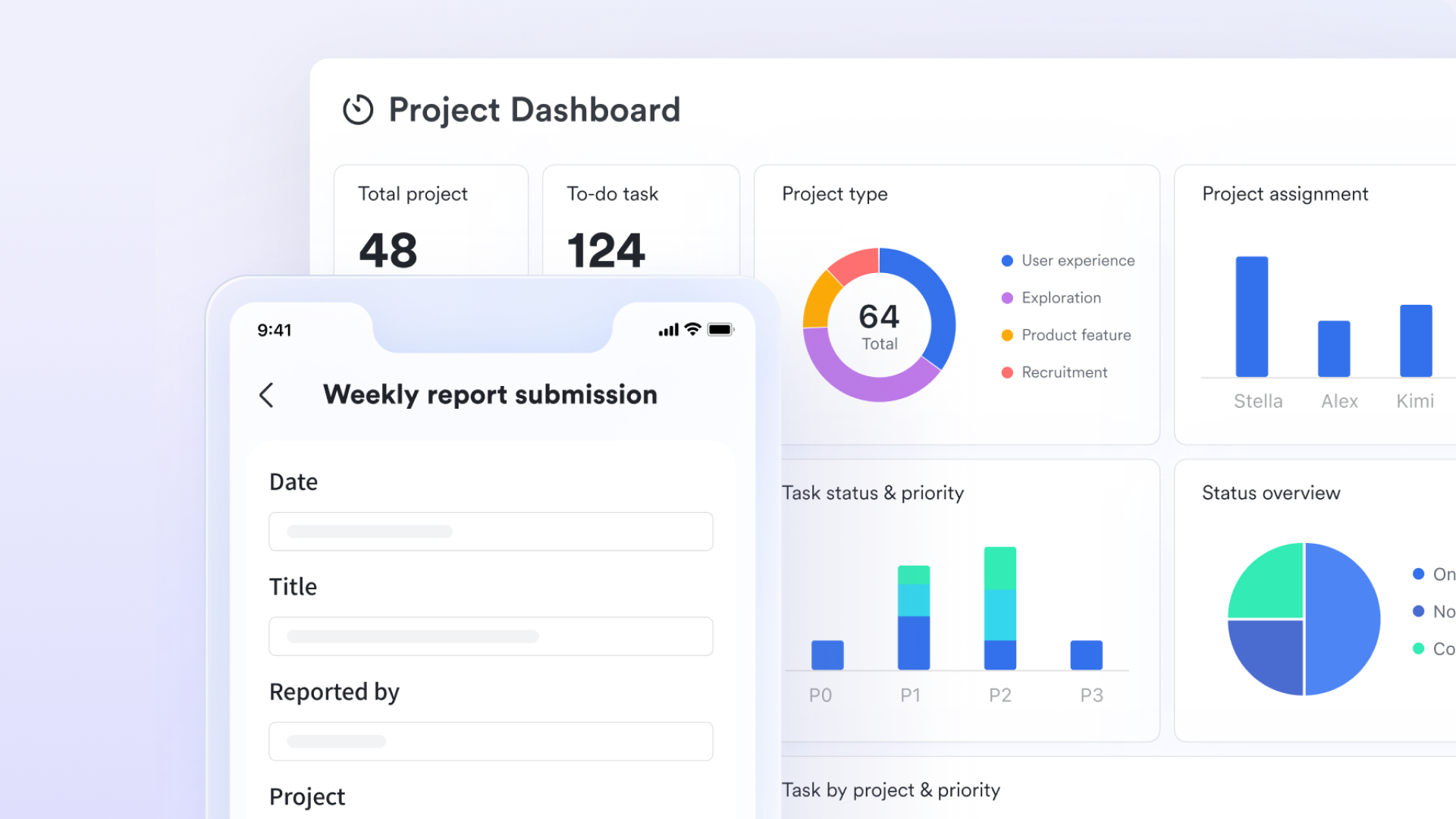
You can set up a rule: when the "actual hours" field for a task is filled in and exceeds the "estimated hours," a notification is automatically sent to the project group to alert the project manager. This data-driven proactive warning means the team no longer waits until a milestone is missed to realize there's a problem. Instead, they can immediately assess the impact when a deviation occurs.
Challenges in project estimation
Despite the various techniques available, project estimation can be fraught with challenges. Understanding these challenges is essential for creating more accurate and reliable estimates. Here are some common pitfalls:
Unclear project scope
One of the most significant challenges in project estimation is an unclear or poorly defined project scope. When stakeholders do not articulate their expectations or when requirements change frequently, it can be difficult to accurately estimate time, cost, and resources. This often leads to projects going over budget and missing deadlines.
Incomplete information
Incomplete or insufficient data can hinder the estimation process. If project managers lack important historical data or do not have access to comprehensive analysis from previous projects, they may struggle to make informed estimates. This is particularly relevant in fields like software engineering, where historical performance metrics can significantly enhance estimation accuracy.
Pressure from stakeholders
Project managers often face pressure from stakeholders to deliver projects faster and cheaper. This pressure can lead to rushed estimations that do not fully consider all variables. When speed and cost override thorough analysis, the risk of underestimating resources and time increases significantly.
Changing market conditions
Market volatility and changing business environments can impact project estimations. Economic factors, technology changes, and evolving customer needs may all lead to shifts that need to be incorporated into project estimates. These uncertainties can make previous estimations obsolete.
Team experience and dynamics
The experience and dynamic of the team carrying out the work can also influence estimation accuracy. A highly skilled team may produce more accurate estimates, while a less experienced team may not have the insights needed to forecast effectively. Additionally, interpersonal dynamics within the team can impact contributions to estimates, either positively or negatively.
Best practices for accurate project estimations
To improve the accuracy of project estimates, it's essential to adopt best practices that address these challenges. Here are several strategies to consider:
Engage stakeholders early
Involving stakeholders from the outset is crucial for understanding project requirements and expectations. Early engagement can help clarify the project scope, minimize misunderstandings, and ensure that all relevant factors are considered in the estimation process.
Use historical data
Leveraging historical data from previous projects can provide valuable insights into potential challenges and resource needs. Analyze past performance metrics to draw parallels with current projects and improve the accuracy of your estimates. Maintaining a project estimation template can also facilitate this process by structuring data for easier comparison.
Regularly review estimates
Project estimation is not a one-time activity; it should be revisited throughout the project lifecycle. Regularly reviewing and adjusting estimates based on new information, stakeholder feedback, and ongoing performance can help keep projects on track. Agile methodologies emphasize this point, allowing for continual refinement.
Incorporate buffer time
Adding buffer time to project estimates can help account for uncertainties and potential delays. By including contingency reserves in timelines and budgets, project managers can better absorb unexpected challenges without derailing the overall project.
Implementing these best practices can significantly enhance the accuracy of your project estimates. As you refine your estimation techniques, consider incorporating strategies that adapt to your specific project needs and organizational culture. This proactive approach will position you for greater success in managing project timelines, budgets, and resources.
Conclusion
Accurate project estimation is essential for successful project management, enabling effective resource allocation, budget management, and risk reduction. By engaging the right stakeholders and applying appropriate estimation techniques, you can improve project outcomes and foster a culture of continuous improvement.
To enhance your estimation processes and ensure seamless collaboration, consider utilizing tools like Lark. With its integrated features, Lark makes it easier to communicate, document, and track project estimates, empowering your team to achieve greater success.
FAQs
What are the 4 types of estimation?
The four main types of estimation are top-down (high-level overview), bottom-up (detailed task breakdown), analogous (using historical data from similar projects), and parametric (statistical models for estimating). Utilizing a collaborative tool like Lark can enhance these estimation processes by facilitating team discussions and data sharing.
What is the best way to estimate a project?
The best way to estimate a project is to use a combination of methods that suit the project's complexity. Employing bottom-up estimates for detailed tasks alongside top-down estimates for overall alignment often yields the best results. Tools like Lark can streamline collaboration and ensure all team members contribute to accurate estimations.
What are the three most used techniques for estimation in project management?
The three most commonly used estimation techniques in project management are analogous estimation, which relies on historical data, expert judgment, leveraging insights from experienced team members, and bottom-up estimation, which breaks down tasks in detail for accuracy. Integrating Lark into this process can enhance communication and collect diverse inputs easily.
What are five estimating techniques you can use for agile projects?
Five effective estimating techniques for agile projects include Planning Poker (consensus-building), T-shirt Sizing (categorizing tasks by complexity), Bucket System (visual categorization), Story Points (measuring effort for user stories), and Dot Voting (prioritizing through team votes). Using Lark during these methods fosters collaboration and ensures that all team members' perspectives are included.
Related reading
Table of contents
Start using Lark today

Manage all your work in one place
Boost team efficiency by 10x
Save up to 70% on software costs
Table of contents
Start using Lark today
Manage all your work in one place
Boost team efficiency by 10x
Save up to 70% on software costs
Keep reading








2026 Lark Technologies Pte. Ltd.
Headquartered in Singapore with offices worldwide.






Explore: