Project prioritization has become one of the most difficult challenges for modern teams. Organizations are not short of ideas, initiatives, or urgent requests. What they lack is a consistent way to decide which work deserves attention first and which should wait. When everything feels important, teams end up overloaded and leaders struggle to explain decisions.
As businesses grow, prioritization in project management becomes less about individual judgment and more about shared systems. Clear criteria, visible trade-offs, and repeatable processes help teams move from reactive decisions to intentional execution. Many teams now rely on structured frameworks and digital tools to support these decisions.
Platforms like Lark increasingly appear in these conversations, not as decision makers, but as systems that connect prioritization logic to real execution. This guide explains how project prioritization works in practice and how high-performing teams make it sustainable.
What is project prioritization?
Project prioritization is the structured process of ranking projects, initiatives, or tasks based on defined value and constraints. Instead of reacting to the loudest request, teams evaluate work using shared criteria such as impact, urgency, effort, and risk. This ensures that limited resources are focused where they matter most.
At a practical level, project prioritization answers one essential question. Given limited time, budget, and people, what should we work on now, later, or not at all. Without this clarity, teams fall into constant context switching and unfinished work.
A project prioritization framework makes this decision repeatable. Whether teams use a simple project prioritization matrix or a more detailed project prioritization scoring model, the goal is the same: Create alignment, reduce conflict, and improve delivery outcomes.
What project prioritization really means for leadership
For leadership teams, project prioritization is a signal of strategy in action. What gets approved and funded shows teams what the organization truly values. When prioritization decisions feel inconsistent, trust erodes, and execution slows.
Strong prioritization requires leaders to say no as clearly as they say yes. This discipline protects teams from overload and creates focus. It also reduces hidden work that quietly drains capacity without delivering measurable value.
When leaders rely on transparent project prioritization criteria, decisions become easier to explain and defend. Over time, this consistency builds confidence across and ensures that remain aligned with high-level objectives.
How prioritization in project management shapes results
Effective prioritization in project management directly influences outcomes across execution, morale, and stakeholder confidence. When priorities are clear, teams spend less time debating and more time delivering.
- : Clear project prioritization ensures that people, budget, and tools are allocated intentionally. Teams avoid spreading resources thin across too many initiatives. High-impact work receives the attention it deserves, while lower-value projects are deferred or stopped. This clarity also reduces hidden overload. Managers can see where resources are overcommitted and rebalanced before burnout occurs. Over time, allocation decisions become proactive rather than reactive.
- Delivery speed: When priorities are ranked and visible, teams move faster. They spend less time waiting for decisions or switching between competing tasks. Work flows through the system with fewer interruptions. A defined project prioritization process removes ambiguity at handoffs. Teams know what comes next and why. This predictability shortens delivery cycles and improves throughput.
- Team morale: Unclear priorities are a major source of frustration. Teams feel pulled in multiple directions and struggle to meet expectations. Clear prioritization reduces this stress by setting realistic boundaries. When teams understand why certain projects matter more, motivation increases. People see how their work contributes to outcomes rather than reacting to constant urgency.
- : Stakeholders lose confidence when priorities change without explanation. A transparent project prioritization framework creates shared understanding. Decisions feel grounded rather than arbitrary. Over time, stakeholders learn to trust the process. Even when their requests are deferred, they understand the reasoning and timing behind decisions.
Apply clearer project prioritization across your teams
Project prioritization process used by high-performing teams
High-performing teams treat prioritization as a cycle, not a one-time event. Their project prioritization process balances intake, evaluation, governance, and .
Step 1: Intake
Every prioritization process begins with structured intake. Instead of ideas living in chats or emails, teams can use an information collection tool, such as , to gain requests in a consistent format. This ensures every proposal is visible and evaluated fairly. Structured intake captures key data upfront. Teams document objectives, estimated effort, and expected outcomes. This information becomes the foundation for evaluation.
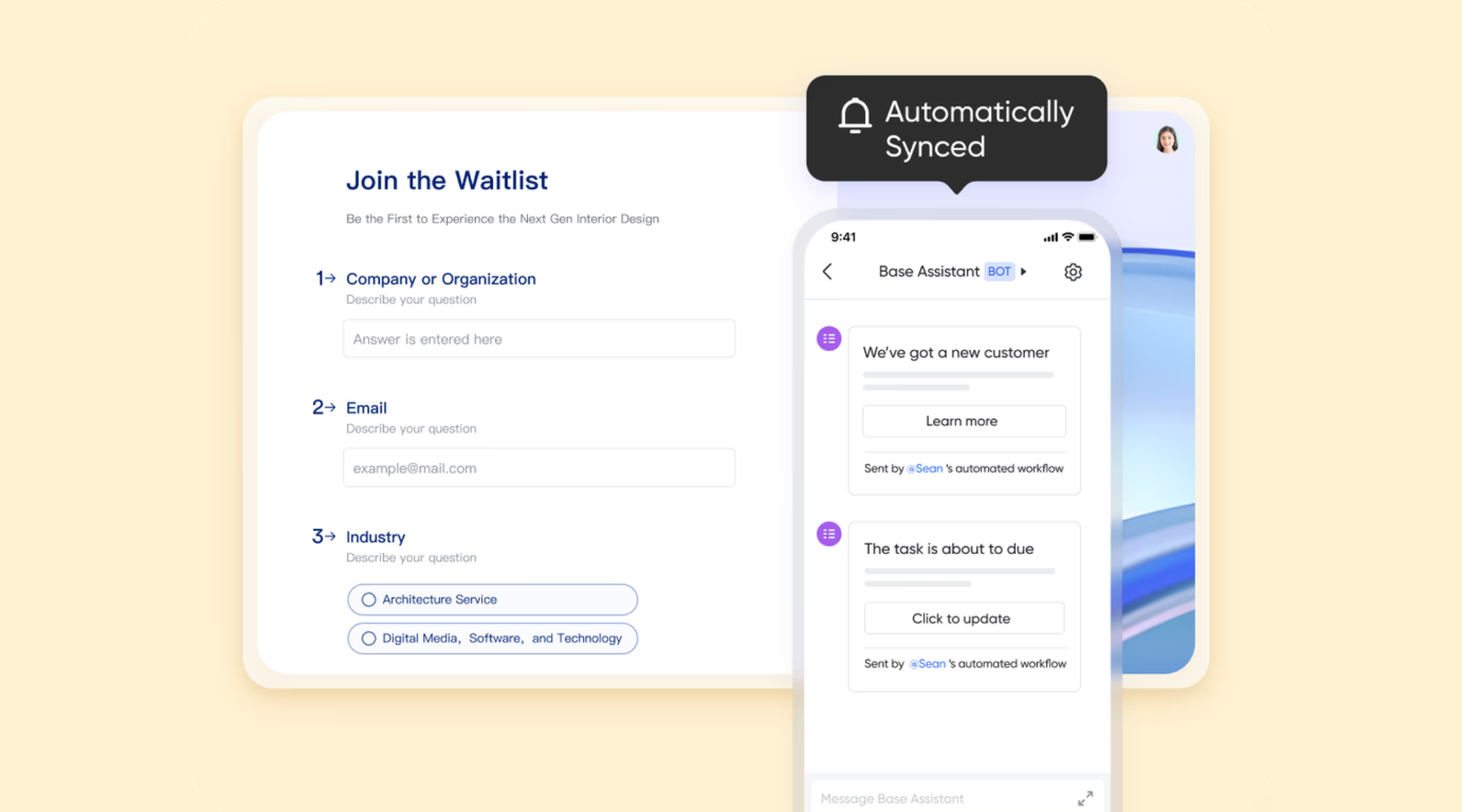
Step 2: Scoring
Scoring introduces objectivity into prioritization. Teams apply a project prioritization scoring model using agreed criteria such as impact, urgency, and effort. Each project receives a numerical or weighted score. This allows teams to compare initiatives side by side rather than debating them individually.
Step 3: Validation
Scoring alone is not enough; validation ensures assumptions are realistic. Using Lark Docs, leaders and subject matter experts can review business cases in a formal document collaboratively. Comments, mentions, and inline feedback help surface hidden risks and dependency issues. This step improves decision quality without slowing momentum.

Step 4: Approval
Approvals turn priorities into official commitments. With Lark Approval workflows, leadership can review proposals and approve or reject them in a structured flow. Every decision is logged with timestamps and comments, creating a transparent audit trail. Teams know exactly which projects are approved and resourced.
Step 5: Review cycle
Prioritization is never static. Regular allow teams to reassess priorities as conditions change. New data informs adjustments. A consistent review rhythm keeps the project prioritization process relevant and trusted.
Project prioritization matrix in real scenarios
A project prioritization matrix is one of the most accessible for ranking work. It visually compares initiatives using two key dimensions.
- Impact vs effort: This matrix helps teams identify quick wins. High-impact, low-effort projects rise to the top. Low-impact, high-effort initiatives are deprioritized. Teams use this project prioritization matrix to focus on efficiency. It encourages smarter use of limited capacity.
- Risk vs reward: This view balances potential upside against uncertainty. High-reward, require careful justification. Using a project prioritization matrix template for risk helps leaders avoid betting too much on fragile initiatives.
- Strategic fit vs cost: This scenario evaluates alignment with. Projects that strongly support the strategy but require moderate investment often win. This matrix reinforces strategic discipline and prevents drift.
Project prioritization templates for quick starts
Project prioritization kanban templates
This template visualizes ranked work in a clear, column-based flow. Teams can see which projects are currently top priority and which are waiting. As priorities change, items can be moved easily without rewriting plans. This keeps discussions focused on order rather than justification. It also helps teams align quickly during reviews.
Project management template
This template brings together timelines, ownership, dependencies, and priority fields in one place. Teams can evaluate work not only by importance but also by readiness and capacity. It supports structured planning across multiple initiatives. Leaders gain visibility without relying on separate tracking files. Execution stays aligned with prioritization decisions.
Task management template
This template connects daily tasks directly to higher-level priorities. Team members understand how their work contributes to broader goals. It reduces the risk of spending time on low-value activities. Managers can spot overload or misalignment early. This strengthens prioritization in project management at the execution level.
Urgent important matrix template
This project prioritization matrix template separates urgency from importance visually. Teams can identify which items demand immediate attention and which require strategic focus. It reduces reactive decision-making driven by noise. Discussions become more objective and structured. This template is especially useful during intake and review cycles.
Modern choice: How Lark enables smarter project prioritization
As expand, manual methods struggle to keep up with increasing complexity. Teams need project prioritization software that supports scoring, visibility, governance, and execution in a single environment. At the same time, leadership teams often rely on a project prioritization tool, ABM strategy playbook, to ensure initiatives align with long-term goals. Modern systems make prioritization a repeatable and scalable practice rather than a one-off exercise.
supports smarter project prioritization by bringing structured data, collaboration, and execution into one shared workspace. Rather than replacing judgment, it reinforces prioritization in project management with real-time visibility, consistent criteria, and automated governance. This allows teams to move from static prioritization exercises to an ongoing, adaptable process that evolves as work and business needs change.
Visual prioritization boards
Lark supports rapid reprioritization through its multi-view engine. In the Kanban view, you can stack-rank projects within a "Priority" column via simple drag-and-drop. In the Grid view, you can use "multi-level sorting" to organize the list first by "Priority score" and second by "Deadline." Because Lark is a cloud-native platform, when a manager moves a card on the board, the change is reflected on every stakeholder's screen in real-time, eliminating the confusion of multiple versions of a spreadsheet. 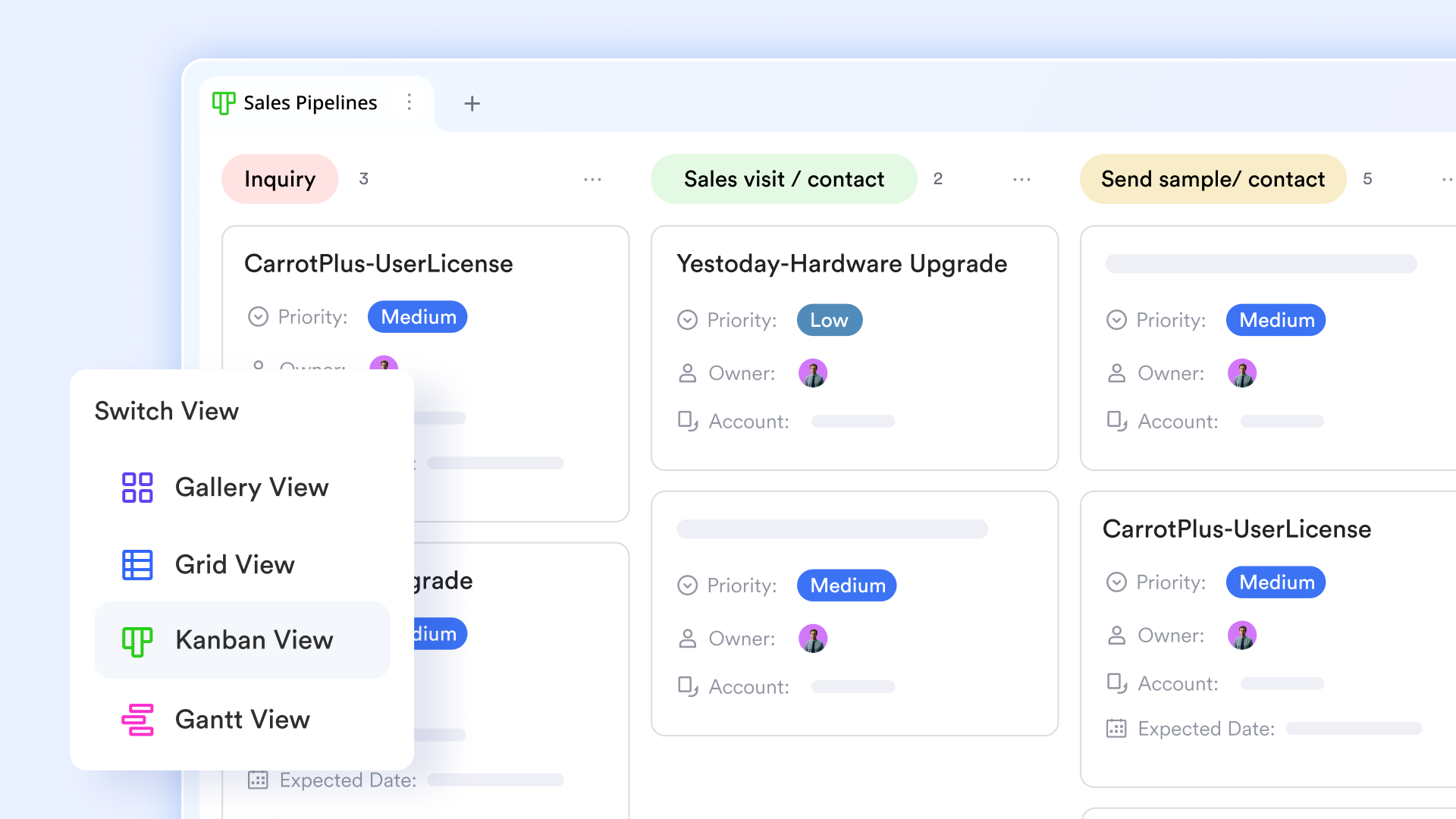
Custom scoring models in Lark Base
enables objective prioritization through formula fields and rating fields. You can set up columns for "Impact," "Urgency," and "Effort" (using 1–5 stars or numerical values). By applying a weighted formula, for example, (Impact + Urgency) / Effort, Lark calculates a "Priority Score" for every project. This ensures that the team focuses on "Quick Wins" (high impact, low effort) rather than subjective "pet projects." If business goals shift, you simply update the weights in the formula, and the entire portfolio's rankings recalculate instantly. 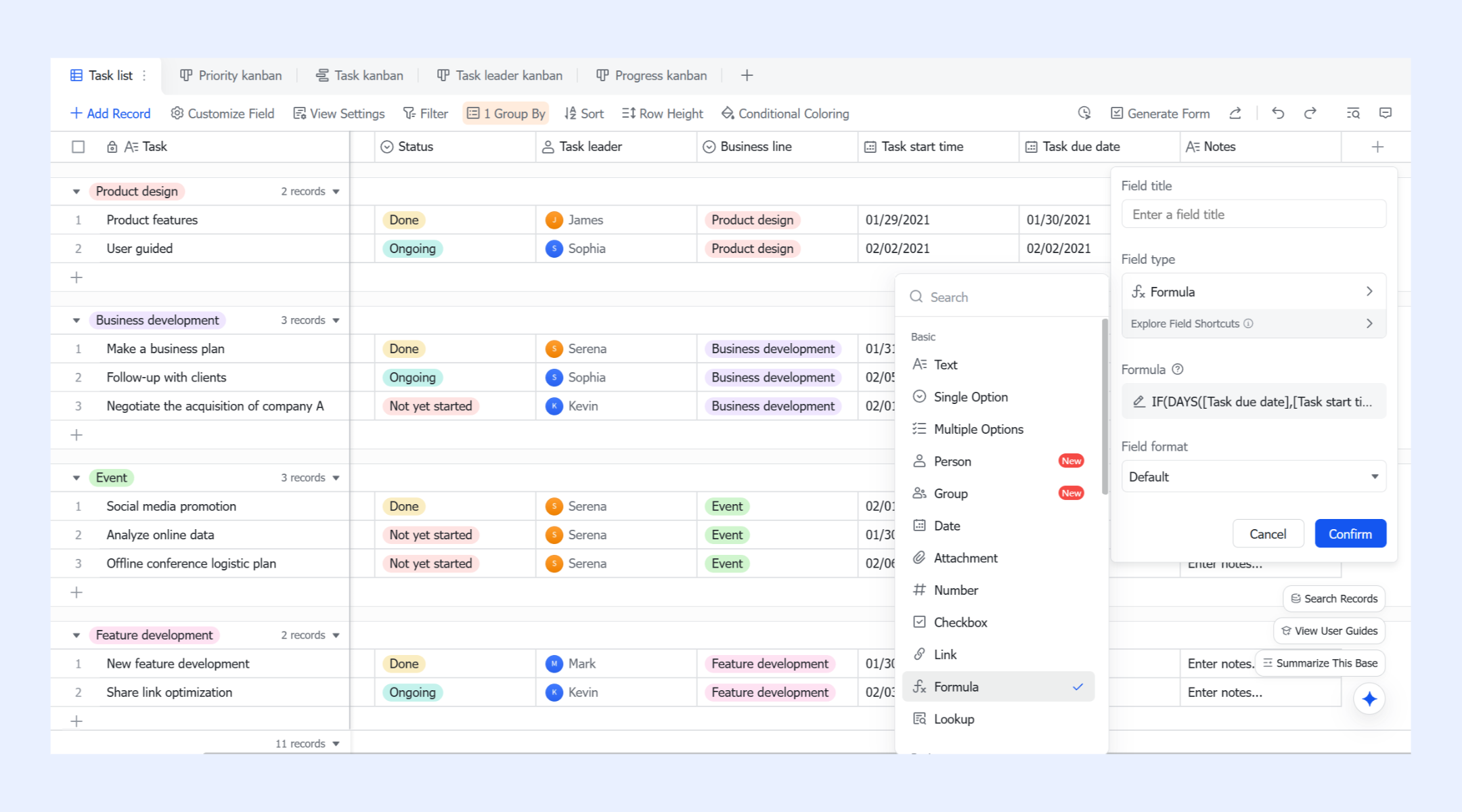
Risk tracking fields and flags
To manage project fragility, Lark Base uses conditional coloring and single-option fields for . With conditional coloring, teams can apply specific background or text colors to records based on custom rules, instantly highlighting high-risk tasks or overdue deadlines. On the other hand, color-coding by single-option fields allows managers to visualize project health at a glance. 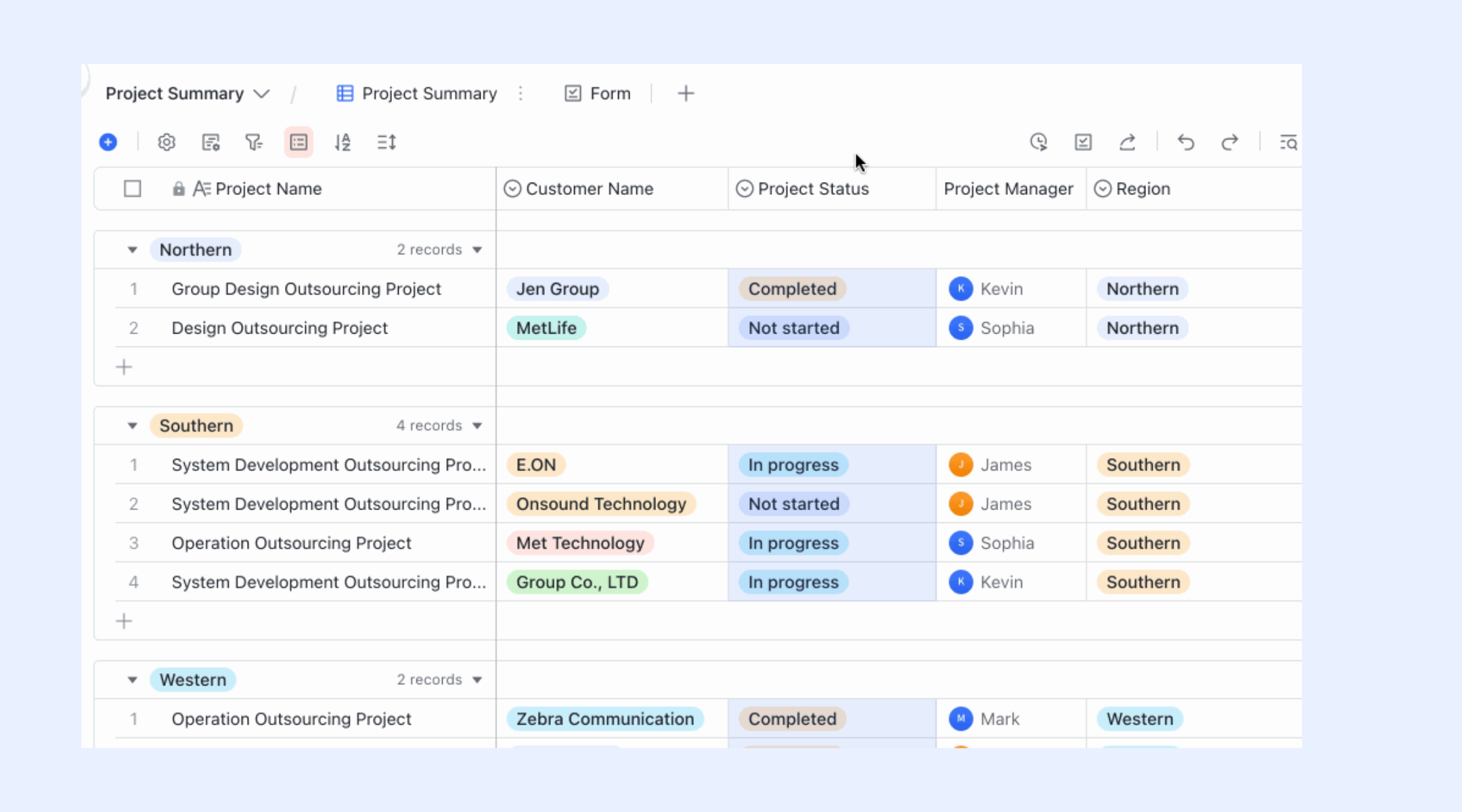
Real-time dashboards for leadership
For executive oversight, Lark Base dashboard blocks aggregate granular project data into high-level visuals. You can create a pie chart showing the distribution of "Project Impact" or a bar chart comparing "Resource spend" across different strategic themes. These dashboards allow executives to monitor "Portfolio health" at a glance. If a dashboard reveals that 80% of resources are focused on "Low impact" maintenance rather than "High impact" innovation, leaders can make evidence-based decisions to pivot immediately. 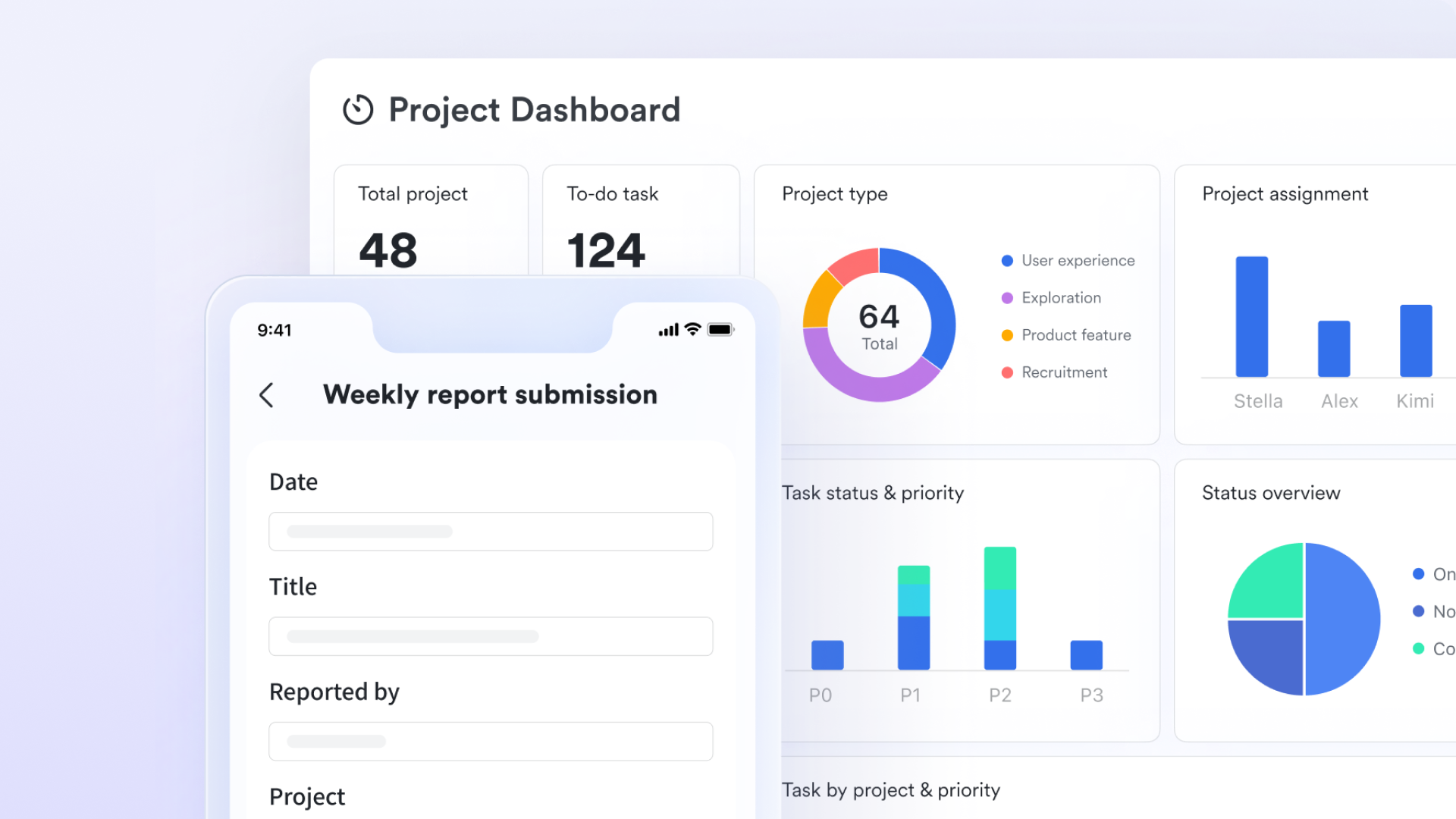
Workload visibility with task ownership
Lark ensures that prioritization is grounded in reality with Lark Tasks. By grouping the task table by "Assignee," managers can see exactly how many high-priority tasks are allocated to a single person. If the Gantt view shows a team member is overloaded, managers can drag and drop tasks directly within Lark Tasks to rebalance workloads without leaving the view. This prevents a common prioritization mistake—approving projects that teams simply do not have the capacity to execute effectively. 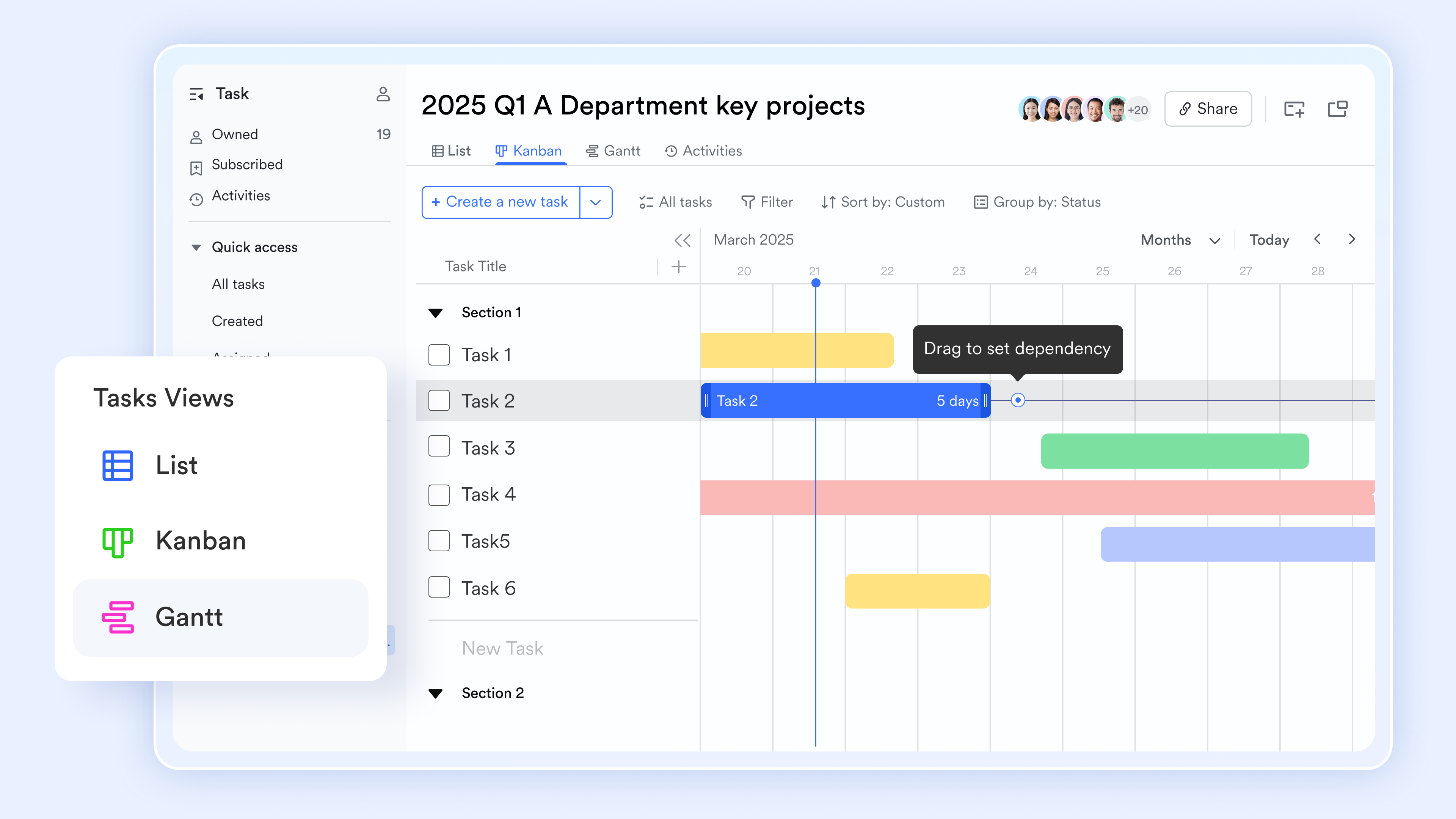
:
- Starter plan: Free forever plan that includes 11 powerful tools for up to 20 users. It also comes with 100GB of storage, 1000 automation runs, AI translations, and more.
- Pro plan: $12/user/month (billed annually) for up to 500 users. It includes everything in Starter plus group calling for up to 500 attendees, 15TB of storage, 50,000 automation runs, and more.
- Enterprise plan: for custom pricing. Supports unlimited users and includes even more automation runs and advanced security, compliance, and management features.
For small teams with simple communication needs

18 months message history
1000 Base automation runs/month
2000 rows per table in Base
Most POPULAR
For companies with comprehensive collaboration and management needs
Unlimited message history
500-participant video meetings
50k Base automation runs/month
20k rows per table in Base
For large companies with advanced security and organizational management needs
Get a personalized demo and pricing
Unlimited message history
500-participant video meetings
15 TB storage + 30 GB storage/user
500k Base automation runs/month
50k Base automation runs/month
Most POPULAR
For companies with comprehensive collaboration and management needs
Unlimited message history
500-participant video meetings
50k Base automation runs/month
20k rows per table in Base
Warning signs your prioritization process is broken
When prioritization fails, the symptoms usually appear in daily execution long before leaders recognize the root cause. These warning signs indicate that the project prioritization process lacks clarity, consistency, or realistic capacity planning. Teams often feel busy but struggle to make meaningful progress. Over time, these issues compound and directly impact delivery quality, morale, and .
- Constant rework: Constant rework occurs when projects are started without stable priorities or clear project prioritization criteria. Teams repeatedly revise scope, timelines, or deliverables as priorities shift mid execution. This signals weak validation and poor alignment during intake and approval. Over time, rework consumes capacity that should be spent delivering value. It also reduces trust in the prioritization framework.
- Priority churn: Priority churn happens when projects move up and down the list without a . Decisions are driven by urgency or influence rather than a consistent project prioritization scoring model. Teams lose focus as work is constantly reshuffled. This instability prevents momentum and makes long-term planning difficult. Priority churn often indicates the absence of a disciplined project prioritization process.
- Burnout: Burnout emerges when too many initiatives are labeled as high priority at the same time. Without clear limits, teams carry unrealistic workloads and feel constant pressure. This is a sign that prioritization in project management is not grounded in real capacity. Over time, motivation drops and error rates increase. Burnout is often the hidden cost of poor prioritization decisions.
- Missed deadlines: Missed deadlines are a downstream effect of unclear or conflicting priorities. Teams struggle to sequence work when everything appears equally important. Dependencies are overlooked, and timelines become unrealistic. This signals that project prioritization methods are not aligned with execution reality. Repeated delays erode stakeholder trust and confidence in planning.
Conclusion
Project prioritization is not about finding the perfect framework. It is about creating shared understanding and disciplined decision-making. When teams rely on clear criteria, visible trade-offs, and repeatable processes, prioritization becomes a strength rather than a source of conflict.
As organizations scale, manual approaches break down. Spreadsheets and meetings cannot keep pace with constant change. As complexity increases, tools like help teams strengthen prioritization in project management through clear links between decisions and execution data.
The goal is not to automate judgment but to support it. With the right project prioritization methods, templates, and tools, teams focus on work that matters, protect capacity, and deliver results with confidence.
Build clearer project prioritization with Lark
FAQs
What are the 4 P's of prioritization?
The 4 P's refer to purpose, priority, people, and process. Purpose explains why a project exists and what outcome it supports. Priority ranks the work against other initiatives competing for limited resources. People ensure clear ownership and realistic capacity. As teams scale, platforms like Lark help keep these elements visible and connected across planning and execution.
What are the 5 levels of priority?
The five commonly used levels are critical, high, medium, low, and backlog. Critical items demand immediate attention due to high risk or impact. High and medium priorities guide sequencing and resource focus. Low-priority work is intentionally deferred, while backlog items are reviewed periodically. Tools such as Lark help teams apply these levels consistently across projects and teams.
Who should own project prioritization in large teams?
In large teams, project prioritization is typically owned by leadership or a centralized group. This ensures decisions align with strategy rather than individual preferences. Input from delivery teams and stakeholders remains essential for accuracy. Systems like Lark support this model by making priorities, ownership, and capacity visible to everyone involved.
Can project prioritization be automated?
Project cannot be fully automated, but many supporting activities can be. Scoring models, approvals, and visibility can be standardized using modern tools. Human judgment still guides trade-offs and strategic choices. Platforms such as Lark reduce manual effort and keep prioritization updated as data and conditions change.
Related reading