Agile is no longer limited to software development or engineering teams. Across industries, organizations now rely on adaptive planning, rapid feedback, and continuous improvement to respond to constant change. What makes agile effective is not theory alone, but how it is applied in real working environments.
While frameworks and terminology are widely documented, practical execution often diverges significantly from textbook definitions. This guide focuses on Agile project management examples drawn from real teams and industries, showing how agile principles translate into daily work. Toward the end, modern platforms like Lark appear naturally as enablers rather than starting points.
What is Agile project management?
Agile project management is an approach to planning and delivering work that prioritizes adaptability, continuous feedback, and incremental progress over rigid upfront planning. Instead of locking teams into long timelines and fixed scopes, agile encourages short work cycles that allow teams to respond quickly to changing requirements. This explains what is in practical, real-world terms rather than theoretical models.
At its core, agile project management focuses on collaboration, transparency, and customer value. Teams regularly review outcomes, adjust priorities, and refine processes to improve results over time. These principles form the foundation of every agile and help explain the long-term benefits of agile project management across industries.
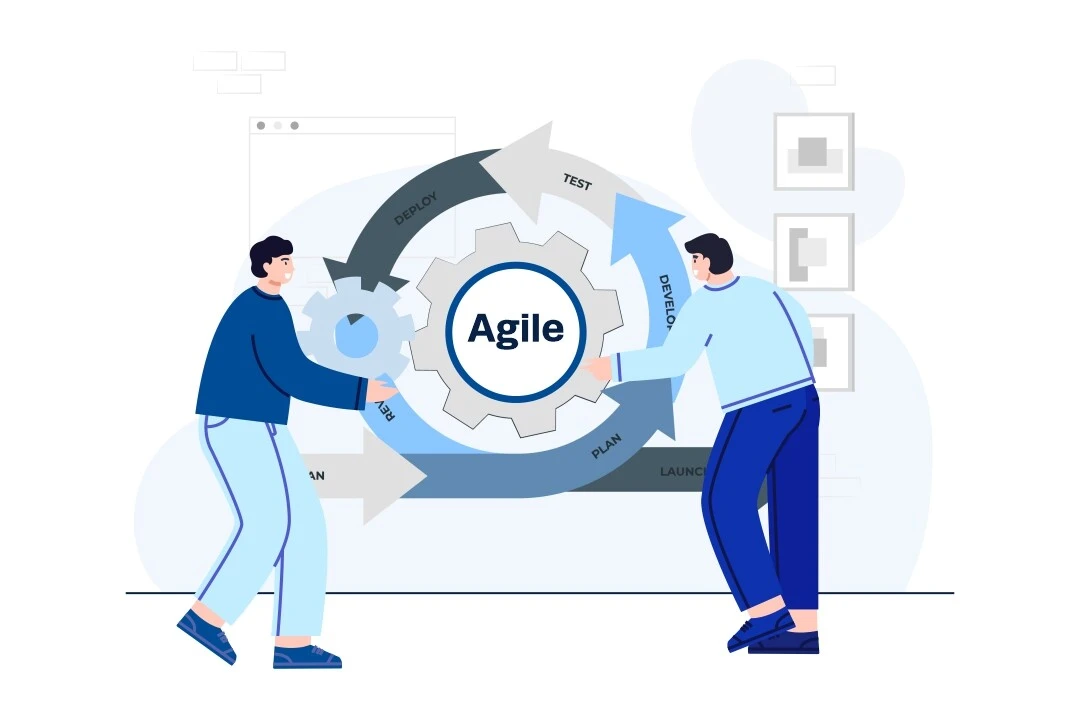
Image source: projectmanagement.ie
Core Agile project management frameworks and where they fit
provides structure without sacrificing flexibility, helping teams apply agile principles consistently. Scrum, Kanban, and scaled frameworks each support different and operating environments. Understanding how these frameworks fit specific contexts helps organizations avoid adopting methods that do not align with their work patterns.
Each agile project management framework emphasizes iterative delivery and continuous improvement, but they differ in governance and cadence. Scrum suits teams that benefit from structured roles and time-boxed sprints, while Kanban supports continuous flow and visualization. These differences help agile project managers select frameworks that match business complexity and maturity.
7 Agile project management examples by industry
Agile project management adapts well beyond teams. Below are real-world agile project management examples across industries, showing how different frameworks and practices fit specific business needs. These real-life examples of agile project management demonstrate how flexibility and iteration support both creative and operational work. Across industries, agile allows teams to break large initiatives into smaller deliverables, test ideas early, and incorporate feedback continuously. This approach reduces risk, improves responsiveness, and highlights the practical benefits of agile project management in diverse environments.
Technology & software development
Technology teams rely heavily on Agile methods to manage frequent releases while maintaining high code quality. A critical part of this process is the ability to catch, document, and resolve software defects without slowing down the sprint velocity. These Agile project management real-life examples demonstrate how integrating a structured into the development workflow prevents small glitches from becoming major launch delays. By documenting defects in real-time, Agile project managers can prioritize fixes alongside new features, ensuring that innovation never comes at the cost of stability. This transparent approach keeps both engineers and stakeholders aligned on the health of the product roadmap.
Marketing & creative agencies
Marketing and creative teams use agile to manage campaigns, content production, and approvals more efficiently. Short cycles allow teams to test messaging and adjust creative direction based on audience response. These examples of agile project management highlight improved speed and collaboration.
Agile frameworks help agencies coordinate designers, writers, and strategists without long approval bottlenecks. This flexibility supports experimentation while keeping campaigns aligned with business goals.
Human resources & people ops
Human resources teams apply agile principles to onboarding, policy updates, and . Work is divided into small deliverables that can be reviewed and improved continuously. These real-life examples of agile project management show how HR becomes more responsive to employee needs.
Agile also improves transparency by making priorities and progress visible across teams. This supports better planning and stakeholder alignment.
Retail & E-commerce
Retail and E-commerce teams use agile to respond quickly to demand changes, promotions, and inventory shifts. Short planning cycles help teams adapt to customer behavior and supply chain variability. These agile project management examples demonstrate how flexibility improves customer experience. Cross-functional collaboration between merchandising, operations, and marketing becomes more effective through shared agile workflows.
Sales & CRM
Sales teams apply agile methods to , campaigns, and account planning. Iterative reviews allow teams to refine strategies based on market feedback. These examples of agile project management show improved forecasting and responsiveness.
Agile also helps align sales and marketing by making work visible and priorities shared.
Food & beverage operations
Food and beverage teams use agile to test menus, optimize operations, and respond to seasonal demand. Small experiments reduce risk while supporting innovation. These real-life examples of agile project management show agility in physical operations.
Feedback from customers and frontline staff drives continuous improvement and faster decision-making.
Manufacturing & construction
Manufacturing and apply agile principles to manage phased delivery and complex dependencies. Large initiatives are broken into manageable increments with regular review points. These agile project management examples highlight reduced rework and better risk control.
Agile planning improves coordination across suppliers, contractors, and internal teams, supporting more predictable outcomes.
Where Agile project management often breaks down
Even with strong intent, many teams struggle to sustain agility as complexity increases. Agile project management often breaks down not because the principles are flawed, but because they are applied mechanically or without the right supporting structure. Understanding these breakdown points helps teams preserve the benefits of agile project management while scaling across functions and initiatives.
- Treating agile ceremonies as checklists: One common failure occurs when teams treat agile rituals as mandatory meetings rather than purposeful feedback loops. Standups, reviews, and retrospectives lose value when they are performed without reflection or adjustment. In these cases, what is agile project management becomes misunderstood as process rather than continuous improvement. This approach limits learning and reduces the effectiveness of the agile project management framework.
- Losing visibility as teams and projects scale: As organizations grow, visibility across teams becomes harder to maintain. Information fragments across tools, updates become delayed, and leaders struggle to understand real progress. These challenges weaken agile project management real life examples by breaking feedback loops. Without shared visibility, coordination slows, and the benefits of agile project management diminish as scale increases.
- Agile tools that fragment work instead of connecting it: Many teams adopt multiple tools for planning, communication, and execution, unintentionally creating silos. When work, decisions, and documentation live in separate systems, context is lost. This fragmentation undermines the efficiency seen in examples of agile by increasing handoffs and delays. Effective agility depends on that offer connected workflows, keeping teams cross-functionally aligned and responsive.
Maintaining agility becomes increasingly difficult when your team is forced to juggle separate tools for chat, data, and planning. These structural silos often lead to visibility gaps and fragmented workflows that cause even the best-laid Agile frameworks to fail. By consolidating these functions into Lark’s single live ecosystem, organizations can move away from mechanical process compliance and return to the core goal of continuous, cross-functional improvement.
Improve delivery across complex work
Meet Lark: Practice Agile project management in a live ecosystem
Agile works best when planning, execution, and collaboration happen in one place rather than being scattered across disconnected apps. brings this together with a suite of tools designed to support every stage of the agile process from initial backlog grooming to the final sprint retrospective.
By merging Lark Base for structured tracking and Lark Tasks for individual accountability, teams can maintain a high velocity without the "context switching" tax. When Lark Docs, Messenger, and Meetings are used in tandem, cross-functional collaboration becomes seamless, ensuring that every agile ceremony from daily standups to PI planning is documented and actionable. This merged approach ensures your remains flexible and transparent as your organization scales.
Smart project management hub
Agile teams thrive on visibility and adaptability. With , you can build a program database with live records and fields, sort out backlogs with the filter and group feature, and track dependencies using customizable views like the Gantt view. This flexibility allows an agile project manager to flip from a high-level roadmap to a granular task board in one click. It makes it easier to plan program increments (PI), align cross-team work, and monitor progress in real-time, keeping everyone on the same page throughout the entire cycle. 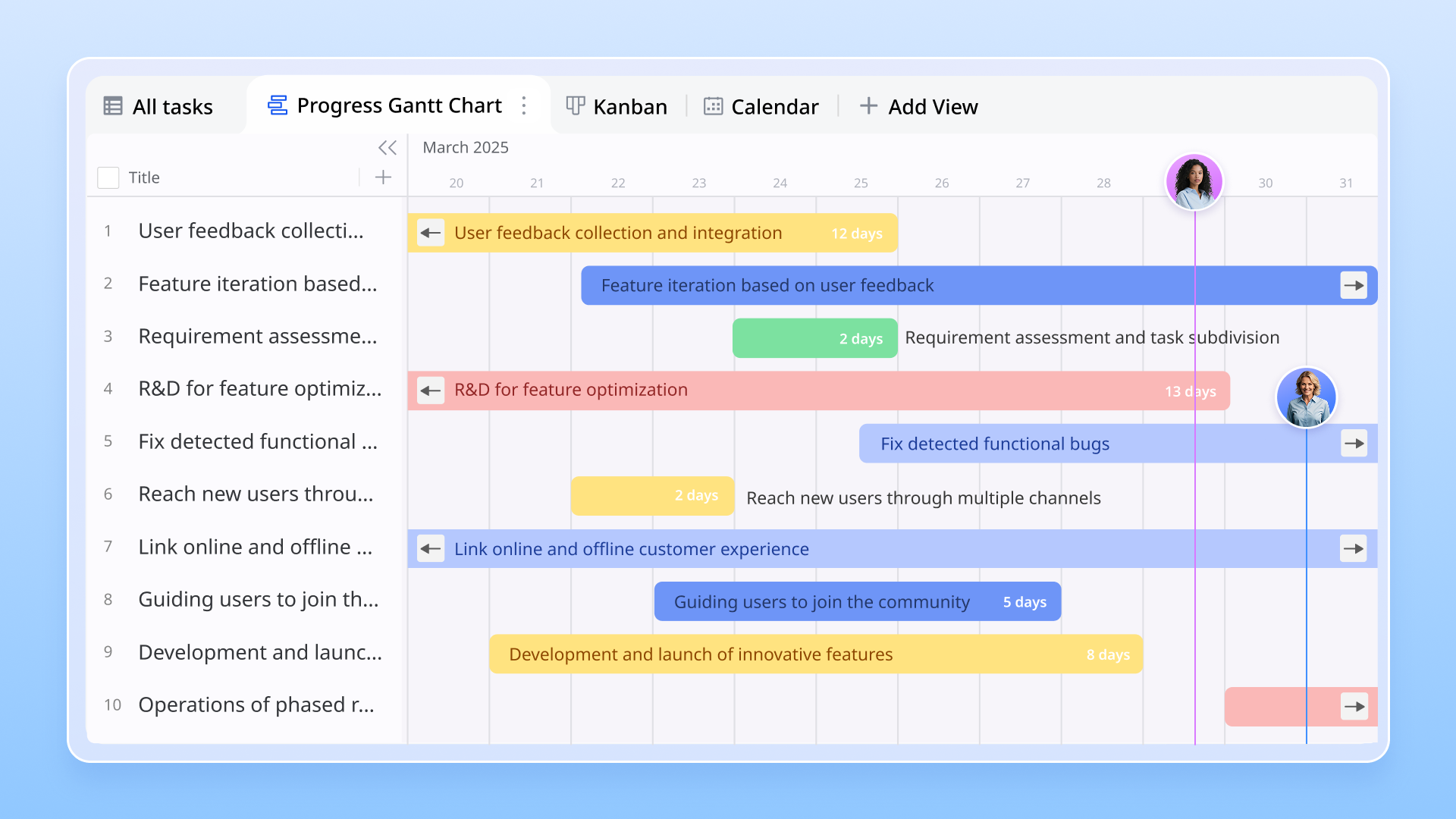
Streamlined workflows to reduce manual efforts
Efficiency is a core principle of the agile project management framework, and Lark Base automations reinforce this by handling the "busy work". You can set intelligent triggers to send instant notifications when a task is blocked, automate reminders for upcoming sprint deadlines, and update record statuses automatically based on team input. This ensures the flow of work remains uninterrupted and reduces the manual effort required to keep project boards up to date. For even more complex logic, you can explore the overview of workflow in base to synchronize your team's output. 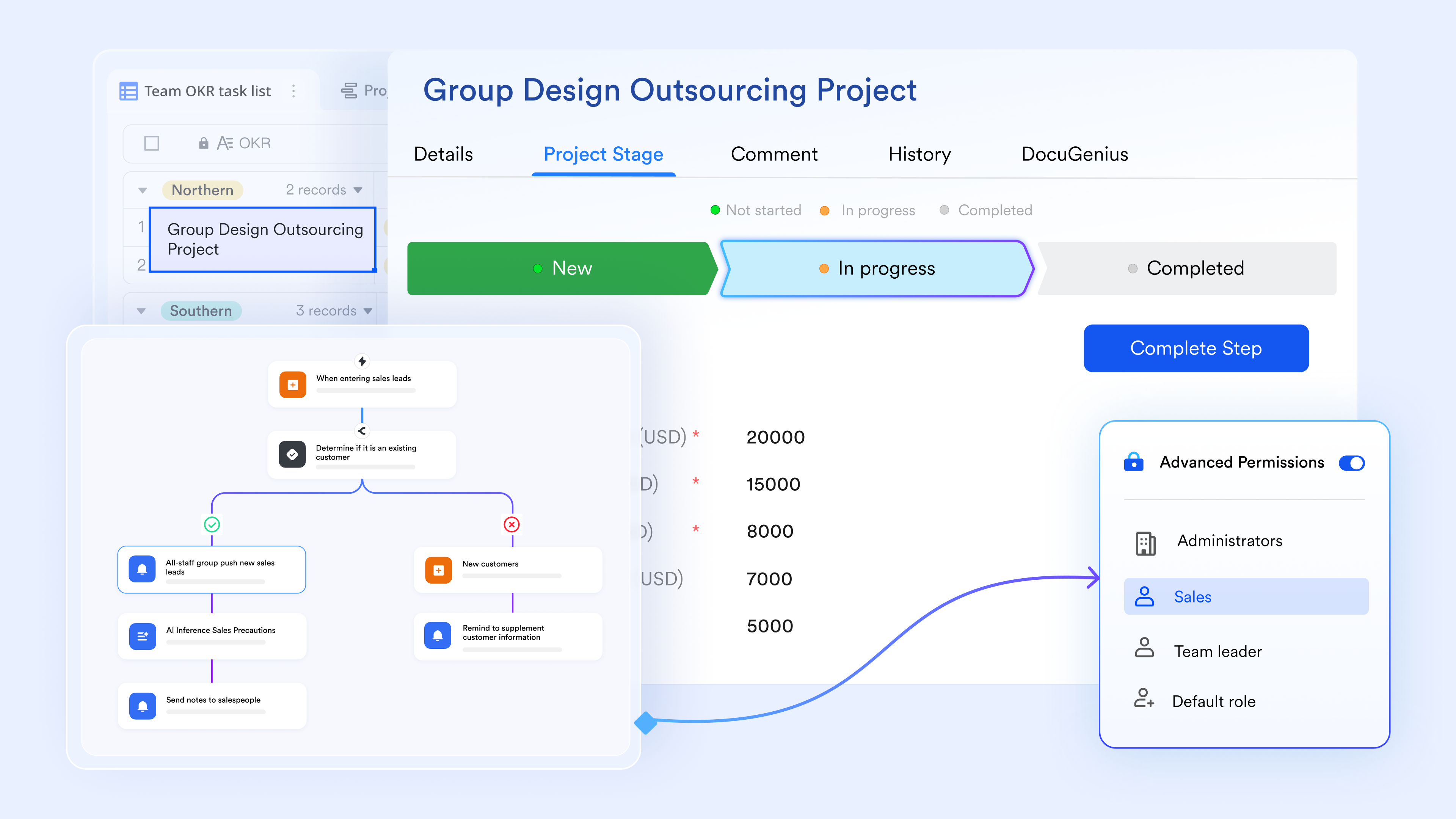
Real-time document collaboration
Agile requires shared ownership of plans, risks, and objectives. enables teams to co-create PI objectives, risk assessments, and sprint plans in real-time. By embedding live Base views, mentioning colleagues for instant feedback, and using rich content support, Docs becomes a "living" document collaboration platform. Instead of static files, your sprint plans become interactive documents where every team member can contribute to the agile journey. 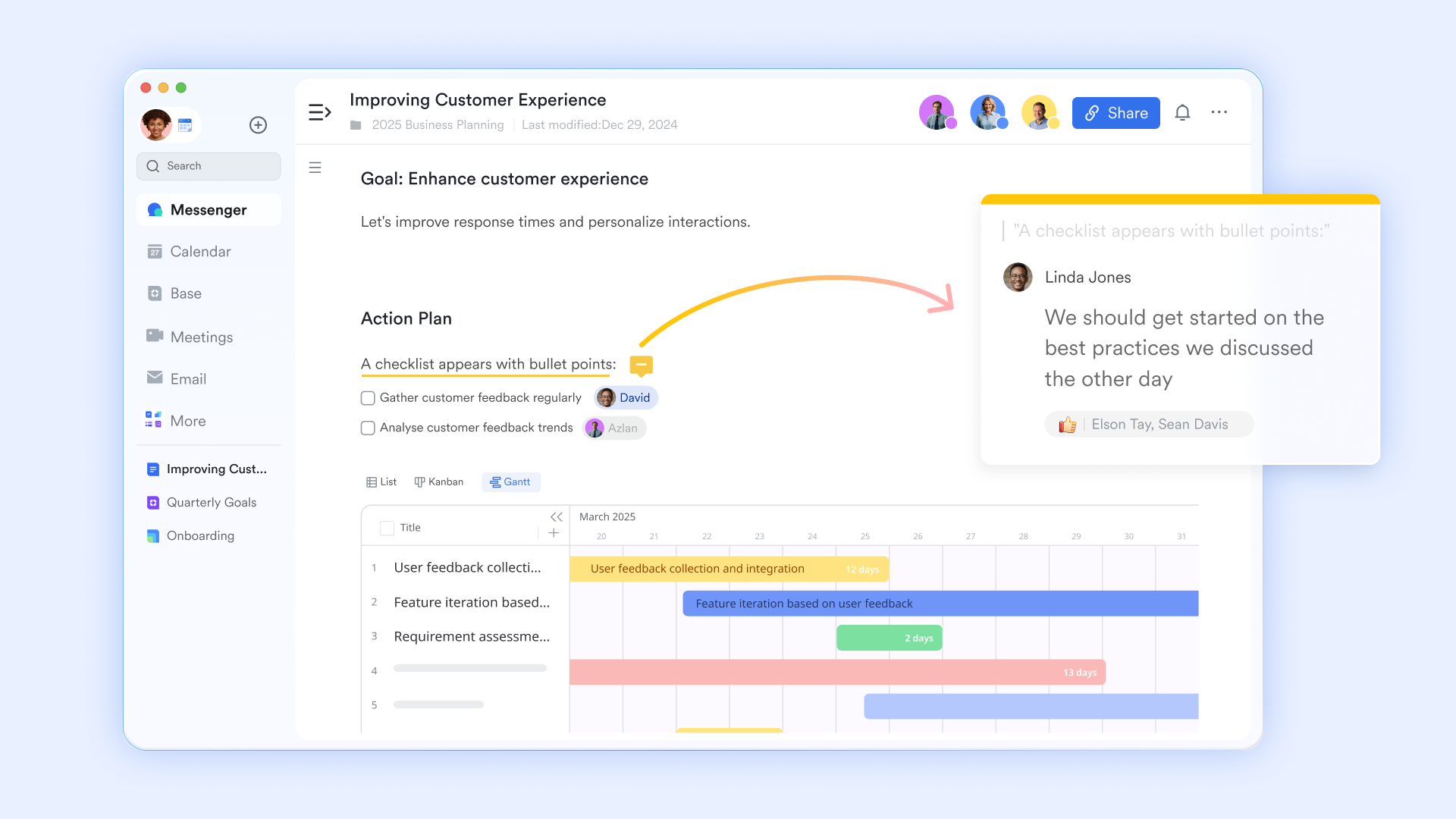
Seamless communication and task execution
Effective execution depends on continuous, transparent communication. provides topic-based chats and threaded conversations to resolve issues without derailing the main channel. When a decision is made in chat, you can instantly turn it into Lark Tasks, assign an owner, and set a deadline. This ensures that large features are broken down into actionable items, creating a smooth flow from conversation to measurable progress. 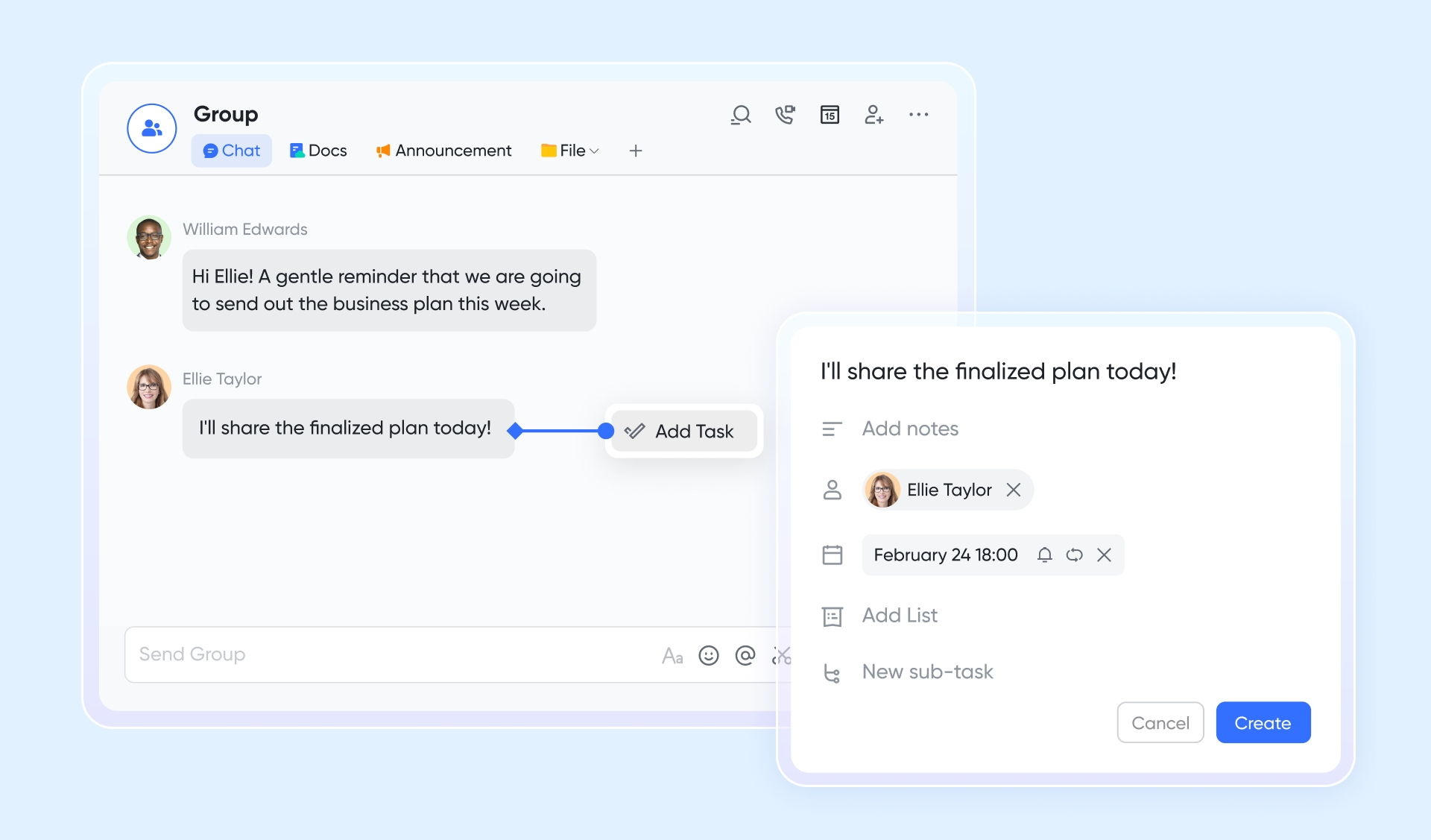
High-engagement online conferencing
From daily standups to large-scale PI planning, keeps agile events productive. Teams can brainstorm on virtual whiteboards and use Magic Share to co-edit documents during the call. To ensure no decision is lost, provide searchable, translatable notes, allowing the team to focus on the discussion rather than manual note-taking. This turns every meeting into a launchpad for the next sprint. 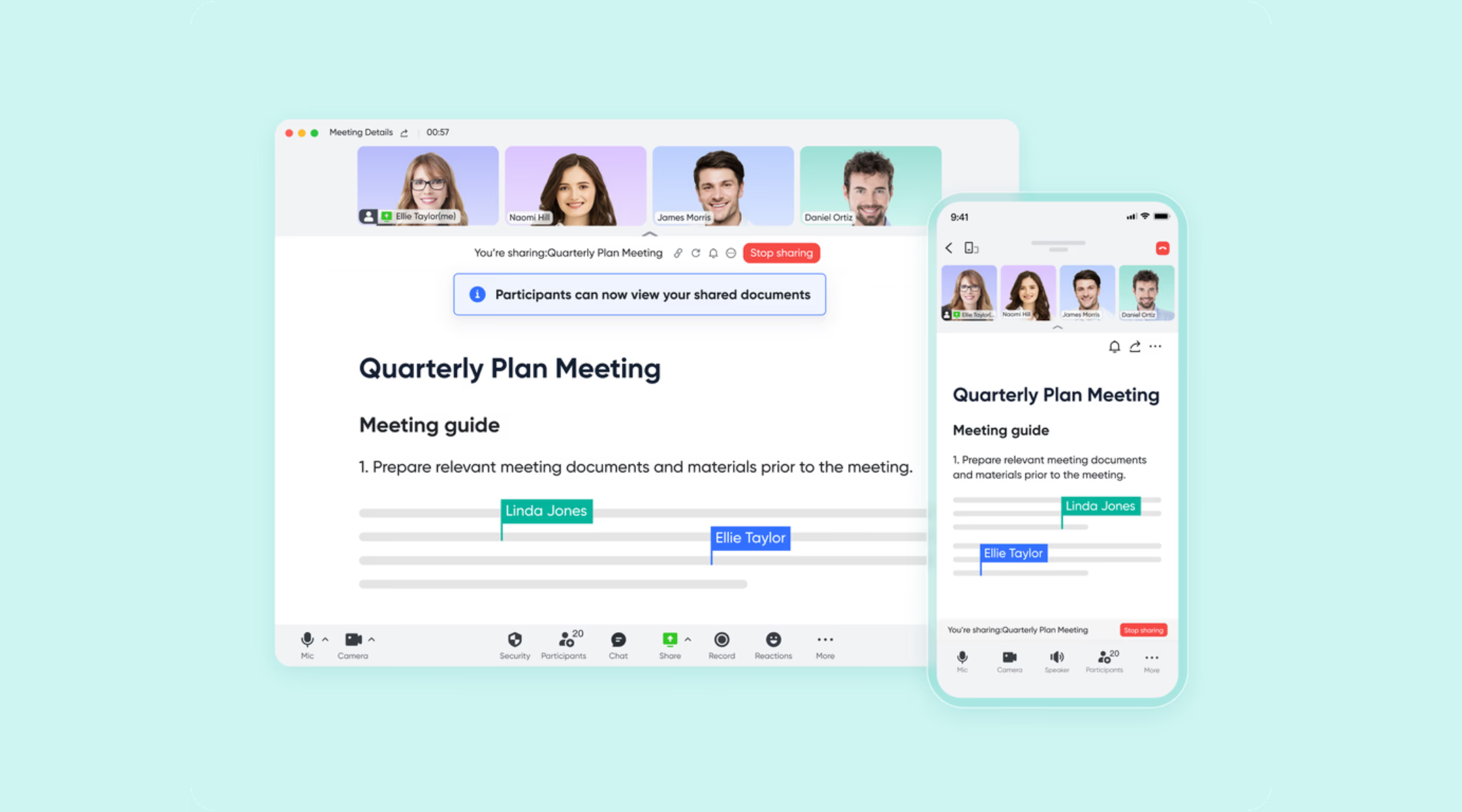
:
- Starter plan: Free forever plan that includes 11 powerful tools for up to 20 users. It also comes with 100GB of storage, 1000 automation runs, AI translations, and more.
- Pro plan: $12/user/month (billed annually) for up to 500 users. It includes everything in Starter plus group calling for up to 500 attendees, 15TB of storage, 50,000 automation runs, and more.
- Enterprise plan: for custom pricing. Supports unlimited users and includes even more automation runs and advanced security, compliance, and management features.
For small teams with simple communication needs

18 months message history
1000 Base automation runs/month
2000 rows per table in Base
Most POPULAR
For companies with comprehensive collaboration and management needs
Unlimited message history
500-participant video meetings
50k Base automation runs/month
20k rows per table in Base
For large companies with advanced security and organizational management needs
Get a personalized demo and pricing
Unlimited message history
500-participant video meetings
15 TB storage + 30 GB storage/user
500k Base automation runs/month
50k Base automation runs/month
Most POPULAR
For companies with comprehensive collaboration and management needs
Unlimited message history
500-participant video meetings
50k Base automation runs/month
20k rows per table in Base
4 real-world examples of teams adopting Agile methodologies
Understanding agile principles is easier when you see how they are applied at scale. Real organizations often face constraints such as legacy systems, regulatory pressure, and cultural resistance that theory does not fully address. The following real-life examples of agile project management show how global companies reshaped their structures, workflows, and collaboration models to move from to adaptive execution.
PayPal's "Big Bang" Scrum transformation
PayPal is famous for its "all-at-once" transition. Faced with internal silos and slow release cycles, the company skipped the gradual pilot phase and transitioned its entire organization to Scrum in 2013. By assembling a massive transition team of 150 employees and retraining thousands of staff members simultaneously, they moved to a universal two-week sprint cycle.
The result: Within just six months of the switch, PayPal delivered 58 new products at a pace that was previously impossible under their old waterfall constraints.
The Spotify model: Squads, tribes, and guilds
Spotify's approach is so unique that it earned its own name: "The Spotify Model." Instead of a traditional hierarchy, they use a matrix of nesting groups. Employees work in squads (mini-startups of 6-12 people), which group into tribes (business areas). To ensure knowledge doesn't stay siloed, they use chapters (skill-based groups) and guilds (company-wide communities).
The result: This structure allows Spotify to scale rapidly while maintaining the creative autonomy of a small startup, ensuring that the music player and infrastructure teams stay perfectly synchronized.
Cisco's Scaled Agile (SAFe) for billing efficiency
In 2015, Cisco moved its subscription billing platform to the Scaled Agile Framework (SAFe). Before this, they suffered from the "waiting game" of waterfall, where one delay crippled the entire three-month release cycle. By creating three "Agile Release Trains" (capabilities, defects, and projects), they synchronized their workflows through 15-minute daily check-ins. Using a gave them the real-time visibility needed to identify defects before they stalled the release train.
The result: Cisco saw a 40% reduction in significant defects and a 14% improvement in defect removal efficiency, all while drastically reducing employee overtime.
JPMorgan's cross-departmental acceleration
JPMorgan proves that Agile works even in highly regulated industries like finance. By pairing engineers with legal and compliance experts in the same "sprint," they eliminated the weeks-long back-and-forth typically required for approvals. This cross-functional collaboration allows them to incorporate customer feedback into banking products in real-time. High-velocity delivery in regulated industries depends on that break down departmental silos.
The result: Their e-gifting initiative, which was projected to take a full year under traditional methods, was brought to market in just six months, halving their time-to-value.
Conclusion
Agile project management delivers its strongest results when teams move beyond surface-level practices and fully embrace adaptability, transparency, and continuous improvement. Real-world agile project management examples show that agility is not limited to software tools, but applies equally well to marketing, operations, finance, and manufacturing environments. When teams focus on iterative delivery, frequent feedback, and shared accountability, they are better equipped to respond to change without sacrificing quality or alignment.
As organizations grow and initiatives span multiple teams, sustaining agility becomes increasingly challenging. Visibility gaps, fragmented tools, and misaligned priorities can slowly erode the benefits of agile project management. This is why many teams gradually shift toward merging environments that connect planning, execution, and communication. Over time, platforms like help teams preserve agile principles at scale by keeping work transparent, decisions documented, and collaboration continuous across the entire .
Apply proven methods across teams
FAQs
What are the 5 phases of Agile project management?
Agile project management typically follows five repeating phases: concept, inception, iteration, release, and review. Unlike traditional models, these phases are cyclical rather than sequential, allowing teams to revisit goals and adjust priorities continuously. Each phase builds on real feedback rather than assumptions made early in planning. As teams scale, maintaining visibility across these phases becomes essential, which is where platforms like Lark begin to support continuity and alignment.
Can Agile project management work without Scrum roles?
Yes, agile project management can function effectively without formal Scrum roles such as Product Owner or . Many teams tailor responsibilities based on size, maturity, and industry requirements. What matters most is clear ownership, frequent feedback, and shared understanding of priorities. Over time, collaborative workspaces like Lark help teams maintain structure and clarity even when roles are flexible rather than rigidly defined.
How do enterprises scale Agile examples across multiple teams?
Enterprises scale agile by planning cycles, standardizing visibility, and aligning priorities across teams. Frameworks such as SAFe or custom hybrid models often support this effort. However, tooling plays a critical role in preventing fragmentation as scale increases. Centralized environments like Lark gradually help enterprises connect multiple agile teams by unifying communication, execution data, and shared documentation.
What metrics best reflect success in Agile project management?
The most effective agile focus on outcomes rather than activity. Cycle time, customer value delivered, defect trends, and team sustainability are more meaningful than task volume alone. These metrics help teams learn and improve instead of simply reporting encouragement. As teams mature, having these indicators visible in context becomes increasingly important, which is where tools like Lark support informed decision-making.
How do teams transition from waterfall to Agile without disruption?
A successful transition from waterfall to agile usually starts with small pilot teams before expanding organization-wide. Clear communication, leadership support, and incremental change reduce resistance and confusion. Maintaining transparency during the transition is critical to preserving trust and . Over time, platforms such as Lark help teams sustain agility by keeping workflows, updates, and decisions connected as processes evolve.
Related reading





























