A project's success is not measured only by delivery milestones or system performance, but by how effectively financial expectations are managed throughout execution. In modern software environments, cost overruns remain one of the most common reasons initiatives fail to deliver expected value.
As requirements evolve, infrastructure pricing fluctuates, and distributed teams expand, estimating costs accurately becomes increasingly complex. This guide explains IT project cost estimation in practical terms, explores proven methods, real examples, templates, and tools, and shows how teams improve accuracy through better visibility and collaboration. Modern platforms such as Lark appear later as enablers, not starting points.
What is IT project cost estimation?
IT project cost estimation is the structured process of forecasting the total financial resources required to deliver an IT initiative within a clearly defined scope. Rather than being a one-time calculation, it evolves continuously from the discovery phase through execution as requirements, timelines, and resource assumptions change. A well-prepared cost estimate format helps teams move from rough assumptions to data-backed forecasts, often supported by , an IT project cost estimation template, or dedicated IT project cost estimation software.
An accurate estimate serves as the financial backbone of the initiative. It supports budget approval by giving stakeholders confidence in funding decisions, enables resource allocation by clarifying the number of developers, testers, and designers required, and strengthens through early identification of potential overruns. By using a clear cost breakdown template and consistent , teams can surface financial blind spots early and apply cost analysis template techniques to prevent small variances from turning into major budget issues. Likewise, individuals often turn to simplify payments with a to gain clearer visibility over their financial commitments and avoid compounding costs.
Types of project costs
Understanding the various types of is essential for creating a reliable IT project cost estimation. A comprehensive cost breakdown template must account for every category of expense that impacts the budget, not just the most visible ones. When teams clearly define cost types early, they improve estimate accuracy, strengthen project cost tracking, and reduce the risk of unexpected overruns later in the lifecycle.
Direct costs
These are expenses directly tied to the :
- Labor: Labor costs include salaries or hourly rates for developers, project managers, and QA engineers directly involved in delivery. These costs scale with team size, duration, and complexity. Because labor is the largest budget component, accurate effort estimates are critical to avoid overruns.
- Software licenses: Software licensing covers IDEs, APIs, and third-party tools required for development. These may be one-time or recurring costs and often increase as usage grows. Using a allows development teams to leverage pre-built website creation functionality, integrate it into custom applications, and automate repetitive tasks without building everything from scratch. Including such APIs in the budget ensures that subscription fees, support costs, and potential scaling charges are considered early, preventing surprises later in the project lifecycle. Proper planning around these integrations can significantly streamline development while keeping financial estimates accurate.
- Hardware: Hardware expenses include servers, workstations, or specialized devices needed for development and deployment. These costs can significantly impact upfront budgets if overlooked. Planning for hardware ensures infrastructure needs are fully reflected.
Indirect costs
Often overlooked, these are the "hidden" costs of doing business:
- Utilities and rent: Utilities and office rent support the physical environment where teams operate. While these costs are shared across projects, a portion should be allocated to reflect actual usage. Ignoring them creates an incomplete view of total expenditure. Including these costs leads to more realistic long-term budgeting.
- Administrative support: Administrative costs include HR services, legal reviews, compliance checks, and . These activities are essential for staffing and governance but are often overlooked during estimation. Although indirect, they still consume budget and time. Factoring them strengthens financial planning and reduces hidden cost exposure.
IT project cost estimation example to understand better
To visualize how these costs come together, consider a 6-month project to develop a custom inventory management system.
Example:
- Labor (direct): 3 developers + 1 designer + 1 PM = $250,000
- Infrastructure (direct): AWS cloud hosting + database licenses = $15,000
- Administrative (indirect): Allocated HR & legal fees = $5,000
- Contingency (15%): Buffer for scope changes/technical debt = $40,500
- Total estimated cost: $310,500
In this example, using a bottom-up approach allows the team to see that labor is the primary driver. If a developer is delayed by two weeks, the project manager can immediately calculate the $10,000+ impact on the total budget.
Capital expenditures (CapEx) vs. operating expenses (OpEx)
Distinguishing between capital expenditures and operating expenses is critical in IT project cost estimation. Capital expenditures typically include one-time investments such as purchasing physical servers or long-term equipment. Operating expenses cover recurring costs like cloud subscriptions, hosting services, and managed platforms.
Proper classification is essential for accurate project cost tracking, financial reporting, and compliance with accounting standards. By establishing a robust , teams can forecast cash flow more effectively and avoid misalignment with finance stakeholders. When these distinctions are managed through online collaboration tools, it ensures total project transparency and simplifies between engineering and accounting departments.
Ready to bring precision to cost estimation?
Core components of an IT project cost estimate
A reliable IT project cost estimation depends on more than rough assumptions or high-level numbers. A professional cost estimate format is built on clearly defined components that work together to create financial clarity. These core elements ensure that estimates are structured, defensible, and adaptable as the project evolves.
- Scope of Work (SOW): The scope of work defines exactly what will be delivered and what is excluded from the estimate. It outlines functional requirements, assumptions, and constraints that shape cost expectations. A clearly documented SOW reduces ambiguity and prevents uncontrolled expansion during execution. Strong scope definition is the foundation of accurate estimation.
- Resource requirements: Resource requirements identify the human and technical assets needed to complete the work. This includes roles, skill levels, and or infrastructure. Accurately mapping resources helps teams forecast labor and tooling costs more precisely. Clear resource planning also supports better allocation and scheduling decisions.
- Timeline: The project timeline outlines how work is distributed across phases such as discovery, development, testing, and deployment. Duration directly influences costs related to staffing, tools, and infrastructure. A realistic timeline accounts for dependencies and review cycles. Aligning cost estimates with timing improves budget predictability.
- Contingency buffer: A contingency buffer provides a financial safety margin for uncertainty. In , unknown risks such as technical complexity or merging delays are common. Including a buffer of approximately 10 to 20 percent helps absorb these impacts without derailing the budget. This component strengthens estimate resilience and stakeholder confidence.
IT project cost estimation methods and when to use each
Choosing the right IT project cost estimation method is essential for balancing speed, accuracy, and . Different methods serve different purposes depending on how clearly requirements are defined and how much historical data is available. As projects move from discovery to delivery, teams often shift between methods to refine estimates and reduce financial risk.
Analogous estimating (top-down)
Analogous estimating compares the current initiative with similar past projects to predict overall cost. It relies on high-level similarities such as project size, technology stack, or rather than detailed task analysis. This method is especially useful when stakeholders need quick direction before committing to deeper planning.
- When to use: This method is most effective during early discovery, feasibility analysis, or when leadership needs an initial estimate to decide whether to proceed. It works well for high-level planning and early budget conversations.
- Strengths: Analogous estimating is fast, simple, and requires very little detailed input. It enables teams to move forward quickly without waiting for full requirements.
- Limitations: Accuracy depends heavily on how closely the past project matches the current one. Unique technical challenges or new requirements can significantly reduce reliability.
Parametric estimating
Parametric estimating uses mathematical relationships between cost and measurable variables such as the number of features, lines of code, or data volume. It introduces more structure and consistency than top-down approaches by grounding estimates in quantifiable inputs.
- When to use: This method works best for repeatable or standardized work such as system migrations, environment provisioning, or feature enhancements with predictable effort patterns.
- Strengths: Because it is data-driven, parametric estimating offers better accuracy and consistency than purely comparative methods. It also scales well when estimating similar work across multiple projects.
- Limitations: Only reliable when units of work are truly consistent. To mitigate risks, teams should use to document variables that might distort results.
Bottom-up estimating
Bottom-up estimating involves breaking the full scope into detailed tasks and estimating the cost of each one individually. These task-level estimates are then aggregated to calculate the total project budget. This method provides maximum visibility into where money is being spent.
- When to use: Bottom-up estimating is ideal once technical requirements are finalized and teams are ready for detailed planning. It is commonly used before final budget approval.
- Strengths: This approach delivers the highest accuracy and produces a clear cost breakdown template that supports ongoing project cost tracking. It also improves accountability by linking costs directly to tasks.
- Limitations: The process is time-consuming and requires deep technical input from developers and architects. It may not be practical during early .
Three-point estimating (PERT)
Three-point estimating acknowledges uncertainty by modeling three scenarios for each major task or feature: optimistic, most likely, and pessimistic. The final estimate is a weighted average that reflects potential variability in effort and risk.
- When to use: This method is most valuable for high-risk projects, innovative solutions, or work involving unfamiliar technologies where uncertainty is unavoidable.
- Strengths: Three-point estimating improves realism by explicitly accounting for risk and variability. It helps expectations and supports more resilient budgeting.
- Limitations: Estimating multiple scenarios for every major component increases effort and requires disciplined data collection to remain effective.
Expert judgment
Expert judgment leverages the experience of senior , solution architects, or external consultants to assess cost implications that data alone may not reveal. It is often used as a validation layer rather than a standalone method.
- When to use: Expert judgment is most effective when combined with other estimation methods, especially for complex architectures or niche technologies.
- Strengths: Experienced professionals can identify hidden costs such as security compliance, performance optimization, or long-term maintenance. Their insight adds context that models may miss.
- Limitations: Because it relies on human judgment, this method can be subjective and influenced by optimism bias if not cross-checked with data.
Tools and software for IT project cost estimation
Accurate IT project cost estimation depends not only on methods and templates but also on the tools used to manage financial data. Different tools serve different purposes, ranging from simple cost modeling to forecasting and reporting. Understanding the strengths and limitations of each tool category helps teams choose solutions that match their project complexity, scale, and collaboration needs.
Need better visibility into cost data?
Popular choice: Try Lark to manage IT projects alongside cost estimation
In IT , inaccurate cost estimation is often the result of "hidden" variables, such as untracked developer hours, fluctuating vendor rates, or unforeseen hardware requirements. Lark addresses these issues by creating a tight feedback loop between the budget plan and actual execution data.
Instead of relying on static that become outdated the moment work begins, uses a relational data model to ensure your estimates are based on real-time resource costs and historical performance data.
Collaborative estimation document
Inaccurate estimates often come from "hidden" requirements. allows product managers to @mention developers, co-edit the file, and reply to testers' comments directly on specific lines in a cost estimation document. This real-time, threaded discussion ensures that technical complexities are exposed early. A requirement document with zero unresolved comments leads to a significantly more precise assessment of effort. 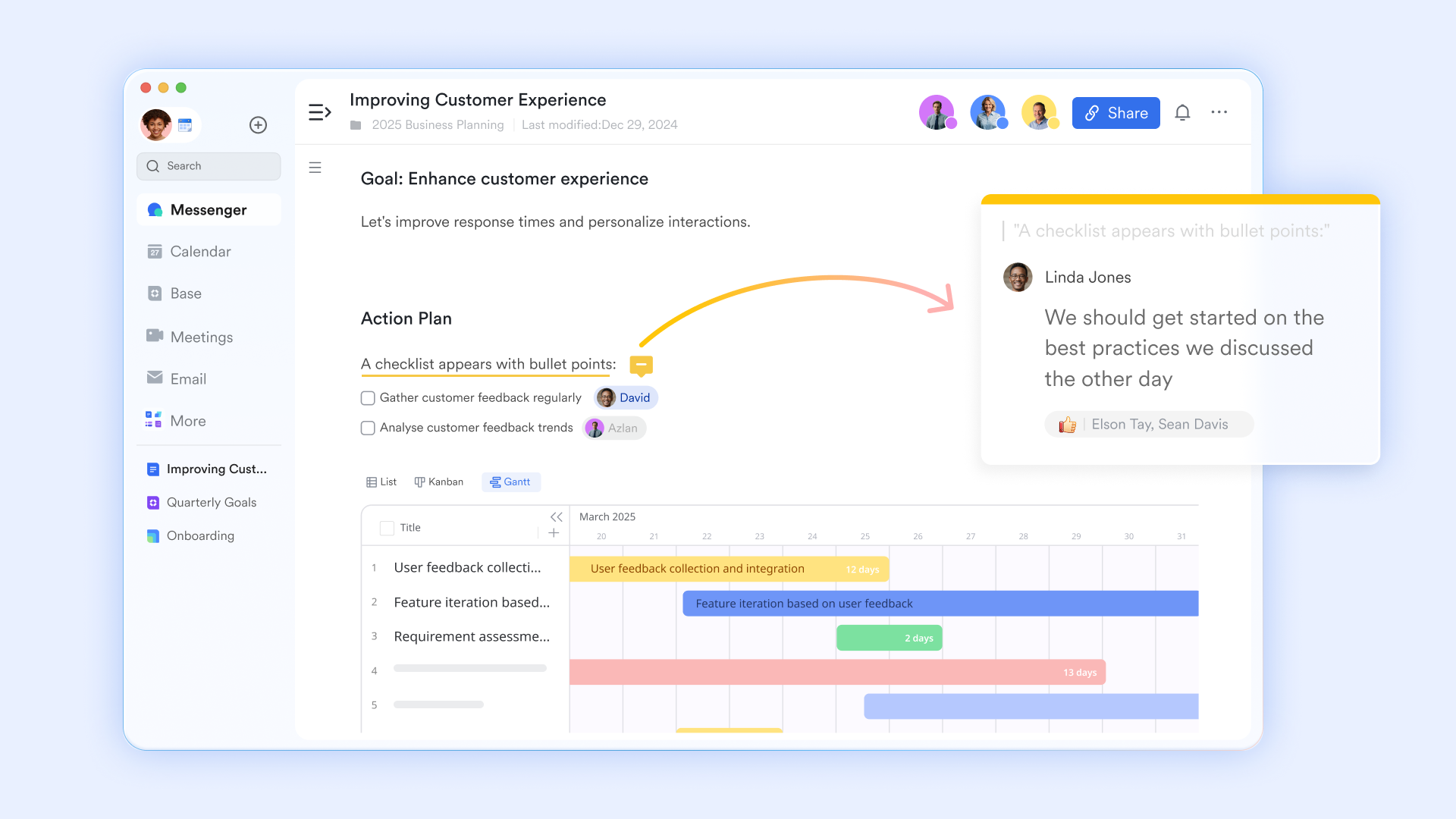
Historical benchmarking with Lark Base
Instead of relying on guesswork, teams can use to create a structured database of past projects. By maintaining live records of variables—such as technology stacks, team sizes, and planned versus actual hours—the team transforms "gut feelings" into searchable data assets. When a new project starts, managers can filter and sort for similar past entries to set realistic, data-backed budget baselines. 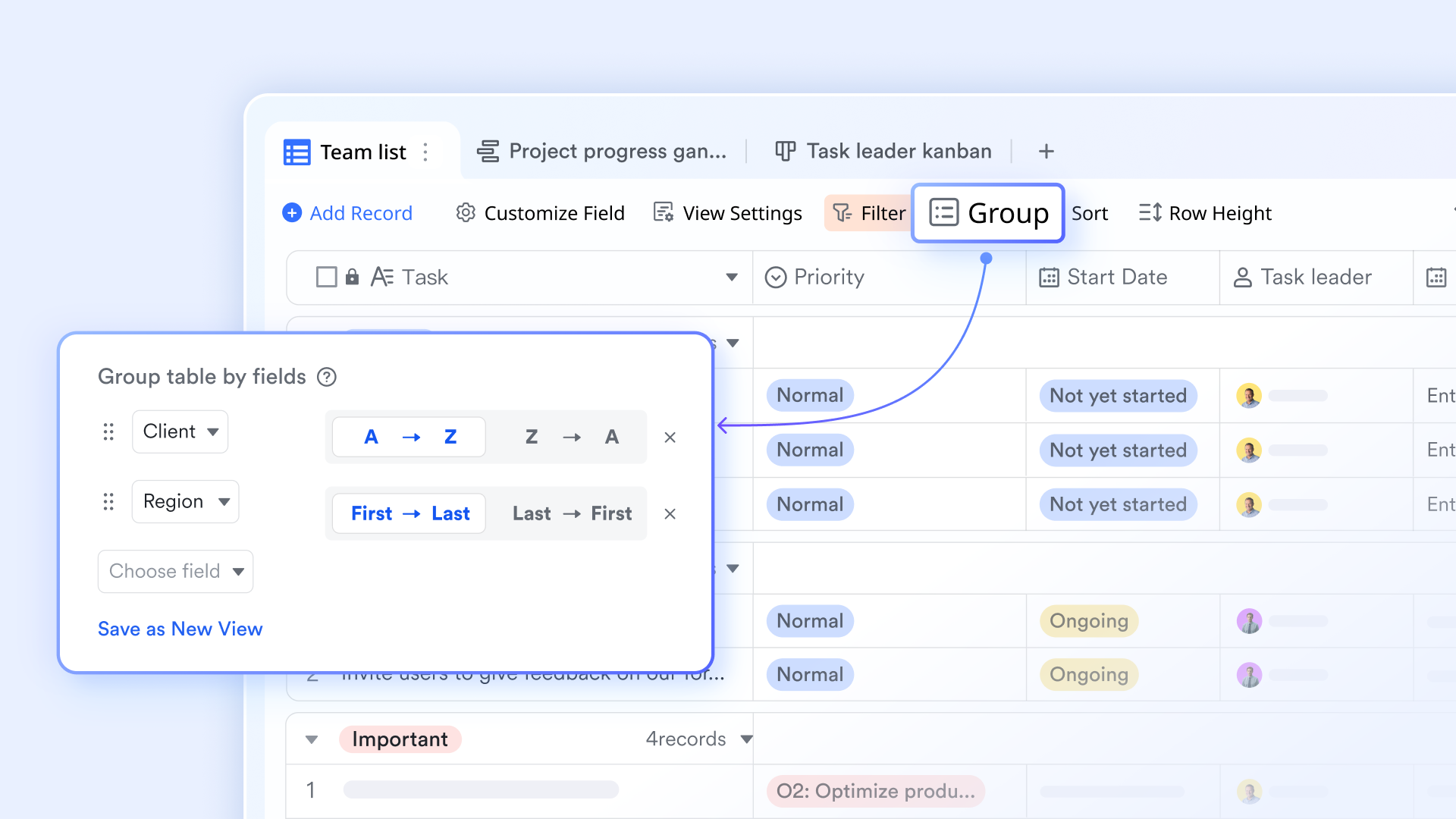
Complex formulas for accurate projections
IT projects often involve global vendors and cloud service costs billed in different currencies or tiered pricing models. supports custom formulas that can handle everything from currency conversions to overhead multipliers. You can build an automated "Cost Calculator" within your project board that factors in tax, contingency buffers (e.g., adding a 15% safety margin), and exchange rates, ensuring the final estimate is financially sound across different regions. 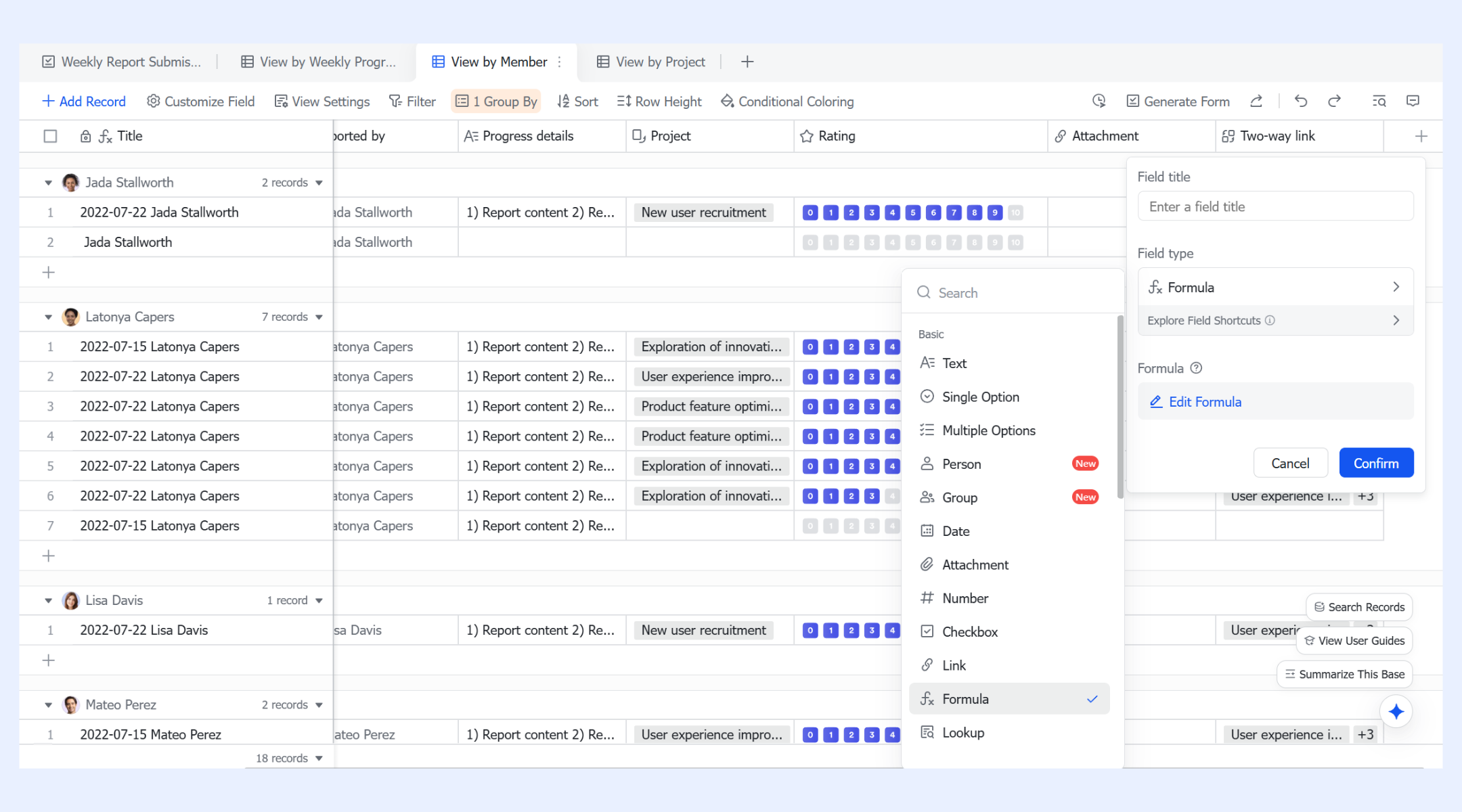
Real-time visual dashboards
Lark Base dashboards provide a high-level view of "task schedule deviation" across the entire project lifecycle. Rather than waiting for a weekly status report, stakeholders can see a live visual representation of how the project is performing against the initial estimate. This transparency allows for proactive adjustments to resource allocation and costs. By utilizing the combo chart or funnel charts in dashboards, teams can instantly identify bottlenecks in the workflow. 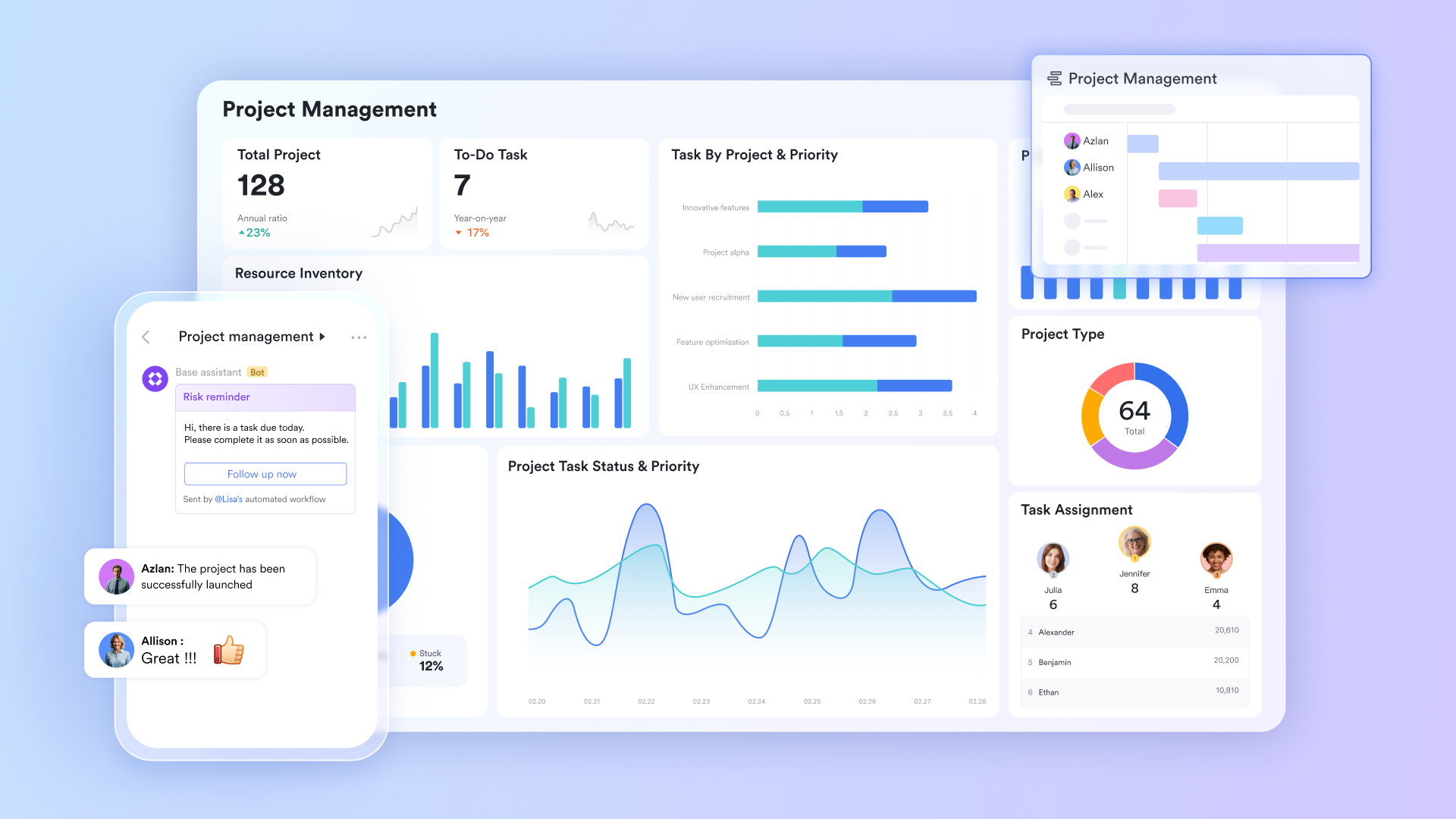
Automated deviation alerts
Lark Base features automation rules that act as an early warning system. You can configure a rule where, if the "Actual Hours" entered for a task exceed the "Estimated Hours," an automatic notification is sent to the project group. This prevents small delays from snowballing into massive budget overruns by forcing an immediate impact assessment. By using formulas to track these discrepancies in real-time, project managers can ensure that data is updated through without manual oversight. 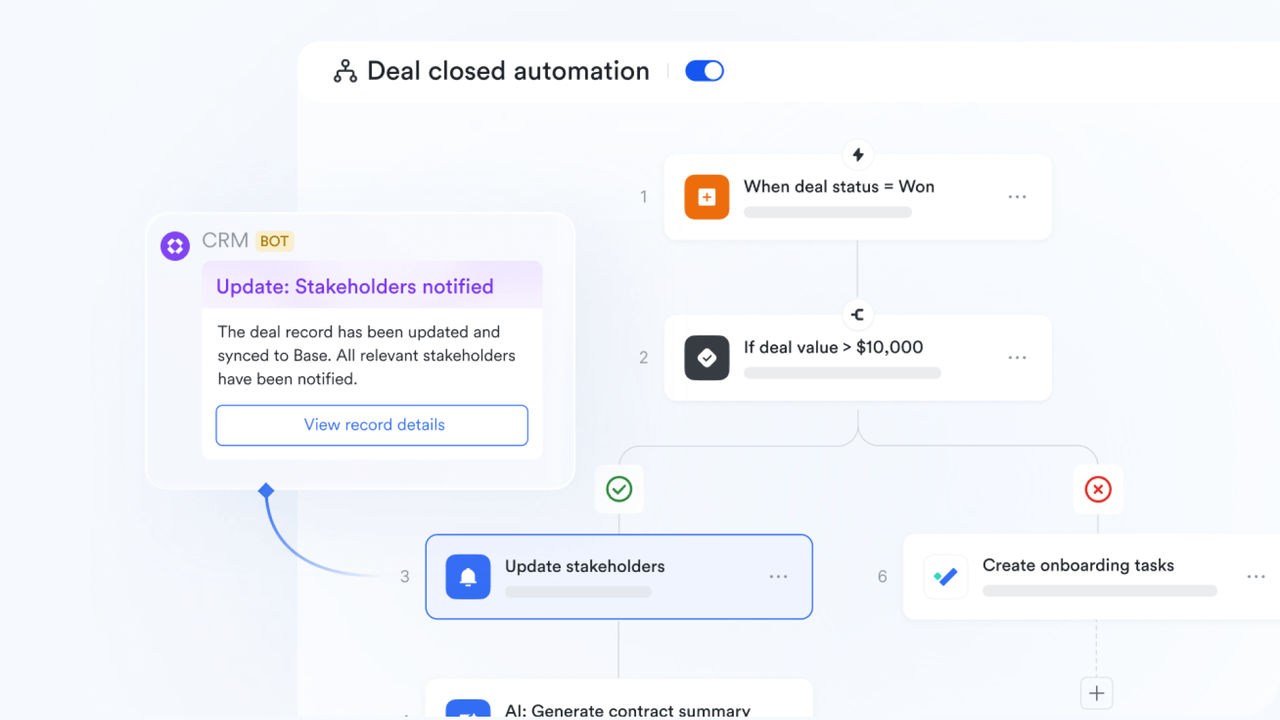
Centralized approval workflows
By integrating within the estimation process, teams can ensure that all cost assumptions and budget changes are documented and signed off by the right stakeholders. This creates a shared audit trail of approvals, ensuring that every estimate is vetted for accuracy and that "scope creep" is formally accounted for in the budget. To streamline this, you can sync Approval data to Base, allowing managers to track the status of budget requests directly alongside their project tasks. 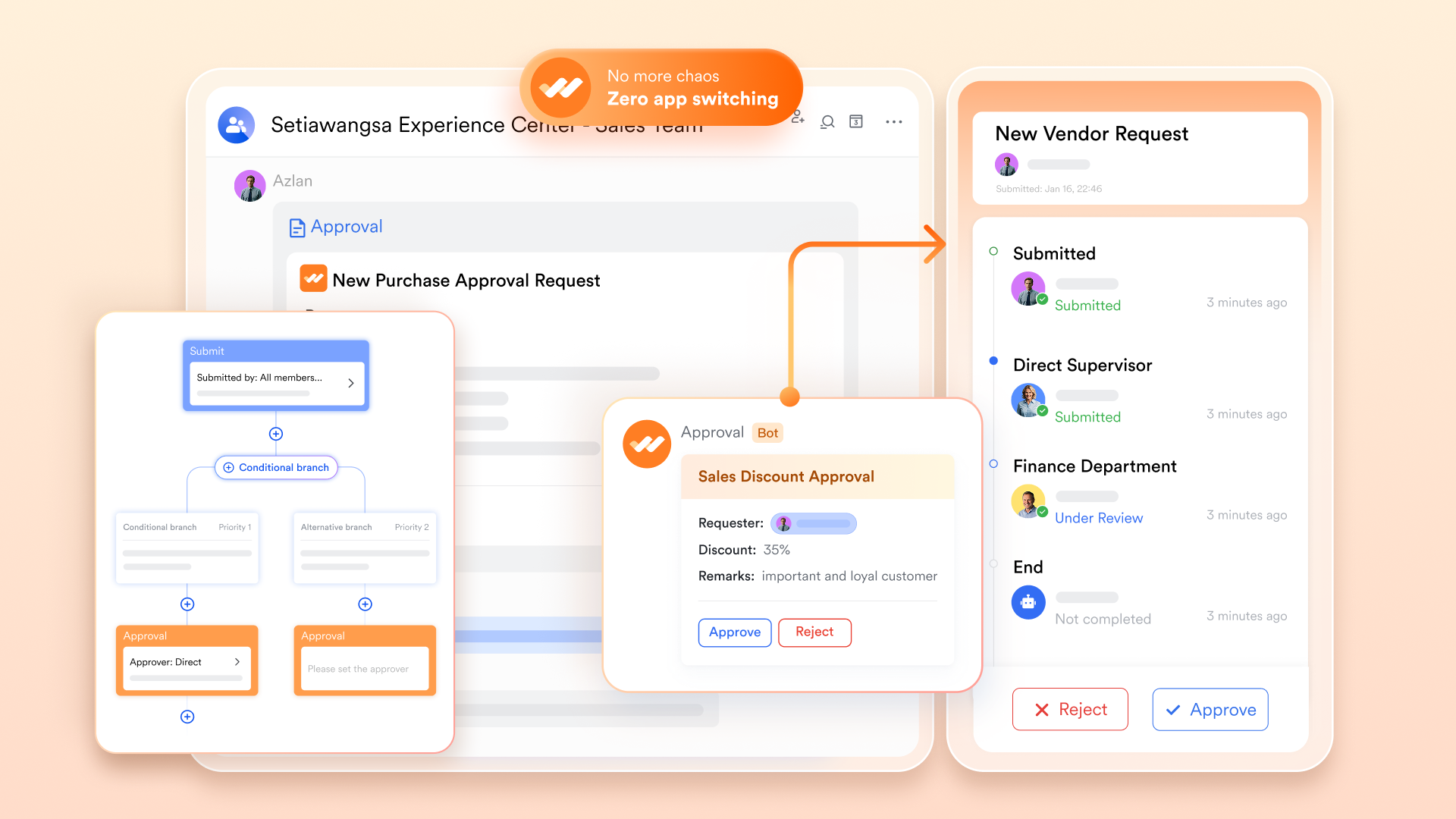
:
- Starter plan: Free forever plan that includes 11 powerful tools for up to 20 users. It also comes with 100GB of storage, 1000 automation runs, AI translations, and more.
- Pro plan: $12/user/month (billed annually) for up to 500 users. It includes everything in Starter plus group calling for up to 500 attendees, 15TB of storage, 50,000 automation runs, and more.
- Enterprise plan: for custom pricing. Supports unlimited users and includes even more automation runs and advanced security, compliance, and management features.
For small teams with simple communication needs

18 months message history
1000 Base automation runs/month
2000 rows per table in Base
Most POPULAR
For companies with comprehensive collaboration and management needs
Unlimited message history
500-participant video meetings
50k Base automation runs/month
20k rows per table in Base
For large companies with advanced security and organizational management needs
Get a personalized demo and pricing
Unlimited message history
500-participant video meetings
15 TB storage + 30 GB storage/user
500k Base automation runs/month
50k Base automation runs/month
Most POPULAR
For companies with comprehensive collaboration and management needs
Unlimited message history
500-participant video meetings
50k Base automation runs/month
20k rows per table in Base
Ready-to-use IT project cost estimation templates
Cost-benefit analysis template
Making strategic investment decisions requires a thorough understanding of financial implications like and break-even points. This template helps project managers and business owners analyze the potential value of a project by weighing its total costs against its projected benefits. By using this data-driven approach, teams can prioritize high-return initiatives and optimize their long-term project planning.
Expense tracking template
Effective finance management starts with a clear record of where money is being spent, whether for personal use or business operations. This template simplifies the process of recording and categorizing expenses, allowing you to gain visibility into spending trends and habits at a glance. It is an ideal tool for freelancers and small businesses looking to streamline their reporting and make more informed financial decisions.
Tech project budget tracker
Tech projects often involve complex components like hardware, software, and specialized labor, making budget overruns a common risk. This template simplifies oversight by allowing you to input estimated costs and actual spend for every individual expense item in your technical stack. It helps team leads monitor discrepancies and build more accurate financial projections for future technological upgrades.
Expense report template
Keeping track of team expenses like travel, meals, and office supplies is crucial for maintaining financial control and policy compliance. This template allows employees to easily submit expenses while providing managers with a transparent system for review and . By centralizing all reimbursement data, finance teams can ensure accurate categorization and protect the business against fraudulent spending.
When to revisit and re-estimate IT project costs
IT project cost estimation should be treated as a dynamic process rather than a one-time exercise. As requirements evolve, work progresses, and external conditions change, initial assumptions quickly become outdated. Revisiting and updating estimates at key moments helps teams maintain financial control, manage risk proactively, and ensure that budgets remain aligned with real execution throughout the .
- After the discovery phase, initial estimates are often based on high-level ideas, but the discovery phase uncovers the granular technical requirements and potential roadblocks. Once these details are finalized, you must update your budget to reflect the actual engineering complexity revealed during research.
- At the end of each sprint: Sprints provide a regular cadence to compare your "Estimated" versus "Actual" effort for specific tasks. If the team consistently overshoots their hours in early sprints, re-estimating the remaining backlog ensures your end-of-project projections remain realistic.
- When scope changes: "Scope creep" is a leading cause of budget overruns, as adding new features naturally requires more time and resources. Any addition to the product backlog must trigger an immediate re-estimate to ensure stakeholders understand the financial impact of the new requirements.
- Market shifts: often rely on external factors like third-party vendor rates, hardware availability, or cloud service pricing models. If a major provider changes their subscription tiers or exchange rates fluctuate significantly, you must adjust your cost tracking to account for these external economic shifts.
Conclusion
Mastering IT requires more than selecting the right formulas or templates. It is an ongoing discipline built on refining assumptions, improving data quality, and maintaining visibility across scope, resources, and timelines. Traditional estimation methods provide a necessary framework, but they are only effective when teams actively revisit and adjust estimates as conditions change. Projects that stay financially healthy are those where cost awareness is embedded into everyday decision-making rather than treated as a one-time planning task.
As IT environments become more dynamic, static spreadsheets and disconnected tools struggle to keep pace with real execution. Teams increasingly benefit from data-driven approaches that link estimates directly to actual work and outcomes. Over time, platforms like help bridge the gap between planning and reality by connecting cost breakdown templates with live execution data, enabling earlier intervention and more resilient budgeting.
Ready to bring precision to your next project?
FAQs
How to cost an IT project?
Costing an IT project requires a comprehensive breakdown of technical labor, software licensing, and infrastructure expenses like cloud hosting. Beyond the initial build, you must factor in "hidden" costs such as legacy system integration, security audits, and ongoing technical debt management. By totaling these specialized resources against the project's Work Breakdown Structure, you can establish a realistic financial baseline that accounts for both development and post-launch support.
How to estimate costs for a project?
Project estimation generally relies on four key methods: Analogous (using past similar projects), Parametric (using statistical data), Bottom-Up (summing individual tasks), and Three-Point (averaging best, worst, and likely scenarios). The Three-Point method is particularly effective for managing uncertainty, as it uses the formula $E = (O + 4M + P) / 6$ to create a weighted average. Choosing the right method depends on how much detailed information is available at the start of the planning phase.
What are the 5 levels of cost estimation?
Cost estimation is categorized into five classes based on project maturity, starting with Class 5 (Rough Order of Magnitude), which has a wide accuracy range for initial screening. As the project definition grows, it moves through Class 4 (Feasibility) and Class 3 (Budgeting), where the margin of error narrows significantly. Finally, Class 2 (Bid) and Class 1 (Definitive) provide highly accurate figures used for final contracts and strict project control.
How do enterprises standardize cost estimation across multiple IT teams?
Enterprises typically standardize estimation by enforcing common cost estimate formats, shared templates, and centralized IT project cost estimation software. This approach enables consistent benchmarking and governance across teams. Standardization also improves long-term forecasting accuracy. Platforms such as Lark gradually support this by providing shared data models and collaborative visibility.
How can businesses choose tools and software for estimating costs?
Choosing the right tools depends on , scale, and collaboration needs. Smaller teams may rely on spreadsheets, while larger organizations require merged platforms that connect estimates with execution and reporting. The goal is to reduce manual updates and improve transparency. Over time, teams often move toward solutions like Lark that balance collaboration with real-time cost tracking.
Related reading