Turning a high-level strategy into tangible results is often the biggest hurdle for growing companies. You might have a clear destination in mind, but without a reliable map, teams can easily lose focus or drift into silos. OKR planning serves as that map. It is the mechanism that connects your long-term mission to the immediate priorities of the quarter.
Effective planning helps you move beyond vague aspirations and establish a clear rhythm of execution. It ensures that every team member knows exactly what success looks like and how their daily work contributes to the bigger picture.
In this guide, I will walk you through a practical, comprehensive approach to the OKR planning process. From understanding the fundamentals to facilitating your first session and choosing a simple OKR planning tool, this article covers everything you need to drive alignment and real impact.
What are OKRs?
Before we dive into the mechanics of the planning session, we need to agree on the definitions. OKR stands for . It is a collaborative framework used by teams and individuals to set challenging, ambitious goals with measurable results.
To fully grasp what OKRs entail, it's essential to understand the two distinct components:
- The Objective (O): This represents the "What." It is a qualitative, inspirational description of what you want to achieve. A good objective is short, memorable, and engaging, designed to motivate the team. Objectives can be categorized into various types, such as aspirational (stretch) objectives that push teams beyond current capabilities and operational objectives that focus on improving efficiency or maintaining standards.
- The Key Results (KRs): This reflects the "How." These are a set of metrics that measure your progress toward the objective. Typically, you have a set of 2 to 5 key results for each objective. Key results can also vary in type; for instance, quantitative KRs involve measurable data, while qualitative KRs might capture customer feedback or satisfaction levels. This diversity in key results ensures that teams can capture the nuances of their performance.
OKR planning is the dedicated period where teams debate and finalize these components. It is not a solo activity done by a manager in a dark room; it is a negotiation between company priorities and team realities.
OKR vs. KPI: What's the difference?
This is the most common question I hear when teams start their OKR planning process. "We already have KPIs (); why do we need OKRs?"
It is easy to confuse them because both involve numbers and targets, but they serve completely different psychological and operational functions. Think of your business like a car.
- KPIs are your dashboard. They tell you if the engine is running, if you have gas, and if the temperature is stable. They measure the "business as usual" health. If a KPI drops below a certain threshold (like site uptime dropping below 99.9%), you pull over and fix it.
- OKRs are your GPS. They tell you where you are going. You don't set the GPS for the grocery store you visit every week (that's a KPI); you set the GPS for the new destination you have never reached before.
In your OKR strategic planning, you need both. If you only focus on OKRs, you might crash the car because you run out of gas (ignored revenue hygiene). If you only focus on KPIs, you will have a very healthy car that never goes anywhere new. A simple should clearly distinguish between these two. Use OKRs to change the business, and use KPIs to run the business.
Benefits of strategic OKRs
Why go through the effort? Implementing a rigorous planning cycle takes time and mental energy. However, the return on investment for getting your OKR strategic planning right is immense. Here is why high-performing teams commit to this cadence:
- : The hardest part of management isn't deciding what to do; it is deciding what not to do. By limiting your team to 3-5 objectives, you force difficult trade-off conversations early in the quarter. This prevents the "everything is a priority" syndrome that leads to burnout.
- Drastic alignment: Most dysfunction in companies comes from two teams working with good intentions but in opposite directions. Marketing is trying to , while Sales is trying to close high-value . They are both "working hard," but they are misaligned. OKR planning forces these dependencies into the light. It ensures that everyone is rowing the boat in the same direction.
- Outcome over output: This is a cultural shift. In many organizations, people are rewarded for "doing things" (shipping features, writing blog posts, sending emails). OKRs shift the focus to the impact of those things. Did the new feature actually reduce churn? Did the blog post drive qualified traffic? The planning process forces you to define success before you start the work.
- Transparency and agility: When goals are visible to everyone—from the CEO to the intern—it creates a sense of shared purpose. Furthermore, shorter quarterly cycles allow teams to adapt. If the market changes, you don't have to wait for an annual review to pivot; you adjust in the next planning cycle.
See these benefits with a powerful OKR planning tool
A step-by-step guide to OKR planning
Many teams treat planning as a single event—a long, exhausting workshop where everyone stares at a whiteboard for four hours. This is the wrong approach. Effective OKR strategic planning is a process, not just a meeting. It works best when broken down into distinct phases: preparation, drafting, alignment, and finalizing. Here is a practical workflow you can adapt for your next quarterly cycle.
Phase 1: Context and reflection
You cannot set a destination if you don't know where you are standing. The first step involves looking backward to inform the future.
Review the previous cycle: Look at your current OKRs. Did you hit them? If not, why? Was the execution poor, or was the hypothesis wrong? Be honest about these failures.
Share leadership priorities: Leadership must share the high-level company objectives before teams . This "North Star" context ensures that when teams draft their goals, they are solving the right problems.
Phase 2: Asynchronous drafting
This is where many teams waste time. Instead of gathering everyone in a room to brainstorm from scratch (which usually leads to silence or the loudest person dominating), do the drafting asynchronously.
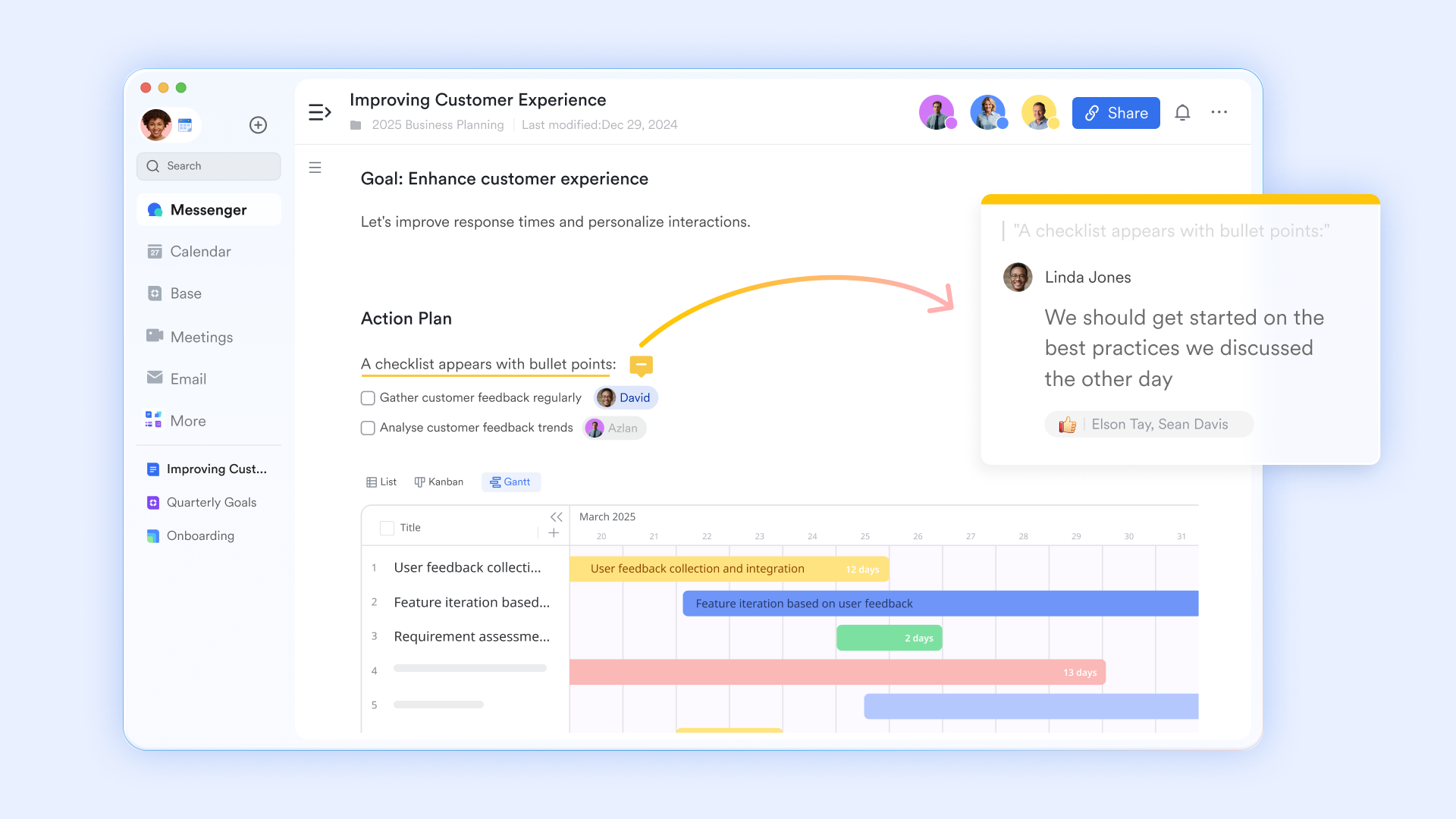
Drafting in docs: Using a collaborative tool like allows team members to write, comment, and refine ideas on their own time. They can tag colleagues to ask clarifying questions directly in the text.
Refinement: By the time you actually meet, you aren't starting with a blank page. You are starting with a list of thoughtful suggestions that have already been reviewed. This turns a potential 4-hour meeting into a focused 90-minute session.
Phase 3: The planning session
Now you hold the meeting. Since you have done the prep work, this session is strictly for debate, decision-making, and alignment.
Debate the "Why": Review the . Do they align with the company's OKR strategic planning? Eliminate the ones that are just "nice to have."
Refine the "How": This is the hardest part. Take the surviving objectives and write the key results. Ask the hard questions: Is this measurable? Is it ambitious enough?
Assign owners: Every key result needs a single owner. If two people own it, nobody owns it. The following template can help you assign owners clearly and gain full control of progress.
Phase 4: Cross-functional alignment
Once your team has a draft plan, you need to look sideways.
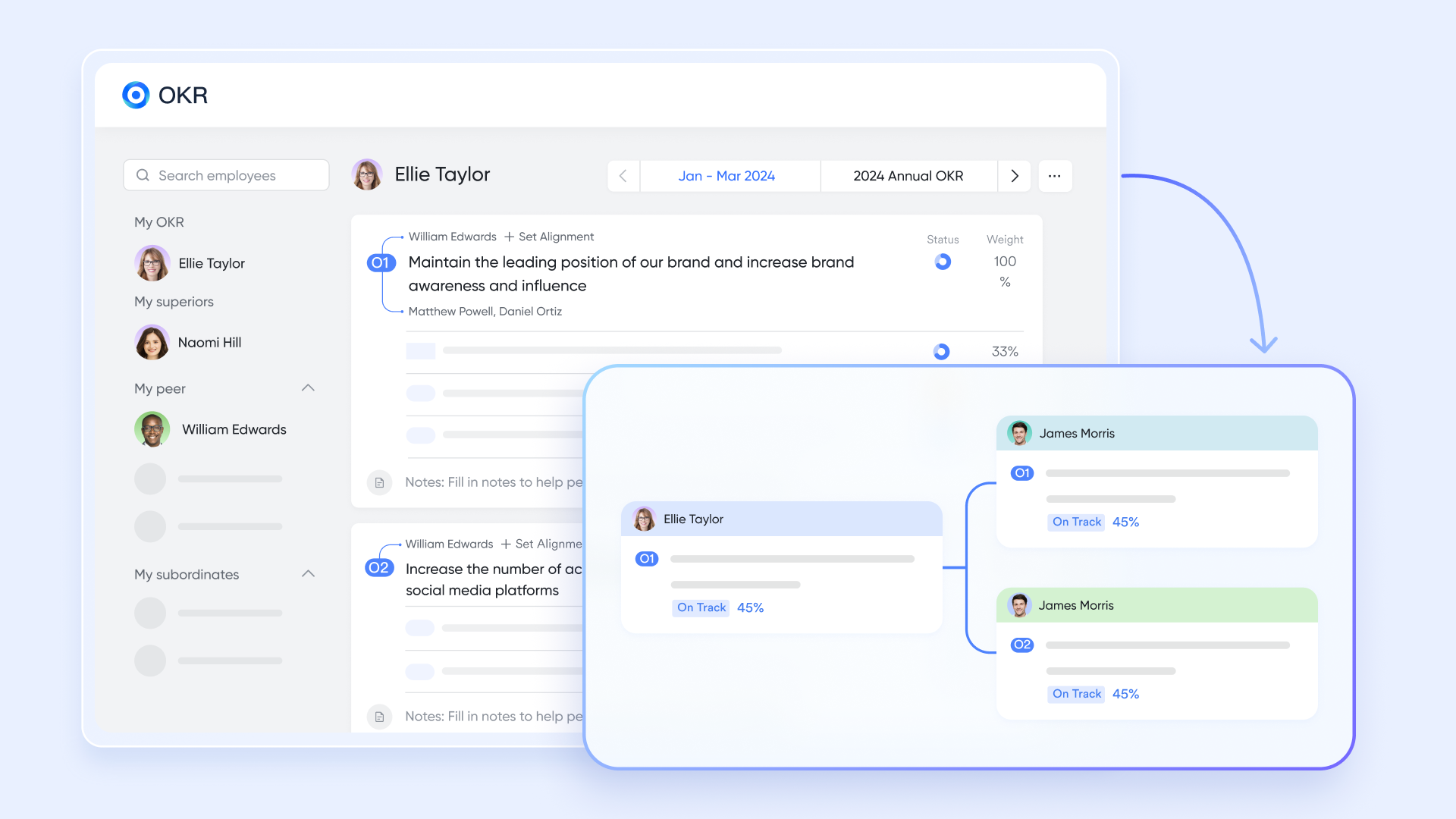
: Does your goal to "Launch Feature X" depend on the Marketing team's goal to "Prepare Launch Campaign"? Powerful tools like Lark OKRs offer a helpful hand for identifying the relationships between tasks.
Negotiate support: Reach out to those teams immediately. If they cannot commit to supporting your goal, you must adjust your key result. You cannot hold yourself accountable for work that relies on a team that hasn't agreed to help.
Phase 5: Finalize and publish
Once the negotiations are complete, it's time to lock in your goals. Transition your finalized objectives and key results from your drafting document to your OKR planning tool or system of record.
Ensure that the final plan is to the entire organization, rather than being stored hidden away in a folder. This transparency encourages accountability and alignment, allowing everyone to stay informed about the team's strategic direction and progress.
Implement these steps right now
Guiding questions to ask when planning your OKRs
Even with a great OKR planning process, it is easy to write bad goals. We often trick ourselves into writing key results that look impressive but don't actually move the needle. As you review your drafts, use these four questions as a filter to test the quality of your plan.
Is this a result or just a task?
This is the most common trap. A task is "Write 5 blog posts." A result is "Generate 1,000 leads from blog content."
The test: Ask "So what?" If you complete this key result, will the business actually be in a better place? If you can do the work and achieve zero value, it is a task, not a result.
Is it ambitious but realistic?
Google famously talks about "stretch goals"—aiming for the stars to hit the moon. A good OKR should make you feel slightly uncomfortable.
The test: If you look at the goal and think, "We can definitely hit that," it is probably too easy (sandbagging). If you look at it and think, "There is zero chance," it is demoralizing. You want to be in the "sweet spot" where success is possible but requires your best effort.
Do we have control over this?
While you want to measure outcomes, you need to ensure the team has enough influence over the metric to be held accountable.
The test: If hitting this goal depends 90% on the economy or another department, it might not be the right target for your specific team.
Simple OKR planning tool or complex suite?
This question is about your infrastructure. Are you overcomplicating the tracking?
The test: Can you check your progress in less than 5 minutes? If updating your OKRs requires a manual login to a complex, disconnected system that nobody likes using, the best OKR planning tool in the world won't save you. You need a system like that fits into your daily workflow, keeping the friction low so the focus remains on the work itself.
Mastering OKR planning and execution with Lark
The biggest failure point in the OKR planning process isn't usually a lack of ambition; it is the disconnect between the plan and the daily work. In many organizations, the "Plan" lives in a static presentation deck, while the "Goals" live in a rigid, specialized software that nobody logs into.
bridges this gap by treating OKRs not as a standalone administrative task, but as a core part of the where your team actually communicates and works. Here is how you can use a unified ecosystem to upgrade your entire cycle, from the first brainstorm to the final result.
Collaborative drafting with a dynamic document
Effective planning starts asynchronously. You should never walk into a strategy meeting with a blank whiteboard. Instead, you need a shared space that encourages contribution before the meeting starts.
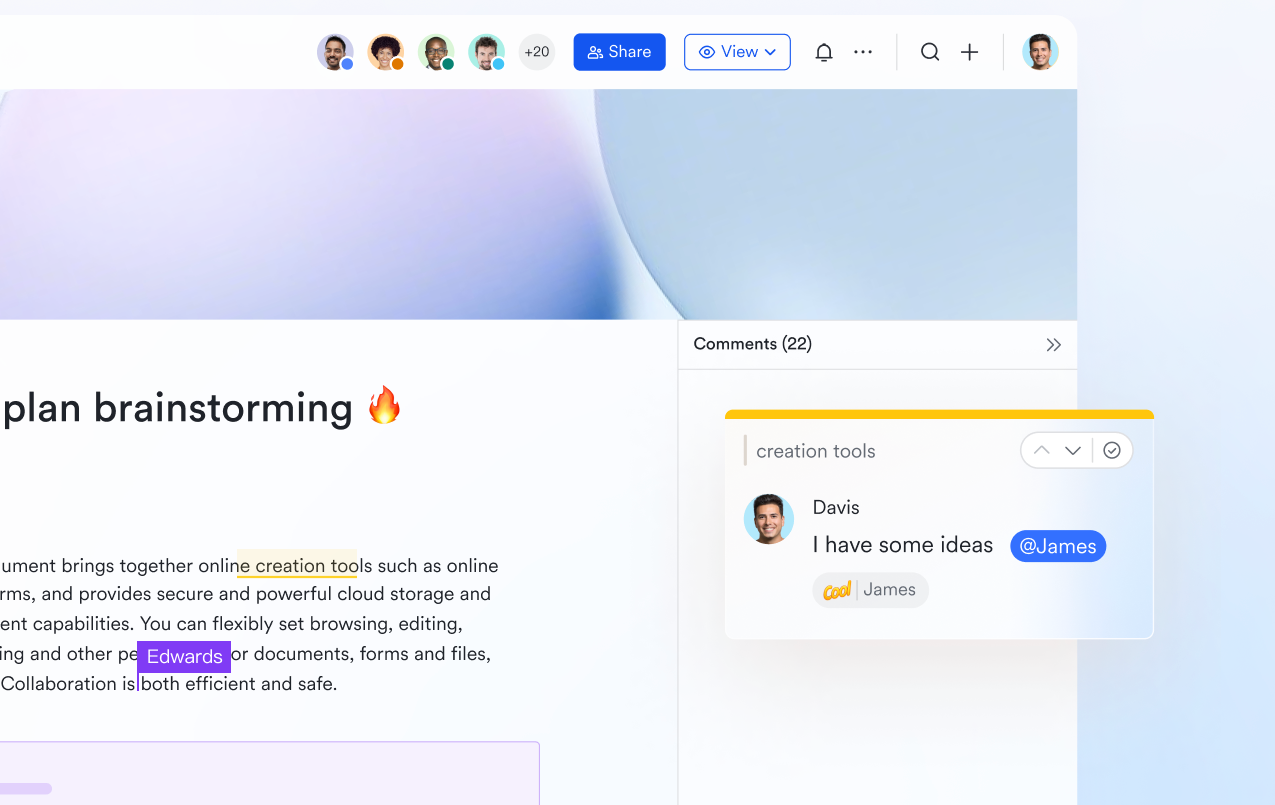
Unlike static spreadsheets, allows for rich discussion. Teams can tag one another to discuss dependencies directly in the draft text. For example, a product manager can comment, "Hey @Marketing, if we commit to this launch date, can you ?" This resolves conflicts before the synchronous OKR planning meeting begins, making your face-to-face time significantly more efficient.
Visualizing strategy to ensure alignment
To make the workflow described above possible, offers specific features designed to support the entire OKR strategic planning lifecycle. It goes beyond simple tracking to provide deep visibility into organizational health.
Visual alignment view: One of the hardest parts of planning is seeing how individual goals connect to the big picture. Lark provides a visual "Alignment View" that maps out the relationship between objectives. You can see a clear tree structure showing how a company-level objective cascades down to department and individual levels. This makes it instantly obvious if a team's goal is orphaned or misaligned. 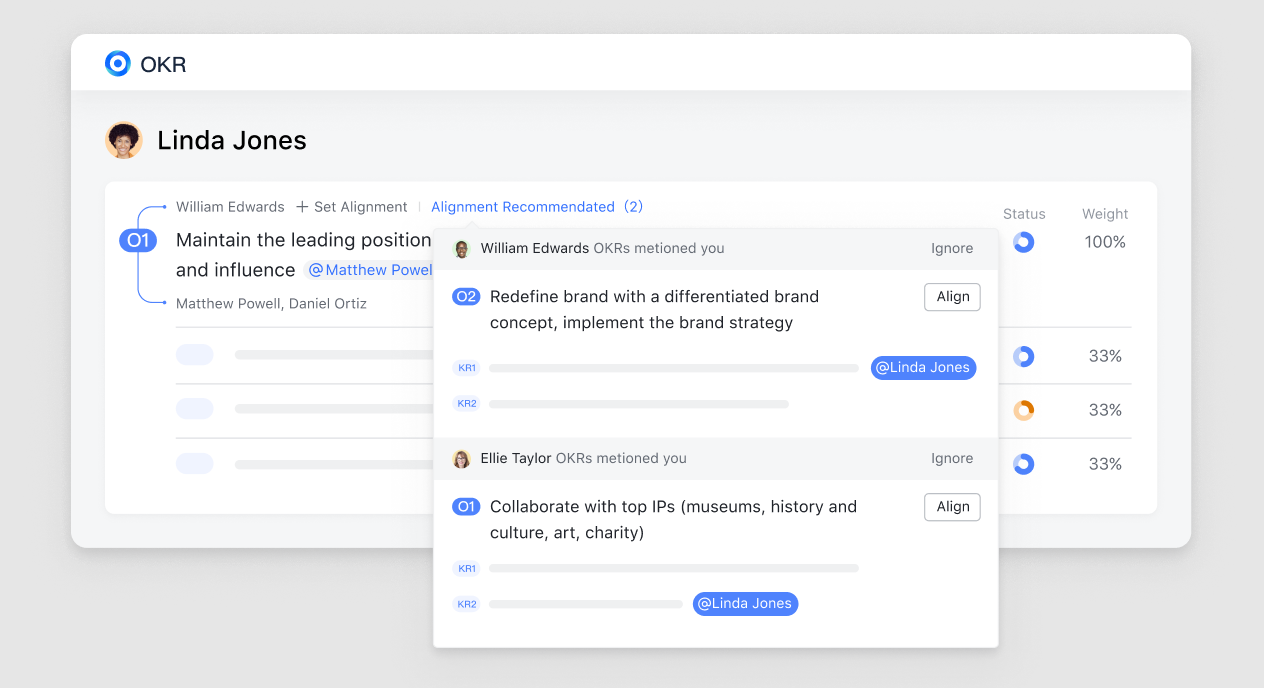
Comprehensive data dashboards: For leaders, Lark OKR dashboard offers a bird's-eye view of the entire organization's progress. You can analyze participation rates (who has set OKRs vs. who hasn't), alignment percentages, and overall progress distributions. This data is crucial for the "Review" phase of your planning cycle, helping you identify which teams might be struggling or need additional resources before it's too late. 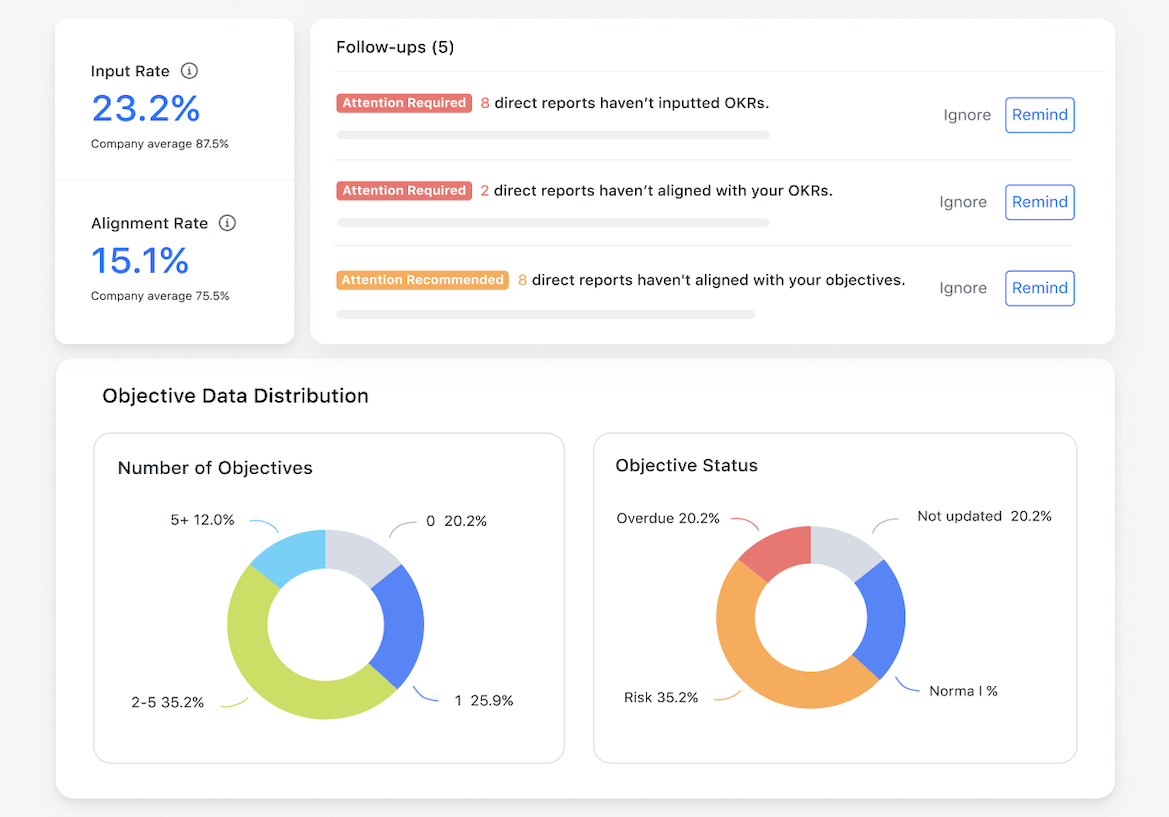
Keeping strategy and goals in a single view
Once the plan is approved, a common pain point with even the best OKR planning tool is the "context gap." The strategic context explains why you are doing something, but the tracker only shows what the numbers are.
Lark solves this by allowing you to insert OKR directly into your strategy documents. This means your team can read the quarterly strategy memo and see the live OKR status right next to the relevant paragraphs. If you update the status of a key result in the document, it updates the system with just one click. This ensures that the "Why" remains front and center throughout the execution phase. 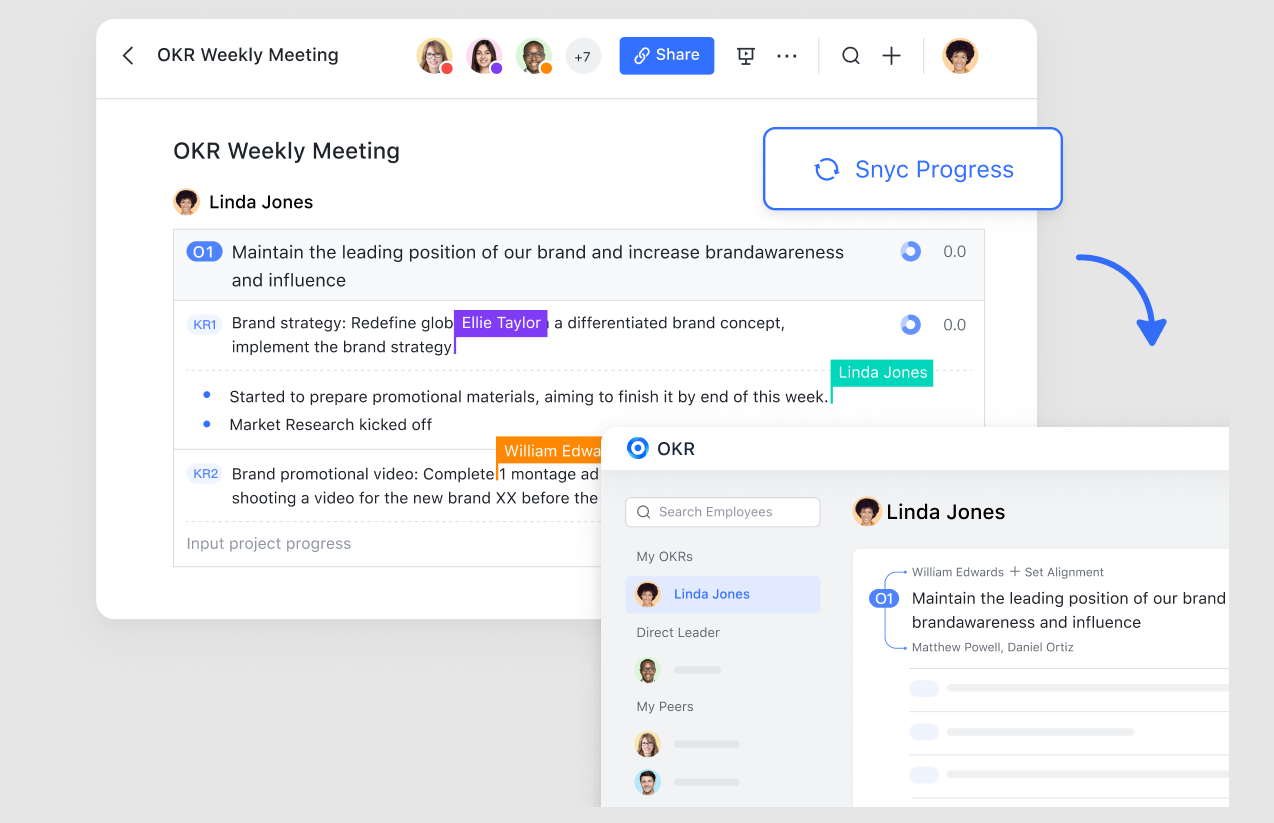
Turning high-level strategy into actionable workflows
A common hurdle in OKR strategic planning is that objectives remain too abstract. You might set a goal to "Launch Project X," but without a clear path of execution, it stalls.
serves as a powerful, flexible engine to bridge this gap between high-level strategy and daily operations. Instead of just staring at a target number, your team can list every concrete step required to hit that number. You can link specific tasks directly to a key result, ensuring that every piece of work has a clear strategic purpose. Lark Base also allows you to visualize your plan in the way that suits your workflow best. You can use a to track the status of tasks ("To Do", "In Progress", "Done") or switch to a Gantt view to see the timeline and dependencies. :
- Starter plan: Free forever plan that includes 11 powerful for up to 20 users. It also comes with 100GB of storage, 1000 automation runs, AI translations, and more.
- Pro plan: $12/user/month (billed annually) for up to 500 users. It includes everything in Starter plus group calling for up to 500 attendees, 15TB of storage, 50,000 automation runs, and more.
- Enterprise plan: for custom pricing. Supports unlimited users and includes even more automation runs and advanced security, compliance, and management features.
For small teams with simple communication needs

18 months message history
1000 Base automation runs/month
2000 rows per table in Base
Most POPULAR
For companies with comprehensive collaboration and management needs
Unlimited message history
500-participant video meetings
50k Base automation runs/month
20k rows per table in Base
For large companies with advanced security and organizational management needs
Get a personalized demo and pricing
Unlimited message history
500-participant video meetings
15 TB storage + 30 GB storage/user
500k Base automation runs/month
50k Base automation runs/month
Most POPULAR
For companies with comprehensive collaboration and management needs
Unlimited message history
500-participant video meetings
50k Base automation runs/month
20k rows per table in Base
Common OKR pitfalls to avoid
Even with the best intentions, the OKR planning process can easily go off track. Being aware of these common traps will help you keep your team on track.
The "set and forget" trap
This is the most frequent failure mode. Teams treat OKR planning as a New Year's Resolution—they write it down in January and don't look at it again until March.
The fix: Integrate OKRs into your weekly rituals. Spend 5 minutes at the start of every weekly team meeting reviewing the dashboard. If you aren't talking about your goals weekly, you aren't actually working on them. Confusing outputs with outcomes
It is easy to measure activity ("Launched 3 new features") rather than value ("Increased user retention by 5%").
The fix: Always ask "So what?" If you launch the features but nobody uses them, was the objective successful? If the answer is no, rewrite the key result to measure the impact, not the effort.
Too many goals (the "laundry list")
If everything is a priority, nothing is. A common mistake in OKR strategic planning is trying to capture every single thing the team does.
The fix: Limit yourself to 3-5 objectives per cycle. OKRs are for the most critical strategic changes, not for tasks like answering emails or fixing minor bugs.
Top-down dictatorship
If leadership dictates every single key result, teams will lack ownership. Conversely, if there is zero guidance, teams will align to nothing.
The fix: Aim for a healthy mix. Leadership sets the strategic "North Star" objectives, but the teams should draft their own key results to define how they will get there.
Avoid these common challenges with Lark
Effective OKR examples for diverse teams
To exemplify how to structure strong OKRs across different functions, consider the following scenarios. For a , an effective objective might be to launch the new Mobile App 2.0 successfully and drive engagement. Key results could include achieving 10,000 active daily users within the first 30 days of launch, maintaining an App Store rating of 4.5 stars or higher, and reducing the crash rate from 1.5% to less than 0.2%.
In a team, the objective could focus on establishing the company blog as a primary source of inbound leads. Key results here might involve increasing organic search traffic from 5,000 to 15,000 monthly visitors, generating 200 Marketing Qualified Leads (MQLs) from newsletter signups, and publishing five "hero" articles that get mentioned by industry influencers.
For a (People Ops) team, the objective may center on improving company culture and retention during a period of rapid scaling. Key results could include increasing the Employee Net Promoter Score (eNPS) from 30 to 45, maintaining an offer acceptance rate of 85% for engineering roles, and rolling out a new manager training program with a 100% completion rate. These examples demonstrate how clear, measurable objectives and key results can align teams toward shared goals, driving meaningful progress and engagement across various functions.
As you develop your OKRs, it's important to remember that each team's goals should reflect its unique challenges and priorities. Tailor your objectives and key results to align with your team's current circumstances and future aspirations. Consider factors such as your organization's overall strategy, the capabilities of your team, and the specific outcomes you wish to achieve. By customizing your OKRs to fit your team's context, you can foster a stronger sense of ownership and drive meaningful results that contribute to your organization's success.
Conclusion
Effective OKR planning is not about administrative compliance; it is about alignment. It is the difference between a group of people working hard in different directions and a team moving together toward a shared destination.
However, the best plan in the world will fail if it lives in a silo. To truly bridge the gap between strategy and execution, you need a system that brings your goals into the daily flow of work. By using a platform like , you can turn your OKRs from static text into dynamic, trackable, and collaborative action plans.
Ready to streamline your planning cycle? Try Lark for free and see how seamless goal management can be.
Transform your approach to OKR planning
FAQs
What does OKR planning mean?
OKR planning is the collaborative process where teams define their top priorities (Objectives) and the specific metrics used to measure success (Key Results) for a set period, usually a quarter. It goes beyond simple to-do lists to ensure that every team is aligned and focusing its effort on the company's most critical strategic goals.
How to do OKR planning?
Start by establishing the company's top-level strategy, then allow teams to draft their own contributions bottom-up. It is best to use a collaborative platform like Lark Docs to brainstorm asynchronously and identify dependencies before meeting. This ensures that when you do meet, the discussion focuses on alignment and strategy rather than basic word-smithing.
What is an OKR vs KPI?
KPIs (Key Performance Indicators) typically track the ongoing "health" of business-as-usual activities (like maintaining server uptime or steady sales volume). OKRs are designed for aggressive change, growth, and new initiatives. You can track both side-by-side in Lark's data dashboards to ensure you aren't sacrificing operational stability while chasing ambitious new targets.
What is an OKR example?
An Objective might be "Create a world-class customer support experience." The Key Results would be the measurable proof, such as "Reduce average response time to under 2 minutes" and "Achieve a CSAT score of 95%." In Lark OKR, you can link these specific metrics directly to your data sources so progress updates automatically as your team works.
Related reading