Starting a complex project often feels like standing at the base of a massive mountain without a map. You know where you need to go, but the path is obscured by a fog of tasks, deadlines, and resources. This is where a clear structure becomes your compass. Many project managers search for a work breakdown schedule example to understand how to turn chaos into an actionable plan. While technically distinct—a Work Breakdown Structure (WBS) defines deliverables, while a schedule defines time—they are inseparable partners in project success. By visualizing the entire scope upfront, you ensure nothing gets lost in the shuffle.
What is a work breakdown structure?
To navigate the complexities of project management, you first need to understand the map itself. A is a visual, hierarchical decomposition of a project into smaller, manageable components. Think of it as a tree diagram or a structured list that breaks down your final project goal into bite-sized pieces.
Unlike a to-do list that might just jumble tasks together, a WBS is strictly deliverable-oriented. It does not focus on the actions needed to do the work (like "attend meeting" or "write code") but rather on the outcomes of that work (like "meeting minutes" or "software module"). The structure starts with at the top—the "parent." This parent is then supported by "children," which are the major phases or deliverables required to complete the project. These are further broken down until you reach the lowest level of the hierarchy, known as the "work package."
A work package represents the smallest unit of work that a project manager can assign, estimate, and monitor. For example, if you are building a house, the house is Level 1 deliverable. The foundation, framing, and plumbing might be Level 2. The specific act of pouring concrete for the driveway would be a work package further down the line.
The primary function of this structure is to define the total scope of the project. If a task isn't in the WBS, it is effectively out of scope. This "100% rule" ensures that the WBS captures absolutely every deliverable—internal, external, and interim—required to complete the project, providing a solid foundation for all subsequent planning steps, including scheduling and budgeting.
Plan, track, and manage your WBS seamlessly
Why use a work breakdown structure
You might wonder why you should spend valuable time creating a hierarchical chart before you even start assigning tasks. The answer lies in the clarity and control it provides. Without a WBS, you are essentially building a puzzle without looking at the picture on the box.
Single source of truth for scope
First and foremost, a WBS serves as the single source of truth for the . It aligns the team and stakeholders on exactly what is being delivered. When everyone can see the hierarchy of deliverables, misunderstandings regarding scope evaporate. It prevents the dreaded "scope creep," where small, unauthorized additions to the project eat away at your budget and timeline. By agreeing on the WBS upfront, you have a baseline to measure changes against.
Foundation for an accurate work breakdown schedule
Furthermore, a WBS is the prerequisite for an accurate work breakdown schedule. You cannot realistically estimate time or costs until you know exactly what needs to be built. By breaking a massive project down into small work packages, you can estimate the effort for each small piece with much higher accuracy than trying to guess the cost of the whole project at once. These granular estimates roll up to create a realistic budget and a feasible timeline.
Significant help in resource allocation
Finally, it aids significantly in . When you see the project laid out in components, it becomes obvious which skills are needed where. You can assign specific teams or individuals to specific branches of the tree, ensuring accountability. If a specific deliverable is delayed, you can instantly see which part of the hierarchy is affected and how it impacts the overall goal. It transforms a vague project concept into a concrete, executable plan.
Components of a work breakdown structure
A robust WBS is more than just boxes and lines; it is composed of specific elements that work together to provide a complete picture of the project. Understanding these components is essential for building a structure that actually helps your team.
- WBS levels: The hierarchy is organized into levels. Level 1 is always the final project deliverable or goal. Level 2 typically represents the major phases or major deliverables (like "Design Phase" or "Foundation"). Level 3 and below are sub-deliverables that decompose the work further. The depth of these levels depends on the project's complexity, but you generally stop at the point where work can be easily managed and estimated.
- Work packages: Sitting at the very bottom of any branch in the WBS is the work package. This is the lowest level of decomposition. A work package is distinct because it is small enough to be assigned to a specific team member or department and has a clear start and end point. It is the level at which cost and duration are estimated.
- WBS dictionary: While the chart is visual, it can't hold all the details. The WBS dictionary is a companion document that provides the narrative for each element. It includes detailed descriptions of work, acceptance criteria, associated costs, and responsible parties for each work package. It ensures that when someone looks at a box labeled "User Interface," they know exactly what that entails.
- Control accounts: These are management points placed at selected levels of the WBS. A control account allows the project manager to integrate scope, budget, and schedule for performance measurement. It is often placed at a level where a specific functional group (like the Electrical Dept) takes ownership.
- WBS codes: To keep things organized, each element is assigned a unique identifier or number (e.g., 1.0, 1.1, 1.1.2). These codes allow for easy tracking in and accounting systems, linking the visual chart to the budget and schedule.
Learn more about work breakdowns and workflows
Types of work breakdown schedule example
When you begin searching for a work breakdown schedule example, you will likely encounter two primary methods of structuring your project. While the destination is the same—a complete project plan—the route you take depends on how your team prefers to organize their work.
- Deliverable-based WBS: This is the most common and often the preferred method for ensuring scope definition. In this type, the hierarchy is organized by the physical or functional components of the final product. For example, if you are building a bicycle, Level 2 headers might be "Frame System," "Brake System," "Gearing System," and "Wheels." The focus here is entirely on what you are building, not when you are building it. This type is excellent for helping teams visualize the final product and ensuring that no physical piece of the puzzle is missing. It acts as a clear checklist of tangible results.
- Phase-based WBS: Alternatively, you can structure your WBS around the . In this scenario, Level 2 headers would be "Initiation," "Planning," "Execution," "Control," and "Closeout," or perhaps specific project stages like "Design," "Development," and "Testing." This approach feels more natural to teams who think chronologically and is often easier to transition into a timeline or Gantt chart later. However, the danger here is focusing too much on the process rather than the product, which can sometimes lead to scope gaps if a specific deliverable is forgotten within a phase.
Both types can lead to a successful work breakdown schedule, but the choice depends on your project's nature. A construction project might benefit from a deliverable-based approach (Foundation, Walls, Roof), while a software update might flow better with a phase-based approach (Requirements, Coding, Testing).
Work breakdown schedule example scenarios
To truly grasp how this tool works, it helps to look at specific scenarios. We will explore detailed breakdowns for three different industries: software development, construction, and event planning. These scenarios demonstrate how the theory translates into a practical roadmap.
Software development project
Imagine a team tasked with building a new E-Commerce Mobile App. A work breakdown schedule example for this project would likely use a phase-based approach mixed with deliverables to ensure the software functionality is met.
- Project management: This branch handles the administrative side. It includes deliverables like the , the scope statement, and the budget plan. It ensures the team is organized before coding begins.
- Analysis and requirements: Before building, the team needs to know what is required. Sub-deliverables here include user interviews, use cases, and the functional requirements specification document.
- Design: This is where the app starts to take shape visually and structurally.
- UI/UX Design: Wireframes, high-fidelity mockups, and prototype designs.
- System Architecture: Database schema design and API specification.
- Development: The core build phase, often broken down by feature sets.
- Frontend: Login screen, product catalog, shopping cart, and checkout flow.
- Backend: User authentication integration, payment gateway integration, and inventory database setup.
- Testing: Quality assurance is critical. Work packages include unit testing, integration testing, user acceptance testing (UAT), and bug fixing.
- Deployment: The final push. This includes app store submission, server deployment, and the final launch party.
Construction project
are heavily deliverable-based because the outcome is a physical structure. Let’s look at a WBS for building a generic commercial office.
- Site preparation: This involves the physical land. Sub-deliverables include land clearing, excavation, and perimeter fencing.
- Foundation: The base of the building. Work packages include pouring concrete footings, installing rebar, and curing the concrete.
- Structure/Framing: The skeleton of the building.
- Steel columns: Erection of main support beams.
- Flooring: Installation of floor decks.
- Roofing: Trusses, sheathing, and weatherproofing layers.
- Systems installation: The veins and nerves of the building.
- Electrical: Rough-in wiring, panel installation, and lighting fixtures.
- Plumbing: Water supply lines, waste pipes, and fixtures.
- HVAC: Ductwork installation and A/C unit placement.
- Interior finishes: Making it look good. Drywall installation, painting, flooring (carpet/tile), and cabinetry.
- Exterior finishes: Landscaping, parking lot paving, and external signage.
Event planning project
Planning a large corporate conference requires tight coordination. A WBS helps ensure no logistical detail is missed.
- This phase covers strategic elements. Deliverables include the event budget, the theme concept, and the date selection.
- Selection: Researching locations and signing the contract.
- Layout: Designing the floor plan for booths and seating.
- Catering: Selecting the menu, confirming headcounts, and arranging dietary restriction options.
- Marketing and promotion:
- Digital: Creating the event website, email campaigns, and social media schedule.
- Physical: Printing banners, flyers, and attendee badges.
- Outreach: Sending invitations and confirming speakers.
- Logistics: Booking travel and accommodation for VIPs.
- Content: Collecting presentation slides and bios.
- Registration: Setting up the check-in desk.
- AV Setup: Testing microphones, projectors, and lighting.
- Staffing: Briefing volunteers and security personnel.
In all these examples, you can see how the "work breakdown schedule" concept comes to life. While the WBS itself isn't a calendar, these detailed breakdowns are the exact ingredients you need to populate your calendar. You simply take the "Testing" work packages from the software example or the "HVAC" packages from the construction example, estimate their duration, and place them into your timeline.
Use Lark to create a work breakdown structure
Transforming a static diagram into a living project engine requires a platform that bridges the gap between planning and execution. facilitates this by integrating your documents, databases, and tasks into a single collaborative ecosystem. Instead of toggling between disparate apps, you can build a dynamic WBS that evolves alongside your project, ensuring that your work breakdown schedule example becomes a reality.
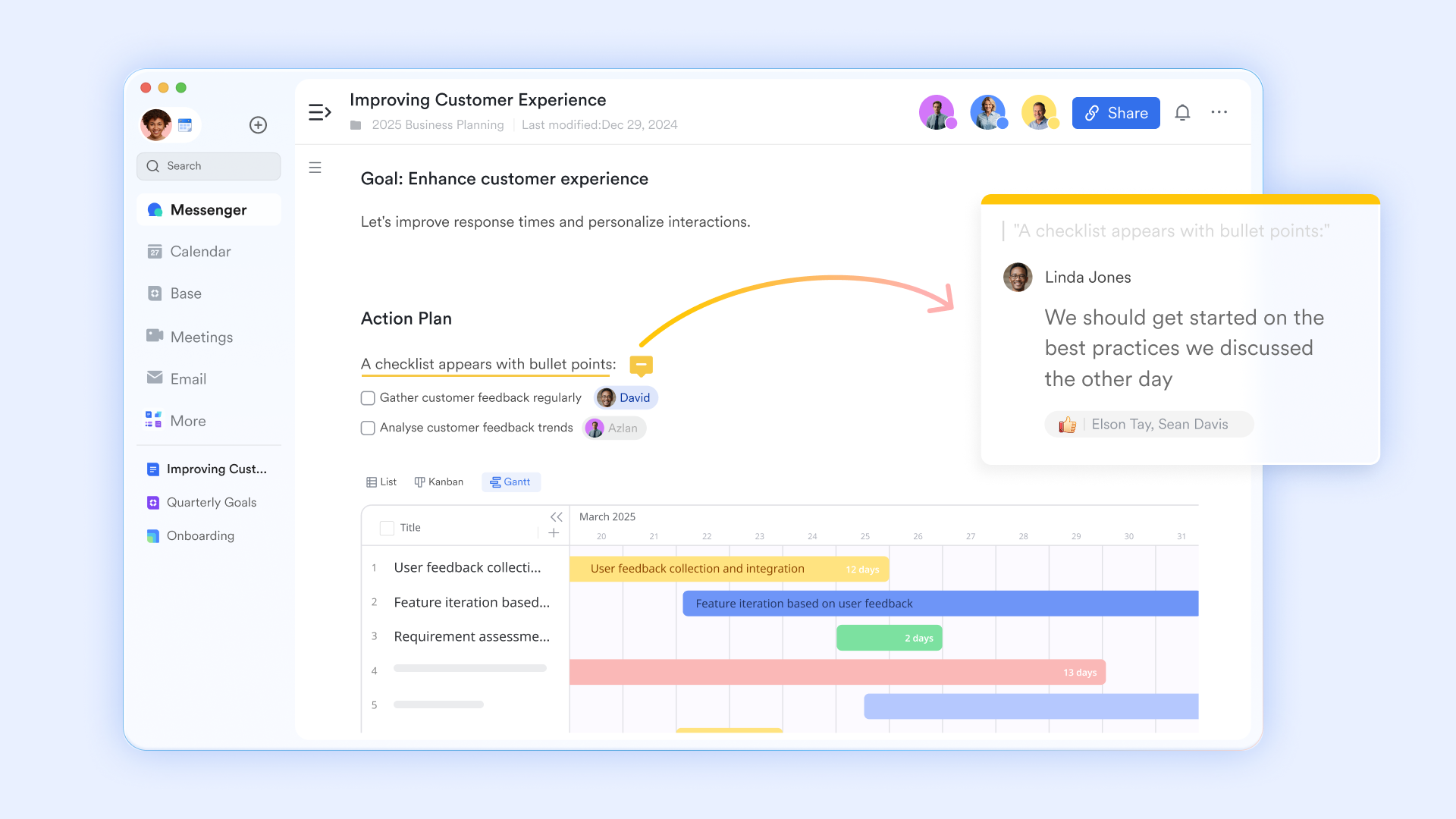
Defining scope in a collaborative space: Before you build the structural hierarchy, you must define the deliverables clearly. offers a flexible canvas where teams can collaboratively draft the WBS dictionary, outline assumptions, and detail acceptance criteria. You can use embedded diagrams and checklists to clarify requirements, while inline comments ensure that every stakeholder is aligned on the scope before execution begins. This version-controlled environment keeps your definitions accurate and accessible.
Structuring components with relational databases: serves as the digital backbone of your WBS. It allows you to organize deliverables and work packages into structured, relational tables with specific fields for owners, cost estimates, and timelines. By using linked records, you can maintain the essential parent-child relationships of your hierarchy, ensuring the "100% rule" is strictly respected. Whether you prefer any of the multiple views like Grid, Kanban, or Gallery view, Base lets you visualize how high-level goals break down into actionable data. 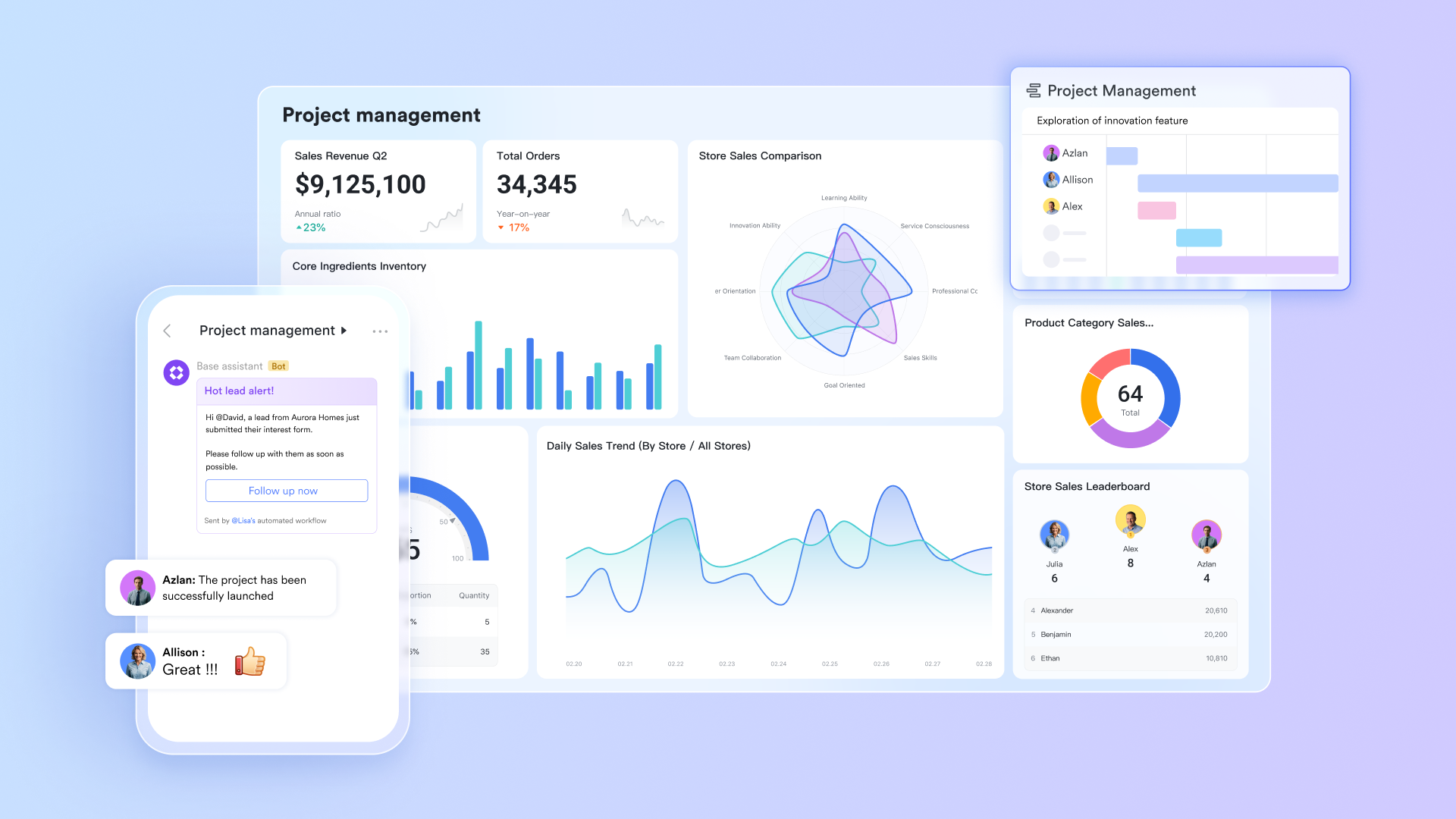
Automating progression and updates: Keeping a WBS updated manually can be tedious, but Lark Base workflow streamlines this process. You can set up automation rules that trigger notifications when a work package changes stage or automatically update priority fields based on progress. This ensures that your WBS reflects the real-time status of the project, preventing the administrative lag that often leads to scheduling gaps. 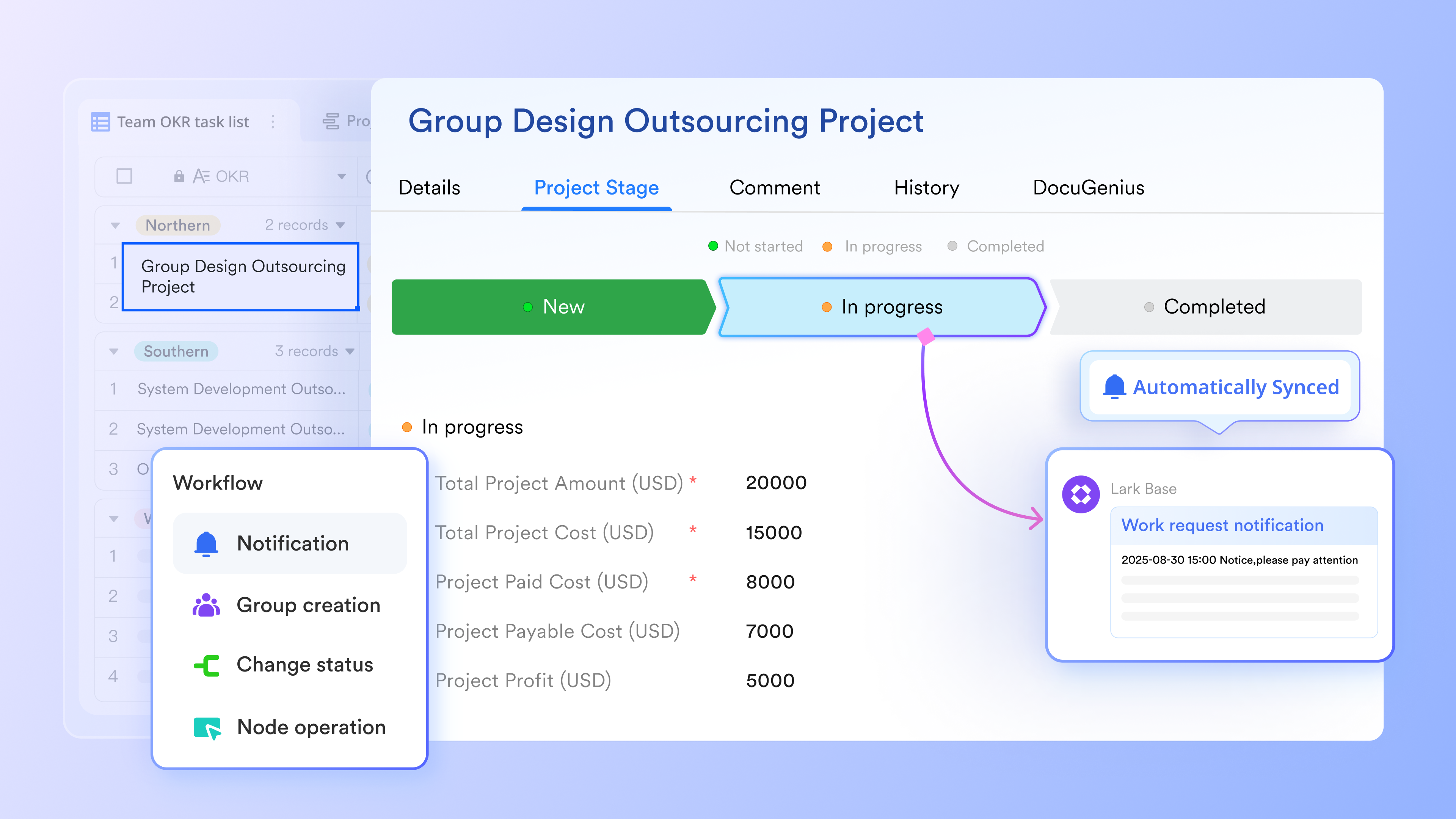
Turning work packages into action: Once your structure is set, Lark Tasks helps you convert the lowest-level work packages into trackable assignments. You can set clear deadlines, assign specific owners, and establish dependencies that reflect the actual sequence of work. 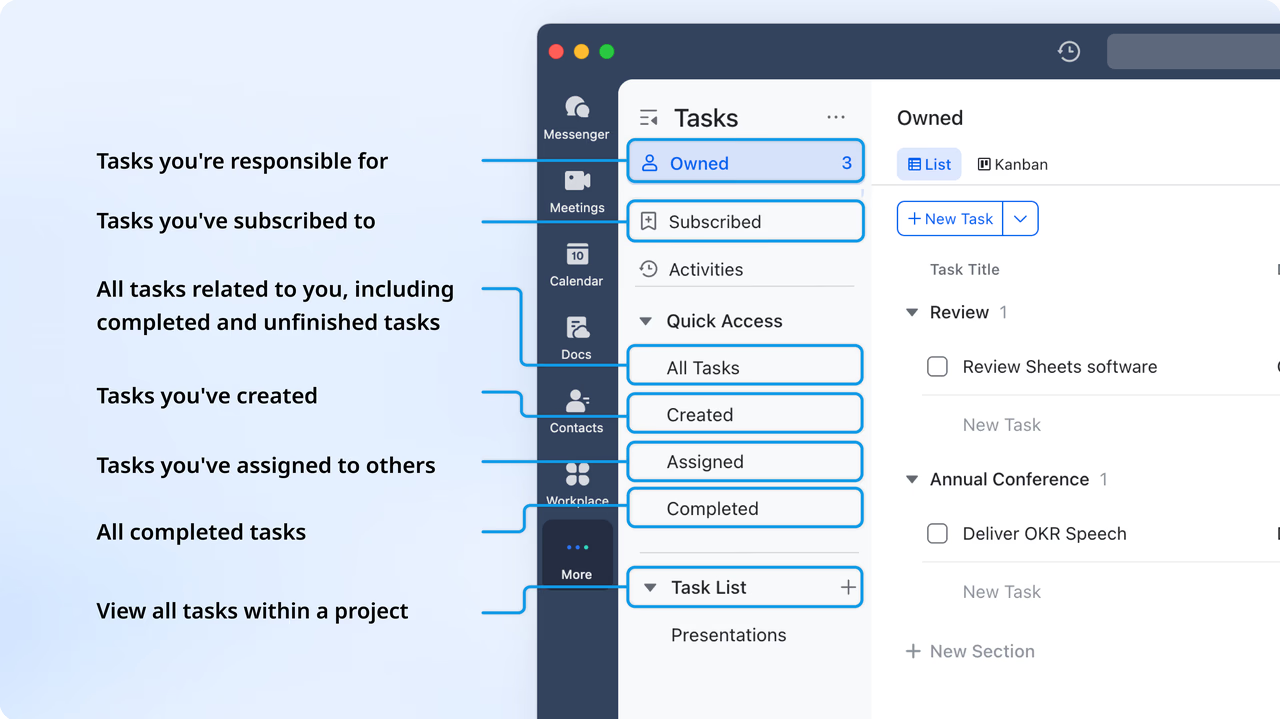
Visualizing timelines and health: To truly master the schedule aspect, Lark Calendar and Lark Base dashboards provide critical visibility. You can map WBS milestones directly to a shared calendar, turning your breakdown into a coordinated timeline that the entire team can follow. Meanwhile, dashboards can pull live data from Base to visualize completion rates, budget usage, and risks, giving you an instant health check of your project without the need for manual reporting. 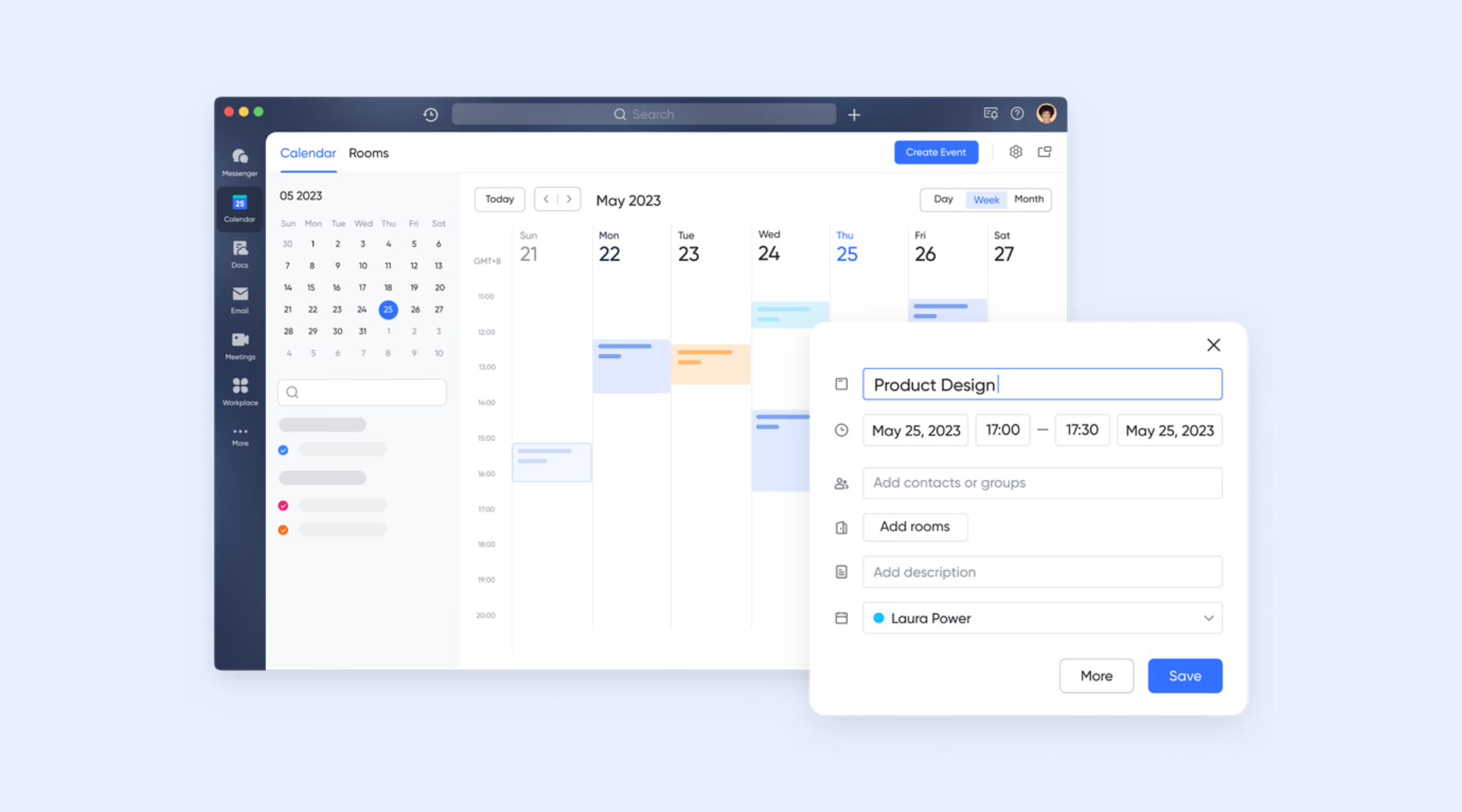
:
- Starter plan: Free forever plan that includes 11 powerful tools for up to 20 users. It also comes with 100GB of storage, 1000 automation runs, AI translations, and more.
- Pro plan: $12/user/month (billed annually) for up to 500 users. It includes everything in Starter plus group calling for up to 500 attendees, 15TB of storage, 50,000 automation runs, and more.
- Enterprise plan: for custom pricing. Supports unlimited users and includes even more automation runs and advanced security, compliance, and management features.
For small teams with simple communication needs

18 months message history
1000 Base automation runs/month
2000 rows per table in Base
Most POPULAR
For companies with comprehensive collaboration and management needs
Unlimited message history
500-participant video meetings
50k Base automation runs/month
20k rows per table in Base
For large companies with advanced security and organizational management needs
Get a personalized demo and pricing
Unlimited message history
500-participant video meetings
15 TB storage + 30 GB storage/user
500k Base automation runs/month
50k Base automation runs/month
Most POPULAR
For companies with comprehensive collaboration and management needs
Unlimited message history
500-participant video meetings
50k Base automation runs/month
20k rows per table in Base
Benefits of a work breakdown structure
Investing time in creating a WBS yields high returns throughout the project lifecycle. It is not just a planning artifact; it is a tool for ongoing management efficiency.
One of the most significant benefits is improved cost estimation. When you look at a project as a whole, guessing the budget is a gamble. However, estimating the cost of a single work package—like "installing 10 light fixtures"—is straightforward. By summing up these small, accurate estimates, you generate a highly reliable total project budget.
Additionally, a WBS enhances communication. It provides a visual language that everyone understands, from the client to the technical team. It clearly delineates boundaries, and, implicitly, what is excluded. This transparency builds trust and manages expectations.
Finally, it simplifies risk management. By decomposing the project, you can identify risk points at a granular level. You might not see a risk in "Building a House," but you will definitely identify potential supply chain delays when you look at the "Import Italian Marble" work package. This allows you to create mitigation plans for specific elements rather than vague generalities.
Best practices for your work breakdown schedule example
To ensure your WBS is effective and leads to a reliable work breakdown schedule example, you should adhere to industry-standard best practices.
- The 100% rule: As mentioned earlier, this is non-negotiable. Your WBS must include 100% of the work defined by the . If a sub-deliverable is missing, the parent deliverable is incomplete. Conversely, work that is not in the WBS should not be performed.
- Use nouns, not verbs: A WBS is about deliverables, not activities. Instead of writing "Pour concrete," write "Foundation." Instead of "Write code," write "Payment Module." This subtle shift keeps the focus on the product rather than the process, which is the domain of the schedule, not the WBS.
- Mutually exclusive elements: Do not overlap work. Each work package should be distinct and separate from others. If "Testing" is included in "Module A" and also as a separate "Testing Phase," you risk double-counting costs and confusing your team about who is responsible for what.
- Appropriate granularity: A common mistake is breaking work down too far. You don't need to list "Pick up hammer" as a work package. A good rule of thumb is the "8/80 rule," which suggests that a work package should take no less than 8 hours and no more than 80 hours to complete. If it's too large, it's hard to track; if it's too small, you're micromanaging.
By following these guidelines, you create a structure that is robust enough to support your project but flexible enough to adapt to the reality of the work.
Conclusion
Creating a detailed work breakdown schedule example is more than just a planning exercise; it is the strategic blueprint that separates successful projects from chaotic ones. By decomposing complex goals into manageable deliverables, you gain the clarity needed to control costs, timelines, and resources effectively. Whether you are managing a software launch or a construction site, this structure provides the foundation for every decision you make.
However, a static diagram is only as good as the execution that follows. To truly bridge the gap between planning and reality, you need a platform that keeps your team aligned and your data dynamic. Lark integrates your WBS directly into your daily workflow, transforming isolated tasks into a cohesive engine for delivery. Start building your path to success today by signing up for Lark and experiencing seamless project management.
FAQs
What is a work breakdown schedule?
A work breakdown schedule is often used to describe the integration of a Work Breakdown Structure (WBS) with a project timeline. While the WBS itself is a hierarchical decomposition of the project into manageable deliverables (outcomes), the "schedule" aspect introduces timeframes. By breaking the total project scope down into small "work packages," project managers can accurately estimate the duration and cost of each piece. This granular level of detail serves as the foundation for creating a realistic timeline, ensuring that every specific deliverable is accounted for and assigned a deadline.
What does a typical WBS look like?
A typical WBS resembles a tree diagram or a nested organizational chart. At the very top (Level 1) sits the final project goal or product. This "parent" node branches down into major phases or key deliverables (Level 2). These branches further split into smaller sub-deliverables until they reach the bottom level, known as "work packages." It can also be formatted as a structured outline or list. Regardless of the visual format, it must represent 100% of the project scope, organizing work into mutually exclusive components without overlapping duties.
What are the 5 levels of work breakdown structure?
While the depth depends on project complexity, a standard 5-level hierarchy typically includes:
- Project: The final deliverable or overall goal.
- Major deliverables/phases: The main segments of the project (e.g., "Design Phase").
- Sub-deliverables: Components required to complete the major deliverables.
- Work components: Further decomposition of specific tasks or elements.
- Work packages: The lowest level where work is assigned, estimated (cost/time), and monitored.
How do I create a work breakdown structure?
To create a WBS, start by clearly defining your final project objective. Next, identify the major deliverables or phases required to achieve that goal. Decompose these major components into smaller sub-deliverables, continuing this process until you reach "work packages" that are small enough to be assigned to a single team or person. Ensure you follow the "100% rule," verifying that all work—and only the necessary work—is included. Finally, document the details of each component in a WBS dictionary to clarify scope, costs, and acceptance criteria.
Related reading