Project management has become an essential skill across industries. Whether you're launching a campaign, building an app, or managing daily operations, understanding project management basics helps you plan, organize, and deliver work more efficiently. While the process can feel overwhelming for beginners, the proper structure and mindset make it accessible to anyone.
This guide covers the fundamentals—from phases and methodologies to documentation and essential skills—so you can confidently approach any project. You'll also see how modern tools like Lark support collaboration and clarity without complicating workflows.
Start improving team coordination and project clarity
What are the basics of project management?
The basics of project management revolve around planning, organizing, and controlling work to achieve specific goals within defined constraints such as time, budget, and scope. At its core, project management begins with clearly understanding the and outlining what is included—and excluded—in the scope. From there, work is broken into manageable tasks, assigned to the right people, and arranged on a timeline to ensure smooth execution.
Effective communication, risk identification, and continuous monitoring help keep the project on track as conditions change. Documentation such as charters, , and status reports ensures alignment among stakeholders. Ultimately, the basics of project management focus on clarity, coordination, and consistent progress toward a defined outcome.
Foundation: Core principles of project management
Understanding these principles helps beginners build a strong foundation in structured delivery. They also offer clarity for anyone exploring a project management basics course. For learners looking to apply these skills in sustainability, infrastructure, or policy settings, programs such as a can also provide useful context for managing complex, multi-stakeholder projects. This is especially relevant in fields where planning, compliance, and long-term resource coordination are closely connected.
- Clear objectives and scope: Projects succeed when , measurable, and aligned with business needs. A clear scope prevents confusion and keeps teams focused on what truly matters in the context of project portfolio management.
- Defined roles and responsibilities: Assigning ownership ensures accountability and reduces overlap. Teams work more efficiently when everyone knows their role and decision boundaries.
- Effective planning and scheduling: A maps out tasks, timelines, and dependencies. This ensures that work progresses logically and resources are used effectively.
- Risk identification and mitigation: Spotting risks early helps minimize delays and unexpected costs. Mitigation strategies protect timelines and maintain project stability.
- Continuous communication: Regular updates keep teams aligned and reduce misunderstandings. supports collaboration and faster issue resolution.
- Monitoring progress and adjusting plans: Tracking status enables timely course correction. Adjustments ensure the project remains aligned with goals despite changing conditions.
- Ensuring stakeholder satisfaction: Engaging stakeholders throughout the project builds trust and clarity. Their feedback helps refine deliverables and improve outcomes.
Process: The five phases of project management
Every successful project follows a structured lifecycle that guides teams from idea to completion. These phases create clarity, ,, and reduce uncertainty throughout the process. Using a unified workspace like Lark helps teams connect communication, documentation, tasks, and timelines at every step—so progress remains visible and well coordinated.
1. Initiation
The initiation phase defines the project’s purpose, scope, and feasibility. Stakeholders are identified, objectives are clarified, and approvals are secured to formally begin. With and group chats, early project discussions and decision records are captured in one shared workspace, ensuring everyone has access to the same goals and background information from day one.
2. Planning
Planning converts objectives into actionable steps by building task lists, schedules, budgets, and risk-management plans. Teams outline responsibilities and milestones to prevent confusion later. Lark Tasks and tools support this phase by enabling teams to assign work, set deadlines, visualize dependencies, and keep all planning documents collaboratively updated. 3. Execution
During execution, teams carry out the plan by completing assigned tasks and producing deliverables. Strong coordination is essential as work happens across departments and roles. , Docs, and Tasks allow teams to communicate in real time, collaborate on documents, and track task progress without switching between disconnected tools.
4. Monitoring & Controlling
This phase ensures ongoing work stays aligned with the plan. Managers , track progress, manage risks, adjust schedules, and maintain quality standards. Lark dashboards, task updates, and timeline views provide live visibility into performance metrics, workloads, and potential delays, enabling quick adjustments when issues emerge. 5. Closure
Closure completes the project by delivering outcomes, running retrospectives, and documenting lessons learned for continuous improvement. Teams finalize approvals, archive project documentation, and transfer deliverables. With Lark Docs and , all project records, insights, and completion reports are stored centrally for easy future reference.
Start managing projects clearly across every phase
Rationale: Project management methodologies
provide structured ways to plan and deliver work based on the team's needs, project complexity, and workflow style. Choosing the correct method helps teams stay organized, adaptable, and efficient. Below are the most common approaches beginners should understand.
1. Waterfall
Waterfall is a linear, sequential methodology where each project phase must be completed before the next begins. It works best for projects with precise, stable requirements. Its predictability makes planning and budgeting straightforward.
2. Agile
Agile is an iterative approach that focuses on flexibility, , and rapid delivery. Work is completed in small increments, allowing teams to adapt quickly to changing requirements. Agile is ideal for dynamic environments like software development.
3. Scrum
Scrum is a subset of Agile built around short, time-boxed sprints. Teams work collaboratively with defined roles such as "Product Owner" and "". Daily stand-ups and regular reviews keep progress visible and issues manageable.
4. Kanban
Kanban uses a to manage workflow and limit work in progress. Tasks move through stages, making bottlenecks easy to identify. It supports continuous delivery and is great for teams with unpredictable or ongoing work.
5. Hybrid approaches
Hybrid methodologies blend elements of Waterfall and Agile to balance structure with flexibility. Teams may use while adopting Agile for execution. This approach works well for complex projects requiring both clarity and adaptability.
Toward better: Key components of successful project management
Successful projects rely on structured documentation and transparent processes that guide planning, execution, and decision-making. These components create consistency, , and reduce uncertainty across the project lifecycle.
- Scope statement: The scope statement defines what the project will deliver and what is excluded. It sets expectations and prevents misunderstandings as work progresses.
- Work Breakdown Structure (WBS): A WBS breaks the project into smaller, manageable tasks. This helps teams organize work logically and estimate time and resources accurately.
- Gantt charts and timelines: visualize task durations, dependencies, and overall schedules. They give teams a clear snapshot of progress and upcoming milestones.
- Resource allocation: Resource allocation ensures people, , and materials are assigned efficiently. Proper distribution prevents overload and keeps work moving smoothly.
- Budgeting and cost control: Budgeting outlines expected costs, while cost control tracks spending. Together, they help prevent overruns and maintain financial discipline.
- Communication plan: A communication plan defines how information flows between team members and stakeholders. It ensures updates are consistent, timely, and accessible.
- Risk assessment matrix: The risk matrix identifies potential issues and evaluates their likelihood and impact. It helps teams prioritize risks and prepare .
- Change management framework: This framework governs how change requests are reviewed and approved. It maintains project stability while allowing necessary adjustments.
Upgrade your project management system with Lark
Record in time: Project management documentation essentials
Documentation creates clarity, alignment, and traceability throughout the . These core documents help teams communicate effectively and ensure nothing important is overlooked.
- Project charter: The project charter outlines the purpose, objectives, and key stakeholders. It authorizes the project and sets the foundation for all planning.
- Scope and requirements document: This document defines what the project will deliver and the criteria for success. It prevents scope creep by establishing clear boundaries and expectations.
- Task lists and RACI matrix: Task lists organize work into actionable steps, while a RACI matrix clarifies ownership. Together, they ensure accountability and prevent confusion.
- Status reports and meeting notes: These provide consistent updates on progress, risks, and decisions. They help stakeholders stay informed and aligned throughout the project.
- Risk and change logs: Risk logs track potential issues, while change logs record modifications to scope or plans. Both ensure transparency and controlled decision-making.
- Final project handover document: This , approvals, and lessons learned. It ensures a smooth transition to operations or the next project phase.
Pitfalls: Common challenges in project management
Even well-structured projects encounter obstacles that can slow progress or impact outcomes. Understanding these challenges helps teams anticipate issues and respond proactively.
- Poor scope definition: Unclear scope leads to confusion, rework, and unmet expectations. Without boundaries, teams struggle to prioritize and deliver efficiently.
- Unrealistic timelines: Overly ambitious schedules cause stress and reduce quality. Projects need realistic time estimates based on effort and .
- Communication gaps: When information doesn't flow smoothly, misunderstandings and delays occur. Clear, consistent communication keeps the entire team aligned.
- Budget overruns: Costs can rise unexpectedly if not tracked closely. Regular monitoring and adjustments prevent financial setbacks.
- Team misalignment: If team members aren't aligned with goals or responsibilities, productivity drops. Alignment requires shared understanding and .
- Inadequate risk planning: Ignoring risks early can lead to significant disruptions later. Proactive identification and mitigation reduce the impact of uncertainties.
Explore plans to streamline your project workflow
From basic to pro: Use Lark to streamline and marshal your projects
Lark provides a comprehensive workspace that supports every fundamental discipline beginners need to learn in . It brings planning, execution, collaboration, governance, and knowledge management into a single unified platform. By reducing dependency on scattered standalone tools, Lark streamlines workflows and keeps teams organized. This integrated environment helps beginners adopt project management basics with far less complexity.
Lark Base: Workflow planning and visibility
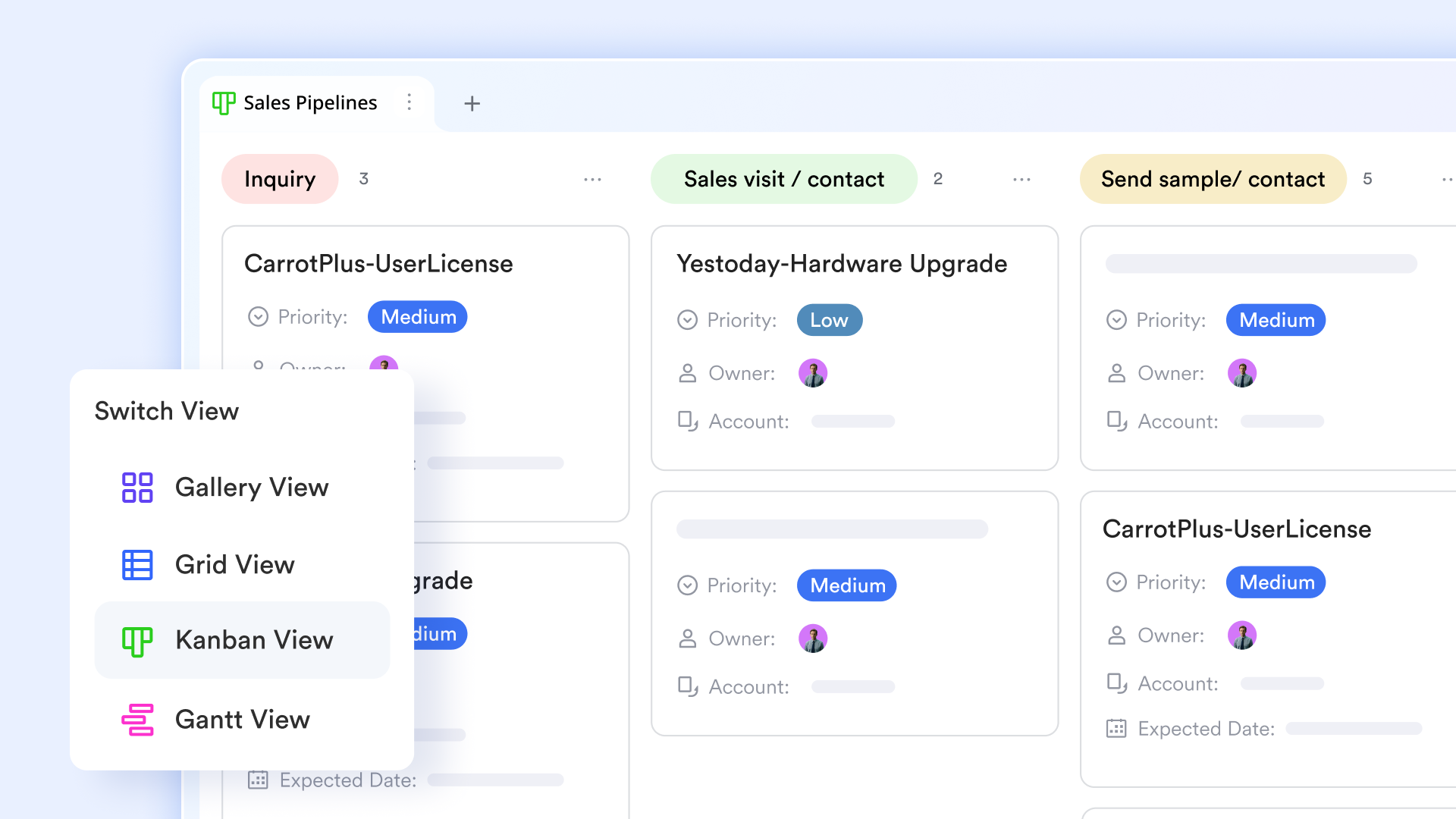
acts as the operational engine for project planning and tracking. Project managers build structured workflows using tables, , and timeline-style views to organize deliverables into stages such as backlog, planning, execution, review, and completion.
Custom fields track ownership, deadlines, priorities, dependencies, status changes, and risk categorization. Because workflows update instantly when records are modified, managers gain real-time oversight of overall project health without needing separate progress reporting systems.
The platform also supports automation triggers that move tasks between stages, notify owners of upcoming deadlines, and escalate overdue actions—ensuring workflows continue forward without manual monitoring.
Primary value:
- Visual project pipelines.
- Real-time performance visibility.
- Automated milestone movement.
Lark Tasks: Assignment and accountability
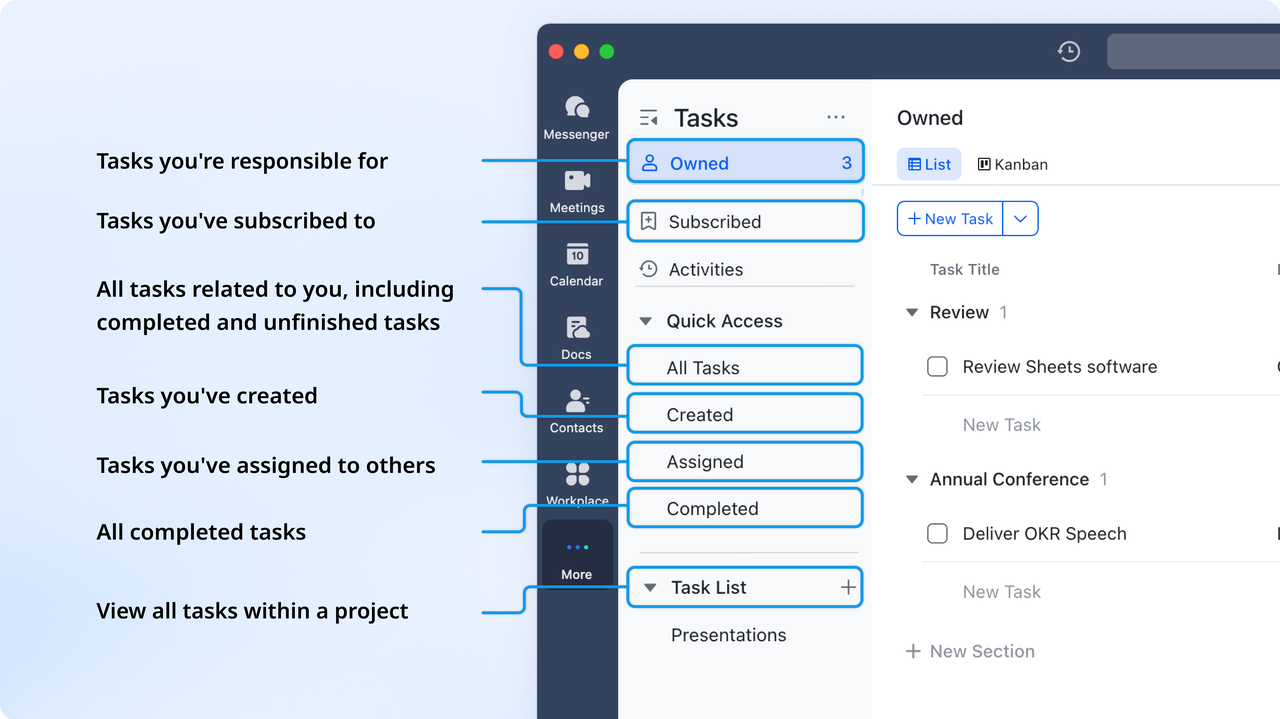
Lark Tasks transforms high-level plans into actionable, trackable commitments. Each task includes an assigned owner, a due date, priority markers, checklists, and subtasks. Dependencies signal which actions must be completed before the next phase can progress. provides clear accountability for individual deliverables while giving managers centralized insight into workload balance across the team. Task deadline reminders reduce missed handoffs, while status updates feed back into overall project views configured in Lark Base.
Primary value:
- Explicit ownership of project work.
- Cross-team workload visibility.
Lark Messenger: Team communication hub
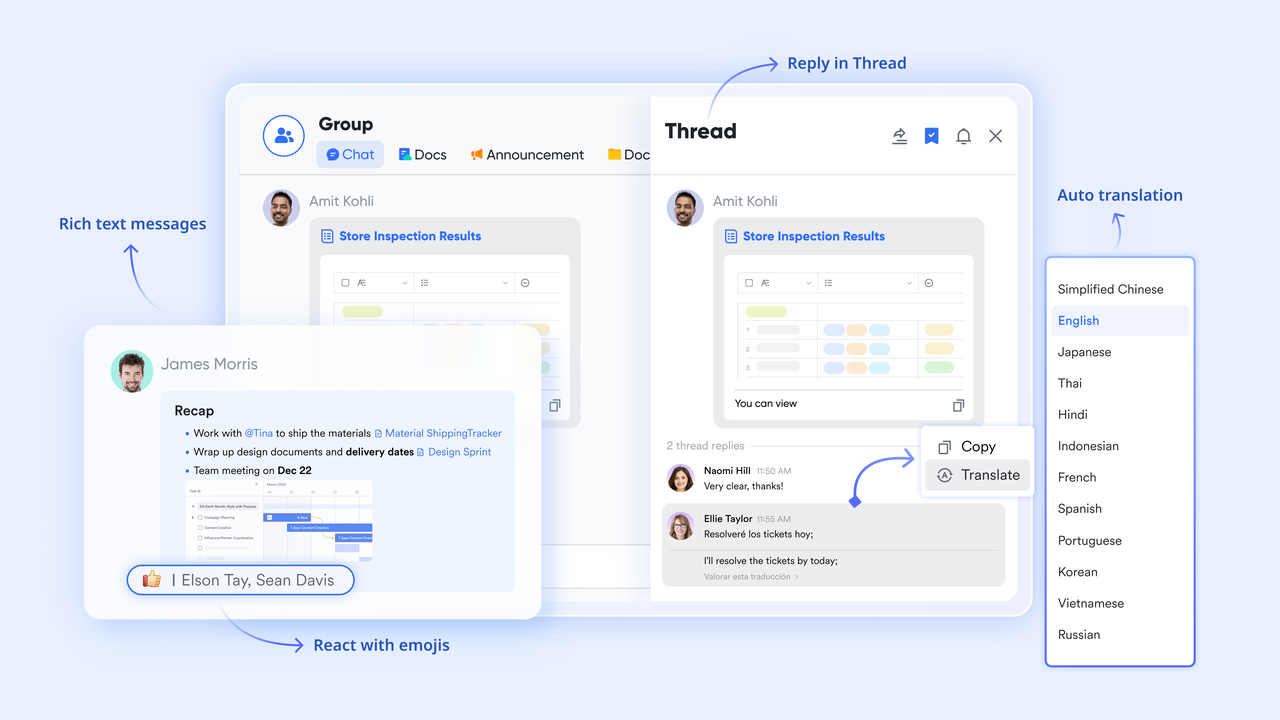
enables instant, contextual collaboration across project teams. Conversations remain attached to relevant documents, tasks, or workflows, allowing discussions to happen directly where work is managed rather than across disconnected .
Team members can share files, flag blockers, coordinate meetings, and resolve clarifications all inside topic-specific chat channels. This minimizes information loss and eliminates the duplication common across separate chat tools—while preserving conversation history for ongoing reference.
Primary value:
- Real-time problem solving.
- Context-driven discussions.
Lark Docs: Planning and documentation
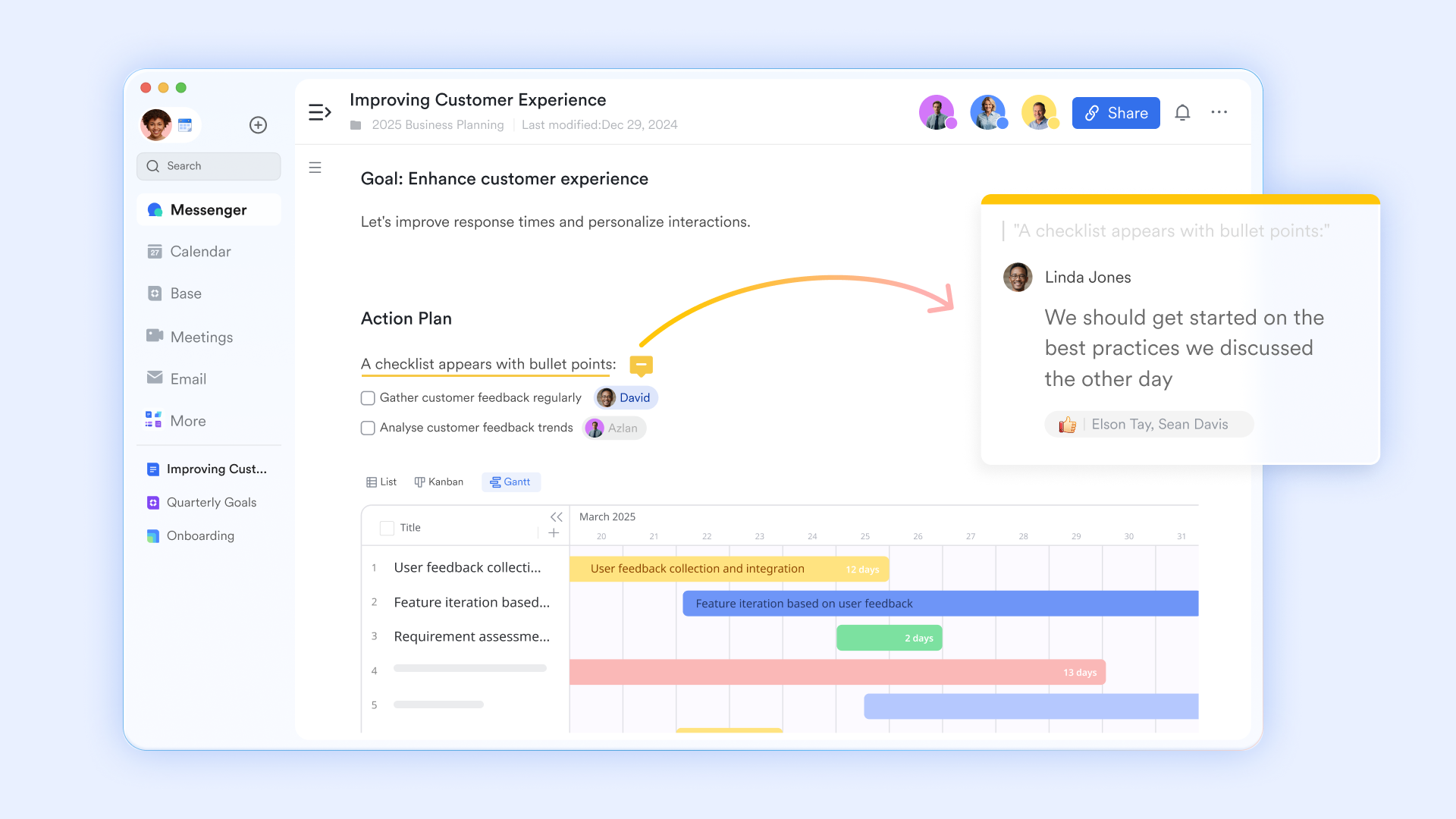
serves as the foundation for early-stage project planning and continuous documentation throughout the project lifecycle. Teams use Docs to draft project charters, scope statements, work breakdown structures, stakeholder communication plans, meeting agendas, and retrospectives—all in shared documents that update in real time.
Multiple contributors can while using comments and mentions to clarify decisions or request change approvals. This keeps stakeholder feedback centralized and auditable, avoids version conflicts seen with email attachments, and ensures all project information remains accessible from kickoff through final delivery.
Primary value:
- Unified project documentation.
- Live collaboration with immediate feedback.
- Clear documentation audit trails.
Lark Wiki: Knowledge repositories
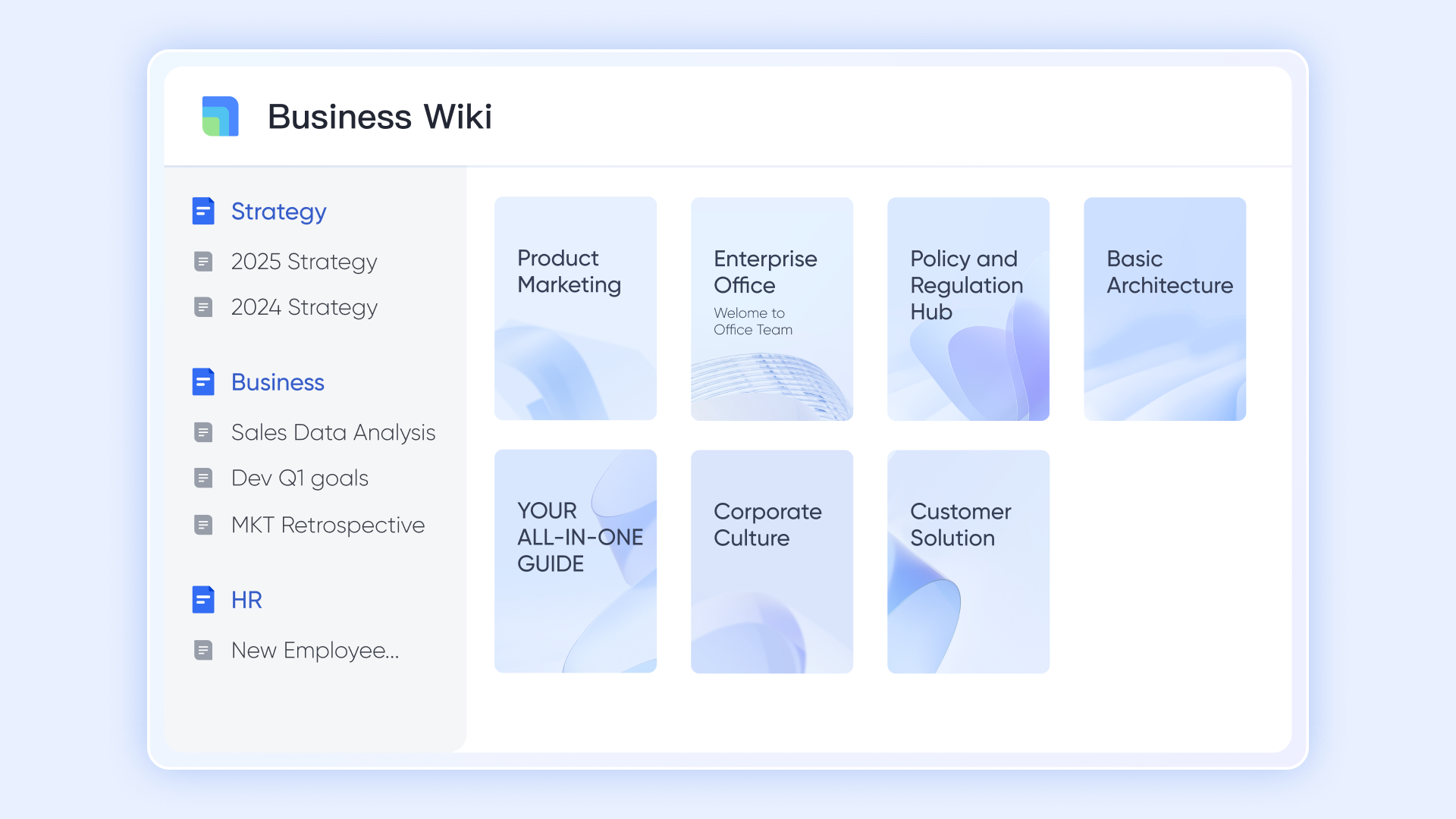
organizes institutional knowledge by turning project documentation into structured, searchable . Teams archive finished project plans, SOP manuals, onboarding guides, risk playbooks, and best-practice templates inside curated spaces.
This long-term knowledge retention improves maturity across project operations by enabling new team members to learn from historical initiatives rather than starting knowledge systems from scratch for each project.
Primary value:
- Long-term knowledge preservation.
- Continuous improvement enablement.
Lark Approval: Workflow sign-offs and governance
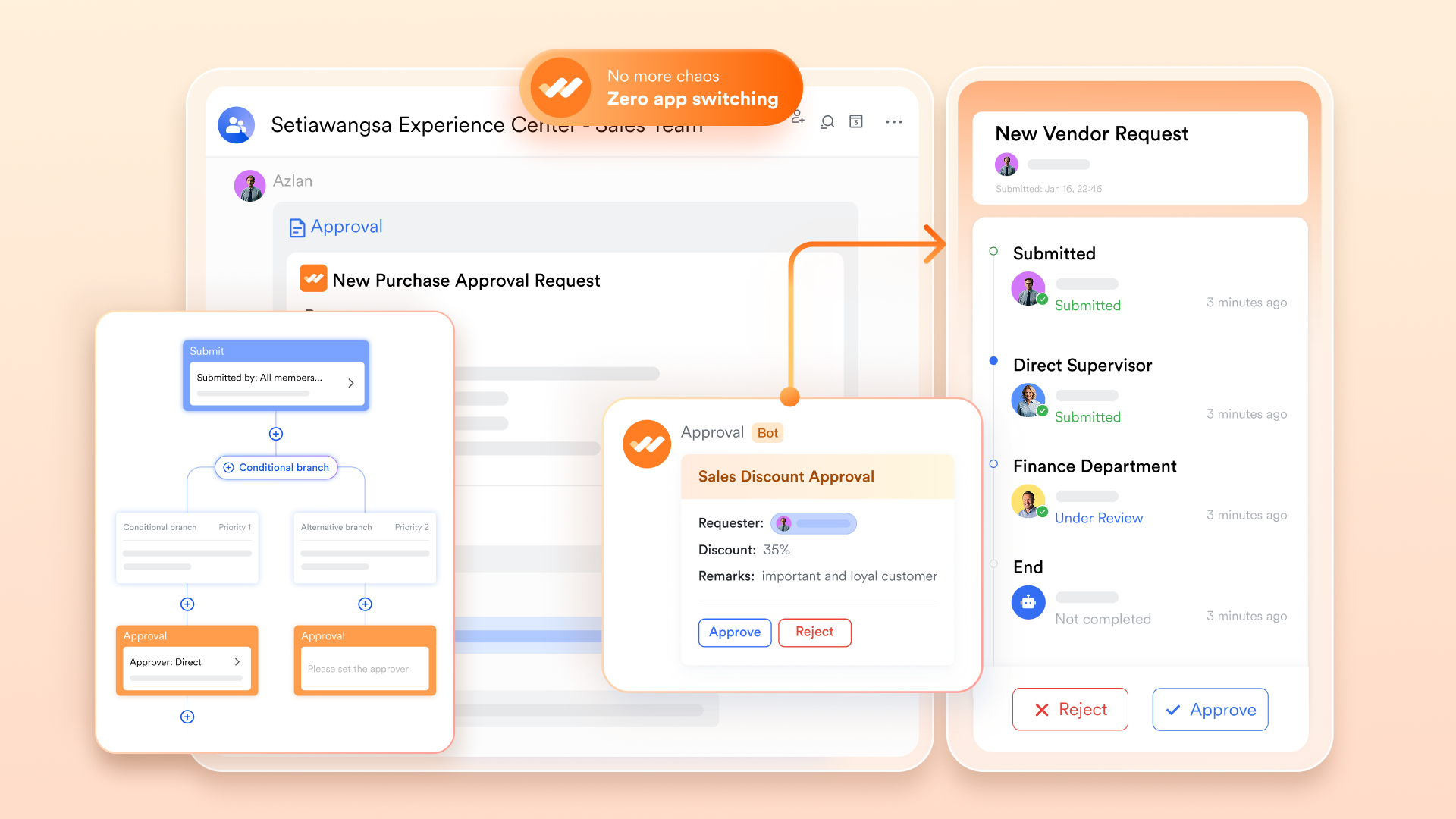
digitizes approval processes that commonly slow beginner project teams—including budget authorization, scope change requests, procurement orders, milestone stage gates, and contract approvals.
Approval flows are configured in advance with predefined reviewers based on request type or budget thresholds. Once submitted, requests automatically route to reviewers, notify stakeholders, capture digital signatures, and timestamp decisions—eliminating back-and-forth emails. All approval outcomes are logged for and audit readiness, ensuring governance does not become a barrier to operational speed.
:
- Starter plan: Free forever plan that includes 11 powerful tools for up to 20 users. It also comes with 100GB of storage, 1000 automation runs, AI translations, and more.
- Basic plan: $6/user/month (billed annually) for up to 500 users. It includes everything in Starter plus group calling for up to 500 attendees, 5TB of storage, 1000 automation runs, and more. For more details, please .
- Pro plan: $12/user/month (billed annually) for up to 500 users. It includes everything in Basic plus group calling for up to 500 attendees, 15TB of storage, 50,000 automation runs, and more.
- Enterprise plan: for custom pricing. Supports unlimited users and includes even more automation runs and advanced security, compliance, and management features.
For small teams with simple communication needs

18 months message history
1000 Base automation runs/month
2000 rows per table in Base
Most POPULAR
For companies with comprehensive collaboration and management needs
Unlimited message history
500-participant video meetings
50k Base automation runs/month
20k rows per table in Base
For large companies with advanced security and organizational management needs
Get a personalized demo and pricing
Unlimited message history
500-participant video meetings
15 TB storage + 30 GB storage/user
500k Base automation runs/month
50k Base automation runs/month
Most POPULAR
For companies with comprehensive collaboration and management needs
Unlimited message history
500-participant video meetings
50k Base automation runs/month
20k rows per table in Base
Bonus tips: Essential project management skills
Strong project managers blend strategic thinking with practical execution skills. These capabilities help teams stay aligned, solve problems quickly, and consistently deliver successful outcomes.
- Leadership and communication: Leaders guide teams with clarity, motivation, and direction. ensures everyone understands goals, expectations, and progress.
- Time management: well helps prioritize tasks and meet deadlines. It enables teams to stay productive without unnecessary delays.
- Critical thinking and decision-making: Critical thinking helps evaluate options objectively and anticipate challenges. Sound decision-making keeps the project moving forward confidently.
- Stakeholder management: Engaging stakeholders builds trust and alignment throughout the project. Their feedback and expectations are managed to avoid surprises later.
- Budgeting and negotiation: Budgeting ensures resources are used wisely, while negotiation helps resolve conflicts or secure better terms. Together, they protect project viability.
- Problem-solving: Problem-solving enables quick identification and resolution of issues. It minimizes disruptions and keeps teams focused on delivery.
- Technical and domain knowledge: Understanding the project's technical and industry context improves . It helps bridge gaps between teams, tools, and requirements.
Conclusion
Project management becomes far more approachable when beginners understand the fundamental concepts—clear scope, structured planning, , and consistent monitoring. By learning the core phases, methodologies, documentation requirements, and essential skills, anyone can build the confidence needed to lead projects successfully. Modern teams also benefit from choosing tools that simplify collaboration, streamline workflows, and support knowledge-sharing.
That's where offers an advantage, bringing tasks, communication, documentation, approvals, and automation together in one place. Whether you're managing your first project or refining your workflow, Lark helps you stay organized and maintain clarity at every stage. If you're ready to apply these principles with less complexity and more efficiency, explore how Lark can support your next project.
Get started building clear and efficient project plans
FAQs
What is the first step in project management?
The first step is to define the project's objectives, scope, and expected outcomes to ensure everyone starts with clarity. This foundation guides all planning and execution activities that follow. Tools like Lark help teams document and align on these details from day one.
Do I need certification to learn project management basics?
Certification is helpful but not required; beginners can start by understanding core concepts and applying them to small projects. Practical experience often matters more at the early stages. Platforms like Lark make it easy to practice these fundamentals through real collaborative .
Which PM methodology is best for beginners?
Agile and Kanban are often the easiest for beginners because they emphasize flexibility and visual clarity. These methods reduce complexity while encouraging continuous improvement. Lark supports both approaches with dynamic boards and real-time task updates.
How can AI improve basic project management tasks?
AI can automate routine updates, flag risks early, and enhance decision-making—key ideas highlighted in the basics of AI project management. This boosts efficiency and reduces manual oversight. Lark integrates AI assistance to streamline planning, , and reporting.
What documents should every project begin with?
Projects should start with a charter, a scope document, and a simple task plan to ensure alignment. These documents clarify responsibilities and expectations upfront. With Lark, teams can create, share, and update these materials collaboratively in one centralized workspace.
Related reading